

“Do you think I did the right thing?”
“Are you sure you’re not upset with me?”
“Do you still love me?”
“Did I say something wrong?”
If questions like these frequently run through your mind, you’re not alone. Many people find themselves seeking reassurance from their partner, family, friends, or even colleagues—not because they enjoy asking, but because they desperately want to feel certain that everything is okay.
Table of Contents
At first, reassurance feels comforting. A kind word, a quick text, or someone saying, “Don’t worry, you’re fine,” can bring an immediate sense of relief. For a while, the anxious thoughts quiet down, your heart feels lighter, and you can finally breathe. But before long, the doubts return. You begin checking again, asking again, and searching for the same comfort you received just hours—or even minutes—earlier.
If this pattern sounds familiar, it doesn’t mean you’re “too needy,” “too emotional,” or “too dependent.” More often, it reflects the way your mind has learned to cope with uncertainty, emotional vulnerability, or fear of losing connection. In other words, your repeated need for reassurance may be less about attention and more about feeling emotionally safe.
As psychologists understand it, reassurance seeking is not simply a habit—it is often a coping strategy. It develops because the brain is trying to reduce emotional discomfort as quickly as possible. The problem is that while reassurance can calm anxiety in the moment, relying on it too often may unintentionally strengthen the very fears you’re trying to escape. Over time, your confidence begins to depend more on other people’s words than on your own judgment.
This pattern is well explained in Cognitive Behavioural Therapy (CBT), developed by psychiatrist Aaron Beck. CBT suggests that anxious thoughts often lead to behaviours—such as repeatedly seeking reassurance—that temporarily reduce distress. While this relief feels helpful, it can also reinforce the belief that you cannot cope without someone else’s confirmation. As a result, the cycle repeats, making reassurance feel increasingly necessary rather than simply comforting.
Psychological research has also shown that people who frequently seek reassurance are not necessarily looking for compliments or constant attention. In many cases, they are searching for certainty in situations that feel emotionally unpredictable. Whether it’s wondering if a relationship is secure, worrying about making the wrong decision, or fearing that others are silently judging them, the underlying need is often the same: “Help me feel safe again.”
This is why reassurance seeking can appear in many different areas of life. You might repeatedly ask your partner if they’re happy with the relationship, seek your manager’s approval after completing every task, replay conversations with friends to check whether you offended someone, or constantly search the internet for answers about your physical symptoms despite receiving medical reassurance. Although these situations look different on the surface, they often share the same psychological roots.
The encouraging news is that this cycle is not a personality flaw, nor is it something you’re destined to live with forever. Once you understand why you need constant reassurance, you can begin replacing the need for external certainty with something far more stable: self-trust. That doesn’t mean never asking for support again. Healthy reassurance has an important place in every relationship. The goal is to reach a point where reassurance becomes a source of connection—not a requirement for feeling okay.
In this article, we’ll explore the psychology behind reassurance seeking, why some people struggle with it more than others, the hidden emotional patterns that keep it alive, and practical, science-backed strategies to help you gradually build confidence from within. Along the way, you’ll discover that the question isn’t simply, “Why do I need constant reassurance?” A more meaningful question might be, “What is my mind trying to protect me from?”
What Is Reassurance Seeking? Understanding the Difference Between Healthy Support and Emotional Dependence
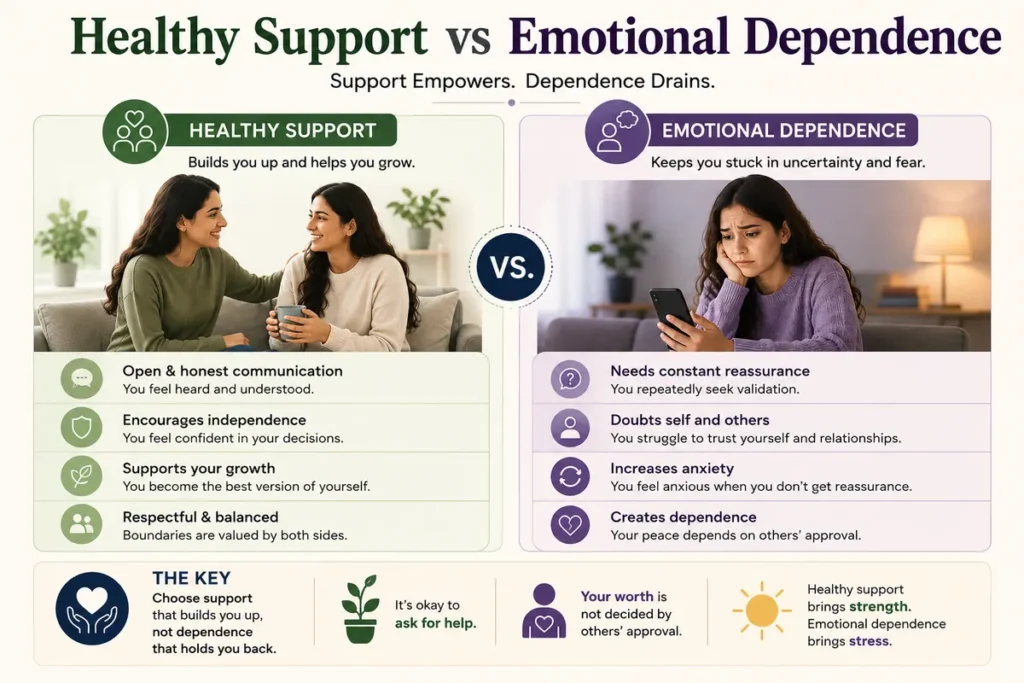
Before asking, “Why do I need constant reassurance?”, it’s important to understand what reassurance seeking actually means. Contrary to popular belief, reassurance seeking isn’t a sign of weakness or immaturity. In fact, everyone seeks reassurance at certain points in life. Whether it’s asking a friend if you made the right decision, checking with your partner after a misunderstanding, or looking for encouragement before an important presentation, seeking reassurance is a natural part of being human.
From a psychological perspective, reassurance seeking is the act of looking to other people for confirmation that you are safe, accepted, loved, competent, or making the right choices. It serves an important purpose: reducing uncertainty and helping us feel emotionally secure during stressful moments. Healthy relationships thrive on this kind of mutual support because reassurance can strengthen trust, deepen emotional bonds, and remind us that we don’t have to face life’s challenges alone.
The difficulty begins when reassurance changes from an occasional source of comfort into the primary way of managing difficult emotions. Instead of helping you move forward, it becomes something you feel you cannot function without. You may find yourself asking the same question repeatedly, even after receiving a clear answer. The relief you experience is real—but often short-lived. Before long, doubt quietly returns, bringing with it another urge to seek reassurance.
Imagine someone who has just sent an important email at work. Most people might briefly wonder if it was written well and then continue with their day. However, someone caught in a reassurance-seeking cycle may repeatedly ask colleagues if the email sounded professional, reread it several times, and worry for hours about how it might be received. Although each reassuring response reduces anxiety for a while, the mind soon generates another “what if,” restarting the cycle.
This pattern is especially common among people who struggle with anxiety, low self-confidence, or fear of rejection. When your brain becomes overly focused on preventing mistakes or avoiding emotional pain, it naturally searches for certainty wherever it can find it. Unfortunately, absolute certainty rarely exists in everyday life. Relationships, decisions, and social interactions always involve some degree of uncertainty, making it impossible for reassurance alone to provide lasting peace of mind.
Psychologists often explain this through the concept of negative reinforcement in behavioural psychology. When reassurance temporarily removes uncomfortable feelings such as fear or doubt, the brain quickly learns that asking for reassurance is an effective way to escape emotional discomfort. Because the behaviour is rewarded with immediate relief, it becomes more likely to happen again in the future. Over time, the brain begins to depend on external reassurance instead of learning to tolerate uncertainty or trust its own judgment.
Another helpful way to understand this is by thinking of reassurance as emotional pain medication. Taking pain relief after an injury can be helpful and appropriate. But if someone relies on it every day without addressing the underlying cause of the pain, the problem often remains unresolved. Similarly, reassurance can ease emotional distress in the moment, but if it becomes your only coping strategy, it may prevent you from developing lasting emotional resilience and self-trust.
It’s also important to recognise that healthy reassurance and reassurance dependence are not the same thing.
Healthy reassurance usually happens occasionally, is linked to a specific situation, and helps you regain confidence before moving on. It strengthens relationships because both people feel heard, respected, and emotionally connected.
In contrast, reassurance dependence often feels urgent and repetitive. You may continue asking for confirmation even after receiving it, find it difficult to trust positive feedback, or feel anxious again shortly afterwards. Over time, this pattern can become exhausting—not only for you but also for the people who genuinely care about you. Loved ones may want to help, yet they may struggle to provide enough reassurance because the real problem isn’t the answer you’re receiving—it’s the anxiety that’s asking the question.
This is one of the most important insights in psychology: the need for constant reassurance is usually a symptom, not the root cause. The repeated search for validation often points toward deeper emotional patterns involving insecurity, attachment experiences, anxiety, perfectionism, or difficulties regulating emotions. Understanding these hidden influences is the first step toward breaking the cycle rather than simply managing it.
Why Do I Need Constant Reassurance? 8 Hidden Psychological Reasons
If you’ve ever wondered, “Why do I need constant reassurance even when people keep telling me everything is okay?”, the answer rarely lies in a single personality trait. Instead, reassurance seeking is usually the result of several psychological factors working together over time.
Think of reassurance like an iceberg. What you see on the surface is repeatedly asking for validation, approval, or certainty. Beneath the surface, however, are deeper emotional experiences that quietly shape the way you think, feel, and respond to uncertainty.
Let’s explore some of the most common psychological reasons behind this pattern.
1. Your Brain Finds Uncertainty Emotionally Uncomfortable
For some people, uncertainty is simply an inconvenience. For others, it feels emotionally unbearable.
Imagine sending a message to someone you care about. Ten minutes pass without a reply. While one person might assume they’re simply busy, another may immediately think:
“Did I upset them?”
“Are they losing interest?”
“Did I say something wrong?”
The situation hasn’t changed—but the interpretation has.
Psychologists refer to this as Intolerance of Uncertainty, a concept extensively studied by researchers such as Michel Dugas and colleagues. It describes a tendency to experience uncertain situations as stressful, threatening, or emotionally difficult to tolerate.
When your mind struggles with uncertainty, reassurance feels like the quickest way to reduce emotional discomfort. A simple reply, a reassuring message, or someone’s confirmation temporarily settles the anxious thoughts. Unfortunately, because the relief is short-lived, your brain learns to seek reassurance again whenever uncertainty appears.
The real issue isn’t the unanswered message or unanswered question. It’s the discomfort your brain experiences while waiting for certainty.
Learning to tolerate uncertainty—rather than eliminating it completely—is one of the most effective ways to reduce reassurance seeking over time.
2. Your Attachment Style May Be Influencing Your Relationships
One of the most powerful explanations comes from Attachment Theory, originally developed by psychiatrist John Bowlby and later expanded through the groundbreaking research of psychologist Mary Ainsworth.
According to this theory, our earliest relationships with caregivers shape our expectations about love, trust, and emotional safety. When caregivers are generally responsive and emotionally available, children often develop a secure sense of connection. They learn that support will be there when needed and gradually develop confidence in themselves and others.
However, when care is inconsistent, unpredictable, or emotionally unavailable, some individuals may develop what psychologists call an anxious attachment style.
Adults with an anxious attachment style often care deeply about their relationships but may also become highly sensitive to signs of distance or rejection. They don’t seek reassurance because they want excessive attention—they seek it because uncertainty feels like a possible threat to the relationship.
This may sound familiar if you often find yourself asking:
“Are you sure you’re not angry with me?”
“Do you still love me?”
“Is everything okay between us?”
These questions usually come from a genuine desire to feel emotionally safe rather than from a lack of love or appreciation.
It’s important to remember that attachment styles are patterns, not permanent labels. Research consistently shows that with self-awareness, healthy relationships, and sometimes professional support, attachment patterns can become more secure over time.
3. Low Self-Worth Makes Other People’s Opinions Feel More Reliable Than Your Own
Imagine having an inner voice that constantly questions your abilities.
“Maybe I wasn’t good enough.”
“What if they’re just being polite?”
“Perhaps I don’t deserve this opportunity.”
When self-worth is fragile, your own judgment often feels less trustworthy than someone else’s opinion. As a result, external reassurance becomes the primary source of confidence.
Rather than believing,
“I did my best.”
you may need someone else to tell you,
“You did well.”
Rather than trusting,
“My friend probably had a busy day.”
you may immediately wonder,
“Maybe they don’t want to talk to me anymore.”
Over time, this dependence on external validation creates an exhausting cycle. Every compliment feels temporary. Every decision requires confirmation. Every silence invites doubt.
Interestingly, psychologists have observed a related phenomenon known as Self-Verification Theory, proposed by researcher William Swann. The theory suggests that people naturally seek information that confirms their existing beliefs about themselves—even when those beliefs are negative.
This means that if you secretly believe you’re “not good enough,” reassurance may provide temporary comfort, but your mind may continue searching for evidence that supports the original negative belief. This explains why compliments sometimes feel reassuring for only a few moments before self-doubt quietly returns.
True confidence begins to grow when your sense of worth comes increasingly from your own values, experiences, and self-understanding rather than from constant external approval.
4. Anxiety Trains the Brain to Keep Checking
Anxiety has one primary goal: to protect you from possible danger.
The challenge is that an anxious brain often struggles to distinguish between a genuine threat and an imagined possibility.
Instead of asking,
“What is most likely happening?”
an anxious mind tends to ask,
“What is the worst thing that could happen?”
This is why reassurance seeking is so common among people experiencing anxiety. Every time a worrying thought appears, the brain looks for immediate relief.
You might repeatedly ask your partner if everything is okay.
Check online symptoms after a minor headache despite receiving medical advice.
Ask friends whether you made the right decision.
Seek repeated confirmation that people aren’t judging you after a conversation.
Each reassuring answer lowers anxiety—for a little while.
From the perspective of Cognitive Behavioural Therapy (CBT), this creates a powerful learning loop. Because reassurance successfully reduces anxiety in the short term, the brain remembers it as an effective coping strategy. The next time anxiety appears, it automatically encourages you to seek reassurance again.
This is why reassurance can gradually become a habit rather than a conscious choice.
The reassuring words themselves are not the problem. The problem is that your brain never gets the opportunity to discover something equally important: that you can survive uncertainty without always needing someone else to remove it for you.
That discovery—learning to sit with uncertainty while trusting your own ability to cope—is one of the foundations of lasting emotional resilience.
5. Perfectionism Makes Every Decision Feel Like It Has to Be Right
Many people associate perfectionism with high standards or attention to detail. However, psychologists increasingly understand that perfectionism is often driven by fear rather than excellence. Beneath the desire to “get everything right” is often a deep fear of making mistakes, disappointing others, or being judged.
If you’re a perfectionist, even small decisions can feel emotionally overwhelming.
You may wonder:
“Did I choose the right words?”
“What if I made the wrong decision?”
“Should I have handled that conversation differently?”
Instead of trusting your judgment, you may repeatedly ask others for confirmation that everything is fine. The reassurance isn’t simply about the decision itself—it’s about reducing the fear of being wrong.
This tendency is closely linked to what psychologists call maladaptive perfectionism, where self-worth becomes tied to flawless performance rather than genuine effort or personal growth. Research by psychologists such as Gordon Flett and Paul Hewitt has shown that this form of perfectionism is associated with higher levels of anxiety, self-criticism, and reassurance-seeking behaviour.
The difficult truth is that no amount of reassurance can eliminate the possibility of mistakes. Growth comes not from making perfect decisions but from learning that you can handle imperfect outcomes with confidence and self-compassion.
6. Your Emotional Experiences May Have Taught You to Doubt Yourself
Sometimes, the need for constant reassurance doesn’t begin in adulthood—it starts much earlier.
Children naturally look to the adults around them to understand themselves and the world. When caregivers consistently acknowledge a child’s emotions with empathy and support, the child gradually learns an important lesson:
“My feelings make sense, and I can trust my emotional experiences.”
But when emotions are repeatedly dismissed with comments such as:
“You’re overreacting.”
“Stop being so sensitive.”
“There’s nothing to cry about.”
“You’re imagining things.”
The child may begin to question their own perceptions.
Over time, this can create a habit of relying on other people to decide whether their feelings are valid. As adults, they may constantly seek reassurance because they have learned to trust external opinions more than their own emotional experience.
This process is related to emotional invalidation, a concept widely discussed in clinical psychology. Emotional invalidation doesn’t necessarily require abuse or neglect. Even well-meaning caregivers may unintentionally dismiss emotions while trying to comfort or protect a child. However, repeated invalidation can make it difficult to develop confidence in one’s own thoughts and feelings.
As a result, reassurance becomes a substitute for self-trust.
Healing often begins when people learn to acknowledge their own emotions with the same kindness and understanding they have always searched for in others.
7. Fear of Rejection Can Make You Constantly Look for Signs That Everything Is Okay
Human beings are naturally wired for connection. Throughout evolution, belonging to a group increased the chances of survival. Because of this, our brains remain remarkably sensitive to social acceptance and rejection.
For some people, however, this sensitivity becomes much stronger than usual.
Psychologists describe this pattern as Rejection Sensitivity—the tendency to anxiously expect, quickly perceive, and strongly react to possible rejection, even when there is little evidence that it has actually occurred.
For example, if a friend replies with a short message, someone with high rejection sensitivity might immediately think:
“They’re annoyed with me.”
“I must have done something wrong.”
“They’re pulling away.”
Similarly, if a partner seems distracted after work, the mind may interpret their tiredness as a sign of emotional distance.
These interpretations often trigger an urgent need for reassurance:
“Are you upset with me?”
“Do you still care about me?”
“Is everything okay between us?”
Research by psychologists Geraldine Downey and Scott Feldman suggests that people with higher rejection sensitivity are more likely to experience relationship anxiety, misunderstand social situations, and seek frequent reassurance to reduce emotional distress.
The irony is that repeatedly asking for reassurance can sometimes create tension in relationships, increasing the very fears the person is trying to prevent.
Learning to pause before assuming rejection—and considering alternative explanations—can gradually weaken this cycle.
8. You Haven’t Yet Learned to Regulate Difficult Emotions Without External Help
Perhaps the deepest reason behind reassurance seeking is that many of us were never taught how to soothe ourselves emotionally.
When anxiety, sadness, guilt, or fear becomes overwhelming, the brain naturally searches for the fastest way to feel better. Sometimes that means calling someone, sending another message, repeatedly checking for replies, or asking the same question until the anxiety settles.
In these moments, reassurance becomes an external emotion regulator.
While there is nothing wrong with seeking support from people we trust, problems arise when reassurance becomes the only way we know how to calm ourselves. Over time, the brain begins to believe:
“I can’t feel okay unless someone else tells me everything is okay.”
This belief quietly undermines emotional independence.
Healthy emotional regulation doesn’t mean handling everything alone or never asking for help. Instead, it means developing the ability to recognise emotions, understand what they are communicating, and respond with healthy coping strategies before immediately looking outside yourself for certainty.
This is one of the central goals of Emotional Fitness—the ability to experience uncomfortable emotions without becoming overwhelmed or completely dependent on external validation.
The encouraging news is that emotional regulation is a skill, not an inborn talent. Just as physical strength develops through consistent practice, emotional strength grows each time you pause, reflect, and learn to comfort yourself with patience instead of panic.
A Common Thread Behind All These Reasons
Although these eight psychological factors may seem different, they all point toward one underlying need: the desire to feel emotionally safe.
Whether your reassurance seeking is influenced by anxiety, an anxious attachment style, perfectionism, low self-worth, rejection sensitivity, emotional invalidation, or difficulty tolerating uncertainty, your mind is trying to protect you from emotional pain—not trying to make your life more difficult.
Recognising this can be surprisingly liberating.
Instead of criticising yourself for being “too needy” or “too sensitive,” you can begin to see reassurance seeking for what it truly is: a learned coping strategy that once served a purpose but may no longer be helping you.
The next question, then, is not why the cycle exists—but why it keeps repeating, even after you receive the reassurance you were looking for.
To answer that, we need to understand how the brain quietly traps us in what psychologists often describe as the reassurance cycle—a loop that offers temporary relief while unintentionally keeping anxiety alive.
The Hidden Reassurance Cycle: Why Relief Never Seems to Last
Have you ever noticed that reassurance works—but only for a little while?
Perhaps you ask your partner if they’re upset with you. They smile and say, “No, everything’s fine.” Instantly, you feel calmer. The tightness in your chest eases, your mind quiets down, and life seems normal again.
But a few hours later, they seem quieter than usual.
A new thought appears.
“Maybe they were just trying to make me feel better.”
“What if something has changed?”
“Should I ask again?”
Before you know it, the anxiety has returned, and so has the urge to seek reassurance.
If you’ve experienced this, you’re not imagining it. This repeating pattern is one of the most common psychological loops seen in people who struggle with anxiety, self-doubt, or reassurance-seeking behaviour. The important thing to understand is that the problem isn’t the reassurance itself—it’s the way the brain learns to depend on it.
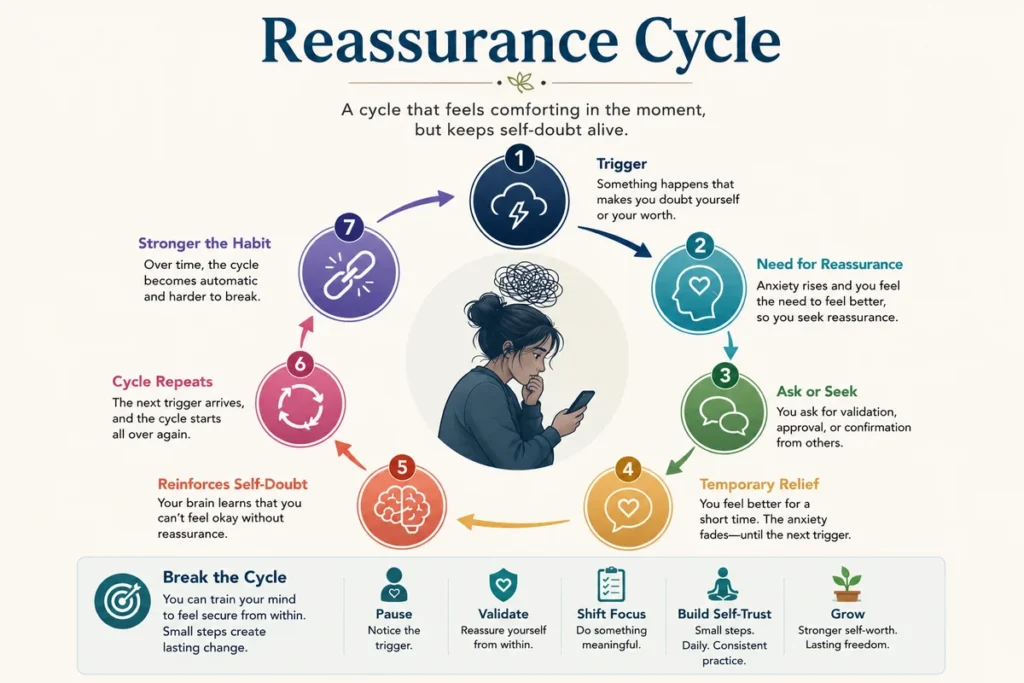
The Five-Step Reassurance Cycle
Most reassurance-seeking follows a predictable emotional pattern:
1. A Trigger Appears
The cycle often begins with something ordinary—an unanswered message, a change in someone’s tone of voice, a mistake at work, a disagreement with a loved one, or even an intrusive thought that suddenly pops into your mind.
The event itself is rarely the real problem. Instead, it acts as a trigger that activates uncertainty.
2. Your Mind Tries to Fill the Gaps
Our brains naturally dislike uncertainty. When information is incomplete, the mind often tries to “fill in the blanks.” Unfortunately, an anxious mind tends to imagine the worst rather than the most likely explanation.
Instead of thinking:
“They’re probably busy.”
Your mind may jump to:
“They’re avoiding me.”
Instead of:
“Everyone makes mistakes.”
You may think:
“I’ve ruined everything.”
Psychologists sometimes refer to this as catastrophic thinking, a cognitive distortion in which the mind automatically predicts negative outcomes without sufficient evidence.
3. Anxiety Builds
As these thoughts become more convincing, your body begins to respond.
Your heart may beat faster.
Your stomach may tighten.
You might find it difficult to focus on work or enjoy conversations.
Emotionally, it feels as though you need an answer immediately.
Not because you’re impatient—but because your nervous system has started treating uncertainty as a threat.
4. You Seek Reassurance
To reduce the discomfort, you look for certainty.
You send another message.
You ask someone if they’re upset.
You replay conversations with friends.
You search the internet for answers.
You ask the same question again, hoping this time you’ll finally feel convinced.
When reassurance arrives, anxiety decreases almost instantly.
For a short time, everything feels okay again.
5. The Relief Fades—and the Cycle Begins Again
Here’s where the brain quietly learns the wrong lesson.
Instead of learning,
“I managed my anxiety.”
It learns,
“I only felt better because someone else reassured me.”
This creates a powerful psychological shortcut.
The next time anxiety appears, your brain doesn’t encourage self-reflection or emotional regulation—it automatically tells you to seek reassurance again because that’s what worked before.
Without realising it, you’ve trained your brain to depend on external certainty instead of building internal confidence.
Why This Cycle Feels So Convincing
One of the reasons reassurance seeking becomes so difficult to break is that it genuinely works in the short term.
Every reassuring message, comforting conversation, or encouraging response reduces emotional discomfort for a while. Your brain experiences this as a reward.
From a behavioural psychology perspective, this is an example of negative reinforcement. The behaviour (seeking reassurance) removes an unpleasant feeling (anxiety), making the behaviour more likely to happen again in the future.
This doesn’t mean you’ve done anything wrong. It simply means your brain has learned an effective short-term solution—but not necessarily the healthiest long-term one.
Imagine someone who checks the weather app every five minutes before leaving home because they’re worried it might rain. Each time they check, they feel slightly more certain. But within minutes, the uncertainty returns, prompting another check.
The problem isn’t the weather app.
The problem is that the repeated checking prevents the person from becoming comfortable with the small amount of uncertainty that naturally exists.
Reassurance works in much the same way.
Why Constant Reassurance Can Affect Relationships
Many people worry that seeking reassurance means they’re “too much” for others.
The reality is far more compassionate.
The desire for reassurance is a reflection of emotional pain—not personal weakness. Most partners, friends, and family members genuinely want to provide comfort when someone they care about is struggling.
However, when reassurance becomes frequent and repetitive, loved ones may begin to feel confused or helpless.
They may think:
“I’ve already answered this.”
“Why doesn’t my reassurance seem to help?”
“What else can I say?”
At the same time, the person seeking reassurance may feel guilty for asking again, yet still unable to stop.
This creates frustration on both sides—not because either person lacks love or care, but because reassurance is trying to solve a deeper emotional need that words alone cannot fully satisfy.
Healthy relationships certainly include reassurance, affection, and emotional support. The goal isn’t to stop asking for comfort when you genuinely need it. Rather, it’s to gradually develop enough self-trust that reassurance becomes something you appreciate—not something you depend on to feel emotionally safe.
Understanding this cycle is empowering because it shifts the question from:
“How can I get more reassurance?”
to a much healthier one:
“How can I help my mind feel safe even when certainty isn’t immediately available?”
That shift marks the beginning of lasting emotional growth. Instead of relying solely on external validation, you begin strengthening your ability to calm your own mind, tolerate uncertainty, and trust yourself a little more each day.
And that’s exactly what we’ll explore next through a practical, research-informed approach designed to help you break the reassurance cycle without ignoring your emotions or facing them alone.
How to Stop Needing Constant Reassurance: The S.T.A.B.L.E.™ Framework
Understanding why you seek reassurance is an important first step. But insight alone doesn’t always change behaviour.
The real transformation begins when you learn a new way of responding to uncertainty.
This doesn’t mean you should never ask for reassurance again. Healthy relationships are built on emotional support, honest communication, and mutual comfort. There will always be moments when seeking reassurance is both appropriate and helpful.
The goal is different.
Instead of relying on reassurance as your first response to anxiety, you gradually learn to make it your last option—after giving yourself the opportunity to understand, regulate, and trust your own emotions.
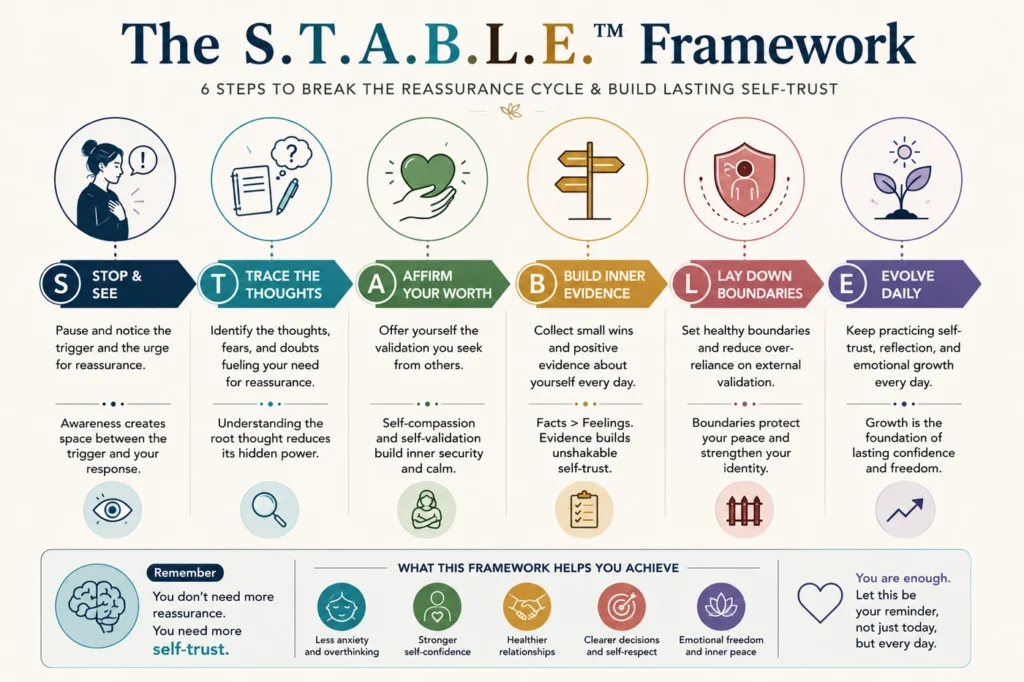
To help you do that, here’s a practical framework you can remember whenever self-doubt begins to take over.
S – Stop the Automatic Reassurance Loop
When anxiety appears, your brain often wants an immediate answer.
Before sending another message, asking the same question again, or searching for more confirmation online, simply pause.
Ask yourself:
- What am I feeling right now?
- What exactly am I afraid might happen?
- Am I looking for information—or am I looking for certainty?
This small pause interrupts the automatic habit that has been running on autopilot.
Research in cognitive psychology suggests that creating even a brief space between emotion and action helps reduce impulsive responses and increases psychological flexibility. You’re not ignoring your feelings—you are giving yourself permission to understand them before reacting.
T – Track the Trigger
Every reassurance-seeking episode begins with a trigger.
Sometimes it’s obvious.
Sometimes it’s surprisingly subtle.
Try to identify what happened just before you felt the urge to seek reassurance.
Was it:
- A delayed text message?
- Constructive criticism at work?
- A disagreement with your partner?
- Making an important decision?
- A social media post that made you compare yourself to others?
Keeping a simple journal can reveal patterns you may never have noticed before.
Over time, you’ll begin to recognise that it isn’t every situation that causes anxiety—it is specific situations that activate old emotional fears.
Awareness reduces automaticity.
The more clearly you understand your triggers, the easier it becomes to respond thoughtfully instead of reacting instinctively.
A – Accept That Uncertainty Is Part of Every Healthy Life
This may be the most challenging step.
Most reassurance seeking is really an attempt to eliminate uncertainty.
But no relationship, career, friendship, or life decision comes with absolute certainty.
Trying to remove every doubt is like trying to stop the wind—it consumes enormous energy without ever truly succeeding.
Acceptance doesn’t mean enjoying uncertainty.
It means recognising that uncertainty is not the same as danger.
The next time uncertainty appears, try replacing the thought:
“I need to know right now.”
with:
“I don’t have all the answers yet, and that’s okay.”
This simple shift helps train your nervous system to tolerate uncertainty instead of treating it as an emergency.
Research on Intolerance of Uncertainty consistently shows that gradually learning to sit with uncertainty can reduce anxiety and reassurance-seeking behaviour over time.
B – Build Self-Validation Before Looking Outside Yourself
One of the healthiest questions you can ask is:
“If no one were available to reassure me right now, what would I say to myself?”
At first, this may feel uncomfortable.
Many people realise they are far kinder to friends than they are to themselves.
Imagine your closest friend saying:
“I’m worried I ruined everything.”
Would you immediately criticise them?
Probably not.
You would likely remind them of the facts, encourage them to be patient, and offer compassion.
Your inner dialogue deserves the same kindness.
Self-validation doesn’t mean convincing yourself that everything is perfect.
It means acknowledging your emotions without allowing them to become the only truth.
You might say:
“I’m feeling anxious, and that’s understandable. But anxiety isn’t always an accurate predictor of reality.”
This practice gradually shifts your confidence from external approval to internal trust.
L – Lean on Healthy Coping, Not Just Reassurance
When anxiety rises, your brain naturally wants relief.
The question is where that relief comes from.
Instead of immediately asking someone else to calm your fears, experiment with coping strategies that help regulate your own emotions first.
These might include:
- Taking a mindful walk without your phone.
- Practising slow, diaphragmatic breathing.
- Writing your worries in a journal.
- Challenging catastrophic thoughts using CBT techniques.
- Spending a few minutes in meditation or prayer.
- Talking to a trusted friend about your feelings rather than repeatedly asking for certainty.
Notice the difference.
Healthy coping aims to help you understand and manage your emotions.
Reassurance dependence simply tries to make uncomfortable emotions disappear as quickly as possible.
The more coping tools you develop, the less your emotional well-being depends on immediate external validation.
E – Evaluate Your Progress with Compassion, Not Perfection
Breaking the reassurance cycle doesn’t happen overnight.
Some days you’ll resist the urge to seek reassurance.
Other days you’ll find yourself asking the same questions again.
Both experiences are part of learning.
Instead of asking:
“Did I completely stop seeking reassurance today?”
Try asking:
- Did I pause before reacting?
- Did I understand what triggered me?
- Did I practise self-validation first?
- Did I tolerate uncertainty a little longer than before?
Small improvements matter.
Psychological growth is rarely dramatic.
More often, it happens quietly.
One day you realise you waited thirty minutes before asking for reassurance.
A few weeks later, you realise you didn’t need to ask at all.
Those moments may seem ordinary, but they are powerful signs that your emotional confidence is becoming stronger.
Remember, the goal isn’t to become completely independent of other people. Human beings will always need love, encouragement, and support.
The real goal is to know that even when reassurance isn’t immediately available, you are still capable of calming your mind, trusting your judgment, and moving forward with confidence.
That is what emotional resilience looks like—not the absence of uncertainty, but the ability to live well despite it.
When Should You Seek Professional Help?
Everyone seeks reassurance from time to time. Asking a loved one for comfort after a difficult day, discussing an important decision with a trusted friend, or looking for encouragement during stressful moments is a healthy part of human relationships.
The concern arises when reassurance seeking becomes so frequent that it begins to control your thoughts, affect your relationships, or interfere with your daily life.
You may benefit from speaking with a qualified mental health professional if you notice that:
- You feel compelled to seek reassurance multiple times a day, even after receiving clear answers.
- Anxiety quickly returns after being reassured.
- You avoid making decisions without someone else’s approval.
- You repeatedly worry that people are angry with you, even when there is little evidence.
- Your relationships are becoming strained because of repeated requests for reassurance.
- You spend excessive time checking messages, searching online for certainty, or replaying conversations in your mind.
- The cycle is affecting your sleep, work, studies, or overall quality of life.
These experiences do not necessarily mean that you have a mental health disorder. However, they may indicate that deeper emotional patterns deserve attention and care.
In some cases, persistent reassurance seeking can be associated with conditions such as Generalized Anxiety Disorder (GAD), Obsessive-Compulsive Disorder (OCD), Health Anxiety, Social Anxiety Disorder, or certain attachment-related difficulties. A trained psychologist or counsellor can help identify the underlying cause and recommend evidence-based approaches that fit your individual needs.
One of the most effective treatments for excessive reassurance seeking is Cognitive Behavioural Therapy (CBT). Rather than simply encouraging people to stop asking for reassurance, CBT helps them understand the thoughts, emotions, and behaviours that keep the cycle alive. Through practical techniques such as cognitive restructuring, behavioural experiments, and gradual exposure to uncertainty, individuals learn that they are capable of managing anxiety without becoming dependent on constant external validation.
Other therapeutic approaches may also be helpful depending on the person’s experiences and needs. For example, Acceptance and Commitment Therapy (ACT) encourages people to make room for uncomfortable emotions instead of struggling against them, while Compassion-Focused Therapy (CFT) helps reduce harsh self-criticism and strengthen a kinder relationship with oneself. For those whose reassurance seeking is rooted in early relationship experiences, attachment-based counselling can provide a safe space to develop healthier patterns of trust and emotional security.
Seeking professional help is not a sign that you have failed to cope on your own. In fact, it often reflects something much healthier: the willingness to understand yourself rather than continue struggling in silence. Just as we consult a doctor for persistent physical symptoms, reaching out to a mental health professional is a proactive step toward emotional well-being.
Key Takeaways

•	Reassurance seeking is a normal human behaviour, but it can become unhealthy when it becomes your primary way of managing anxiety.

•	The need for constant reassurance is often linked to anxious attachment, low self-worth, perfectionism, fear of rejection, emotional invalidation, or difficulty tolerating uncertainty.

•	While reassurance provides temporary relief, it can unintentionally reinforce anxiety by creating a repeating reassurance cycle.

•	Building self-validation, emotional regulation, and tolerance for uncertainty helps reduce dependence on external approval.

•	Seeking professional support can be beneficial if reassurance seeking is significantly affecting your relationships, work, or emotional well-being.
Final Thoughts
If you’ve read this far, you may have recognised parts of yourself in these pages.
Perhaps you realised that your constant need for reassurance isn’t really about wanting attention.
Perhaps it’s about wanting certainty in an uncertain world.
Perhaps it’s about protecting yourself from rejection, disappointment, or emotional pain.
And perhaps, for the first time, you’ve started to understand that your mind has been trying to help you—even if its strategy is no longer serving you.
The good news is that reassurance seeking is not your identity.
It is a learned pattern.
And like any learned pattern, it can be changed.
Every time you pause before asking for reassurance, challenge an anxious thought, tolerate uncertainty for a little longer, or choose self-validation over self-doubt, you are teaching your brain something new.
You’re showing yourself that safety doesn’t always have to come from someone else’s words.
Sometimes, it can come from your own growing confidence.
Remember, emotional strength isn’t measured by never needing support. We all need encouragement, comfort, and connection. True emotional resilience is knowing that while support from others is valuable, your sense of worth doesn’t have to depend entirely on it.
The next time you catch yourself wondering, “Why do I need constant reassurance?”, try asking a different question:
“What would it look like to trust myself just a little more today?”
That single question may become the beginning of a healthier relationship—not only with other people but also with yourself.
Frequently Asked Questions (FAQs)
1. Is it normal to need reassurance sometimes?
Yes. Seeking reassurance is a normal part of being human. Most people look for comfort, advice, or emotional support during stressful situations, major life decisions, or relationship challenges. It only becomes a concern when reassurance turns into the primary way of managing anxiety or self-doubt. If you find yourself repeatedly asking for confirmation despite receiving clear answers, it may be helpful to explore the underlying emotional patterns rather than simply seeking more reassurance.
2. Why do I keep asking the same question even after someone answers me?
This often happens because the reassurance is calming your anxiety temporarily rather than addressing its root cause. Once the relief fades, your brain begins to doubt again and looks for more certainty. This creates a reassurance cycle in which the same question keeps returning, even though the answer hasn’t changed.
3. Can anxiety cause a constant need for reassurance?
Yes. Anxiety is one of the most common reasons people seek repeated reassurance. An anxious mind often overestimates potential threats and underestimates its ability to cope with uncertainty. Asking others for reassurance provides temporary relief, but it may also reinforce the habit over time if it becomes the main coping strategy.
4. Is reassurance seeking a sign of low self-esteem?
Not always, but low self-esteem can make reassurance seeking more frequent. When people doubt their own abilities, decisions, or worth, they may rely heavily on other people’s opinions to feel confident. Building self-validation and self-trust can gradually reduce this dependence on external approval.
5. Can childhood experiences influence reassurance-seeking?
Yes. Early relationships with caregivers play an important role in shaping emotional security. According to Attachment Theory, children who experience inconsistent emotional support may become more sensitive to rejection or uncertainty later in life. This can increase the likelihood of seeking reassurance in adult relationships, especially during emotionally stressful situations.
6. How can I stop seeking constant reassurance?
The goal isn’t to stop asking for support altogether. Instead, focus on recognising your triggers, learning to tolerate uncertainty, practising self-validation, and developing healthier emotional coping skills. Techniques from Cognitive Behavioural Therapy (CBT), mindfulness, and self-compassion can be particularly effective in reducing reassurance-seeking behaviour over time.
7. Can reassurance seeking affect relationships?
Yes. Healthy reassurance strengthens relationships, but repeated reassurance seeking can sometimes create frustration or emotional exhaustion for both partners. Loved ones may genuinely want to help, yet feel unable to provide enough reassurance because the underlying anxiety keeps returning. Open communication, emotional awareness, and developing self-trust can help create a healthier balance.
8. Is reassurance seeking linked to OCD or other mental health conditions?
It can be. Persistent reassurance seeking is sometimes associated with conditions such as Generalized Anxiety Disorder (GAD), Obsessive-Compulsive Disorder (OCD), Health Anxiety, and Social Anxiety Disorder. However, many people who seek reassurance frequently do not have a mental health disorder. If reassurance seeking is causing significant distress or interfering with daily life, consulting a qualified mental health professional can help identify the underlying cause.
9. What is the difference between reassurance and emotional validation?
Although they are related, they are not the same. Reassurance focuses on reducing doubt by providing certainty, while emotional validation involves acknowledging and accepting someone’s feelings without necessarily removing uncertainty. Emotional validation helps people feel understood, whereas excessive reassurance may unintentionally reinforce anxiety if it becomes repetitive.
10. Can I learn to trust myself instead of constantly seeking reassurance?
Absolutely. Self-trust is a skill that develops through practice, not perfection. Every time you pause before seeking reassurance, tolerate uncertainty, challenge anxious thoughts, and respond with self-compassion, you strengthen your confidence in your own judgment. Over time, you’ll discover that while support from others remains valuable, your emotional stability no longer depends entirely on external reassurance.
4 thoughts on “Why Do I Need Constant Reassurance? The Psychology Behind Seeking Validation and How to Break the Cycle”