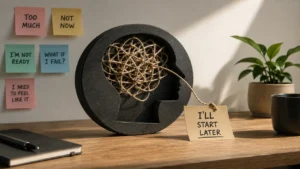

Featured image illustrating why do I procrastinate, with tangled thoughts representing overwhelm, fear of failure and the tendency to put important tasks off.

Why Do I Procrastinate Even When I Want to Get Things Done? 9 Hidden Psychological Reasons

You know the task matters. You genuinely want to get it done. Yet somehow, you keep putting it off. Procrastination isn’t always about laziness or poor discipline. Sometimes, there’s more happening beneath the surface. Understanding why you procrastinate can help you stop blaming yourself, break the cycle, and finally start moving forward.

Woman setting a respectful boundary, illustrating why I feel guilty saying no.

Why Do I Feel Guilty Saying No? 9 Psychological Reasons—and How to Set Boundaries Without Guilt

You know you do not have the time. You can already feel how tired, overcommitted or uncomfortable saying yes will make you. Yet when someone asks for your help, attention or availability, the word “no” seems to disappear. Perhaps you agree immediately and regret it later. Or perhaps you refuse, but then replay the conversation … Read more

Why do I need constant reassurance: A woman checking her phone while seeking reassurance, reflecting the psychology behind the need for constant reassurance.

Why Do I Need Constant Reassurance? The Psychology Behind Seeking Validation and How to Break the Cycle

“Do you think I did the right thing?” “Are you sure you’re not upset with me?” “Do you still love me?” “Did I say something wrong?” If questions like these frequently run through your mind, you’re not alone. Many people find themselves seeking reassurance from their partner, family, friends, or even colleagues—not because they enjoy … Read more

Why do I take everything so personally? A thoughtful professional reflecting while two colleagues talk in the background, illustrating personalization and emotional interpretation.

Why Do I Take Everything So Personally? Understanding the Psychology Behind It

Have you ever spent hours replaying a conversation in your head, wondering whether you offended someone without realizing it? Perhaps a friend replied with a short text, your manager offered constructive feedback, or a family member seemed unusually quiet. Instead of moving on, your mind keeps searching for hidden meanings until you find yourself asking, … Read more

Resilience as a Life Skill

Resilience as a Life Skill: Adapt, Recover, and Thrive in Modern Life

Resilience as a life skill means more than simply coping—it’s the ability to adapt, recover, and thrive through life’s challenges. From childhood to old age, resilience shapes how we handle stress, change, and setbacks. This guide breaks down resilience at different life stages and shares simple, practical strategies to strengthen it in your everyday life. … Read more

Dealing with Boredom

Dealing with Boredom: Understand How It Shapes Our Daily Life, Relationships & Mental Health

Boredom is not “just being idle”—it’s a psychological signal. Left unchecked, it can drain daily energy, weaken relationships, and harm mental health. But when addressed with awareness and purpose (like through the B.O.R.E.D. framework), it can become a doorway to creativity, growth, and deeper connections. Why Dealing with Boredom Matters More Than We Think While … Read more

Aging Gracefully

Aging Gracefully: The Science and Psychology of Successful Aging

Introduction: Rethinking Old Age “Last scene of all,That ends this strange eventful history,Is second childishness and mere oblivion;Sans teeth, sans eyes, sans taste, sans everything.”— William Shakespeare, All the World’s a Stage Shakespeare’s famous lines depict old age as a drab and dependent phase of life with almost nothing exciting to enjoy. For centuries, society … Read more