

Perhaps nothing dramatic is happening between you.
There may be no relationship. No clear promise. Maybe not even regular contact.
Yet this person keeps appearing in your thoughts.
You remember the exact way they spoke to you. You revisit a message, searching for a meaning you may have missed. When your phone lights up, a part of you hopes it is them.
Some days, a small sign of interest makes you feel unusually hopeful. On other days, their silence leaves you unsettled.
You may know that your attention has become excessive. You may even tell yourself, “I need to stop thinking about this.” But the harder you try to push the person out of your mind, the more insistently they seem to return.
If you are wondering, “Why can’t I stop thinking about someone?”, it does not necessarily mean that you are weak, desperate or incapable of moving on. Your mind may be caught between hope and uncertainty. It may be trying to resolve an emotional question that has never received a clear answer.
Sometimes this is part of an ordinary crush, heartbreak or emotional attachment. At other times, the intensity and persistence may resemble a psychological experience known as limerence.
Understanding that word can be useful. But it should not become another label with which to judge yourself.
The more meaningful question may be:
“What has thinking about this person come to mean to me?”
Quick Answer
You may be unable to stop thinking about someone because your mind is trying to make sense of attraction, uncertainty, rejection or an emotionally unfinished connection. When the preoccupation includes intrusive thoughts, idealisation and a powerful need for the other person to return your feelings, it may resemble limerence. Limerence is a descriptive psychological concept, not a formal mental-health diagnosis.
Table of Contents
What Is Limerence?
Psychologist Dorothy Tennov introduced the term ‘limerence’ in her 1979 book Love and Limerence. She used it to describe an intense and often involuntary longing for another person to return one’s feelings.
That definition contains an important detail. Limerence is not simply finding someone attractive. At its centre is a strong need for reciprocation.
You do not only want the person. You want evidence that they want you too.
Because their feelings are uncertain, your mind begins looking for clues. A warm reply may feel deeply reassuring. A shorter message the next day may create hours of doubt. Your mood starts following their behaviour – or your interpretation of it.
You might think:
“They remembered something I told them. That must mean I matter.”
“Their reply seems different today. Have they lost interest?”
“Maybe they feel the same way but are afraid to admit it.”
These thoughts can feel like careful relationship analysis. In reality, the mind may be circling the same uncertainty without reaching a dependable answer.
A published clinical paper describes limerence as involving intrusive thinking, emotional dependence, fear of rejection and longing for reciprocation. Scientific research is still limited. However, a cognitive-behavioural case study found improvement after the thoughts and reinforcing behaviours were addressed, but one case cannot explain how every person experiences limerence.

Limerence Is Not a Diagnosis
Limerence is not recognised as a separate mental-health disorder in the DSM-5-TR. This does not make the distress imaginary. It means we should not treat the term as a diagnosis with one established cause or one standard treatment.
It can share features with anxiety, depression, grief or obsessive-compulsive difficulties. But persistent thoughts about one person do not automatically mean that you have any of these conditions. An individual assessment is needed when symptoms are severe or widespread.
Feelings may also arise without permission, but behaviour still carries responsibility. Intense longing never creates a right to monitor, pressure or repeatedly contact someone who has set a boundary.
Limerence vs Love – Or Something Else?
Thinking about someone repeatedly is not enough, by itself, to identify limerence. You might be falling in love, grieving a breakup, struggling with rejection or trying to understand something left unsaid.
| Experience | What usually sits at its centre |
| Attraction | Interest and a wish to know someone better. |
| A crush | Excitement, curiosity and imagined possibility. |
| Love | Caring for a real, known person, including their imperfections. |
| Emotional attachment | A bond connected with closeness, familiarity and security. |
| Heartbreak or grief | Adjusting to the loss of a person or hoped-for future. |
| Limerence | Intrusive preoccupation and an urgent desire for reciprocation. |
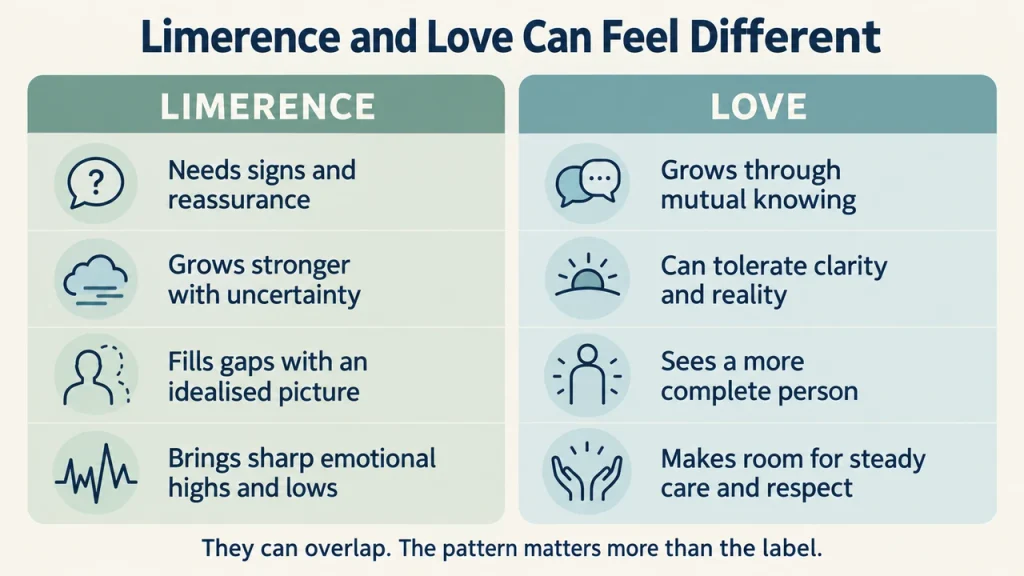
Intensity Is Not Always Intimacy
Emotional intensity feels meaningful. You may assume, “I would not feel this strongly if this person were not important.” The feeling is important. It tells you that something inside you has been deeply activated. It does not necessarily prove compatibility.
Intensity describes the strength of your response. Intimacy develops through mutual knowledge, honesty, safety and consistent participation over time.
You can feel intense longing for someone who knows little about your inner life. You can also experience secure love without constant anxiety or emotional highs. Healthy love becomes increasingly grounded in reality. Limerence often remains organised around possibility.
7 Signs of Limerence You May Recognise
There is no single test that can tell you whether you are experiencing limerence.
You may recognise several of the following signs and still have a different explanation for what you feel. What matters is the overall pattern—especially whether the thoughts feel difficult to control and begin interfering with your emotional balance.
Your mind returns without being invited
You may begin the day intending to focus on work, study or family responsibilities.
Then something small brings the person back.
A song plays. You pass a familiar place. Someone uses a phrase they once used. You remember a conversation and begin replaying it.
Soon, several minutes have passed.
This is different from consciously choosing to remember someone you care about. In limerence, thoughts often feel intrusive. They enter your awareness even when you would prefer to concentrate on something else.
You might be completing a routine task while another mental conversation runs quietly in the background.
Part of you remains occupied with questions such as:
“What did they mean by that?”
“Are they thinking about me too?”
“What might happen the next time we meet?”
The mind does not return only to the person. It returns to the possibility of reciprocation.
Small moments create large mood changes
A brief message may lift your mood for the rest of the day.
A delayed reply may do the opposite.
Perhaps they react to your social media post, remember a personal detail or speak to you more warmly than usual. The moment itself may be ordinary, but its emotional effect feels unusually powerful.
You may experience a rush of hope:
“Something is changing between us.”
Later, they appear distant or unavailable. The hope quickly becomes disappointment, anxiety or self-doubt.
Your mood begins following their behaviour—or your interpretation of their behaviour.
This emotional movement does not mean you are deliberately overreacting. It suggests that the person’s attention has acquired a much larger psychological value than the interaction alone would explain.
You search interactions for clues
When feelings are mutual and communication is clear, you usually do not have to investigate every interaction.
Limerence often grows in ambiguity.
You may reread messages to examine the wording. You notice how long the person took to respond. You compare today’s tone with yesterday’s. You remember where they looked, how they smiled or whether they seemed nervous around you.
The mind becomes a detective.
Unfortunately, it is investigating evidence that can support several explanations.
A friendly message might indicate attraction. It might also be simple kindness. A period of silence might indicate disinterest. It might also mean the person is busy.
Because no interpretation feels certain, the investigation continues. Instead, every new interpretation often produces another question.
Your feelings are larger than what you know
You may feel deeply connected to someone while knowing relatively little about how they live, handle conflict or behave in a committed relationship.
Perhaps most of your contact happens at work, online or in brief social situations. You see selected parts of their personality. Your mind then uses those parts to construct a more complete picture.
This is not deliberate dishonesty.
Human beings naturally form impressions from incomplete information. In limerence, however, emotional hope may influence how those gaps are filled.
You may imagine that the person would understand you completely. You assume their values match yours. You picture how safe, exciting or fulfilling a relationship would feel.
Meanwhile, inconvenient information receives less attention.
Their inconsistency becomes “confusion”.
Their emotional unavailability becomes “fear of getting hurt”.
A clear incompatibility becomes something love might eventually overcome.
You may be relating partly to a real person and partly to a version of them built by longing.
You rehearse an imagined future
Occasional romantic daydreaming is common.
In limerence, fantasy can become a major emotional space.
You may imagine the person confessing their feelings. You rehearse future conversations. You picture ordinary life together—travelling, sharing a home or being accepted by each other’s families.
These scenes can feel comforting because they temporarily remove uncertainty. Inside the fantasy, the relationship is no longer unclear. You are chosen, understood and secure.
The difficulty is not imagination itself.
It begins when the imagined relationship becomes emotionally more influential than the relationship that actually exists.
You may start making decisions around a future the other person has never agreed to build.
Their attention feels like proof of your worth
At first, you may simply want the person to like you.
Gradually, being liked by them begins to mean something more:
“If they choose me, perhaps I really am desirable.”
“If they miss me, then I must matter.”
“If they reject me, maybe I was never enough.”
At this point, the mind is no longer seeking only affection. It is seeking emotional confirmation.
This can make every interaction feel unusually high-stakes. A warm response briefly settles your self-doubt. But because the reassurance comes from outside you, its effect rarely lasts.
You may soon need another message, another sign or another moment of closeness. Relief arrives, but the underlying insecurity remains unanswered.
The preoccupation begins costing you something
Strong feelings become concerning when they repeatedly interfere with how you live.
You might:
- struggle to concentrate at work
- stay awake imagining conversations
- check your phone during important moments
- withdraw from friends who question the connection
- neglect interests that once mattered to you
- repeatedly look at the person’s online activity
- compare potential partners with an idealised image
- remain emotionally unavailable to your existing relationship
You may also organise your day around opportunities to encounter them.
Perhaps you take a particular route, attend an event mainly because they may be present or post something online with the hope that they will notice.
One action may seem harmless. The wider pattern is more revealing.
Your life may be slowly narrowing around someone who is not actively building a shared life with you.
Recognising yourself here may feel embarrassing. Try not to turn awareness into self-attack. People can understand logically that a relationship is unlikely and still feel emotionally caught by the thought, “But what if it happens?”
A necessary boundary

You are not at fault for every thought that enters your mind. You are responsible for how you respond. Repeated messaging, monitoring, arriving unexpectedly or using other people to gather information should never be romanticised as persistence.
Why Your Mind Keeps Returning to Them
Limerence rarely continues because of one feeling alone. Several ordinary human processes can become unusually powerful when hope and uncertainty meet.
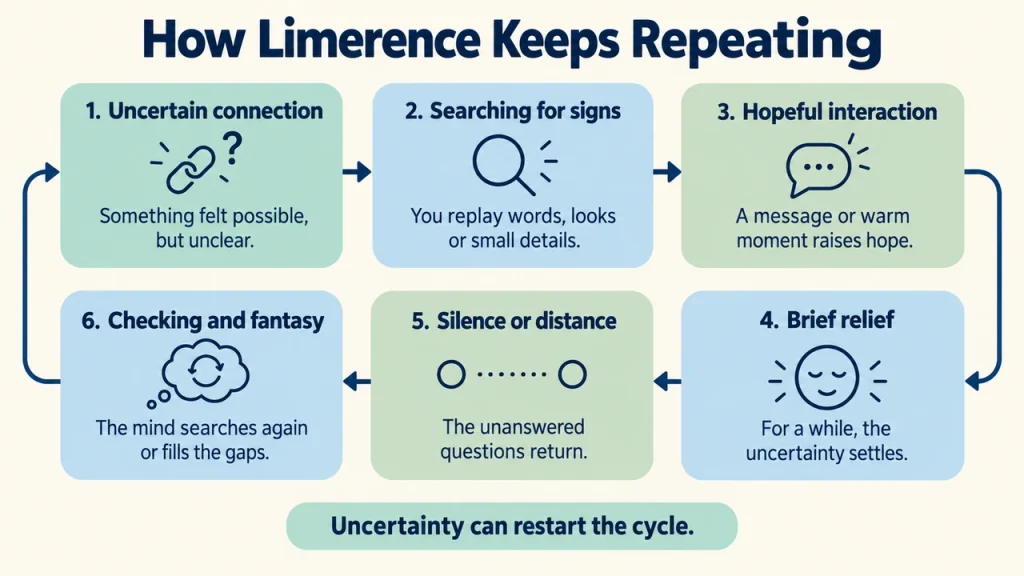
Uncertainty Keeps the Story Open
A definite answer may hurt, but it gives you something real to process. An unclear connection keeps the mind waiting. There is enough warmth to preserve hope, but not enough clarity to feel secure.
In one experiment, women who were uncertain about how much several men liked them reported thinking about the men more and feeling more attracted than women given a clearer answer. The study involved a limited group and does not prove that uncertainty causes limerence. It does show how not knowing can hold attention.
This resembles the mind’s need for closure. The mind wants to complete an unfinished sentence. In limerence, it may favour explanations that keep the sentence hopeful.
A useful question is, “What do I know from consistent behaviour, rather than what remains possible?”
Unpredictable Attention Trains You to Wait
Warmth followed by distance can make each return feel especially powerful. Relief arrives: “I knew the connection mattered.” Then communication changes again, and waiting restarts.
Research on romantic love links focused attention and partner-seeking motivation with reward-related systems. This does not mean love is simply a chemical reaction or that limerence is a clinical addiction. It means emotionally meaningful interactions can teach the mind what to anticipate and seek.
Inconsistency is not always manipulation. People may be busy, uncertain, emotionally unavailable or less invested. Their intention may be unclear while the effect on you is obvious. Security comes from reliable care, not from rare moments of intense relief.
Your Mind Completes the Person
When information is limited, imagination fills the gaps. Someone listens kindly once, and the mind concludes, “They would always understand me.” You may notice limitations but explain each one in a way that protects hope.
Compassion is valuable. It becomes costly when it repeatedly stops you from accepting what behaviour shows. You may understand every reason someone cannot meet your needs while barely considering what that does to you.
Try completing two sentences:
“What I genuinely know about this person is…”
“What I imagine life with this person would give me is…”
The difference may reveal that you are holding not only a person but also a promise.
Their Attention Begins to Carry Your Self-Worth
Perhaps they made you feel visible during a lonely or doubtful period. Their interest awakened confidence, playfulness or hope. It makes sense that you valued the experience.
The difficulty begins when you believe only this person can keep that version of you alive. Their attention did not create all those qualities. It helped you notice capacities that were already yours.
When reassurance repeatedly settles doubt for only a short time, it can help to understand the need for constant reassurance. Support is human; the goal is simply not to make one person the only evidence that you are lovable.
Replaying Feels Like Finding Certainty
You reread messages, compare their tone or ask a friend what an interaction meant. This can feel productive. But reflection helps you understand or decide; rumination returns you to familiar ground without producing reliable new information.
Checking may lower anxiety briefly. It also teaches your mind that every uncertain feeling requires immediate action. Social media then supplies more ambiguous details, not more truth.
This pattern is closely related to the hidden psychology of overthinking. If no dependable new information exists, more analysis produces more interpretations, not certainty.
Fantasy Offers Emotional Relief
Thinking about the person may brighten a repetitive day, soften loneliness or create a private escape from dissatisfaction. In the imagined relationship, you feel chosen, alive and understood.
That is why letting go can feel like losing more than a person. You may also be losing an emotional refuge and an imagined future.
Ask: “What feeling do I experience in this fantasy, and where is that feeling missing from my present life?” The answer may involve closeness. It may also involve freedom, recognition, novelty or the wish to begin again. The need deserves attention, even when this particular person cannot meet it.
Why ‘Just Stop Thinking About Them’ Does Not Help
Trying to guarantee that you never think about someone again requires you to keep checking whether the thought has returned. That monitoring keeps the person mentally relevant.
Research on thought suppression has sometimes found a rebound in unwanted thoughts. The effect is not identical for everyone, but it helps explain why mental force can become exhausting.
The aim is not perfect mental silence. It is to let a thought appear without automatically turning it into checking, fantasy or another search for hope.
You may still think, “I miss them.” You can learn to add, “I do not have to follow this thought any further.”
The R.E.T.U.R.N. Framework
Moving through limerence is rarely one decisive act. It is a series of small returns – to reality, to your boundaries and to the parts of life that have been pushed aside.
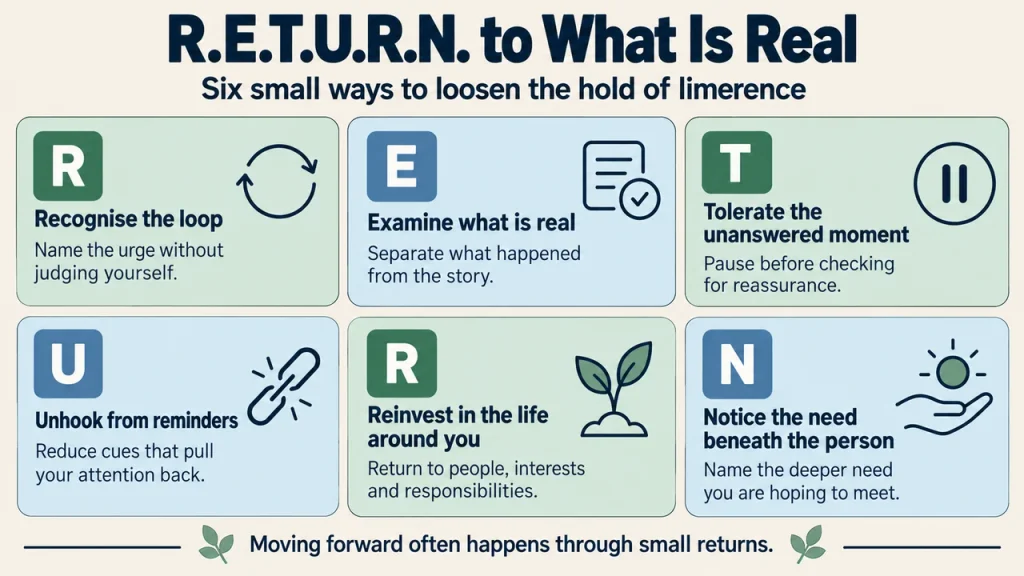
R – Recognise the loop
Name what is happening without insulting yourself. Try, “My mind is looking for certainty,” or, “This is an urge to check, not a sign that I must check.” Naming creates a little space between you and the thought.
E – Examine what is real
Separate observation from interpretation. “They replied after three days” is an observation. “They waited because they are afraid of their feelings” is one possible story. Ask whether their choices are consistent and whether both of you want the same relationship.
T – Tolerate the unanswered moment
When you want to check or message mainly for reassurance, wait for a manageable period. Ask, “What answer am I hoping this action will give me?” Delaying is practice in tolerating uncertainty, not punishment for caring.
U – Unhook from reminders
Mute updates, archive conversations and stop requesting news from mutual friends. If contact is unavoidable, keep it relevant and respectful. A boundary is meant to protect your attention, not make the person notice your absence.
R – Reinvest in the life around you
Return gradually to friends, interests, movement and delayed responsibilities. Stable activities may initially feel quiet beside romantic anticipation. Do not ask whether they made you forget completely. Ask whether you became present in your own life for a while.
N – Notice the need beneath the person
Replace “I need them” with the more precise need: “I need closeness,” “I miss feeling alive,” or “I want to be appreciated.” Once the need has a name, one person is no longer the only imagined doorway to meeting it.
Progress may feel uneven

A dream, unexpected encounter or lonely evening may bring the person back to mind. That does not return you to the beginning. Progress is shown by what happens next: whether you automatically follow the thought or notice it and continue with the life in front of you.
Should You Tell Them How You Feel?
A direct conversation can sometimes end the guessing. If the relationship is safe and open to honest communication, you might say:
“I have started feeling more than friendship toward you. I do not want to make assumptions, so I wanted to ask how you see our connection.”
The purpose is clarity, not persuasion. Listen to the answer as it is given.
Before speaking, ask whether they have already communicated disinterest, whether they are actually available and whether you can respect an answer you do not want. If they have said no or asked for distance, another declaration is unlikely to create closure.
A hesitant answer can also preserve hope. Unless both people clearly agree to explore the connection, make decisions from what is available now. You do not have to place your life on hold for a possible future answer.
When Distance May Help
Distance can reduce the cues that keep limerence active. It should not be used to punish the person or make them miss you.
Healthy distance may mean no longer initiating unnecessary conversations, muting social media, declining situations attended mainly to see them, and allowing a clear rejection to remain final.
Complete no-contact is not always possible. You may work together or share responsibilities. In that case, choose purposeful contact: discuss what genuinely needs to be discussed without creating extra opportunities to search for hope.
At first, distance may increase longing. That does not prove the boundary is wrong. Your mind may be adjusting to the loss of familiar anticipation.
Let the Imagined Future Be Grieved
Sometimes you are not only releasing a person. You are releasing the conversations that never happened, the relationship that never began and the version of yourself you pictured beside them.
This can create genuine grief even when there was no formal relationship. A possibility can be emotionally meaningful without being a shared commitment. You can honour what you hoped for without continuing to organise your life around it.
When Professional Support May Help
You do not have to wait until the experience becomes unbearable. Consider speaking with a qualified mental-health professional when the preoccupation:
- repeatedly disrupts your sleep or concentration
- interferes with work, study or existing relationships
- leads to compulsive checking or reassurance seeking
- contributes to persistent anxiety or low mood
- centres repeatedly on unavailable people
- continues despite your efforts to change the pattern
- leads you to disregard another person’s boundaries
- makes you feel unable to manage daily life
Therapy is not meant to shame you out of your feelings. A professional may help you examine rumination, beliefs, unmet needs and behavioural habits. If intrusive or compulsive thoughts occur across several parts of life, an assessment can also explore whether another condition needs attention.
If you feel at risk of harming yourself or someone else, contact local emergency services or an appropriate crisis service in your area immediately.
Frequently Asked Questions
Is limerence a mental-health disorder?
No. Limerence is a descriptive concept, not a formal DSM-5-TR diagnosis. It can still cause real distress. Professional support may help when thoughts or behaviours interfere with daily life.
How long does limerence last?
There is no dependable timetable. Continued contact, uncertainty, fantasy and checking may keep the pattern active. It may weaken as hope is no longer repeatedly reinforced, although emotional adjustment takes time.
Can limerence happen during a relationship?
Yes. A person may become preoccupied with their existing partner, particularly when the relationship feels uncertain. Someone in a committed relationship may also develop limerent feelings for another person. Having a feeling is different from deciding how to act on it.
Does limerence mean I truly love the person?
It can coexist with genuine care, but intensity alone cannot establish love. Love grows through knowing the whole person, respecting their autonomy and participating in a mutual relationship. Limerence can develop when much of the connection still rests on hope and imagination.
Can the pattern happen more than once?
Yes. Some people experience intense preoccupation with different people at different stages of life. Repeated patterns may be worth exploring, especially when they involve unavailable people, unclear connections or a strong need to feel chosen.
How can I stop thinking about someone I see regularly?
Change what surrounds the unavoidable contact. Keep communication appropriate, reduce online monitoring and do not analyse every pleasant exchange. After seeing them, return to a planned activity rather than extending the encounter in your imagination.
Final Perspective
If you have been asking, “Why can’t I stop thinking about someone?”, you may have hoped for a technique that would remove them immediately. Emotional change is usually quieter than that.
You notice a thought without turning it into a story. You stop treating every interaction as a clue. You allow unanswered questions to remain unanswered. You return to relationships and experiences that can meet you in the present.
None of this requires you to pretend that the person meant nothing. They may have awakened a desire for closeness, recognition, excitement or change. Listen to that information. But do not assume that only this person can answer it.
Limerence often says, “This feeling is intense, so this connection must be destined.” A more grounded response is, “This feeling is intense, so something inside me deserves understanding.”
That shift does not deny love. It makes room for love that is mutual, available and real.
You cannot always decide who enters your thoughts. You can gradually decide how much authority those thoughts receive. You can care without chasing. You can miss someone while still returning to yourself.
A Gentle Note
Psychoeducation and mental-health awareness

This article is intended to educate and inform. It cannot diagnose a mental-health condition or replace professional care. If these thoughts are causing significant distress, affecting daily life or making you feel unsafe, please seek guidance from a qualified mental-health professional.
Research and Further Reading
Wyant, B. E. (2021). Treatment of limerence using a cognitive behavioral approach.
Bode, A., & Kushnick, G. (2021). Proximate and ultimate perspectives on romantic love.
Magee, J. C., et al. (2012). Psychopathology and thought suppression: A quantitative review.