

“Why did I react like that?”
Perhaps it was a simple comment from your partner, a delayed reply to your message, a small criticism at work, or an innocent joke from a friend. To others, it seemed insignificant. But inside you, something shifted. Your heart raced, your thoughts spiraled, and your emotions felt overwhelming.
Hours later, you may still be replaying the moment, wondering:
“Why do I get triggered so easily when other people seem to handle these situations just fine?”
If you’ve ever asked yourself this question, you’re not alone. Emotional triggers are a common part of being human. Yet they often leave us feeling confused, ashamed, or frustrated with ourselves. Many people assume that being easily triggered means they are too sensitive, emotionally weak, or unable to cope with everyday life. In reality, psychology suggests something very different.
Table of Contents
An emotional trigger is rarely about the present moment alone. More often, it is the mind and body responding to an experience that feels familiar—even if you are not consciously aware of why. What appears to be an overreaction is often an emotional pattern shaped by your past experiences, beliefs, relationships, and the way your brain has learned to protect you.
Understanding your triggers is not about finding someone to blame or reliving every painful memory. It is about becoming curious instead of critical. When you understand why your emotions respond the way they do, you gain the ability to respond with greater awareness rather than reacting automatically.
This is where emotional fitness becomes important. Just as physical fitness helps your body adapt to challenges, emotional fitness helps your mind recognize, regulate, and recover from emotionally intense moments. It doesn’t eliminate difficult emotions, but it changes your relationship with them. In this article, we’ll explore the psychology behind emotional triggers, why small situations can sometimes evoke surprisingly intense feelings, how childhood experiences may influence emotional reactions in adulthood, and practical ways to build healthier emotional responses. By the end, you’ll see that your triggers are not signs of weakness—they are signals that deserve understanding.
What Does It Mean to Be Emotionally Triggered?
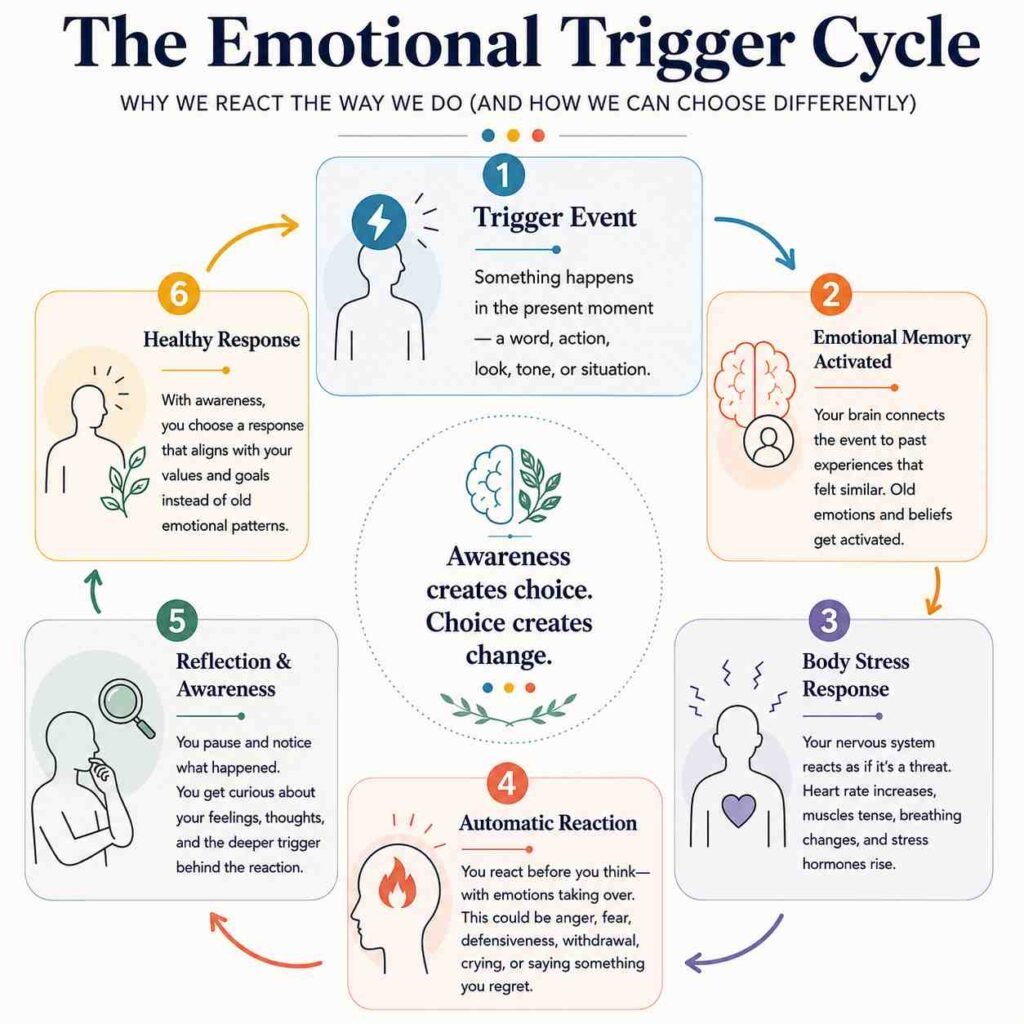
The word “triggered” has become common in everyday conversations and social media, but it is often misunderstood.
From a psychological perspective, an emotional trigger is anything—an event, situation, memory, person, or even a particular tone of voice—that activates an intense emotional response. These reactions may include anger, fear, sadness, shame, anxiety, or even emotional numbness.
The important thing to remember is that the trigger itself is not always the true source of the emotion. Instead, it acts like a switch that activates an emotional network already stored in the brain.
Imagine touching a bruise on your arm. The touch itself isn’t necessarily painful, but because the area is already sensitive, even gentle pressure can hurt. Emotional triggers work in much the same way. A present-day experience touches an emotional “bruise” created by previous experiences, causing a reaction that feels much larger than the situation alone might explain.
For example:
- A colleague offers constructive feedback, yet you immediately feel deeply criticized or inadequate.
- A friend takes several hours to reply to your message, and you begin worrying that you’ve done something wrong.
- Your partner raises a concern calmly, but you instantly become defensive or withdraw from the conversation.
- Someone interrupts you during a discussion, and you feel unexpectedly angry or invisible.
In each of these situations, the immediate event may seem relatively small. Yet the emotional response can feel intense because your brain is connecting the present experience with older emotional memories and learned patterns.
This doesn’t mean your feelings are irrational or “made up.” Your emotions are real. They are simply influenced by more than what is happening in the present moment.
Psychologists often describe this as the interaction between current experiences and stored emotional learning. Throughout life, your brain continually learns from experiences—especially those involving safety, relationships, rejection, acceptance, and belonging. Over time, these experiences shape how quickly you detect emotional threats and how strongly you respond to them.
The encouraging news is that emotional triggers are not fixed parts of your personality. They are learned responses, and like many learned responses, they can become more manageable with awareness, reflection, and practice.
Why Do Small Things Feel So Big?
One of the most confusing aspects of emotional triggers is that the situation itself often appears minor.
You might think:
“It was just a comment.”
“Why couldn’t I simply let it go?”
“Why did I react so strongly over something so small?”
The answer lies in an important psychological principle:
Our emotional reactions are influenced more by what an event means to us than by the event itself.
Two people can experience the same situation but react very differently because their brains interpret it through different life experiences.
Imagine two colleagues receiving identical feedback from their manager.
One sees it as an opportunity to improve.
The other spends the entire evening feeling anxious, embarrassed, and convinced they are failing.
The difference is not necessarily the feedback—it is the personal meaning attached to it.
For someone who grew up feeling constantly criticized, even gentle suggestions may unconsciously activate fears of rejection or inadequacy.
For someone whose opinions were often dismissed, being interrupted during a conversation may feel far more painful than it appears on the surface.
For someone who experienced inconsistent affection, a delayed text message may quickly become a fear of abandonment.
In psychology, this process is sometimes described as emotional association. Your brain naturally connects present experiences with similar emotional experiences from the past. Because this process often happens automatically, you may react before you’ve had time to consciously evaluate what is actually happening.
This is one reason emotional triggers can feel so immediate. The emotional brain is designed to detect potential threats quickly. While this ability helped humans survive physical dangers throughout evolution, it can also cause us to react strongly to emotional situations that remind us of earlier experiences.
This doesn’t mean your brain is “broken.” It means your brain is doing what it has learned to do—protect you based on previous emotional experiences.
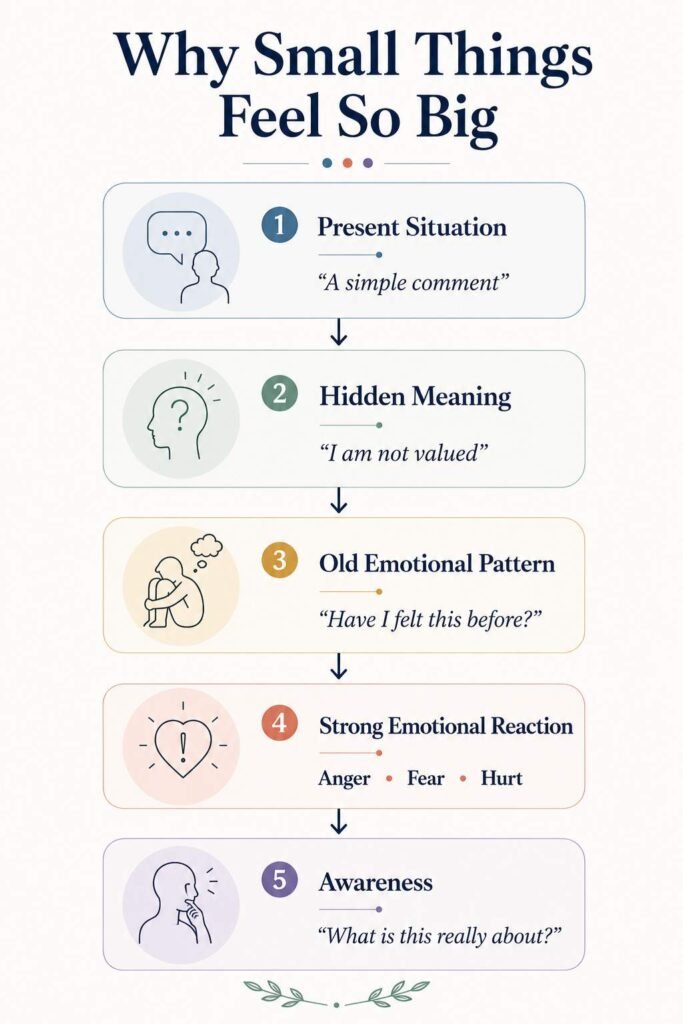
Recognizing this shift is often the first step toward healthier emotional regulation. Instead of asking,
“What’s wrong with me?”
you can begin asking,
“What might this situation be reminding me of?”
That single question replaces self-judgment with curiosity, opening the door to greater emotional awareness.
How Childhood Shapes Emotional Triggers
Many of our emotional responses begin long before we are able to understand them.
Childhood is the period when the brain is rapidly learning one of life’s most important lessons:
“Is the world emotionally safe?”
The answers don’t come from words alone. They come from repeated experiences with parents, caregivers, teachers, siblings, and other important people.
Every comforting hug, every moment of encouragement, every experience of being ignored, criticized, comforted, or misunderstood becomes part of the brain’s emotional learning system.
Over time, children begin developing unconscious beliefs such as:
- “My feelings matter.”
- “I have to hide my emotions.”
- “People usually leave.”
- “I need to be perfect to be accepted.”
- “It’s not safe to disagree.”
- “I have to take care of everyone else first.”
These beliefs are rarely conscious decisions. Instead, they become emotional templates that influence how we interpret situations throughout adulthood.
For example, a child who was frequently criticized may become an adult who instinctively hears criticism even when someone is offering supportive feedback.
A child whose emotions were dismissed may grow into an adult who struggles to identify or express feelings, often reacting with frustration or withdrawal instead.
Someone who experienced inconsistent emotional support may become especially sensitive to signs of rejection, distance, or conflict in close relationships.
This does not mean childhood determines your future or that every emotional difficulty is caused by parenting. Human development is influenced by many factors, including temperament, later life experiences, supportive relationships, and resilience.
However, decades of psychological research consistently show that early emotional experiences help shape how people regulate emotions, perceive relationships, and respond to stress later in life.
If you’d like to explore this connection in greater depth, you can read our detailed guide on how childhood shapes emotional regulation, where we examine how early emotional experiences influence the way adults respond to life’s challenges.
Perhaps the most hopeful finding from modern psychology is this:
The brain remains capable of learning throughout life.
This means the emotional patterns you developed as a child are not permanent. Through greater self-awareness, supportive relationships, intentional practice, and emotional fitness, it is possible to develop healthier ways of responding to emotional challenges.
Rather than asking, “Why am I like this?” a more empowering question becomes:
“What has my emotional system learned—and what new patterns can I begin learning today?”
The Brain Science Behind Emotional Triggers
Have you ever reacted to something so quickly that it felt as though your emotions took control before you had time to think?
Perhaps you later wondered,
“Why did I say that?”
“Why couldn’t I calm down?”
“Why did I know I was overreacting but still couldn’t stop?”
This experience is more common than most people realize. It isn’t a sign that you lack self-control. Rather, it reflects how the human brain has evolved to respond to perceived threats.
One of the key players in this process is a small, almond-shaped structure deep inside the brain called the amygdala. Often described as the brain’s emotional alarm system, the amygdala constantly scans your environment for anything that might signal danger—whether physical or emotional.
When the amygdala perceives a threat, it acts remarkably fast. It prepares your body to respond before your logical thinking has fully caught up. Your heart may beat faster, your muscles tense, your breathing change, and your attention narrow toward the perceived threat.
This rapid response was essential for our ancestors facing predators or other life-threatening situations. In today’s world, however, the “threat” is more likely to be emotional than physical.
A critical comment.
A disappointed expression.
A raised voice.
Feeling excluded from a conversation.
Receiving no reply to an important message.
Although these situations are rarely dangerous in a physical sense, the brain may interpret them as threats if they resemble emotionally significant experiences from the past.
Meanwhile, another part of the brain—the prefrontal cortex, located just behind the forehead—helps us evaluate situations, regulate emotions, consider different perspectives, and make thoughtful decisions.
You can think of these two brain systems as working together:
- The amygdala asks, “Am I safe?”
- The prefrontal cortex asks, “What’s actually happening here?”
When we’re calm, these systems communicate effectively. But when emotions become intense, the amygdala can temporarily dominate the conversation, making it harder to think clearly or respond calmly.
This is why emotionally charged situations often lead to impulsive reactions that we later regret.
The encouraging news is that the brain is remarkably adaptable. Thanks to neuroplasticity—the brain’s ability to form new neural connections—people can strengthen emotional regulation over time.
Every time you pause before reacting, name your emotions, reflect instead of assuming, or respond thoughtfully during a difficult conversation, you’re helping your brain build healthier emotional pathways.
Emotional regulation is not about suppressing emotions. It is about helping your thinking brain stay connected to your emotional brain, even during stressful moments.
That is one of the central goals of emotional fitness.
Why Certain Triggers Feel Stronger Than Others
Not everyone reacts to the same situations in the same way.
One person may remain calm during criticism but become deeply upset when ignored.
Another may handle conflict confidently but struggle with uncertainty.
Someone else may appear composed in public yet feel overwhelmed by even minor disappointment.
Why?
Because emotional triggers are deeply personal.
Our brains assign emotional significance based on experiences, not simply events.
Think of emotional memories as invisible folders stored in the brain.
Whenever something happens in the present, your brain quickly searches those folders looking for similar experiences.
If it finds a close match, it may respond as though the past is happening again.
For example:
A manager says,
“Can we talk about your report?”
Objectively, this is simply a request for a conversation.
But your brain may unconsciously associate it with:
- being criticized by a parent
- being embarrassed at school
- feeling like you weren’t good enough
- disappointing someone important
Without realizing it, your emotional system fills in the blanks before you’ve had time to evaluate the situation objectively.
This process often explains why people later say,
“I know they didn’t mean it that way, but I still couldn’t help feeling hurt.” Understanding this doesn’t invalidate your emotions. Instead, it helps explain why they can feel so immediate and powerful.
Common Emotional Triggers Most People Don’t Recognize
Many people expect emotional triggers to involve major life events.
In reality, triggers are often woven into ordinary moments.
Below are some of the most common emotional triggers psychologists observe.
1. Feeling Criticized
Constructive feedback can sometimes feel like a personal attack.
This is especially true for people who grew up in highly critical or perfectionistic environments.
Instead of hearing,
“Here’s something you can improve,”
the emotional brain hears,
“You’re not good enough.”
2. Feeling Ignored
A delayed reply.
Someone looking at their phone while you’re talking.
Not being invited.
These experiences may awaken deep feelings of rejection or invisibility.
This is one reason social exclusion often feels surprisingly painful.
3. Feeling Rejected
Humans have an innate need to belong.
Even small experiences of rejection—such as not receiving a response or being left out of a conversation—can activate strong emotional reactions.
For some people, rejection is interpreted as evidence that they are unworthy or unlovable, even when there is little objective evidence to support that conclusion.
4. Feeling Controlled
Some individuals become emotionally reactive when they feel pressured, criticized, or told what to do.
This may stem from earlier experiences where personal choices were ignored or where control was used instead of collaboration.
5. Feeling Misunderstood
Many people don’t become upset because someone disagrees with them.
They become upset because they feel unseen.
When people repeatedly feel misunderstood, they may become defensive, frustrated, or emotionally withdrawn.
6. Comparison
Social media has amplified this trigger.
Seeing others appear happier, more successful, or more confident can quietly activate feelings of inadequacy.
Although comparison is natural, excessive comparison often undermines emotional well-being.
7. Conflict
Some people grew up in homes where conflict was loud and frightening.
Others grew up where disagreements were avoided altogether.
As adults, even healthy conflict may feel emotionally unsafe because the brain associates disagreement with danger.
8. Uncertainty
Waiting for medical test results.
A delayed message.
A job interview.
Unexpected changes.
For individuals with heightened anxiety, uncertainty itself can become a trigger because the brain prefers predictability.
Signs You’re Emotionally Triggered
Emotional triggers don’t always look dramatic.
Sometimes they are subtle and easy to miss.
Learning to recognize these early signs can help you respond before emotions become overwhelming.
Emotional Signs
- Feeling unusually hurt
- Sudden anger
- Anxiety
- Shame
- Fear
- Emotional numbness
Physical Signs
- Tight chest
- Rapid heartbeat
- Clenched jaw
- Muscle tension
- Shallow breathing
- Feeling hot or shaky
Your body often notices the trigger before your conscious mind does.
Thinking Patterns
You may notice thoughts such as:
- “They don’t respect me.”
- “I’m going to fail.”
- “Nobody cares.”
- “It’s happening again.”
- “I always mess things up.”
These thoughts often appear automatic because they reflect well-established emotional patterns.
Behavioural Signs
You might:
- become defensive
- withdraw from conversations
- argue impulsively
- cry unexpectedly
- seek constant reassurance
- avoid people
- overthink for hours
- replay the situation repeatedly
Many of these behaviors are attempts to regain a sense of emotional safety.
Why Emotional Triggers Are Not a Sign of Weakness
Perhaps one of the most harmful myths about emotional triggers is the belief that they indicate weakness.
People often tell themselves,
“I should be stronger.”
“I shouldn’t let this bother me.”
“Other people handle this better than I do.”
But emotional triggers are not character flaws.
They are messages.
They reveal where your emotional system has learned to become especially alert.
Imagine walking on an old ankle injury.
If it still feels sensitive, you wouldn’t conclude that your ankle is weak.
You would recognize that it needs attention, care, and gradual strengthening.
The same principle applies to emotional health.
Being emotionally triggered does not mean you are broken.
It means your mind and body are responding according to patterns they learned over time.
The real measure of emotional strength is not whether you never get triggered.
It is how you respond after you notice the trigger.
Do you become curious instead of judgmental?
Can you pause before reacting?
Can you reflect instead of assuming?
Can you learn from the experience?
These are the qualities of emotional fitness.
Every trigger offers an opportunity—not to criticize yourself—but to better understand your emotional world.
Instead of asking,
“Why am I so sensitive?”
try asking,
“What is this emotion trying to protect me from?”
That simple shift transforms emotional triggers from something to fear into something you can learn from.
The P.A.U.S.E. Method™: A Practical Way to Respond to Emotional Triggers
Understanding emotional triggers is the first step, but awareness alone is not always enough.
The real challenge comes in the moment when emotions rise.
Your heart starts racing.
Your thoughts become intense.
You feel the urge to defend yourself, withdraw, argue, or react immediately.
This is where emotional fitness becomes a practical skill.
The goal is not to eliminate emotional reactions. Human beings are emotional by nature. The goal is to create a small space between what happens and how you respond.
That space is where emotional growth happens. To help develop this skill, The Psyche Inspire introduces the P.A.U.S.E. Method™—a simple five-step approach to managing emotional triggers with greater awareness.
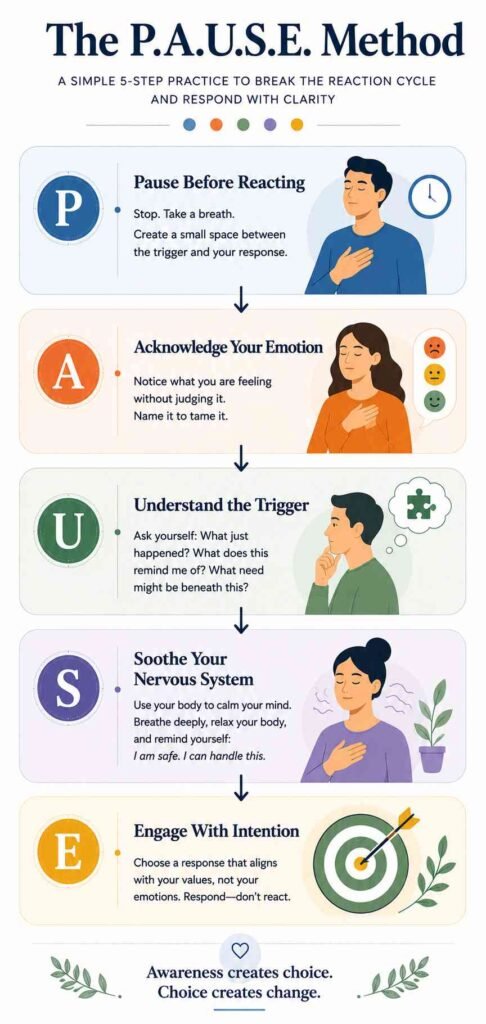
P – Pause Before Reacting
The first step is creating a moment of interruption.
When you feel triggered, your natural tendency may be to immediately respond:
- send the angry message
- raise your voice
- defend yourself
- walk away
- assume the worst
But a short pause allows your brain to move from automatic reaction toward conscious response.
A pause does not mean ignoring your feelings.
It means giving yourself enough time to understand them.
You can try:
- taking a few slow breaths
- counting slowly to ten
- stepping away briefly if possible
- noticing what is happening inside your body
A pause creates emotional space.
Even a few seconds can change the direction of a conversation.
A – Acknowledge What You Are Feeling
Many people either suppress emotions or become overwhelmed by them.
Emotional fitness requires a middle path: recognizing emotions without being controlled by them.
Instead of saying:
“I shouldn’t feel this way.”
Try:
“I am feeling hurt right now.”
“I am feeling angry.”
“I am feeling afraid of being rejected.”
Naming emotions has been associated with better emotional regulation because it helps bring awareness to experiences that may otherwise feel overwhelming.
You cannot regulate what you refuse to recognize.
An emotion becomes easier to manage when you can observe it clearly.
U – Understand the Deeper Trigger
This is often the most important step.
Ask yourself:
“Is my reaction only about what is happening right now?”
or
“Is this situation reminding me of something older?”
For example:
Someone cancels plans with you.
The immediate situation:
“They cannot meet today.”
But the deeper emotional meaning might be:
“People don’t prioritize me.”
or
“I am going to be abandoned.”
The current event may be small, but the emotional meaning attached to it may be much larger.
This is where understanding your personal emotional patterns becomes powerful.
Many of these patterns are connected to earlier experiences, relationships, and beliefs about yourself.
This is why understanding how childhood shapes emotional regulation is so important. Early experiences can influence how we interpret safety, rejection, criticism, and connection in adulthood.
However, awareness does not mean blaming the past.
It means understanding yourself better.
S – Soothe Your Nervous System
When emotions become intense, the body often enters a stress response.
You may experience:
- rapid heartbeat
- muscle tension
- racing thoughts
- difficulty thinking clearly
Before trying to solve the problem, help your nervous system return to a calmer state.
Some simple grounding strategies include:
Slow Breathing
Longer exhales can signal safety to the nervous system.
Example:
Inhale gently for four seconds.
Exhale slowly for six seconds.
Repeat several times.
Physical Grounding
Notice:
- five things you can see
- four things you can feel
- three things you can hear
- two things you can smell
- one thing you can taste
This brings attention back to the present moment.
Self-Compassion
Instead of criticizing yourself:
“Why am I reacting like this?”
Try:
“Something inside me feels threatened right now. I can understand this before responding.”
Self-compassion does not mean avoiding responsibility.
It creates the emotional safety needed for growth.
E – Engage With Intention
The final step is choosing your response consciously.
After pausing, acknowledging, understanding, and calming yourself, ask:
“What response reflects the person I want to become?”
Maybe the answer is:
- having a calm conversation
- expressing your feelings clearly
- setting a boundary
- asking for clarification
- letting go of unnecessary conflict
Emotional maturity is not the absence of strong emotions.
It is the ability to choose your actions even when emotions are strong.
How Emotional Fitness Helps You Respond Instead of React
Emotional triggers are not the enemy.
In many ways, they are teachers.
They reveal areas where we need greater awareness, healing, and emotional strength.
This is the foundation of emotional fitness.
Just as physical fitness involves developing strength, flexibility, and endurance, emotional fitness involves developing the following:
Emotional Awareness
Understanding what you feel and why you feel it.
Emotional Regulation
Managing emotions without suppressing or being controlled by them.
Emotional Resilience
Recovering after difficult emotional experiences.
Self-Compassion
Treating yourself with understanding during moments of struggle.
Emotional Flexibility
Being able to adjust your response instead of repeating old patterns.
A person with emotional fitness can still feel anger, sadness, disappointment, or fear.
The difference is that these emotions no longer automatically control their behavior.
They become information rather than instructions.
For example:
Anger may communicate:
“Something feels unfair.”
Fear may communicate:
“Something feels uncertain.”
Sadness may communicate:
“Something meaningful has been lost.” The emotionally fit person listens to emotions but does not surrender complete control to them.
Can Emotional Triggers Really Change?
A common fear people have is:
“What if I am just an emotional person? What if this is who I am?”
The answer from modern psychology is encouraging.
Emotional patterns can change.
The brain has the ability to adapt through neuroplasticity. Repeated experiences, reflection, and healthier responses can gradually strengthen new emotional pathways.
Change usually does not happen overnight.
It happens through small moments:
- pausing instead of reacting
- communicating instead of withdrawing
- questioning assumptions instead of believing every thought
- showing yourself compassion instead of criticism
Every time you respond differently, you teach your brain a new possibility.
You are not trying to become someone who never gets triggered. You are becoming someone who understands their triggers and responds with greater wisdom.
When Should You Seek Professional Support?
Emotional triggers are a normal part of human experience. However, professional support may be helpful when emotional reactions become overwhelming or significantly affect your daily life.
Consider seeking guidance from a qualified mental health professional if you experience:
- intense emotional reactions that feel difficult to control
- frequent relationship conflicts because of emotional responses
- persistent anxiety, fear, or sadness
- painful memories that repeatedly disrupt your life
- difficulty functioning at work or in relationships
- feelings of hopelessness or emotional distress
Therapy can provide a safe space to understand emotional patterns, develop healthier coping strategies, and build stronger emotional regulation skills.
Seeking support is not a sign of weakness.
It is an investment in emotional health.
Final Thoughts: Your Triggers Are Signals, Not Your Identity
If you often wonder,
“Why do I get triggered so easily?”
Remember this:
Your emotional reactions are not random.
They are shaped by your experiences, relationships, beliefs, and the ways your mind has learned to protect you.
A trigger is not proof that something is wrong with you.
It is a signal.
A signal that something inside you needs attention, understanding, or care.
The journey of emotional fitness is not about becoming emotionless. It is about becoming emotionally aware.
It is about learning to say:
“I notice what I feel.”
“I understand where it may come from.”
“I can choose how I respond.”
Your past may have influenced your emotional patterns, but it does not have to define your future.
With awareness, practice, and compassion, you can move from automatic reactions toward intentional responses.
And that is one of the most powerful forms of emotional growth.
Why do I get triggered so easily?
You may get triggered easily because your brain is responding to emotional patterns developed through past experiences, beliefs, relationships, and learned responses. A present situation may activate emotions connected to earlier experiences.
Are emotional triggers a sign of trauma?
Not always. Emotional triggers can develop from many experiences, including childhood experiences, relationship patterns, stress, criticism, rejection, or repeated emotional situations. Not every trigger is related to trauma.
How can I stop being triggered so easily?
You cannot completely prevent emotional triggers, but you can learn to manage them better. Developing emotional awareness, practicing emotional regulation, understanding your triggers, and creating a pause before reacting can help.
Why do small things trigger me more than others?
People respond differently because emotional experiences and personal meanings differ. Something that feels small to one person may connect with a deeply meaningful emotional pattern for another.
Can emotional regulation improve with practice?
Yes. Emotional regulation is a skill that can develop over time. Through awareness, self-reflection, healthy coping strategies, and supportive relationships, people can strengthen their ability to manage emotions.
Explore more articles on Emotional Fitness and Psychology Explained to continue building emotional awareness, resilience, and healthier relationships.
About the Author

Sunil Prasad holds a Master's degree in Counselling Psychology and has over four years of counseling experience. He is the founder of The Psyche Inspire, where he writes research-informed articles on emotional fitness, emotional regulation, relationships, overthinking, and personal growth. His goal is to make psychology understandable, practical, and applicable to everyday life through evidence-based insights, real-world examples, and compassionate guidance. Every article is carefully researched and written to help readers develop healthier emotional habits and greater psychological resilience.
1 thought on “Why Do I Get Triggered So Easily? The Hidden Psychology of Emotional Triggers”