

Why Am I Such a People Pleaser?
Do you find yourself saying “yes” when every part of you wants to say “no”? Do you worry about disappointing others, even when meeting their expectations leaves you exhausted? Perhaps you apologise too often, avoid conflict at all costs, or constantly put other people’s needs ahead of your own. If this sounds familiar, you may have wondered, “Why am I such a people pleaser?”
Table of Contents
At first glance, people pleasing can look like kindness, generosity, or being a caring person. Society often praises those who are always available, helpful, and selfless. But beneath these behaviors, there is often a deeper psychological pattern. Many people pleasers aren’t simply being kind—they are trying to stay emotionally safe by avoiding rejection, criticism, conflict, or disapproval.
People pleasing isn’t a personality flaw or a sign of weakness. In many cases, it develops as an adaptive survival strategy. Over time, your brain may learn that keeping others happy reduces emotional discomfort, protects relationships, or prevents painful experiences. While this strategy may have helped you in the past, it can gradually lead to chronic stress, resentment, emotional exhaustion, and a weakened sense of identity.
The good news is that these patterns are not permanent. Once you understand the psychology behind people pleasing, you can begin replacing automatic habits with healthier choices that protect both your relationships and your own well-being.
In this article, you’ll discover why people pleasing develops, how childhood experiences, emotional learning, and relationship patterns influence it, the signs that often go unnoticed, and practical ways to build healthier boundaries without losing your compassion.
What Is People Pleasing?
People pleasing is a behavioral pattern in which a person consistently prioritises the needs, feelings, or expectations of others at the expense of their own well-being. While helping others is a healthy part of human relationships, people pleasing goes beyond genuine kindness. It is often driven by an internal fear of rejection, criticism, conflict, or disappointing others rather than a freely chosen desire to help.
A people pleaser may agree with opinions they don’t actually share, take on responsibilities they don’t have time for, or struggle to express personal needs because saying “no” feels emotionally uncomfortable. Over time, this pattern can create a cycle where self-worth becomes increasingly dependent on gaining approval and avoiding disapproval.
Psychologically, people pleasing is closely linked to emotional regulation, attachment experiences, and the brain’s natural need for safety and belonging. Human beings are wired for connection, and our brains often interpret social acceptance as a form of security. When someone repeatedly associates approval with feeling safe, they may begin to sacrifice their own needs to maintain harmony in relationships.
It is important to understand that being kind is not the same as being a people pleaser. Healthy kindness comes from choice and compassion, whereas people pleasing is often motivated by fear and emotional self-protection. A kind person can set boundaries without feeling guilty. A people pleaser often feels anxious, guilty, or selfish simply for protecting their own time, energy, or emotional needs.
Understanding this difference is the first step towards breaking the cycle. True emotional health isn’t about making everyone else happy—it is about learning to care for others without abandoning yourself.
Why Do People Become People Pleasers?
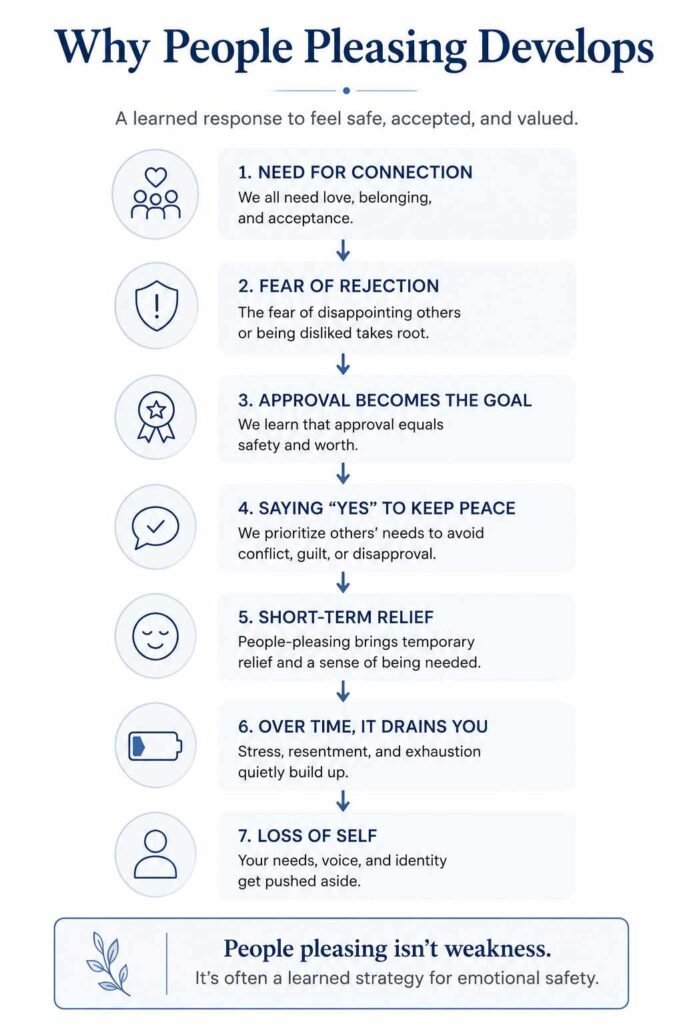
If you’ve ever asked yourself, “Why am I such a people pleaser?”, the answer is rarely as simple as being “too nice.” Most people pleasing behaviors develop gradually over many years as the brain learns ways to feel accepted, protected, and emotionally secure.
At its core, people pleasing is often an attempt to reduce emotional discomfort. For some people, saying “yes” feels safer than risking conflict. For others, avoiding disagreement becomes a way to protect important relationships. Instead of expressing their true thoughts or needs, they learn to prioritise harmony—even when it comes at a personal cost.
Psychologists describe this as an adaptive coping strategy. In other words, the behavior originally develops because it serves a purpose. If pleasing others once helped someone avoid criticism, rejection, punishment, or emotional distance, the brain may continue using the same strategy long after the original situation has changed.
The Brain Learns What Feels Safe
Our brains are constantly looking for patterns that increase safety and reduce perceived threats. Emotional experiences during childhood, adolescence, and adulthood teach us which behaviors lead to acceptance and which lead to discomfort.
For example, imagine a child who receives warmth and praise only when they behave perfectly or meet everyone’s expectations. Over time, that child may unconsciously conclude:
- “People will love me only if I make them happy.”
- “If I disappoint others, they’ll reject me.”
- “My needs are less important than everyone else’s.”
These beliefs often continue into adulthood without conscious awareness. As a result, saying “no” can feel emotionally risky, even when there is no real danger.
This is why many people pleasers describe feeling guilty after setting even reasonable boundaries. Their logical mind knows they have done nothing wrong, but their emotional brain interprets the situation as a threat to belonging and connection.
The Hidden Need Behind People Pleasing
Most people pleasers are not seeking praise for its own sake. Instead, they are trying to satisfy deeper emotional needs, such as:
- Feeling accepted
- Feeling valued
- Feeling needed
- Avoiding rejection
- Preventing conflict
- Maintaining emotional closeness
- Protecting relationships
These needs are completely human. Every person wants to feel connected and appreciated. The challenge arises when self-worth becomes dependent on constantly meeting other people’s expectations.
Instead of asking, “What do I need?”, people pleasers often find themselves asking:
“What will keep everyone else happy?”
Over time, this habit can weaken self-awareness. Many people eventually struggle to identify their own preferences because they have spent years focusing almost entirely on the emotions and expectations of others.
Why Saying “No” Feels So Difficult
One of the most common characteristics of people pleasing is the inability to say “no” without experiencing guilt or anxiety.
This isn’t because people pleasers lack confidence or intelligence. More often, their nervous system has learned to associate boundary-setting with emotional discomfort.
A simple refusal may trigger thoughts such as:
- “They’ll think I’m selfish.”
- “What if they get upset?”
- “What if they stop liking me?”
- “I don’t want to disappoint anyone.”
Even when these fears are unrealistic, they can feel very real. The brain responds to anticipated social rejection in ways that can resemble responses to physical danger. As a result, agreeing to something unwanted may temporarily relieve anxiety, reinforcing the habit of people pleasing.
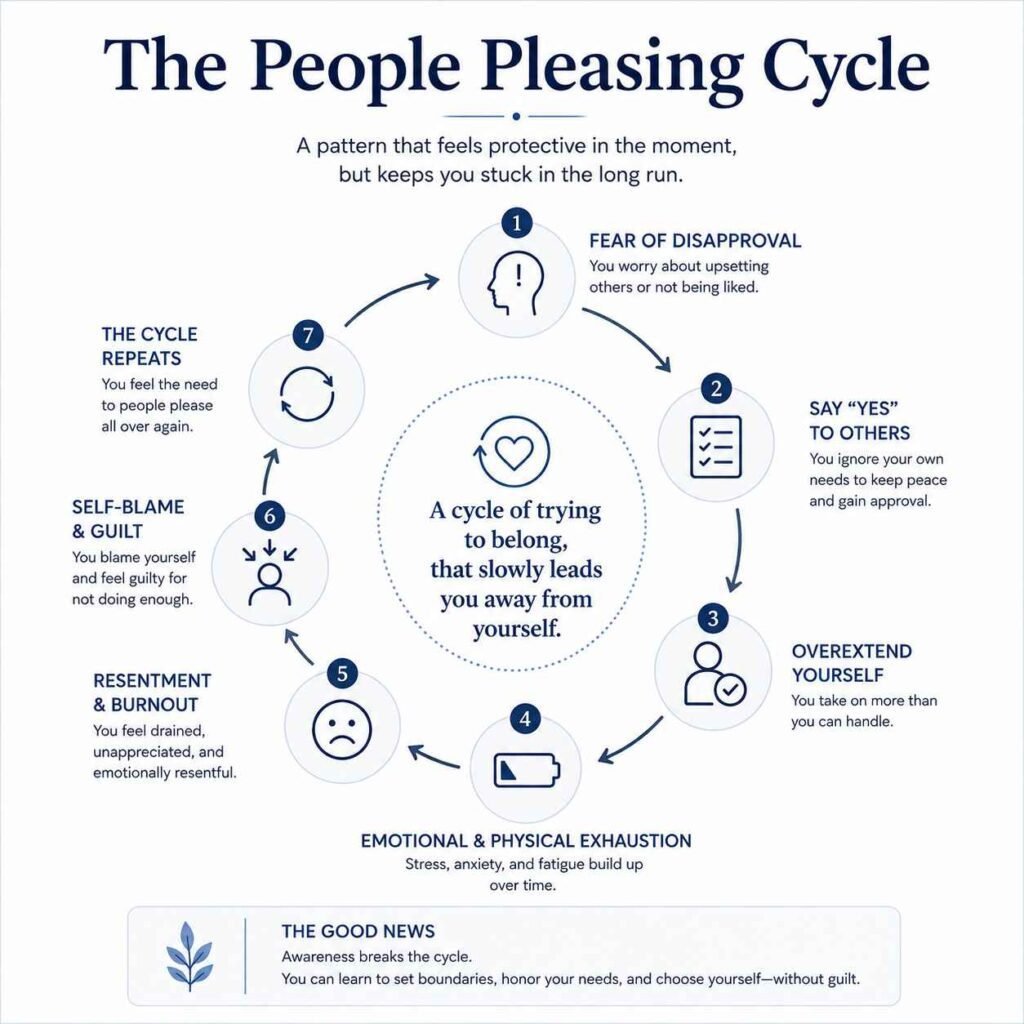
Unfortunately, this relief is usually short-lived. While saying “yes” may reduce immediate discomfort, it often leads to stress, resentment, burnout, and emotional exhaustion later.
When Kindness Turns Into Self-Sacrifice
Helping others is one of the strengths of healthy relationships. Compassion, generosity, and empathy enrich our lives and strengthen social bonds. However, these qualities become unhealthy when they consistently require abandoning your own needs.
A healthy person may choose to help because they genuinely want to.
A people pleaser often feels they must help—even when they are overwhelmed, exhausted, or emotionally drained.
The difference lies not in the behavior itself but in the motivation behind it.
Healthy kindness is guided by choice.
People pleasing is often guided by fear.
Recognising this distinction is one of the most important steps towards building healthier relationships with both yourself and others.
As you’ll see in the next section, these patterns don’t appear overnight. They are often shaped by childhood experiences, attachment relationships, family dynamics, and the emotional lessons we learn long before we fully understand them.
How Childhood Shapes People Pleasing
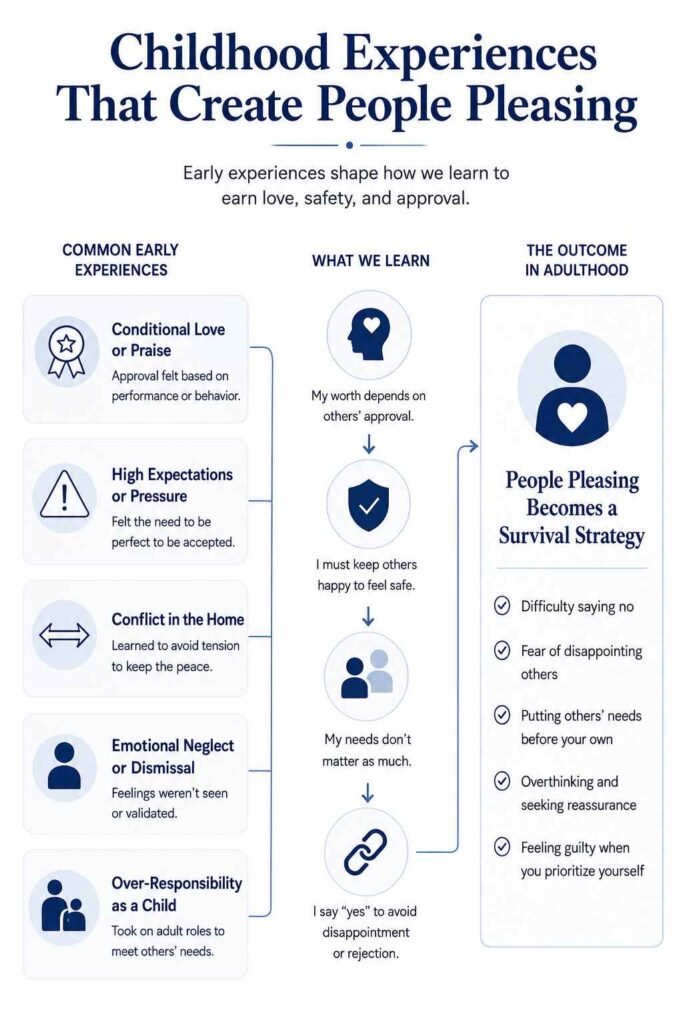
People pleasing rarely begins in adulthood. For many people, its roots can be traced back to childhood, when the brain is learning what it takes to feel safe, accepted, and loved. During these early years, children naturally depend on caregivers not only for physical care but also for emotional security. The messages they receive—through words, actions, and everyday interactions—can quietly shape how they relate to others for years to come.
It’s important to remember that this doesn’t mean parents or caregivers intentionally create people-pleasing behaviors. Most do the best they can with the knowledge and circumstances they have. Rather, children are highly sensitive learners. They often develop beliefs based on how they interpret their experiences, even when no one intended those lessons.
When Love Feels Conditional
One common pathway to people pleasing is growing up with the belief that love or approval must be earned.
For example, a child may receive praise only when they achieve high grades, behave perfectly, avoid causing trouble, or constantly help others. Although encouragement is healthy, problems arise when affection seems to depend on performance or compliance rather than being consistently available.
Over time, the child may unconsciously develop beliefs such as:
- “I’m valuable only when I make others happy.”
- “If I disappoint people, they’ll stop loving me.”
- “My needs should come after everyone else’s.”
These beliefs rarely remain limited to childhood. They often become automatic assumptions that influence friendships, romantic relationships, and workplace interactions later in life.
Growing Up Around Conflict
Children who frequently witness intense arguments, unpredictable anger, or emotional tension may become highly alert to other people’s moods.
In these environments, avoiding conflict can feel like a way to stay emotionally safe. The child learns to monitor facial expressions, tone of voice, and emotional reactions, trying to prevent situations from becoming worse.
As adults, this heightened awareness can become people pleasing.
Instead of expressing disagreement, they may stay silent.
Instead of asking for what they need, they may prioritise keeping the peace.
Instead of setting healthy boundaries, they may believe that everyone else’s comfort is their responsibility.
Although these behaviors once helped them cope, they may no longer be necessary in healthier relationships.
Emotional Neglect Can Teach Silence
People pleasing is not always linked to criticism or conflict. Sometimes it develops because emotional needs were rarely acknowledged.
A child whose feelings are repeatedly ignored, dismissed, or minimised may gradually stop expressing them altogether.
They may hear messages like:
- “You’re overreacting.”
- “Don’t be so sensitive.”
- “Stop crying.”
- “It’s not a big deal.”
Even when these comments are well-intentioned, repeated experiences can teach children that their emotions are inconvenient or unimportant.
As adults, they may become skilled at recognising everyone else’s needs while struggling to identify their own.
This is one reason many people pleasers find it difficult to answer simple questions like:
“What do you want?”
After years of focusing outward, looking inward can feel unfamiliar.
Attachment Patterns and People Pleasing
Psychologists have long recognised that early relationships with caregivers influence how we approach relationships throughout life. This idea is known as attachment theory.
When children experience consistent emotional support, they are more likely to develop confidence that relationships can remain secure even when disagreements occur.
However, when emotional connection feels inconsistent or unpredictable, some children become especially sensitive to signs of rejection or disapproval.
As adults, they may work extra hard to maintain closeness by:
- Avoiding conflict
- Seeking reassurance
- Constantly helping others
- Ignoring their own needs
- Becoming overly responsible for other people’s emotions
These behaviors often reflect a desire to preserve connection rather than a genuine preference for self-sacrifice.
The Brain Remembers Emotional Lessons
One of the remarkable features of the human brain is its ability to learn from repeated experiences.
When certain behaviors consistently reduce emotional discomfort, the brain begins to automate them.
If saying “yes” repeatedly helped avoid criticism…
If staying quiet prevented arguments…
If taking care of others earned affection…the brain may continue repeating those behaviors years later, even when the environment has changed.
This explains why many adults recognise that they don’t need to please everyone, yet still feel anxious whenever they try to set a boundary.
Their conscious mind understands the situation.
Their emotional brain is still following an older survival pattern.
Childhood Influences Are Not Life Sentences
Understanding childhood influences is not about blaming parents or dwelling on the past. Instead, it helps explain why certain patterns feel so automatic.
The encouraging news is that the brain remains capable of learning throughout life. As we develop healthier relationships, practice emotional awareness, and build stronger boundaries, we can gradually teach ourselves that acceptance doesn’t have to depend on constant self-sacrifice.
Healing begins when we realise that our worth has never been determined by how well we meet everyone else’s expectations.
It comes from recognising that our own needs, feelings, and boundaries deserve the same care and respect that we so readily offer to others.
The Hidden Psychology That Keeps People Pleasing Alive
If childhood experiences help explain how people pleasing begins, psychology helps us understand why it continues long after those experiences have passed.
Many adults recognise that they don’t have to keep everyone happy. They understand that saying “no” is healthy and that setting boundaries is important. Yet, when the moment arrives, they still agree to things they don’t want to do, apologise unnecessarily, or worry for hours about disappointing someone.
Why?
Because people pleasing is rarely driven by logic alone. It is sustained by a network of emotional beliefs, automatic thought patterns, and nervous system responses that operate beneath conscious awareness.
The Need for Approval Is a Need for Belonging
Every human being has a deep psychological need to belong. Throughout human history, staying connected to a group increased the chances of survival. Although modern life is very different, our brains still treat social acceptance as something deeply important.
For someone who struggles with people pleasing, approval often becomes more than appreciation—it becomes a measure of safety.
A compliment may bring temporary relief.
A disagreement may feel like rejection.
A disappointed expression may trigger anxiety.
An unanswered message may lead to hours of self-doubt.
These reactions don’t necessarily reflect reality. Instead, they reflect how the brain has learned to interpret social situations.
Over time, the mind begins to equate being liked with being safe.
The Fear of Rejection Is Often Stronger Than the Desire for Authenticity
One of the strongest forces behind people pleasing is the fear of rejection.
This fear doesn’t always appear dramatically. It often hides behind everyday thoughts like:
- “I don’t want them to think I’m rude.”
- “It’s easier if I just agree.”
- “Maybe my opinion doesn’t matter.”
- “I’ll deal with it later.”
Although these thoughts seem harmless, they slowly teach us to prioritise acceptance over authenticity.
Eventually, avoiding rejection becomes more important than expressing our genuine thoughts, feelings, or needs.
Ironically, this can create relationships where people know the helpful version of us—but never truly know us.
The Inner Critic Never Stops Evaluating
Many people pleasers carry a powerful inner critic that constantly evaluates their behavior.
After a simple conversation, they may replay events in their mind and wonder:
“Did I sound rude?”
“Should I have said something different?”
“Are they upset with me?”
“What if they misunderstood me?”
This internal dialogue can be exhausting.
Instead of accepting that disagreements and misunderstandings are normal parts of relationships, the inner critic searches for evidence that something has gone wrong—and assumes personal responsibility for fixing it.
Over time, this creates a cycle of overthinking, self-blame, and emotional fatigue.
When Self-Worth Depends on Being Needed
Healthy self-worth comes from recognising your inherent value as a person.
People pleasing, however, can quietly shift that foundation.
Instead of believing:
“I have value because I exist.”
The mind begins believing:
“I have value because I’m useful.”
This subtle difference changes everything.
If your worth depends on helping others, resting feels selfish.
If your worth depends on being needed, setting boundaries feels uncomfortable.
If your worth depends on making everyone happy, even small conflicts can feel like personal failures.
The result is a constant pressure to earn acceptance rather than simply receive it.
The Brain Prefers Familiar Patterns
One reason people pleasing is difficult to change is that the brain naturally prefers familiar behaviors, even when they are unhealthy.
Every time saying “yes” prevents an uncomfortable conversation, the brain receives immediate relief.
That relief becomes a reward.
The next time a similar situation arises, the brain remembers:
“Last time, agreeing reduced my anxiety.”
Without realising it, we repeat the same behavior.
Psychologists sometimes refer to this as negative reinforcement. The behavior continues because it helps remove an unpleasant feeling in the short term.
The problem is that short-term relief often creates long-term emotional costs.
The more we avoid discomfort today, the harder it becomes to face tomorrow.
The Emotional Safety Trap
Perhaps the most overlooked aspect of people pleasing is that it often feels emotionally safer than honesty.
Imagine someone asking for a favour when you’re already overwhelmed.
You know saying “yes” will leave you exhausted.
You also know saying “no” may disappoint them.
At that moment, your brain weighs two emotional risks:
- Temporary guilt from setting a boundary.
- Temporary relief from avoiding conflict.
For many people pleasers, avoiding conflict feels like the safer choice.
But over weeks, months, or years, this pattern slowly drains emotional energy.
Instead of protecting well-being, people pleasing begins to erode it.
This is what we call the Emotional Safety Trap.
The very behavior that once protected you gradually becomes the source of stress, resentment, burnout, and emotional exhaustion.
Awareness Is the Beginning of Change
The encouraging news is that people pleasing isn’t a fixed personality trait.
It is a learned pattern.
And what is learned can be unlearned.
The first step isn’t forcing yourself to become confrontational or stop caring about others.
Instead, it begins with recognising the hidden beliefs that drive your behavior.
When you notice yourself automatically saying “yes,” apologising unnecessarily, or worrying excessively about disappointing someone, pause for a moment and ask:
“Am I acting from genuine kindness… or from fear?”
That single question can begin shifting your behavior from automatic reaction to intentional choice.
Real change starts not with judging yourself, but with understanding yourself.
Signs You May Be a People Pleaser (That Often Go Unnoticed)
People pleasing isn’t always obvious. Many people imagine a people pleaser as someone who simply can’t say “no.” In reality, the pattern is often much more subtle. It can influence how you think, communicate, make decisions, and even judge your own worth.
Because these behaviors develop gradually, they often feel normal. You may describe yourself as “easy-going,” “helpful,” or “someone who avoids drama,” without realising that you’re consistently putting your own emotional needs last.
The following signs don’t necessarily mean you’re a people pleaser. However, if several of them feel familiar and occur repeatedly across different areas of your life, they may point to a deeper pattern worth exploring.
1. You Feel Guilty Whenever You Say “No”
One of the strongest signs of people pleasing is experiencing guilt after setting even reasonable boundaries.
You might decline an invitation because you’re exhausted, refuse extra work because your schedule is already full, or ask for personal time to recharge. Even though your decision is completely reasonable, your mind quickly begins questioning it.
“Was I too selfish?”
“Should I have helped anyway?”
“What if they’re disappointed?”
The guilt often has little to do with the situation itself. Instead, it reflects an old belief that protecting your own needs may damage relationships.
Healthy boundaries create respect.
People pleasing often makes boundaries feel like betrayal.
2. You Constantly Worry About Disappointing Others
Everyone wants to maintain good relationships, but people pleasers often carry an unusually strong fear of letting others down.
Before making decisions, they may automatically think:
- “Will this upset someone?”
- “What will they think of me?”
- “I don’t want anyone to be angry.”
As a result, other people’s expectations gradually become more influential than their own preferences.
Over time, this habit can make decision-making emotionally exhausting because every choice feels like it carries the responsibility of protecting someone else’s feelings.
3. You Apologise More Than Necessary
Have you ever apologised for asking a simple question?
Or for expressing your opinion?
Or even when something wasn’t your fault?
Excessive apologising is often a subtle form of people pleasing.
Instead of simply communicating, the apology becomes a way of reducing the possibility of conflict or negative judgement.
While genuine apologies strengthen relationships, unnecessary apologies can slowly undermine confidence by sending you the message that your presence is somehow inconvenient.
4. You Avoid Conflict at Almost Any Cost
Disagreements are a normal part of healthy relationships.
People pleasers, however, often experience conflict as emotionally threatening.
Rather than discussing concerns openly, they may:
- Stay silent.
- Agree outwardly while feeling differently inside.
- Change their opinion to avoid disagreement.
- Suppress frustration until it eventually becomes resentment.
Ironically, avoiding every conflict doesn’t create healthier relationships.
It often prevents honest communication and leaves important issues unresolved.
5. You Find It Difficult to Ask for Help
Many people pleasers are incredibly generous when others need support.
Yet when they themselves are struggling, asking for help feels uncomfortable.
Some worry about becoming a burden.
Others fear appearing weak.
Some simply believe everyone else’s needs are more important.
As a result, they often carry emotional stress alone while continuing to support everyone around them.
6. You Measure Your Worth by How Useful You Are
One of the less obvious signs of people pleasing is feeling valuable only when you’re helping someone.
If you’re productive, available, solving problems, or making life easier for others, you feel appreciated.
But when you rest, decline requests, or focus on your own needs, guilt begins to appear.
This can create a cycle where busyness becomes confused with worthiness.
Your value, however, is not something you have to earn through constant sacrifice.
7. You Overthink Everyday Interactions
After conversations, messages, or meetings, do you replay everything in your mind?
You may wonder:
“Did I sound rude?”
“Should I have explained myself better?”
“What if they misunderstood me?”
“Do they think I’m selfish now?”
This tendency often reflects a heightened sensitivity to social evaluation rather than a realistic assessment of what actually happened.
The mind searches for reassurance, even when there is little evidence that anything is wrong.
8. You Feel Emotionally Drained but Keep Saying “Yes”
Perhaps the clearest sign of people pleasing is emotional exhaustion.
You genuinely want to help.
You care deeply about others.
Yet despite your good intentions, you begin noticing that you’re constantly tired, overwhelmed, or emotionally depleted.
You may feel trapped between two uncomfortable choices:
- Saying “yes” and feeling exhausted.
- Saying “no” and feeling guilty.
Neither option feels peaceful.
This emotional tug-of-war often continues until healthier boundaries are developed.
A Simple Reflection
Rather than asking yourself whether you’re “too nice,” consider asking these questions:
- Do I often ignore my own needs to avoid disappointing others?
- Do I feel responsible for other people’s emotions?
- Do I apologise even when I’ve done nothing wrong?
- Do I fear that setting boundaries will make people stop liking me?
- Do I struggle to separate kindness from self-sacrifice?
If your answer is “yes” to several of these questions, it doesn’t mean something is wrong with you.
It simply suggests that your brain may have learned to prioritise acceptance over authenticity.
The encouraging news is that awareness is the first and most important step toward lasting change.
Quick Self-Check: Could You Be Stuck in People Pleasing?

Take a moment to reflect on the statements below. The more often you answer "Yes," the more likely people-pleasing patterns may be influencing your daily life.

✓ I feel uncomfortable saying "no," even when I'm overwhelmed.

✓ I worry too much about disappointing others.

✓ I apologise for things that aren't my fault.

✓ I often put other people's needs before my own.

✓ I avoid difficult conversations to keep the peace.

✓ I feel guilty when I choose myself.

✓ My mood depends heavily on other people's approval.

✓ I often feel emotionally exhausted after helping everyone else.

This isn't a diagnosis. It's simply a starting point for self-awareness and reflection.
The B.O.U.N.D.A.R.Y. Framework™: A Practical Way to Break Free from People Pleasing
Understanding why you became a people pleaser is an important first step. But awareness alone doesn’t automatically change long-standing habits.
The real challenge begins in everyday moments—when a colleague asks for another favour, a friend expects more of your time, or a family member makes a request you don’t have the energy to fulfill.
In those moments, people pleasing often feels automatic.
That’s because your brain is relying on familiar emotional patterns rather than conscious decisions.
The good news is that these patterns can change. By practicing new responses consistently, you can teach your brain that protecting your own well-being does not mean rejecting other people.
The B.O.U.N.D.A.R.Y. Framework™ is designed to help you pause, reflect, and respond with confidence instead of acting from guilt or fear.
B – Become Aware of Approval Seeking
The first step is noticing when your decisions are being driven by the need for approval rather than genuine willingness.
Before agreeing to something, pause and ask yourself:
- Am I saying “yes” because I truly want to?
- Or am I afraid of disappointing someone?
This simple moment of awareness interrupts automatic behavior and gives you the opportunity to make a conscious choice.
Remember, awareness is not about judging yourself. It’s about recognising patterns that have been operating quietly in the background.
O – Observe Your Emotional Triggers
Not every request affects you in the same way.
Certain situations may immediately trigger guilt, anxiety, or fear of rejection.
For example:
- Being asked for a last-minute favour.
- Receiving criticism from someone you respect.
- Feeling responsible for keeping everyone happy.
- Seeing someone disappointed.
Instead of reacting immediately, become curious.
Ask yourself:
“Why does this situation feel so emotionally intense?”
Often, the trigger is less about the present moment and more about an older emotional pattern being activated.
U – Understand Where the Pattern Comes From
People pleasing doesn’t appear overnight.
Take time to reflect on questions such as:
- When did I first learn that saying “yes” kept me safe?
- Did I grow up believing love had to be earned?
- Was I praised mainly for being helpful or obedient?
- Did avoiding conflict become my way of maintaining peace?
Understanding your history isn’t about assigning blame.
It’s about recognising that your behavior once served a purpose.
What helped you survive emotionally in the past may no longer be necessary today.
N – Notice Your Own Needs
People pleasers often become experts at recognising everyone else’s emotions while overlooking their own.
That’s why this step is so important.
Before responding to someone else’s request, ask yourself:
- How am I feeling right now?
- Do I have the emotional energy for this?
- What do I genuinely need today?
Your needs deserve attention too.
Choosing yourself occasionally doesn’t make you selfish—it makes your kindness sustainable.
D – Decide Before Saying Yes
Many people pleasers answer immediately because silence feels uncomfortable.
Instead, give yourself permission to pause.
You don’t have to respond instantly.
Simple phrases such as:
- “Let me think about it.”
- “I’ll check my schedule.”
- “Can I get back to you later?”
Create valuable space between the request and your response.
That pause allows your rational mind to participate instead of letting guilt make the decision.
Remember:
A delayed “yes” is healthier than an immediate “yes” followed by resentment.
A – Accept Temporary Discomfort
This may be the hardest step.
The first few times you set healthy boundaries, you may feel guilty.
You may worry that people are disappointed.
You may even question whether you’ve done the right thing.
These feelings are normal.
Your brain is adjusting to a new way of responding.
Temporary discomfort doesn’t mean you’ve made a bad decision.
Often, it simply means you’re breaking an old habit. With practice, the guilt usually becomes weaker while confidence grows stronger.
R – Respond With Healthy Boundaries
Healthy boundaries are not walls that push people away.
They are guidelines that protect your emotional well-being while allowing relationships to remain respectful.
A boundary might sound like:
- “I’d love to help, but I can’t this week.”
- “I’m not available today.”
- “I need some time to think before I commit.”
- “I understand your situation, but I won’t be able to do that.”
Notice that none of these responses are rude.
They’re honest, respectful, and clear.
Healthy relationships can usually adapt to honest communication.
Y – Your Worth Isn’t Based on Pleasing Others
This final step is the foundation of lasting change.
People pleasing often teaches us:
“I matter because I make other people happy.”
Healing involves replacing that belief with something healthier:
“I matter because I am a human being with needs, feelings, and inherent worth.”
Your kindness has value.
Your empathy has value.
Your generosity has value.
But those qualities become even healthier when they are offered freely—not from fear, guilt, or the constant need for approval.
Real confidence grows when you understand that love, respect, and belonging don’t have to be earned through endless self-sacrifice.
They begin with believing that you are already enough.
Putting the Framework into Practice
Imagine your manager asks you to take on another project when your workload is already overwhelming.
Your old pattern might be:
Request → Fear of disappointing → Immediate “Yes” → Stress → Resentment
Using the B.O.U.N.D.A.R.Y. Framework™, the situation changes:
- Become aware that you’re seeking approval.
- Observe the anxiety you’re feeling.
- Understand that this pattern has shown up before.
- Notice your current workload and energy levels.
- Decide after giving yourself time to think.
- Accept that saying “no” may feel uncomfortable.
- Respond with a respectful boundary.
- Remember that your worth isn’t defined by constant availability.
The outcome isn’t just a healthier decision—it’s a healthier relationship with yourself.
Key Takeaway

Breaking free from people pleasing doesn't mean becoming cold, selfish, or uncaring.

It means learning that kindness and boundaries can exist together.

In fact, the healthiest relationships are built not on constant self-sacrifice but on honesty, mutual respect, and emotional balance.

The more you practice the B.O.U.N.D.A.R.Y. Framework, the more your decisions will come from intention rather than fear—and that's where lasting emotional freedom begins.
Small Daily Habits That Help You Stop People Pleasing
Breaking free from people pleasing doesn’t happen overnight. If you’ve spent years putting everyone else’s needs first, it’s unrealistic to expect those habits to disappear after reading one article.
The encouraging news is that meaningful change doesn’t require dramatic action. It usually begins with small, consistent choices that gradually teach your brain a new way of responding.
Each time you choose honesty over automatic approval or a healthy boundary over unnecessary guilt, you’re strengthening a healthier emotional pattern.
The following habits may seem simple, but practiced consistently, they can make a significant difference.
Pause Before You Answer
People pleasers often respond immediately because silence feels uncomfortable.
Instead of giving an instant answer, try pausing for a few seconds.
If you need more time, say:
- “Let me think about it.”
- “I’ll get back to you this evening.”
- “I need to check my schedule first.”
A brief pause creates space for thoughtful decisions rather than automatic reactions.
Check In With Yourself Every Day
Many people pleasers are highly aware of everyone else’s emotions but rarely stop to notice their own.
Spend a few minutes each day asking yourself:
- What am I feeling right now?
- What do I need today?
- Am I emotionally exhausted?
- Have I ignored my own needs this week?
This simple habit strengthens self-awareness, which is the foundation of healthy boundaries.
Practise One Honest “No” Each Week
If saying “no” feels overwhelming, don’t try to change everything at once.
Start small.
Decline one request each week that doesn’t align with your time, energy, or priorities.
You may feel uncomfortable at first, but remember that discomfort is often part of growth—not a sign that you’ve done something wrong.
Over time, saying “no” becomes less frightening and more natural.
Replace Guilt With Curiosity
When guilt appears after setting a boundary, resist the urge to judge yourself.
Instead, become curious.
Ask:
- Why does this boundary feel uncomfortable?
- What am I afraid might happen?
- Is this fear based on the present—or on an older emotional pattern?
Curiosity creates understanding.
Self-criticism often keeps old patterns alive.
Stop Measuring Your Worth by Your Usefulness
One of the most powerful shifts you can make is separating your identity from your ability to help others.
You deserve rest even when you haven’t “earned” it.
You deserve kindness even when you’re not solving someone else’s problems.
You deserve respect even when you choose yourself.
Your value isn’t something you achieve through endless giving.
It’s something you already possess.
Celebrate Progress, Not Perfection
There will be days when you fall back into old habits.
You may agree to something you didn’t want to do.
You may apologise unnecessarily.
You may avoid a difficult conversation.
That doesn’t mean you’ve failed.
Changing long-standing behavioral patterns takes time.
Instead of asking,
“Why am I still doing this?”
Try asking,
“What did I learn from this situation?”
Progress grows through repeated practice, not perfect performance.
Common Myths About People Pleasing
Many misconceptions make it harder for people to recognise and change these patterns. Let’s clear up a few of the most common myths.
Myth 1: People Pleasers Are Just Nice People
Kindness and people pleasing are not the same.
Kindness comes from genuine choice.
People pleasing is often driven by fear of rejection, conflict, or disappointing others.
Healthy kindness includes caring for yourself as well as others.
Myth 2: Setting Boundaries Is Selfish
Healthy boundaries don’t push people away.
They protect your emotional well-being while creating more honest and respectful relationships.
In fact, boundaries often improve relationships because they reduce resentment and encourage clearer communication.
Myth 3: You Have to Keep Everyone Happy
No matter how thoughtful, caring, or generous you are, you cannot control how everyone feels.
Every person is responsible for managing their own emotions.
Supporting others is healthy.
Taking responsibility for everyone’s happiness is not.
Myth 4: If Someone Is Upset With Me, I’ve Done Something Wrong
Disappointment is a normal part of life.
Someone can be disappointed by your boundary without you having made a bad decision.
Learning to tolerate temporary discomfort is an important part of emotional growth.
Frequently Asked Questions
1. Is people pleasing a mental illness?
No. People pleasing is not a mental illness or a clinical diagnosis. It is a behavioral pattern that may develop through life experiences, relationship dynamics, emotional learning, or coping strategies. However, it can sometimes occur alongside conditions such as anxiety or low self-esteem, which may benefit from professional support.
2. Can people pleasing damage relationships?
Yes. Although people pleasing often begins with good intentions, it can lead to resentment, emotional exhaustion, poor communication, and relationships that lack honesty. Healthy relationships benefit from mutual respect, not constant self-sacrifice.
3. Why do I feel guilty when I say no?
Many people feel guilty because their brain has learned to associate setting boundaries with rejection or conflict. With practice, this emotional response usually becomes less intense as healthier patterns develop.
4. Can people stop being people pleasers?
Yes. Because people pleasing is a learned behavior, it can also be unlearned. Building self-awareness, practicing healthy boundaries, strengthening self-worth, and developing emotional regulation skills can gradually replace old habits with healthier ones.
Final Thoughts
If you’ve recognised yourself throughout this article, remember one important truth:
People pleasing doesn’t mean you’re weak.
More often, it means you’ve spent years trying to protect your relationships in the best way you knew how.
Perhaps you learned that keeping everyone happy reduced conflict.
Perhaps you believed your worth depended on being helpful.
Perhaps you simply wanted to feel accepted.
Those patterns may once have helped you navigate difficult situations.
But you don’t have to carry them forever.
Healing doesn’t mean becoming less compassionate.
It means allowing your compassion to include yourself.
When you learn to express your needs honestly, set respectful boundaries, and recognise your own worth, something remarkable happens.
You stop living for constant approval.
You begin living with greater authenticity.
And that’s where emotional freedom truly begins—not in pleasing everyone around you, but in building a life where kindness and self-respect grow side by side.
Call to Reflection

Before you leave, take a moment to ask yourself:

What's one small boundary I can set this week that honors both my kindness and my well-being?

Real change doesn't begin with a perfect life.

It begins with one honest decision.