

A close friend does not reply to your message for several hours. At first, you wonder whether they are busy. Soon, another thought appears: “Perhaps I am not important to them anymore.”
Your partner seems unusually quiet one evening. Instead of asking what happened, your mind starts preparing for the worst: “Something has changed between us. Maybe they are losing interest.”
Or perhaps you miss a few days of exercise after following your routine regularly. Rather than seeing it as a temporary break, you tell yourself, “I have lost my discipline again. I can never remain consistent.”
The situation may be small. But the conclusion feels final.
Sometimes the mind does not move slowly from one possibility to another. It jumps. A mistake becomes failure. A disagreement becomes rejection. One difficult day begins to describe your whole life.
This pattern is commonly called black and white thinking or all-or-nothing thinking. You may know logically that life is rarely so simple. Yet when you are hurt, anxious or disappointed, the extreme conclusion can feel completely true.
The aim of this article is not to tell you that your feelings are wrong. It is to help you notice when one part of an experience has started telling the whole story. We will look at how that happens, what it can do to your self-worth and relationships, and how you can gradually develop a more balanced response.
Table of Contents
What Does Black and White Thinking Really Mean?
Black and white thinking is the habit of seeing a situation through two opposite possibilities, with little room for anything between them. Something is right or wrong. A person is caring or selfish. A relationship is secure or failing. You are successful or you are a failure.
Psychologists also call it all-or-nothing, polarised or dichotomous thinking. It is described as a cognitive distortion because it reduces a complicated reality to a simple but incomplete conclusion. It is a thinking pattern, not a diagnosis.
The thought usually begins with something real. You may have made a mistake. Someone may have disappointed you. A plan may not have worked. Your partner may have responded in a way that felt cold.
Then the mind goes further. “This did not go well” becomes “Nothing ever goes well for me.” “They were not there when I needed them” becomes “They have never cared about me.”
The original experience may be valid. The final conclusion may still be much larger than the available evidence.
When behaviour becomes identity
Imagine that you lose patience with your child after a tiring day. Later, you regret the way you spoke.
A responsible response would be: “I should not have spoken that way. I need to apologise and handle it differently next time.”
An extreme response would be, “I am a terrible parent.”
The first identifies a behaviour and leaves room for repair. The second turns one behaviour into your whole identity. The same shift happens when we judge someone else. A friend forgets to call, and “That hurt me” becomes “They are completely selfish.”
Sometimes one event does reveal something serious. More often, we need to look at context, the wider pattern and the person’s willingness to repair before reaching a larger conclusion.
A feeling can be real even when the conclusion is extreme
You may genuinely feel rejected when someone does not reply. You may feel ashamed after a mistake or angry when your needs are ignored. Your feelings are not false because your interpretation might be incomplete.
The feeling tells you that something matters. It does not always tell you the complete meaning of what happened.
“I feel rejected” describes your emotional experience. “They rejected me because I am not important to anyone” adds conclusions about the other person, your worth and perhaps all your relationships.
Balanced thinking respects the feeling while remaining curious about the meaning: “Their silence has made me feel unimportant. Before I decide what it means, I need more information.”
Balanced thinking is not forced positivity
Moving away from extremes does not mean replacing every painful thought with a pleasant one. It does not mean excusing repeated disrespect, abandoning your values or staying in an unsafe relationship.
If someone repeatedly lies, a balanced conclusion may be: “This person may have good qualities, but repeated dishonesty makes the relationship unsafe for me.”
Balanced thinking considers the complete pattern. It can lead to understanding and repair. It can also lead to a firm boundary or a decision to leave. The aim is not to find a comfortable answer. It is to find an answer that fits the evidence.
7 Signs You May Be Thinking in Extremes
Black and white thinking does not always sound dramatic. It may hide behind high standards, strong opinions or the wish to protect yourself. These signs can help you recognise it without turning recognition into another reason to criticise yourself.
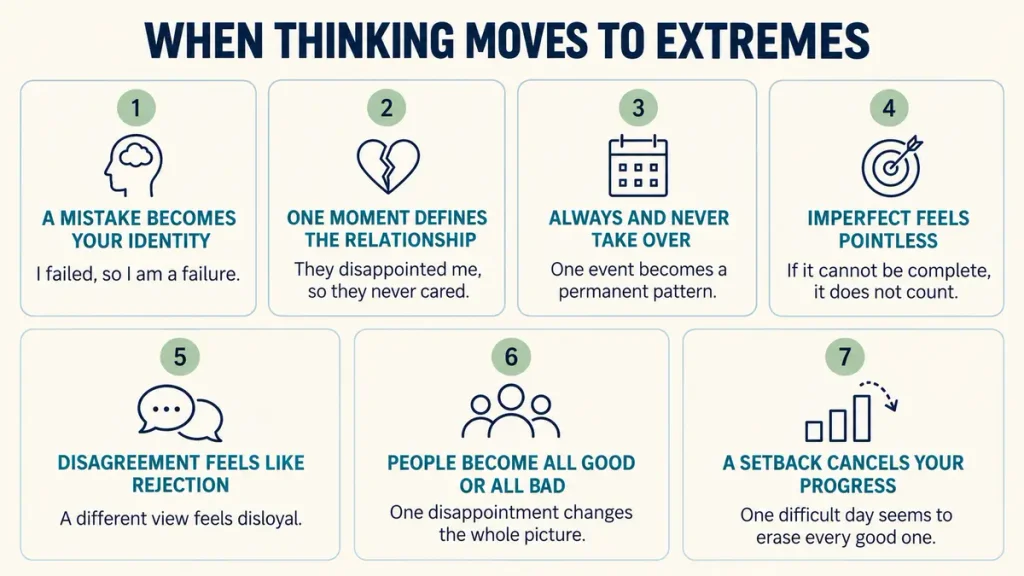
1. One mistake begins to define who you are
You make an error at work, forget something important or lose patience during a conversation. “I made a mistake” becomes “I am incompetent.” “I spoke harshly” becomes “I am a terrible partner.”
Riya gives a presentation at work. She explains most points clearly but loses track of one section and checks her notes. Her manager appreciates her preparation and suggests one improvement. On the way home, Riya remembers only the pause: “I am terrible at speaking. I should never volunteer again.”
Her mind is no longer evaluating one presentation. It is using one uncomfortable moment to define her ability.
Responsibility says, “I need to improve this.” Self-condemnation says, “This proves what is wrong with me.” The first can guide change. The second often creates shame and avoidance.
2. One difficult moment changes how you see the whole relationship
A partner forgets an important date. A friend cancels a plan. A family member responds impatiently when you need support. The disappointment may be understandable, but the mind starts reviewing the entire relationship through that moment.
Aman’s partner forgets to call before an important medical appointment. He feels hurt and alone. When she asks what happened, he says, “There is no point discussing it. You only think about yourself.”
His pain deserves to be heard. But the conclusion has moved beyond the missed call. His partner’s complete character is now being judged through one disappointing experience. When the whole relationship has already been declared uncaring, explanation and repair become harder to receive.
3. “Always” and “never” appear often in conflict
Absolute words can reveal absolute conclusions: “Nobody understands me.” “You never listen.” “I always spoil good things.” “Nothing I do is enough.”
These words are not automatically inaccurate. The question is whether they describe the evidence or the intensity of the current emotion.
If your partner interrupts you during an argument, you may say, “You never let me speak.” Perhaps what you need to express is, “I do not feel heard in this conversation.”
The second statement is more specific. It gives the other person something clear to respond to. When every disagreement contains “always” and “never”, the original hurt often gets lost inside an argument about the past.
4. Anything less than perfect feels pointless
You plan to walk for forty-five minutes every morning. One day, you have only fifteen minutes. A flexible response is to take a shorter walk. An extreme response says, “Fifteen minutes will not make any difference. I will start properly tomorrow.”
The same pattern can affect studying, saving, eating habits and personal projects. If you cannot complete the whole plan, you do nothing. If the result cannot be excellent, beginning feels risky.
Research across clinical, student and athlete groups has found an association between dichotomous thinking and maladaptive or negative perfectionism (Egan et al., 2007). The person may look unmotivated from the outside while feeling enormous pressure inside. They may not be avoiding effort so much as the painful possibility of trying and still being imperfect.
5. Disagreement feels like rejection or disloyalty
When agreement becomes proof of love, a different opinion can feel like abandonment. “If you cared about me, you would agree.” “If you were loyal, you would defend me.”
Kavita tells a close friend about an argument at home. Her friend listens but gently suggests that both people may have misunderstood each other. Kavita feels hurt: “I thought you would support me.”
Her friend’s attempt to offer another view is experienced as taking the other person’s side. This can make honest relationships difficult. People may feel they must agree with every interpretation to prove that they care.
Support, however, is not always agreement. Sometimes a caring person validates your pain while helping you see something you may have missed.
6. Your view of someone changes sharply after disappointment
Someone may seem thoughtful, trustworthy and unusually understanding. Then they disappoint you. Suddenly, their earlier kindness feels false, and their mistakes seem to prove that you never really knew them.
Sometimes new information should change how you see someone. Serious dishonesty or repeated mistreatment must not be minimised. In other situations, the person has not changed from completely good to completely bad. Your attention has shifted towards the part that hurt you.
The harder but fuller thought is: “This person has cared for me before, and I am deeply hurt by what they did.” Seeing complexity does not deny harm. It helps you evaluate the whole pattern instead of swinging between idealising someone and rejecting them entirely.
7. A setback makes you abandon the whole effort
You follow a new routine for ten days. On the eleventh, you become distracted and do very little. The next morning, instead of returning to it, you think, “I knew I would not remain consistent.”
Ten days of effort disappear behind one difficult day. Someone learning to respond calmly during conflict may manage several conversations well, lose their temper once and conclude, “I have not changed at all.”
Change is rarely a clean movement from old behaviour to new behaviour. There are pauses and uneven days. A setback may show that a plan was too demanding, a situation was triggering or more support is needed. It does not automatically cancel earlier progress.
Why Does the Mind Begin to Think in Extremes?
People do not usually choose this pattern. It often develops gradually because it once made a confusing situation feel clearer. Several pathways may contribute, and not every reason applies to every person.
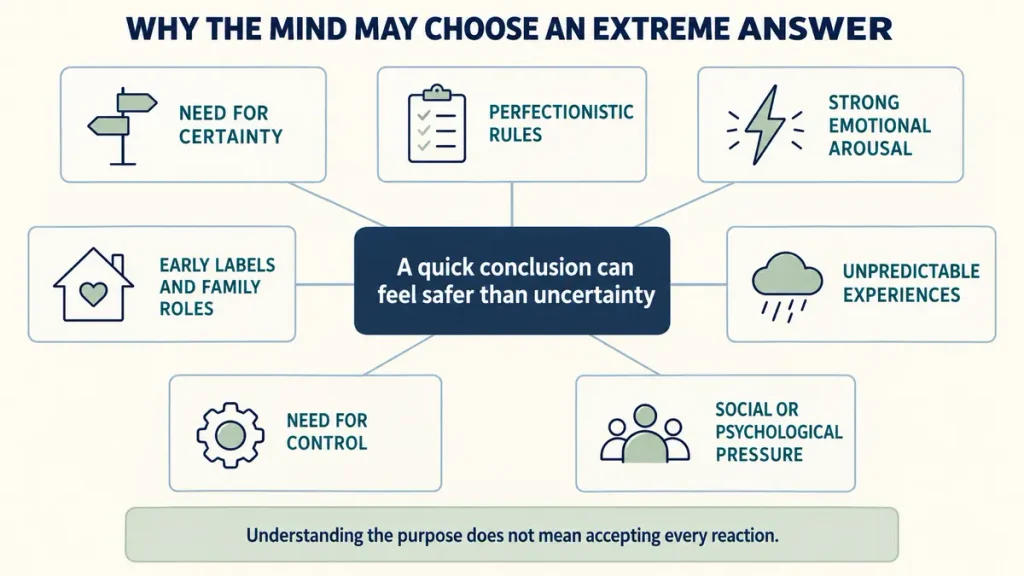
1. Certainty may feel safer than not knowing
Someone important becomes quiet. You do not know whether they are tired, upset, distracted or pulling away. Several explanations are possible, but none can be confirmed immediately.
Your mind settles on: “They are avoiding me.” The conclusion hurts, yet it ends the uncertainty. You no longer have to remain with “I do not know.”
Psychologists use intolerance of uncertainty to describe difficulty coping with unclear situations. Research suggests that cognitive flexibility may influence how intolerance of uncertainty relates to distress, although this evidence is largely correlational and cannot explain every person’s experience (Inozu et al., 2022).
A more flexible response would be: “Their behaviour feels different today. I am worried, but I do not yet know why.” This separates what you know from what you fear.
2. Perfectionistic rules leave no acceptable middle
Some people learn that mistakes are part of learning. Others experience mistakes as a source of shame, criticism or lost approval. They may begin living by strict rules: “I must remain in control.” “Strong people do not need help.” “A healthy relationship should not have conflict.”
Arjun does not clear a competitive examination on his first attempt. Although the exam is difficult, he tells himself, “If I were truly intelligent, I would have succeeded the first time.”
His conclusion depends on a rigid idea of what intelligence should look like. Healthy standards can guide effort. The problem begins when only one outcome is acceptable.
3. Strong emotions narrow what you notice
When you are calm, you may see several sides of a situation. When you feel rejected, ashamed or angry, attention can narrow towards evidence that matches the emotion.
If you feel rejected, you may remember every time someone was unavailable. Moments when they supported you become harder to access. The feeling is genuine, but it may be deciding the meaning of the whole relationship before you have considered its wider pattern.
This is why debating the thought in the middle of intense emotion often fails. The body may need time to settle before the mind can consider alternatives.
4. Rigid labels may have been learned early
Children learn about themselves through the language used around them. In one family, a parent may say, “What you did was unkind. Let us repair it.” In another, the message becomes, “You are selfish. You always create problems.”
When behaviour repeatedly becomes identity, children may learn to divide people into the responsible one, the difficult one, the successful one or the disappointing one. Later, one mistake can awaken the old label: “I knew I was the problem.”
Parents do not necessarily create this deliberately. Families often repeat the language they inherited. An old label, however, does not have to remain a permanent truth.
5. Unpredictable experiences can encourage quick categories
A child living around unpredictable reactions may learn to watch a parent’s voice, face or mood closely. A small change could mean that affection, approval or safety was about to disappear. Quickly deciding “Everything is fine” or “Something is wrong” may have helped that child prepare.
The same system can continue in adult relationships. A partner becomes quiet, and the mind immediately concludes, “They are angry with me.” A friend cancels, and the conclusion becomes, “They are pulling away.”
Betrayal, bullying or rejection can also strengthen rapid “safe or unsafe” sorting for some people. This is one possible pathway, not proof that everyone who thinks in extremes has experienced trauma or an unstable childhood.
6. A final answer can create a sense of control
Complex situations can leave us feeling powerless. After disappointment in a relationship, holding love and fear together may feel unbearable. “I will never trust anyone again” creates immediate closure and protects against vulnerability.
Someone criticised at work may decide, “I will stop sharing my ideas.” Someone whose new habit did not last may say, “Routines do not work for me.”
These conclusions create control by closing the situation. They can also block gradual trust, learning and change.
7. Psychological and social context can strengthen the pattern
Extreme positions often sound confident. Families, workplaces, online spaces and social groups may reward certainty and divide people into loyal or disloyal, strong or weak, with us or against us. Nuance can feel risky when belonging depends on taking the accepted side.
Black and white thinking may also appear more often alongside anxiety, depression, trauma-related distress, eating difficulties and maladaptive perfectionism. Dichotomous interpretations of other people have been found to be clinically relevant in borderline personality disorder (Arntz et al., 2012). This does not mean the thinking pattern by itself indicates BPD or any other diagnosis.
It is usually more useful to ask how often the pattern appears, which feelings bring it out and how much it affects your choices.
How Extreme Thinking Affects Your Life
The thought may last only a few seconds, but its effect can continue much longer:
Difficult event → extreme conclusion → stronger emotion → rigid reaction → painful result → the original conclusion feels confirmed.
A friend does not return your call. You decide that they no longer value the friendship. Feeling rejected, you stop contacting them. Your friend assumes you need space and does not call again. Their silence now seems to prove, “I knew I did not matter.”
The original belief may have helped create the outcome that appears to confirm it.
Self-worth becomes fragile
When you judge yourself in extremes, your sense of worth can change with each result. A productive day makes you feel capable. One critical comment makes you doubt everything.
Sameer receives a positive annual review with one suggestion: improve how he delegates. Later, he remembers only that point: “They do not think I am good enough for this role.” The feedback was about one skill; his mind turned it into a judgement about his whole ability.
Mistakes also become harder to learn from. Instead of asking, “What can this teach me?” the mind asks, “What does this say about me?” The person may hide the error or avoid the situation because looking closely at it feels like examining their worth.
Partial progress becomes easy to dismiss. Someone learning assertiveness may speak up in several smaller situations, then freeze during one tense family conversation. “Nothing has changed,” they think. Yet the new responses are real. Growth has occurred even though it is incomplete.
Relationships lose room for mixed feelings
Healthy relationships require us to hold mixed experiences. You can love someone and feel angry with them. You can trust a person and question one decision. You can recognise someone’s care while asking them to change harmful behaviour.
Extreme thinking makes these truths harder to hold. After a warm interaction, the relationship feels completely secure. After conflict, it feels uncaring or unsafe. One partner may wonder, “Yesterday I was the only person who understood you. Today you say I have never supported you. Which one is true?”
Disagreement may also become a test of love. A partner says, “I understand why you are upset, but I see it differently.” The other hears, “You are not on my side.” Over time, honest conversation may reduce because people become afraid that one different opinion will threaten the bond.

Repair becomes harder when a person has already been judged as entirely selfish or false. The opposite is also dangerous: someone may be seen as completely good, so their repeated controlling or dismissive behaviour is excused. Balanced thinking allows a clearer sentence: “This person may care about me, and this repeated behaviour is still hurting me.”
Everyday choices become rigid
All-or-nothing thinking quietly removes workable options:
“I cannot save a large amount, so saving a little is pointless.”
“I ate something outside my plan, so the whole week is spoiled.”
“I did not understand this quickly, so I am not intelligent enough.”
“If I cannot finish the whole task today, there is no point starting.”
“If I cannot feel confident, I should not attend.”
Life can then move between intense effort and withdrawal. Important decisions may also be made for the relief they offer during a temporary emotion: ending a relationship after one argument, planning to resign after criticism or avoiding social contact after embarrassment.
Some major decisions are necessary. The useful question is whether the choice reflects a repeated pattern and considered values or the emotional force of one moment.
The deepest cost may be loss of choice. If a person is completely good, warning signs disappear. If they are completely bad, repair seems impossible. If you are a failure, trying again feels pointless. Seeing the middle returns the ability to respond to what is actually happening.
How to Stop Black and White Thinking: The S.H.A.D.E.S. Framework
You may not prevent every extreme thought from appearing. Thoughts often arrive before we consciously choose them. Change begins when you notice the thought, slow the reaction and decide whether the conclusion fits the whole situation.
Do not turn this into another absolute rule: “I had an extreme thought again, so I am not improving.” Progress may be noticing it earlier, waiting before sending a message or using a more specific sentence during conflict.
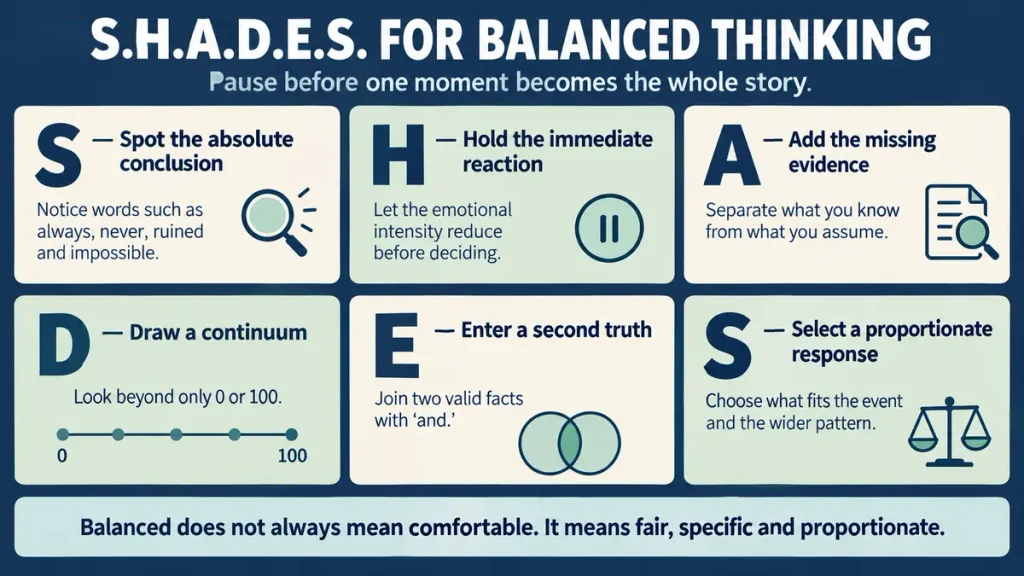
S — Spot the absolute conclusion
Listen for words such as ‘always’, ‘never’, ‘completely’, ‘everyone’, ‘no one‘, ‘ruined’, ‘perfect’, ‘useless’ and ‘impossible’. Ask: “Am I describing this event or giving a verdict about myself, another person or the future?”
Also notice hidden either-or rules: “Either I do it properly, or I should not do it.” “Either they agree, or they do not support me.”
Replace “I always get things wrong” with the specific fact: “I missed an important detail in this task.” The second thought is not more comfortable, but it tells you what can be addressed.
H — Hold the immediate reaction
An extreme thought often brings pressure to act at once. You may want to send a long message, withdraw, abandon a plan or make a final decision.
Ask, “How upset am I from 0 to 10?” If the answer is eight or nine, pause unless immediate safety is involved. Take slower breaths, walk briefly, write instead of sending, or say, “I am too upset to discuss this clearly. I want to return to it after I settle.”
Holding the reaction is not avoiding the problem. A calmer body gives the mind more room to examine it.
A — Add the missing evidence
Ask what supports your conclusion and what does not fully support it. Have there been exceptions? Are you judging one incident or a repeated pattern? What do you know, and what are you assuming?
Suppose your thought is, “My friend does not care.” The supporting evidence is that they cancelled at the last minute. The missing evidence may be that they usually stay in contact, helped you recently and mentioned feeling overwhelmed.
A fuller thought might be, “Cancelling so late felt inconsiderate. I am disappointed, but I do not yet have enough evidence to conclude that they do not care.”
Looking for missing evidence is not automatic forgiveness. If someone has repeatedly lied, controlled or humiliated you, the larger pattern matters.
D — Draw a continuum
Imagine a line from 0 to 100. If 0 means your presentation went terribly and 100 means it was flawless, where did it actually fall?
Perhaps it was 65: most points were clear, some questions were answered well and one section became difficult. Ask what made it 65 rather than 20, and then what could move it to 70 next time.
You can use a continuum for other questions: How serious was this mistake? How certain am I about my interpretation? How supportive has this person generally been? How much progress have I made?
The exact number does not matter. The exercise reminds the mind that more than two positions exist.
E — Enter a second truth
Join two truths with and:
“I am hurt, and I may not know the complete reason.”
“I made a mistake, and I can correct part of it.”
“This person has supported me before, and today’s behaviour was hurtful.”
“I care about this relationship, and I need a firmer boundary.”
“I feel anxious, and I can take one useful step.”
This is dialectical thinking: holding apparently opposing truths without forcing one to disappear. The second truth does not weaken the first. It restores information that the extreme conclusion removed.
S — Select a proportionate response
Ask, “What response fits what actually happened?” It may be asking for clarification, correcting a mistake, requesting a change, watching whether an incident becomes a pattern, setting a boundary, seeking support or leaving a repeatedly harmful situation.
If your partner replies impatiently, an extreme response might be, “You never respect me. There is no point talking.” A proportionate response could be, “The way you spoke felt dismissive. I want to continue, but not in that tone.”
Being proportionate does not always mean being gentle. Repeated harm may require a firm decision. It means that your response matches the evidence and pattern rather than the emotional force of one moment.
Practise with one recent thought
Consider: “I have ruined my chance of succeeding.”
Spot: “Ruined” assumes no recovery is possible.
Hold: Do not abandon the goal while feeling ashamed.
Add: One deadline was missed, but other work is complete, and another option may exist.
Draw: This may be a serious setback, not a total loss.
Enter: “I created a problem, and I may still repair part of it.”
Select: Contact the relevant person, acknowledge the delay and ask what can still be done.
The new thought should be believable. “Everything will definitely be fine” is not balanced when you do not know that. Try: “This has created a problem. I do not know the final outcome, but I can take the next responsible step.”
Balanced thoughts are not always comforting. They are fair, specific and useful.
When Someone Close to You Thinks in Extremes
It can be painful when someone quickly moves from one upsetting moment to, “You never care about what I need.” Your first response may be to prove them wrong. Facts matter, but immediate correction may feel like further dismissal when the person is emotionally overwhelmed.
Acknowledge the feeling without confirming the conclusion
You can say, “I can see that what happened made you feel unimportant.” This recognises the emotional experience without agreeing that nobody values them.
Avoid “You are overreacting” or “Why can’t you think normally?” Try: “It sounds as though this incident is making the whole relationship feel uncertain. Can we talk about this situation without deciding what it means about everything between us?”
Ask questions that reopen the middle
Gentle questions often work better than a contest over who is right:
What happened that made you feel this way?
What do you know for certain?
What are you worried this might mean?
Has this happened every time, or did today feel especially painful?
What part of this needs to change?
The tone should be curious, not like cross-examination. The aim is to move from a total judgement towards the event that needs attention.
Use specific language and keep your boundary
Responding to an extreme statement with another one grows the conflict. Instead of “You always behave like this,” try: “I understand that you felt unsupported when I did not call. I also find it painful when that becomes ‘you never care’. Can we talk about what you needed today?”
Understanding the fear behind a reaction does not require accepting insults, threats or control. You may say, “I am willing to listen to what hurt you. I am not willing to continue while I am being insulted.”
If both people are overwhelmed, pause and say when you intend to return. A pause should create safety, not become silent punishment.
Look for willingness rather than instant calm. Can the person later listen, recognise an exaggerated statement, apologise and try another response? If they consistently refuse responsibility and expect you to absorb every reaction, understanding their psychology will not by itself create a healthy relationship.
When Professional Support May Help
Occasional extreme thoughts do not automatically require therapy. Professional support may be helpful when the pattern repeatedly damages relationships, causes impulsive decisions, creates severe shame, intensifies fear of rejection, disrupts eating, work or study, or continues despite sincere efforts to change.
Cognitive behavioural therapy can help people notice automatic conclusions, examine evidence and build more balanced interpretations. Dialectical behaviour therapy teaches skills for holding two truths together, regulating intense emotions and responding more effectively during conflict.
A review of psychotherapy research found that cognitive change, including work with distorted thinking, was meaningfully associated with therapy outcomes, while also noting limits in measuring the exact mechanisms involved (Ezawa & Hollon, 2023). The right support depends on the wider context. Extreme thinking connected with perfectionism may need a different focus from a pattern connected with depression, trauma or intense relationship insecurity.
Frequently Asked Questions
Is black and white thinking a mental illness?
No. It is a cognitive pattern, not a diagnosis. Most people experience it sometimes, especially during stress, fear, anger or disappointment. One feature alone cannot establish any mental-health condition.
Are black and white thinking and all-or-nothing thinking the same?
They are commonly used for the same pattern: placing an experience into opposite categories while overlooking the possibilities between them. “Dichotomous thinking” is the term often used in psychological research.
Why do I think in extremes when I am upset?
Strong emotions can narrow attention. When you feel rejected, you may notice every sign that someone is pulling away. When you feel ashamed, mistakes may be easier to remember than progress. The feeling is real, but the conclusion formed during it may not include the whole picture.
Can black and white thinking damage relationships?
Yes. One disagreement may become proof that a partner is uncaring or disloyal. Other people may feel they must agree, respond perfectly or repeatedly prove their love. It can also make apology and repair difficult.
Does balanced thinking mean lowering my standards?
No. You can maintain clear standards while examining context and patterns. Healthy standards guide behaviour. Extreme thinking judges the complete worth of a person or situation.
Does seeing the middle mean staying in a harmful relationship?
No. Sometimes the complete evidence shows repeated dishonesty, control, humiliation or unwillingness to change. You do not have to ignore harm because the other person also has good qualities.
How long does it take to change this pattern?
There is no fixed timeline. A long-practised pattern may return during emotional stress. Change often begins with noticing it earlier and reacting less quickly. The aim is not perfect control of thought, but greater awareness and choice over time.
Final Perspective: The Middle Path Is Not a Weak Position
The mind may choose extremes because they feel clear: “They care, or they do not. I succeeded or I failed. This relationship is right or it is wrong.”
The middle path can feel less certain. It asks you to pause before giving a final answer and to hold feelings, facts and patterns together. That is not weakness or indecision. It is emotional steadiness.
You can be deeply hurt without deciding that you were never loved. You can recognise someone’s good qualities without ignoring harmful behaviour. You can make a mistake without turning it into your identity.
Balanced thinking will not make every situation comfortable. Some truths will still hurt. Some relationships will need boundaries. Some decisions will require courage.
But one feeling, one incident or one label will no longer have to tell the whole story. The middle path gives you something extreme thinking often takes away: the freedom to see clearly and choose your response.
A Gentle Note
Black and white thinking is a common human pattern. Recognising it does not mean that something is fundamentally wrong with you.
For some people, it becomes stronger during anxiety, depression, relationship insecurity or overwhelming stress. It may also connect with earlier experiences that deserve individual understanding.
This article offers psychoeducation and general self-reflection. It cannot diagnose a mental-health condition or replace personalised professional support. If extreme thoughts are causing significant distress, repeatedly damaging your relationships or making you feel hopeless, consider speaking with a qualified mental-health professional.
If you are in immediate danger or thinking about harming yourself, contact local emergency services or a crisis-support service available in your region.