

You know how much effort it took. Yet somehow, you still feel you should have done more.
You should have handled it better. Learned faster. Stayed calmer. By now, you should have figured this out.
The expectations can sound so reasonable that you rarely question them. Instead, you question yourself.
Even when someone reassures you that you did well, part of you starts explaining why it does not count. They did not notice the mistake. They were just being kind. Someone else would have done it better.
It can be tiring to live with that running commentary. Especially when you are already trying.
If you have been wondering, “Why am I so hard on myself?”, there may be another question underneath it: Why does understanding come so much more easily when someone else is struggling?
Table of Contents
You can see their effort. You consider what they were dealing with. You allow them to have a difficult day. But when it is your turn, those same circumstances begin to sound like excuses.
You do not have to force yourself to feel positive about everything. A more useful starting point is to understand how this unequal treatment became familiar—and whether it is helping you as much as you think.
Quick Answer: Why Am I So Hard on Myself?
Being hard on yourself may be connected with perfectionism, learned expectations or a sense that your worth depends on achievement and approval. You may also believe that criticism keeps you motivated or protects you from making another mistake. There is no single explanation that fits everyone. Understanding your own pattern can help you respond more fairly while still taking responsibility for what needs to change.
When Your Effort Never Quite Feels Like Enough
Self-criticism does not always sound cruel. Sometimes it sounds like discipline. You tell yourself that you are simply being realistic or refusing to settle.
But notice what happens after you meet an expectation. Can you acknowledge the effort? Or does your mind immediately raise the standard?
You may recognise this pattern if:
- You accept criticism quickly but struggle to believe praise.
- One unfinished task overshadows everything you completed.
- You expect yourself to know things you have not had a chance to learn.
- You keep judging a mistake after you have already corrected it.
- You feel that understanding your limits would mean letting yourself off the hook.
These experiences are not a diagnosis. They are invitations to notice how you treat yourself when something falls short.
Research on self-compassion examines a different way of responding to difficulty—one that can include both support and the motivation to improve.
For now, consider this: after you have recognised a mistake, does your inner voice help you decide what to do next? Or does it keep you feeling bad about yourself?
That is where the difference between accountability and self-criticism begins.
Is Being Hard on Yourself the Same as Being Responsible?
You may worry that easing up on yourself means lowering your standards. After all, if you made a mistake, shouldn’t you feel bad about it?
Disappointment can tell you that something matters. Regret can help you recognise that an apology or a change is needed. You do not have to push those feelings away.
But there is a difference between facing something uncomfortable and repeatedly putting yourself down.
When “I Got This Wrong” Becomes “There Is Something Wrong With Me”
Researchers describe self-criticism as harsh self-evaluation and negative reactions to perceived failures. It goes beyond an honest review of what happened. Research on self-criticism
The phrase ‘inner critic’ is a way of describing this pattern of thoughts. It does not mean there is a separate person or literal voice inside you.
Healthy reflection stays close to the situation: “I interrupted. I need to listen more carefully.”
Harsh self-criticism makes a much larger claim: “I’m selfish. I always ruin conversations.”
That larger claim gives you little useful guidance. It leaves you defending or condemning yourself when you could be learning what to do differently.
| Healthy accountability | Harsh self-criticism |
| “I missed something important.” | “I can’t do anything right.” |
| Considers the impact and the circumstances | Treats circumstances as excuses |
| Identifies a repair or change | Keeps returning to blame |
| Allows learning to take time | Expects you to have known better already |
You Can Make Amends Without Attacking Yourself
Consider Leena, a fictional character created for this article. She forgets to return a book that her neighbour needs for a class.
An accountable response is straightforward. She apologises, arranges to return it that evening and sets a reminder for future borrowing.
A self-critical response adds something else: she spends hours calling herself unreliable and wonders whether she deserves her neighbour’s trust.
Her neighbour’s inconvenience still matters. But insulting herself does not return the book any sooner. The apology and follow-through are what help repair the situation.
Why Can Harshness Feel Like It Is Working?
Sometimes self-pressure gets you moving. You finish a task because you cannot bear another round of criticism from yourself. That can make harshness feel necessary.
But getting something done does not prove that self-attack was the only way to do it. Research on self-compassion and motivation challenges the assumption that treating yourself supportively must make you less willing to improve.
You can take your responsibilities seriously and still speak to yourself with respect. If that feels unfamiliar—or even undeserved—it is worth exploring where you learned that kindness had to be earned.
Why Am I So Hard on Myself? Where the Pattern May Begin
There may not be one clear moment when you started treating yourself this way. Often, expectations build gradually. What other people once expected of you can become what you demand from yourself—even when nobody is watching.
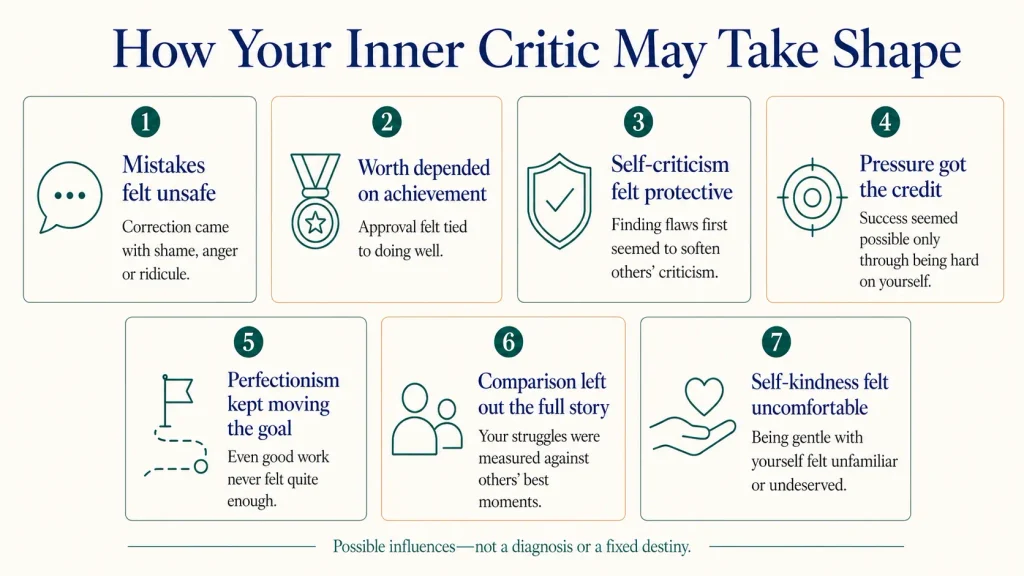
The following reasons are possible influences, not a checklist for diagnosing yourself. You may recognise several. Others may not fit your experience.
1. Mistakes Once Came With More Than a Correction
Some mistakes are met with guidance. Others bring ridicule, anger or a silence that feels difficult to bear.
If getting something wrong repeatedly led to those reactions, you may have learned to watch yourself closely. Being careful was not only about doing the task well. It was also about avoiding what might happen afterwards.
Over time, that watchfulness can become an internal habit. You catch every hesitation. You rehearse what to say. You feel uncomfortable letting anyone see you learning.
This does not mean that everyone who criticises themselves had a harmful childhood. Experiences at school, in relationships or at work may also matter. Nor does an occasional impatient response explain an entire lifelong pattern.
The useful question is more specific: When I got something wrong, was there room to learn—or did I feel smaller as a person?
Our article on how childhood shapes emotional regulation explores how early emotional experiences can influence later responses.
2. Achievement Became a Way to Feel Worthwhile
There is a difference between enjoying success and needing success to feel acceptable.
Perhaps you received the most attention when you achieved something. Or you became known as the dependable one who rarely needed help. Meeting expectations brought a sense of belonging that you did not want to lose.
Psychologists use the term ‘contingent self-worth’ when a person’s sense of worth depends heavily on particular outcomes or approval.
Research on parental conditional regard suggests that linking approval to desired behaviour can be associated with internal pressure and emotional costs. This does not establish what happened in any individual family. It helps explain one possible route into the pattern.
As an adult, you may still feel that you need to earn your place. A slower week then means more than reduced output. It raises an uncomfortable question: “If I am not contributing enough, what makes me valuable?”
Wanting to achieve is not the problem. The strain comes when achievement feels like a condition for respecting yourself.
3. You Criticise Yourself Before Someone Else Can
For some people, self-criticism feels like preparation.
If you spot every weakness first, perhaps a correction will hurt less. If you keep reminding yourself of an embarrassing moment, perhaps you can prevent another one.
This is one possible way to understand the pattern, not a universal explanation. Ask yourself whether your harshest thoughts tend to appear when you expect to be evaluated.
You may notice that you judge your work most severely just before sharing it. Or you dismiss something you are proud of before anyone has offered an opinion.
The difficulty is that anticipating criticism can begin to feel like receiving it. You are already upset, although the response you fear may never come.
Noticing this distinction matters: are you responding to feedback that actually happened or trying to protect yourself from feedback you imagine?
4. You Have Learned to Give Pressure the Credit
If self-criticism has accompanied years of effort, it can become difficult to separate the two. You remember pushing yourself hard and then succeeding. Naturally, you wonder whether easing that pressure would put future success at risk.
An early study examining the functions of self-criticism found that people reported different reasons for it, including attempts at self-improvement. Because the study involved female students, its findings should not be treated as an explanation for everyone.
Still, it raises a useful question about your own experience: what else helped you succeed?
Your preparation mattered. So did your skills, persistence, support and willingness to learn. When the inner critic takes all the credit, these contributions become easy to overlook.
You do not have to dismiss your achievements or deny how hard you worked. You can begin by questioning whether the harshness deserves as much credit as you have been giving it.
5. Perfectionism Leaves No Clear Place to Stop
Having high standards can help you produce thoughtful work. But with self-critical perfectionism, the standard can become difficult to satisfy.
You might complete something well, then decide it should have taken less time. You meet your goal, then tell yourself it was not ambitious enough. Each achievement brings another condition.
Notice the difference between wanting to improve a skill and feeling unable to tolerate being imperfect at it. The first leaves room for practice. The second can make the learning process feel embarrassing.
Consider Farah, a fictional character created for this article. After several weeks of swimming lessons, she completes a length without stopping. She had been looking forward to this moment. But she immediately notices that another learner swims faster.
Before she has even left the pool, her achievement feels unimpressive.
Her wish to improve is understandable. The difficulty is that she has changed the measure of success before allowing herself to recognise any progress.
This pattern can also make starting harder. If every attempt must prove your ability, an unfinished task may feel safer than work someone could judge. Our article on why you procrastinate even when you want to get things done explores that connection further.
6. Comparison Gives You an Incomplete Measure of Yourself
Comparison can provide useful information. You might learn from someone’s approach or discover a goal you would like to pursue.
But it becomes painful when someone else’s progress turns into a verdict about yours.
You see their promotion, confidence or well-organised home. You do not necessarily see their resources, responsibilities, setbacks or years of practice. Meanwhile, you know every unfinished task and uncertain thought in your own life.
Research examining social comparison, social media and self-esteem found that exposure to profiles portraying others more favourably could affect participants’ immediate self-evaluations. That does not mean all social media use or comparison is harmful. It shows why the comparison you make matters.
Sometimes you also compare yourself with several different people at once. One person becomes your standard for career success. Another sets the standard for fitness. Someone else seems effortlessly patient.
Without noticing, you may be expecting yourself to match each person’s strongest area.
Before accepting the conclusion that you are falling behind, consider whether the comparison accounts for the life you are actually living.
7. Being Kind to Yourself Feels Uncomfortable
For some people, the obstacle is not knowing what a supportive response sounds like. It is allowing that response to apply to them.
You may understand self-compassion in principle but feel uneasy when you try it. Warm words can sound false. Acknowledging your hurt may feel self-indulgent. You might believe comfort is something you can accept only after you have fixed the problem.
Research on fears of compassion has explored this resistance. The findings suggest that discomfort with compassion can be associated with self-criticism. They do not mean that everyone who dislikes reassuring language has the same history or needs the same approach.
For some, slowing down also makes previously brushed-aside feelings more noticeable. It can be easier to keep correcting yourself than to admit that you feel disappointed, lonely or overwhelmed.
You do not need to force an affectionate inner voice that feels unnatural. There is room to begin with plain, respectful language.
Recognising that something is difficult is not the same as feeling sorry for yourself. It gives you information about what you are dealing with. And that information matters when deciding what you reasonably need next.
Why Does Self-Criticism Keep Returning, Even When You Know It Hurts?
Understanding where a habit comes from does not always explain why it continues. For that, it helps to notice what happens immediately after you criticise yourself.
Do you check everything again? Put off a decision? Or do you ask someone whether they are disappointed in you?
These responses may ease the discomfort briefly. But sometimes they leave the underlying fear untouched.
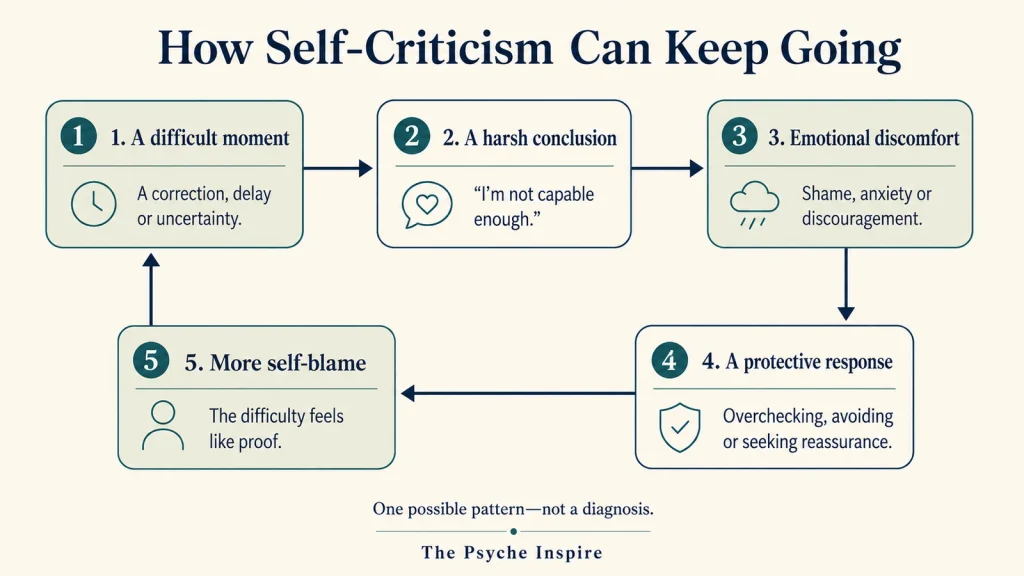
How the Pattern Can Feed Itself
Here is one possible sequence. It is an illustration, not a fixed psychological rule:
- Something unsettles you. You receive a correction, fall behind or feel uncertain.
- You reach a harsh conclusion. “I’m not capable enough.”
- The conclusion changes how you feel. You become ashamed, anxious or discouraged.
- You try to escape that feeling. You overcheck, avoid the task or repeatedly seek reassurance.
- You interpret what follows as further evidence against yourself. Taking longer becomes “proof” that you are slow. Avoiding the task becomes “proof” that you lack discipline.
What gets overlooked is that your response to the difficulty may have made the next step harder.
This does not mean every delay comes from self-criticism. Workload, health, unclear instructions and practical barriers matter too. Blaming yourself for having this pattern would simply add another layer of criticism.
Repeated reassurance can become part of it as well. Someone tells you that you did nothing wrong, and you feel better. Later, doubt returns because you still distrust your own judgement. Our article on why you need constant reassurance explores this pattern in more detail.
Notice What You Do Next—not Just What You Think
The effects may be quieter than you expect. You stop offering ideas unless you are certain they will be welcomed. You hide a mistake that could have been resolved with a short conversation. You spend so long checking that there is little time left to rest.
You might also overlook moments that challenge your negative view. A mistake gets corrected without conflict. Someone appreciates your contribution. You cope with something unfamiliar. Yet these moments receive less attention than the uncomfortable ones.
A useful question is: After I speak to myself this way, what becomes easier—and what becomes harder?
You do not need to argue with every critical thought. First, notice whether it helps you take a useful step or leaves you circling the same concern. That gives you a practical place to begin changing your response.
How Can You Stop Being So Hard on Yourself Without Lowering Your Standards?
You do not need to change your entire inner dialogue today. Begin with one moment when you would usually turn against yourself.
The aim is not to replace every uncomfortable thought with something positive. It is to respond accurately enough that you can decide what to do next.
Start by Naming the Thought, Not Accepting the Verdict
When “I am useless” appears, try noticing: “I am having a harsh thought about myself.”
This small change creates room to examine the thought. You do not have to believe it’s opposite immediately.
Then return to what you actually know. Did you miss an instruction? Make a decision without enough information? Take on more than you could reasonably manage?
Specific descriptions give you something to work with. Labels about your whole character rarely do.
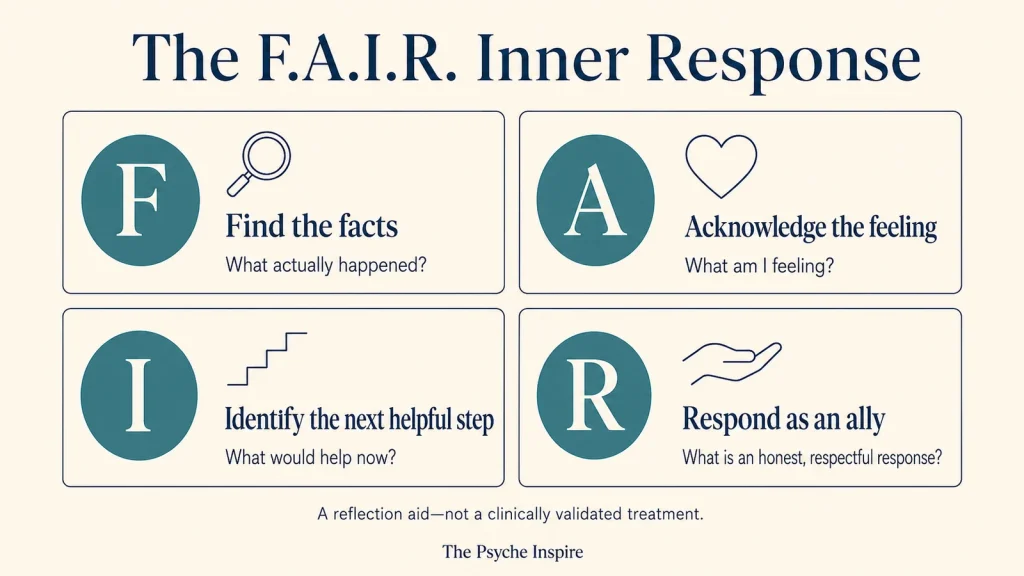
Try the F.A.I.R. Inner Response
The following is a reflection aid created for this article. It brings together practical prompts; it is not a clinically validated treatment.
F — Find the Facts
Describe what happened without adding a judgement about your worth.
“I submitted the form late” is a fact. “I ruin every opportunity” is a much broader conclusion.
Include relevant circumstances, too. Context helps you understand the situation. It does not automatically remove your responsibility.
A — Acknowledge the Feeling
Ask what is underneath the criticism. Are you embarrassed, disappointed, worried or hurt?
You might say, “I’m disappointed because this mattered to me.”
There is no need to force the feeling away before taking action. Naming it simply helps you recognise what you are dealing with.
I — Identify the Next Helpful Step
Choose one response that fits the situation. You may need to correct something, apologise, ask a question or make a more realistic plan.
Sometimes no repair is needed. You may be facing an ordinary limit, such as tiredness or not knowing something yet.
Ask: “What would help here—not just punish me?”
R — Respond as an Ally
Use a tone that is honest and respectful.
For Dev, a fictional character, this might follow a missed community workshop. He confused the dates and feels embarrassed about contacting the organiser. His fairer response could be: “I missed it, and I’m disappointed. I can ask whether another session is available and put confirmed dates straight into my calendar.”
He does not need to call himself organised or successful. He needs a response that helps him move forward.
Decide What “Enough” Means Before You Begin
If your standards keep changing, make the task clearer at the start.
What must be accurate? What needs checking? What level of detail is appropriate? A message arranging lunch does not need the same review as an important work document.
Choose a sensible stopping point that matches the stakes. Otherwise, anxiety may keep adding requirements long after the task is complete.
Let Progress Count Without Forcing Praise
After a demanding task, briefly note:
- What worked?
- What was difficult?
- What is one useful adjustment?
This gives effort and learning a place alongside mistakes. You do not have to make a daily ritual of it. Use it when you notice that your review contains nothing but faults.
And if you catch yourself being self-critical again, try not to make that another failure. Noticing the pattern is part of practice. It is not evidence that practice has failed.
When Would Professional Support Help?
Consider speaking with a qualified mental-health professional if self-criticism feels relentless, leads to persistent hopelessness or interferes with sleep, eating, work or relationships. You do not need to wait until things become severe.
A systematic review of compassion-focused therapy found promising results, including improvements in compassion-related outcomes. However, study quality varied, and longer-term effects need further research. A brief reflection exercise is not equivalent to receiving therapy.
Frequently Asked Questions
Why am I so hard on myself over small mistakes?
The mistake may carry a larger meaning for you, such as appearing incompetent or disappointing someone. Notice the conclusion you draw about yourself. Its intensity does not necessarily reflect the seriousness of the event.
Does self-criticism always mean low self-esteem?
No. Self-criticism can overlap with low self-esteem, but it may also involve perfectionism or learned expectations. You might feel capable in one area and judge yourself harshly in another.
Can self-criticism be connected with trauma?
It can occur after painful or threatening experiences, but self-criticism alone does not establish trauma or a trauma-related disorder. Avoid using one pattern to diagnose your history. Professional support can help you explore it safely.
Will being kinder to myself make me less motivated?
Kindness does not require abandoning goals. You can maintain clear expectations, follow through and accept consequences without insults. A useful test is whether your response helps you engage with the task, not whether it sounds sufficiently tough.
What if supportive self-talk feels fake?
Begin with neutral language you can believe. “This is difficult, and I need more information” may feel more useful than an enthusiastic affirmation. Fairness is a reasonable starting point.
Final Perspective: You Can Grow Without Turning Against Yourself
If you keep asking, “Why am I so hard on myself?”, you may already recognise that something about this pattern is costing you.
You do not have to stop caring about your responsibilities. You can begin by making your response more specific: what happened, what matters and what can be done now.
Some days, you will manage that more easily than others. You are learning a different way to handle difficulty. That learning deserves the same patience you would allow someone else.
A Gentle Note

This article provides general psychological information, not a diagnosis or personalised treatment. If self-criticism is affecting your daily life, consider qualified professional support. If you have thoughts of self-harm or suicide, seek prompt help. If you may act on them or cannot stay safe, contact local emergency services or go to the nearest emergency department.