

Have You Ever Wondered Why Some People Stay in Your Mind Long After They’ve Gone?
You tell yourself you’re going to move on.
You delete the messages, mute their profile, and promise yourself you won’t check your phone again. For a while, it works. Then a song reminds you of them. A familiar place brings back a memory. Before you know it, you’re replaying conversations, imagining different endings, and wondering why someone who was only part of your life for a short time still has such a powerful hold on your emotions.
It can be confusing—and sometimes even embarrassing.
You may ask yourself:
- Why do I get emotionally attached so quickly?
- Why does it hurt so much when someone pulls away?
- Why can’t I stop thinking about people who no longer choose me?
- Why do I become deeply invested before I truly know someone?
If these questions feel familiar, you’re not alone.
Table of Contents
Many people believe becoming emotionally attached too easily means they are “too sensitive,” “too needy,” or “bad at relationships.” But psychology tells a far more compassionate story.
In many cases, strong emotional attachment isn’t a sign of weakness. It’s your mind and nervous system trying to create a sense of safety, belonging, and emotional security. The intensity you feel often reflects deeper psychological patterns—not personal flaws.
Understanding those patterns can be life-changing.
When you stop blaming yourself and start understanding why your brain forms emotional bonds the way it does, something remarkable happens. Shame gives way to self-awareness. Confusion turns into clarity. And instead of trying to suppress your emotions, you learn how to work with them in healthier ways.
That shift is the foundation of emotional fitness.
Emotional Attachment Is a Human Need—Not a Human Flaw
From the moment we are born, our brains are designed to seek connection.
An infant doesn’t survive through intelligence or independence. They survive because someone responds to their cries, offers comfort, and creates a sense of safety. Over thousands of interactions, the brain learns an important lesson:
“When I feel safe with someone, I can relax.”
That lesson doesn’t disappear in adulthood.
As we grow older, our need for emotional connection evolves, but it never truly goes away. Friends, partners, mentors, and family members often become the people our minds associate with comfort, understanding, and belonging.
This is why losing an important relationship—or even fearing that we might lose it—can feel surprisingly painful. Your brain isn’t only reacting to the person. It’s reacting to the loss of emotional safety that person came to represent.
In other words, what you’re missing may not simply be them. You may be missing the feeling of security, acceptance, or hope that existed when they were part of your life. Recognizing this difference is one of the first steps toward building healthier relationships with both others and yourself.
Why This Article Is Different
Much of the advice online about emotional attachment falls into two extremes.
One tells you to “stop caring so much,” “be more detached,” or “play hard to get.”
The other romanticizes intense attachment as proof of deep love.
Neither approach reflects what psychology actually teaches us.
Healthy emotional connection is not about becoming emotionally unavailable, nor is it about losing yourself in another person.
It’s about developing the ability to care deeply while staying emotionally grounded.
In this article, you’ll discover:
- Why your brain forms strong emotional attachments.
- The hidden psychological patterns that make some people attach more quickly than others.
- The difference between healthy attachment and emotional dependency.
- Why rejection often hurts more than we expect.
- Practical strategies to build secure, emotionally healthy relationships without suppressing your feelings.
You’ll also learn The S.A.F.E. Method™, a practical framework developed by The Psyche Inspire to help you understand your emotional needs, recognize attachment patterns, and build stronger emotional resilience.
Whether you’re recovering from heartbreak, struggling with overthinking, or simply trying to understand yourself better, this guide will help you replace self-criticism with self-understanding.
Because the goal isn’t to stop feeling.
The goal is to understand what your feelings are trying to tell you.
The Science Behind Emotional Attachment – Why Your Brain Holds On
Before you blame yourself for becoming emotionally attached too quickly, it’s worth asking a different question:
What if your brain is doing exactly what it was designed to do?
Many people think emotional attachment is simply about personality. They assume some people are “clingy,” while others are naturally independent.
Modern psychology paints a much richer picture.
The way we form emotional bonds is influenced by a combination of our early experiences, our nervous system, our past relationships, our emotional needs, and even the way our brain processes safety and uncertainty.
Understanding these influences doesn’t excuse unhealthy relationship patterns—but it does explain them. And once you understand them, you can begin to change them.
Your Brain Is Wired for Connection
Imagine living thousands of years ago.
A person separated from their family or tribe faced real danger. Being alone often meant less protection, fewer resources, and a lower chance of survival.
Because of this, the human brain gradually evolved to treat social connection as a survival need, not simply a pleasant experience.
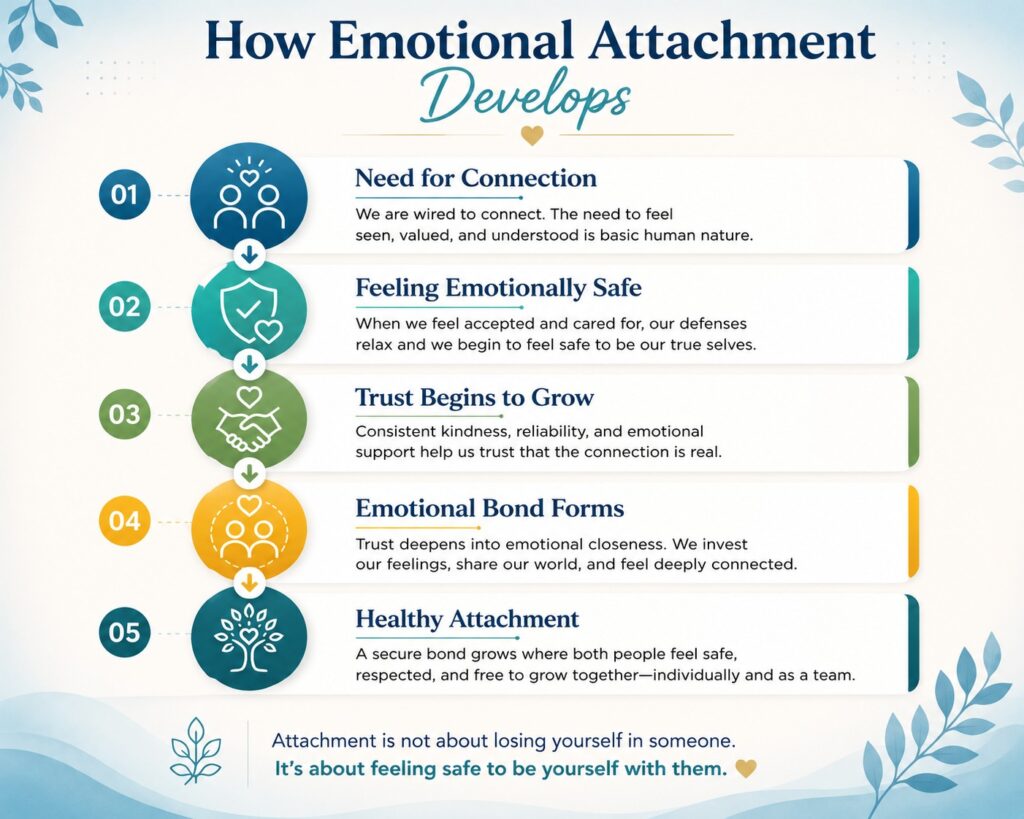
Even today, although our environment has changed dramatically, our brains still respond to emotional disconnection as though something important has been threatened.
This is why experiences like being ignored, rejected, ghosted, or emotionally abandoned can feel physically painful.
Research suggests that experiences of social rejection activate some of the same brain regions involved in processing physical pain, which helps explain why emotional rejection can feel intensely distressing (Eisenberger, Lieberman, & Williams, 2003).
While emotional pain and physical pain are not identical, they overlap enough to explain why heartbreak can genuinely “hurt.”
That pain isn’t imaginary. It’s your brain’s way of signaling that an important emotional bond may be at risk.
Attachment Begins Long Before Your First Relationship
Many people believe attachment starts when they fall in love.
Psychology suggests it starts much earlier.
Long before we understand words, our brains are learning important emotional lessons.
Every comforting hug, reassuring voice, or responsive caregiver teaches a child:
“When I feel distressed, someone helps me feel safe again.”
Over time, these repeated experiences shape what psychologists call an attachment style—the emotional blueprint that influences how we expect relationships to work.
This doesn’t mean childhood permanently determines your future.
Rather, it creates an early starting point that can continue to evolve throughout life as we experience healthy relationships, self-awareness, and emotional growth.
The encouraging news is that attachment patterns are adaptable. They are not lifelong labels.
Why Some People Attach More Quickly Than Others
Have you ever noticed that two people can experience the same relationship very differently?
One person enjoys getting to know someone slowly.
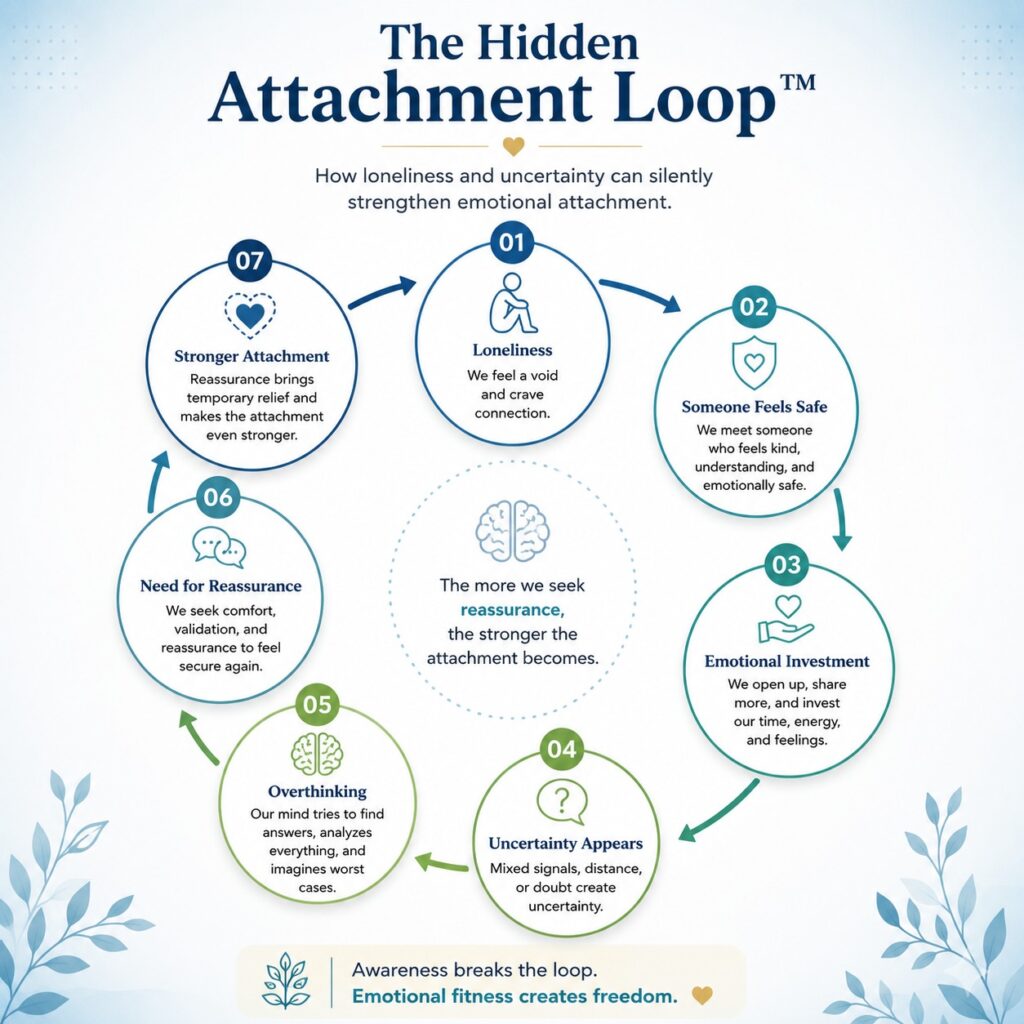
The other starts imagining a future together after only a few meaningful conversations.
This difference isn’t simply about being “too emotional.”
Several psychological factors can make emotional attachment develop more quickly.
1. You Crave Emotional Safety
Sometimes it isn’t the person you’re becoming attached to.
It’s the feeling they create.
If someone makes you feel understood, accepted, appreciated, or emotionally safe, your brain naturally wants to preserve that experience.
The attachment often forms around the emotional security they represent rather than who they actually are.
2. Your Brain Fills in the Missing Pieces
When we don’t know someone well, our minds naturally fill the gaps.
A few positive experiences can become the foundation for an idealized image of who we believe they are.
Psychologists sometimes refer to this as idealization—the tendency to imagine qualities that haven’t yet been fully observed.
We don’t intentionally deceive ourselves.
Our brains simply complete an incomplete story.
This is one reason early-stage relationships can feel so intensely exciting—and why disappointment can be equally intense when reality doesn’t match the image we’ve created.
3. Uncertainty Makes the Mind Hold On
One of the strongest psychological drivers of attachment is uncertainty.
When someone’s attention becomes inconsistent—replying warmly one day and disappearing the next—our brain often becomes even more focused on them.
Why?
Because uncertainty creates an “unfinished story.”
Our minds dislike unanswered questions.
Instead of letting go, we keep searching for explanations.
“Did I do something wrong?”
“Are they losing interest?”
“Should I message them again?”
The more unanswered questions there are, the more mental space the relationship occupies. This is one reason emotionally unavailable relationships can become surprisingly difficult to move on from.
The Role of Your Nervous System
Many people think emotions exist only in the mind.
In reality, your entire body participates.
When you feel emotionally close to someone, your nervous system often shifts into a calmer, more regulated state.
Your breathing may slow.
Your muscles relax.
You feel understood.
You experience safety.
When that connection suddenly disappears, your nervous system can react as though it has lost an important source of stability.
This is why emotional loss can produce very real physical experiences, such as the following:
- A tight chest
- Difficulty concentrating
- Trouble sleeping
- Loss of appetite—or emotional eating
- Constant thoughts about the other person
- Feeling emotionally restless or “on edge”
These reactions don’t mean you’re weak.
They often reflect your body’s attempt to regain emotional balance.
Why Emotional Attachment Is Not the Same as Love
One of the biggest misconceptions about relationships is believing that strong emotional attachment automatically means deep love.
They are not the same.
Love grows through mutual trust, respect, honesty, shared values, and consistent care over time.
Attachment is different.
Attachment answers a simpler question:
“Do I feel emotionally safe with this person?”
Sometimes the answer is yes.
Sometimes the answer is based more on hope than reality.
This distinction matters because many people remain in unhealthy relationships—not because they are deeply loved, but because they have become deeply attached.
Learning to recognize that difference is one of the most important emotional skills you can develop.
Reflection Exercise
Take a quiet moment and ask yourself:
- Do I miss this person—or do I miss how I felt around them?
- Am I attached to who they truly are, or to the future I imagined with them?
- Does this relationship make me feel consistently safe, respected, and valued?
- Am I seeking genuine connection or relief from loneliness, uncertainty, or fear?
There are no right or wrong answers.
The purpose isn’t to judge yourself.
It’s to become curious about your emotional patterns.
Awareness is the beginning of change.
Key Takeaways

•	Your brain is biologically designed to seek emotional connection.
•	Strong attachment is often rooted in the need for safety rather than weakness.
•	Early experiences influence—but do not permanently define—how you relate to others.
•	Uncertainty and idealization can strengthen emotional attachment.
•	Attachment and love are related, but they are not the same.
•	Understanding your attachment patterns is the first step toward building healthier, more secure relationships.
The Four Attachment Styles – Understanding Your Emotional Blueprint
Have you ever noticed that two people can experience the same relationship in completely different ways?
One person enjoys closeness without feeling overwhelmed.
Another constantly worries that their partner will lose interest.
Someone else feels uncomfortable whenever a relationship becomes too intimate, while another swings between wanting closeness and pushing people away.
These patterns are rarely random.
Psychologists call them attachment styles—the habitual ways we think, feel, and behave in close relationships. They are shaped by a combination of early life experiences, later relationships, personality, and emotional learning throughout life.
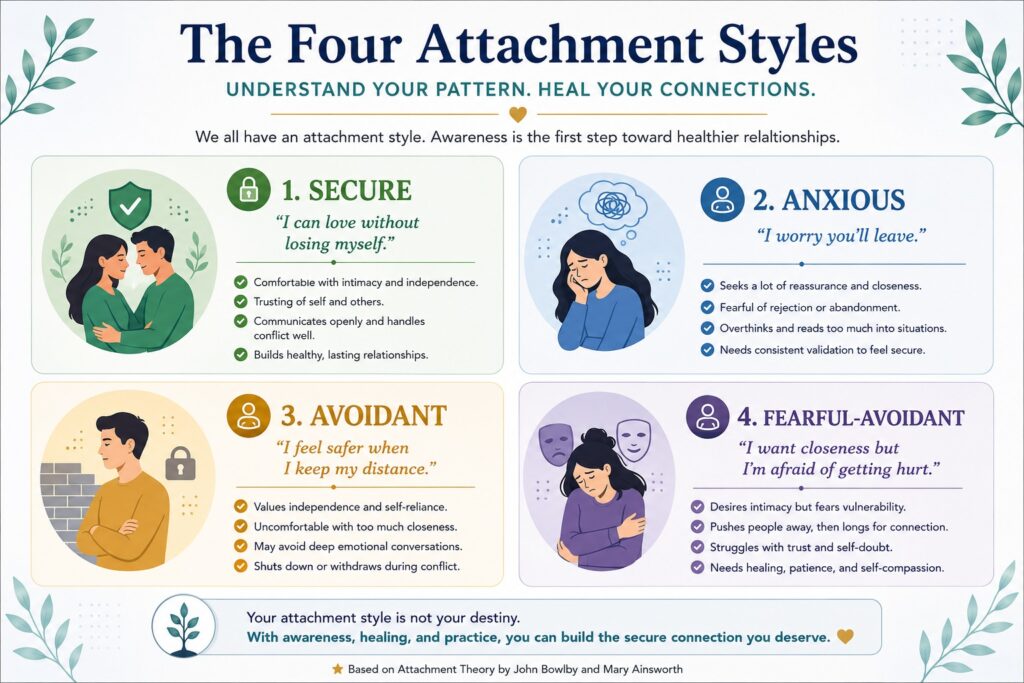
Your attachment style is not your identity. It is simply a pattern your brain has learned over time.
And like many learned patterns, it can change. Let’s explore the four major attachment styles and what they might look like in everyday life.
1. Secure Attachment: Feeling Close Without Losing Yourself
Imagine having a disagreement with someone you love.
Instead of immediately assuming the relationship is over, you trust that the issue can be discussed and resolved.
You feel comfortable expressing your emotions, listening to the other person’s perspective, and working through challenges together.
This is what psychologists refer to as secure attachment.
People with a secure attachment style generally:
- Feel comfortable giving and receiving love.
- Trust others while maintaining healthy boundaries.
- Communicate openly about their needs.
- Recover more easily from conflict.
- Value both connection and independence.
This doesn’t mean they never feel hurt or anxious.
It simply means they don’t let fear control the relationship.
Example
A partner takes longer than usual to reply to a message.
Instead of immediately thinking, “They’re losing interest,” someone with secure attachment is more likely to think:
“They’re probably busy. I’ll hear from them when they’re free.”
Their mind doesn’t automatically jump to the worst-case scenario.
2. Anxious Attachment: When Closeness Feels Uncertain
If you’ve ever found yourself constantly checking your phone, overanalyzing text messages, or worrying that someone will leave without warning, you may recognize some features of anxious attachment.
People with this pattern often value relationships deeply but struggle with uncertainty.
Small changes in another person’s behaviour can feel much bigger than they actually are.
For example:
- A delayed reply feels like rejection.
- A cancelled plan feels like abandonment.
- A brief disagreement feels like the relationship is falling apart.
This doesn’t happen because someone is “too emotional.”
Often, the brain has learned to stay highly alert for signs that an important relationship might be threatened.
Common Signs of Anxious Attachment
- Frequently seeking reassurance.
- Overthinking conversations.
- Fear of being abandoned.
- Feeling responsible for keeping the relationship together.
- Difficulty relaxing when communication becomes inconsistent.
- Placing another person’s happiness above your own.
If this sounds familiar, remember:
These behaviours developed for a reason.
They may have once helped you feel emotionally safe—but they don’t have to define your future relationships.
3. Avoidant Attachment: Protecting Yourself by Staying Independent
Some people respond to emotional closeness in the opposite way.
Instead of fearing distance, they fear becoming too dependent on others.
They value independence so strongly that emotional intimacy can feel uncomfortable.
This is known as avoidant attachment.
People with this pattern may:
- Find it difficult to express vulnerable emotions.
- Withdraw during conflict.
- Prefer solving problems alone.
- Feel overwhelmed when someone becomes emotionally dependent on them.
- Keep relationships at a comfortable distance.
From the outside, they may appear emotionally detached.
Inside, however, they often experience emotions just as intensely as anyone else.
The difference is that they’ve learned to manage difficult feelings by relying primarily on themselves.
Many people with avoidant attachment deeply care about others but struggle to show it in ways that create emotional closeness.
4. Fearful-Avoidant Attachment: Wanting Love but Fearing It
Perhaps the most confusing attachment pattern is fearful-avoidant attachment, sometimes called disorganized attachment.
People with this pattern often experience two powerful desires at the same time:
“I want someone close to me.”
“I’m afraid they’ll hurt me.”
As a result, relationships can feel emotionally exhausting.
They may:
- Long for intimacy.
- Pull away when someone gets too close.
- Fear rejection.
- Fear dependence.
- Struggle to trust even caring partners.
- Feel caught between hope and self-protection.
This push-and-pull dynamic can create cycles of intense closeness followed by emotional distance. Understanding this pattern often brings tremendous relief because it helps explain experiences that once felt confusing or contradictory.
A Gentle Reminder: You Are More Than a Label
One of the biggest mistakes people make after learning about attachment styles is trying to fit themselves neatly into one category.
Human beings are far more complex than that.
You might recognize aspects of anxious attachment in romantic relationships but feel secure with close friends.
You may have become more secure over time after experiencing supportive relationships.
Your attachment style can also change depending on stress, life experiences, and personal growth.
Rather than asking:
“Which attachment style am I?”
Try asking:
“What patterns do I notice most often, and what might they be trying to protect?”
That question leads to curiosity instead of self-judgment.
The Hidden Connection Between Attachment and Overthinking
If you’ve read our article on The Hidden Psychology of Overthinking, you may already notice a connection.
When we fear losing an important relationship, the mind naturally starts searching for certainty.
It replays conversations.
It analyses every message.
It imagines different outcomes.
It looks for hidden meanings.
In other words, overthinking is often an attempt to create emotional safety.
Unfortunately, the more we chase certainty through endless thinking, the more emotionally exhausted we become.
This is why understanding your attachment style can be such a powerful step toward reducing overthinking.
Sometimes the solution isn’t to think harder. It’s to understand what your emotions have been asking for all along.
Self-Reflection: Which Patterns Sound Most Familiar?
Take a few quiet moments to reflect.
There is no need to diagnose yourself.
Instead, notice which statements resonate most:
- I worry that people I care about will leave me.
- I often need reassurance that everything is okay.
- I struggle to trust people even when they treat me well.
- I feel uncomfortable depending on others.
- I pull away when relationships become emotionally intense.
- I find it difficult to express my emotional needs.
- I generally feel safe giving and receiving love.
Your answers are not a measure of your worth.
They are simply clues that can help you better understand your emotional world.
Awareness creates choice. And every healthy choice strengthens emotional fitness.
Key Takeaways

•	Attachment styles are learned relationship patterns, not permanent personality traits.
•	Secure attachment allows closeness while maintaining healthy independence.
•	Anxious attachment often reflects heightened sensitivity to uncertainty and abandonment.
•	Avoidant attachment emphasizes self-reliance and emotional distance as forms of protection.
•	Fearful-avoidant attachment combines the desire for closeness with the fear of being hurt.
•	Recognizing your attachment pattern is the first step toward building healthier, more secure relationships.
Why Do You Get Emotionally Attached So Quickly? 7 Hidden Psychological Reasons
If you’ve ever told yourself,
“I knew this relationship wasn’t good for me… so why couldn’t I let go?”
You’re asking one of the most important questions in psychology.
The answer usually isn’t that you’re “too emotional.”
More often, your brain is responding to deeper emotional needs that operate beneath conscious awareness.
Emotional attachment rarely happens because of a single reason. Instead, it’s often the result of several psychological processes working together.
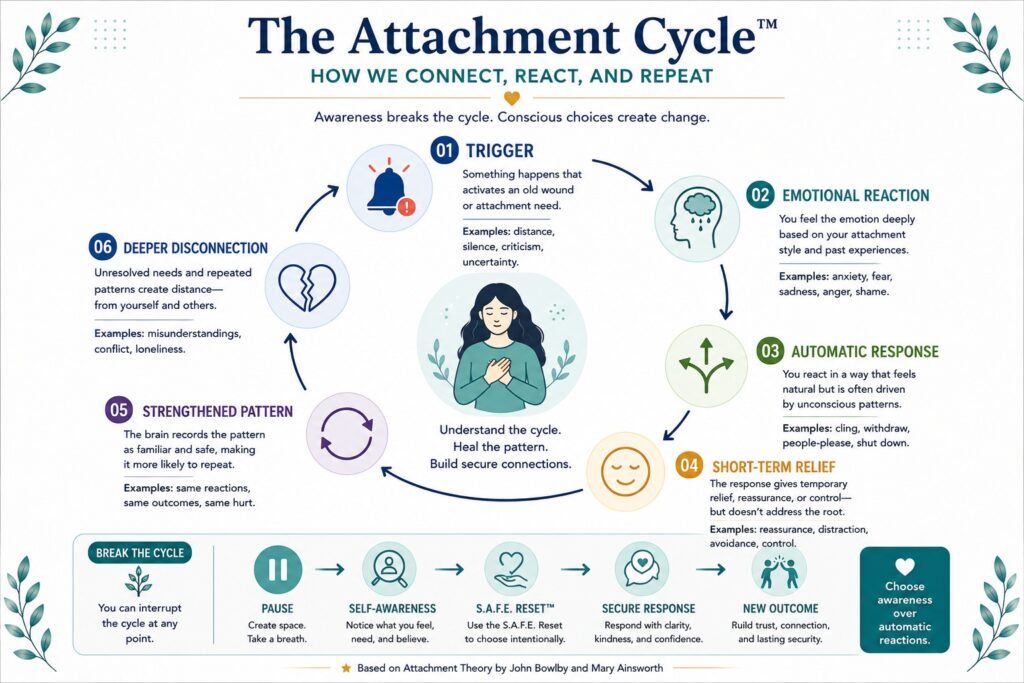
Let’s explore the hidden forces that can make emotional attachment feel so powerful.
1. You’re Looking for Emotional Safety—Not Just Love
Many people believe they’re searching for love.
In reality, they’re searching for something even more fundamental:
A place where they feel emotionally safe.
Think about the people you’ve felt closest to.
Was it only because they were attractive or interesting?
Or was it because they made you feel accepted, understood, valued, or seen?
Our nervous system remembers people who make us feel safe.
When someone listens without judging us, remembers small details about our lives, or makes us feel comfortable being ourselves, our brain begins to associate that person with emotional security.
Sometimes, what we become attached to isn’t the person alone—it’s the sense of peace we experience in their presence.
This is why losing that connection can feel as though we’ve lost a part of ourselves.
2. Loneliness Can Make Emotional Bonds Feel Stronger
Loneliness is more than simply being alone.
It is the feeling that our need for meaningful connection isn’t being met.
When someone enters our life during a lonely season, they can quickly become emotionally significant.
This doesn’t mean the relationship isn’t real.
It simply means our emotional need for connection may increase the intensity of our attachment.
Imagine someone who has spent months feeling isolated.
A new friend shows genuine interest, checks in regularly, and offers emotional support.
The relationship naturally begins to feel incredibly important.
This isn’t weakness.
It’s a reminder that human beings are wired to seek belonging.
The solution isn’t to feel guilty about needing people.
It’s to gradually build a life where emotional support comes from multiple healthy relationships rather than one person carrying all that responsibility.
3. You Fall in Love With Potential Instead of Reality
One of the mind’s greatest strengths is imagination.
Unfortunately, it can also become one of its greatest traps.
Sometimes we don’t become attached to who someone is.
We become attached to who we hope they’ll become.
You might find yourself thinking:
- “They’re just going through a difficult phase.”
- “Once they heal, things will be different.”
- “I know they love me—they just don’t know how to show it.”
Hope is a beautiful quality.
But when hope consistently replaces evidence, it can keep us emotionally invested in relationships that never become healthy.
Healthy relationships are built on consistent actions—not imagined futures.
A helpful question to ask yourself is:
“If this person never changed, would this relationship still be good for me?”
That question often brings remarkable clarity.
4. Your Brain Confuses Familiarity With Safety
Here’s something surprising.
The brain doesn’t always prefer what’s healthy.
It often prefers what’s familiar.
If you grew up in an environment where love felt unpredictable, emotionally distant, or inconsistent, those dynamics may feel strangely familiar in adulthood.
That doesn’t mean you consciously choose unhealthy relationships.
It means your brain recognizes patterns it has experienced before.
Psychologists sometimes describe this as the pull of familiarity.
Even when those familiar patterns create stress, they can still feel emotionally recognizable.
This is one reason people sometimes leave supportive relationships but repeatedly return to emotionally unavailable partners.
Healing often requires teaching the brain that calm, respectful, and consistent relationships are not boring—they are safe.
5. Uncertainty Keeps Your Mind Emotionally Invested
Have you ever noticed how difficult it is to stop thinking about someone who sends mixed signals?
One day they’re affectionate.
The next day they’re distant.
Their behaviour becomes unpredictable.
Instead of reducing attachment, inconsistency often strengthens it.
Why?
Because uncertainty activates the brain’s search for answers.
We replay conversations.
We analyse text messages.
We imagine different scenarios.
We search for hidden meanings.
The relationship becomes mentally unfinished.
The more unfinished it feels, the harder it can be to emotionally let go.
Sometimes what keeps us attached isn’t love.
It’s the unanswered questions.
6. You Seek Validation Through Relationships
Everyone appreciates feeling valued.
But sometimes our self-worth becomes closely tied to another person’s approval.
When this happens, relationships can begin to feel like emotional report cards.
A compliment lifts your mood.
A delayed reply makes you question yourself.
A disagreement feels like proof that you’re not enough.
Over time, the relationship becomes less about connection and more about seeking reassurance.
This can leave both people emotionally exhausted.
Healthy relationships should add to your sense of worth—not become the only place you find it.
The strongest relationships are built between two people who value each other, not between one person seeking constant validation and another trying to provide it.
7. Your Emotional Needs Haven’t Been Fully Understood
Sometimes people ask,
“Why am I so needy?”
A more compassionate question is:
“What emotional need am I trying to meet?”
Perhaps you long to feel accepted.
Perhaps you’ve rarely experienced consistent emotional support.
Perhaps you’ve spent years taking care of everyone else while quietly hoping someone would finally take care of you.
When emotional needs remain unrecognized, we naturally look for someone who seems capable of filling that emptiness.
The problem is that no single relationship can permanently satisfy every emotional need.
Real emotional security develops from many sources:
- Self-understanding.
- Healthy friendships.
- Meaningful family connections.
- Personal purpose.
- Self-compassion.
- Emotionally balanced romantic relationships.
The more diverse your sources of emotional support become, the less pressure any one relationship has to meet every need.
The Important Difference Between Emotional Need and Emotional Dependency
There is nothing unhealthy about needing people.
Human beings are biologically and psychologically designed for connection.
The difficulty begins when one relationship becomes the primary source of your emotional stability.
Healthy attachment sounds like this:
“I deeply value this relationship, but I also know who I am without it.”
Emotional dependency sounds more like this:
“Without this person, I don’t know who I am.”
That distinction is incredibly important.
One grows from connection.
The other grows from fear. Learning the difference is one of the greatest gifts you can give yourself.
Reflection Exercise
Pause for a moment and think about someone you’ve struggled to let go of.
Now ask yourself these questions honestly:
- Did this person make me feel emotionally safe—or emotionally uncertain?
- Was I attached to their actions or to my hopes about who they could become?
- Was I seeking love, reassurance, validation, or relief from loneliness?
- Which emotional need was I hoping this relationship would fulfill?
- If I already felt secure within myself, would I experience this relationship differently?
These questions aren’t meant to create guilt.
They’re meant to replace self-criticism with self-awareness. Because lasting change begins with understanding—not blame.
Key Takeaways

•	Emotional attachment often grows from the search for safety rather than weakness.
•	Loneliness can intensify emotional bonding by increasing the need for connection.
•	Hope is healthy, but relationships should be judged by consistent behaviour rather than imagined potential.
•	The brain often prefers familiar relationship patterns, even when they aren't healthy.
•	Uncertainty keeps the mind emotionally engaged, fueling overthinking and emotional exhaustion.
•	Emotional needs are normal, but relying on one person to meet all of them can lead to emotional dependency.
•	Understanding why you attach is the first step toward learning how to build healthier relationships.
Healthy Emotional Attachment vs. Emotional Dependency — How to Tell the Difference
One of the biggest myths about relationships is that the stronger your feelings are, the deeper your love must be.
But intensity and health are not the same thing.
Many people mistake emotional dependency for love because both involve strong emotions. In reality, they are fundamentally different experiences.
Healthy attachment allows two people to grow together.
Emotional dependency slowly causes one person to lose themselves.
Understanding the difference can transform not only your relationships but also the relationship you have with yourself.
What Is Healthy Emotional Attachment?
Healthy emotional attachment is built on trust, mutual respect, emotional safety, and personal independence.
You care deeply about the other person, but your emotional well-being doesn’t depend entirely on their presence or approval.
Healthy attachment sounds like this:
- “I love spending time with you, but I also enjoy my own life.”
- “I miss you when we’re apart, but I know we’ll reconnect.”
- “We can disagree without fearing the end of the relationship.”
- “I feel emotionally close to you without losing my own identity.”
Healthy attachment creates security rather than anxiety.
It encourages growth rather than control.
And it allows both people to feel accepted without needing to be perfect.
What Is Emotional Dependency?
Emotional dependency happens when another person becomes the primary source of your emotional stability, self-worth, or sense of security.
Instead of enriching your life, the relationship begins to define it.
Your mood may rise and fall depending on their attention.
You might feel lost when they are unavailable.
You may ignore your own needs simply to keep the relationship intact.
This doesn’t happen because you’re weak.
It often develops gradually, especially when unmet emotional needs, loneliness, fear of abandonment, or low self-worth remain unaddressed.
The important thing to remember is this:
“Needing support is healthy. Needing one person to carry your entire emotional world is exhausting for both people.“
Healthy Attachment vs. Emotional Dependency
Let’s compare the two side by side.
| Healthy Emotional Attachment | Emotional Dependency |
| You value the relationship without losing your identity. | Your identity becomes closely tied to the relationship. |
| You enjoy closeness while respecting boundaries. | Boundaries feel threatening or unnecessary. |
| You trust the relationship even during temporary distance. | Distance immediately creates fear and panic. |
| Your happiness comes from many parts of life. | Your happiness depends mostly on one person. |
| You communicate your needs openly. | You fear expressing needs because the relationship might end. |
| Conflict becomes an opportunity to grow. | Conflict feels like proof the relationship is failing. |
| You encourage each other’s independence. | Independence feels like rejection or abandonment. |
| Love feels calm, secure, and respectful. | Love often feels intense, unpredictable, and emotionally exhausting. |
As you read through this comparison, notice which column feels more familiar.
The goal isn’t to judge yourself. It’s to understand your patterns with honesty and compassion.
Seven Signs You May Be Becoming Emotionally Dependent
Most people don’t wake up one morning and realize they’ve become emotionally dependent.
The shift usually happens slowly.
Here are some common signs to watch for.
1. Their Mood Controls Your Mood
If they seem happy, you feel peaceful.
If they become distant or upset, your entire day changes.
Your emotional state begins revolving around theirs.
Healthy relationships involve empathy.
Dependency makes your emotional balance dependent on someone else’s emotional weather.
2. You Constantly Seek Reassurance
Do you often wonder:
- “Do they still love me?”
- “Are they losing interest?”
- “Did I say something wrong?”
Occasional reassurance is completely normal.
But when reassurance becomes a daily emotional requirement, it may indicate underlying insecurity rather than relationship problems.
3. You Neglect Your Own Needs
Perhaps you’ve stopped spending time with friends.
Maybe your hobbies no longer interest you.
You postpone personal goals because the relationship consumes most of your emotional energy.
Healthy relationships should expand your life—not gradually replace it.
4. Being Alone Feels Unbearable
Solitude and loneliness are not the same.
Healthy solitude creates space for rest, creativity, and self-reflection.
Dependency often turns being alone into something frightening because your emotional stability feels dependent on another person’s presence.
Learning to enjoy your own company is one of the strongest foundations of emotional health.
5. You Ignore Red Flags
Have you ever found yourself making excuses like:
- “They’re just stressed.”
- “They didn’t mean it.”
- “Things will improve.”
Compassion is important.
But repeatedly ignoring behaviour that hurts you can slowly erode your emotional well-being.
Healthy love doesn’t require pretending harmful patterns don’t exist.
6. You Fear Losing the Relationship More Than Losing Yourself
This is one of the clearest signs of emotional dependency.
You avoid expressing your true feelings.
You stay silent during conflict.
You tolerate disrespect because you’re afraid honesty might end the relationship.
In trying to protect the relationship, you slowly disconnect from yourself.
Ironically, genuine intimacy becomes impossible when one person feels unable to be authentic.
7. You No Longer Recognize Yourself
One of the quietest consequences of emotional dependency is losing touch with who you are.
Ask yourself:
- What activities bring me joy?
- What values matter most to me?
- What dreams have I placed on hold?
- Who was I before this relationship became the center of my life?
These questions aren’t meant to encourage separation.
They’re meant to help you reconnect with yourself.
The healthiest relationships are formed by two whole people—not by one person disappearing into another.
Why Emotional Dependency Isn’t a Personal Failure
If you recognize yourself in some of these signs, please don’t conclude that something is “wrong” with you.
Psychological patterns develop for understandable reasons.
Sometimes they begin in childhood.
Sometimes they emerge after painful breakups, emotional neglect, loneliness, or repeated experiences of rejection.
Your mind wasn’t trying to make life harder.
It was trying to protect you.
The challenge is that strategies that once helped us feel safe can eventually limit our emotional freedom.
The good news is that the brain can learn new patterns.
With self-awareness, healthier relationships, and consistent practice, emotional dependency can gradually give way to secure, balanced attachment.
That journey doesn’t happen overnight.
But it absolutely can happen.
A Moment of Honest Reflection
Before moving to the next section, pause and ask yourself:
- Do I feel loved—or do I feel anxious most of the time?
- Does this relationship encourage me to become more myself or less?
- Am I choosing this relationship freely, or am I holding on because I’m afraid of being alone?
- If this relationship ended tomorrow, what parts of me would still remain?
These questions aren’t designed to create fear.
They’re designed to help you distinguish between connection that strengthens you and dependence that quietly weakens you.
Sometimes the most powerful relationship breakthrough doesn’t come from understanding another person.
It comes from understanding yourself.
Key Takeaways

•	Healthy emotional attachment supports both closeness and individuality.
•	Emotional dependency develops when one person becomes your main source of emotional stability or self-worth.
•	Strong emotions do not automatically indicate healthy love.
•	Dependency often grows gradually through unmet emotional needs, fear of abandonment, loneliness, or low self-esteem.
•	Reconnecting with your own identity is an essential step toward healthier relationships.
•	Emotional patterns are learned, which means they can also be reshaped through awareness, practice, and supportive relationships.
The S.A.F.E. Reset™ — A Practical Way to Build Healthier Emotional Attachment
By now, you may have recognized some of your own emotional patterns.
Perhaps you realized you often seek reassurance.
Maybe you noticed that uncertainty makes you overthink.
Or perhaps you’ve discovered that what you called “love” was sometimes a search for emotional safety.
Awareness is a powerful first step.
But awareness alone doesn’t create change.
Real change happens when awareness is followed by intentional action.
That’s why we developed The S.A.F.E. Reset™—a simple, practical framework that helps you pause automatic emotional reactions and respond in ways that strengthen emotional fitness instead of emotional dependency.
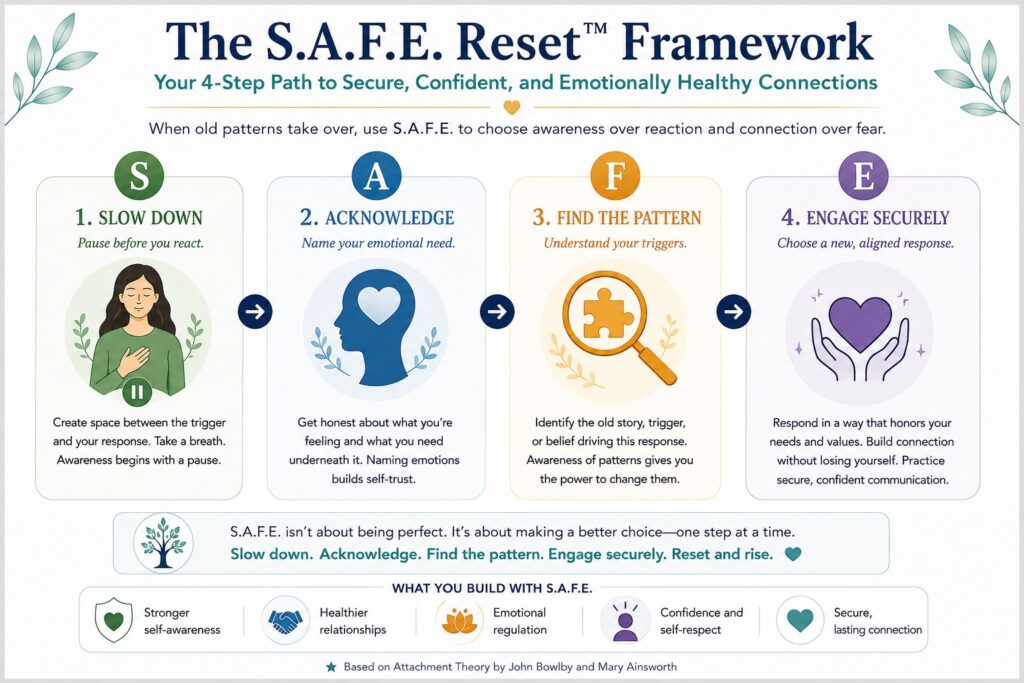
The goal isn’t to stop caring.
The goal is to care without losing yourself.
S — Slow Down Before You React
When we fear losing someone, our first impulse is often immediate action.
We sent another message.
We check if they’ve been online.
We replay conversations.
We imagine worst-case scenarios.
These reactions feel urgent because our brain interprets emotional uncertainty as a potential threat.
But urgency isn’t always accuracy.
One of the greatest gifts you can give yourself is a pause.
That pause creates space between what you feel and what you choose to do.
Try This
The next time you feel emotionally triggered:
- Take five slow, steady breaths.
- Put your phone down for ten minutes.
- Notice what you’re feeling without trying to fix it immediately.
Ask yourself:
“Am I responding to what actually happened or to what I’m afraid might happen?”
That single question can interrupt hours of unnecessary overthinking.
A — Acknowledge Your Emotional Need
Every strong emotion carries a message.
Instead of asking:
“How do I stop feeling this?”
Try asking:
“What is this feeling trying to tell me?”
Perhaps you need reassurance.
Perhaps you’re feeling lonely.
Perhaps you want to feel appreciated.
Perhaps you’re longing for emotional closeness after a stressful week.
Emotions are not enemies.
They are information.
When we ignore them, they often become louder.
When we understand them, they become easier to manage.
Emotional Check-In
Complete this sentence honestly:
Right now, beneath all these thoughts, I really need ____________.
You might be surprised by your answer.
Often, what we need most isn’t another text message.
It’s understanding, rest, connection, acceptance, or self-compassion.
F — Find the Pattern
Every emotional reaction has a story.
Maybe you’ve noticed that you become especially anxious when someone takes a long time to reply.
Or perhaps you withdraw whenever conflict appears.
Rather than judging these reactions, become curious.
Ask yourself:
- Have I felt this way before?
- Does this situation remind me of another experience?
- What belief about myself becomes activated in moments like this?
- Am I reacting to this relationship—or to an old emotional wound?
Patterns aren’t signs that you’re broken.
They’re clues.
And clues help us understand what our emotional system has learned over time.
Once you recognize a pattern, you gain the power to choose a different response.
E — Engage Securely
The final step is where emotional fitness becomes visible.
Instead of acting from fear, choose behaviors that strengthen trust, respect, and emotional security.
Secure engagement might look like:
- Expressing your feelings honestly instead of expecting others to read your mind.
- Respecting another person’s need for space without assuming rejection.
- Maintaining your friendships, hobbies, and personal goals.
- Setting healthy boundaries with kindness.
- Choosing consistent actions over emotional intensity.
Remember:
Healthy relationships don’t require you to abandon yourself.
They invite you to bring your whole self into the relationship.
The S.A.F.E. Reset™ in Everyday Life
Let’s imagine a common situation.
Your partner usually replies within an hour.
Today, six hours pass without a message.
Your first thought is:
“They must be losing interest.”
Without emotional awareness, you might:
- Send several follow-up messages.
- Check their social media repeatedly.
- Spend the day imagining the worst.
Now apply The S.A.F.E. Reset™.
Slow Down
Instead of reacting immediately, you take a few deep breaths and remind yourself that one delayed reply does not define the relationship.
Acknowledge
You realize what you’re feeling isn’t only frustration.
It’s uncertainty.
And beneath that uncertainty is a need for reassurance.
Find the Pattern
You notice that delayed responses have triggered anxiety in previous relationships too.
This isn’t just about today.
It’s an emotional pattern you’ve carried for some time.
Engage Securely
Rather than accusing or withdrawing, you wait until you can communicate calmly.
When the opportunity arises, you say:
“I noticed I felt anxious when I didn’t hear from you today. I know you may have been busy, but I’d like to talk about how we can communicate in ways that help both of us feel connected.”
Notice the difference.
The goal isn’t to suppress emotion. It’s to express emotion with clarity instead of fear.
Emotional Fitness Is a Daily Practice
No one becomes securely attached overnight.
Just as physical fitness develops through repeated training, emotional fitness grows through small, consistent choices.
Every time you:
- pause before reacting,
- understand your emotional needs,
- recognize an old pattern,
- and choose a healthier response,
You’re strengthening emotional pathways that support resilience, confidence, and secure relationships.
Progress won’t always feel dramatic.
Sometimes it looks like waiting before sending another message.
Sometimes it looks like saying “no” without guilt.
Sometimes it looks like enjoying your own company instead of fearing it.
These quiet moments are where lasting change begins.
Remember This
You don’t become emotionally stronger by feeling less.
You become emotionally stronger by understanding your feelings more deeply.
The aim isn’t emotional distance.
The aim is emotional balance.
When you stop asking,
“How do I stop getting attached?”
and start asking,
“How do I build secure, healthy attachment?”
Everything begins to change. That is the essence of emotional fitness.
Key Takeaways

•	The S.A.F.E. Reset™ helps transform emotional reactions into intentional responses.
•	Slowing down creates space for wiser decisions.
•	Emotions carry valuable information about unmet needs.
•	Recognizing recurring patterns helps break unhealthy relationship cycles.
•	Secure engagement strengthens both relationships and self-respect.
•	Emotional fitness develops through repeated practice—not perfection.
Can You Change Your Attachment Style? The Science Says Yes.
If you’ve recognized yourself in the previous sections, you might be wondering the following:
“Does this mean I’ll always be like this?”
It’s an understandable question.
Many people believe their attachment style is permanent—that if they developed anxious or avoidant patterns early in life, they’re destined to repeat the same relationship struggles forever.
Fortunately, psychology offers a much more hopeful answer.
Your attachment style is a pattern, not a life sentence.
Patterns can be understood.
Patterns can be challenged.
And with consistent practice, patterns can change.
Your Brain Is Designed to Learn Throughout Life
One of the most exciting discoveries in modern psychology and neuroscience is that the human brain remains capable of adapting throughout adulthood.
This ability, known as neuroplasticity, means your brain continually forms and strengthens new neural pathways based on repeated experiences.
Think of it like walking through a field.
The first time you walk across the grass, the path is barely visible.
Walk the same route every day, and a clear trail begins to appear.
Your emotional habits work in much the same way.
The more often you react with fear, reassurance-seeking, or withdrawal, the stronger those pathways become.
But the opposite is also true.
Each time you respond with self-awareness, emotional regulation, and healthy communication, you’re helping your brain build a new emotional pathway.
Change doesn’t happen because you suddenly become a different person.
It happens because you repeatedly choose different responses.
Healing Doesn’t Mean Becoming Emotionless
Some people think becoming securely attached means never feeling anxious, hurt, or disappointed again.
That’s neither realistic nor healthy.
Even emotionally secure people experience the following:
- Heartbreak.
- Rejection.
- Conflict.
- Grief.
- Loneliness.
- Self-doubt.
The difference isn’t whether they experience difficult emotions.
It’s how they respond to them.
Instead of assuming,
“Something must be wrong with me.”
They’re more likely to think:
“This is painful, but I can cope with it.”
That quiet confidence is one of the hallmarks of secure attachment.
Emotional strength isn’t the absence of vulnerability.
It’s trusting yourself to navigate vulnerability without losing your sense of self.
Five Evidence-Based Ways to Build Secure Attachment
While every person’s journey is unique, research and clinical practice consistently highlight several habits that help people move toward more secure relationships.
1. Build a Secure Relationship With Yourself
The most important relationship you’ll ever have is the one you have with yourself.
Ask yourself:
- Do I speak to myself with kindness?
- Can I comfort myself during difficult moments?
- Do I believe I’m worthy of love even when someone disagrees with me?
Self-compassion isn’t self-indulgence.
It’s the emotional foundation that allows you to seek connection without becoming dependent on it.
The more secure you become within yourself, the less you need another person to constantly reassure you of your worth.
2. Choose Relationships That Feel Consistent
Many people unknowingly confuse emotional intensity with emotional compatibility.
But healthy relationships usually feel less dramatic than unhealthy ones.
They are characterized by:
- Consistent communication.
- Mutual respect.
- Emotional honesty.
- Reliability.
- Healthy boundaries.
These qualities may not produce the emotional “high” of unpredictable relationships, but they create something far more valuable:
Trust.
Trust is the soil where secure attachment grows.
3. Learn to Regulate Your Emotions Before Seeking Reassurance
Imagine feeling anxious because someone hasn’t replied to your message.
Your first impulse might be to seek immediate reassurance.
Instead, try asking:
- What am I feeling right now?
- What story am I telling myself?
- What evidence do I actually have?
- Is there another possible explanation?
This doesn’t mean ignoring your emotions.
It means giving yourself the opportunity to understand them before asking someone else to calm them for you.
Over time, this strengthens emotional resilience.
4. Expand Your Sources of Emotional Support
No single relationship can meet every emotional need.
That isn’t a flaw in the relationship.
It’s simply how human beings are designed.
Secure people often draw emotional strength from multiple sources, including:
- Family.
- Close friendships.
- Meaningful work.
- Personal hobbies.
- Physical health.
- Spiritual practices or personal values.
- Professional support when needed.
The more balanced your emotional world becomes, the less pressure any one relationship has to carry.
5. Practice Healthy Communication
Many relationship difficulties aren’t caused by emotions themselves.
They’re caused by unspoken expectations.
Secure communication sounds like:
“I’d like to talk about something that’s been on my mind.”
“When this happened, I felt hurt. Can we discuss it?”
“I don’t need you to be perfect. I just want us to understand each other better.”
Notice that these statements express feelings without blame.
Healthy communication isn’t about winning an argument.
It’s about strengthening understanding.
Growth Isn’t Always Comfortable
As you begin changing old emotional patterns, you may notice something surprising.
Healthy relationships can initially feel unfamiliar.
If you’re used to chasing unpredictable attention, consistency might seem “boring.”
If you’re used to hiding your needs, honest communication might feel uncomfortable.
That’s normal.
Growth often feels unfamiliar before it feels natural.
The important question isn’t:
“Does this feel familiar?”
It’s:
“Does this help me become the person I want to be?” That question shifts your focus from habit to healing.
Progress Is Measured in Small Moments
Many people expect emotional growth to happen through one life-changing breakthrough.
In reality, lasting change usually happens through ordinary moments.
It’s choosing not to send the impulsive text.
It’s expressing your feelings calmly instead of withdrawing.
It’s spending an evening alone without believing you’re unworthy of love.
It’s respecting your own boundaries even when saying “no” feels difficult.
These moments may seem small.
But over weeks, months, and years, they quietly reshape your emotional life.
Remember This
You are not defined by the attachment patterns you learned.
You are defined by the choices you make moving forward.
Your past may explain your emotional habits.
It does not have to predict your future.
Every act of self-awareness, every healthy conversation, every boundary you set, and every compassionate choice you make is another step toward becoming more emotionally secure.
And that journey is always worth taking.
Key Takeaways

•	Attachment styles are learned patterns that can change over time.
•	Your brain remains capable of forming healthier emotional habits throughout adulthood.
•	Secure attachment is built through repeated practice, not perfection.
•	Self-compassion, healthy relationships, emotional regulation, and honest communication all support lasting change.
•	Progress is measured by consistent, everyday choices rather than dramatic transformations.
Building Secure Emotional Attachment—One Day at a Time
If you’ve read this far, you’ve already taken an important step.
Not because you’ve learned a few psychological concepts.
But because you’ve chosen to understand yourself instead of judging yourself.
That choice alone is a powerful act of emotional fitness.
The goal of this article was never to convince you to stop loving deeply.
It was to help you love without losing yourself.
Secure emotional attachment isn’t about becoming emotionally distant.
It’s about feeling connected while remaining grounded in who you are. That kind of emotional security is built through small, everyday choices.
10 Daily Habits That Strengthen Secure Attachment
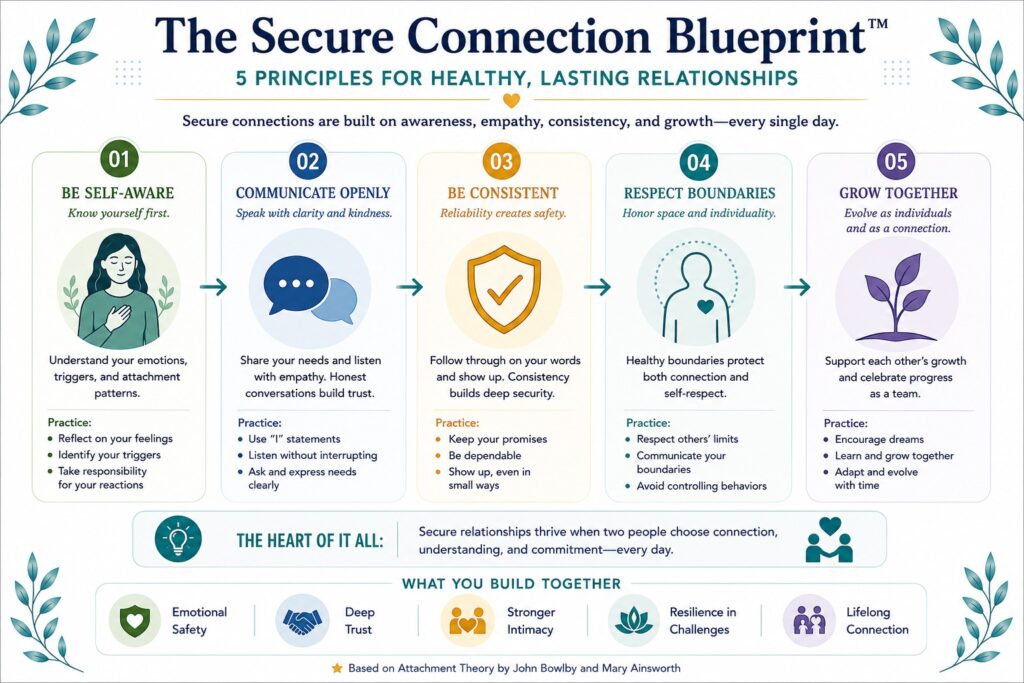
Healthy relationships begin long before we meet the right person.
They begin with the habits we practice every day.
Here are ten simple habits that gradually strengthen emotional security.
1. Pause Before Reacting
Strong emotions deserve attention—not immediate action.
When something triggers you, give yourself permission to pause before responding.
A calm response is usually more effective than an impulsive reaction.
2. Name Your Feelings
Instead of saying,
“I’m a mess.”
Try saying,
“I’m feeling anxious.”
Or,
“I’m feeling disappointed.”
Research suggests that putting emotions into words can reduce their intensity and improve emotional regulation.
3. Maintain Your Own Identity
Continue investing in your interests, friendships, health, career, and personal goals.
A healthy relationship should become an important part of your life—not your entire life.
4. Practice Honest Communication
Speak about your feelings before resentment begins to build.
Healthy communication isn’t about saying everything you think.
It’s about expressing what truly matters with kindness and respect.
5. Accept That Uncertainty Is Part of Every Relationship
No relationship comes with complete certainty.
Trying to eliminate every doubt often creates more anxiety.
Learning to tolerate reasonable uncertainty is one of the foundations of emotional resilience.
6. Strengthen Your Relationship With Yourself
Spend time alone without treating solitude as loneliness.
Read.
Exercise.
Meditate.
Learn a new skill.
Write in a journal.
The more comfortable you become with yourself, the less you rely on constant external reassurance.
7. Set Healthy Boundaries
Boundaries don’t push people away.
Healthy boundaries protect relationships by creating mutual respect.
You can be kind while still saying:
“I’m not comfortable with that.”
Or,
“I need some time to think before I respond.”
8. Celebrate Progress Instead of Perfection
Healing isn’t linear.
Some days you’ll respond calmly.
Other days old patterns may return.
That’s part of being human.
The goal isn’t perfection.
The goal is gradual progress.
9. Build a Circle of Support
Healthy emotional lives rarely depend on one person.
Invest in friendships.
Stay connected with family members who support your well-being.
Seek professional help if you’re struggling.
Emotional resilience grows stronger when support comes from multiple sources.
10. Keep Practicing the S.A.F.E. Reset™
Whenever emotional uncertainty appears, remember:
S – Slow Down
A – Acknowledge Your Emotional Need
F – Find the Pattern
E – Engage Securely
Small moments of awareness gradually become lifelong emotional habits.
Five Common Myths About Emotional Attachment
Let’s clear up some common misunderstandings.
Myth 1: Getting Attached Easily Means You’re Weak
Reality:
It usually means your brain values emotional connection.
The goal isn’t to stop caring.
It’s to build secure ways of caring.
Myth 2: Independent People Don’t Need Others
Reality:
Psychologically healthy people value both independence and connection.
Human beings are naturally social.
Needing support is normal.
Myth 3: Strong Love Should Feel Intense All the Time
Reality:
Healthy love is often calmer than people expect.
It grows through trust, consistency, and mutual respect—not constant emotional highs and lows.
Myth 4: Your Attachment Style Can Never Change
Reality:
Research consistently shows that attachment patterns can become more secure through healthier relationships, self-awareness, emotional regulation, and supportive environments.
Growth is possible at every stage of life.
Myth 5: Healing Means You Won’t Feel Hurt Again
Reality:
Healing doesn’t remove painful emotions.
It changes how you respond to them.
Emotionally secure people still experience disappointment and heartbreak.
They simply recover without losing themselves.
Frequently Asked Questions (FAQ)
Why do I get emotionally attached so quickly?
Many factors can contribute, including your attachment style, past experiences, emotional needs, loneliness, and the way your brain seeks safety and connection. Becoming attached quickly doesn’t automatically mean something is wrong with you—it may simply indicate that your emotional system values close relationships.
Is getting emotionally attached a bad thing?
Not at all.
Healthy emotional attachment is essential for meaningful relationships.
The challenge arises when attachment turns into emotional dependency or causes you to ignore your own needs and boundaries.
Can adults develop a secure attachment style?
Yes.
Psychological research suggests that attachment patterns can become more secure through self-awareness, emotionally healthy relationships, consistent communication, emotional regulation, and, when appropriate, professional support.
How long does it take to become more securely attached?
There is no fixed timeline.
For some people, meaningful change begins within months.
For others, it may take longer.
What matters most is practicing healthy emotional habits consistently rather than expecting immediate transformation.
Should I seek professional help?
If emotional attachment repeatedly leads to overwhelming anxiety, unhealthy relationship patterns, emotional dependency, or significant distress in your daily life, speaking with a qualified mental health professional can be a valuable step toward understanding and healing.
Seeking help is a sign of strength—not weakness.
A Final Thought
If there’s one message we hope you carry with you, let it be this:
You are not “too much.”
You are not “too needy.”
And you are not “broken.”
Like every human being, you were born with a deep need for connection, belonging, and emotional safety.
Sometimes life teaches us relationship patterns that no longer serve us.
The encouraging news is that patterns can change.
Every time you pause before reacting…
Every time you communicate honestly…
Every time you respect your own boundaries…
Every time you choose understanding over self-criticism…
You strengthen your emotional fitness.
And with every small step, you move closer to relationships that feel less exhausting and more secure.
You deserve relationships where you can love deeply without losing yourself.
That journey begins not with finding the perfect person—
but with understanding the remarkable person you already are.
Your Emotional Fitness Challenge
Over the next seven days, practice one step of the S.A.F.E. Reset™ whenever you notice yourself feeling emotionally triggered.
At the end of each day, ask yourself:
- What emotion did I notice today?
- Which emotional need was underneath it?
- What pattern did I recognize?
- How did I choose to respond?
You don’t need perfect answers.
You simply need honest awareness.
Because awareness is where lasting emotional growth begins.
Note—At The Psyche Inspire, our articles combine established psychological research with practical, reader-friendly guidance. While this article is intended for educational purposes and should not replace professional mental health care, every effort has been made to base the concepts discussed on peer-reviewed research and guidance from recognized psychological and public health organizations.
References

American Psychological Association. (2023). Developing emotional awareness and emotional intelligence.

American Psychological Association. (2023). Building resilience.

Ainsworth, M. D. S., Blehar, M. C., Waters, E., & Wall, S. (1978). Patterns of attachment: A psychological study of the strange situation. Lawrence Erlbaum Associates.

Bowlby, J. (1969/1982). Attachment and loss: Vol. 1. Attachment (2nd ed.). Basic Books.
Bowlby, J. (1973). Attachment and loss: Vol. 2. Separation: Anxiety and anger. Basic Books.

Cassidy, J., & Shaver, P. R. (Eds.). (2016). Handbook of attachment: Theory, research, and clinical applications (3rd ed.). Guilford Press.

Fraley, R. C. (2019). Attachment in adulthood: Recent developments, emerging debates, and future directions. Annual Review of Psychology, 70, 401–422.

Johnson, S. M. (2019). Attachment theory in practice: Emotionally focused therapy (EFT) with individuals, couples, and families. Guilford Press.

National Institute of Mental Health. (2024). Caring for your mental health.
3 thoughts on “Why Do I Get Emotionally Attached So Easily? The Hidden Psychology Behind Strong Emotional Bonds”