

Have you ever spent an hour deciding something that should have taken ten minutes?
You compare the options. Read another review. Ask someone you trust. Think about what could go wrong. Then you reconsider the option you had almost chosen.
Eventually, even a simple decision feels exhausting.
You may begin wondering:
“Why can’t I make decisions?”
Table of Contents
The answer is not always that you are confused.
Sometimes, the real difficulty is what making the decision means to you. You may be afraid of choosing badly. You may want to avoid regret. You may feel uncomfortable with uncertainty. Or you may believe there is a perfect choice waiting somewhere if you search long enough.
This is where decision paralysis can develop.
It is not a diagnosis. It is a useful way of describing a pattern in which thinking, comparing or worrying makes it increasingly difficult to choose and act.
What Is Decision Paralysis?
Decision paralysis happens when the process of deciding becomes so difficult that you delay, avoid or repeatedly reopen a choice.
It can happen with major decisions:
- Should I change my job?
- Should I move to another city?
- Should I start this relationship?
- Should I pursue another course?
- Should I make this financial commitment?
But it can also appear in ordinary situations.
You spend twenty minutes choosing what to order. You compare dozens of products before buying something inexpensive. You draft a message several times because you are afraid it might be misunderstood. The decision itself may not be especially complicated. The emotional meaning attached to it may be.
This is also why decision paralysis is not exactly the same as overthinking. Overthinking can involve repeatedly analysing the past, present or future. Decision paralysis specifically becomes a problem when that mental activity interferes with choosing or acting.
If you recognise the overlap, my earlier article on the hidden psychology of overthinking explores the broader pattern in more detail. The focus here is narrower: why uncertainty can make choosing so difficult.
Why Is It So Hard to Make a Decision?
One important factor is how comfortable you are with uncertainty. Every meaningful decision contains some unknowns.
You can research a job, but you cannot know exactly what the workplace will feel like six months later. You can carefully choose a course, but you cannot guarantee that your interests will remain unchanged. You can make a thoughtful relationship decision, but you cannot control another person’s future behaviour.
For some people, this uncertainty is simply uncomfortable. For others, not knowing feels almost intolerable. Psychologists refer to this tendency as intolerance of uncertainty.
A 2019 meta-analysis examined 181 studies involving more than 52,000 participants and found a moderate overall association between intolerance of uncertainty and symptoms across several psychological difficulties. The researchers also found substantial variation between studies, so the finding should not be interpreted as proof that intolerance of uncertainty causes every case of anxiety or indecision.
More recently, a preregistered 2025 experiment with 301 participants provided stronger evidence for a causal role: experimentally increasing intolerance of uncertainty led to greater indecisiveness across two personally relevant decisions. This is important because it moves beyond simple correlation, although it does not mean that every person who struggles with decisions has a psychological disorder.
The practical lesson is simple:
Sometimes the hardest part of a decision is not choosing. It is tolerating what you cannot know.
When Your Mind Wants the “Best” Decision
Imagine you are buying a laptop. You have already found three models that meet your needs. But instead of choosing, you continue searching. Another review mentions a fourth model. Then another comparison suggests a slightly better processor. Soon, you are comparing specifications that you may never actually use.
This is sometimes called maximizing—trying to identify the very best possible option rather than a satisfactory one.
The alternative is often described as satisficing: choosing an option that meets the important requirements and stopping the search when the standard has been reached.
Neither approach is automatically good or bad. For important decisions, careful comparison can be sensible. The problem begins when “finding the best” becomes an endless search.
Research on maximizing has found an important distinction. In a five-study programme involving 1,479 participants, researchers separated the desire to choose the best from the strategy of exhaustively searching alternatives. The two were not psychologically identical. The goal of choosing the best could be associated with positive experiences, while exhaustive alternative-search was more strongly associated with negative experiences such as stress and dissatisfaction.
That distinction matters.
You may not actually be obsessed with having the perfect choice.
You may simply have learned that more information feels safer than committing.
Why Fear of Regret Can Keep You Stuck
Sometimes the question behind indecision is not:
“Which option is better?”
It is:
“What if I choose this and regret it?”
Regret is powerful because it makes us imagine an alternative future.
You choose Job A. Then your mind imagines how successful you might have been at Job B. You decide to stay in your city. Then you imagine the life you might have had elsewhere.
You end a relationship. Then your mind remembers only the best moments. This is counterfactual thinking: mentally comparing what happened with what might have happened.
Anticipated regret can influence decisions before they are made.
In a diary study of 108 participants followed for eight days, people anticipated regret for about 70% of future decisions, while they reported actually regretting about 30% of decisions made. The study illustrates an important gap between how much regret we expect and how much regret we actually experience.
That does not mean regret is unimportant. It means the mind may sometimes prepare for much more regret than the eventual decision produces. And when avoiding regret becomes the main goal, not choosing can start to feel safer than choosing.
Why Not Deciding Can Feel Safer
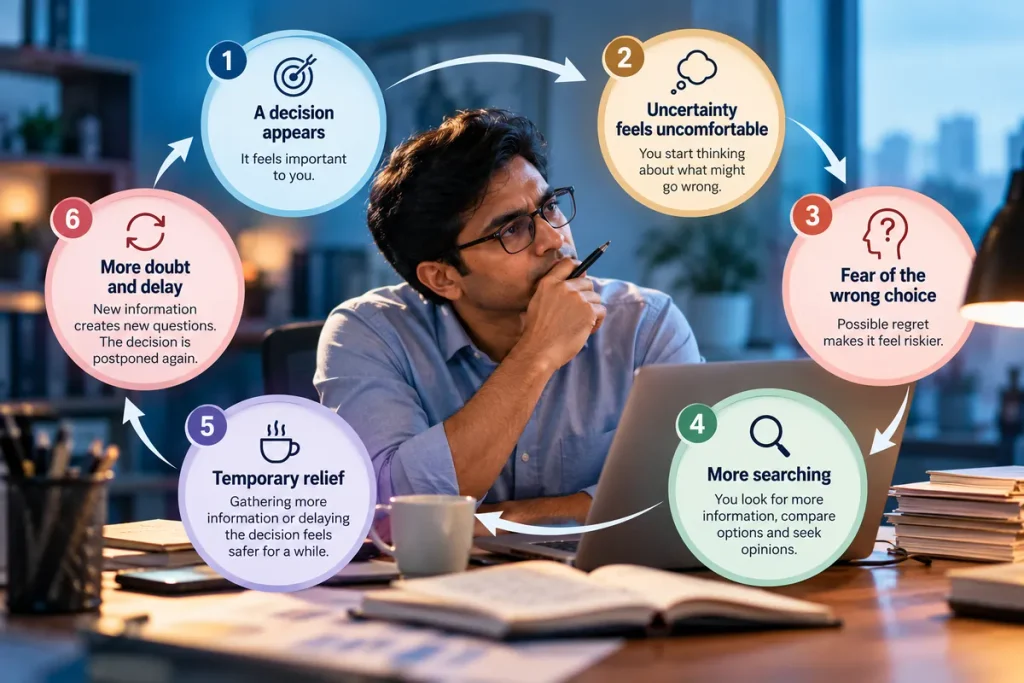
There is a strange comfort in postponement. If you do not choose, you cannot immediately discover that your choice was wrong.
You can tell yourself: “I’ll decide tomorrow.”
Then tomorrow becomes next week. The decision remains unresolved, but at least you have avoided the discomfort of committing.
This can become decision avoidance.
The short-term emotional effect can be reassuring. You have removed the immediate pressure. But the decision has not disappeared. It may simply become more stressful because it remains unfinished.
There is another psychological factor here: the status quo.
When changing something feels risky, staying where you are can feel like the safer option because it is familiar. Research on status quo bias has repeatedly examined this tendency to favour an existing state over alternatives, particularly when decisions are difficult.
Consider someone who dislikes their job but keeps postponing a career change. The current job is stressful. Yet leaving it introduces uncertainty.
So the mind compares: Known discomfort versus unknown possibility.
Sometimes staying is genuinely the sensible choice. But sometimes the decision is being made by fear of change rather than by a careful evaluation of the alternatives.
A useful question is:
“If I make no decision, what happens next?”
Doing nothing is not always neutral. Sometimes circumstances eventually make the decision for you.
When Too Many Choices Become Too Much
You open a shopping website looking for a pair of headphones. There are six models. Then sixty. Then hundreds. You begin comparing battery life, sound profiles, reviews, prices, colours and tiny differences in specifications.
More information was supposed to help. Instead, you feel less certain. This is where choice overload can become relevant.
But there is an important correction to the popular idea that “more choices always cause paralysis.” Research does not support such a simple rule.
A 2010 meta-analysis examined 50 experiments involving 5,036 participants and found an overall mean effect of choice overload that was virtually zero, with considerable variation between studies.
A later 2015 meta-analysis of 99 observations involving 7,202 participants found that the effect of having more options depended on factors such as the complexity of the choice set, task difficulty, uncertainty about personal preferences and the goal of the decision.
So the problem is not simply quantity.
It is the interaction between the number of options and the person, task and situation. Ten simple choices may be easier than three complicated ones.
This is why reducing options can sometimes help—but reducing them blindly is not the answer.
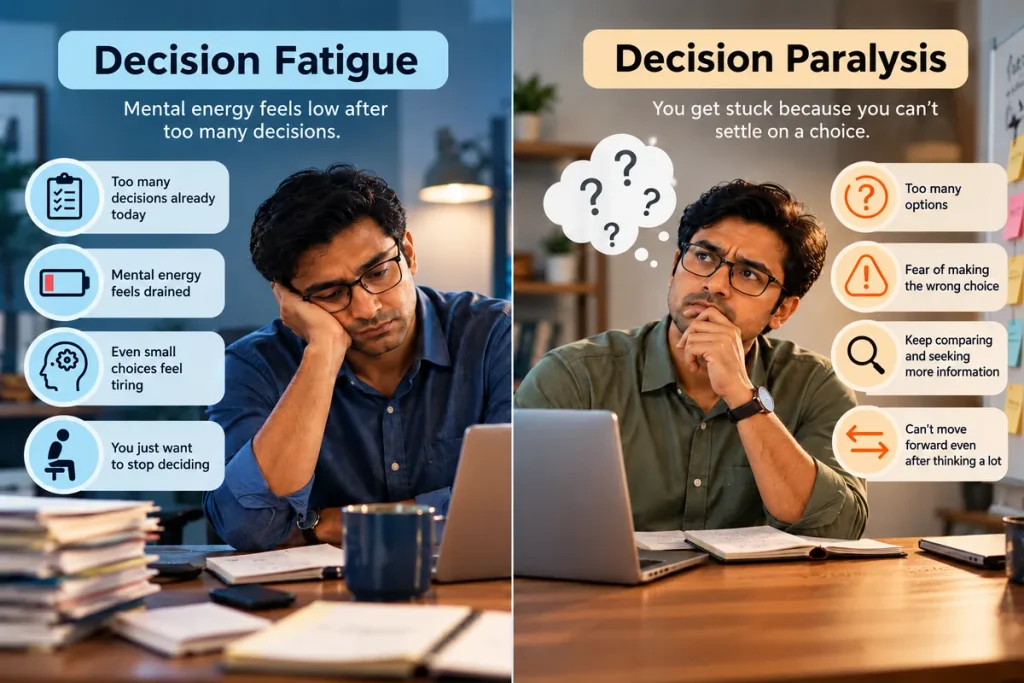
Is Decision Fatigue Making You Indecisive?
You have worked all day. You have answered emails, attended meetings, solved problems and dealt with other people’s requests.
Then someone asks: “What do you want for dinner?”
Suddenly, you do not care. You just want someone else to decide.
This experience is often described as decision fatigue.
There is evidence that repeated decision-making can be mentally demanding, but the popular idea that everyone has a fixed daily supply of decision-making energy is much too simple.
A 2025 systematic review examined 82 studies of decision fatigue among healthcare professionals and trainees. Only 45% of the quantitative cases provided evidence for significant decision-fatigue effects, and the researchers noted substantial inconsistency in how the concept was defined and measured.
So it is better to say:
A demanding day can make some decisions feel harder, but decision fatigue is not a universal explanation for indecisiveness.
Sometimes the problem is tiredness. Sometimes it is uncertainty. Sometimes it is perfectionism. Sometimes it is fear. Often, several factors interact.
How Do You Know When You Have Thought Enough?
This may be the most useful question in the entire article. The goal is not to make every decision quickly. Good decisions sometimes require time. The question is whether your thinking is still producing something useful.
Ask yourself:
- Am I learning something new?
- Is there important information I genuinely do not have?
- Could new information realistically change my choice?
- Do I know what matters most to me?
- Am I comparing meaningful differences or tiny details?
- Am I looking for evidence—or reassurance?
- Am I trying to improve the decision or eliminate all uncertainty?
There is a difference between information-seeking and certainty-seeking.
Information-seeking can improve a decision. Certainty-seeking can continue indefinitely because complete certainty is often impossible. Once additional searching stops changing your understanding, another hour of research may not make the decision better.
It may simply make you more tired.
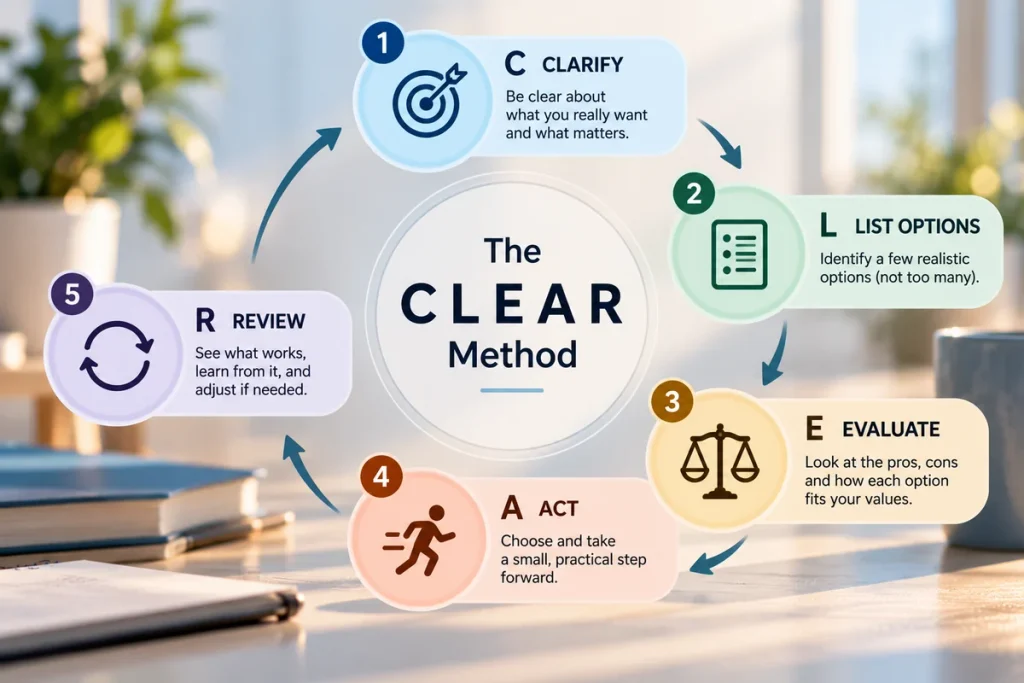
The C.L.E.A.R. Decision Method™
When decision paralysis becomes a pattern, a simple structure can help.
The C.L.E.A.R. Decision Method™ is an original educational reflection framework used here to organise the ideas in this article. It is not a clinically validated intervention or diagnostic tool.
C — Clarify What You Are Actually Deciding
Sometimes the decision becomes mixed with several other questions.
You may think you are deciding whether to change jobs. But underneath it may be:
“Am I capable of succeeding somewhere else?”
“What will my family think?”
“What if I fail?”
“What if leaving means I made a mistake?”
Separate the decision from the story surrounding it.
Try writing:
I am deciding whether to: _______
Then identify the three things that matter most.
For example:
- Financial stability
- Growth opportunity
- Time with family
You do not need twenty criteria. A decision becomes easier when the important criteria are visible.
L — Limit the Options Without Limiting Your Thinking
You do not need to investigate every possible alternative. For a manageable decision, create a shortlist. You might divide your criteria into:
Must have
What is essential?
Would be good
What would improve the choice but is not necessary?
Deal-breaker
What would make an option unacceptable?
This prevents one common trap:
“Maybe there is one more option I haven’t found yet.”
Of course, sometimes another option really is worth considering. The question is whether it could meaningfully change the decision. If not, continuing to search may be adding noise rather than value.
E — Examine What You Know and What You Predict
This is where many decisions become clearer. Take a piece of paper and make two columns.
What I Know
Facts you can reasonably verify.
What I Predict
Things you think might happen.
For example:
What I know:
“My current job offers stable income.”
What I predict:
“If I leave, I will definitely regret it.”
The second statement may be possible.
It is not a fact. This does not mean emotions should be ignored. Fear can tell you something important about what matters to you.
But emotion and evidence are not the same thing.
Ask:
“What would actually change my mind?”
If you cannot identify anything, you may already have enough information.
A — Accept What You Cannot Know
Acceptance does not mean liking every possible outcome. It means recognising the boundary between what you can influence and what you cannot guarantee.
You can research a job. You cannot guarantee your future happiness there. You can communicate honestly in a relationship. You cannot control how another person will respond. You can prepare for an examination. You cannot control every question that appears.
A useful distinction is between risk and uncertainty.
Risk involves outcomes you can at least estimate or prepare for. Uncertainty involves information you simply do not have. Trying to remove all uncertainty before acting can keep you waiting indefinitely.
Sometimes the more realistic question is:
“Can I live with the uncertainty that remains?”
That is different from asking:
“Can I guarantee that everything will work out?”
R — Respond and Allow the Decision to Become an Experience
Eventually, a decision has to leave your notebook and enter real life.
Choose.
Act.
Then give the decision some space. This does not mean refusing to change your mind. If meaningful new information appears, reconsider. If circumstances change substantially, adjust.
But do not reopen a decision every time anxiety returns. This distinction is important.
New information is a reason to reconsider.
The return of an old fear is not necessarily new information.
Suppose you accept a new job and feel nervous during the first week. The discomfort does not automatically mean the decision was wrong. It may simply mean something new is happening.
Let experience provide information before judging the decision.
Decision Paralysis in Real Life
Decision paralysis does not stay inside the mind. It can influence important areas of everyday life.
Career
A person may spend months comparing jobs because every option has a possible downside. Meanwhile, the current job becomes increasingly frustrating. The issue may not be a lack of career information. It may be the belief that the “right” career choice should feel completely safe before it is made.
Relationships
Someone may keep analysing whether they should stay in a relationship. They compare good memories with difficult ones. Ask friends for opinions. Revisit old conversations. Sometimes this careful reflection is necessary.
But if the same questions return without new information, the person may be caught in a cycle of uncertainty rather than moving towards clarity.
Education
A student may compare courses, universities and career paths for so long that the application deadline approaches. Research is useful. But eventually, choosing requires accepting that no course can guarantee a particular future.
Money
Financial decisions naturally deserve caution. But caution can become paralysis when every possible downside is treated as a reason to wait indefinitely. Important financial decisions should involve appropriate professional advice where necessary.
The psychological lesson remains the same:
Good decision-making does not mean eliminating every possibility of loss.
Everyday Life
Sometimes decision paralysis appears in tiny ways.
What should I eat?
Which phone should I buy?
Should I attend this event?
Which book should I read?
These small decisions can become useful practice. You can choose something reasonable without turning every choice into a referendum on your future.
When Indecisiveness May Need More Attention
Being indecisive sometimes is normal. The concern is not simply how long you take. Look at the impact.
Ask yourself:
- Do important decisions regularly consume disproportionate amounts of time?
- Do I avoid opportunities because I cannot guarantee the outcome?
- Do I repeatedly seek reassurance about the same decision?
- Do I keep checking information even when nothing new is emerging?
- Do I reopen decisions mainly because anxiety has returned?
- Is indecision affecting my work, relationships, studies or responsibilities?
There is no diagnostic score hidden inside these questions. They are simply prompts for self-reflection.
Persistent indecisiveness can occur alongside anxiety, perfectionistic concerns, obsessive-compulsive symptoms and other psychological difficulties. Research has also found associations between indecisiveness and perfectionistic concerns, although these relationships are complex.
Indecision itself is not a diagnosis.
If the pattern is persistent, distressing or significantly affecting your life, speaking with a qualified mental-health professional can help you understand what is maintaining it.
What If You Still Cannot Decide?
Sometimes you have thought carefully, and you are still uncertain. That is normal.
First ask:
“Do I need more information, or do I need more certainty?”
If you can name specific information that could genuinely change the decision, gather it. If you cannot identify what is missing, continuing to search may not help. You can also give the decision a reasonable stopping point.
For example:
“I will compare these three options tonight, check the important facts and decide tomorrow.”
The purpose is not to force an artificial deadline. It is to prevent endless analysis from becoming your default response. Then practise making smaller decisions without reopening them.
Choose the restaurant.
Send the ordinary message.
Buy the reasonable option.
Let someone else choose the film.
Notice what happens when you make a choice and allow some uncertainty to remain.
You may discover something important:
Discomfort can exist without requiring another round of analysis.
Frequently Asked Questions About Decision Paralysis
Why can’t I make decisions even when the choice seems simple?
A simple choice can feel difficult when the emotional stakes are high.
Fear of making the wrong choice, regret, perfectionistic standards, uncertainty or the desire for reassurance can make a decision feel much larger than it appears from the outside.
Is indecisiveness a sign of anxiety?
Not necessarily.
Everyone becomes indecisive sometimes.
Persistent indecision can occur alongside anxiety, and research has found a meaningful relationship between intolerance of uncertainty and psychological symptoms. But indecisiveness by itself does not establish an anxiety disorder.
What is the difference between decision paralysis and overthinking?
Overthinking is repetitive or excessive thinking.
Decision paralysis specifically involves difficulty choosing or acting.
They often overlap, but they are not identical.
Is decision paralysis the same as analysis paralysis?
The terms are commonly used in similar ways.
Both describe situations in which continued analysis, comparison or information-seeking interferes with action.
The important issue is not the label. It is whether additional thinking is still improving the decision.
Does having too many choices cause decision paralysis?
Sometimes it can contribute, but research does not support the idea that more choices automatically cause paralysis.
The effect depends on factors such as task difficulty, complexity, uncertainty about preferences and the goal of the decision.
Is decision fatigue real?
Decision-making can become mentally demanding, especially after sustained cognitive effort.
However, the evidence is more complicated than the popular idea that everyone has a fixed amount of daily decision-making energy.
Decision fatigue remains an active area of research, and definitions and measurements vary.
Should I always trust my gut?
Not always.
Intuition can be useful, particularly when you have relevant experience.
But unfamiliar or high-stakes decisions may benefit from deliberate consideration of evidence, risks and alternatives.
A strong feeling is information about your internal state. It is not automatically proof about the external situation.
What if I make the wrong decision?
You might.
No decision-making method can guarantee a good outcome every time.
A thoughtful decision can produce an unwanted result because circumstances change or because some information was unknowable at the time.
Try to evaluate the quality of your decision using what you reasonably knew when you made it, rather than judging yourself entirely from hindsight.
You Don’t Need Perfect Certainty
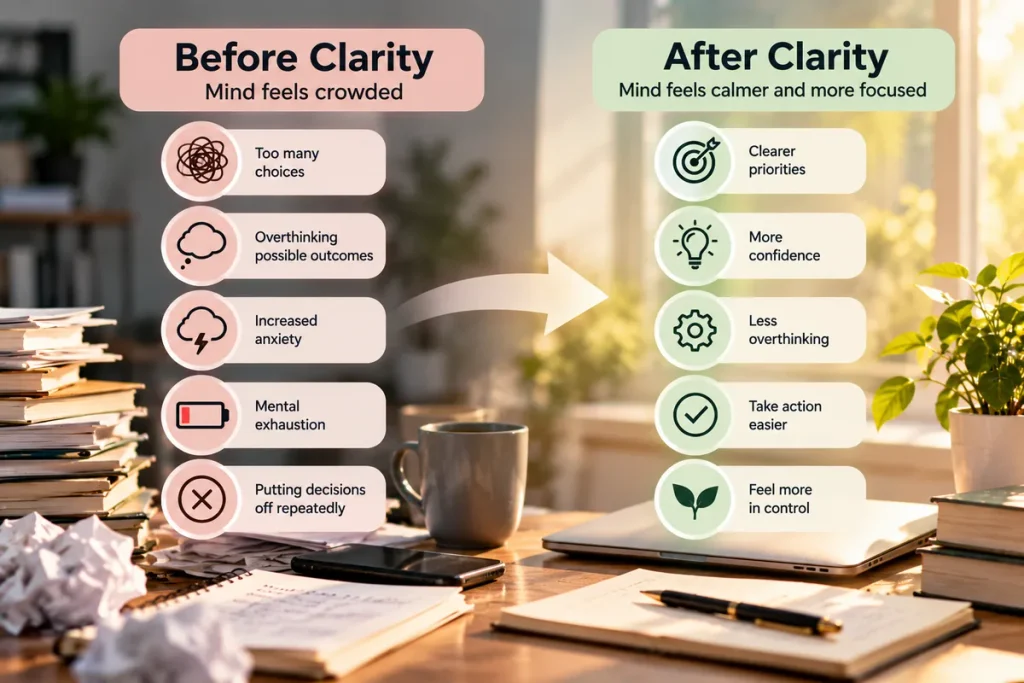
Decision paralysis is rarely just about choosing between two or three options. Often, it is about what the decision represents.
The fear of getting it wrong. The fear of regret. The need to feel certain. The wish to know the outcome before you take the first step.
But certainty does not always come before a decision.
Sometimes, you have to clarify what matters, limit the noise, examine what is actually true, accept what you cannot know, and then respond.
That is the heart of the C.L.E.A.R. approach.
Not perfect decisions. Not complete certainty. Just a more grounded way of choosing.
So the next time you find yourself going around the same decision again and again, pause and ask:
“Do I need more information, or am I waiting for certainty that may never come?”
If you have enough information, know what matters, and understand the trade-offs, you may already have what you need.
You can still feel uncertain. You can still be afraid of regret. And you can still choose.
Because making a thoughtful decision does not mean knowing exactly how everything will turn out.
It means being willing to move forward with the information, values, and circumstances you have today.
A Gentle Note
This article is intended for psychological education and self-reflection. Decision paralysis and indecisiveness are not, by themselves, diagnoses.
If difficulty making decisions is persistent, causes significant distress, or interferes with your work, relationships, studies or everyday functioning, consider speaking with a qualified mental-health professional.
The purpose of understanding your decision-making pattern is not to label yourself. It is to develop greater self-awareness, make more informed choices and build a more balanced relationship with uncertainty.