

You know you do not have the time. You can already feel how tired, overcommitted or uncomfortable saying yes will make you. Yet when someone asks for your help, attention or availability, the word “no” seems to disappear.
Perhaps you agree immediately and regret it later. Or perhaps you refuse, but then replay the conversation for hours:
Was I selfish? Did I sound rude? Are they upset with me?
You may send another message to soften your answer, provide a long explanation or even reverse the boundary altogether.
If this sounds familiar, the problem is probably not that you do not understand boundaries. You may understand them perfectly well. The real difficulty is that saying no activates guilt, fear or a sense of responsibility that feels more powerful than your actual preference.
Table of Contents
So, why do I feel guilty saying no?
Often, it is because your mind has learnt to associate helpfulness with goodness—and another person’s disappointment with having done something wrong. Childhood roles, attachment experiences, family expectations, fear of rejection and people-pleasing can all strengthen this association.
However, feeling guilty does not necessarily mean that your boundary was harmful. Sometimes guilt is a useful moral signal. At other times, it is simply the discomfort of behaving differently from an old emotional pattern.
Learning to say no is therefore not about becoming uncaring, selfish or emotionally distant. It is about recognising that compassion for others does not require the abandonment of your own needs.
Quick answer: You may feel guilty saying no because refusal has become emotionally associated with selfishness, rejection, conflict or disappointing others. This guilt may develop through conditional approval, family roles, people-pleasing, fear of negative evaluation or a habit of feeling responsible for other people’s emotions. A healthy boundary can still feel uncomfortable at first. The goal is not to eliminate every uncomfortable feeling, but to make decisions according to your values and realistic capacity rather than fear.
What Is Boundary Guilt?
Boundary guilt is the uneasiness, self-doubt or moral discomfort that can arise when you protect your time, energy, privacy, values or emotional capacity. It may appear before you say no, immediately afterwards or when the other person reacts.
It can sound like, “A good friend would agree.” “They will think I do not care.” “Their disappointment is my fault,” or “Maybe I should just do it and avoid the tension.”
Boundary guilt is not a diagnosis. It is a description of an emotional experience and does not automatically indicate trauma, anxiety or a particular attachment style.
The important question is not simply, “Do I feel guilty?” It is, ‘What is this guilt asking me to notice—and is its message accurate?’
Healthy guilt may alert you that you broke a promise or caused preventable harm. Learned boundary guilt can appear even when you communicated respectfully and did nothing unethical. The feeling is real in both cases, but its meaning differs.
Why Can a Healthy Boundary Feel Wrong?
The emotional brain does not evaluate every present situation independently. It also relies on earlier experiences, learned associations and predictions about what might happen next.
If saying no previously resulted in criticism, emotional withdrawal, conflict or accusations of selfishness, your mind may begin treating refusal as a threat to connection. Even in a safer present-day relationship, setting a boundary can activate the old expectation:
If I disappoint someone, I may lose their affection, approval or support.
This explains why intellectually understanding boundaries is not always enough. You may know that your limit is reasonable while your body reacts as though the relationship is in danger.
The guilt is therefore not necessarily confirming that the decision was wrong. It may be signalling that the decision is unfamiliar.
This distinction is important because people often reverse healthy boundaries simply to obtain immediate emotional relief. Agreeing again reduces guilt in the short term, but it teaches the brain that discomfort can only be resolved through compliance.
Over time, this strengthens the very pattern you are trying to change.
Healthy Guilt Versus Learned Boundary Guilt
Guilt usually focuses on behaviour:
I did something wrong.
Shame goes further and judges your identity:
I am selfish, uncaring or wrong.
When saying no activates shame, one ordinary boundary can begin to feel like a verdict on your entire character. Instead of evaluating whether the decision was fair, you begin questioning whether you are a good person.
Recognising the difference between healthy guilt and learned boundary guilt can prevent this emotional confusion.
Healthy guilt is more likely when:
- You knowingly violated an important personal value.
- You made a clear commitment and withdrew carelessly.
- Your words were unnecessarily harsh, dishonest or dismissive.
- You ignored a responsibility that genuinely belonged to you.
- An apology, repair or change in behaviour would address the harm.
Healthy guilt can be constructive. It encourages accountability and helps protect relationships by motivating us to correct behaviour that conflicts with our values.
Learned boundary guilt is more likely when:
- You declined respectfully because you lacked capacity.
- The request was optional, but you experienced it as compulsory.
- You assumed that another adult’s disappointment was yours to prevent.
- You felt you needed the other person’s approval before your decision could be valid.
- You experienced yourself as selfish for resting, asking for privacy or choosing differently.
- The guilt persisted even though your decision was consistent with your values.
This form of guilt does not necessarily call for an apology. It may call for emotional tolerance, self-reflection and practice.
A helpful three-question check is:
- Did I violate one of my values, or did I merely disappoint someone?
- Was I disrespectful, or was I simply unavailable?
- Does something need to be repaired, or am I trying to escape discomfort?
If you treat every uncomfortable feeling as evidence that you did something wrong, you may repeatedly abandon reasonable limits just to feel emotionally safe.
But discomfort and wrongdoing are not the same.
Sometimes guilt means that you need to repair your behaviour. Sometimes it means that an old pattern is being challenged. Learning to recognise which one is happening is the beginning of setting boundaries without abandoning either compassion or self-respect.
Why Do I Feel Guilty Saying No? 9 Psychological Reasons
There is rarely one universal cause behind boundary guilt. Several psychological processes may overlap, and the pattern can operate differently across family, work, friendships and romantic relationships.
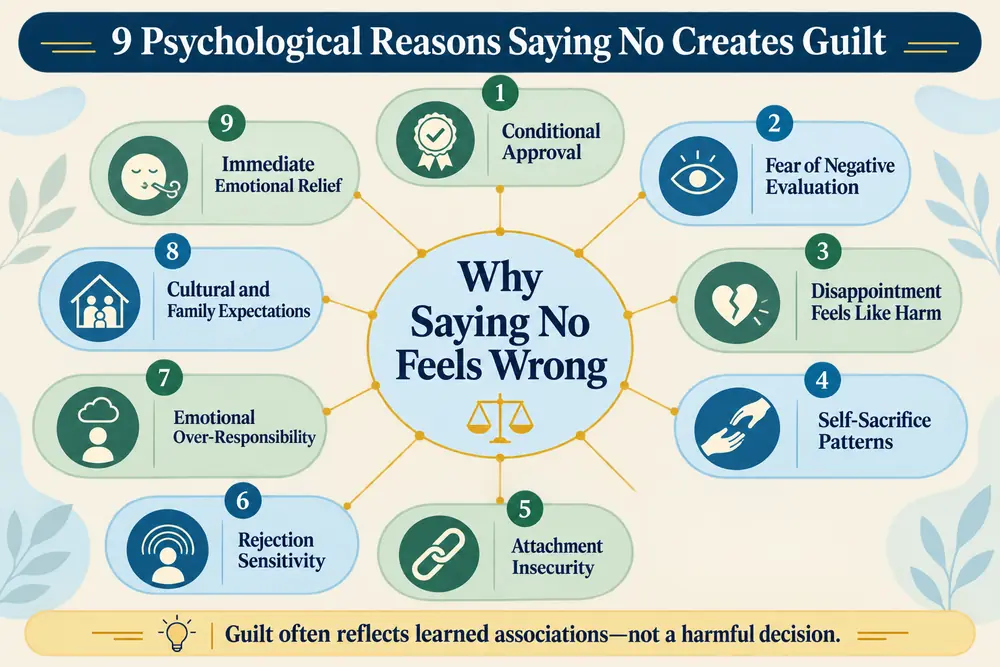
Understanding these causes is not about blaming your childhood, labelling your personality or diagnosing yourself. It is about recognising the emotional rules that may be influencing your decisions without your awareness.
1. You Learned That Being “Good” Meant Being Agreeable
Some children receive their warmest approval when they are quiet, helpful, accommodating or undemanding. They may be praised for adjusting to everyone else, caring for siblings or never creating problems.
None of these qualities is harmful by itself. Cooperation and kindness are valuable. The difficulty begins when affection and approval appear to depend on them.
A child may gradually form an implicit emotional rule:
When I cooperate, people are pleased with me. When I resist, I risk criticism, withdrawal or conflict.
As an adult, the situation may be entirely different, but the old rule can remain active. A request then feels like more than a request—it becomes a test of whether you are generous, loyal or lovable.
Saying no may threaten an identity built around being:
- the reliable one;
- the easy-going one;
- the person who never creates conflict;
- the responsible child; or
- the one everyone can depend on.
Families communicate these expectations through repetition, praise, disappointment, tone and role modelling. The lesson absorbed by the child may be:
My needs are acceptable only when they do not inconvenience anyone else.
When this belief continues into adulthood, setting a boundary can feel like a character failure rather than a normal decision about capacity.
2. You Fear Negative Evaluation
Psychologists David Watson and Ronald Friend introduced the construct of fear of negative evaluation to describe apprehension about being judged unfavourably and the expectation that other people may evaluate us negatively.
Their research led to the development of the Fear of Negative Evaluation Scale, which has subsequently been widely used in research on social anxiety and evaluation-related distress. Later, Mark Leary developed a shorter version of the scale.
When fear of negative evaluation is strong, saying no can produce a cascade of imagined judgments:
They will think I am lazy.
They will assume I do not care.
They will stop including me.
They will remember this when I need help.
Notice what has happened: your mind is no longer evaluating whether the request is reasonable. It is trying to manage your future reputation.
This can lead to:
- automatic agreement;
- excessive apologising;
- overexplaining;
- changing your answer when someone appears disappointed; and
- repeatedly checking whether the relationship is still okay.
You may believe that if your explanation is detailed and persuasive enough, the other person will approve your boundary—and then you will finally feel permitted to maintain it.
However, you cannot completely control another person’s evaluation. Treating universal approval as a safety requirement gives ordinary requests disproportionate power over your decisions.
3. You Confuse Disappointment With Harm
Saying no may disappoint someone without harming them. These experiences are not identical.
A friend may feel disappointed that you cannot attend an event. A colleague may feel inconvenienced because you cannot absorb another task. A family member may wish you had made a different decision.
Their feelings deserve acknowledgement, but those feelings do not automatically prove that your boundary was unfair.
People who feel responsible for emotional harmony may interpret every negative reaction as evidence of wrongdoing. If the other person sounds disappointed, becomes quiet or replies less warmly, they immediately try to remove the discomfort by changing their answer.
This may provide temporary emotional relief, but it teaches the brain:
I can only feel safe when everyone is pleased with me.
Emotionally mature relationships have room for two truths:
- Another person may genuinely dislike your answer.
- You may still have the right to give that answer.
Understanding this difference does not mean becoming indifferent to other people’s feelings. It means recognising that disappointment is a normal part of relationships between people with different needs, capacities and priorities.
You are responsible for communicating respectfully. You are not responsible for ensuring that every reasonable decision feels pleasant to everyone involved.
4. You Have Developed a Self-Sacrifice or Subjugation Pattern
Schema therapy describes deeply established emotional patterns through which people interpret themselves, other people and relationships. Two patterns particularly relevant to boundary guilt are the self-sacrifice schema and the subjugation schema.
With a self-sacrifice pattern, a person habitually prioritises other people’s needs and may experience guilt when attending to personal needs. They may believe that putting themselves first—even temporarily—is morally wrong.
The person may:
- feel guilty while resting;
- provide help before it is requested;
- minimise personal exhaustion;
- feel responsible for vulnerable people;
- struggle to receive care; and
- become resentful when their sacrifices go unnoticed.
The problem is not generosity. It is that generosity has stopped being a genuine choice.
Subjugation is somewhat different. A person suppresses preferences, needs or emotions because they fear anger, retaliation, abandonment or rejection. In daily life, both schemas may look like compliance, but their emotional engines differ.
- Self-sacrifice is often driven by guilt and duty.
- Subjugation is more commonly driven by fear of consequences.
These concepts should be used as reflective lenses rather than self-diagnoses. Ask yourself:
Am I freely choosing to help, or does helping feel like the only emotionally permitted option?
Care is healthiest when it includes agency. Chronic self-erasure does not become emotionally healthy simply because it is described as kindness.
5. Your Attachment System Interprets Boundaries as Relational Danger
Attachment theory proposes that early interactions with caregivers contribute to internal expectations about closeness, availability and emotional security.
Adult attachment is more complex than the four simplified labels commonly presented online. No attachment style determines how a person will behave. However, attachment insecurity can help explain why a small refusal sometimes feels disproportionately threatening.
If closeness has previously felt uncertain, you may monitor changes in affection, tone or response time after saying no.
A brief “okay” may sound cold.
A delayed response may feel punitive.
A change in tone may seem to confirm that the relationship is weakening.
This can activate reassurance-seeking behaviour. You may ask whether the person is upset, explain your decision again or compensate by offering another favour.
The boundary becomes connected with a deeper fear:
If I am not constantly available, will I still matter?
For someone with this fear, learning to say no is not merely a communication exercise. It is the gradual discovery that healthy connection can survive differences, frustration and temporary disappointment.
A secure relationship does not require permanent agreement. It allows both people to express needs without treating every difference as a threat of abandonment.
6. You Are Highly Sensitive to Rejection
Rejection sensitivity refers to the tendency to anxiously expect, readily perceive and strongly react to rejection.
Psychologists Geraldine Downey and Scott Feldman demonstrated how anxious expectations of rejection can influence perceptions and behaviour in close relationships. When rejection is anticipated, even ambiguous social cues can feel threatening.
After saying no, a neutral response may be interpreted as evidence that the person is offended. Your nervous system may react to this interpretation before you have enough evidence to understand what the other person actually means.
For example:
- What happened: “They replied with one word.”
- What fear concluded: “They no longer value me.”
Or:
- What happened: “They did not call me today.”
- What fear concluded: “They are punishing me for saying no.”
This does not mean every concern is imagined. Some people do use silence, guilt, withdrawal or pressure when boundaries inconvenience them.
The essential skill is separating observed behaviour from feared meaning.
Ask:
- What do I factually know?
- What am I predicting?
- Is there another reasonable interpretation?
- Do I need to respond now, or can I wait for more information?
This separation reduces mind-reading and helps you respond to evidence rather than to a feared rejection scenario.
7. You Equate Empathy With Responsibility
Empathy allows you to recognise and understand another person’s experience. Responsibility concerns what you are genuinely accountable for.
These two qualities can coexist without becoming identical.
You can understand why a colleague is overwhelmed and still decline their task.
You can care that a relative feels lonely and still be unavailable tonight.
You can acknowledge a partner’s disappointment while maintaining a boundary around rest, privacy or respectful communication.
When empathy becomes emotional over-responsibility, noticing someone’s need begins to feel like an obligation to meet it. This pattern is particularly common among people who have served as caregivers, mediators or emotional stabilisers in their families.
They may believe:
If I can prevent their discomfort, I should.
But being able to help does not always mean you are responsible for helping. Capacity, relationship, urgency, fairness and your existing commitments also matter.
A more balanced internal statement is:
Their feelings matter, and my capacity matters too.
Compassion does not require you to become the solution to every difficult emotion you can perceive.
8. Cultural and Family Expectations Make Refusal More Complicated
Boundary advice is often written from an individualistic perspective in which direct refusal is presented as simple, universally appropriate and free from social consequences. Real lives are more layered.
In many Indian and other collectivist families, interdependence, respect for elders, family duty and mutual support carry profound meaning. These values should not automatically be pathologised as people-pleasing.
Supporting family may be freely chosen, culturally grounded and emotionally fulfilling.
The difficulty arises when belonging seems to require unlimited compliance—or when every personal choice is described as selfishness or disrespect.
In an interdependent environment, a healthy boundary may sound relational rather than highly individualistic:
“I understand why this is important to the family. I cannot manage it today, but let us consider another arrangement.”
Self-Determination Theory provides useful nuance here. Developed through the work of Richard Ryan and Edward Deci, the theory identifies three basic psychological needs:
- autonomy;
- competence; and
- relatedness.
Autonomy does not necessarily mean independence, separation or putting yourself first in every situation. It means experiencing meaningful choice and acting with a sense of willingness—even when you choose to honour family or community responsibilities.
The goal is not independence at any cost. It is:
Connected choice rather than coerced compliance.
9. Saying Yes Provides Immediate Emotional Relief
The habit of saying yes often continues because it works—at least temporarily.
A request arrives and activates anxiety, guilt or fear. Agreeing removes the immediate possibility of conflict, disapproval or disappointment. Your body relaxes.
That relief can reinforce the behaviour.
The next time a similar request arrives, automatic agreement becomes even more tempting. Unfortunately, the delayed costs—exhaustion, resentment, lost time and emotional overload—appear later and therefore have less influence in the moment.
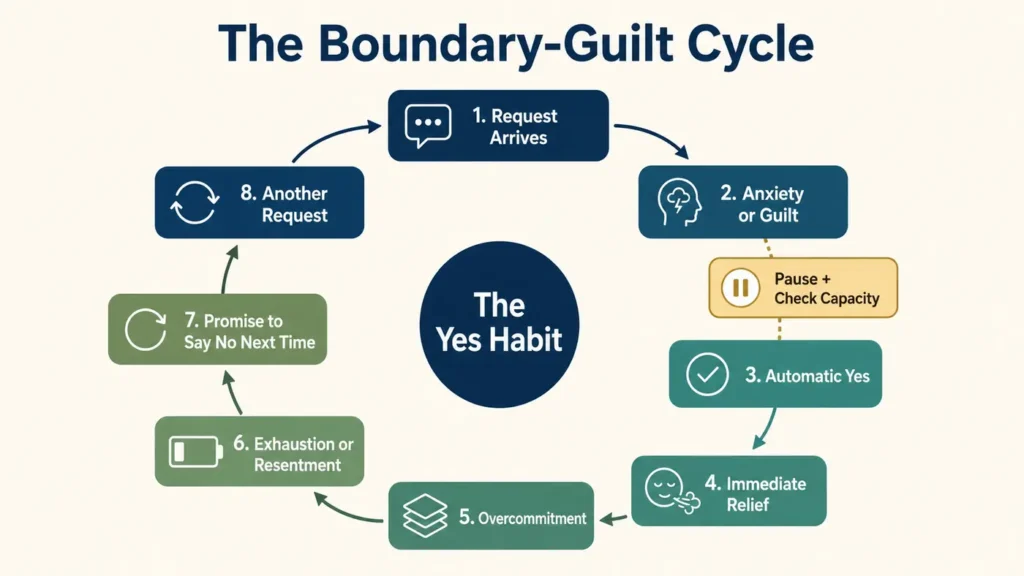
This creates a predictable cycle:
Request → anxiety or guilt → automatic yes → immediate relief → overcommitment → exhaustion or resentment → promise to say no next time → another request
The cycle is maintained not because you enjoy overextending yourself, but because saying yes quickly removes emotional discomfort.
Breaking it requires discovering that guilt and anxiety can rise and fall without being obeyed.
Your first successful boundary may not feel empowering. It may feel shaky, unfamiliar and emotionally unfinished. That discomfort can be evidence that you are practising a new response—not evidence that you have made a bad decision.
What Happens When You Keep Saying Yes but Mean No?
Saying yes occasionally when you would prefer to say no is a normal part of relationships. Meaningful connections involve compromise, responsibility and moments when we willingly accept inconvenience for someone we care about.
The problem begins when saying yes is no longer a genuine decision. It becomes an automatic response driven by guilt, fear or the need to preserve approval.
A reluctant yes may protect you from immediate discomfort, but it frequently transfers that discomfort into the future. The conflict you avoided externally can gradually become an internal conflict between what you agreed to do and what you actually needed.
Over time, this pattern can affect your energy, self-trust and relationships in ways that may not be immediately obvious.
1. You Become Emotionally and Physically Overextended
Every yes carries a cost. It may require time, attention, emotional labour, physical energy or money. When you repeatedly agree without checking your capacity, those costs accumulate.
You may begin to experience:
- mental exhaustion;
- irritability;
- difficulty concentrating;
- reduced time for rest;
- resentment towards people you care about;
- neglect of personal responsibilities; or
- a constant sense of being needed by everyone.
The exhaustion is not always caused by the request alone. It can also arise from the emotional work surrounding it—worrying about disappointing someone, preparing explanations, monitoring reactions and trying to remain pleasant while feeling overwhelmed.
You might describe yourself as “bad at time management” when the deeper issue is that other people’s priorities repeatedly enter your schedule without a genuine decision from you.
Emotional fitness includes recognising capacity before exhaustion makes the decision on your behalf.
2. Resentment Builds Beneath Helpful Behaviour
When you give more than you can willingly sustain, resentment often follows.
You may quietly hope that the other person will notice how much you are sacrificing. If they do not acknowledge it—or if they ask for more—you may feel invisible, used or taken for granted.
Yet the other person may not realise that your boundary has been crossed. From their perspective, they made a request and you agreed.
This creates a painful mismatch:
- Outwardly, you communicated willingness.
- Inwardly, you experienced pressure or obligation.
- Later, you expected the other person to understand the cost you did not express.
Resentment is not always proof that someone has treated you unfairly. Sometimes it is information that you have repeatedly agreed to something you did not freely choose.
A useful question is:
What boundary am I expecting another person to recognise without having clearly communicated it?
This does not excuse exploitation or manipulative behaviour. Some people intentionally ignore limits. But in many everyday relationships, resentment develops because personal capacity was never made visible.
3. Your “Yes” Becomes Less Authentic
Healthy consent requires the meaningful possibility of refusal. If you believe that you cannot say no without losing approval, your yes may represent fear more than willingness.
This can weaken authenticity in relationships.
People may know you as dependable, agreeable and endlessly available, but they may not know:
- what you genuinely prefer;
- when you are tired;
- what behaviour makes you uncomfortable;
- which responsibilities you resent; or
- what you would choose without pressure.
Maintaining harmony by concealing your real experience may prevent open conflict temporarily, but it also prevents people from knowing you fully.
A relationship in which one person must constantly adjust is not necessarily peaceful. It may simply be a relationship where conflict has been moved inside one person.
A respectful no gives others accurate information about who you are, what you can offer and where your limits are. It makes your future yes more trustworthy because it is more likely to be genuine.
4. You Begin to Lose Trust in Your Own Decisions
Every time you recognise a limit and immediately override it, you send yourself a subtle message:
My needs are less reliable than other people’s reactions.
Over time, this can weaken self-trust. You may find it increasingly difficult to know what you want, what you can manage or whether your discomfort is legitimate.
You may begin seeking external permission for ordinary decisions:
- “Is it okay if I take some time for myself?”
- “Am I being unreasonable?”
- “Do you think I should agree?”
- “Was my message too rude?”
- “Are you sure I did the right thing?”
Consulting trusted people can be healthy. The concern arises when no decision feels valid until someone else approves it.
This is where boundary guilt and reassurance seeking reinforce each other. You feel guilty, seek reassurance, experience temporary relief and then doubt yourself again when the next situation appears.
Rebuilding self-trust does not mean rejecting advice. It means allowing your values, capacity and observations to participate meaningfully in your decisions.
5. People May Develop Unrealistic Expectations of You
Relationships naturally adapt to repeated patterns.
If you consistently respond immediately, accept extra work, solve crises or change plans whenever someone is disappointed, others may begin to experience this availability as normal.
Not everyone who benefits from your lack of boundaries is intentionally taking advantage of you. Some people simply respond to the pattern you have established.
When you later begin setting limits, they may react with surprise:
“You never had a problem with this before.”
“You have always done it.”
“Why are you changing now?”
Their reaction does not necessarily mean your new boundary is wrong. It may mean the relationship is adjusting to information that was previously hidden.
You can acknowledge the change without apologising for it:
“I know I have usually taken care of this, but I can no longer do it every time. We need a more balanced arrangement.”
People who are accustomed to unlimited access may not immediately welcome the change. Consistency gives them time to understand that your boundary is a new relational expectation rather than a temporary mood.
6. Avoiding Small Conflicts Can Create Larger Ones
People often say yes because they want to avoid tension. Ironically, consistently avoiding small disagreements can create more serious conflict later.
Unspoken frustration may eventually appear as:
- irritability over minor issues;
- emotional withdrawal;
- passive-aggressive comments;
- sudden refusal after a long period of compliance;
- burnout followed by disengagement; or
- ending a relationship without first discussing the problem.
The other person may experience this reaction as unexpected because they were unaware of the resentment accumulating beneath your agreement.
Small, respectful boundaries allow relationships to adjust before emotional pressure becomes unmanageable.
Saying, “I cannot help today,” is usually easier to understand than months of automatic agreement followed by an angry declaration that nobody respects you.
Healthy conflict is not the opposite of connection. When handled respectfully, it helps two people understand each other’s needs and negotiate realistic expectations.
7. You May Swing From Overgiving to Emotional Withdrawal
When constant availability becomes exhausting, some people do not move gradually towards balanced boundaries. Instead, they swing between extremes.
At one end, they:
- agree to everything;
- remain constantly accessible;
- suppress frustration; and
- prioritise everyone else.
When the emotional cost becomes too high, they move to the other end:
- stop responding;
- refuse every request;
- withdraw without explanation; or
- create rigid boundaries to avoid being needed.
This pattern can be understood as overcorrection. After experiencing the pain of having weak limits, emotional distance begins to feel safer than balanced connection.
But healthy boundaries are neither total self-sacrifice nor permanent withdrawal. They allow you to remain caring and connected without making your availability unlimited.
The aim is not to move from “I must always help” to “I owe nobody anything.” It is to develop enough emotional flexibility to decide according to the actual situation.
8. Your Self-Worth Becomes Tied to Usefulness
If helping others is one of the main ways you receive appreciation, belonging or identity, saying no may threaten more than the relationship. It may threaten your sense of worth.
You may ask yourself:
If I am not useful, what value do I bring?
This can lead you to provide support even when it is not requested, remain in one-sided relationships or feel uneasy when other people do not need you.
Being helpful is a meaningful quality, but it cannot safely carry the entire weight of your identity.
Your value within a relationship should not depend only on what you solve, provide or tolerate. Healthy connection also includes companionship, honesty, mutual interest, shared experience and the ability to be present without performing a service.
You are allowed to be valued for who you are—not only for how convenient you make life for other people.
Can Saying No Improve Relationships?
Yes—when it is communicated respectfully and used responsibly.
Clear limits can:
- reduce hidden resentment;
- clarify expectations;
- make consent more meaningful;
- encourage shared responsibility;
- protect emotional energy;
- improve trust; and
- help relationships become more balanced.
A boundary does not guarantee that every relationship will improve. Some people may resist a limit that reduces their access to your time, attention or labour. In other cases, a boundary may reveal that a relationship depended heavily on your compliance.
But healthy relationships generally have room for both people’s needs. They do not require one person to remain endlessly flexible so that the other never experiences inconvenience.
A respectful boundary communicates:
I care about this relationship enough to participate honestly rather than agree resentfully.
What a Healthy Boundary Actually Is
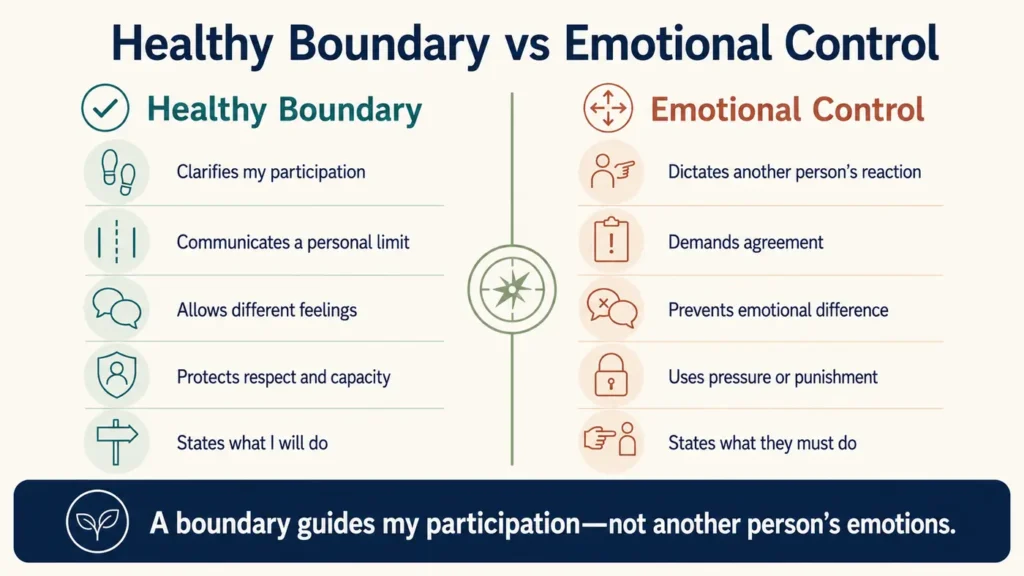
A boundary is not a demand that controls another person. It is a clear expression of what you will do, accept, share or participate in.
Compare the following examples:
Control:
“You are not allowed to be angry with me.”
Boundary:
“I am willing to discuss this, but I will pause the conversation if there is shouting.”
Control:
“You must stop asking me for help.”
Boundary:
“I cannot take this responsibility on. Please make another arrangement.”
Control:
“You have to agree with my decision.”
Boundary:
“I understand that you disagree, and this is still my decision.”
A boundary does not control another person’s feelings or choices. It clarifies your participation and the action you will take.
Healthy boundaries also carry responsibility. They should be:
- communicated as clearly as the situation allows;
- proportionate to the circumstances;
- applied with reasonable consistency;
- respectful of genuine obligations; and
- adjusted when new information makes adjustment appropriate.
Boundaries are not walls against every inconvenience. They are points of clarity that help care, responsibility and self-respect coexist.
How to Say No Without Feeling Guilty
Many people wait for guilt to disappear before setting a boundary. Unfortunately, this can keep them trapped in the same pattern for years.
A more realistic goal is to learn how to say no while some guilt is still present.
Confidence often follows action rather than preceding it. Your first healthy boundary may not feel natural, calm or empowering. It may feel uncomfortable precisely because it challenges a long-established emotional habit.
The objective is not to eliminate compassion or become unaffected by other people’s reactions. It is to prevent temporary discomfort from making every decision for you.
1. Pause Before Giving an Answer
If you habitually agree under pressure, do not force yourself to give an immediate yes or no.
Create a standard pause:
- “Let me check my schedule and come back to you.”
- “I need a little time to think about that.”
- “I cannot confirm immediately. I will let you know this evening.”
- “Let me consider what I already have committed to.”
This pause is not avoidance. It creates enough emotional distance to assess the request rather than simply escaping the anxiety it produces.
Without a pause, your decision may follow this sequence:
Request → emotional pressure → automatic yes
With a pause, you create a different pathway:
Request → emotional awareness → capacity check → considered response
The pause gives your reflective mind time to participate.
It is especially helpful if you have learned to say yes quickly and experience resentment only after the conversation has ended.
2. Check Your Capacity Before Your Guilt
Before deciding, consider four areas:
Time
Do you realistically have enough time, including preparation, travel and recovery?
Energy
Do you have the physical and emotional capacity—not merely an empty space in your calendar?
Responsibility
Is this genuinely your responsibility, a shared responsibility or an optional favour?
Willingness
If you were not afraid of disappointing anyone, would you still want to agree?
You do not have to say no whenever something is inconvenient. Caring relationships sometimes involve willing sacrifice. The purpose of these questions is to distinguish a conscious sacrifice from automatic self-abandonment.
Try asking:
- Do I genuinely want to do this?
- What will I have to neglect if I agree?
- Am I saying yes from care, fear or guilt?
- Would I expect someone I care about to accept this request?
- Will I be able to help without becoming resentful?
Sometimes your considered answer will still be yes. It will simply be a more intentional yes.
3. Identify the Fear Hidden Beneath the Guilt
Boundary guilt is often a surface emotion covering a more specific fear.
You may not simply be thinking, I feel bad saying no.
Underneath, you may be predicting:
- “They will reject me.”
- “They will think I am selfish.”
- “They will become angry.”
- “They will stop asking me to be involved.”
- “They will tell other people that I am unreliable.”
- “I will no longer be the good person in this relationship.”
Naming the actual fear makes it easier to evaluate.
Ask yourself:
- What exactly am I afraid will happen?
- How likely is that outcome?
- What evidence supports the prediction?
- If it happens, can I cope with it?
- Is avoiding this possibility worth repeatedly ignoring my capacity?
A vague fear can feel overwhelming. A specific prediction can be examined.
For example:
Fear: “They will be upset.”
More precise possibility: “They may feel disappointed for a few hours because I cannot attend.”
The second statement may still be uncomfortable, but it is more realistic and manageable.
4. Separate Your Responsibility From Their Reaction
You are responsible for:
- considering genuine obligations;
- communicating honestly;
- choosing a respectful tone;
- avoiding unnecessary cruelty;
- repairing harm when you have caused it; and
- following through on commitments you freely make.
You are not automatically responsible for:
- ensuring that nobody feels disappointed;
- securing universal approval;
- preventing another adult from becoming frustrated;
- changing your decision whenever someone disagrees; or
- providing unlimited explanations until your boundary is accepted.
This distinction protects both accountability and autonomy.
It prevents boundary advice from becoming “I can do whatever I want” while also preventing empathy from becoming “I must manage everyone’s feelings.”
A balanced reminder is:
I am responsible for how I communicate my boundary, but I cannot control every response to it.
5. Distinguish Discomfort From Danger
When saying no activates your nervous system, the emotional intensity may make the situation feel unsafe.
Your heart may beat faster. Your body may tense. You may feel an urgent need to explain, apologise or reverse the decision.
Pause and ask:
Is this situation actually dangerous, or is it emotionally uncomfortable?
This question is important because the appropriate response differs.
If you are dealing with coercion, abuse, threatened violence or serious retaliation, direct refusal may not be safe. In such situations, prioritise safety and consider confidential professional or local support.
In an ordinary safe relationship, however, the sensation of danger may reflect an old emotional association rather than a present threat. Naming the difference can reduce the urgency to undo the boundary.
Try telling yourself:
My body is anticipating conflict. That does not necessarily mean I am doing something wrong.
6. Stop Treating Guilt as a Command
Emotions provide information, but they do not always provide instructions.
Guilt may invite you to examine your behaviour. It does not automatically require you to apologise, change your answer or abandon your limit.
When guilt appears, ask:
- Did I violate an important value?
- Did I act dishonestly or disrespectfully?
- Did I neglect a responsibility that genuinely belonged to me?
- Is repair necessary?
- Or am I experiencing discomfort because I behaved differently from an old pattern?
If repair is needed, take responsibility.
If the boundary was fair and respectfully communicated, allow the guilt to exist without treating it as a command.
You might say:
I notice that I feel guilty. I will listen to this feeling, but I will not assume it is automatically correct.
This creates a small but powerful distance between experiencing an emotion and obeying it.
7. Reduce Overexplaining
Overexplaining often functions as a form of reassurance seeking.
You may hope that if your reason is detailed enough, the other person will approve your boundary. Once they approve, you will feel safe enough to maintain it.
Explanations are appropriate when trust, responsibility or practical arrangements require them. But a long defence can imply that your limit is open for negotiation. It can also provide more details for someone to challenge.
Consider the difference:
Overexplained response:
“I am really sorry, but this week has been so difficult. I have work on Monday, then I have to help someone else, and I have not been sleeping well. I might possibly manage it later, but I do not know. I hope you are not upset.”
Clear response:
“I am sorry, but I do not have the capacity to take this on this week.”
The shorter answer is not less caring. It is simply clearer.
A useful rule is:
Explain what is necessary for understanding; not everything you believe is necessary for permission.
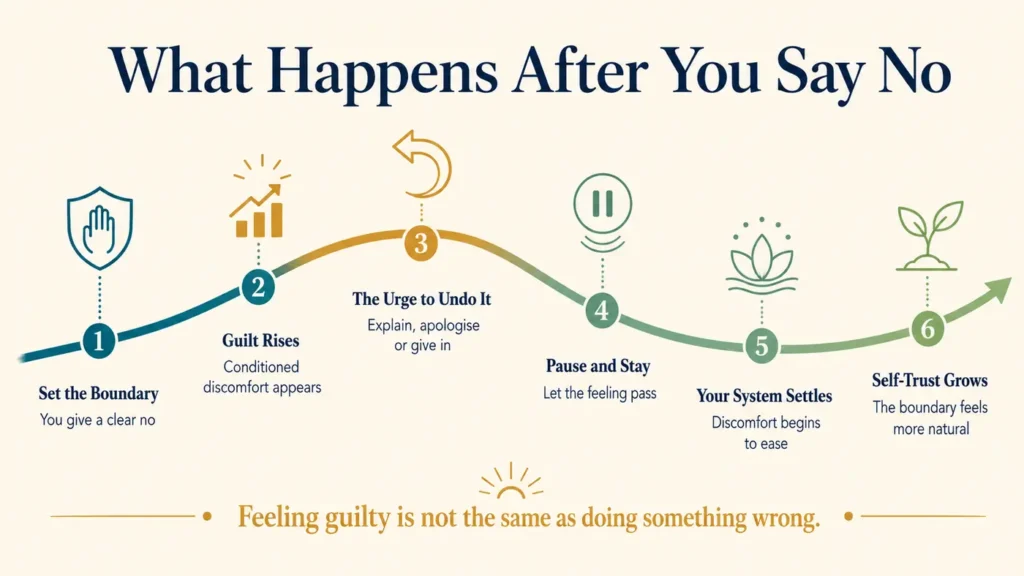
8. Expect an Emotional Aftershock
After saying no, you may experience an emotional aftershock—the period in which guilt, anxiety and self-doubt become stronger because the boundary has already been communicated.
You may want to:
- send another explanatory message;
- check whether the person is angry;
- offer a different favour;
- apologise repeatedly; or
- reverse the decision.
Unless new information requires an immediate response, allow the emotional intensity to settle before taking further action.
Try this short reset:
- Put both feet on the floor.
- Slow your breathing, particularly the exhale.
- Name the emotion: guilt, fear, shame or anxiety.
- State the facts of what you communicated.
- Identify the value or need the boundary protected.
- Delay any follow-up message until the emotional intensity decreases.
For example:
I feel anxious because I declined the request. I said I was unavailable; I did not insult or deceive anyone. The boundary protected an existing responsibility. I will wait before sending another message.
The purpose is not to suppress emotion. It is to prevent a temporary emotional surge from automatically reversing a considered decision.
9. Let Other People Experience Reasonable Disappointment
Another person is allowed to feel disappointed.
You are allowed to care about that disappointment without immediately fixing it.
You can say:
“I understand that this is frustrating.”
That acknowledgement does not need to be followed by:
“So I will change my answer.”
Validation recognises an emotion. It does not surrender the boundary.
This can be especially difficult if you learnt that love means preventing other people from experiencing discomfort. But healthy relationships are not relationships in which nobody is ever frustrated.
They are relationships where disappointment and difference can be expressed without coercion, punishment or threats of abandonment.
A person’s disappointment may be evidence that the request mattered to them. It is not automatic evidence that your refusal was wrong.
10. Practise With Low-Stakes Boundaries
Do not begin with the relationship or situation you fear most.
Start with smaller boundaries:
- decline an optional promotional call;
- ask for time before accepting an invitation;
- correct a minor misunderstanding;
- state a preference about timing or food;
- say you cannot reply to a non-urgent message until tomorrow; or
- decline a small request when you genuinely lack capacity.
These experiences teach your mind that preference, disagreement and refusal can be survivable.
Progress is not measured by the complete absence of guilt. It is measured by your growing ability to act with clarity while guilt is present.
Keep a short boundary record:
- What was requested?
- What did I decide?
- What did I fear would happen?
- What actually happened?
- What did I learn?
Over time, this gives your brain evidence that many feared outcomes do not occur—or that you can cope even when someone reacts negatively.
11. Use Self-Compassion Without Abandoning Accountability
Self-compassion is not telling yourself that everything you do is right. It is treating yourself fairly while remaining open to evidence and responsibility.
After setting a boundary, try saying:
I can care about their feelings without treating my capacity as irrelevant. I communicated respectfully. This discomfort may be present because the behaviour is new, not because the decision is wrong.
Researcher Kristin Neff describes self-compassion through three broad elements: self-kindness, recognition of common humanity and mindful awareness of difficult experiences.
Applied to boundary guilt, these mean:
- responding to yourself without harsh self-condemnation;
- remembering that disappointing people is an unavoidable human experience; and
- noticing guilt without exaggerating or suppressing it.
Self-compassion helps you evaluate your conduct internally instead of needing immediate reassurance from someone else.
12. Apply the B.O.U.N.D.A.R.Y. Framework
If difficulty saying no forms part of a wider people-pleasing pattern, isolated communication scripts may not be enough.
Use the B.O.U.N.D.A.R.Y. Framework from our people-pleasing guide to examine the beliefs, emotional triggers and relationship patterns beneath your automatic yes.
The framework helps you move from simply learning what to say towards developing a more durable capacity to:
- recognise personal needs;
- pause before agreeing;
- tolerate reasonable disapproval;
- communicate clear limits;
- stop measuring worth through usefulness; and
- choose relationships that can accommodate mutual needs.
The goal is not to become someone who says no to everything.
It is to become someone whose yes and no both carry meaning.
When you can decline without treating yourself as unkind, your generosity becomes more freely chosen, your relationships become more honest and your future ‘yes’ becomes more trustworthy.
The C.A.L.M. N.O. Method: How to Respond When Saying No Feels Difficult
Consider this everyday situation.
Ananya has already spent most of her week managing work deadlines and family responsibilities. On Friday evening, a relative asks her to handle an additional task over the weekend. She knows she needs rest, but almost immediately she begins thinking:
They have helped me before. What if they think I am becoming selfish? It may be easier to agree than explain why I cannot do it.
Ananya’s difficulty is not a lack of knowledge. She already understands that rest is reasonable. Her struggle occurs in the brief emotional space between receiving the request and giving an answer.
That is where many boundaries are lost.
When guilt rises quickly, complicated psychological advice is difficult to apply. The C.A.L.M. N.O. Method is designed as a short, in-the-moment process for moving from automatic agreement towards a more intentional response.
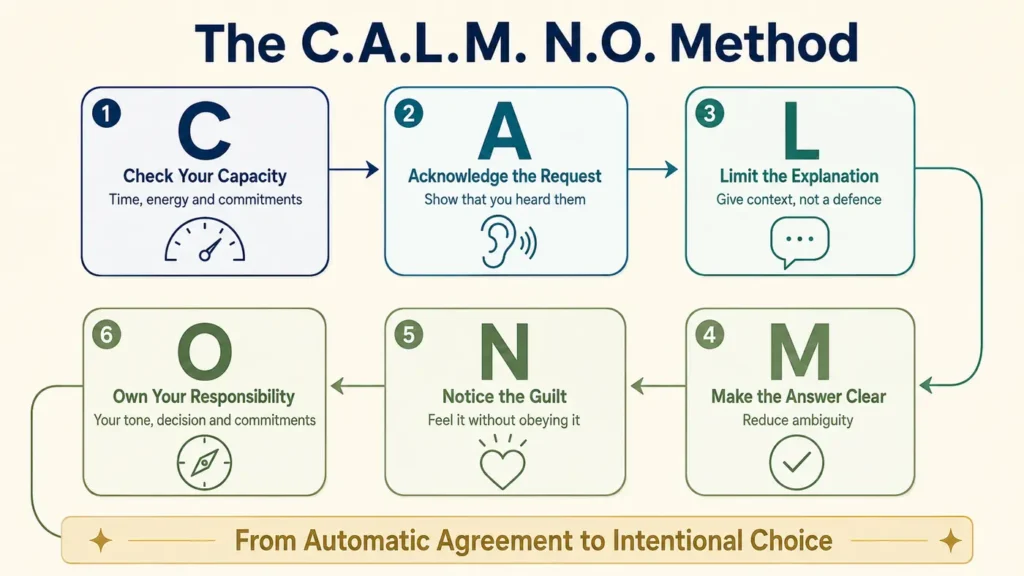
It does not instruct you to refuse every request. It helps ensure that whether you say yes or no, the answer reflects your capacity, values and responsibilities—not only your fear of another person’s reaction.
C — Check Your Capacity
Before considering how the other person may react, check what the request will actually require from you.
Capacity includes more than an empty space in your calendar. It also includes emotional energy, physical health, existing responsibilities and the recovery time you may need afterwards.
Ananya might ask:
If I agree, what will I have to postpone, neglect or carry while already exhausted?
This question is different from:
Can I somehow force myself to manage it?
People who habitually overextend themselves often assess whether a task is technically possible rather than whether it is realistically sustainable.
Checking capacity is not selfishness. It is an honest assessment of what you can offer without creating avoidable resentment, exhaustion or broken commitments elsewhere.
A — Acknowledge the Request
A clear boundary does not need to sound emotionally cold.
You can acknowledge why the request matters without implying that you will accept it:
“I understand why you need help with this.”
“Thank you for considering me.”
“I can see that the timing is difficult for you.”
Acknowledgment communicates that you have heard the person. It can preserve warmth while creating space for an honest answer.
However, acknowledgement should not become emotional surrender. Understanding someone’s need does not automatically make you responsible for meeting it.
L — Limit the Explanation
Give enough context for clarity and trust, but do not turn your boundary into a legal defence.
Ananya does not need to provide an hour-by-hour account of her week to prove that she deserves rest. She might simply say:
“I have had a demanding week and do not have the capacity to take this on during the weekend.”
A lengthy explanation can unintentionally communicate uncertainty. It may also invite the other person to solve, minimise or challenge each reason:
“You can rest later.”
“It will only take an hour.”
“Surely you can adjust one other thing.”
The purpose of an explanation is to help someone understand—not to obtain a verdict that your boundary is acceptable.
M — Make the Answer Clear
An unclear ‘no’ often becomes a prolonged negotiation.
Phrases such as “maybe”, “I will try”, or “let us see” may feel gentler, but they can leave both people uncertain. If you have already decided that you cannot accept the request, clarity is usually kinder than false possibility.
A clear response might be:
“I will not be able to do this over the weekend.”
Clarity does not require bluntness. Tone can remain warm while the meaning remains definite.
N — Notice the Guilt Without Obeying It
After communicating the boundary, Ananya may still feel guilty. She may be tempted to send another message or change her answer.
This is the moment to notice what the guilt is saying:
They might be disappointed.
They may think differently about me.
I am not behaving like the endlessly available person I have usually been.
These thoughts deserve awareness, but they do not automatically require action.
Ananya can remind herself:
This guilt may be present because I am changing an old pattern. I will examine it, but I do not have to obey it immediately.
The aim is not to argue with every feeling. It is to prevent emotional discomfort from functioning like a command.
O — Own Only Your Responsibility
Ananya is responsible for communicating respectfully and considering obligations that genuinely belong to her. She is not responsible for controlling every emotion her relative experiences after hearing no.
This distinction can be expressed internally:
I own my decision, my tone and my commitments. I do not own another adult’s entire reaction.
If she was unnecessarily harsh, broke a firm promise or ignored a genuine responsibility, accountability may be appropriate. But if she declined an optional request because she lacked capacity, another person’s disappointment does not automatically create wrongdoing.
The C.A.L.M. N.O. method, therefore, leads to a complete response:
“I understand that you need help with this. I have had a demanding week and do not have the capacity to take it on during the weekend. I hope you can find another arrangement.”
The sentence is considerate, clear and proportionate. It does not guarantee approval—and no communication method can. Its purpose is to help you respond honestly without becoming needlessly harsh or abandoning your limit.
Practical Ways to Say No Without Being Rude
The most effective boundary language is usually brief, warm and definite. The wording should be adapted to the relationship, cultural context, level of responsibility and possible consequences.
These examples are starting points rather than rigid formulas.
Saying No to a Friend
“I would really like to see you, but I cannot make it this weekend. Can we look at another date?”
This response communicates interest in the relationship while being honest about availability. Offering another date is useful when you genuinely want to meet. It should not be added merely to reduce guilt.
If you do not want to make another plan, a simpler response is enough:
“Thank you for inviting me. I will not be able to join this time.”
Saying No to a Family Member
Family boundaries often require warmth, context and respect without becoming indefinite.
“I understand that this is important. I cannot manage it today, but I can help for an hour on Saturday.”
This is a limited yes rather than a complete refusal. Limited agreements are valuable when you genuinely want to contribute but cannot meet the full request.
When no alternative is available:
“I understand why you asked me, but I cannot take responsibility for this. Another arrangement will be needed.”
This may feel uncomfortable if your family is accustomed to your availability. Discomfort does not necessarily mean disrespect.
Saying No at Work
Workplace boundaries require particular nuance because responsibilities, hierarchy and consequences matter. Instead of refusing abruptly, make workload and trade-offs visible:
“I am currently committed to completing A and B. I can take this on, but one of those deadlines will need to move. Which task should take priority?”
This response does not simply say, “That is not my job.” It gives the manager accurate information and places the prioritisation decision where it belongs.
If the request is optional:
“Thank you for considering me. I do not have the capacity to take on an additional assignment at present.”
A workplace boundary should be professional and evidence-based. It should also recognise that employment roles include legitimate responsibilities that cannot always be declined merely because they are inconvenient.
When Someone Wants an Immediate Answer
People who habitually agree may benefit from a standard policy of not making non-urgent commitments on the spot:
“I need to check my existing commitments. I will give you an answer by tomorrow.”
If the person continues pressing:
“I understand that you would prefer an answer now, but I need time before committing.”
The purpose is not to create artificial delay. It is to prevent emotional pressure from replacing genuine consideration.
When You Do Not Want to Share a Detailed Reason
Privacy is also a legitimate boundary.
“Thank you for asking. I am not available.”
Or:
“I will not be able to participate, but I appreciate the invitation.”
You do not owe every person full access to the circumstances behind your decision. However, close relationships and significant responsibilities may reasonably require more explanation than casual requests.
The appropriate amount of context depends on trust and obligation—not on how guilty you feel.
When You Have Already Said Yes but Need to Reconsider
Changing an answer can inconvenience someone, so this boundary requires accountability:
“I agreed too quickly and have realised that I cannot manage this responsibly. I am sorry for the inconvenience. I wanted to tell you as soon as possible so that another arrangement can be made.”
This response owns the earlier commitment without forcing you to continue towards burnout or failure.
If the other person has incurred a real cost because of your agreement, consider what repair is reasonable. Boundary setting should not be used to avoid responsibility for commitments already made.
When Someone Keeps Pushing After You Say No
Repeated explanations often create repeated negotiation. Use a calm restatement:
“I understand that you were hoping I would agree. My answer is still no.”
If the pressure continues:
“I have explained what I can manage. I am not going to continue discussing this decision.”
This is sometimes called the broken-record technique: repeating a clear position without adding new justifications each time. Its effectiveness comes from consistency rather than hostility.
When You Need to End a Disrespectful Conversation
A boundary identifies both the unacceptable behaviour and your response:
“I am willing to continue this conversation when we can speak respectfully. I am ending it for now.”
Notice that the statement does not command the other person to become calm. It explains the condition under which you will participate.
If you fear retaliation, violence or abuse, direct confrontation may not be safe. Prioritise safety and seek confidential professional or appropriate local support rather than relying on a general communication script.
When You Are Changing a Long-Established Pattern
People may be confused when someone who has always agreed begins setting limits.
Acknowledge the change directly:
“I know I have usually handled this, but I cannot continue doing it every time. We need a more balanced arrangement.”
You do not need to pretend that the old arrangement never existed. Naming the pattern can help others understand that the change is intentional.
Some people will adjust. Others may resist because the previous pattern benefited them. Their resistance is information about the relationship, but it should still be evaluated carefully rather than automatically labelled manipulation.
What If Someone Calls You Selfish?
Being called selfish can activate the exact fear that made saying no difficult.
Before defending yourself or surrendering the boundary, examine the feedback.
Ask:
- Did I communicate honestly and respectfully?
- Did I ignore a responsibility that genuinely belonged to me?
- Am I protecting a legitimate need, or am I trying to punish someone?
- Is my response proportionate to the request?
- Would I consider the same limit reasonable if another person set it?
Sometimes feedback reveals that a boundary was communicated harshly or that a commitment was neglected. Healthy boundary work includes accountability.
At other times, “selfish” means only:
Your decision does not give me what I want.
Someone who benefited from your previous lack of limits may experience a more balanced arrangement as unfair.
If your decision remains grounded after honest reflection, you may need to tolerate being misunderstood. A boundary that can exist only after everyone agrees with it is not yet fully yours.
A Boundary Is Not a Guarantee of Approval
No perfect script can guarantee that another person will respond calmly, understand your reasons or continue seeing you exactly as before.
The purpose of boundary communication is not to manufacture universal approval. It is to communicate your participation with honesty, proportionality and respect.
A psychologically healthy ‘no’ does not say:
Your needs do not matter.
It says:
Your needs matter, but they are not the only needs present in this relationship.
That is the difference between emotional withdrawal and a relationally responsible boundary.
When Boundary Advice Needs More Nuance
Not every request should be declined, and not every uncomfortable relationship is unhealthy.
Dependable relationships involve compromise, responsibility and moments when we help despite inconvenience. Parents care for children when exhausted. Partners adjust plans during difficult periods. Friends sometimes offer support when they would rather rest. Colleagues accept additional responsibilities when circumstances genuinely require cooperation.
The healthier question is not:
Am I always putting myself first?
It is:
Can I participate in care without repeatedly disappearing from the equation?
A boundary should not become a justification for avoiding every obligation, difficult conversation or emotional demand. It should help you distinguish between:
- freely chosen care and coerced compliance;
- a genuine responsibility and an optional request;
- temporary sacrifice and chronic self-neglect;
- another person’s reasonable feedback and emotional manipulation; and
- ordinary discomfort and actual danger.
This distinction is particularly important in relationships involving differences in authority, financial dependence or caregiving responsibility.
An employee cannot always respond to a legitimate work instruction as if it were an optional favour. A parent’s responsibilities towards a dependent child differ from obligations towards another capable adult. A caregiver may have duties that require careful transition rather than immediate withdrawal.
Healthy boundaries work alongside responsibility. They do not erase it.
What If Saying No Is Not Emotionally or Physically Safe?
Much online boundary advice assumes that people are free to communicate limits without serious consequences. That is not always true.
People living with coercive control, threatened violence, financial dependence, workplace retaliation or abuse may face real risks when refusing demands.
In such situations, advice such as “be firm” or “stop explaining” may be inappropriate or unsafe. The immediate priority is not perfect assertiveness—it is safety.
If setting a direct boundary could expose you to retaliation, consider confidential support from a qualified mental-health professional, legal resource, trusted support person or appropriate local service. Safety planning should reflect the individual circumstances rather than a general internet script.
Feeling unable to say no in a controlling environment is not necessarily evidence of weakness. It may be an understandable response to real consequences.
When to Seek Professional Support
Occasional guilt after saying no is common. Professional support may be helpful when boundary difficulties repeatedly interfere with emotional health, daily functioning or relationships.
Consider speaking with a qualified mental-health professional if you have difficulty saying no:
- repeatedly contributes to exhaustion, burnout or resentment;
- triggers intense panic, shame or fear of abandonment;
- keeps you in exploitative or one-sided relationships;
- is connected with trauma, coercion or controlling behaviour;
- prevents you from protecting essential health, financial or work needs;
- causes persistent conflict despite efforts to communicate clearly;
- makes it difficult to identify your own preferences; or
- leads to compulsive reassurance-seeking after ordinary decisions.
Therapy can help identify the beliefs and emotional expectations behind automatic agreement. Depending on individual needs, relevant approaches may include cognitive-behavioural strategies, schema therapy, compassion-focused work, interpersonal therapy, trauma-informed therapy or assertiveness training.
The purpose is not to make you less caring. It is to make care more freely chosen, honest and sustainable.
A Counselling-Informed Perspective
One pattern stands out in many conversations about people-pleasing and boundaries: people often already know what a healthy boundary looks like.
Their difficulty is not always finding the correct words. It is tolerating what happens emotionally after those words are spoken.
A person may communicate a respectful and reasonable limit, yet still experience guilt, fear and the urge to take it back. That is why boundary work cannot be reduced to communication scripts. It also involves emotional regulation, self-trust and the capacity to remain present when someone else is disappointed.
The most meaningful shift occurs when a person stops asking only:
How can I make them accept my boundary?
and begins asking:
Can I communicate responsibly and remain grounded even if they do not immediately approve?
This does not remove empathy. It creates a more mature form of empathy—one that recognises both people in the relationship.
Final Thoughts: Guilt Is a Feeling, Not Always a Verdict
If you feel guilty saying no, you may have spent years learning that love is maintained through availability, that goodness requires self-sacrifice or that another person’s disappointment is yours to prevent.
These patterns often began as understandable attempts to preserve connection, approval or emotional safety. But an old protective rule can become a present limitation.
You can be compassionate without being endlessly accessible.
You can value family and community while acknowledging your capacity.
You can disappoint someone and still care about them.
You can feel guilt and still conclude that your boundary is reasonable.
At first, saying no may not feel like confidence. It may feel like a racing heart, an unfinished explanation and a strong temptation to take everything back.
With practice, the discomfort becomes less authoritative. You learn that an emotion can be present without determining your behaviour. You also learn that a healthy relationship can contain two people’s needs, two perspectives and occasional disappointment.
The goal is not to become someone who refuses everything. It is to become someone whose yes and no are both honest.
When you are genuinely allowed to say no, your yes becomes more meaningful.
Frequently Asked Questions (FAQs)
Why do I feel guilty saying no to my family?
Family roles, cultural values, fear of disappointing loved ones and earlier experiences of approval can make refusal feel disloyal. Consider whether the request is a freely chosen expression of care or whether you feel you have no emotionally safe option. A relational boundary can acknowledge the family’s needs while clearly stating your capacity.
Is it selfish to say no when someone needs help?
Not automatically. Consider the urgency of the need, your actual responsibility, available alternatives and the cost of helping. Healthy generosity includes choice and capacity. Repeatedly sacrificing essential health, safety or obligations is not the only way to be caring.
How can I say no without hurting someone’s feelings?
You can reduce unnecessary hurt by being respectful, clear and proportionate, but you cannot guarantee that no one will feel disappointed. Focus on communicating without contempt, deception or avoidable harshness rather than controlling the other person’s entire emotional response.
Why do I overexplain when I say no?
Overexplaining may be an attempt to prevent judgement, secure permission or reassure yourself that the boundary is acceptable. Give enough context for trust and logistics, but remember that every optional refusal does not require a detailed defence.
Why do I feel anxious after setting a boundary?
The anxiety may reflect fear of rejection, conflict, negative evaluation or a learned association between compliance and safety. Pause before reversing the decision. Review the facts, regulate your body and ask whether you acted according to your values.
How long does boundary guilt last?
There is no fixed timeline. It often decreases as you repeatedly set proportionate boundaries and discover that discomfort can pass without undoing them. If guilt remains intense or affects daily functioning, professional support may help identify its deeper roots.
A Gentle Note

The information in this article is intended for educational and informational purposes only. It does not replace professional mental-health assessment, diagnosis or treatment.
If guilt, anxiety, trauma or relationship difficulties are affecting your daily life, consider seeking support from a qualified mental-health professional. Reaching out for help is a sign of strength, and you do not have to navigate difficult emotional patterns alone.