

A difficult conversation begins, and you genuinely want to explain yourself. You know that the issue matters. You may even have thought about what you wanted to say beforehand. But as soon as the other person’s voice becomes sharper, their questions arrive more quickly, or you sense disappointment in their expression, something changes inside you.
Your thoughts become scattered. Words that seemed clear a few minutes earlier suddenly disappear. You may stare at the floor, give one-word answers or repeatedly say, “I don’t know.” Perhaps you agree simply because you want the conversation to end. From the outside, it can look as though you do not care. Inside, however, you may feel overwhelmed, trapped or completely unable to organise a response.
Then, hours later, everything you wanted to say returns.
You replay the conversation and construct clear, thoughtful responses—but they arrive when the moment has already passed. This can leave you wondering: Why do I shut down during arguments when I actually have so much to say?
Table of Contents
Shutting down during conflict is not always a sign of indifference, emotional immaturity or poor communication. It can happen when emotional intensity exceeds your present ability to process information, retrieve words and remain connected to the conversation. Emotional flooding, fear of escalation, shame, cognitive overload, previous experiences with unsafe conflict and established relationship patterns can all contribute.
However, emotional shutdown is not one single psychological response. It is also not automatic proof of childhood trauma, an avoidant attachment style or a mental health condition. Two people may display almost identical silence during an argument while experiencing very different things internally.
Understanding that difference matters. It allows you to replace self-criticism with curiosity, take responsibility without unfairly blaming yourself, and learn how to pause a difficult conversation without emotionally abandoning it.
Quick Answer:

Why Do I Shut Down During Arguments?

You may shut down during arguments when emotional arousal becomes greater than your present ability to think, listen and express yourself clearly. As the conversation feels more threatening or overwhelming, your attention may shift away from reflective communication and toward preventing further distress. Your mind may go blank, your body may become tense or numb, and even simple words can feel difficult to access.

Previous experiences with criticism, rejection or unpredictable conflict can make this response more likely, but shutting down does not always mean that you have unresolved trauma. Anxiety, shame, accumulated stress, sensory overload, fear of saying the wrong thing, difficulty identifying emotions and repeated relationship dynamics can also contribute.

The goal is not to force yourself to continue after you have lost the ability to participate constructively. A healthier approach is to recognise the early signs, communicate the need for a specific pause and return to the issue when you can think and respond more clearly.
What Does Shutting Down During an Argument Actually Feel Like?
Emotional shutdown does not look or feel exactly the same for everyone. Some people experience intense emotion but cannot express it. Others feel suddenly numb or distant. Some remain physically present while mentally struggling to follow what is being said.
Internally, shutting down may feel like:
- Your mind suddenly becoming empty or foggy
- Losing the words you had planned to say
- Being unable to follow a long or emotionally charged explanation
- Feeling detached from your surroundings
- Becoming unsure of what you actually feel
- Thinking that every possible response will make things worse
- Wanting to leave, hide or make the conversation stop
- Agreeing even though you do not genuinely agree
- Feeling emotionally numb despite knowing that the issue matters
- Remembering your thoughts clearly only after the argument is over
Externally, the same experience may appear as silence, avoiding eye contact, looking expressionless, responding with “fine” or “whatever”, abruptly leaving the room or repeatedly saying, “I don’t know what to say.”
This creates one of the most painful misunderstandings in relationships: what looks like calmness or indifference on the outside may coexist with considerable emotional activation on the inside.
The other person cannot automatically see that internal struggle. They may interpret your silence as rejection, punishment or refusal to take responsibility. Feeling ignored, they may press harder for an answer. The additional pressure can increase your overwhelm, causing you to withdraw further. What begins as one person struggling to communicate can gradually become a repeating pursue–withdraw cycle.
This is why understanding the behaviour is important—but understanding it does not remove responsibility. Even when shutdown is involuntary, learning how to communicate it and return to unfinished conversations remains essential for a healthy relationship.
Emotional Shutdown, Stonewalling and the Silent Treatment Are Not the Same
The terms ’emotional shutdown‘, ‘stonewalling’ and ‘silent treatment’ are often used interchangeably online. Although they can look similar from the outside, they do not necessarily describe the same internal process or intention.
| Pattern | What may be happening internally | Is it voluntary? | What distinguishes it? |
| Emotional flooding | Emotion and arousal overwhelm attention, language and problem-solving | Largely involuntary | The person may feel intensely distressed despite appearing quiet |
| Defensive freezing | The body temporarily inhibits action when a situation feels threatening or inescapable | Involuntary | Silence or immobility occurs before the person can organize a response |
| Dissociation | The person feels numb, unreal, distant or disconnected from the interaction | Involuntary | It involves a deeper sense of detachment than simply needing time to think |
| Conflict avoidance | The person attempts to escape discomfort, disagreement or possible consequences | Sometimes voluntary | Avoiding the issue may provide immediate relief but leave it unresolved |
| Stonewalling | The person disengages, stops responding or withdraws from the interaction | Can be deliberate, defensive or overwhelm-driven | It describes observable withdrawal but does not, by itself, explain the motive |
| Silent treatment | Silence is used to punish, control, pressure or withhold emotional connection | Generally intentional | The goal is often to affect the other person rather than regulate temporary overwhelm |
| Healthy processing pause | The person recognizes that continuing would be unproductive and requests time to regulate | Intentional and constructive | The need for space is communicated and the person commits to returning |
Stonewalling is best understood as a behavioural pattern rather than a reliable explanation of someone’s intention. One person may withdraw because they feel physiologically overwhelmed. Another may do so because they want to avoid accountability. A third may deliberately use silence to make the other person anxious. The visible behaviour alone cannot tell us which process is occurring.
The most useful question is therefore not simply, “Did this person become silent?” It is:
What was happening internally? How was the pause communicated? And did the person return to the conversation?
A healthy pause creates temporary space in service of a better conversation. Avoidance repeatedly postpones the issue without a plan to address it. The silent treatment uses disconnection itself as a form of pressure or punishment.
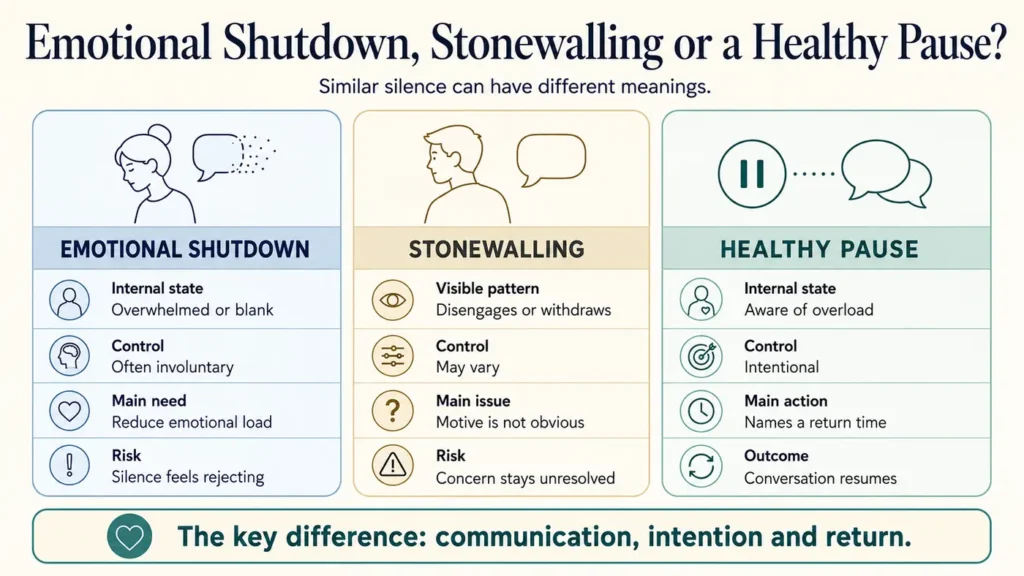
This distinction also protects people on both sides of the interaction. It prevents an overwhelmed person from being automatically labelled manipulative while also preventing “I was shutting down” from becoming a permanent excuse for refusing communication or accountability.
Learning to recognise your own pattern is the first step. The next step is understanding what happens in your mind and body when emotional intensity rises—and why the words you need can become temporarily inaccessible.
What Happens in Your Mind and Body When You Go Blank?
During a calm conversation, you can hold several pieces of information in mind at once. You can listen to what another person is saying, recall relevant details, notice their emotional tone and decide how you want to respond. A tense argument places much heavier demands on these abilities.
You are no longer processing words alone. At the same time, you may be monitoring facial expressions, anticipating criticism, controlling your own reactions, remembering previous disagreements and worrying about the consequences of saying the wrong thing. When that mental and emotional load becomes too great, your capacity for thoughtful communication can narrow considerably.
This is why going blank during an argument is not necessarily a sign that you have nothing to say. Sometimes, too much is happening inside you for your thoughts to be organised into words.
Emotional Flooding Narrows Your Ability to Respond
Emotional flooding occurs when the intensity of an interpersonal situation becomes difficult to process and regulate. It may involve anger, fear, shame, helplessness or several emotions arriving together. Researchers describe flooding during relationship conflict as an experience of emotional overwhelm that can interfere with cognitive organisation and constructive problem-solving.
When you become emotionally flooded, your attention tends to narrow. Instead of considering the entire conversation, you may become fixed on one threatening detail: a raised voice, an accusation, a particular facial expression or the fear that the relationship is in danger.
At that point, several communication abilities can become less accessible:
- Holding the other person’s full argument in working memory
- Separating what is being said from how it is being said
- Recognizing more than one possible interpretation
- Finding accurate words for complex emotions
- Listening without mentally preparing for danger
- Considering the longer-term consequences of your response
- Expressing disagreement without becoming defensive or withdrawing
This does not mean that the reasoning parts of your brain have literally “switched off”. That popular description is too absolute. A more accurate explanation is that high emotional arousal can reduce the flexible use of attention, memory and verbal organisation. Your brain is still functioning, but it is prioritising immediate emotional demands over careful conversation.
Research on emotional flooding during couple conflict suggests that the experience is shaped not only by a person’s general emotional sensitivity but also by how they perceive and respond to their partner’s negative emotions. In other words, shutdown is not always an isolated reaction occurring entirely within one person. The interaction itself can intensify or reduce the overwhelm.
The Defensive System Can Apply a Temporary Brake
Some people experience more than emotional overload. They notice a sudden stillness: their body becomes rigid or heavy, their voice feels unavailable, and initiating any response seems unusually difficult.
This experience is sometimes described as defensive freezing. Human freezing is not simply “doing nothing”. Research suggests that it can function as a temporary brake on action while the nervous system assesses threat and prepares for what to do next. Studies have associated defensive freezing with changes in movement, attention and physiological activity, although laboratory findings cannot tell us exactly what is happening in every real-life argument.
A detailed review of the human defence cascade explains that defensive responses can shift according to how near, intense or escapable a perceived threat feels. Further research describes freezing as a state that may briefly interrupt action while influencing later approach or avoidance decisions (Klaassen et al., 2021).
In everyday conflict, this may help explain why someone can hear a question and understand that an answer is expected, yet still feel momentarily unable to speak.
However, not every quiet or blank moment should be labelled a freeze response. Silence may also reflect uncertainty, deliberate restraint, slower emotional processing or a wish to avoid the subject. Behaviour alone cannot reveal the exact mechanism.
Defensive freezing is also not automatic evidence of childhood trauma. Previous exposure to frightening, humiliating or unpredictable conflict may increase sensitivity to similar cues, but immediate stress, exhaustion, anxiety and the present relationship environment can also shape a person’s response.
Why Language Becomes Harder to Access
Speaking during conflict requires more than knowing how you feel. You must identify the emotion, decide what information is relevant, predict how the other person might react and convert an internal experience into understandable language—all while continuing to listen.
This becomes especially difficult when several emotions compete for expression. You may feel hurt by what was said, angry about how it was said, ashamed of your reaction and afraid of what will happen next. The answer to “What are you feeling?” is therefore not one clear emotion but a crowded internal experience that has not yet been sorted.
Some people respond by repeating a general phrase, such as:
- “I’m fine.”
- “It doesn’t matter.”
- “I don’t know.”
- “Just leave it.”
- “Do whatever you want.”
These statements may sound dismissive, but they can sometimes mean ‘I cannot yet translate what is happening inside me into words.’
Difficulty identifying emotions can further complicate the process. If you notice physical discomfort before recognising whether it represents fear, anger, shame or sadness, you may need more time than the conversation allows. Being pressured to explain immediately can then create a second layer of anxiety about not having an answer.
Gently naming even a partial experience may help create some structure. For example:
“I’m not completely sure what I’m feeling yet, but I can tell that I’m becoming overwhelmed.”
Research on affect labelling—putting emotional experiences into words—suggests that naming feelings can influence emotional processing and reduce aspects of emotional reactivity. A well-known neuroimaging study found that labelling emotional stimuli was associated with increased activity in a prefrontal region and reduced amygdala responses compared with another labelling task (Lieberman et al., 2007).
This finding should not be interpreted to mean that naming an emotion will instantly end shutdown. Its practical value is simpler: a modest, accurate label can be easier to access than a complete explanation. “I feel cornered,” “I’m confused,” or “I need the conversation to slow down” may provide a starting point when a polished response is impossible.
Why the Right Words Return After the Argument
Once the interaction ends and emotional intensity decreases, some of the mental resources consumed by monitoring threat and managing overwhelm become available again. You are no longer simultaneously listening, interpreting tone, anticipating another response and trying to control your own reaction.
With less immediate pressure, you may be able to:
- Reconstruct what was said
- Identify what affected you most
- Separate your feelings from your assumptions
- Remember relevant details
- Form clearer sentences
- Consider the other person’s perspective
- Imagine a response without fearing instant interruption
This delayed clarity explains why people often create their best response in the car, shower or bed. It does not necessarily mean that they are over-dramatic or intentionally withheld their thoughts. Their thinking occurred under different emotional conditions.
However, repeatedly rehearsing the conversation afterwards can turn reflection into an overthinking loop. Helpful reflection produces a clearer understanding or a plan for repair. Rumination repeats the same exchange without creating either.
The objective is therefore not to produce a perfect answer while highly activated. It is to recognise when your capacity is narrowing, preserve enough connection to request a pause, and use the quieter period to prepare for a constructive return.
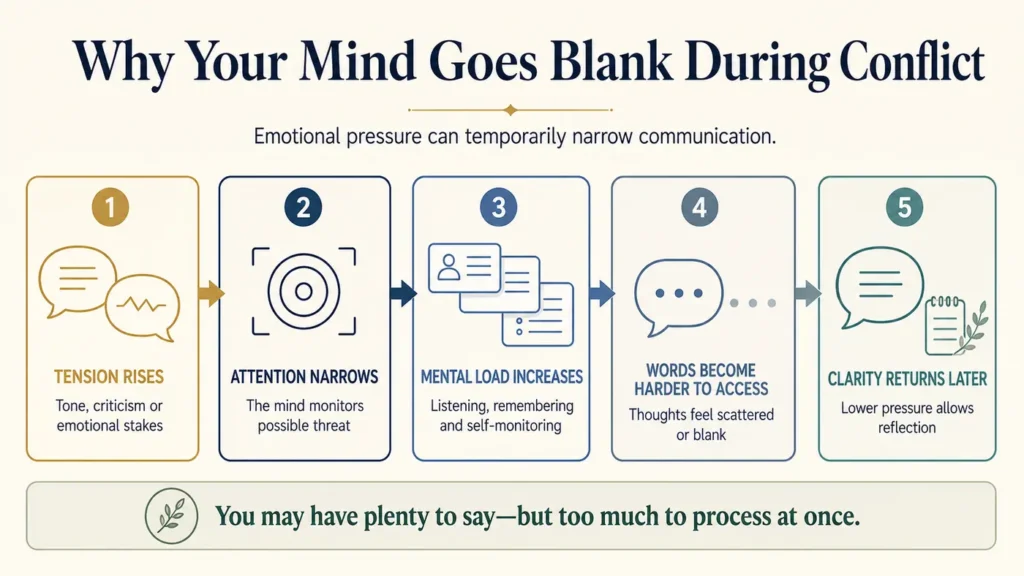
Understanding this process explains how shutdown can occur. The next question is more personal: why does your mind respond this way in some arguments—and what psychological factors make shutdown more likely?
9 Psychology Reasons You Shut Down During Arguments
Knowing that emotional intensity can disrupt thinking explains how shutdown happens. It does not fully explain why one person remains able to communicate while another becomes silent, confused or mentally distant in a similar situation.
There is rarely one universal cause. Your response may reflect your emotional state that day, what conflict has meant in previous relationships, the way the present conversation unfolds and the skills you have had an opportunity to develop. Several of the following reasons may operate together.
1. You Become Emotionally Flooded
Some arguments become emotionally intense faster than you can process them. One critical remark may activate hurt, anger, embarrassment and fear at the same time. Before you have understood the first feeling, another question or accusation arrives.
Emotional flooding is especially likely when a conversation is the following:
- Moves rapidly between several complaints
- Includes raised voices, contempt or repeated interruption
- Revisits unresolved issues from the past
- Feels unpredictable or impossible to end
- Takes place when you are already stressed or exhausted
- Carries a perceived threat of rejection or relationship loss
At this point, silence may become an attempt to reduce incoming emotional information. You are not necessarily refusing to listen; you may no longer be able to process the conversation at its present speed.
Flooding can also create a mismatch between how you feel and how you appear. While the other person sees withdrawal, you may be experiencing intense internal distress. Because that distress remains invisible, they may assume you need more explanation, more questions or greater pressure. Unfortunately, each additional demand can make clear communication less accessible.
The immediate need is often not a better argument but a lower level of intensity. Slowing the pace, addressing one concern at a time and requesting a defined pause can create enough mental space for genuine engagement.
2. Conflict Has Become a Learned Danger Cue
Your mind does not interpret every disagreement only by examining what is happening in the present. It also uses previous experience to predict what may happen next.
If earlier conflicts regularly involved yelling, humiliation, punishment, withdrawal of affection or unpredictable reactions, you may have learnt that disagreement carries emotional risk. Staying quiet, agreeing quickly or becoming less visible may once have reduced that risk.
This learning can develop in childhood, but it can also arise from later experiences:
- A previous partner responded aggressively to disagreement.
- A friend shared private information after an argument.
- A workplace punished people who questioned authority.
- Family members treated differences of opinion as disrespect.
- Attempts to explain yourself repeatedly made situations worse.
Later, an impatient tone, a raised voice or a disappointed expression may evoke the expectation that the present conversation will follow the same course. Your reaction can therefore feel larger than the immediate situation appears to justify.
This does not mean your body is literally reliving the past or that every shutdown reveals hidden trauma. It means that people learn from repeated interpersonal consequences. When silence has repeatedly been safer than speaking, it can become an automatic protective habit.
Changing that expectation requires more than telling yourself that conflict is normal. You need repeated experiences in which disagreement remains respectful, boundaries are honoured and expressing a different view does not cost you connection.
3. You Fear That Anything You Say Will Make the Situation Worse
Sometimes the problem is not an absence of thoughts but an excess of possible consequences.
Before speaking, you may ask yourself:
- What if my words sound selfish?
- What if I hurt them further?
- What if they misunderstand my tone?
- What if I reveal how angry I really am?
- What if this becomes a bigger argument?
- What if they leave?
The more you monitor and revise every possible answer, the harder spontaneous speech becomes. You may discard one response for sounding defensive, another for sounding uncaring and a third because it might invite more questions. Eventually, saying nothing feels like the least dangerous option.
This is particularly common when you feel responsible for keeping the interaction calm. You may believe that expressing your genuine reaction will add to the other person’s distress, so you suppress it and search for a perfectly safe response.
However, no honest conversation comes with complete protection from disappointment or misunderstanding. Trying to eliminate every interpersonal risk can make authentic communication impossible. Silence may prevent an immediate reaction, but it can also leave your needs unspoken and allow resentment to grow.
A more realistic goal is not to find the perfect sentence. It is to offer one clear, respectful piece of information:
“I want to answer honestly, but I’m becoming afraid that anything I say will make this worse. Can we slow the conversation down?”
This communicates both your internal experience and your intention to remain engaged.
4. Shame Replaces the Ability to Explain Yourself
Guilt and shame can produce very different responses during conflict.
Guilt focuses on behaviour: I did something that may have hurt this person. It can encourage responsibility, apology and repair.
Shame focuses on identity: this conflict proves that I am selfish, inadequate, difficult or unloveable. Instead of helping you examine one behaviour, shame makes your entire self feel accused.
When shame takes over, even a specific complaint may sound like a judgement of your worth. “I felt unsupported yesterday” may be heard internally as “You always fail the people who need you.” Your attention then shifts from understanding the concern to protecting yourself from exposure.
Shame-related shutdown may look like:
- Lowering your head or avoiding eye contact
- Being unable to explain your intention
- Assuming that your perspective no longer matters
- Agreeing with every criticism
- Becoming numb or emotionally distant
- Wanting to disappear from the interaction
- Attacking yourself internally instead of addressing the issue
People with contingent self-worth—a sense of value heavily dependent on approval, usefulness or being seen as “good”—may find relational criticism especially destabilising. A disagreement does not feel limited to one incident; it feels as though their acceptance is being withdrawn.
This creates an important distinction: taking responsibility requires enough emotional stability to examine what happened. Shame often removes that stability by turning a repairable mistake into a verdict on your identity.
A more balanced internal response is:
“I may have contributed to this problem, but I am still allowed to understand what happened, explain my perspective and participate in repairing it.”
This allows accountability without self-erasure.
5. You Need More Processing Time Than the Conversation Allows
Not everyone identifies feelings, retrieves memories and organises language at the same speed. Some people understand their internal response only after they have had quiet time to separate facts, emotions and assumptions.
This difference becomes more visible during conflict. One person may think aloud, discovering what they feel while speaking. The other may need to reflect privately before words feel accurate. Neither style is automatically healthier, but the mismatch can create frustration.
The faster processor may interpret delay as avoidance:
“Why won’t you just tell me what you think?”
The slower processor may experience that pressure as evidence that there is no room to think:
“How can I answer when I haven’t understood it myself?”
Processing time may become longer when the person is tired, overstimulated, anxious or confronted with several concerns at once. It may also vary by subject. Someone who communicates confidently at work may still struggle when discussing intimacy, disappointment or relationship uncertainty.
Needing time is not the same as avoiding responsibility. The difference lies in what happens after the pause.
A processing pause becomes constructive when you:
- Explain that you need time rather than disappearing
- Clarify what you need to think about
- Agree on when the conversation will resume
- Use the break to organize your response
- Return even if the issue still feels uncomfortable
Without a return, “I need time” can become an indefinite escape from difficult conversations. With a clear return, it becomes a legitimate communication need.
These first five reasons show how emotional intensity, learned expectations, fear, shame and processing differences can make speech difficult during conflict. But shutdown is not shaped by emotion alone. Difficulty identifying feelings, cognitive overload and the behaviour of both people can also turn one blank moment into a repeating relationship pattern.
6. You Struggle to Identify What You Are Feeling
It is difficult to explain an emotion that you have not yet identified.
During an argument, you may notice that something feels wrong without knowing whether you are angry, frightened, embarrassed, disappointed or hurt. You may first experience the emotion physically—as pressure in your chest, a tight throat, restlessness or heaviness—while its meaning remains unclear.
When someone asks, “How do you feel about this?” your honest answer may be, “I don’t know.” Unfortunately, that response can be mistaken for unwillingness to communicate.
Emotional awareness is not simply the ability to feel. It involves several related skills:
- Noticing changes in your emotional state
- Distinguishing one emotion from another
- Connecting feelings with the situation that triggered them
- Understanding what the emotion may be communicating
- Finding language that another person can understand
Some people developed these skills in families where feelings were discussed openly. Others grew up in environments where emotions were dismissed, criticised or rarely named. A person may therefore reach adulthood with a rich emotional life but a limited vocabulary for expressing it.
Temporary difficulty naming feelings during conflict should not automatically be labelled alexithymia. Alexithymia refers to a broader pattern involving difficulty identifying and describing emotions; it cannot be inferred from one behaviour during an argument. Stress alone can make emotional clarity harder for almost anyone.
When a complete explanation feels unavailable, begin with what you can identify:
“I know I’m affected, but I can’t tell yet whether I’m more hurt or angry.”
You can also describe the physical experience without claiming to understand it completely:
“My chest feels tight, and I’m having trouble organising my thoughts.”
This type of partial emotional labelling creates a bridge between total silence and a fully developed response. Research on affect labelling suggests that putting emotions into words can influence emotional processing, but the purpose here is not to make difficult feelings disappear. It is to give an unclear internal experience enough structure for communication to begin.
7. The Conversation Creates Cognitive Overload
Conflict requires considerable mental coordination. You must listen, interpret meaning, remember relevant events, regulate your reaction and plan a response—often within a few seconds.
That capacity can be exceeded when a conversation contains too much information at once.
Cognitive overload may occur when:
- Several unrelated concerns are raised together
- Old disagreements are added to the current issue
- Questions arrive without enough time to answer
- You are frequently interrupted
- The other person speaks rapidly or for a long time
- You are expected to remember exact details under pressure
- You are trying to interpret sarcasm, indirect language or mixed messages
- The discussion happens when you are already mentally exhausted
Under these conditions, your silence may reflect a processing bottleneck rather than emotional indifference. By the time you have begun constructing an answer to the first concern, the conversation has moved to the fourth. You may then abandon your response because it no longer seems relevant.
Cognitive overload can also produce apparent inconsistency. You may deny something initially, remember it differently later or struggle to explain events in chronological order. Although dishonesty is one possible explanation for inconsistency, confusion under pressure is another. A single fragmented response should not automatically be treated as proof of deception.
A useful intervention is to reduce the amount of information being processed:
“There are several concerns here, and I’m losing track. Can we start with what happened this morning and address the other issues afterward?”
Writing down the main point can also help when verbal information is difficult to hold in mind. The goal is not to turn an intimate conversation into a formal meeting. It is to create enough structure for both people to respond to the same issue.
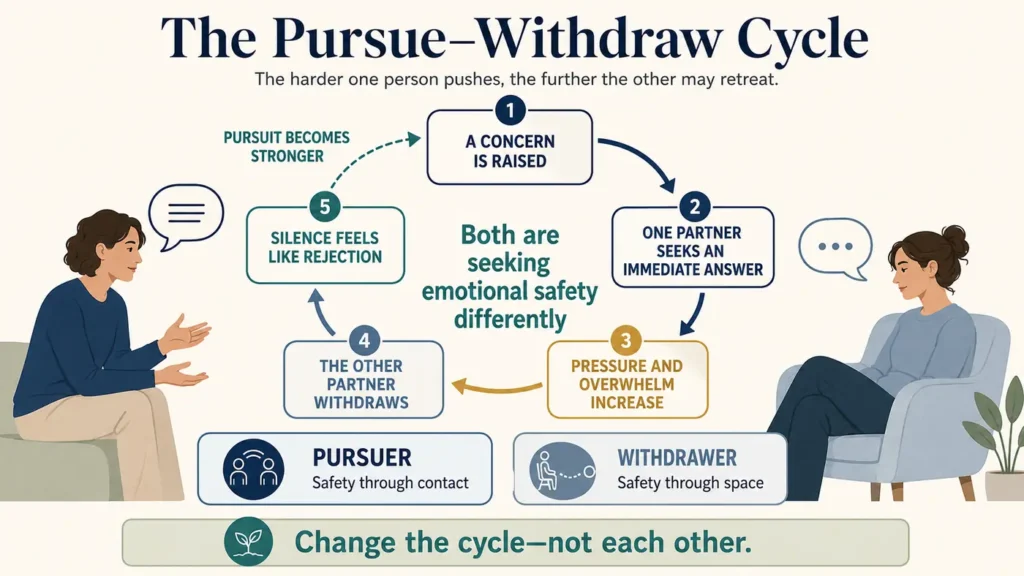
8. Withdrawal Has Become Part of a Relationship Cycle
Sometimes shutdown cannot be understood by examining only one person. It develops inside a repeating interaction between two people.
One partner may seek immediate discussion because distance feels threatening. They ask more questions, repeat the concern or increase emotional intensity in an attempt to restore connection. The other partner experiences that pressure as overwhelming and withdraws to regain control.
The withdrawal then makes the first partner feel ignored or abandoned. They pursue an answer more urgently. The increased pursuit makes the second partner retreat even further.
The cycle may look like this:
Concern is raised → pressure for resolution increases → overwhelm rises → one person withdraws → the other feels dismissed → pressure intensifies → shutdown deepens
Relationship researchers commonly describe this as a demand–withdraw pattern. Research indicates that demand–withdraw dynamics can be connected with attachment-related concerns and are associated with relationship distress, although the roles are not fixed permanently by gender or personality. Either partner may pursue or withdraw depending on the subject, perceived power and emotional stakes. Recent research continues to examine how attachment and gender interact with these patterns (Seedall et al., 2024).
The important insight is that both reactions may be attempts to create safety:
- The pursuing person seeks safety through contact, clarity and immediate reassurance.
- The withdrawing person seeks safety through distance, reduced intensity and additional processing time.
Although both responses may be understandable, their interaction can make each person feel less secure. The pursuer experiences silence as rejection, while the withdrawer experiences pursuit as emotional pressure.
Breaking the cycle requires both people to respond differently. The withdrawing partner needs to communicate the pause and reliably return. The pursuing partner needs to allow temporary space without treating every delay as abandonment.
Instead of:
“Leave me alone. I’m done talking.”
A clearer response is:
“I am becoming overwhelmed, but I am not abandoning this conversation. I need 30 minutes, and I will come back at 8:00.”
Instead of:
“You always run away because you don’t care.”
The other person might say:
“I can give you some space if we agree when we will continue.”
This shifts the problem from you against me to both of us against the cycle.
9. Shutdown Has Become Your Fastest Route to Relief
Behaviours often repeat because of what happens immediately after them.
If becoming silent, agreeing, leaving the room or emotionally disconnecting causes an uncomfortable argument to stop, you experience relief. That relief can strengthen the behaviour, making shutdown more likely during the next disagreement.
In behavioural psychology, this process is called negative reinforcement. The word ‘negative’ does not mean ‘bad’; it means that something unpleasant is removed. The argument feels unbearable; withdrawal reduces the discomfort, and the mind learns:
“When conflict becomes intense, shutting down helps me escape it.”
The short-term result is relief. The long-term consequences may include:
- Unresolved resentment
- Important needs remaining unspoken
- Increasing anxiety before difficult conversations
- A partner escalating more quickly to get a response
- Reduced confidence in your ability to handle disagreement
- Growing emotional distance
- Repetition of the same conflict
Agreeing merely to end the conversation can function similarly. It removes immediate pressure, but because the agreement is not genuine, the underlying issue returns. Over time, you may feel unheard even though you technically said “yes”.
This is one reason people can sincerely want to communicate differently yet continue withdrawing. The behaviour works in the short term, even while damaging connections in the longer term.
Changing the pattern involves learning that relief can come from reducing the intensity without abandoning the issue. A communicated pause offers temporary distance, while a planned return prevents avoidance from becoming the final outcome.
Each time you notice overwhelm, request space appropriately and return as promised, you create a new experience:
“I can step away without disappearing. I can feel uncomfortable without surrendering my position. Conflict can pause and still be repaired.”
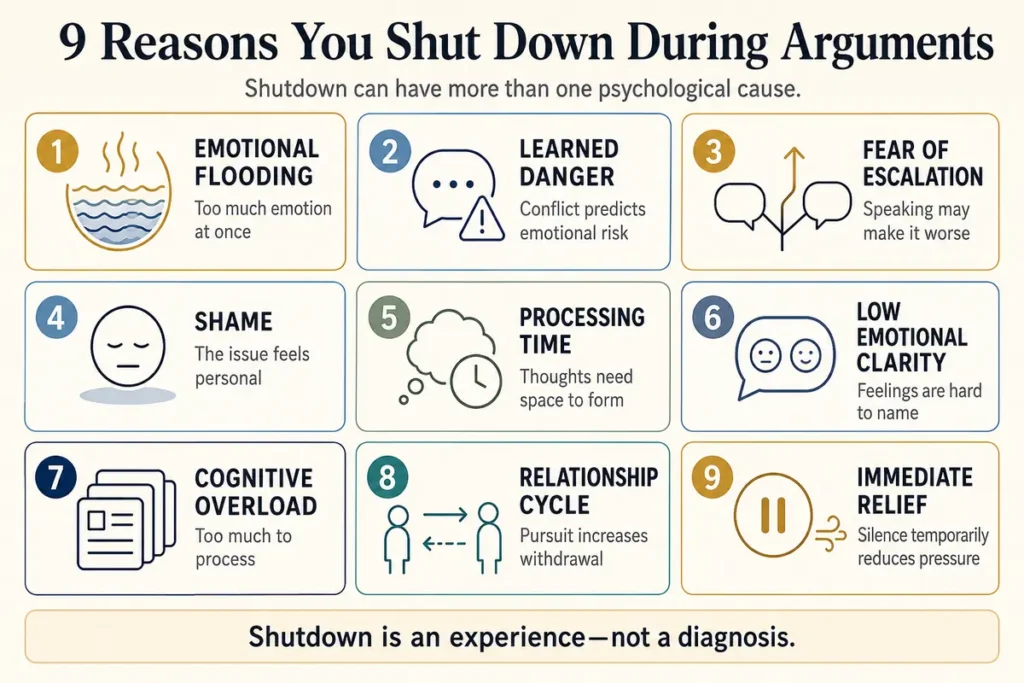
These nine reasons reveal why the question “Why do I shut down during arguments?” rarely has a one-line answer. Shutdown may reflect emotional flooding, learned threat expectations, shame, slower processing, difficulty identifying feelings, cognitive overload, relationship dynamics or a habit reinforced by immediate relief.
Understanding your particular combination is more helpful than adopting a broad label. It also prepares you to examine an especially confusing question: why shutdown may happen frequently with a partner while you remain articulate and confident with friends, colleagues or strangers.
Why Do I Shut Down With My Partner but Not With Other People?
You may communicate confidently at work, handle disagreements with friends and express your opinions clearly in ordinary situations, yet become silent or confused during conflict with your partner.
This contrast can feel contradictory. Your partner may even ask, “You can talk to everyone else. Why can’t you talk to me?”
The answer is not necessarily that you care less about the relationship. Sometimes, you shut down more because the relationship carries greater emotional importance.
The Emotional Stakes Are Higher
A disagreement with a colleague may be uncomfortable, but it usually does not carry the same fear of emotional rejection, abandonment or loss of intimacy. A partner’s disappointment can affect your sense of connection, belonging and security more deeply.
As the perceived consequences increase, so can the pressure to respond correctly. You may begin monitoring every sentence:
- Will this make them feel unloved?
- Will they think I am selfish?
- Will this become a larger relationship problem?
- What if they stop trusting me?
- What if this argument changes how they see me?
When the relationship matters greatly, you may feel that you have more to lose. The desire to protect the connection can therefore make honest communication harder rather than easier.
This is especially relevant if you already tend to take disagreement personally or interpret another person’s disappointment as evidence that the relationship is becoming unsafe. A concern about one behaviour may begin to feel like a judgement of the entire relationship.
Your Partner Knows Your Most Sensitive Areas
Close relationships involve emotional knowledge that casual relationships do not. Your partner knows what matters to you, what disappoints you and where you feel uncertain. Even when they do not intend to hurt you, their words may reach places that other people’s comments do not.
A statement from a colleague may remain a practical criticism. A similar statement from your partner may feel like evidence that you are failing someone whose opinion deeply matters.
Current arguments can also carry the emotional weight of previous unresolved disagreements. You may not be responding only to what was said today. You may also be anticipating the familiar direction the conversation usually takes.
For example, if previous discussions repeatedly ended with interruption, criticism or days of distance, your mind may begin preparing for that outcome as soon as tension appears. Shutdown can start before the conversation has actually become unmanageable.
Closeness Can Increase Vulnerability
Being emotionally close requires allowing another person to see your needs, uncertainty and imperfections. Conflict can make that openness feel risky.
You may be comfortable discussing facts but struggle to say:
- “That hurt me.”
- “I am afraid you will leave.”
- “I feel inadequate.”
- “I need reassurance.”
- “I am angry, but I still care about you.”
- “I made a mistake, and I feel ashamed.”
These statements involve vulnerability rather than explanation alone. If you have learned to remain composed, useful or emotionally self-sufficient, admitting that you feel hurt or afraid may seem more threatening than staying silent.
Shutdown can then become a shield against being fully seen. Unfortunately, the same shield that reduces immediate vulnerability can also prevent the closeness you are trying to protect.
How Emotional Shutdown Affects Both Partners
Emotional shutdown is painful for the person experiencing it, but it also affects the person waiting for a response.
What shutdown can feel like from the inside
The person who shuts down may experience:
- Frustration at being unable to speak
- Shame about appearing weak or emotionally unavailable
- Fear that any response will escalate the conflict
- Pressure to produce immediate emotional clarity
- Exhaustion after the interaction
- Anger at feeling misunderstood
- Guilt for leaving the issue unresolved
- Delayed rumination about what should have been said
They may sincerely want connection while feeling unable to create it in the moment.
What shutdown can feel like to the other person
The partner may experience the silence as:
- Being ignored or dismissed
- Evidence that their feelings do not matter
- Refusal to accept responsibility
- Emotional punishment
- Loss of connection
- Uncertainty about whether the conversation will ever continue
- Pressure to pursue harder in order to receive any response
Neither interpretation fully captures the other person’s experience. One partner thinks, I am trying not to make this worse. The other thinks, You are leaving me alone with the problem.
This is why intention and impact must be considered together.
You may not intend to reject your partner, but your unexplained withdrawal may still make them feel rejected. At the same time, your partner may not intend to overwhelm you, but repeated demands for an immediate answer may still intensify your shutdown.
A healthier conversation allows both truths to exist:
“I understand that my silence made you feel ignored. I was overwhelmed rather than indifferent, but I can see why it affected you that way.”
And:
“I understand that you were overwhelmed. I still need reassurance that we will return to the issue rather than leaving it unresolved.”
This approach avoids two unhelpful extremes. It does not blame someone for an involuntary response, and it does not use involuntary overwhelm to avoid responsibility for the response’s impact.
How to Support a Partner Who Shuts Down
Supporting an overwhelmed partner does not mean abandoning your own concerns. It means helping create conditions in which both people can participate more constructively.
Slow the pace without dropping the subject
Ask one clear question and allow time for an answer. Avoid repeating the question in several different ways, introducing old grievances or demanding an immediate conclusion.
You might say:
“You don’t have to explain everything at once. What is the most important thing you want me to understand?”
Describe what you observe without assigning a motive
Instead of saying, “You are ignoring me because you don’t care,” try:
“You have become very quiet, and I’m not sure whether you need time or want to end the conversation.”
This allows the person to clarify their internal state rather than defend themselves against an assumed intention.
Agree on what ‘a pause’ means.
Discuss this outside an argument. Decide:
- How either partner can request a pause
- How long the first pause might be
- What contact is appropriate during it
- When the conversation will resume
- What to do if more time is genuinely needed
The purpose is not to impose a rigid rule. It is to remove the uncertainty that often makes temporary distance frightening.
Do not demand emotional clarity on command
A partner may not immediately know whether they feel angry, hurt or afraid. Asking for a perfect explanation while they are overwhelmed can deepen the shutdown.
A smaller question may be easier:
“Do you need me to listen, slow down or give you some space?”
Maintain boundaries around indefinite avoidance
Compassion does not require accepting repeated disappearance, days of unexplained silence or permanent refusal to discuss important issues.
It is reasonable to say:
“I respect that you need time, but this issue affects both of us. I need us to agree on when we will continue.”
A processing pause protects communication. Indefinite avoidance prevents it.
The objective is not for one partner to become the other’s emotional regulator. Both people remain responsible for noticing their reactions, communicating their needs and participating in repair.
The next step is learning how to do that in real time—before overwhelm becomes complete shutdown, while words are becoming difficult, and after enough calm has returned to continue.
How to Stop Shutting Down During Arguments: The Stay–Pause–Return Plan
Learning how to stop shutting down during arguments does not mean forcing yourself to speak while your thoughts are disorganised. Nor does it mean leaving every time a conversation becomes uncomfortable.
The more realistic goal is to recognise overwhelm early, preserve connection while taking necessary space, and return when you can participate more constructively.
The Stay–Pause–Return Plan organises this process into three stages:
- Stay connected long enough to recognise and communicate what is happening.
- Pause before overwhelm becomes complete shutdown or reactive behaviour.
- Return to the conversation with greater clarity and a manageable structure.
This plan is not a clinical treatment or a guarantee that every disagreement will be resolved. It is a practical communication structure that can prevent temporary overwhelm from becoming indefinite avoidance.
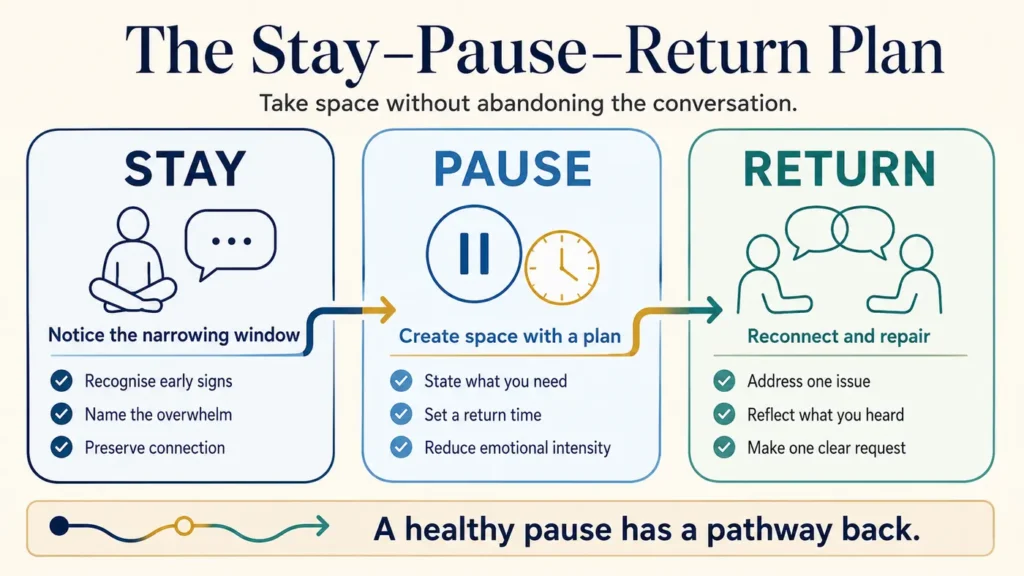
Stage 1: Stay—Recognize Your Narrowing Window
Shutdown often feels sudden, but it may be preceded by a short period in which your capacity begins to narrow. Recognising this window gives you an opportunity to respond before words become completely inaccessible.
Your early warning signs may include:
- Losing track of what the other person is saying
- Reading every statement as criticism
- Repeating the same sentence without moving forward
- Becoming unusually quiet
- Feeling pressure in your chest or throat
- Holding your breath or breathing more rapidly
- Struggling to remember what started the conversation
- Feeling numb, unreal or mentally distant
- Wanting to agree merely to make the discussion stop
- Thinking, “Nothing I say will help”
- Feeling a sudden urge to escape, hide or end the relationship
The aim is not to monitor every physical sensation anxiously. Instead, identify two or three signs that reliably appear before you shut down.
For example, you might notice that you first lose the ability to follow long explanations, then feel tension in your jaw, and finally begin answering every question with “I don’t know.” That sequence becomes your personal warning pattern.
Once you recognise it, name what is happening without trying to explain the entire psychology behind it:
“I want to stay with this conversation, but I’m starting to lose track of what we’re discussing.”
Or:
“I can feel myself becoming overwhelmed, and I don’t want to respond carelessly.”
This is different from announcing, “You are making me shut down.” The first statement describes your present capacity. The second assigns the entire cause to the other person and may intensify defensiveness.
Staying connected does not mean remaining in the conversation indefinitely. It means communicating before you withdraw whenever the situation is safe enough to do so.
Stage 2: Pause—Create Space Without Disappearing
A healthy pause has a clear purpose: to restore enough emotional and cognitive capacity for the conversation to continue.
An effective pause request contains three elements:
- Connection: The issue and the relationship still matter.
- Need: You are no longer processing the conversation effectively.
- Return: You specify when or how the discussion will resume.
A complete pause request might sound like:
“This conversation matters to me, and I want to respond properly. I’m becoming too overwhelmed to think clearly. I need a short break. Can we continue at 8:00?”
Other useful versions include:
“I’m not refusing to discuss this. I need some time to understand what I’m feeling. I will come back after dinner.”
“I can hear that this is important to you. I’m losing the ability to listen properly, so I need us to pause and return to it in an hour.”
“I’m becoming reactive, and I don’t want to say something hurtful. Can we stop for now and continue tomorrow morning at 10:00?”
There is no universally correct break length. The appropriate time depends on the level of arousal, the seriousness of the issue, practical responsibilities and whether both people feel emotionally safe. A short pause may be enough in one situation, while a longer break may be appropriate in another.
What matters is that the pause is not vague. “We’ll talk later” can leave the other person uncertain about whether later will ever arrive. A specific time or clear condition—such as “after the children are asleep”—makes the commitment more credible.
What to do during the pause
Use the break to reduce intensity and organise your response—not to build a stronger argument against the other person.
Helpful options include:
- Moving to a quieter environment
- Slowing your breathing without forcing it
- Walking or stretching gently
- Drinking water and attending to basic physical needs
- Writing the central issue in one sentence
- Separating what was said from what you assumed it meant
- Naming the emotions you can identify
- Deciding what you need the other person to understand
- Considering what part of the concern may be valid
- Preparing one question rather than several counterarguments
A simple written reflection can help:
- What happened?
- What did I feel or notice in my body?
- What meaning did I assign to it?
- What do I need to explain, ask or acknowledge?
Avoid using the pause to send reactive messages, recruit other people against your partner, repeatedly rehearse insults or collect evidence for every previous disagreement. Those activities may maintain or intensify activation rather than restore clarity.
The pause is also not the best time to make major relationship decisions unless immediate safety is involved. Thoughts such as “I should end everything” can feel convincing when distress is high but may not reflect your considered judgement.
Stage 3: Return—Complete the Part That Builds Trust
Returning is the most important and most frequently neglected stage.
Without a return, taking space can become avoidance. When you resume the conversation as promised, you teach both yourself and the other person that a pause does not mean abandonment.
Begin by acknowledging the interruption:
“Thank you for giving me time. I understand more clearly what was happening for me, and I’m ready to continue.”
You do not need to return with a perfect explanation or complete solution. You only need enough clarity to participate.
A constructive return can follow this order:
1. Address one issue at a time
If several concerns were raised, agree on which one to discuss first.
“Can we begin with what happened this morning and discuss the earlier issue separately?”
2. Reflect what you understood
Before defending yourself, summarise the other person’s concern.
“What I heard is that when I changed the plan without telling you, you felt that your time did not matter.”
This does not mean you agree with every interpretation. It demonstrates that you understand what requires a response.
3. Explain your internal experience without using it as an excuse
“When the conversation became intense, I felt ashamed and stopped processing clearly. That explains why I became quiet, but I understand that my silence left you feeling dismissed.”
This holds intention and impact together.
4. State your perspective simply
Avoid delivering every thought you prepared during the pause. Lead with the central point:
“I should have told you about the change. I also want you to understand that I was trying to solve a practical problem, not disregard you.”
5. Make one repair or one request
“Next time, I will message you before changing the plan.”
Or:
“If I ask for a pause, can we agree not to follow each other from room to room?”
Specific agreements are more useful than broad promises such as “I’ll communicate better”.
When you need more time than expected
Sometimes the agreed return time arrives and you still do not feel ready. Do not disappear or repeatedly postpone the conversation without explanation.
Instead, renegotiate openly:
“I know I said I would be ready at 8:00. I’m still too activated to discuss this fairly. I am not cancelling the conversation. Can we continue tomorrow at 9:00 after breakfast?”
Repeated extensions should not become routine. If every difficult issue is postponed several times, the problem may no longer be temporary overwhelm; avoidance may also be operating.
A Necessary Safety Exception
The Stay–Pause–Return Plan is intended for difficult but fundamentally safe disagreements. It does not require you to remain engaged during intimidation, threats, coercion, stalking, physical aggression or abuse.
If the other person blocks your exit, follows you aggressively, threatens harm, destroys property, controls your access to help or makes you fear for your safety, leaving is not unhealthy conflict avoidance. It is a protective action.
In an unsafe situation, prioritise reaching a secure place and contacting trusted people, local emergency services or an appropriate domestic-abuse support organisation. A communication framework cannot make an abusive interaction safe.
For ordinary relationship conflict, however, practising the full sequence gradually strengthens confidence: you can notice overwhelm without judging yourself, request space without disappearing and return without surrendering your perspective.
The objective is not perfect calm. It is remaining responsible for connection even when you temporarily need distance.
When Emotional Shutdown May Need Professional Attention
Occasionally needing time to process a difficult conversation does not necessarily indicate a psychological problem. Many people become less articulate when tired, stressed or emotionally surprised.
Professional support may be worth considering when shutdown becomes frequent, intense or disruptive. This may be particularly important if you:
- Shut down during most disagreements, including relatively minor ones
- Feel unreal, detached from your body or disconnected from your surroundings
- Experience memory gaps after emotionally intense interactions
- Develop panic-like symptoms when someone raises their voice
- Remain emotionally numb long after the conversation ends
- Avoid important discussions for days or weeks
- Agree to things you do not want because speaking feels impossible
- Alternate between complete withdrawal and explosive reactions
- Have experienced abuse, frightening conflict or other traumatic events
- Find that repeated shutdown is damaging your work or relationships
- Fear that either you or another person may become unsafe during conflict
A qualified mental-health professional can help explore what contributes to the pattern. Depending on the person, this may include anxiety, trauma-related reactions, difficulty identifying emotions, communication habits, relationship dynamics or another source of distress.
Shutting down during arguments cannot, by itself, establish a diagnosis. It does not automatically mean that you have post-traumatic stress disorder, dissociation, an avoidant attachment style, autism, ADHD or any other condition. A proper assessment considers the wider pattern, its duration, the situations in which it appears and its effect on daily functioning.
Individual counselling may help you recognise early signs, improve emotional clarity and practise expressing difficult feelings. Couples counselling may be useful when both partners feel trapped in a repeating pursuit-and-withdrawal cycle. However, joint counselling may not be appropriate where coercion, intimidation or abuse is present; individual safety should come first.
Final Perspective: Silence Does Not Always Mean You Do Not Care
If you frequently wonder, “Why do I shut down during arguments?”, it may be tempting to conclude that you are weak, emotionally unavailable or incapable of healthy communication. Those judgements do not explain the behaviour, and they rarely help you change it.
Your silence may begin as an involuntary response to emotional flooding, shame, cognitive overload or perceived threat. It may also have become a learnt way to obtain immediate relief from conflict. Understanding the origin gives you context, but it does not remove your responsibility for what happens next.
You may not always be able to prevent the first wave of overwhelm. You can gradually learn to notice it earlier, describe it more clearly and respond before total shutdown takes over.
Progress may initially look small:
- Recognizing that your thoughts are becoming disorganized
- Saying “I need the conversation to slow down”
- Naming one feeling instead of explaining everything
- Requesting a pause before abruptly leaving
- Returning at the time you promised
- Listening to the impact of your silence without attacking yourself
- Expressing one honest need even when disagreement remains
The goal is not to remain perfectly calm or produce the ideal response during every argument. It is to create enough space between overwhelm and withdrawal for a more intentional choice to become possible.
Sometimes that choice will be to remain in the conversation. Sometimes it will be to pause. In an unsafe situation, it may be best to leave and seek help. What distinguishes emotional growth is not whether you ever need distance—it is how clearly, responsibly and safely you use it.
A difficult conversation does not have to be completed in one sitting to be meaningful. But when both people are safe, it does need a pathway back.
Frequently Asked Questions (FAQs)
Why does my mind go blank during arguments?
Your mind may go blank when emotional arousal and cognitive demand exceed your present processing capacity. Attention becomes narrower, working memory is placed under pressure, and organising feelings into language becomes more difficult. Fear of escalation, shame, exhaustion and previous conflict experiences may also contribute.
Is shutting down during conflict always a trauma response?
No. Trauma can make certain conflict cues feel more threatening, but shutdown can also be associated with anxiety, emotional flooding, cognitive overload, slower processing, shame, accumulated stress or established communication patterns. The behaviour alone cannot identify its cause.
Is emotional shutdown the same as stonewalling?
Not necessarily. Emotional shutdown describes an internal experience of overwhelm, blankness or disconnection. Stonewalling describes observable withdrawal from an interaction and may be deliberate, defensive, habitual or driven by overwhelm. Context, intention and whether the person returns to the conversation help clarify the difference.
Why do I think of the right words only after an argument?
After the conversation ends, emotional pressure and incoming information decrease. This can make attention, memory retrieval and verbal organisation more available. You may then understand what affected you and construct the response that was difficult to access during the argument.
How can I stop shutting down during arguments?
Begin by identifying your earliest warning signs, such as losing track of the conversation, becoming physically tense or repeating “I don’t know.” Communicate that you are becoming overwhelmed, request a specific pause and commit to returning. During the break, reduce intensity and organise your main point rather than rehearsing the argument.
How long should a break during an argument last?
There is no universally correct duration. The break should be long enough for both people to regain the ability to participate constructively but specific enough that it does not become indefinite avoidance. Agree on a return time and communicate openly if it genuinely needs to change.
What can I say when I feel myself shutting down?
A helpful statement combines connection, need and return:
“This matters to me, but I’m becoming too overwhelmed to think clearly. I need a pause. Can we continue at 8:00?”
This reassures the other person that you are pausing the conversation rather than abandoning it.
Why do I shut down only with my partner?
Romantic conflict can carry greater emotional stakes than disagreements with colleagues or acquaintances. Your partner’s disappointment may affect your sense of connection, acceptance or relationship security more deeply. Repeated unresolved interactions can also create a familiar pattern in which one partner pursues an answer while the other withdraws.
Can anxiety make it difficult to speak during confrontation?
Yes. Anxiety can narrow attention, increase self-monitoring and make it harder to retrieve and organise words under pressure. However, difficulty speaking during conflict has several possible explanations, so persistent or severe symptoms should be assessed in their wider context.
How can I help a partner who shuts down?
Slow the pace, address one issue at a time and ask whether they need clarification, quiet or a temporary pause. Avoid assuming that silence automatically means indifference. At the same time, it is reasonable to expect a clear commitment to return so that important concerns are not indefinitely avoided.
A Gentle Note

This article is intended for educational and informational purposes and cannot diagnose the cause of emotional shutdown. If conflict regularly leaves you panicked, disconnected or unable to function—or if a relationship feels threatening or unsafe—consider seeking support from a qualified mental-health professional or an appropriate local support service.
Research References
Berenguer-Soler, M., et al. (2023). Breaking the cycle of emotional flooding: The protective role of emotional intelligence in couple conflict.
Read the full study
Klaassen, F. H., et al. (2021). Defensive freezing and its relation to approach–avoidance decision-making under threat.
Read the full study
Kozlowska, K., et al. (2015). Fear and the defence cascade: clinical implications and management.
Read the full review
Lieberman, M. D., et al. (2007). Putting feelings into words: Affect labeling disrupts amygdala activity in response to affective stimuli.
Read the PubMed record
Malik, J., et al. (2020). Emotional flooding in response to negative affect in couple conflict.
Read the full study
Seedall, R. B., et al. (2024). Gender, attachment and demand–withdraw patterns in couple relationships.
Read the PubMed record
Simpson, J. A., and Rholes, W. S. (2017). Adult attachment, stress and romantic relationships.
Read the PubMed record
1 thought on “Why Do I Shut Down During Arguments? 9 Psychology Reasons You Go Blank—and How to Stay Present”