

Someone’s voice suddenly becomes louder. You know you want to answer. You may even have a reasonable explanation ready. But before you can express it, something changes inside you.
Your thoughts disappear. Your body becomes tense and unusually still. Perhaps you look down, agree just to end the conversation or find yourself unable to say anything at all. Later, when the situation has passed, every sentence you wanted to speak returns clearly.
You may then wonder, why do I freeze when someone raises their voice when I am perfectly capable of speaking at other times?
Table of Contents
This reaction can feel especially confusing at work, in a relationship or during a family disagreement. You may judge yourself for not being more confident. You might assume that staying silent means you are weak, overly sensitive or incapable of handling conflict.
But freezing is not a deliberate decision. It does not necessarily mean you agree with the other person, have nothing to say or lack courage. It may happen because your nervous system detects something potentially threatening and briefly shifts its attention from thoughtful communication to protection.
For some people, it is the loudness itself. For others, it is the anger, facial expression, power difference or possibility of what might happen next. Previous experiences can strengthen this response, but freezing does not automatically mean that you have experienced trauma or have a mental health condition.
If you tend to become silent throughout difficult conversations—not only when someone raises their voice—you may also find it helpful to understand why people shut down during arguments. The focus here is more specific: why the sound and emotional intensity of a raised voice can make your body pause before you have consciously decided how to respond.
Quick Answer: Why Do I Freeze When Someone Raises Their Voice?
You may freeze when someone raises their voice because your brain and nervous system interpret the change in volume, tone or expression as a possible sign of danger, rejection or loss of control.
Your body may briefly reduce spontaneous movement and speech while trying to assess what is happening. As attention shifts toward the perceived threat, it can become difficult to organise thoughts, retrieve words or decide whether to speak, leave or remain quiet.
Earlier experiences with anger, fear of making the situation worse, unequal power, rejection sensitivity and accumulated stress can make this reaction more likely. However, not everyone who freezes has unresolved trauma. Sometimes the response develops through ordinary learning, repeated conflict, anxiety or a period of emotional exhaustion.
The goal is not to force yourself to speak while your mind and body are overwhelmed. It is to recognise what is happening, restore enough steadiness to make a deliberate choice and gradually learn that you have more options than silence.
What Happens When Your Body Freezes?
Freezing does not look exactly the same for everyone. It also does not always mean becoming completely unable to move.
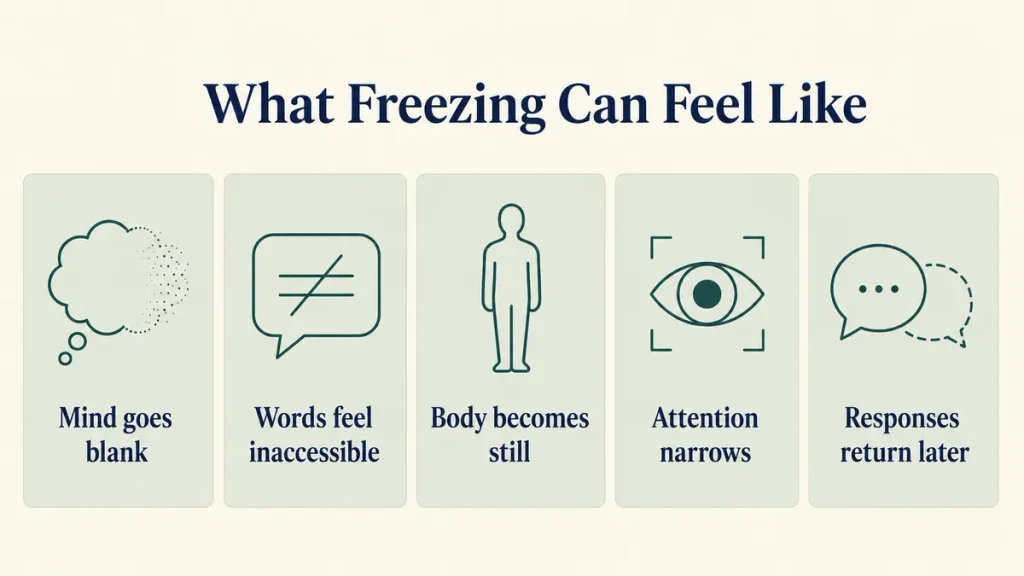
You might remain standing, maintain eye contact or even continue performing a familiar task. Internally, however, you may feel unable to think clearly or respond in a way that represents what you actually feel.
A freeze response may involve:
- your mind suddenly becoming blank;
- difficulty finding simple words;
- holding your breath or breathing shallowly;
- tightness in your chest, jaw or throat;
- becoming unusually quiet or physically still;
- feeling detached from yourself or the conversation;
- automatically agreeing so the situation will end;
- remembering the response you wanted only afterwards.
Imagine that your manager questions a decision you made. You are ready to explain your reasoning. But when their voice becomes sharp and noticeably louder, your attention moves away from the facts you had prepared. You begin monitoring their face, tone and possible reaction. Your explanation feels inaccessible, even though you understood it clearly a few moments earlier.
A similar experience can happen at home. Your partner may be frustrated rather than dangerous, but the sudden intensity in their voice still makes your body tense. You know you want to ask them to speak more calmly, yet the words do not come until much later.
This pause is not necessarily passive. Research describes defensive freezing as a state involving reduced movement and changes in bodily arousal while the brain evaluates a possible threat and prepares for what to do next. A major scientific review, Freeze for Action, explains that freezing can support attention, risk assessment and preparation for action. Research examining freezing-like responses to social threat has also observed changes in heart rate and body movement when people encounter angry social signals.
In everyday language, however, people often use “freezing” broadly. They may be describing a momentary mental blank, inhibited speech, emotional detachment or a strong urge to become unnoticed. These experiences can overlap, but they are not identical.
It is also important not to automatically label an everyday freeze response as tonic immobility. Tonic immobility is a more extreme defensive state associated with situations experienced as severe and inescapable. Going quiet when someone raises their voice does not, by itself, mean that this more serious response is occurring.
What matters is the central experience: your thinking mind may understand that you want to speak, while your protective system is still trying to decide whether speaking feels safe.
The next question is why a raised voice produces this reaction in some situations—or for some people—more strongly than others. The answer rarely comes down to one cause. Biology, learning, relationships, perceived control and current emotional capacity can all play a part.
7 Reasons You May Freeze When Someone Raises Their Voice
There is rarely one explanation for a freeze response. The same raised voice can feel irritating to one person, frightening to another and overwhelming to someone else.
Your reaction may be shaped by what is happening now, what similar situations have meant in the past and how much control you feel you have in the moment. The following reasons are possibilities to explore—not diagnoses to apply to yourself.
1. Your brain interprets the raised voice as a possible threat
A raised voice is more than an increase in sound. It is usually accompanied by a sharper tone, faster speech, a tense expression or more forceful body language. Together, these signals can tell your brain that the interaction is becoming unpredictable.
This evaluation can begin before you have consciously decided whether the person is dangerous. Your attention shifts towards questions such as ‘What will they do next?’ Is this getting worse? Should I speak or stay quiet?
Freezing creates a brief pause while the nervous system assesses these possibilities. Research on the human defence cascade suggests that freezing can occur early in a threat response, before more active reactions such as confronting the situation or moving away from it.
For example, imagine that you are discussing a delayed task with a colleague. The conversation is manageable until they suddenly speak much louder and lean towards you. You stop thinking about the task itself and begin watching their face, hands and tone. Your mind has not failed. Its priority has temporarily changed from explaining to monitoring.
People differ in how strongly they respond to these cues. If you frequently feel that ordinary words, facial expressions or changes in tone affect you more intensely than expected, understanding why you get triggered so easily may provide broader context.
A perceived threat is not always an actual threat. But the body must make its initial judgement quickly, often with incomplete information.
2. Earlier experiences taught your nervous system what loud voices mean
Present reactions are partly shaped by what the mind has learned from previous experiences.
If raised voices once regularly preceded punishment, humiliation, rejection or frightening conflict, a similar tone may later activate an expectation that something painful is about to happen. This association can remain influential even when the present person and situation are different.
Consider someone who grew up in a home where a parent’s raised voice meant that criticism would soon become personal. Years later, their partner becomes louder during a disagreement. They know their partner is frustrated and has never harmed them. Still, their chest tightens and their thoughts disappear.
This does not mean that the person is consciously confusing their partner with their parent. It means that an old cue may still carry an emotional meaning learned through repetition.
Research has found that children exposed to physical abuse can show heightened attention towards angry facial cues. Such findings do not prove that every person who freezes has experienced abuse. They demonstrate a broader principle: repeated threatening experiences can influence how attention responds to later signs of anger. The original study on childhood physical abuse and attention to threat offers relevant scientific support.
Early relationships can also shape the way people recognise, express and manage strong emotions. This connection is explored more fully in how childhood shapes emotional regulation.
The purpose of recognising this pattern is not to blame the past. It is to understand why your present reaction may feel faster and stronger than the immediate situation seems to require.
3. Staying silent may once have been the safest response
Being exposed to anger does not explain by itself why one person argues back while another becomes silent. The difference may lie in what each person learnt was safest to do.
Some children discover that explaining themselves only invites more criticism. Some partners learn that defending a boundary causes an argument to escalate. An employee may realise that questioning an aggressive senior leads to public humiliation or professional consequences.
In such situations, silence can become protective.
For example, a child tries to explain why they made a mistake, but the parent interprets the explanation as “answering back”. Over time, the child stops speaking whenever the parent sounds angry. That response reduces immediate conflict, so the mind learns to repeat it.
As an adult, the same person may become quiet when a manager raises their voice—even when a calm explanation would now be appropriate. Their circumstances have changed, but the old response still arrives automatically.
A pattern that restricts you today may once have helped you manage a situation in which you had fewer choices.
This is different from simply being afraid of loud voices. The important learning was not only “anger is dangerous“; it was also “staying quiet makes this end sooner.”
Recognising that distinction can reduce shame. It also reveals what needs to change: not your personality, but the expectation that speaking will always make the situation worse.
4. You feel trapped or unable to leave the situation
Freezing may become stronger when neither confronting the person nor leaving feels realistically available.
You might experience this with:
- a manager who controls your appraisal;
- a parent whose approval or support you depend on;
- a partner who reacts badly when challenged;
- a teacher speaking harshly in front of others;
- someone standing too close or blocking your movement;
- an authority figure whose decision could affect your future.
Imagine being criticised loudly by a senior officer during a meeting. You want to correct an inaccurate statement, but you are also aware of the hierarchy, the audience and the possible consequences of speaking firmly. Walking away would appear inappropriate, while responding openly feels risky. With neither option feeling safe, your body pauses.
This is why someone may freeze with one particular person but communicate confidently with others. The response is influenced not only by temperament or emotional history, but also by power and perceived control.
Scientific accounts of defensive responding emphasise that the distance, intensity and escapability of a threat help shape how the body responds. The review Fear and the Defense Cascade describes how perceived threat and the availability of escape can influence defensive reactions.
It is therefore important to ask a practical question alongside the psychological one:
Am I reacting only to an old fear, or is something about this present situation genuinely limiting my safety and freedom to respond?
Sometimes both are true. A previous pattern may sensitise you to anger, while the person in front of you is also behaving in an intimidating way. Understanding your nervous system should never require you to dismiss the reality of someone else’s conduct.

5. The raised voice activates fear of rejection or disconnection
Sometimes it is not the volume alone that feels threatening. It is what the anger appears to mean for the relationship.
When someone important becomes louder, you may quickly fear that they are deeply disappointed, withdrawing their affection or preparing to leave. Your attention moves away from the subject being discussed and towards protecting the connection.
Thoughts may arise automatically:
- They are going to reject me.
- I have ruined the relationship.
- I must not make them any angrier.
- If I disagree, they may stop caring about me.
Imagine that you tell your partner you are unhappy about something. They become defensive and raise their voice. You had planned to explain what you needed, but now you have become silent. Preserving the relationship suddenly feels more urgent than expressing the concern that started the conversation.
This response can be stronger in people who are particularly sensitive to signs of rejection or abandonment. Research on attachment patterns suggests that people with higher attachment anxiety may experience greater emotional activation when they anticipate relationship loss or rejection. However, freezing in one difficult conversation is not enough to identify someone’s attachment style.
Fear of disconnection can also appear outside romantic relationships. A young adult may freeze when a parent sounds disappointed. An employee may become silent when an admired manager speaks harshly. In both situations, the person fears losing more than the immediate disagreement—they fear losing approval, belonging or emotional security.
If another person’s displeasure regularly makes you question your worth or the stability of the relationship, the patterns discussed in why some people need constant reassurance may also be relevant.
The aim is not to become indifferent to relationships. It is to gradually recognise that disagreement and disconnection are not always the same thing.
6. Emotional overload temporarily disrupts your ability to think and speak
You may know exactly what you want to say before a difficult conversation. But once the other person raises their voice, your explanation seems to disappear.
This does not mean that you were unprepared. It can happen because intense stress changes how your limited mental resources are being used.
Working memory helps you hold information in mind while organising a response. During a tense interaction, that capacity may become occupied with monitoring the other person:
- How angry are they?
- Are they moving closer?
- Will my answer make this worse?
- Should I defend myself or remain quiet?
- What will happen after this conversation?
With so much attention directed towards possible danger and consequences, fewer resources remain for recalling details, choosing words and thinking flexibly. A scientific review of acute stress and executive functioning found that stress can impair working memory and cognitive flexibility, although its effects vary according to the person, situation and level of stress.
Consider an employee who has prepared clear facts for a meeting. When questioned calmly, they can explain everything. When the same question is delivered in an angry voice, they struggle to remember even basic details. Later, when the pressure has passed, the information becomes accessible again.
This is also why the perfect response often arrives on the way home, in the shower or while lying in bed. Once the mind is no longer monitoring an immediate social threat, it has more capacity to reconstruct the conversation.
Your delayed clarity does not prove that you are incapable of speaking up. It may simply show that clear thinking becomes harder when your system is overloaded.
7. Your stress system may already be carrying too much
A raised voice may be the immediate trigger without being the complete explanation.
Your ability to remain present during conflict is affected by what your mind and body were carrying before the conversation began. Prolonged pressure, poor sleep, repeated disagreements, anxiety, caregiving demands or emotional exhaustion can leave you with less capacity to manage another intense experience.
Imagine someone who usually handles workplace disagreements confidently. After several weeks of deadlines, family responsibilities and disturbed sleep, their manager speaks sharply to them. This time, they freeze. The reaction may not represent a permanent change in personality. Their emotional capacity was already stretched.
Sleep is particularly relevant. Research examining sleep and emotional brain functioning indicates that insufficient sleep can affect emotional reactivity and the systems involved in regulating responses. This does not mean that better sleep alone will resolve a longstanding freeze pattern, but it can influence how strongly a stressful interaction is experienced.
Accumulated stress can also explain why you respond differently to similar situations. One raised voice may feel manageable on a settled day but overwhelming after a week of conflict or uncertainty.
Before concluding that something is fundamentally wrong with you, it may help to ask:
- Am I physically and emotionally exhausted?
- Have I been dealing with repeated tension?
- Do I feel safe in this environment generally?
- Is this reaction happening everywhere or mainly around one person?
- Has my ability to handle conflict changed recently?
These questions move the focus from self-judgement to context. Emotional capacity is not fixed. It can narrow under strain and expand again when there is rest, support and greater safety.
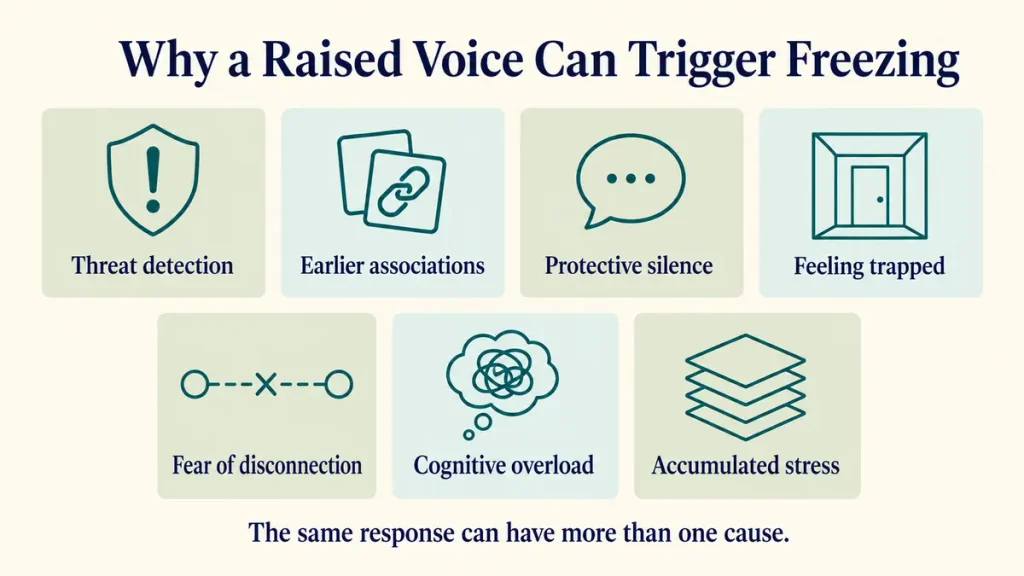
These seven explanations are not mutually exclusive. A person may have learned to stay silent in earlier relationships, feel trapped by a current power difference and also be functioning under considerable stress. Understanding the combination matters because the most helpful response will depend on what is actually happening—not merely on the visible fact that you became quiet.
How to Respond When You Feel Yourself Freezing
When someone raises their voice, you may feel pressure to explain yourself immediately. But once your mind has gone blank, forcing a detailed response can increase the overwhelm.
The first goal is not to win the argument or find the perfect words. It is to recover enough steadiness to recognise your options and choose what happens next.
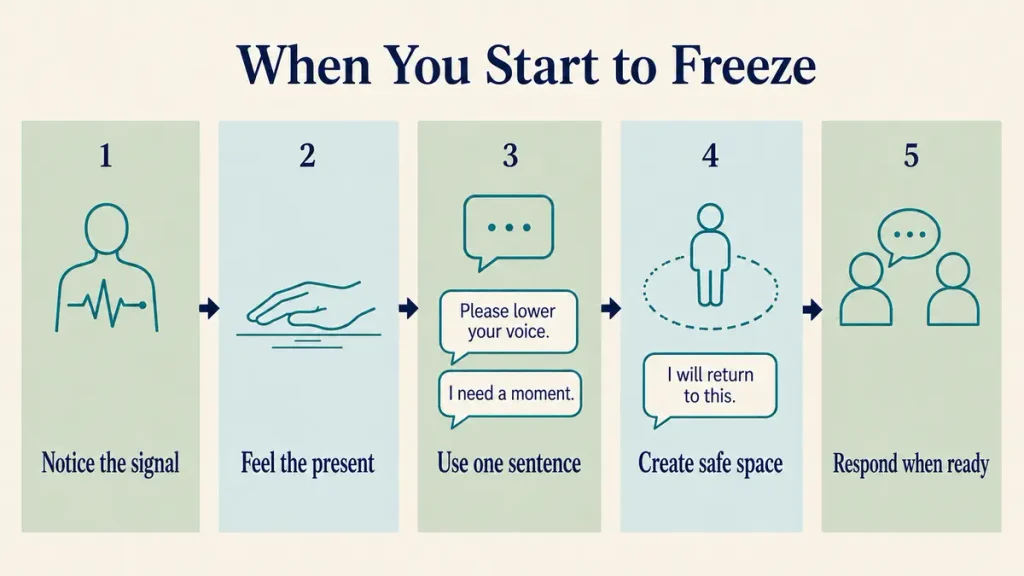
Notice the earliest sign
A freeze response often begins before complete silence. Your jaw may tighten. Your breathing may become shallow. You might stop following what the person is saying or feel a sudden urge to agree so that the conversation ends.
Try to identify your earliest reliable signal. For example:
“When my throat tightens and I begin staring at the floor, I am starting to freeze.”
Recognising this point gives you more choice than waiting until speaking feels impossible. This kind of emotional awareness is an important part of developing emotional regulation as a life skill.
Orient yourself to the present
Gently bring some attention away from the other person and back to your immediate surroundings.
You might:
- feel both feet making contact with the floor;
- notice the support of the chair beneath you;
- look briefly at two or three neutral objects;
- relax your hands or jaw;
- make your exhalation slightly slower and longer;
- remind yourself where you are and who is in front of you.
This is not about pretending that everything is safe. It is a way of gathering present-day information instead of responding only to the emotional intensity of the moment.
One slow breath will not magically “reset” your nervous system. However, these small actions may create enough space to notice whether you need to speak, pause, leave or seek support.
Use one prepared sentence
During overload, a short statement is easier to retrieve than a detailed explanation. Prepare one or two sentences when you are calm and practise saying them aloud.
Depending on the situation, you might say:
- “I want to discuss this, but I need you to lower your voice.”
- “I am finding it difficult to think while we are speaking like this.”
- “Please give me a moment before I answer.”
- “I need a short pause. I will return to this conversation in 20 minutes.”
- “I will continue when we can speak without shouting.”
Your statement does not need to justify every feeling. Its purpose is to communicate what you need next.
If asking someone to lower their voice produces intense guilt, the deeper difficulty may also involve setting boundaries without guilt.
Create space when it is possible and safe
A temporary pause can help thinking and language return. At home, that may mean moving to another room. At work, it might mean asking to continue the discussion after reviewing the facts. During a phone call, it could mean ending the call respectfully and agreeing on a time to reconnect.
A pause is different from indefinite avoidance. When the relationship is basically safe, give a clear indication of whether and when you intend to return:
“I need 15 minutes to settle and organise my thoughts. I will come back so we can finish this.”
You do not have to promise a return when the person is threatening, abusive or physically unsafe. In those circumstances, protection and outside support take priority over completing the conversation.
Do not judge yourself for a delayed response
Sometimes you will not recognise the freeze response until the interaction is over. You may then replay the conversation and criticise yourself for not speaking sooner.
Instead of asking, “Why was I so weak? “Try asking:
- What happened just before my mind went blank?
- What did I fear would happen if I spoke?
- What would I like to communicate now?
- Is it safe and useful to revisit the conversation?
You may still be able to respond later through a calmer conversation, a phone call or a carefully written message. Speaking after you have regained clarity is not less valid than responding immediately.
How to Feel Safer and More Able to Respond
Changing a freeze response is usually not about forcing yourself to become fearless. It is about helping your mind and body discover that you can notice what is happening, assess the situation and choose a response.
That change is often gradual. It begins outside the heated moment, when you have enough space to understand the pattern without judging yourself.
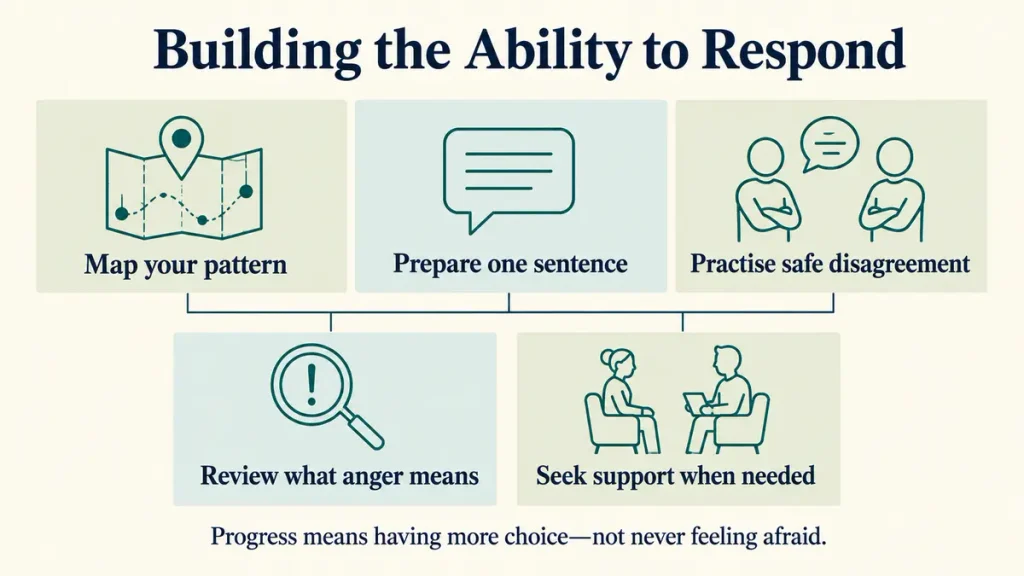
Map what happens before you freeze
Rather than treating every episode as identical, look for the specific sequence.
After a difficult interaction, you might write down:
- Who raised their voice?
- What changed in their tone or behaviour?
- What did I notice in my body first?
- What did I fear would happen if I spoke?
- Did I feel free to leave or ask for a pause?
- Was the situation uncomfortable, intimidating or genuinely unsafe?
- What did I want to say once the moment had passed?
You may discover that loudness alone is not the main trigger. Perhaps you freeze only with authority figures, when criticism happens publicly or when someone moves physically closer. Knowing the pattern makes it easier to prepare for the situation that actually affects you.
Practise language before you need it
Assertive words are harder to create while you are overwhelmed. Rehearsing them in calmer moments can make them more available later.
Start with one sentence that feels believable in your own voice:
“I can answer, but I need a moment to think.”
You can practise it quietly, write it in your phone or use it first during a relatively safe disagreement. The goal is not to deliver it perfectly. It is to become familiar with the experience of speaking while another person is displeased.
Build tolerance through safe disagreements
You do not need to expose yourself deliberately to shouting. Instead, practise expressing differences in relationships where the other person is capable of listening.
This might mean correcting a minor misunderstanding, declining a small request or calmly asking someone to change their tone. Each safe experience can provide new information: disagreement does not always lead to punishment, abandonment or escalation.
If the other person responds respectfully, allow yourself to notice that outcome. The nervous system learns not only from danger but also from repeated experiences of safety and repair.
Reconsider what another person’s anger means
A raised voice can be inappropriate without proving that you are wrong, unworthy or about to lose the relationship.
Ask yourself:
- Is this person’s reaction proportionate to what happened?
- Am I responsible for the issue, or am I taking responsibility for their entire emotional state?
- Can someone be frustrated with me and still care about me?
- What would a respectful disagreement look like here?
This is not about dismissing feedback. It is about separating useful information from the fear created by the way it was delivered.
Seek professional support when the pattern is persistent
Consider speaking with a qualified mental-health professional if freezing happens frequently, disrupts important relationships or work, or is accompanied by panic, dissociation, intrusive memories, nightmares or strong avoidance.
Therapy can help you identify the thoughts, bodily sensations and learned expectations involved. Cognitive behavioural approaches may help with anxiety, beliefs about conflict and practising new responses. If an assessment indicates PTSD or significant trauma-related symptoms, established treatments include trauma-focused cognitive behavioural therapies and EMDR. The American Psychological Association’s PTSD treatment guidance provides an overview of evidence-based options.
A single freeze response does not mean you need trauma treatment. The appropriate approach depends on your history, symptoms, present circumstances and personal preferences.
When the Problem Is Not Your Freeze Response
Understanding your response should never become a reason to excuse another person’s intimidation.
A raised voice may occur occasionally during an emotionally charged disagreement. But repeated yelling used to frighten, control or silence you is not simply a communication problem. The behaviour deserves attention in its own right.
Warning signs may include:
- insults, humiliation or threats;
- repeatedly shouting over you so that you cannot respond;
- blocking a doorway or preventing you from leaving;
- breaking or throwing objects;
- threatening children, pets, finances or employment;
- monitoring your communication or movements;
- punishing you after you express a boundary;
- blaming you for “making” them become aggressive.
The World Health Organization recognises psychological abuse and controlling behaviour as forms of intimate-partner violence. Although women are disproportionately affected, people of any gender can experience intimidation or abuse.
In an unsafe situation, the goal is not to become calm enough to tolerate more. Prioritise distance, support and practical safety. Contact a trusted person, local support service or emergency assistance when necessary. Avoid confronting an aggressive person alone if doing so could increase the danger.
You can work on regulating your freeze response and still hold someone else responsible for the way they treat you. Both truths can exist together.
Learning to stay present does not mean learning to remain available for intimidation. A healthier nervous system response includes recognising when you can communicate—and when you need to protect yourself.
Frequently Asked Questions
Is freezing when someone yells a trauma response?
It can be. A raised voice may activate learned threat associations connected with earlier abuse, intimidation or unpredictable conflict. However, freezing does not automatically mean that you have trauma or PTSD. Anxiety, power differences, fear of rejection, emotional overload and accumulated stress can produce a similar response.
A qualified mental-health professional can help if the reaction is intense, persistent or connected with other trauma-related symptoms.
Why does my mind go blank when someone raises their voice?
When an interaction feels threatening, your attention may shift towards monitoring the other person’s tone, expression and possible actions. This leaves fewer mental resources for recalling information, organising language and responding flexibly.
Your knowledge has not disappeared. It may simply be more difficult to access while your mind is prioritising immediate safety and risk assessment.
Why do I remember everything I wanted to say afterwards?
As the emotional intensity settles, working memory and flexible thinking become more available. You are no longer using as much attention to monitor the other person or predict what might happen next.
This is why clear responses often appear minutes or hours after the conversation. Delayed clarity does not mean you are incapable of standing up for yourself. It shows that you think more effectively when you feel sufficiently safe.
Is freezing the same as shutting down during an argument?
The two experiences can overlap, but they are not identical.
Freezing is usually an involuntary defensive response to a perceived threat. Shutting down is a broader pattern that may involve emotional flooding, withdrawal, numbness, cognitive overload or avoidance of further discussion.
Someone may freeze immediately when a voice becomes louder but regain the ability to communicate once the volume decreases. Another person may remain emotionally withdrawn long after the argument has ended. You can explore this distinction further in why people shut down during arguments.
How can I stop freezing when someone raises their voice?
Trying to command yourself not to freeze can add another layer of pressure. A more realistic approach is to recognise your earliest physical signal, orient yourself to the present and use one prepared sentence.
Over time, practising boundaries and manageable disagreements in safe relationships may increase your sense of choice. Professional support can be helpful when the response is severe, frequent or connected with traumatic experiences.
What should I do if someone keeps yelling at me?
Begin by considering whether the situation is merely uncomfortable or genuinely unsafe.
When it is safe, you can state that you are willing to continue the conversation at a lower volume and take a defined pause if needed. If yelling is repeatedly used to humiliate, threaten, control or prevent you from leaving, the issue is not only your emotional response. Seek support and prioritise your safety.
Learning more about why you may feel emotionally unsafe can help you distinguish an internal alarm from an environment that is actually unstable or intimidating.
A Final Perspective
If you freeze when someone raises their voice, your silence does not define your strength, intelligence or character. It may reflect a protective response that developed when speaking, disagreeing or leaving did not feel available.
Understanding this pattern is not about blaming your past or excusing another person’s behaviour. It is about recognising what your mind and body are trying to protect—and creating enough safety to respond with greater choice.
You may not find the perfect words in every difficult moment. That is not the measure of progress. Progress can begin with noticing the response, taking one steady breath, asking for space or speaking a single honest sentence.
Your voice has not disappeared. It may simply need conditions in which it feels safer to return.
A Gentle Note

This article is intended for psychological education and self-reflection. It is not a diagnosis or a substitute for individual mental-health care. If you feel threatened or unsafe, seek appropriate local support or emergency assistance.