

The Silent Pain Nobody Talks About
“Sometimes the deepest emotional wounds are not caused by harsh words but by the absence of words altogether.”
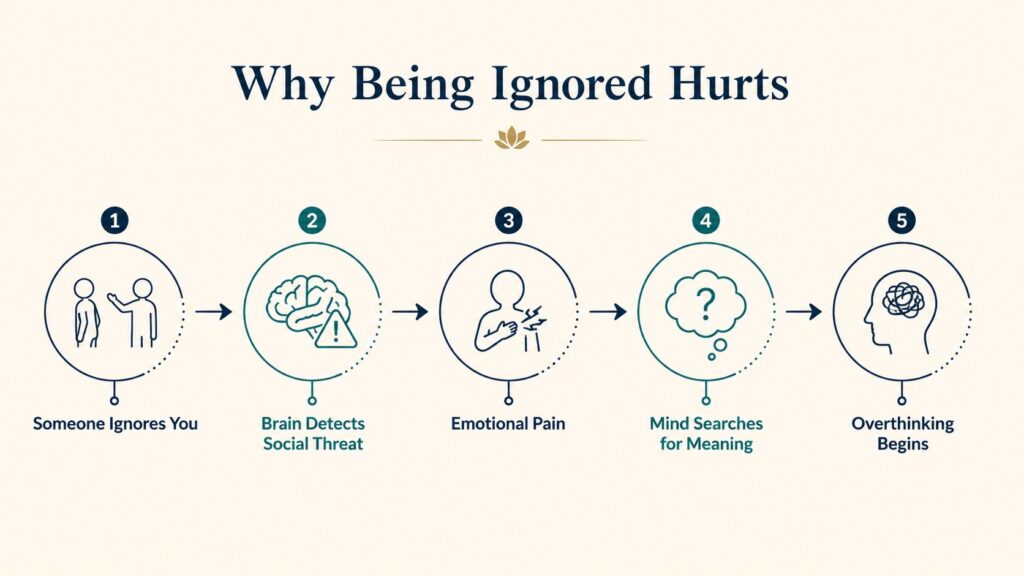
Why being ignored hurts is something almost everyone experiences, yet few people truly understand. Whether it’s an unanswered message, a distant friend, or feeling invisible in a group, being ignored can trigger emotions that seem far stronger than the situation itself. The truth is, this reaction isn’t a sign of weakness—it’s a reflection of how deeply our brains are wired for connection, belonging, and emotional safety.
Table of Contents
Imagine this.
You send a thoughtful message to someone you care about. You see that it has been read. Minutes turn into hours. Hours become days. There is no reply. No explanation. Just silence.
At first, you tell yourself they’re probably busy.
Then your mind starts asking questions.
“Did I say something wrong?”
“Are they upset with me?”
“Did I become unimportant?”
Before long, your thoughts begin filling the silence with stories—most of them painful, and none of them confirmed.
If this feels familiar, you are far from alone.
Whether it is a friend who suddenly becomes distant, a partner who stops communicating, colleagues who leave you out of conversations, or family members who seem emotionally unavailable, being ignored can leave an emotional mark that is surprisingly deep. What makes this experience particularly difficult is that it often lacks closure. There is no argument to resolve, no explanation to understand, and no clear ending. Instead, there is uncertainty—and the human mind has never been comfortable with unanswered questions.
Many people dismiss this pain with phrases like “Don’t take it personally” or “Just move on.” While those words may be well-intentioned, they often overlook something important: the emotional pain of being ignored is not simply a matter of being overly sensitive. It reflects the way the human brain has evolved to protect one of our most fundamental psychological needs—the need to belong.
This article is not about blaming the people who ignored you, nor is it about encouraging resentment. It is about understanding why being ignored hurts so deeply, what is happening inside your mind when rejection occurs, and how you can respond in ways that protect both your emotional well-being and your self-respect.
Because once you understand the psychology behind social rejection, something remarkable happens.
The question changes.
Instead of asking:
“Why am I so affected by being ignored?”
You begin asking:
“What is my mind trying to protect?”
That single shift transforms self-criticism into self-understanding.
Why Silence Often Hurts More Than Criticism
Most people assume criticism is more painful than silence.
Psychological research suggests something more nuanced.
Criticism, while uncomfortable, often provides information. It tells us what another person is thinking or feeling. Silence, on the other hand, leaves the brain searching for answers.
Our minds are remarkably good at creating explanations when information is missing. Unfortunately, during emotionally significant situations, those explanations often lean toward the negative.
A delayed reply becomes:
“They don’t care about me anymore.”
A missed invitation becomes:
“They never really wanted me there.”
A conversation that suddenly fades becomes:
“I’m not important enough.”
These interpretations feel convincing because the brain naturally tries to reduce uncertainty. Yet the story we create is not always the truth.
Often, it is simply our mind attempting to make sense of an incomplete picture.
Why Being Ignored Hurts: The Invisible Wound of Social Rejection
One of the hardest aspects of social rejection is that it is largely invisible.
If someone breaks an arm, people immediately recognize the injury and offer support.
When someone experiences rejection, exclusion, or prolonged silence, there are no visible signs.
Yet the emotional impact can linger for days, weeks, or even years.
Many people carry memories of:
- Not being chosen by friends.
- Being excluded from a group.
- Receiving no response after expressing their feelings.
- Watching others connect while feeling left out.
- Feeling invisible despite trying their best.
These experiences may seem small from the outside, but internally they can shape the way we see ourselves and our relationships.
Sometimes, it isn’t the event itself that stays with us.
It’s the meaning we attach to it.
The Stories We Tell Ourselves
When we feel ignored, we often assume the silence reflects our worth.
But there is an important distinction:
What happened is not always the same as what we believe it means.
For example:
A friend doesn’t reply.
The fact is:
“They haven’t responded yet.”
The story becomes:
“I’m not important.”
Those two statements are very different.
The first is an observation.
The second is an interpretation.
Learning to notice that difference is one of the most powerful emotional skills you can develop.
It creates a small but meaningful space between an event and your emotional reaction.
And in that space lies the possibility of responding with wisdom instead of fear.
A Gentle Reminder Before We Continue
If you’ve ever felt deeply hurt because someone ignored you, please know this:
Your emotional response does not mean you are weak.
It does not mean you are needy.
It does not mean something is wrong with you.
It means you are human.
The need to feel seen, heard, and valued is woven into our psychological makeup. Understanding that need is not a sign of dependence—it is the first step toward building healthier, more secure relationships with others and with yourself.
In the next section, we’ll explore something that surprises many people:
Why the brain often processes social rejection in ways that resemble physical pain—and how this ancient survival system still shapes our emotions today.
Key Takeaways

•	Feeling hurt when you're ignored is a common human experience, not a personal flaw.
•	Silence often creates more distress than criticism because the brain struggles with uncertainty.
•	Our minds naturally fill information gaps with interpretations that are often more negative than reality.
•	The emotional meaning we assign to rejection frequently causes more suffering than the event itself.
•	Developing awareness of the difference between facts and interpretations is a foundational skill for emotional resilience.
Your Brain Is Wired to Fear Rejection
“The pain of being ignored isn’t just emotional—it’s deeply biological.”
Imagine living thousands of years ago.
You are part of a small tribe struggling to survive in an unpredictable world. Food is scarce. Predators are everywhere. Protection depends on staying together.
Now imagine being rejected by your group.
Being excluded didn’t simply mean feeling lonely.
It often meant facing hunger, danger, or even death.
For our ancestors, belonging wasn’t a luxury.
It was survival.
Although our world has changed dramatically, our brains have evolved much more slowly. Deep within us, ancient survival systems still interpret social rejection as something that could threaten our safety.
This is why being ignored can feel so overwhelming—even when we know, logically, that our lives are not in danger.
Your brain is reacting to an ancient survival alarm that has been protecting humans for thousands of generations.
The Human Need to Belong
Psychologists have long recognized that the need to belong is one of our most fundamental psychological needs.
Researchers Roy Baumeister and Mark Leary proposed the influential Belongingness Hypothesis, suggesting that human beings possess a powerful drive to form and maintain meaningful interpersonal relationships.
This explains why we naturally seek the following:
- Close friendships
- Family connections
- Romantic relationships
- Community
- Acceptance
- Emotional support
Feeling accepted provides more than happiness.
It gives us a sense of safety, identity, and purpose.
Conversely, when those connections feel threatened, our emotional system becomes highly alert.
The pain isn’t a sign of weakness.
It’s evidence that relationships matter to the human brain.
Why Rejection Feels Like Physical Pain
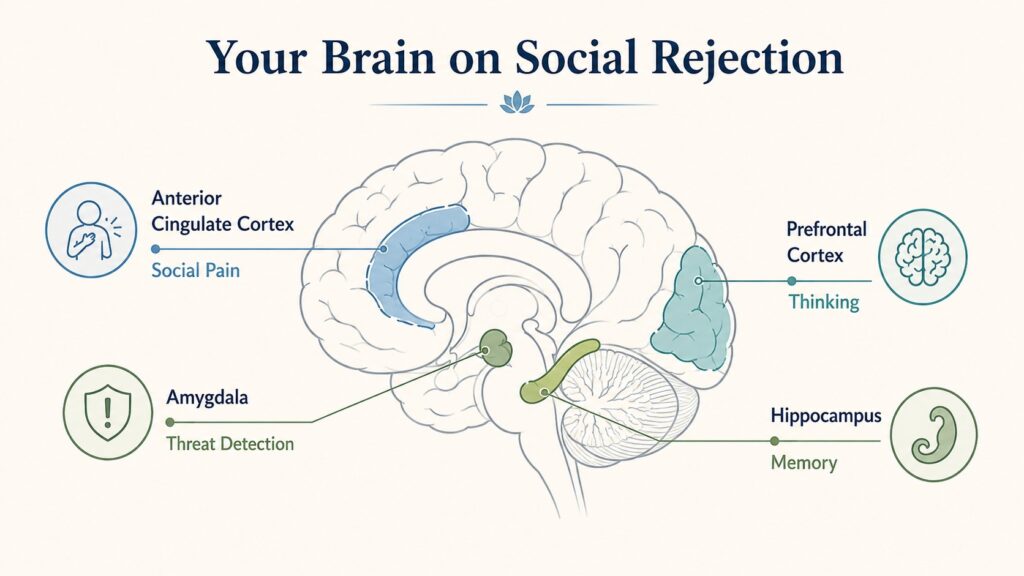
One of the most fascinating discoveries in psychology is that social pain and physical pain share some of the same neural pathways.
Neuroscientist Dr. Naomi Eisenberger and colleagues conducted groundbreaking research showing that experiences of social rejection activate brain regions involved in processing physical pain, particularly the dorsal anterior cingulate cortex (dACC) and the anterior insula.
In other words, your brain does not treat social rejection as “just an emotion.”
It processes it as a genuine threat.
This doesn’t mean emotional pain and physical pain are identical, but they overlap enough that rejection can feel surprisingly real—sometimes as a tight chest, an aching stomach, a racing heart, or a heavy sensation that seems difficult to explain.
Have you ever said,
“That really hurt.”
You probably weren’t speaking metaphorically.
Your brain may have been experiencing a form of pain that shares biological mechanisms with physical injury.
The illustration below highlights the brain regions that help explain why being ignored hurts and why even brief moments of social exclusion can leave a lasting emotional impact.
Why Silence Is Especially Difficult
Our brains prefer certainty.
Even bad news is often easier to process than uncertainty.
Imagine two situations.
In the first, someone tells you,
“I’m upset with you because of what happened.”
It hurts.
But at least you know where you stand.
Now imagine someone simply stops replying.
No explanation.
No conversation.
No closure.
Your mind begins searching for answers.
Was it something you said?
Did they lose interest?
Are they angry?
Are they struggling themselves?
Could they just be busy?
Without information, the brain starts generating possibilities.
Unfortunately, our survival system tends to prioritize negative explanations because, throughout evolution, assuming danger was often safer than assuming everything was fine.
Psychologists sometimes refer to this as a negativity bias—our tendency to notice and give more weight to potential threats than neutral or positive information.
While this bias once helped humans survive, it can also amplify emotional suffering in modern relationships.
When Your Brain Starts Filling in the Blanks
Have you noticed how quickly one unanswered message can turn into an entire story?
Perhaps you’ve experienced thoughts like:
- They must not care about me.
- I always ruin relationships.
- I’m not interesting enough.
- Everyone eventually leaves me.
- Maybe I’m simply not worth loving.
What’s remarkable is that these conclusions often appear before we have any actual evidence.
This happens because the brain dislikes uncertainty.
Rather than waiting patiently for more information, it tries to complete the puzzle—even if some of the pieces are imagined.
Psychologists describe this as meaning-making. When faced with incomplete information, we naturally create explanations that help us understand our experiences.
The challenge is that our emotional state often influences the stories we tell ourselves.
If we’re already feeling insecure or stressed, our interpretations are more likely to be self-critical.
The Alarm System That Doesn’t Know the Difference
Imagine your home’s smoke alarm.
Its job is to detect possible danger.
Sometimes it alerts you to a real fire.
Other times it goes off because someone burned toast.
The alarm isn’t trying to make your life difficult.
It’s trying to keep you safe.
Your emotional brain works in much the same way.
When it senses possible rejection, it activates thoughts, feelings, and physical sensations designed to draw your attention to a potentially important social threat.
The problem is that this system cannot always distinguish between the following:
- Genuine rejection
- Temporary distance
- Miscommunication
- Someone else’s stress
- A delayed response
- Emotional unavailability
As a result, your emotional alarm may become louder than the actual situation requires.
Recognizing this doesn’t invalidate your feelings.
Instead, it helps you understand that emotions are valuable signals—but they are not always complete descriptions of reality.
When Rejection Becomes Personal
One unanswered message rarely hurts because of the message alone.
It hurts because it touches something deeper.
Sometimes it awakens earlier experiences of:
- Feeling left out as a child.
- Being criticized repeatedly.
- Losing important relationships.
- Feeling emotionally unseen.
- Growing up in unpredictable environments.
The present moment quietly connects with the past.
Without realizing it, today’s silence may echo yesterday’s wounds.
Understanding this connection is one of the first steps toward healing.
Because once you realize that your reaction is shaped by both the present experience and your emotional history, you become less likely to judge yourself and more able to respond with compassion.
An Important Truth
There is something incredibly reassuring about understanding the science of rejection.
It reminds us that our emotional responses are not random.
They are rooted in a brain that evolved to protect connection because connection has always mattered.
Feeling hurt when someone ignores you does not mean you are emotionally weak.
It means your nervous system is doing exactly what it was designed to do.
The real challenge isn’t eliminating that response.
It’s learning how to respond wisely once the alarm has sounded.
And that is a skill anyone can develop.
Psychology Insight

Your brain is designed to notice possible social rejection because, throughout human history, belonging increased the chances of survival. Today, that same protective system can sometimes mistake uncertainty for danger, making silence feel more painful than it really is.
Key Takeaways

•	The human brain evolved to value belonging because social connection was essential for survival.
•	Social rejection activates brain regions that also process aspects of physical pain, which helps explain why it can feel so intense.
•	Silence creates uncertainty, and uncertainty often triggers the brain to imagine worst-case explanations.
•	Our negativity bias can amplify rejection by focusing on possible threats rather than alternative explanations.
•	Emotional pain is a meaningful signal—not proof that your interpretations are always accurate.
•	Understanding the science behind rejection is the first step toward responding with greater self-awareness and emotional resilience.
Why Some People Feel Rejection More Deeply Than Others
“The same silence can feel like a small inconvenience to one person and a heartbreaking loss to another.”
Have you ever noticed how differently people react to the same situation?
Two friends send a message to someone they care about.
Neither receives a reply.
One thinks,
“They’re probably busy. I’ll hear from them later.”
The other immediately wonders,
“Did I upset them? Are they pulling away? Have I done something wrong?”
The event is identical.
The emotional experience is completely different.
Why?
The answer often lies in something psychologists call attachment styles—the invisible emotional blueprint that shapes how we connect with others, interpret relationships, and respond to rejection.
Your Emotional Blueprint Begins Early
Long before we understood relationships intellectually, we experienced them emotionally.
As children, we learned about safety, trust, comfort, and connection through our interactions with caregivers.
When caregivers were consistently responsive, children often developed a sense that:
“People can be trusted.”
“I am worthy of care.”
“Relationships are generally safe.”
But life isn’t always predictable.
Some children grow up with inconsistent affection.
Others experience emotional distance, frequent criticism, unpredictable caregiving, or environments where emotional needs are rarely acknowledged.
Without realizing it, the brain begins developing expectations about relationships.
These expectations become part of an internal emotional map that often continues into adulthood.
Importantly, this isn’t about blaming parents or caregivers. Every family is shaped by its own circumstances, stresses, and challenges. Understanding attachment is about gaining insight—not assigning fault.
Attachment Styles: Four Different Ways We Experience Connection
Modern attachment theory suggests that many people tend to develop one of four broad attachment patterns. These are not rigid labels or diagnoses—they’re tendencies that can evolve throughout life.
1. Secure Attachment
People with a secure attachment style generally believe they are worthy of love and that others can be trusted.
When someone is temporarily unavailable, they are more likely to think,
“There is probably a reason. I’ll wait before assuming the worst.”
They value closeness but don’t lose themselves in relationships.
2. Anxious Attachment
People with an anxious attachment style often crave closeness but also fear losing it.
Silence can quickly trigger thoughts such as:
- “They’re losing interest.”
- “I’ve done something wrong.”
- “I need reassurance.”
This doesn’t happen because they’re “too emotional.”
It happens because their nervous system has become especially alert to signs of possible disconnection.
3. Avoidant Attachment
Some people learn that depending on others often leads to disappointment.
As adults, they may protect themselves by keeping emotional distance.
Interestingly, they may appear unaffected by rejection, but that doesn’t necessarily mean they feel no pain.
Often, they have simply learned to cope by suppressing emotional vulnerability.
4. Fearful-Avoidant Attachment
This pattern combines two powerful needs:
“I want closeness.”
and
“I’m afraid closeness will hurt me.”
As a result, relationships may feel confusing.
People may seek connection while simultaneously pulling away when they begin to feel emotionally vulnerable.
Why Rejection Feels Different for Everyone
Imagine that each person’s emotional system has its own sensitivity setting.
Some systems detect only clear signs of rejection.
Others react to even subtle changes.
For example:
A delayed reply.
A shorter text message.
Less eye contact.
A cancelled plan.
A change in someone’s tone.
For someone with heightened rejection sensitivity, these small changes can feel like confirmation that something is wrong—even when no rejection has actually occurred.
Their emotional alarm activates long before there is enough evidence.
This isn’t a character flaw.
It’s an emotional protection system that has become highly sensitive over time.
The Hidden Influence of Emotional Memory
One of the brain’s remarkable abilities is its capacity to connect present experiences with past emotional memories.
Imagine hearing a familiar song that instantly reminds you of childhood.
Emotional memories work in a similar way.
When today’s experience resembles an earlier emotional wound, your brain may respond as though both events are happening at once.
This is why an unanswered message from a colleague can unexpectedly awaken feelings connected to the following:
- Being excluded at school.
- Feeling unnoticed within the family.
- Losing an important friendship.
- Experiencing betrayal.
- Growing up with inconsistent emotional support.
The present moment quietly activates the emotional memory of the past.
Without realizing it, you’re responding to both.
Rejection Sensitivity: When the Mind Expects Disconnection
Some people develop what psychologists call rejection sensitivity—a tendency to anxiously expect, quickly perceive, and strongly react to possible rejection.
Imagine walking through life wearing emotional glasses that magnify signs of exclusion.
You begin noticing things others might barely register.
A delayed response feels intentional.
A neutral facial expression seems negative.
A forgotten invitation feels deeply personal.
The brain isn’t trying to create suffering.
It’s trying to protect you from being hurt again.
Ironically, this heightened vigilance can sometimes increase anxiety and strain relationships, making the very rejection we fear seem even more likely.
The Good News: Your Attachment Style Is Not Your Destiny
This may be the most important message in the entire article.
Attachment styles are patterns, not permanent identities.
They describe how your emotional system learned to respond—not how it must respond forever.
Thanks to the brain’s remarkable ability to adapt throughout life, new experiences, supportive relationships, self-awareness, counseling, and intentional emotional practice can gradually reshape these patterns.
Psychologists refer to this capacity as neuroplasticity—the brain’s lifelong ability to form new neural pathways in response to learning and experience.
Every time you pause before assuming the worst…
Every time you communicate openly instead of withdrawing…
Every time you remind yourself that uncertainty is not proof of rejection…
You are helping your brain build a different response.
Real change doesn’t happen overnight.
It happens one emotionally healthy choice at a time.
A Compassionate Truth
If rejection affects you more deeply than it seems to affect others, please resist the urge to label yourself as “too sensitive.”
Sensitivity is not the problem.
Unexamined emotional patterns are.
When you understand your attachment style, you stop asking,
“What’s wrong with me?”
And begin asking,
“What experiences taught my brain to respond this way?”
That question opens the door to healing because it replaces judgment with curiosity.
And curiosity is where lasting emotional growth begins.
Psychology Insight

Your attachment style is not a life sentence. It is an emotional map created through experience—and like any map, it can be updated as you gain new experiences, healthier relationships, and greater self-awareness.
Key Takeaways

•	People experience rejection differently because each person's emotional history is unique.
•	Attachment styles shape how we interpret closeness, distance, and uncertainty in relationships.
•	Rejection sensitivity often develops as a protective strategy rather than a personal weakness.
•	Present-day rejection can reactivate emotional memories from earlier life experiences.
•	Through neuroplasticity, emotional awareness, and secure relationships, attachment patterns can become healthier over time.
•	Understanding your emotional patterns is the beginning of change, not the end of the story.
The Hidden Rejection Loop: Why One Moment of Being Ignored Can Stay With You for Days
“Rejection rarely ends when the moment is over. More often, it continues in the stories we tell ourselves afterward.”
Think back to the last time you felt ignored.
Perhaps someone didn’t reply to your message.
Maybe you weren’t invited to an event.
Or perhaps someone who once seemed warm suddenly became distant.
Notice something important.
The emotional pain probably didn’t last only a few minutes.
Instead, your mind kept returning to it.
You replayed conversations.
You searched for clues.
You imagined different explanations.
You wondered what you could have done differently.
By the end of the day, the original event had become much larger than it actually was.
Why does this happen?
Because rejection often doesn’t arrive alone.
It activates a psychological cycle that quietly keeps itself alive.
I call this The Hidden Rejection Loop™.
It isn’t a clinical diagnosis. Instead, it’s a practical framework that explains how a single experience of rejection can evolve into prolonged emotional distress if we don’t recognize what’s happening.
Step 1: A Trigger Creates Emotional Uncertainty
Every loop begins with a trigger.
It may be obvious, such as being left out of a gathering, or surprisingly subtle, like receiving a shorter-than-usual text message.
At this stage, the emotional brain notices a possible threat to an important relationship.
Nothing has been concluded yet.
But the alarm has already sounded.
Step 2: Your Mind Searches for Meaning
Human beings are natural meaning-makers.
When information is incomplete, the brain dislikes simply waiting.
Instead, it starts generating explanations.
Sometimes those explanations are accurate.
Often, they are only guesses.
The problem is that anxious minds rarely begin with neutral explanations.
Instead of thinking,
“Maybe they’re having a difficult day.”
our minds often jump to,
“They don’t care about me anymore.”
This isn’t irrational.
It’s your survival system trying to reduce uncertainty as quickly as possible.
Step 3: Overthinking Takes Control
Once the brain adopts a painful explanation, it begins searching for evidence to support it.
You replay conversations.
You analyse every emoji, every pause, every word, and every facial expression.
You remember interactions from months ago that suddenly seem significant.
Ironically, the more you think, the less certain you become.
Overthinking promises clarity.
Instead, it usually produces confusion.
Rather than solving the problem, it keeps your emotional alarm switched on.
Step 4: Self-Doubt Quietly Appears
As uncertainty continues, the focus often shifts.
Instead of wondering,
“What’s happening?”
you begin asking,
“What’s wrong with me?”
This is the turning point.
The rejection is no longer only about another person’s behavior.
It becomes connected to your identity.
Thoughts such as:
- I’m not interesting enough.
- People always leave me.
- I’m too much.
- I’m not enough.
begin to feel like facts rather than temporary emotional reactions.
Repeated often enough, these thoughts can gradually shape self-esteem.
Step 5: The Search for Reassurance
When emotional pain becomes intense, many people naturally seek reassurance.
They may:
- Check whether the person is online.
- Re-read old conversations.
- Ask mutual friends for information.
- Send another message.
- Look for signs that everything is okay.
Reassurance provides a brief sense of relief.
But only briefly.
Because if our emotional security depends entirely on another person’s response, the uncertainty quickly returns.
The brain learns:
“I feel better only when someone reassures me.”
Without intending to, we strengthen the cycle.
Step 6: Emotional Exhaustion
Eventually, the nervous system becomes tired.
Sleep becomes difficult.
Concentration suffers.
Other relationships receive less attention.
Activities that once brought joy begin to feel less meaningful.
What began as one unanswered message now affects your mood, confidence, productivity, and overall well-being.
This is why social rejection can feel disproportionately painful.
It isn’t just the event.
It’s the cycle that follows.
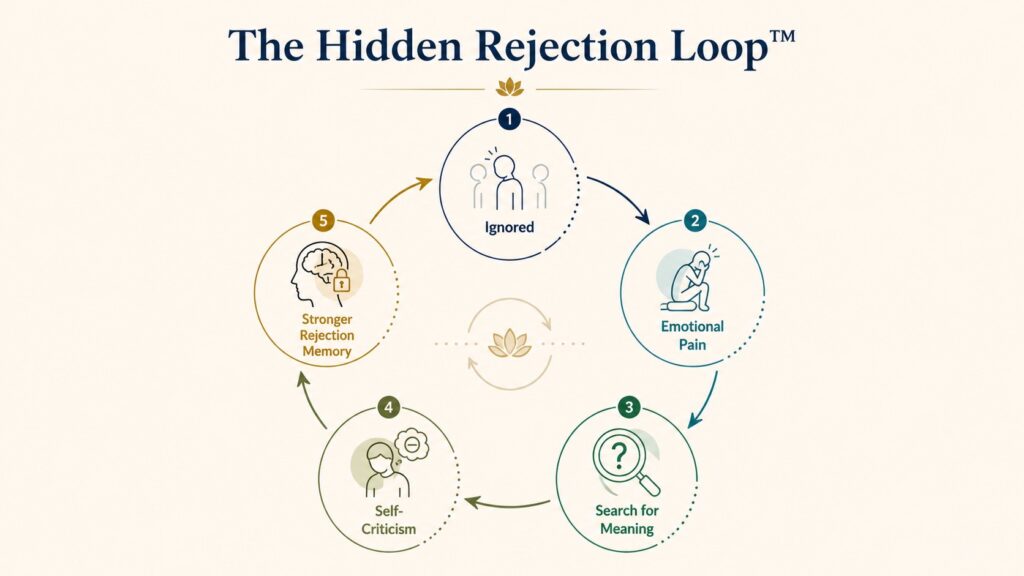
Notice something remarkable.
The final step feeds directly back into the beginning.
Each repetition makes the emotional alarm more sensitive.
Over time, smaller disappointments can begin triggering larger emotional reactions—not because you’re becoming weaker, but because your brain has learned to stay on high alert.
Why This Loop Feels So Convincing
The Hidden Rejection Loop™ is powerful because every step feels reasonable when you’re experiencing it.
Searching for answers feels productive.
Overthinking feels like problem-solving.
Reassurance feels comforting.
Yet together, these responses can unintentionally keep the wound open.
Recognizing the loop doesn’t mean ignoring your emotions.
It means learning to notice when your mind has shifted from understanding the experience to living inside it.
That awareness is where emotional freedom begins.
A Shift That Changes Everything
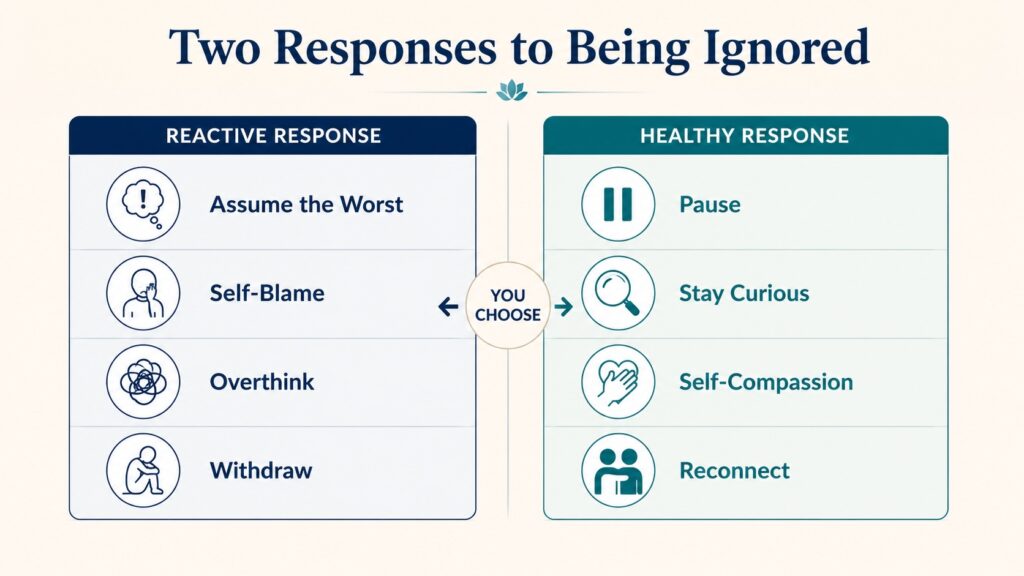
The goal isn’t to stop feeling hurt when rejection happens.
The goal is to prevent one painful moment from becoming an ongoing story about your worth.
The next time you notice yourself replaying an interaction, gently ask:
“Am I responding to what actually happened, or to the story my mind is creating about what happened?”
That single question creates space between the event and your interpretation.
And in psychology, that space is often where healing begins.
Psychology Insight

Rejection becomes most damaging not because of the event itself, but because of the emotional loop that follows. When we learn to recognize that loop, we gain the ability to interrupt it before it shapes our self-worth.
Key Takeaways

•	A single experience of rejection can trigger a repeating cycle of uncertainty, overthinking, self-doubt, and reassurance-seeking.
•	The brain naturally tries to fill gaps in information, but those interpretations are not always accurate.
•	Reassurance provides temporary relief but may reinforce emotional dependence if it becomes the only source of comfort.
•	Emotional healing begins by noticing the difference between what happened and the story we create about it.
•	Awareness is the first step toward breaking the Hidden Rejection Loop™.
Why Social Media Makes Rejection Feel Even More Personal
“Technology has changed the way we communicate, but it hasn’t changed the way our brains experience belonging.”
Imagine this situation.
You post something meaningful.
Hours pass.
Very few people react.
Or perhaps you send a message and see the word “Seen.”
No reply.
No explanation.
Just silence.
Logically, you know there could be countless reasons.
Emotionally, however, it may feel like something entirely different.
You begin wondering:
“Did I say something wrong?”
“Are they avoiding me?”
“Why are they replying to everyone except me?”
Without realizing it, your emotional well-being has become influenced by a tiny digital notification.
This isn’t because social media has made people weak.
It’s because it has amplified something the human brain has always cared about:
social acceptance.
Your Brain Doesn’t Distinguish Between Physical and Digital Rejection
Thousands of years ago, rejection happened face-to-face.
Today, it often happens through screens.
The medium has changed.
Your brain hasn’t.
Whether someone ignores you in person or leaves your message unanswered online, your emotional brain still interprets the experience through the same ancient question:
“Do I still belong?”
This is why digital rejection often feels surprisingly real.
The brain responds to the emotional meaning behind the event—not simply the technology through which it occurred.
The Problem With Invisible Conversations
One of the most emotionally difficult aspects of digital communication is that it provides partial information.
You know:
- They were online.
- They viewed your story.
- They liked someone else’s post.
- They read your message.
But you don’t know:
- What was happening in their life.
- How they were feeling.
- Whether they intended to reply later.
- Whether they simply forgot.
Unfortunately, the human mind dislikes incomplete stories.
When information is missing, imagination often fills the gap.
And imagination is usually influenced more by our fears than by the facts.
The “Seen” Effect
Perhaps no modern experience captures social rejection better than the simple word:
Seen.
That single notification can trigger hours of emotional processing.
Not because of the word itself.
But because of what our mind begins attaching to it.
The notification becomes the following:
“I’m being ignored.”
“They don’t value me.”
“I care more than they do.”
Yet the notification never actually said any of those things.
Our interpretation did.
This is an important distinction.
Digital platforms deliver information.
Our emotional brain supplies the meaning.
Why Social Comparison Makes Everything Worse
Social media doesn’t only expose us to communication.
It exposes us to comparison.
You see:
Someone else’s happy relationship.
Someone else’s successful career.
Someone else’s close friendships.
Someone else’s celebrations.
Meanwhile, your own experience may include loneliness, uncertainty, or rejection.
The comparison isn’t fair.
You’re comparing your private struggles with someone else’s carefully selected highlights.
Over time, this creates a dangerous illusion:
“Everyone else seems wanted. Why not me?”
Psychologists refer to this tendency as upward social comparison, where we compare ourselves with people we believe are doing better than us.
When we’re already feeling rejected, these comparisons can intensify self-doubt and emotional pain.
Ghosting: The Modern Face of Unanswered Questions
Few experiences illustrate modern rejection more clearly than ghosting.
One day, conversations feel effortless.
The next, they disappear.
No explanation.
No goodbye.
No closure.
Ghosting hurts not only because someone leaves.
It hurts because the brain is left searching for an ending that never arrives.
Without closure, many people replay conversations repeatedly, hoping to discover the moment everything changed.
Often, that search becomes more painful than the original silence itself.
When Likes Become Self-Worth
Most people know that likes, comments, and followers don’t define their value.
Yet our emotional brain responds differently.
Each notification can provide a brief sense of validation.
Each absence can feel like quiet disappointment.
Over time, we may begin measuring our worth through numbers that were never designed to measure it.
The danger isn’t using social media.
The danger is allowing external reactions to become the primary source of internal confidence.
Self-worth built on public approval is always fragile because public approval is unpredictable.
Healthy self-worth grows from something much more stable:
Knowing your value even when no one applauds.
Choosing Connection Over Constant Validation
Technology is neither good nor bad.
It simply magnifies existing human needs.
Used intentionally, it can strengthen relationships.
Used unconsciously, it can increase loneliness despite constant connection.
A healthier question isn’t:
“Why didn’t they respond?”
Instead, try asking:
“Am I giving one person’s response more power than it deserves?”
That question shifts your attention from seeking constant validation to protecting your emotional balance.
A Small Daily Practice
The next time you notice yourself checking your phone repeatedly for one person’s reply, pause for a moment.
Take a slow breath.
Then remind yourself:
“A delayed response is information—not a verdict on my worth.”
That single sentence may seem simple.
Yet repeating it consistently helps train the brain to separate uncertainty from self-judgment.
Over time, this small habit can reduce the emotional intensity of digital rejection and strengthen your sense of inner security.
Psychology Insight

Digital rejection feels powerful because the human brain processes the emotional meaning of being ignored, not the device through which it happens. A screen can deliver a message, but only our interpretation determines whether it becomes a threat to our self-worth.
Key Takeaways

•	Social media amplifies the brain's natural need for belonging and acceptance.
•	Digital communication often provides incomplete information, encouraging the mind to fill in the gaps with assumptions.
•	Notifications such as "Seen" or unanswered messages become painful because of the meaning we attach to them.
•	Comparing your everyday life with others' carefully curated online moments can intensify feelings of rejection.
•	Ghosting often hurts because it leaves the brain without closure.
•	Building self-worth from personal values rather than online validation creates greater emotional resilience.
The R.E.A.L. Response: Turning Rejection into Emotional Resilience
“Healing doesn’t begin when rejection disappears. It begins when your relationship with rejection changes.”
Imagine this.
You send an important message.
Hours pass.
No reply.
Immediately, you notice your heart beating faster.
Your mind starts racing.
“Did I do something wrong?”
“Why are they ignoring me?”
“Should I send another message?”
In the past, you may have followed those thoughts automatically.
But what if, instead of reacting immediately, you had a simple roadmap to guide your next few minutes?
That is the purpose of The R.E.A.L. Response™.
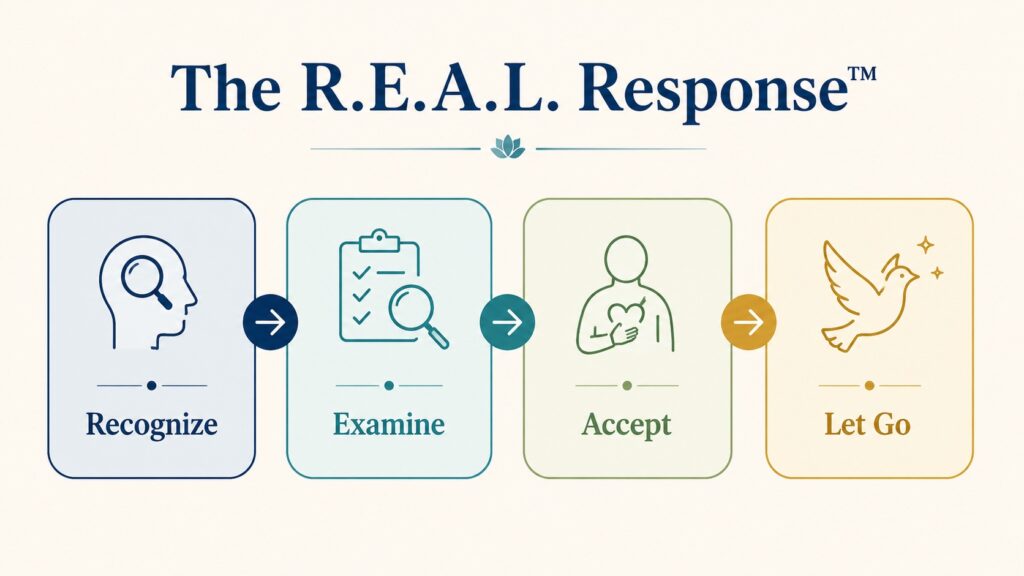
It is not about pretending rejection doesn’t hurt.
It is about responding to emotional pain in a way that protects your mental well-being rather than intensifying your suffering.
The R.E.A.L. Response™
R — Recognize the Emotional Trigger
“You cannot calm an emotion you haven’t noticed.”
Most emotional reactions happen automatically.
Someone ignores us.
Our brain immediately labels it as danger.
Before we realize what’s happening, we’ve already started imagining the worst.
The first step is simply noticing.
Pause and ask yourself:
“What exactly triggered me?”
Was it:
- The unanswered message?
- Being left out?
- Feeling unimportant?
- Fear of losing someone?
Naming the trigger creates psychological distance.
Research on affect labeling suggests that putting emotions into words can reduce the intensity of emotional distress by helping the brain regulate its response.
Instead of saying,
“Everything feels terrible.”
Try saying,
“I’m feeling rejected because I haven’t received a reply.”
That small change shifts you from emotional overwhelm toward emotional awareness.
E — Examine the Story Your Mind Is Creating
Our emotions are influenced not only by events but also by the meaning we assign to them.
Remember the Hidden Rejection Loop™?
The brain naturally fills gaps with stories.
Instead of asking,
“What story is my fear telling me?”
begin asking,
“What evidence do I actually have?”
For example:
Story
“They don’t care about me anymore.”
Evidence
“They haven’t replied for six hours.”
Notice the difference.
One is an interpretation.
The other is a fact.
This doesn’t mean ignoring your intuition.
It means giving reality a chance to speak before fear takes over.
Many emotional wounds become deeper not because of what happened, but because of the stories we repeatedly tell ourselves afterward.
A — Accept the Emotion Without Judging Yourself
One of the most common mistakes people make is fighting their own emotions.
They tell themselves:
“I shouldn’t feel this way.”
“Why am I so sensitive?”
“I’m overreacting again.”
Ironically, judging ourselves often creates a second layer of suffering.
Psychologists sometimes call this secondary emotional distress—feeling bad about feeling bad.
Acceptance does not mean approving of rejection.
It means acknowledging your emotional experience with kindness.
You might simply say,
“This hurts, and that’s understandable.”
Those few words can be surprisingly healing.
Self-compassion researcher Dr. Kristin Neff has shown that treating ourselves with the same kindness we would offer a friend is associated with greater emotional resilience and psychological well-being.
Acceptance isn’t giving up.
It’s giving your nervous system permission to settle before deciding what to do next.
L — Lean Toward Healthy Action
Once the emotional storm begins to calm, the question changes.
Instead of asking,
“How do I make them respond?”
Ask,
“What action supports my emotional well-being?”
Sometimes the healthiest action is:
- Going for a walk.
- Talking with a trusted friend.
- Writing your thoughts in a journal.
- Returning your attention to meaningful work.
- Practicing mindfulness.
- Waiting before sending another message.
- Having an honest conversation instead of making assumptions.
Notice something important.
Every one of these actions returns your attention to something you can influence.
Rejection often makes us focus on what is outside our control.
Healing begins when we gently redirect our energy toward what remains within our control.
Why the R.E.A.L. Response™ Works
The R.E.A.L. Response™ is built on several well-established psychological principles:
- Emotion regulation begins with awareness rather than suppression.
- Cognitive reappraisal helps us examine unhelpful interpretations.
- Self-compassion reduces shame and supports emotional recovery.
- Values-based action encourages behavior that aligns with long-term well-being instead of short-term emotional relief.
Together, these principles help interrupt the Hidden Rejection Loop™ before it gathers momentum.
A Real-Life Example
Imagine that Priya sends an important message to a close friend.
By evening, there is still no reply.
Her first reaction is panic.
“Maybe I’ve upset them.”
Instead of checking her phone every few minutes, she pauses.
Recognize
“I’m feeling anxious because I haven’t heard back.”
Examine
“The only fact is that they haven’t replied yet. I don’t know why.”
Accept
“It’s understandable that this feels uncomfortable. Most people dislike uncertainty.”
Lean
She decides to finish her evening walk, prepares dinner, and gives herself permission to wait until the next day before drawing conclusions.
The next morning, her friend replies.
They had been caring for a sick family member.
Nothing was wrong with the friendship.
What changed wasn’t only the outcome.
It was the way Priya cared for herself during the uncertainty.
Emotional Strength Isn’t Emotional Absence
Many people believe emotionally strong individuals never feel rejected.
The opposite is often true.
Emotionally resilient people feel rejection just as deeply.
The difference is that they don’t allow one painful moment to define their identity.
They understand that emotions deserve attention—but not unquestioning obedience.
That distinction changes everything.
A Practice for Everyday Life
The next time rejection begins to hurt, pause for thirty seconds and ask yourself these four questions:
Recognize
“What emotion am I experiencing?”
Examine
“What story is my mind creating?”
Accept
“Can I allow this feeling without criticizing myself?”
Lean
“What healthy action can I take right now?”
You don’t need perfect answers.
You simply need to slow down long enough to give your wiser mind a chance to participate.
Psychology Insight

Emotional resilience is not the ability to avoid rejection. It is the ability to respond to rejection with awareness, self-compassion, and intentional action rather than automatic fear.
Key Takeaways

•	Emotional awareness is the first step in regulating difficult emotions.
•	The stories we create about rejection often influence our suffering more than the event itself.
•	Self-compassion reduces the additional pain caused by self-criticism.
•	Healthy action focuses on what you can control rather than trying to control another person's behavior.
•	The R.E.A.L. Response™ transforms rejection from an emotional spiral into an opportunity for growth.
Building Emotional Security: Finding Your Worth Beyond Other People’s Approval
“The greatest freedom is not getting everyone to accept you. It is no longer needing everyone to.”
Think about someone you admire for their emotional strength.
Perhaps they have experienced rejection.
They’ve lost relationships.
They’ve been misunderstood.
They’ve been criticized.
Yet somehow, they continue to treat people with kindness, pursue meaningful goals, and maintain a quiet confidence.
What makes them different?
It’s probably not that they experience less emotional pain.
It’s that they have built something deeper than approval.
They have developed emotional security.
Emotional security is not about becoming independent of people.
Human beings will always need love, connection, and belonging.
Instead, emotional security means your sense of worth remains steady—even when relationships become uncertain.
It is the quiet confidence that says:
“I may not be accepted by everyone, but I don’t lose my value because of it.”
That shift changes everything.
The Difference Between Belonging and Seeking Approval
Many of us unknowingly spend years chasing approval.
We try to avoid disappointing people.
We overthink our words.
We apologise excessively.
We say “yes” when we want to say “no.”
We become whoever we think others need us to be.
At first, this may seem like kindness.
But over time, something important happens.
We begin measuring our worth by other people’s reactions.
Psychologist Dr. Brené Brown, whose work on vulnerability and belonging has helped millions, offers a powerful distinction:
True belonging doesn’t require you to change who you are. It asks you to be fully yourself.
Approval depends on pleasing others.
Belonging grows from authenticity.
The difference may seem small.
In reality, it changes the entire relationship you have with yourself.
Emotional Security Begins With Self-Validation
Imagine carrying a cup that only other people can fill.
Whenever someone praises you, the cup fills.
Whenever someone ignores you, it empties.
Living this way is exhausting.
Emotionally secure people learn something different.
They begin filling part of that cup themselves.
Self-validation doesn’t mean pretending rejection doesn’t hurt.
It means reminding yourself that your value is not determined by one unanswered message, one failed relationship, or one person’s opinion.
Healthy self-validation sounds like this:
“I wish things had gone differently, but this experience doesn’t define who I am.”
That single sentence is far more powerful than it appears.
It teaches your brain that disappointment is something you experience—not something you become.
The Circle of Emotional Security
One of the biggest misconceptions about confidence is that it comes from success.
In reality, lasting confidence grows from repeated experiences of keeping promises to yourself.
Think of emotional security as a circle.
Know Your Values
Ask yourself:
“What kind of person do I want to be, regardless of how others treat me?”
Perhaps you value kindness.
Honesty.
Respect.
Growth.
These values become your emotional compass.
Trust Yourself
Every time you handle disappointment with patience rather than panic, you strengthen self-trust.
You begin believing:
“Whatever happens, I can cope with it.”
That belief is far more stable than hoping life will never disappoint you.
Set Healthy Boundaries
Emotionally secure people understand a simple truth:
Not every relationship deserves unlimited access to their emotional energy.
Healthy boundaries are not walls.
They are doors.
You choose who enters your emotional space—and under what conditions.
Boundaries communicate self-respect, not rejection.
They protect relationships by preventing resentment from quietly building over time.
Invest in Multiple Sources of Meaning
When one relationship becomes your entire emotional world, every difficulty feels catastrophic.
A healthier life includes many sources of fulfillment.
Friendships.
Family.
Purposeful work.
Learning.
Creativity.
Faith or spirituality, if meaningful to you.
Exercise.
Nature.
Acts of service.
The more meaningful connections you build, the less your emotional well-being depends on any single person.
Psychologists often describe this as creating a diverse support system, which is associated with greater resilience during stressful life events.
You Cannot Control Other People’s Choices
One of the hardest lessons in emotional maturity is accepting that we cannot control another person’s feelings, priorities, or behavior.
You cannot make someone reply.
You cannot force someone to understand you.
You cannot persuade everyone to appreciate your value.
Trying to control what is outside your influence often creates frustration and emotional exhaustion.
Instead, emotionally secure people focus on three questions:
- Did I communicate honestly?
- Did I act in line with my values?
- Can I respect myself regardless of the outcome?
When the answer is yes, they allow the rest to unfold without sacrificing their peace.
When It’s Time to Let Go
Not every relationship is meant to continue.
Some friendships naturally drift apart.
Some romantic relationships end.
Some people leave without explanation.
Accepting this reality is painful.
Yet there is also freedom in recognising that not every ending is a reflection of your worth.
Sometimes people leave because of their own circumstances, struggles, fears, or limitations.
Sometimes two people simply grow in different directions.
Grieving those losses is healthy.
Defining yourself by them is not.
Healing doesn’t always mean holding on more tightly.
Sometimes healing means loosening your grip on the need for every relationship to last forever.
The Quiet Strength of Self-Compassion
One of the most healing discoveries about why being ignored hurts is realizing that your emotional pain does not define your worth. Responding with self-compassion allows the nervous system to calm down, making it easier to think clearly instead of reacting from fear or self-blame.
Imagine a close friend came to you after being ignored by someone they cared about.
Would you say,
“You’re obviously not good enough.”
Probably not.
You would likely offer kindness.
Understanding.
Patience.
Encouragement.
The question is:
Why do we deserve less compassion from ourselves than we freely offer to others?
Research consistently shows that self-compassion is associated with lower levels of anxiety, depression, and shame, while supporting resilience, motivation, and emotional well-being.
Being kind to yourself is not self-indulgence.
It is emotional wisdom.
A Daily Practice for Building Emotional Security
Once you understand why being ignored hurts, your focus shifts from asking “What’s wrong with me?” to asking “How can I respond in a healthier way?” That small change in perspective can make a profound difference to your emotional resilience.
Before you end each day, ask yourself these three questions:
1. What did I do today that reflected my values?
Perhaps you were honest.
Perhaps you showed kindness.
Perhaps you chose patience over anger.
Celebrate those moments.
2. Did I seek approval—or genuine connection?
Notice the difference without judging yourself.
Awareness is the beginning of change.
3. What is one thing I appreciate about myself that has nothing to do with another person’s opinion?
Maybe it’s your perseverance.
Your curiosity.
Your generosity.
Your willingness to grow.
The more often you answer this question, the less your self-worth depends on external validation.
Slowly, your inner voice becomes stronger than the voices around you.
The Most Important Lesson
Perhaps the deepest lesson rejection can teach us is this:
Your worth has never been something another person had the authority to give.
Therefore, it is not something another person has the power to take away.
People may misunderstand you.
Ignore you.
Leave you.
Disagree with you.
Those experiences can be painful.
But they do not reduce your humanity, your dignity, or your capacity to build meaningful relationships in the future.
The goal of emotional fitness is not to avoid rejection.
It is to become the kind of person who can experience rejection without losing themselves.
And that is a strength that no one else can give you—and no one else can take away.
Psychology Insight

Emotionally secure people do not avoid rejection. They anchor their self-worth in their values, character, and capacity to grow rather than in other people's approval. That inner stability allows them to remain open to connection without becoming dependent on constant validation.
Key Takeaways

•	Emotional security comes from self-worth, not constant approval.
•	True belonging grows from authenticity rather than people-pleasing.
•	Self-validation helps reduce emotional dependence on external reassurance.
•	Healthy boundaries protect emotional well-being and strengthen respectful relationships.
•	Building purpose through multiple meaningful relationships and activities increases resilience.
•	Self-compassion is a scientifically supported practice that helps people recover from rejection with greater emotional balance.
•	Your value remains constant, even when someone else fails to recognise it.
Healing Begins When You Stop Measuring Your Worth by Someone Else’s Attention
“Being ignored can break your heart for a moment. It doesn’t have to define your life forever.”
If you’ve read this far, chances are this topic isn’t just interesting to you.
It’s personal.
Perhaps you’ve been left on read by someone you deeply cared about.
Perhaps you’ve watched friendships slowly fade without understanding why.
Perhaps you’ve experienced the quiet ache of feeling invisible in a room full of people.
Or perhaps you’re carrying an old wound that still whispers,
“Maybe I wasn’t enough.”
If that’s true, I want to leave you with something important.
Your emotional pain deserves understanding.
But it does not deserve to become your identity.
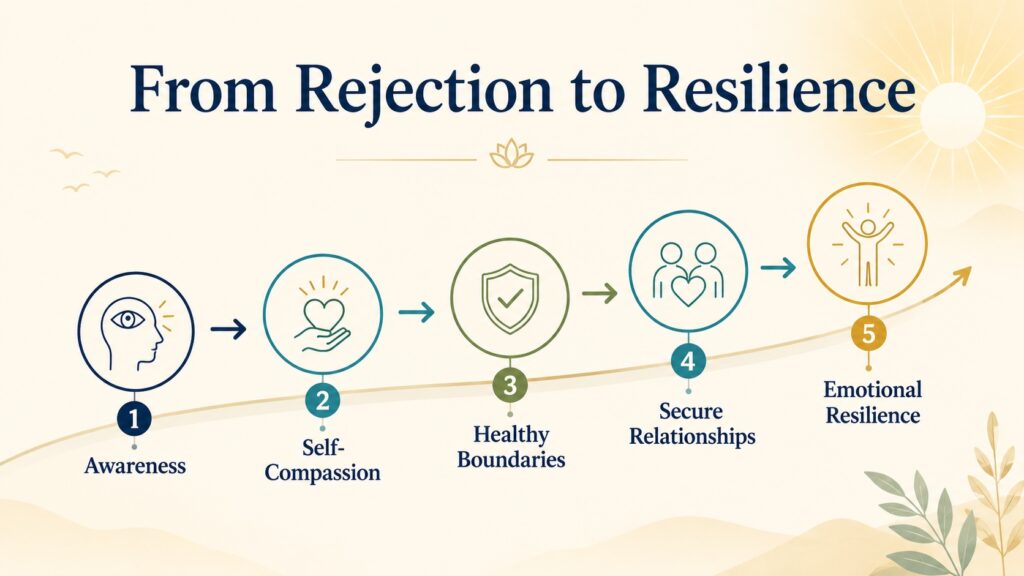
Throughout this article, we’ve explored how your brain evolved to protect connection, how childhood experiences shape attachment, how uncertainty fuels overthinking, and how social media can magnify rejection.
Yet beneath all of those psychological explanations lies a simple truth:
You were never meant to build your entire sense of self on another person’s attention.
Relationships matter deeply.
Love matters.
Belonging matters.
But your worth existed before anyone accepted you.
And it remains even when someone walks away.
Healing doesn’t happen because rejection disappears.
Healing happens because, little by little, you stop asking another person’s behavior to answer questions that only self-understanding can answer.
The goal is not to become someone who never feels hurt.
The goal is to become someone who can feel hurt without forgetting who they are.
That is emotional fitness.
What to Remember the Next Time You Feel Ignored
When rejection begins to trigger self-doubt, pause and come back to these reminders.
✓ Their silence is information—not proof of your worth.
People become distant for many reasons, many of which have nothing to do with you.
✓ Uncertainty is uncomfortable, but it is not evidence.
Your mind may create stories while waiting for answers.
Treat those stories with curiosity rather than certainty.
✓ Feel your emotions without becoming your emotions.
You can say,
“I feel rejected.”
without believing,
“I am unworthy.”
Those are not the same thing.
✓ Not everyone is capable of giving the connection you deserve.
Sometimes another person’s limitations explain their behavior better than your perceived shortcomings.
✓ Healthy relationships create peace more often than confusion.
While no relationship is perfect, genuine connection is built on mutual respect, communication, and emotional safety—not constant anxiety.
✓ Your value does not rise when someone chooses you.
It does not fall when someone doesn’t.
Your value is inherent.
Relationships reveal compatibility.
They do not determine your humanity.
Your Emotional Fitness Challenge
Over the next seven days, try this simple practice.
Whenever you notice yourself feeling ignored or emotionally rejected, write down three things:
1. What happened?
Describe only the facts.
Example:
“My friend hasn’t replied for two days.”
2. What story is my mind creating?
Example:
“They don’t care about me anymore.”
3. What is another possible explanation?
Example:
“They may be overwhelmed, distracted, or planning to reply later.”
You are not trying to convince yourself that everything is fine.
You are simply teaching your brain that uncertainty has more than one possible explanation.
Over time, this habit strengthens emotional flexibility and reduces the automatic pull of catastrophic thinking.
Frequently Asked Questions (FAQs)
1. Why being ignored hurts so much emotionally?
Being ignored activates the brain’s need for belonging and social connection. Research suggests that experiences of rejection can engage some of the same brain regions involved in processing physical pain, making social rejection feel deeply distressing.
2. Why do I overthink when someone doesn’t reply?
The brain naturally tries to reduce uncertainty. When information is missing, it often creates explanations to make sense of the situation. If you’re already feeling insecure or emotionally vulnerable, those explanations are more likely to be negative.
3. Is it normal to feel rejected over a text message?
Yes. Your brain responds to the emotional meaning of the interaction rather than the technology itself. Digital communication can amplify uncertainty because it provides limited context and few emotional cues.
4. Why do some people handle rejection better than others?
Attachment experiences, personality, emotional regulation skills, previous life experiences, and levels of self-compassion all influence how intensely people experience rejection.
5. Can rejection affect mental health?
Repeated or prolonged social rejection may contribute to stress, anxiety, low mood, loneliness, and reduced self-esteem. If these feelings persist or significantly interfere with daily life, seeking support from a qualified mental health professional can be beneficial.
6. What is rejection sensitivity?
Rejection sensitivity is the tendency to anxiously expect, quickly perceive, and strongly react to possible rejection. It often develops through repeated experiences of criticism, inconsistency, or emotional invalidation, but it can improve with awareness and practice.
7. How can I stop seeking constant validation?
Building self-worth through your values, meaningful relationships, personal growth, and self-compassion helps reduce dependence on external approval. Emotional security develops gradually through repeated healthy choices.
8. Does being ignored always mean someone doesn’t care?
No. People may become less responsive because of stress, personal difficulties, different communication styles, or competing responsibilities. While repeated patterns deserve attention, a single instance of silence is not enough to determine another person’s intentions.
9. Can attachment styles change?
Yes. Attachment styles are patterns, not permanent labels. Supportive relationships, self-awareness, therapy, and intentional emotional practice can help people develop greater security over time.
10. What is the healthiest response to social rejection?
A healthy response begins with acknowledging your emotions, examining your assumptions, practicing self-compassion, and choosing actions that align with your values rather than reacting impulsively. The goal is not to avoid pain but to respond to it in ways that protect your emotional well-being.
Final Reflection
Perhaps the greatest lesson psychology offers is not that rejection stops hurting.
It is that human beings are remarkably capable of healing.
Every meaningful relationship carries the possibility of disappointment because every meaningful relationship requires vulnerability. That vulnerability is not a weakness to eliminate; it is the price we pay for genuine connection.
The challenge, then, is not to build walls around our hearts but to build strength within them.
So the next time someone overlooks you, delays a reply, or chooses a different path, remember this:
Their decision may shape your experience, but it does not define your identity.
Your worth is not measured by how quickly someone texts back, how many people applaud you, or whether everyone understands your value.
It is reflected in how you continue to show kindness, integrity, courage, and hope—even after life has disappointed you.
At The Psyche Inspire, we believe emotional fitness isn’t about never feeling pain. It’s about learning to meet pain with wisdom, compassion, and resilience.
And perhaps that’s the quiet truth worth carrying forward:
The people who matter most in your life should help you feel seen—but the person who must never become invisible to you is yourself.
Research-Backed References

•	Baumeister, R. F., & Leary, M. R. (1995). The Need to Belong: Desire for Interpersonal Attachments as a Fundamental Human Motivation. Psychological Bulletin, 117(3), 497–529.

•	Eisenberger, N. I., Lieberman, M. D., & Williams, K. D. (2003). Does Rejection Hurt? An fMRI Study of Social Exclusion. Science, 302(5643), 290–292.

•	Mikulincer, M., & Shaver, P. R. (2016). Attachment in Adulthood: Structure, Dynamics, and Change (2nd ed.). Guilford Press.

•	Neff, K. D. (2011). Self-Compassion: The Proven Power of Being Kind to Yourself. William Morrow.

•	Gross, J. J. (2015). Emotion Regulation: Current Status and Future Prospects. Psychological Inquiry, 26(1), 1–26.

•	Lieberman, M. D. (2013). Social: Why Our Brains Are Wired to Connect. Crown.
1 thought on “Why Being Ignored Hurts So Much: The Hidden Psychology of Social Rejection”