

You receive good news, but the excitement never arrives. Someone you care about is hurting, yet you struggle to feel the concern you believe you should feel. You watch a film that once moved you, listen to a favourite song or spend time with people you love, but something inside remains strangely quiet.
From the outside, life may look normal. You go to work, respond to messages, complete your responsibilities and even laugh at the appropriate moments. Inside, however, it can feel as if someone has turned down the emotional volume.
You are not necessarily sad. But you are not truly happy either.
Perhaps you want to cry but cannot. Perhaps you understand intellectually that something matters yet cannot connect with it emotionally. You may even wonder:
Why do I feel emotionally numb when I know I still care? Have I become cold? Is something wrong with me? Will I ever feel like myself again?
These questions can be frightening because emotions are closely connected to identity, relationships and meaning. When they become difficult to access, you may begin to question not only how you feel, but also who you are.
Table of Contents
Emotional numbness, however, does not automatically mean that you have stopped caring or lost the capacity to love. Sometimes it develops after prolonged stress, grief, emotional overload or painful experiences. In other cases, it may accompany depression, burnout, dissociation, certain medications, substance use or a physical-health concern.
It is therefore better understood as an experience that deserves curiosity and attention, rather than a diagnosis you should assign to yourself.
You may not be empty. You may be temporarily disconnected from emotions that have become difficult to process, recognise or safely experience.
What Does It Mean to Feel Emotionally Numb?
Emotional numbness is a reduced ability to feel, identify or emotionally connect with your usual responses. People often describe it as flatness, emptiness, detachment or the sense that they are watching life rather than fully participating in it.
It does not always mean the complete absence of emotion. You may still experience brief irritation, anxiety or sadness while feeling disconnected from warmth, pleasure, affection or excitement. At other times, every emotion may seem muted—as if it must travel through a thick layer before reaching you.
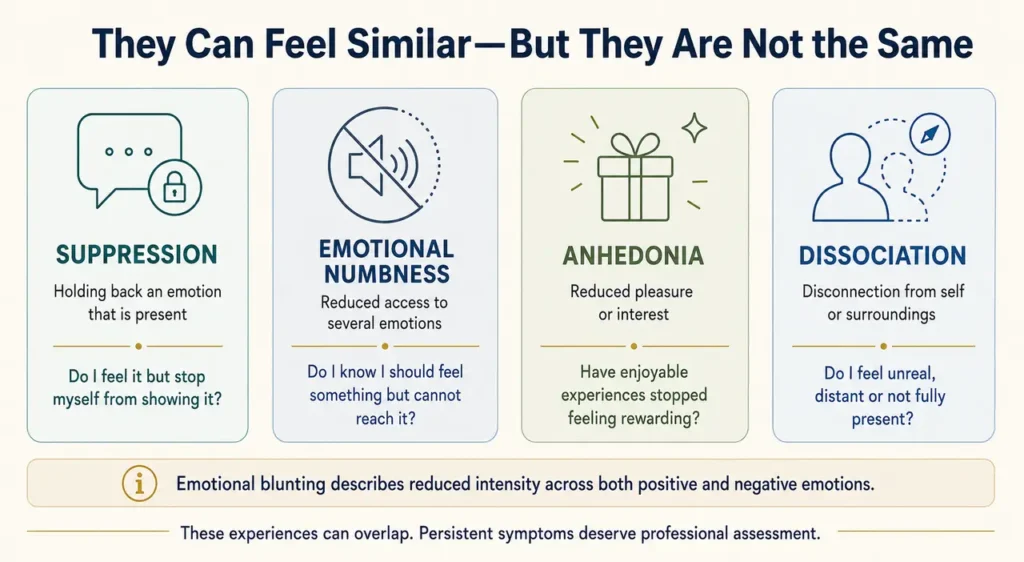
Researchers and clinicians use related terms such as emotional numbing and emotional blunting, although their precise meanings can vary by context. Emotional blunting commonly refers to a reduction in the intensity of both positive and negative emotions. It is different from anhedonia, which more specifically concerns diminished interest or pleasure. These experiences may overlap, but they are not interchangeable.
Most importantly, emotional numbness is not a mental-health diagnosis by itself. It is an experience that can arise in several different psychological, medical and situational contexts.
Emotional numbness is more than “not feeling sad”
Many people initially fail to recognise emotional numbness because they expect psychological distress to feel painful, anxious or visibly overwhelming. Numbness can be quieter.
You might not wake up feeling deeply distressed. Instead, you may feel indifferent about getting out of bed. You may not argue with your partner, but you may no longer feel emotionally present in the relationship. You may not dislike activities you once enjoyed; they simply no longer seem to reach you.
This is why numbness can remain hidden behind high functioning. A person can continue meeting deadlines, caring for family members and participating in conversations while privately feeling as though life has lost its emotional texture.
It can also create guilt. You may think:
- “My life is fine, so why don’t I feel grateful?”
- “I know I love my family, but why do I feel so distant?”
- “Something upsetting happened. Why can’t I cry?”
- “Everyone else is excited. Why do I feel nothing?”
- “Why am I just going through the motions?”
These reactions do not prove that you are selfish, ungrateful or incapable of love. They indicate that there may be a gap between what you understand cognitively and what you can currently access emotionally.
What are the signs of emotional numbness?
Emotional numbness can look different for different people. Some experience a general flattening of emotion, while others feel numb only in particular situations or relationships.
Common experiences include:
- moving through daily life on “autopilot”
- knowing that something matters without emotionally feeling its importance
- feeling detached from friends, partners or family members
- losing interest in activities that once felt meaningful
- experiencing less joy, sadness, excitement, tenderness or affection
- finding it difficult to identify or describe what you feel
- wanting to cry but being unable to
- responding mechanically during emotional conversations
- feeling like a spectator rather than a participant in your own life
- withdrawing because social interaction feels effortful or unreal
- seeking intense stimulation simply to feel something
- feeling disconnected from your body or surroundings
Not everyone who feels emotionally numb will experience all these signs. A brief period of numbness following shocking news, loss or extreme exhaustion may be a temporary response. The concern becomes greater when it persists, spreads across several areas of life or begins interfering with work, relationships, motivation and self-care.
Why emotions may become difficult to recognise
Sometimes an emotion has not disappeared; it has become difficult to identify.
Emotions are not experienced only as labels such as sad, angry or afraid. They may first appear as bodily information: heaviness in the chest, tension in the jaw, restlessness, fatigue, warmth, pressure behind the eyes or the urge to withdraw.
If you have spent years ignoring these signals, remaining productive through distress or prioritising other people’s needs, the connection between bodily sensation and emotional meaning may become faint. You may notice that something feels “off” without knowing what the feeling is trying to communicate.
This does not mean that childhood experiences or emotional suppression explain every case of numbness. Those principles are explored more fully in the articles “How Childhood Shapes Emotional Regulation” and “Emotional Fitness vs. Emotional Suppression“. Here, the essential point is simpler: difficulty naming an emotion is not always the same as having no emotion.
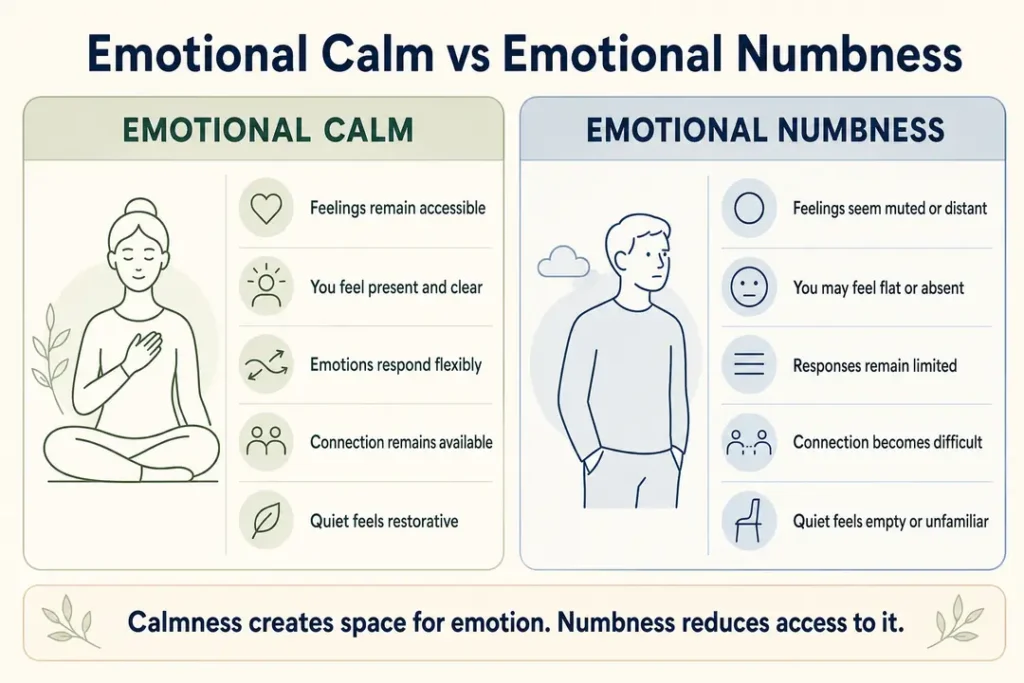
Emotional Numbness Is Not the Same as Emotional Calm
Emotional calm and emotional numbness can both look quiet from the outside, but internally they are very different experiences.
| Emotional calm | Emotional numbness |
| Feelings remain available | Feelings seem muted, distant or inaccessible |
| You feel present and mentally clear | You may feel absent, flat or disconnected |
| Emotions change appropriately with events | Emotional responses remain limited across situations |
| You can experience warmth and connection | Closeness may feel difficult to access |
| Quiet feels restorative | Quiet feels empty or unfamiliar |
| You can respond intentionally | You may simply go through the motions |
Calmness creates room for emotion without being controlled by it. Numbness reduces access to the emotion itself.
For example, a calm person may receive disappointing news, feel sadness and still respond thoughtfully. An emotionally numb person may understand that the news is disappointing but feel almost no internal response. The difference is not how dramatic the reaction appears—it is whether the person remains connected to their emotional experience.
This distinction matters because emotional regulation is sometimes misunderstood as learning to feel less. Healthy regulation does not require becoming detached from emotion. It helps you remain connected to what you feel while choosing how to respond.
If you have previously struggled with intense reactions, numbness may initially seem like relief. There are no racing thoughts, tears or emotional confrontations. Yet over time, the absence of pain may also mean reduced access to joy, affection, curiosity and meaning.
Emotional numbness may therefore protect you from certain feelings while also distancing you from the experiences that make life feel personally significant.
A gentle pause for self-reflection
Before searching for a single explanation, pause and notice the quality of your experience:
- Do you feel peaceful—or emotionally absent?
- Can you still feel warmth, interest, sadness or affection when circumstances change?
- Does the quiet feel restorative, or does it feel empty?
- Are your emotions unavailable everywhere, or only around certain people and situations?
- Did this begin suddenly, or develop gradually after a difficult period?
You do not need to answer these questions perfectly. Their purpose is not to diagnose you. They simply help you move from the frightening conclusion—“I have become emotionless”—towards a more useful question:
“What may be making it difficult for me to access my emotions right now?”
That question opens the door to understanding rather than self-judgement.
Understanding emotional numbness becomes difficult because several psychological experiences can sound similar when described casually. People may say, “I feel nothing,” even though they are suppressing strong feelings, losing interest in pleasurable activities or feeling disconnected from themselves.
These experiences can also occur together. Someone experiencing depression may have both anhedonia and emotional blunting. A person affected by trauma may feel emotionally numb while also experiencing episodes of dissociation. Another person may consciously suppress emotion for years and eventually find it increasingly difficult to recognise what they feel.
Knowing the difference cannot provide a diagnosis, but it can help you describe your experience more accurately and seek the right kind of support.
Emotional Numbness, Suppression, Anhedonia and Dissociation
Emotional Suppression: “I Feel It, but I Don’t Let It Show”
Emotional suppression occurs when a feeling is present, but you attempt to inhibit its expression—or push it away after it has already appeared.
You may feel angry but remain silent because conflict feels unsafe. You may hold back tears at work, hide disappointment from your family or act cheerful because you do not want others to worry. In these situations, the emotion is usually accessible; you are trying not to reveal, express or engage with it.
Suppression is not always harmful. Temporarily containing an emotional reaction can be useful when the situation is inappropriate or when you need time to respond thoughtfully. The difficulty arises when suppression becomes the only available strategy.
If you repeatedly tell yourself to “get over it”, remain strong or avoid burdening others, you may become less practised at noticing and processing emotion. The feeling does not necessarily disappear simply because it is not expressed. It may continue through physical tension, irritability, withdrawal, exhaustion or delayed emotional reactions.
This broader distinction between managing an emotion and habitually disconnecting from it is discussed in “Emotional Fitness vs Emotional Suppression. For the present article, the simplest distinction is:
In suppression, the emotion is usually present but restrained. In emotional numbness, the emotion itself may feel muted or inaccessible.
Emotional Numbness: “I Know I Should Feel Something, but I Can’t Reach It”
Emotional numbness often involves a mismatch between cognitive understanding and emotional experience.
You know that you love someone but cannot feel close to them. You understand that an achievement should make you proud, but the success feels strangely insignificant. You recognise that a loss is painful, but your body does not produce the tears or sadness you expected.
The phrase “I should feel something” often appears in these moments. Unfortunately, that expectation can create a second layer of suffering. In addition to feeling numb, you may feel guilty, defective or frightened by the absence of a familiar response.
Trying harder rarely makes the emotion arrive. In fact, repeatedly testing yourself—Do I feel happy now? Do I miss them? Why am I not crying?—can make you more self-conscious and disconnected.
Emotional numbness may affect both pleasant and unpleasant feelings. Pain becomes quieter, but so can affection, enthusiasm, curiosity and hope. For some people, that muted emotional landscape feels protective at first. For others, it feels deeply unsettling from the beginning.
Anhedonia: “Things No Longer Feel Enjoyable or Rewarding”
Anhedonia refers primarily to a reduced capacity to experience pleasure or a loss of interest in activities that were previously rewarding. It is commonly associated with depression but can occur in other psychological and medical contexts.
Someone experiencing anhedonia may stop looking forward to food, music, exercise, hobbies, intimacy or social interaction. They may still feel sadness, anxiety, guilt or irritation, but positive experiences no longer produce the pleasure they once did.
This is different from a general loss of motivation. You can want to do something but feel no enjoyment when doing it. Alternatively, you may stop initiating the activity because experience has taught you that it will probably feel unrewarding.
Researchers sometimes distinguish between two aspects of pleasure:
- Anticipatory pleasure: looking forward to something
- Consummatory pleasure: enjoying it while it is happening
A person may struggle with one or both. For example, you might not feel motivated to meet a friend but enjoy the conversation once you arrive. Another person may look forward to the meeting yet feel flat throughout it.
Anhedonia and emotional numbness frequently overlap, particularly in depression and following traumatic experiences, but they are not identical. Anhedonia is centred on reduced pleasure and reward, while emotional numbness can involve a wider reduction in both positive and negative emotional experience. Research examining trauma-related symptoms similarly suggests that emotional numbing and anhedonia are related but distinguishable experiences. (Eskelund et al., 2018)
This distinction matters because saying “nothing makes me happy anymore” may point toward a somewhat different experience than saying “I cannot feel happiness, sadness, love or grief.”
Dissociation: “I Don’t Feel Fully Present in Myself or the World”
Dissociation involves a disruption in the usual connection between aspects of awareness, memory, identity, emotion, bodily experience or perception. It exists on a broad spectrum.
Mild, everyday forms of absorption are common. You may become so immersed in a book that you briefly lose track of time or arrive somewhere familiar with little memory of the routine journey. Experiences like these do not automatically indicate a dissociative disorder.
More concerning dissociative experiences may include the following:
- feeling detached from your body or thoughts
- experiencing yourself as if from the outside
- feeling that the world is foggy, dreamlike or unreal
- losing significant periods of time
- feeling emotionally disconnected during stressful situations
- experiencing an unfamiliar sense of distance from your identity
Depersonalisation describes a sense of detachment from yourself. You may feel like an observer of your thoughts, body or actions.
Derealisation describes a sense that the external world feels unreal, distant, visually altered or dreamlike, even though you generally know that this perception is a feeling rather than objective reality.
Dissociation can reduce emotional access, which is why it may be mistaken for ordinary numbness. The main difference is that dissociation often includes a broader disturbance in presence, self-experience or the felt reality of one’s surroundings.
Research supported by the National Institute of Mental Health has linked persistent derealisation following trauma with greater later symptoms of post-traumatic stress and depression. However, this does not mean that every experience of numbness or unreality proves the presence of trauma or a psychiatric disorder. Frequency, duration, intensity and functional impact are essential considerations. (National Institute of Mental Health)
If you frequently feel unreal, detached from your body, unable to account for periods of time or unsafe because of these experiences, professional assessment is more appropriate than trying to diagnose yourself online.
Emotional Blunting: A Related Clinical Description
The term ’emotional blunting’ is often used to describe a noticeable reduction in the intensity of emotional responses. A person may still recognise emotions, but happiness, sadness, anger, affection and excitement all feel less vivid than before.
Emotional blunting may occur as part of depression. It has also been reported by some people taking certain antidepressant medications, particularly selective serotonin reuptake inhibitors. However, separating a possible medication effect from the underlying depression can be difficult because depression itself may reduce emotional responsiveness.
This is why emotional blunting should not automatically be blamed on medication—and why prescribed medication should never be reduced or stopped without consulting the clinician who prescribed it.
A clinical review describes emotional blunting as a reduction in both positive and negative emotions and distinguishes it from anhedonia, which is focused more specifically on diminished pleasure. (Ma et al., 2021)
A Simple Comparison
| Experience | Central feature | What happens to emotion? | Common inner experience |
| Emotional suppression | Deliberately holding back expression | The emotion is present but restrained | “I feel it, but I must not show it.” |
| Emotional numbness | Reduced access to emotional experience | Several emotions feel muted or distant | “I know I should feel something, but I can’t.” |
| Anhedonia | Reduced interest or pleasure | Positive reward becomes difficult to experience | “Nothing feels enjoyable anymore.” |
| Dissociation | Disconnection in awareness or presence | Emotion may feel distant alongside detachment from self or surroundings | “I don’t feel fully here.” |
| Emotional blunting | Reduced emotional intensity | Both positive and negative responses may feel weaker | “I still feel, but everything is turned down.” |
These Experiences Can Overlap
Human emotional experiences rarely fit into perfect categories.
A grieving person may initially feel numb, later experience waves of sadness and temporarily suppress those feelings at work. Someone with depression may lose pleasure in familiar activities while also feeling emotionally blunted in relationships. A person under overwhelming stress may alternate between anxious overactivation and periods of detachment.
For that reason, the most useful question is not always:
“Which single label describes me?”
A more helpful set of questions may be:
- Can I feel emotion but struggle to express it?
- Have I mainly lost pleasure, or do all emotions feel muted?
- Do I feel disconnected only from emotion, or also from my body and surroundings?
- Does the experience occur constantly or only in certain situations?
- Did it begin after a loss, prolonged stress, a traumatic event, illness or medication change?
- How much is it affecting my relationships and daily functioning?
These questions do not replace professional assessment. They simply provide a clearer language for describing what is happening.
You do not need to prove that your experience fits a particular term before it deserves care. Whether you call it numbness, emptiness, flatness or disconnection, persistent changes in your emotional life are worth understanding—especially when they begin to affect your ability to connect, function or recognise yourself.
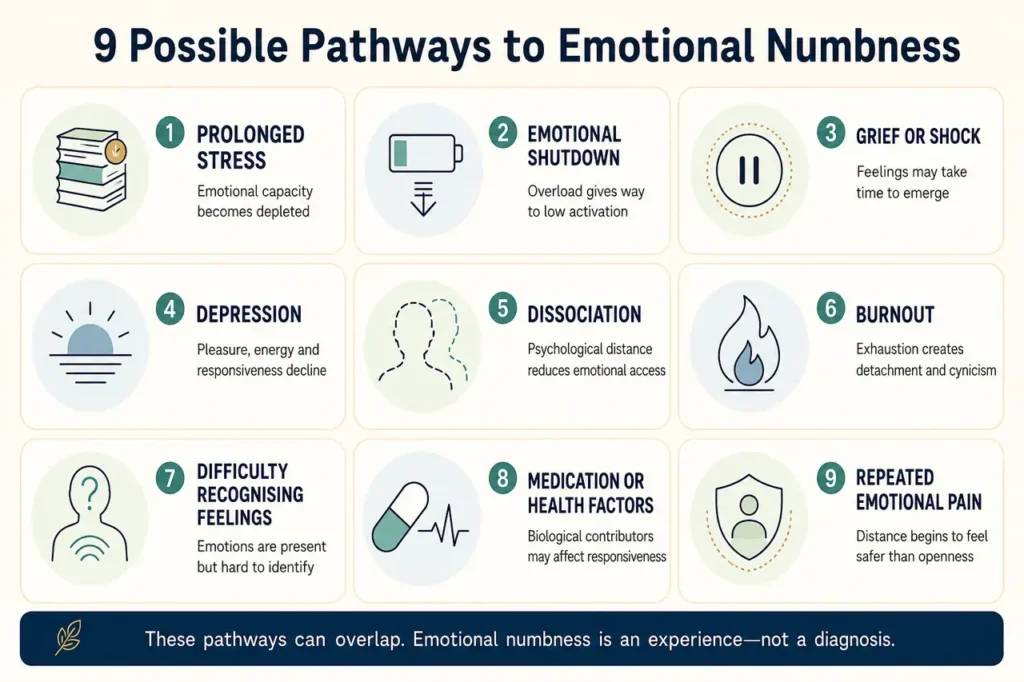
Why Do I Feel Emotionally Numb? 9 Possible Explanations
Emotional numbness rarely has one simple explanation. It can emerge after an identifiable loss or crisis, but it may also develop so gradually that you cannot remember when life began to feel different.
Perhaps you have been functioning under pressure for months. Perhaps something painful happened, but you never had the space to process it. You may be experiencing depression or burnout, adjusting to medication, or having difficulty recognising emotions that are still present beneath the surface.
The following explanations are not a diagnostic checklist. More than one may apply, and similar symptoms can arise from very different causes. Use them as possibilities to explore—not conclusions to impose on yourself.
1. Your Emotional System Has Been Carrying Prolonged Stress
Stress does not always remain loud.
At first, you may feel tense, restless and mentally preoccupied. You work harder, think faster and remain alert to everything that could go wrong. But when demands continue without sufficient recovery, your experience may gradually shift from “I feel overwhelmed by everything” to “I don’t feel much of anything.”
Imagine someone balancing work pressure, family responsibilities, financial concerns and poor sleep. They may continue meeting every obligation, yet slowly lose interest in conversations, celebrations and activities they once enjoyed. Nothing dramatic happened on a particular day; their emotional availability was gradually consumed by constant coping.
When so much attention is directed toward managing demands, there may be less capacity for reflection, pleasure and connection. Life becomes organised around what must be completed rather than what can be felt.
This does not mean that chronic stress literally “switches off” emotion in the same way for everyone. It means that prolonged strain can alter attention, energy, sleep and emotional responsiveness—all of which may contribute to feeling emotionally numb.
A helpful question is:
Have I truly stopped caring, or have I been operating in survival-oriented efficiency for so long that I no longer have space to notice what I feel?
2. You Have Shifted From Emotional Overload Into Shutdown
Emotional distress is often associated with high activation: racing thoughts, panic, agitation, anger or an urge to escape. But people do not remain in one emotional state indefinitely. At other times, distress may appear as withdrawal, flatness, slowed thinking or reduced responsiveness.
This can be understood through patterns of activation:
- High activation: tension, panic, irritability, restlessness and emotional reactivity
- Low activation: heaviness, detachment, low energy, slowed responses and emotional flatness
You may notice this shift after a difficult argument. During the conflict, everything feels intense. Later, you become quiet, distant and unable to explain what you feel. The silence may be mistaken for calmness, even though internally you feel absent rather than settled.
Popular explanations sometimes describe this as the nervous system “shutting down.” That language can be useful as a metaphor, but it should not be treated as a complete neurological diagnosis. Human stress responses are influenced by many interacting psychological, biological and situational factors.
The important counselling insight is that numbness can sometimes follow intensity. A person who appears emotionally unavailable may not be unaffected; they may have moved beyond what they can presently process.
For a fuller explanation of intense emotional activation, see “Why do I get triggered so easily?” rather than repeating those principles here.
3. You Are Processing Grief, Shock or a Major Life Change
Numbness can appear after bereavement, separation, serious illness, job loss, relocation or any event that abruptly changes your understanding of life.
You may receive devastating news and feel surprisingly little. You make phone calls, complete formalities and support everyone else while wondering why you have not “broken down”. Days or weeks later, grief may emerge in waves—or remain difficult to access for longer.
There is no rule that genuine grief must immediately produce tears. Acute grief varies considerably in its intensity, duration and expression, and cultural or spiritual contexts can influence how it is experienced. Research describes numbness and disconnectedness among the reactions that can occur during bereavement. (Jansen et al., 2022)
Numbness after loss does not mean the relationship was unimportant. It may reflect shock, disbelief, exhaustion or the mind’s gradual adjustment to a reality that feels too large to absorb all at once.
Grief also does not progress through a fixed sequence of predictable stages. You may feel numb one day, deeply sad the next and almost normal the day after that. These shifts do not mean you are grieving incorrectly.
However, if numbness remains intense, severely limits functioning or is accompanied by persistent longing, identity disruption or an inability to re-engage with life over an extended period, professional grief support may be helpful.
4. Depression May Be Reducing Your Emotional Responsiveness
Depression is often imagined as constant visible sadness, but it can also feel like emptiness, indifference or the disappearance of emotional colour.
You may not think, “I am deeply unhappy.” Instead, you may notice:
- activities no longer feel rewarding
- relationships require more effort
- decisions feel unusually difficult
- energy and motivation have declined
- you feel slowed down or mentally foggy
- hope, interest and anticipation have become faint
- you are withdrawing without fully understanding why
The National Institute of Mental Health includes persistent empty mood, loss of interest or pleasure, fatigue, difficulty concentrating and changes in sleep or appetite among possible symptoms of depression. A diagnosis, however, depends on the combination, duration, severity and impact of symptoms—not emotional numbness alone. (NIMH)
It is also possible to experience numbness without having depression. This is why self-diagnosis based on one article or online checklist is unreliable.
If your emotional flatness occurs alongside hopelessness, loss of pleasure, significant changes in sleep or appetite, withdrawal or thoughts about death, seek an assessment from a qualified mental-health professional.
5. Dissociation May Be Creating Distance From Overwhelming Experience
Dissociation can create psychological distance from experiences that feel difficult to integrate. Instead of feeling an emotion directly, you may feel detached from yourself, your body or the situation around you.
You might remember a painful event as though it happened to somebody else. During conflict, you may feel foggy or unreal. You may hear yourself speaking but feel strangely separate from the conversation.
Not every instance of emotional numbness is dissociation, and not everyone who dissociates has a trauma-related disorder. Occasional absorption or “zoning out” is common. Concern increases when detachment is frequent, intense, distressing or associated with memory gaps and impaired functioning.
Trauma-related conditions can include detachment or emotional numbness, but trauma should never be assumed merely because a person feels flat. The nature of the experience, its timing and the person’s broader history all matter. (NIMH information on PTSD)
If you regularly feel unreal, disconnected from your body or unable to account for periods of time, professional evaluation is more appropriate than trying to uncover or interpret possible trauma by yourself.
6. Burnout Has Depleted Your Capacity to Engage
Burnout can make a person appear functional while feeling internally absent.
You may still attend meetings, reply to emails and complete tasks, but work feels increasingly mechanical. Colleagues become demands rather than people. Achievements bring relief rather than satisfaction. After work, you have little emotional capacity left for relationships, hobbies or meaningful conversation.
The World Health Organization defines burnout specifically as an occupational phenomenon resulting from chronic workplace stress that has not been successfully managed. Its dimensions include exhaustion, increased mental distance or cynicism toward one’s job, and reduced professional effectiveness. It is not classified as a medical condition. (World Health Organization)
The word ‘burnout’ is commonly used for exhaustion in caregiving, parenting and other areas, but the formal WHO definition applies to work. Outside work, terms such as chronic stress, caregiver strain or emotional exhaustion may be more accurate.
Burnout-related detachment often begins in the area generating the pressure and then spills into the rest of life. Rest may help, but persistent numbness deserves broader assessment because burnout, depression, sleep problems and physical illness can overlap.
7. You Have Become Disconnected From the Signals That Name Emotion
Sometimes the feeling is present, but the pathway for recognising it has become unclear.
An emotion may first appear through bodily sensations: pressure in the chest, a tight jaw, heaviness, restlessness, warmth or an urge to withdraw. Interoception refers broadly to how we sense and interpret internal bodily signals. These signals can contribute to emotional awareness, although their relationship with emotion is complex.
Some people have marked difficulty identifying and describing feelings, a pattern commonly discussed under the term alexithymia. Alexithymia is not the same as having no emotions. A person may experience physiological and emotional reactions but struggle to translate them into clear emotional language.
Research describes alexithymia as difficulty identifying and describing one’s emotions and continues to investigate its relationship with interoceptive awareness. The evidence is not simple enough to claim that poor body awareness causes every difficulty with emotion. (Van Bael et al., 2024)
Repeatedly dismissing feelings, staying productive through distress or focusing primarily on other people’s needs may also make self-recognition harder. Earlier experiences can contribute, but that material is explored in “how childhood shapes emotional regulation” and “why am I such a people pleaser“.
The more useful question here is:
Do I feel nothing—or do I lack a clear language for what my body and mind are already experiencing?
8. Medication, Substances or Physical-Health Factors May Be Involved
Not every change in emotional experience has a purely psychological explanation.
Some people report emotional blunting while taking certain psychiatric medications, including some antidepressants. At the same time, depression itself can cause numbness and reduced pleasure, making the source difficult to identify without a careful clinical review.
If emotional flatness began after starting a medication or changing its dose, record the timing and discuss it with the prescribing clinician.
Do not stop, reduce or alter prescribed medication without medical guidance. Abrupt changes can cause withdrawal effects, a return of the underlying condition or other serious complications.
Alcohol, recreational drugs and the misuse of prescription medication can also alter emotional responsiveness. A substance may temporarily reduce distress while gradually increasing mood difficulties, sleep disruption or disconnection.
Physical-health factors can sometimes contribute to fatigue, slowed thinking or changes in mood that feel like emotional numbness. Sleep deprivation, hormonal changes, nutritional deficiencies, neurological conditions and other illnesses may need consideration depending on the person’s symptoms and history.
A medical professional can review timing, medication effects, substance use and possible physical contributors. Seeking such an assessment does not dismiss the emotional meaning of your experience; it helps avoid overlooking an important part of it.
9. Repeated Emotional Pain May Have Made Disengagement Feel Safer
After repeated rejection, criticism, conflict, betrayal or emotional invalidation, remaining fully open can begin to feel costly.
You may stop expecting support, avoid emotional conversations or convince yourself that nothing matters. Over time, this distancing can become automatic. You are no longer consciously deciding not to care; emotional disengagement has become the familiar way of reducing exposure to disappointment.
For example, someone repeatedly ignored by a partner may initially protest, seek reassurance or overanalyse every interaction. Eventually, they may say, “I don’t care anymore.” Sometimes that statement reflects genuine closure. At other times, it represents exhaustion after caring intensely for too long.
This does not mean every emotionally detached person secretly wants closeness, nor that all numbness is a defence against rejection. It means that repeated pain can shape how available a person feels to future emotional experiences.
Rather than asking, “Why am I incapable of connection?” it may be gentler to ask:
“What has emotional distance been helping me avoid, tolerate or survive?”
The psychology of rejection, being ignored and emotional safety is already explored in “Why rejection changes your personality“, “Why being ignored hurts” and “What emotional safety means“. Here, those experiences are relevant only as possible pathways into protective distance.
Your Numbness May Have More Than One Story
You may recognise yourself in several of these explanations. Prolonged workplace stress may have disrupted sleep, reduced pleasure and strained your relationships. A loss may have occurred during a period when you were already exhausted. Medication may have changed at the same time that depression became more severe.
The goal is not to identify one perfect cause immediately. It is to notice patterns:
- When did the numbness begin?
- What else changed around that time?
- Is it constant or situation-specific?
- Are all emotions muted, or mainly pleasure and interest?
- Do you also feel physically exhausted, unreal, hopeless or disconnected?
- Is your emotional distance affecting work, relationships or self-care?
These observations can help you communicate more clearly with a counsellor, psychologist, psychiatrist or medical professional.
Feeling emotionally numb does not reveal one universal truth about you. It does not automatically mean you are traumatised, depressed, uncaring or permanently disconnected. It tells you that something in your emotional life has changed—and that change deserves understanding rather than judgment.
How Emotional Numbness Can Quietly Affect Your Daily Life
Emotional numbness may appear passive, but its effects are not. Emotions help us recognise what matters, move toward rewarding experiences, respond to other people and make choices consistent with our values. When those signals become faint, life can continue functioning while gradually feeling less personal.
The consequences may not be immediately visible. You may still fulfil responsibilities and appear composed. Yet relationships, decisions and motivation can begin to change in subtle ways.
Relationships May Begin to Feel Distant
One of the most frightening effects of emotional numbness is feeling disconnected from people you know you love.
You may stop missing your partner when they are away, struggle to feel warmth during affection or become impatient when someone needs an emotional response. Conversations that once felt meaningful may start to seem demanding or exhausting.
This can lead to painful misunderstandings. Your partner may interpret reduced expression as rejection. Friends may assume that you are uninterested. You may conclude that the relationship is over because you cannot presently access the emotions you associate with love.
But reduced emotional access is not always the same as reduced love.
Before making a major relationship decision, it can be helpful to ask:
- Do I feel distant only from this person, or from almost everyone?
- Have pleasure, motivation and emotional responsiveness declined elsewhere too?
- Did the disconnection begin after a particular relational event?
- Do I want distance, or do I feel unable to create closeness?
- Do moments of care still appear through concern, responsibility or small acts, even when warmth feels muted?
These questions do not determine whether a relationship should continue. They help distinguish relationship-specific disconnection from a broader emotional change.
Decision-Making Can Become Surprisingly Difficult
We often imagine good decisions as purely logical, but emotions provide information about preferences, values, risk and personal meaning.
When emotional signals are muted, even ordinary choices may feel strangely difficult. You can compare every practical detail and still have no sense of which option feels right. You may repeatedly ask other people what you should do because neither choice produces a clear internal response.
Alternatively, you may make decisions mechanically—choosing whatever requires the least effort or avoids immediate discomfort.
This does not mean emotion should replace reason. Healthy decisions usually involve both. Reason helps you examine consequences, while emotion helps you recognise what feels personally significant.
When you feel numb, delaying irreversible decisions may be wise where circumstances allow. Important choices made during temporary emotional disconnection may not fully represent your enduring needs or values.
Motivation and Meaning May Gradually Decline
Motivation is not sustained only by discipline. Interest, anticipation, satisfaction and emotional reward help make effort feel worthwhile.
When those experiences fade, daily life can become a list of duties:
Wake up. Work. Respond. Complete. Sleep. Repeat.
You may continue performing because responsibility, habit or fear of consequences keeps you moving. But achievements produce little satisfaction. Rest does not feel restorative because nothing feels particularly enjoyable. Even personal goals may begin to seem emotionally irrelevant.
This can create a misleading conclusion: “I must be lazy.”
In reality, reduced initiation can sometimes reflect exhaustion, depression, anhedonia or disconnection from reward—not simply a lack of character. The distinction matters because harsher self-criticism usually adds pressure without restoring emotional engagement.
You May Seek Intensity Just to Feel Something
When ordinary experiences no longer generate much emotion, intense stimulation may become unusually attractive.
Some people scroll compulsively, overspend, provoke arguments, take unnecessary risks, binge-watch content or rely increasingly on alcohol or other substances. Others repeatedly revisit painful memories or unstable relationships because distress feels more familiar than emptiness.
Not everyone who feels numb behaves this way. When it happens, however, the behaviour may not be driven only by pleasure. It may be an attempt to interrupt flatness.
The relief is usually brief. Once the stimulation fades, the person may feel numb again—now accompanied by guilt, conflict or practical consequences.
Recognising this pattern allows for a more useful question than “Why am I so self-destructive?”
“Am I using intensity to prove that I can still feel?”
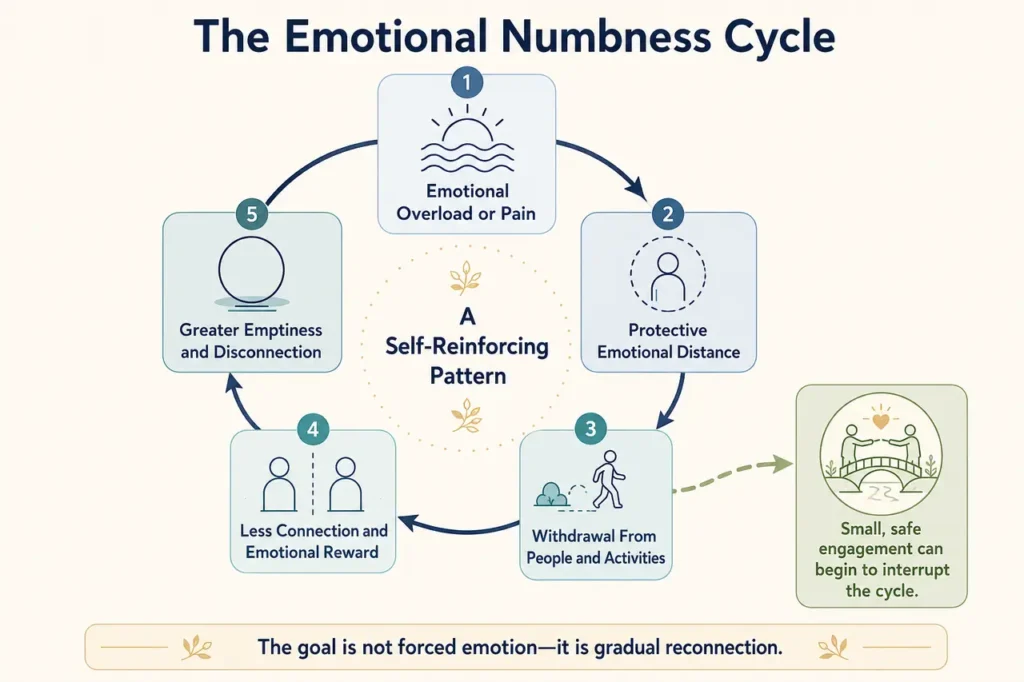
Emotional Numbness Can Become Self-Reinforcing
When you feel detached, you may naturally withdraw from people and activities. But this reduces opportunities for connection, pleasure and meaningful emotional feedback. The resulting emptiness may then encourage further withdrawal.
The cycle may look like this:
Emotional overload or pain
↓
Numbness and protective distance
↓
Less engagement with people and activities
↓
Fewer experiences of connection and reward
↓
Greater emptiness and withdrawal
This does not mean you should force yourself into constant social activity. It means that complete withdrawal can unintentionally maintain the conditions in which numbness continues.
What Might Your Emotional Numbness Be Communicating?
Before trying to make yourself feel differently, it can help to understand the pattern surrounding the numbness.
The following questions are for reflection—not self-diagnosis:
Notice when it began
- When did I first realise that my emotional responses had changed?
- Did it begin suddenly or develop gradually?
- Was there a loss, conflict, illness, work crisis, medication change or extended period of stress around that time?
Notice where it appears
- Do I feel numb everywhere or mainly in certain relationships and situations?
- Are both pleasant and unpleasant emotions muted?
- Can I still experience brief moments of interest, warmth, irritation, relief or sadness?
- Do I feel emotionally flat, physically exhausted or disconnected from reality?
Notice how it affects your life
- Have I withdrawn from people or activities that once mattered?
- Is it harder to make decisions or complete basic tasks?
- Has my sleep, appetite, concentration or substance use changed?
- Am I continuing to function while feeling increasingly absent from my own life?
- Is the numbness affecting my work, relationships or self-care?
Notice what happens when emotion approaches
- Do I immediately distract myself?
- Do certain feelings seem unsafe, overwhelming or unacceptable?
- Am I afraid that if I begin feeling, I will lose control?
- Do I judge myself for not reacting in the “right” way?
You do not need perfect answers. Even recognising that numbness is stronger after conflict, during exhaustion or around a particular memory can provide useful information.
A short record may help. For several days, note the following:
- the situation
- bodily sensations
- any emotion you can identify
- emotional intensity from 0 to 10
- what you felt drawn to do next
The purpose is not to monitor yourself obsessively. It is to notice whether your emotional world is completely absent or communicating through quieter signals.
Do not ask only, “How can I make myself feel again?” Also ask, “What may have made feeling difficult, exhausting or unsafe?”
That change in question replaces pressure with curiosity. It also prepares the way for gradual reconnection—without forcing an emotional breakthrough before you are ready.
How to Reconnect With Your Emotions Without Forcing Them
When people become frightened by emotional numbness, their first instinct is often to force a reaction.
They watch something sad to make themselves cry, revisit painful memories, test whether they still love someone or expose themselves to increasingly intense experiences just to feel something. When no strong emotion appears, they become even more convinced that something is wrong with them.
Emotional reconnection rarely responds well to pressure.
If numbness developed alongside stress, grief, depression, dissociation, exhaustion or emotional overload, demanding an immediate emotional breakthrough may add another layer of strain. A gentler approach is to rebuild contact with emotion gradually—beginning with stability, physical awareness, small moments of engagement and appropriate support.
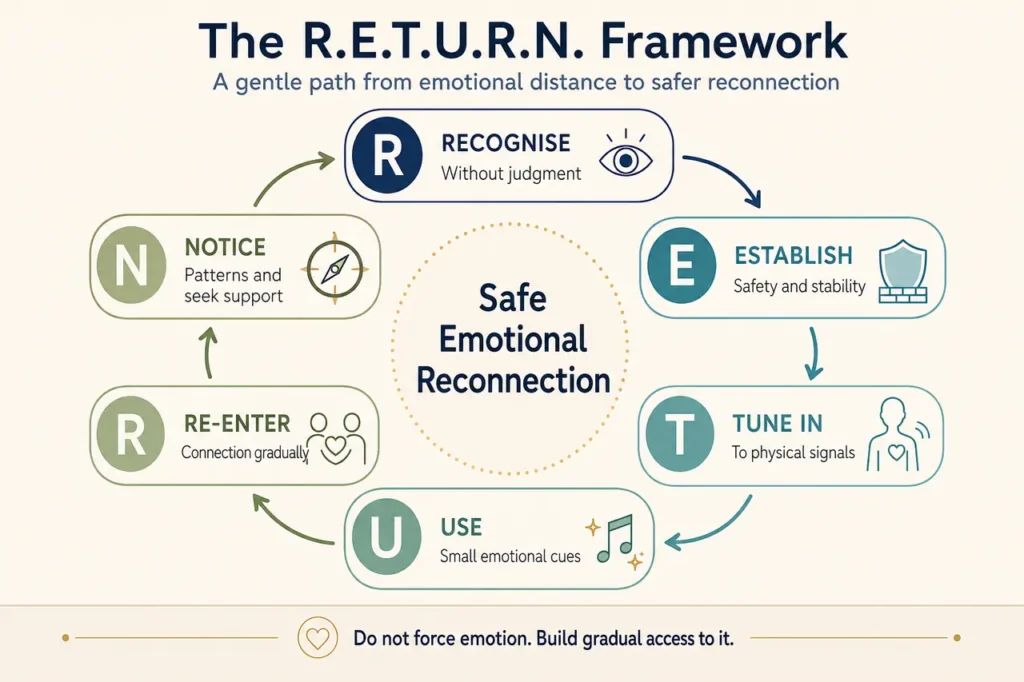
The R.E.T.U.R.N. Framework is not a treatment for depression, trauma, dissociation or any medical condition. It is a practical structure for noticing your emotional experience more safely while deciding whether professional help is needed.
The R.E.T.U.R.N. Framework: A Gentle Path Back to Emotional Connection
R — Recognise the Numbness Without Judging Yourself
Begin by describing what you are experiencing without turning it into an identity.
Compare these statements:
- “I am an emotionless person.”
- “I am noticing that my emotions feel distant right now.”
The first statement defines your entire character. The second describes a present experience that may have causes, patterns and possibilities for change.
Judgement often appears quickly:
- “I should be more grateful.”
- “I must not love them anymore.”
- “Normal people would be upset.”
- “I have become cold.”
- “I am failing at healing.”
These conclusions may feel convincing, but they are interpretations—not established facts.
Try using more precise language:
- “I expected excitement, but I noticed flatness.”
- “I care about this person, although warmth feels difficult to access.”
- “I can understand my sadness, but I cannot fully feel it.”
- “My emotional response is quieter than it used to be.”
Naming an experience does not instantly change it. It can, however, reduce the confusion between what you currently feel and who you permanently are.
If even the word ‘numb’ feels uncertain, begin with broader descriptions such as ‘heavy’, ‘distant’, ‘blank’, ‘foggy’, ‘disconnected’, ‘tired’ or ‘not fully present’. Emotional language can become more specific over time.
E — Establish Safety and Stability First
Before asking your emotional system to become more open, consider whether your daily life provides enough stability to tolerate that openness.
Check the foundations:
- Are you sleeping adequately?
- Are you eating regularly?
- Is your schedule leaving any room for recovery?
- Are you constantly consuming distressing news or online content?
- Are you living with unresolved conflict or an ongoing threat?
- Are alcohol or substances being used to manage the emptiness?
- Do you have at least one person or environment in which you do not need to perform?
Sleep, nutrition and routine are not cures for clinically significant numbness. But severe exhaustion, irregular habits and continuous stimulation can make emotional recognition harder.
Stability also means reducing unnecessary emotional testing. You do not need to repeatedly ask whether you still love your partner, replay distressing memories or measure whether each activity made you happy. Constantly checking for emotion can turn reconnection into a performance.
Instead, create small periods in which nothing is required from you emotionally: a quiet meal, a familiar walk, a predictable bedtime routine or a few minutes away from screens.
The goal is not to make yourself feel good. It is to make feeling a little less demanding.
T — Tune In to Physical Signals
When emotion words feel inaccessible, bodily sensations may provide a gentler entry point.
Pause briefly and ask:
- Does my chest feel open, tight, heavy or neutral?
- Is my jaw tense?
- Does my body feel restless or slowed down?
- Is there warmth, pressure, tingling or emptiness?
- Do I want to move closer, pull away, become still or leave?
- Has my breathing become shallow or held?
Do not immediately interpret every sensation. A tight chest does not automatically mean anxiety, and heaviness does not always mean sadness. Physical sensations can have medical as well as emotional causes.
For now, simply notice:
“There is tension in my shoulders.”
“My stomach feels unsettled.”
“My body becomes heavy during this conversation.”
This helps rebuild the link between situation, physical response and possible emotion.
If you feel unreal or detached from the present, sensory grounding may help orient your attention. You might name what you can see, listen for nearby sounds, feel your feet against the floor or hold an ordinary textured object. NHS trauma guidance describes grounding as a way to bring attention back to the present when someone feels detached. (CNTW NHS self-help guidance)
Grounding is not intended to uncover trauma or make you relive difficult events. If focusing inward makes you feel increasingly panicked, unreal or unsafe, stop and seek guidance from a qualified professional.
U — Use Small Emotional Cues
Emotional reconnection does not have to begin with a powerful memory or dramatic release. Start with low-pressure cues that might produce even a slight response:
- familiar music
- natural light or time outdoors
- gentle physical movement
- photographs associated with safe memories
- cooking or eating something familiar
- meaningful reading
- caring for a plant or animal
- creative activity without performance expectations
- a brief conversation with someone trustworthy
The aim is not to demand happiness. Look instead for small shifts:
- 2% more interested
- slightly calmer
- briefly irritated
- mildly comforted
- curious for a moment
- less distant than before
Irritation, longing and sadness may be among the first emotions to become noticeable. Do not dismiss them because they are uncomfortable. Reconnection means recovering access to a range of emotions—not selecting only pleasant ones.
You might record one sentence each day:
“Today I noticed a small emotional response when…”
If nothing appears, avoid treating the exercise as failure. The activity can still provide information about energy, attention and what currently feels tolerable.
Structured activity is also used within behavioural activation, an evidence-based psychological approach included in treatment guidance for depression. Clinical behavioural activation is more systematic than simply keeping busy, and it should not be reduced to “do enjoyable things and you will feel better”. Its broader principle is that purposeful engagement can help address patterns of withdrawal and reduced reinforcement. (NICE depression guidance)
R — Re-enter Connection Gradually
Emotional numbness often encourages isolation: “I will talk to people again when I feel normal.”
But waiting for complete emotional clarity before reconnecting can prolong distance. Safe connection may sometimes help emotion become more accessible.
Choose low-pressure contact. You might:
- sit with someone without discussing the numbness
- take a short walk together
- send a simple message rather than having a long conversation
- ask for company without asking the person to fix you
- explain that you feel distant, not uncaring
- participate briefly in a familiar shared activity
A simple statement can prevent misunderstanding:
“I care about you, but I have been feeling emotionally flat and disconnected lately. I may not respond as warmly as usual, but that does not mean you have done something wrong.”
Choose carefully whom you trust. Reconnection does not require becoming vulnerable with people who repeatedly dismiss, pressure or exploit your emotions.
If closeness itself triggers fear, shutdown or intense detachment, a trained therapist may provide a safer setting in which to explore that pattern gradually.
N — Notice Patterns and Seek the Right Support
Notice what changes the numbness rather than repeatedly asking whether it has disappeared.
You may track:
- when it becomes stronger or weaker
- whether it affects all emotions or mainly pleasure
- sleep, appetite, energy and concentration
- situations that produce detachment
- medication or dosage changes
- alcohol or substance use
- moments of interest, warmth or emotional presence
- effects on work, relationships and self-care
This record can help a mental-health or medical professional understand the broader pattern.
Professional support becomes especially important when numbness:
- persists or continues worsening
- affects everyday functioning
- is accompanied by hopelessness or severe withdrawal
- follows trauma or major loss
- involves frequent feelings of unreality or memory gaps
- begins after a medication change
- leads to increasing substance use
- occurs alongside thoughts of self-harm or not wanting to live
The appropriate support may include a primary-care doctor, psychologist, psychiatrist, counsellor or another qualified professional, depending on the possible cause.
Seeking help does not mean that you failed to reconnect by yourself. It means you are responding appropriately to an experience that may have psychological, social, medication-related and physical dimensions.
Reconnection May Be Quieter Than You Expect
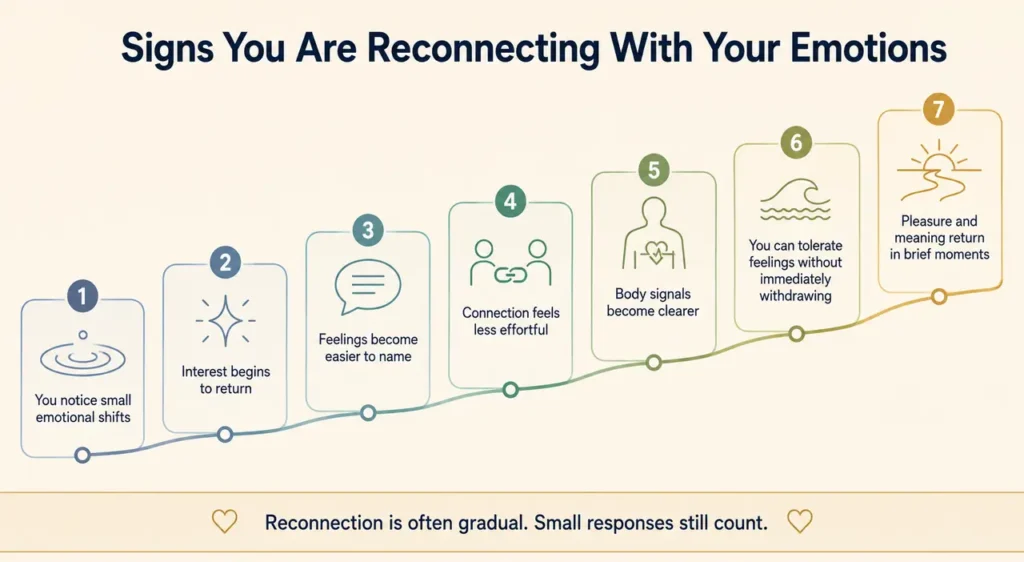
You may imagine emotional recovery as a dramatic moment when everything suddenly returns. Sometimes that happens, but often reconnection is far less visible.
It may begin when music sounds interesting again. You feel a brief moment of affection. A conversation holds your attention. You notice irritation instead of emptiness. You look forward to something small.
These are not insignificant responses. They suggest that emotional access is becoming more flexible.
The goal of the R.E.T.U.R.N. Framework is not to make you intensely emotional. It is to help you become more safely and consistently present with whatever emotions are genuinely there.
Healing is not measured by how strongly you can feel. It is reflected in your growing ability to notice, tolerate and respond to emotion without abandoning yourself.
What Not to Do When You Feel Emotionally Numb
Emotional numbness can make you desperate for evidence that you are still capable of feeling. But some attempts to break through the flatness can increase distress, deepen disconnection or create consequences that outlast the temporary relief.
1. Do Not Force Yourself to Have an Emotional Breakdown
You do not need to cry to prove that you are grieving, and you do not need an intense emotional release to prove that healing has begun.
Repeatedly watching distressing material, revisiting painful memories or pressuring yourself to “let everything out” may leave you overwhelmed without helping you process the underlying experience.
Tears can be meaningful when they arise naturally, but their absence does not mean that you are unaffected. Emotional processing can also appear as fatigue, reflection, changing priorities, bodily tension, gradual acceptance or a growing ability to talk about what happened.
The aim is not to produce the strongest possible emotion. It is to develop safer, more flexible access to what is already there.
2. Do Not Use Conflict or Risk to Feel Alive
Arguments, impulsive spending, reckless behaviour, unstable relationships, excessive scrolling, alcohol or other substances may briefly interrupt emotional flatness. The intensity can feel preferable to emptiness.
But intensity is not the same as emotional connection.
If you notice yourself creating crises or taking unusual risks, pause before judging yourself. Ask what the behaviour is providing: stimulation, escape, attention, punishment, control or temporary relief.
If the urge feels difficult to manage or is placing you or someone else at risk, seek professional support rather than trying to control it through willpower alone.
3. Do Not Isolate Until You “Feel Normal Again”
It is understandable to withdraw when conversation feels artificial or exhausting. A short period of solitude may be restorative, but prolonged isolation can reduce opportunities for emotional feedback, support and meaningful engagement.
You do not need to socialise intensely or explain everything. Begin with low-pressure contact—a brief message, a walk, a shared meal or simply sitting with someone trustworthy.
Try saying:
“I have been feeling emotionally disconnected lately. I may seem quieter than usual, but I would still value some company.”
4. Do Not Assume Numbness Proves You No Longer Love Someone
Emotional flatness can affect affection, attraction, excitement and the felt sense of closeness. This may lead you to question an important relationship.
Sometimes emotional distance is specific to a relationship and carries meaningful information. At other times, it is part of a broader decline in emotional responsiveness.
Before reaching a permanent conclusion, notice whether you also feel disconnected from friends, hobbies, goals and yourself. Where circumstances allow, avoid making irreversible decisions solely to test whether they produce an emotion.
Numbness does not automatically mean that a relationship is healthy or should continue. It simply means that reduced emotional access, by itself, cannot answer every relationship question.
5. Do Not Stop Medication Without Medical Guidance
If numbness began after starting or changing medication, discuss the timing and symptoms with the prescribing clinician.
Do not reduce, skip or abruptly stop prescribed medication by yourself. Sudden changes may cause withdrawal effects, worsen the original condition or introduce other health risks.
Your clinician can help consider whether the numbness may be related to the underlying condition, the medication, its dosage or another factor. Medication concerns deserve review—not silent endurance or unsupervised changes.
When Should You Seek Professional Help for Emotional Numbness?
A temporary period of flatness after shock, intense stress or exhaustion may improve as circumstances stabilise. But persistent numbness should not be ignored simply because it appears less dramatic than panic or visible sadness.
Consider speaking with a qualified mental-health or medical professional when:
- numbness lasts for several weeks or continues worsening
- you have lost interest or pleasure in most activities
- work, relationships or basic self-care are being affected
- you feel detached from your body or surroundings
- you experience significant memory gaps
- sleep, appetite, energy or concentration have changed considerably
- numbness followed trauma, bereavement or another major event
- symptoms began after starting or changing medication
- alcohol or substance use is increasing
- you are using risky behaviour to feel something
- you feel persistently hopeless, trapped or unable to imagine improvement
- you have thoughts of self-harm, death or not wanting to live
A primary care doctor can assess possible physical contributors and review medications. Depending on the pattern, a psychologist, psychiatrist or qualified counsellor can assess depression, trauma-related symptoms, dissociation, grief and other psychological factors.
Take a short record of when the numbness began, associated symptoms, medication changes and effects on daily life. You do not need to arrive with a diagnosis. Describing the experience clearly is enough:
“For the past month, my emotions have felt unusually flat. I have lost interest in activities and feel distant from people. This is affecting my work and relationships.”
If You Feel Unsafe
Emotional numbness can sometimes coexist with suicidal thinking, even when a person does not appear visibly distressed. Feeling empty, hopeless, trapped or as though there is no reason to live can be a warning sign requiring prompt support. (NIMH suicide warning signs)
If you might harm yourself or cannot remain safe:
- contact your local emergency service or go to the nearest hospital emergency department
- stay with a trusted person rather than remaining alone
- move away from anything you could use to harm yourself
- tell someone clearly: “I am not feeling safe and need immediate help”
In India, the Government’s 24-hour Tele-MANAS mental-health service can be reached at 14416 or 1-800-89-14416. (Directorate General of Health Services)
Readers outside India should use their local emergency number or a verified crisis service in their country.
Frequently Asked Questions (FAQs)
1. Why do I feel emotionally numb but still cry sometimes?
Emotional numbness does not always remove every emotion. You may experience occasional tears while still feeling disconnected from the emotion behind them, or emotions may return briefly in waves. Crying can also occur through exhaustion, frustration or physical stress. The presence of tears neither confirms nor rules out emotional numbness.
2. Why can’t I cry even when I know I am sad?
You may understand sadness cognitively while finding its physical and emotional expression inaccessible. Shock, prolonged stress, suppression, certain medications, depression or learned discomfort with emotional expression may contribute. Not crying does not mean the loss or situation is unimportant to you.
3. Can anxiety make you feel emotionally numb?
Yes. Anxiety may involve intense activation, but prolonged anxiety can also be followed by exhaustion, detachment or flatness. Some people alternate between feeling overwhelmed and feeling disconnected. Persistent numbness should still be assessed because anxiety is only one possible explanation.
4. Is emotional numbness a sign of depression?
Emotional numbness can occur with depression, particularly when it accompanies persistent emptiness, loss of pleasure, fatigue, hopelessness, withdrawal or changes in sleep and appetite. However, numbness alone does not establish depression. A professional considers the full pattern, duration and effect on functioning.
5. Does emotional numbness mean I no longer love my partner?
Not necessarily. Broader emotional flatness can reduce your felt sense of affection without erasing care or commitment. Notice whether you feel disconnected only from your partner or across several areas of life. Relationship-specific numbness can also matter, so the wider context should be explored before drawing conclusions.
6. How long can emotional numbness last?
There is no universal timeline. Numbness after shock or exhaustion may be brief, while numbness associated with depression, trauma-related difficulties, prolonged grief, medication effects or ongoing stress may last longer. Seek professional support when it persists, worsens or interferes with daily life.
7. Can antidepressants cause emotional blunting?
Some people report reduced emotional intensity while taking certain antidepressants. Depression itself can also cause emotional blunting, so identifying the source may require clinical review. Discuss changes with the prescribing clinician and never alter medication without medical guidance.
8. What is the difference between emotional numbness and dissociation?
Emotional numbness mainly concerns reduced access to feelings. Dissociation can involve a broader sense of disconnection from your body, identity, memory or surroundings. They can overlap. Frequent unreality, detachment or memory gaps deserve assessment by a qualified professional.
9. How can I start feeling emotions again?
Begin by reducing self-judgement, supporting sleep and daily stability, noticing bodily sensations, using small emotional cues and reconnecting with trusted people gradually. Do not force an emotional breakthrough. If numbness persists or has a significant effect on your life, seek professional support to address its possible causes.
A Final Perspective: Emotional Numbness Is Not the End of Feeling
If you are still wondering, “Why do I feel emotionally numb?”, remember that numbness is an experience—not your identity. Feeling emotionally numb may reflect prolonged stress, grief, depression, emotional overload or another concern that deserves understanding rather than self-judgment.
Even when you are feeling disconnected from yourself, your emotions may not be gone. They may be muted, difficult to recognise or waiting for enough stability to become accessible again. Learning how to reconnect with your emotions is rarely about forcing a breakthrough. It begins with noticing small responses, restoring safe connection and seeking appropriate support when emotional numbness persists.
You have not necessarily lost the person you once were. Reconnection may begin quietly—with a moment of interest, warmth, sadness or meaning that reminds you that your emotional world is still capable of returning.
A Gentle Note

The information in this article is intended for educational purposes and is not a substitute for professional mental-health assessment, diagnosis or treatment. If emotional numbness persists, affects your daily life or occurs alongside thoughts of self-harm, please seek support from a qualified professional or emergency service. Reaching out for help is a responsible step, and you do not have to navigate this experience alone.