
You pick up your phone to check one update before going to bed.
Perhaps something worrying is happening in the world. Maybe you saw a disturbing headline earlier and want to know what happened next. You tell yourself that you will look for only a minute.
One story leads to another. Then you open the comments. A video appears beneath the post. Another headline suggests that the situation could become worse. Before you realise it, a few minutes have turned into half an hour.
You feel tense. Your mind is crowded with frightening possibilities. You know that continuing to scroll is not helping, yet putting the phone down feels strangely difficult.
“Why can’t I stop doomscrolling when it clearly makes me feel worse?”
Table of Contents
This experience can be confusing. We usually expect ourselves to move away from things that make us anxious or upset. Doomscrolling seems to work in the opposite way. The more unsettled you feel, the stronger the urge to look for another update may become.
But this does not necessarily mean that you enjoy negative news. It also does not mean that you are careless or weak.
Often, your mind is trying to find something through the scroll. It may be looking for certainty, reassurance, control or a sign that the situation is becoming safer. The problem is that an endless feed rarely gives you a clear point at which you feel fully informed. Every answer can introduce another question. You keep searching for relief, but the search itself leaves you more anxious.
Why Can’t I Stop Doomscrolling?
You may struggle to stop doomscrolling because your mind treats threatening or uncertain information as important. Checking the news can briefly make you feel prepared. But when the information is disturbing, incomplete or constantly changing, that relief does not last.
You encounter something new that worries you. Your mind then wants more information to settle that worry. A repeating loop can develop: uncertainty leads to checking, checking brings brief relief, new information creates more anxiety, and the anxiety sends you back to the feed.
Platform features can make this harder to interrupt. Infinite feeds, autoplay, notifications and changing recommendations offer no natural ending. There is always another story waiting below the one you are reading.
For one person, doomscrolling may be an attempt to stay prepared. For another, it may offer an escape from loneliness, work pressure or an unfinished task. Understanding what the behaviour is doing for you is often more useful than simply ordering yourself to stop.
What Is Doomscrolling?
Doomscrolling means repeatedly consuming negative, frightening or upsetting content online, even when doing so is beginning to affect how you feel. It can involve breaking news, disturbing videos, crisis updates, health searches, political conflict, crime reports or emotionally charged comment sections.
The behaviour became widely recognised during the COVID-19 pandemic, when many people were constantly checking health updates and restrictions. It is not limited to pandemic news. It may appear whenever events feel frightening, uncertain or personally important.
A study involving researchers from NIMHANS discussed how doomscrolling and related cognitive biases were connected with psychological distress during the COVID-19 lockdown. More recent research has examined its links with anxiety, rumination, well-being and problematic social media use.
Doomscrolling is not a formal mental-health diagnosis. It is better understood as a digital behaviour that can become repetitive and difficult to control.
Is Every Kind of Scrolling Doomscrolling?
No. Ordinary scrolling may involve messages, photographs, entertainment or useful information. Mindless scrolling usually means browsing without a clear purpose, even when the content is not negative.
Doomscrolling is more specific. It involves feeling repeatedly pulled towards threatening or emotionally heavy content. Responsible news checking is different too. You read a reliable report, understand the main facts and remain able to continue with your day.
With doomscrolling, the information often stops being useful. You may already know the important facts, but something inside you continues to ask, “What if there is another update I need to see?” That question suggests the scroll may have become an attempt to manage the discomfort of not knowing.
Why Doomscrolling Feels So Difficult to Stop
Doomscrolling rarely continues because someone wants to feel frightened. More often, it begins with a reasonable intention: to understand, prepare or find reassurance. Several psychological processes can then keep it going.
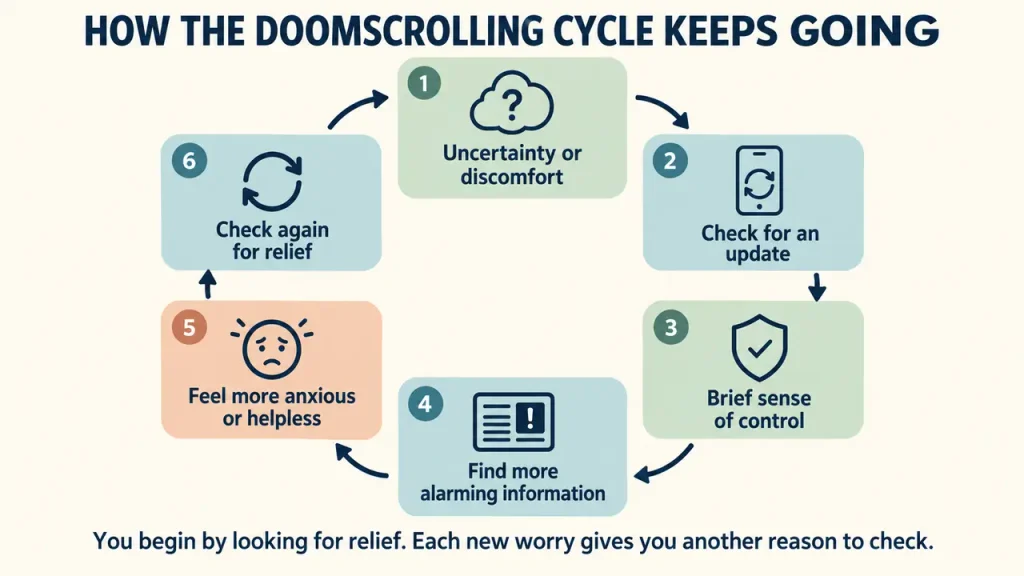
1. Your Mind Gives Possible Danger Extra Attention
Human attention is not completely neutral. We tend to notice information that could signal danger, loss or rejection more quickly than ordinary or reassuring information. Psychologists often describe this as negativity bias.
Imagine seeing ten headlines. Nine are ordinary, but one warns about a possible threat. Your eyes may return to that headline even if it is vague. Once you open it, you may feel an urge to look for more details. Your mind may be treating the information as something important for your safety.
The difficulty is that a phone can place hundreds of threats in front of you within a short time. Most are not things you can personally control, yet each can still receive the attention normally reserved for immediate danger.
When Possibility Begins to Feel Like Probability
If you watch several videos about accidents, crime, illness or financial loss, those events become easier to imagine. Because they come to mind quickly, they may begin to feel more common or personally likely than they are.
Feeds do not show events in proportion to how often they happen. They tend to show what attracts attention. When you pause on frightening material, the platform may recommend more of it. A stream of selected events can gradually make a rare danger feel like the whole world.
2. Uncertainty Makes You Search for One More Answer
Not knowing what will happen can be deeply uncomfortable. Your mind wants an answer: Am I safe? Should I do something? What happens next? Have I missed an important update?
Checking can provide a brief sense of relief. But a new report may contradict the previous one, or a comment may introduce another possibility. You now have more information without feeling more certain, so you check again.
Sometimes you genuinely need facts to make a decision. At other times, you already know the important facts but keep searching because you want the emotional discomfort to end. You may not be looking for more news. You may be looking for certainty.
Research has connected doomscrolling with intolerance of uncertainty, which refers to difficulty coping when a situation is unclear or unpredictable. Findings suggest that doomscrolling and rumination may help explain the relationship between intolerance of uncertainty and lower well-being. These studies show associations; they do not prove that one simple cause applies to everyone.

3. Being Informed Can Briefly Feel Like Being in Control
During an uncontrollable event, monitoring can feel like preparation. Knowing what is happening may reduce helplessness for a moment. The problem begins when gathering information continues after it can no longer change a decision.
You may read several reports about job losses, then move into comments and predictions. You finish with more facts but less ability to act. Information has started to resemble action without giving you meaningful control.
A useful question is, “Is this helping me make a decision, or am I hoping it will remove a feeling?”
Stepping away does not mean that you do not care. You can stay aware of an important event without following every reaction. Concern becomes more helpful when it leads to understanding or action rather than continuous exposure.
4. The Feed Does Not Give You a Natural Place to Stop
A chapter, newspaper or conversation has an ending. An online feed may not. More content appears as you scroll, one video follows another, and notifications lead you elsewhere. Stopping requires a fresh decision each time.
The next post is also unpredictable. It could contain an important update, a hopeful development or another alarming claim. Because it might provide what you want, you continue. Most posts do not bring closure, but the possibility keeps the search alive.
Social media platforms learn from what you watch and open. If emotionally intense content holds your attention, the platform may show you more of it. The feed is not necessarily presenting a balanced picture; it is offering material likely to keep you engaged.
Research on the Doomscrolling Scale has found associations with fear of missing out and problematic social media use. The important point is that this struggle is not happening only inside you. It is also happening in a digital environment that makes stopping less natural.
5. Doomscrolling Can Become Digital Rumination
Rumination is repeated thinking that returns to the same distressing concern without reaching a decision. Doomscrolling can give that process a constant outside supply of material.
You may worry that the future is unsafe. One report strengthens the fear. Another adds a new possibility. The details change, but the emotional message remains the same: something bad may happen, and I am not prepared.
Research involving social media users found that mindfulness and secondary traumatic stress helped explain the relationship between doomscrolling and mental well-being. Another study linked higher doomscrolling with more rumination, reduced hope and lower vitality. The relationship may move in both directions: anxiety can encourage scrolling, and scrolling can provide more material for anxiety.
A helpful question is, “Am I still learning something important, or am I collecting more material for the same fear?”
6. Scrolling May Help You Avoid Another Uncomfortable Feeling
Sometimes the strongest reason for scrolling has little to do with the news. You may reach for your phone when the house feels quiet, a task feels difficult, work has drained you or a conversation has left you unsettled.
The content may be unpleasant, but scrolling still gives your attention somewhere to go. It can postpone contact with loneliness, pressure, boredom or a personal worry.
This does not mean your concern about the world is false. You can care about real events and still use those events, without realising it, to move away from something closer to you. Both can be true.
Ask yourself: “What will I have to feel, begin or face when I put the phone down?” Sometimes the answer is simply tiredness. At other times, it reveals a need that deserves more direct care.
7. Stress and Tiredness Make the Stopping Moment Harder
Doomscrolling often becomes stronger after a demanding day, following conflict or late at night. When you are mentally tired, interrupting an automatic habit takes more effort. The phone asks very little from you. You only have to swipe.
Bedtime can be especially difficult. Daily distractions become quiet, worries are easier to notice and the phone is close by. Scrolling may feel like unwinding, but distressing content can keep you emotionally alert and delay sleep.
Poor sleep can then leave you more sensitive and less focused the next day. By evening, you may again look for the easiest available distraction. Self-criticism does not explain this pattern. Curiosity does: What made stopping particularly difficult at that moment?
The Doomscrolling Cycle
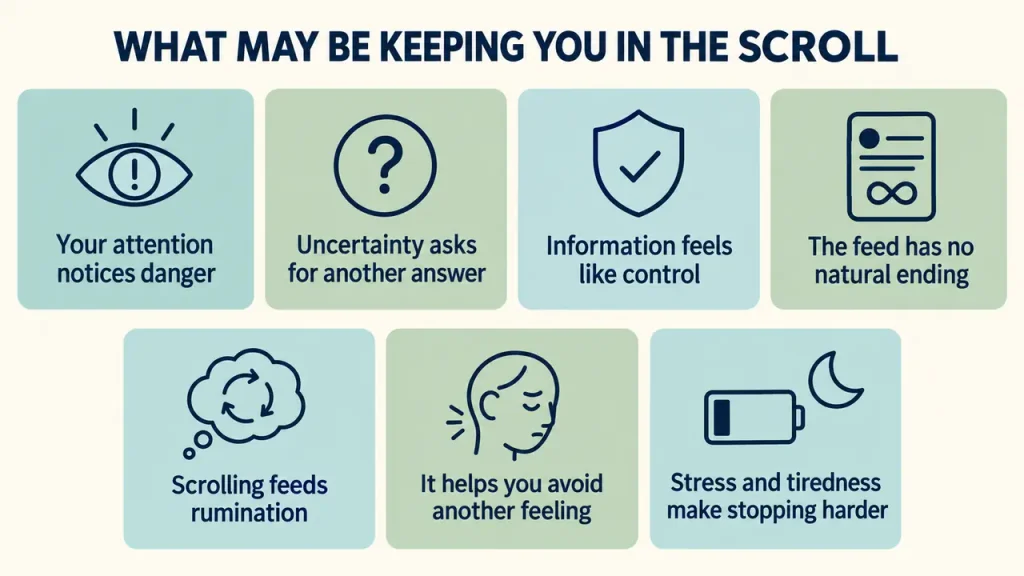
The cycle often begins with a small feeling rather than a deliberate choice. You feel uncertain, worried, lonely or tired. Checking briefly gives that feeling a task. Then new information creates another concern, and you search again to settle it.
You feel uncertain, anxious or emotionally uncomfortable.
You reach for your phone to feel informed, reassured or distracted.
Checking gives you a brief sense of control.
You encounter more negative or unclear information.
Your body and mind become more tense or alert.
You search for another update to calm the new discomfort.
Why It Can Feel Calming at First
Relief does not always mean that the content feels good. Sometimes it comes from no longer sitting still with uncertainty. Searching, reading and refreshing turn a difficult feeling into an action.
Scrolling may also confirm that other people share your concern. That validation can feel comforting, while a stream of fearful reactions makes the worry stronger. You may leave feeling less alone but more frightened.
When Staying Informed Becomes Overwhelming
There is no exact number of minutes that separates healthy news use from doomscrolling. The more useful question is, “What is this information doing to me, and what can I do with it?”
News use may still be helpful when it supports a decision, comes from a reliable source and allows you to return to your day. It may be becoming doomscrolling when you keep reading the same facts, move from reports into rumours, repeatedly check without learning anything useful, lose sleep or leave feeling more helpless than prepared.
How Doomscrolling May Affect Your Mental Health
Studies have found associations between frequent doomscrolling and anxiety, stress, psychological distress and lower well-being. A recent scoping review found broadly consistent links with anxiety, depression, stress and reduced resilience but also noted that much of the evidence is cross-sectional and based on self-report.
We should therefore be careful with cause and effect. Doomscrolling may worsen emotional difficulties, while people who already feel anxious or low may also be more likely to doomscroll.
Mood and Sense of Safety
Closing the app does not always end the experience. Headlines, images and imagined outcomes may remain active in your mind. Repeated exposure can also make the world feel more dangerous because the feed shows selected threats rather than a balanced picture of daily life.
A cross-cultural study found an association between doomscrolling, existential anxiety and more negative beliefs about people and the fairness of the world. This does not mean that reading bad news automatically causes trauma. It suggests that repeated indirect exposure can carry an emotional cost.
Attention, Daily Life and Sleep
After moving quickly through many posts, slower activities may feel harder to enter. You may notice mental tiredness, restlessness, repeated phone checking or trouble returning to work. These experiences do not prove that your attention has been permanently damaged. They may reflect temporary overstimulation, emotional arousal or fatigue.
At night, doomscrolling can delay bedtime and give your mind new worries to process. Timing, duration and emotional content all matter. The next morning, tiredness can make concentration and emotional regulation harder, feeding the same pattern the following evening.

You may also notice jaw or shoulder tension, shallow breathing, tired eyes, headaches or difficulty relaxing. These signs can have many causes, but they may help you recognise when the scroll has stopped being useful.
Ask: “Do I feel more informed now, or simply more alarmed?”
Is Doomscrolling an Addiction?
Doomscrolling is not recognised as a separate mental-health diagnosis. It can, however, become automatic, compulsive and emotionally important. It may overlap with problematic social media or smartphone use.
The effect on your life matters more than the label. Pay closer attention if you regularly lose more time than intended, continue despite distress, lose sleep, struggle to focus, repeatedly check without needing new information or use scrolling as your main way of managing difficult feelings.
Rather than saying, “I have no self-control,” ask, “What keeps bringing me back at this particular moment?” The answer may point towards fear of missing an update, tiredness, loneliness, reassurance seeking or avoidance.
What Is Your Doomscrolling Trying to Do for You?
Most repeated behaviours provide something in the short term. Doomscrolling may offer brief certainty, distraction, connection, validation or the feeling of being involved in a situation you cannot control. It can meet an immediate need while creating a larger problem afterwards.
A Gentle Self-Check
What usually happens just before I begin scrolling?
What am I hoping the next update will give me?
How do I feel before, during and after scrolling?
Am I learning anything meaningfully new?
Can I make a decision or take an action with this information?
What feeling or task will I meet when I put the phone down?
The purpose is not to find one perfect explanation. It is to notice what the habit has been doing for you so that you can choose a response that meets the real need.
How to Stop Doomscrolling Without Ignoring the World
You do not need to stop caring or avoid every piece of news. A more realistic goal is to change how you receive information and make stopping easier before the feed takes over.
Decide What “Informed Enough” Means
Before opening a feed, decide what you need to know. Are you checking an official instruction, looking for facts or following the story because it is difficult to look away? Once you have what you need, say, “I understand the main situation. More updates will not change my decision right now.”
Choose When You Will Check Again
A total ban can make the fear of missing out stronger. Instead, choose a time for the next check. You might read the news after breakfast and once in the evening. A plan reassures your mind that you are postponing the check, not ignoring something important.
Use a Reliable Source, Not an Endless Feed
When you need an update, go directly to a recognised news organisation, official notice or relevant public source. One complete report is usually more useful than dozens of posts, reactions and predictions. Comment sections often add emotion without adding reliable information.
Choose Information With an Ending
Replace an endless feed with one article, one bulletin, one daily summary or one podcast episode. A finite source gives your mind a clear finishing point.
Add a Little Friction
Turn off nonessential notifications, move apps away from the home screen, log out after use, disable autoplay or keep the phone away from the bed. These are not punishments. They create a pause in which choice becomes possible.
Move From Information to One Meaningful Action
If an issue affects you, take one proportionate action: follow a safety instruction, check on someone, make a preparation, verify a fact or support a trustworthy effort. Then allow yourself to step away. You do not have to keep watching suffering to prove that you care.
Give the Underlying Feeling Somewhere Else to Go
If you are anxious, write down what is known, unknown and actionable. If you are lonely, contact someone directly. If you are avoiding a task, begin with five minutes. If you are exhausted, choose actual rest rather than more stimulation. The alternative does not need to be impressive. It needs to meet the need more directly than the feed.
Create a Realistic Bedtime Boundary
Choose a news cut-off time, charge the phone away from the bed or keep a quieter activity nearby. Begin with a manageable period, such as the final 20 minutes before sleep. If one night goes badly, return to the boundary the next night rather than treating it as failure.
The S.C.R.O.L.L. Reset
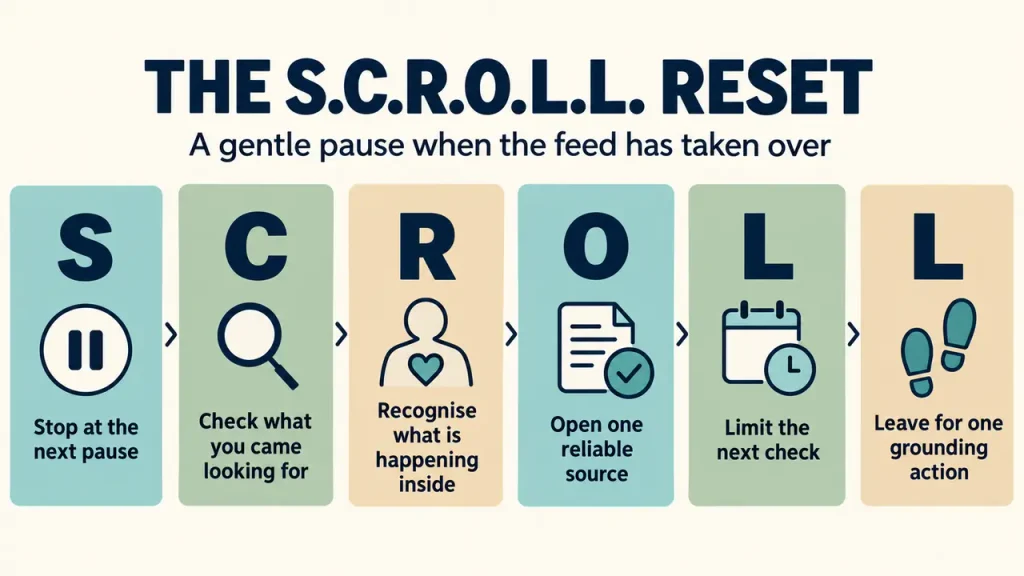
Use this short reset when you notice that the behaviour is already happening.
S — Stop at the next pause: Finish the current paragraph or video, but do not move immediately to the next one.
C — Check what you came looking for: Name whether you wanted information, certainty, reassurance, distraction or connection.
R — Recognise what is happening inside you: Notice your mood, breathing and tension without judging yourself.
O — Open one reliable source: If information is still needed, leave the feed and choose one trustworthy source.
L — Limit the next check: Choose a specific time when you will look again.
L — Leave for one grounding action: Stand up, drink water, stretch, wash your face, look outside or speak to someone.
You will probably return to scrolling sometimes. Progress may first mean noticing ten minutes earlier, stopping before the comments or keeping the phone out of bed twice this week. These changes still matter.
When Doomscrolling May Need More Than a Habit Change
Small changes help many people. But app limits may not fully address ongoing anxiety, low mood, loneliness, traumatic stress or a strong need for reassurance.
Consider speaking with a qualified mental-health professional if doomscrolling repeatedly affects sleep, work or relationships; feels very difficult to control; leaves you deeply distressed; or occurs alongside persistent anxiety, panic, depression or hopelessness. Support can help you work with the feelings beneath the scrolling, not only the screen.
Frequently Asked Questions
Why can’t I stop doomscrolling even when it makes me anxious?
Scrolling may briefly provide information, distraction, reassurance or control. Negative content then creates new worries, and the mind searches again to settle them. Infinite feeds make this loop easier to continue.
Is doomscrolling an addiction?
It is not a separate mental-health diagnosis. It can become automatic and difficult to control, and it may overlap with problematic social media use. The effect on sleep, mood, responsibilities and relationships matters more than the label.
Why do I doomscroll before bed?
You are tired, distractions are quieter and worries may be easier to notice. The phone provides quick escape, but distressing content can keep you alert and delay sleep.
Can doomscrolling make anxiety worse?
Studies show an association with anxiety, stress and rumination. The relationship may work both ways: anxious people may scroll more, while scrolling can supply more material for anxiety.
How can I stay informed without doomscrolling?
Choose reliable sources, use planned news windows, read complete reports and stop when the information no longer supports a decision or action.
What is the difference between doomscrolling and mindless scrolling?
Mindless scrolling lacks a clear purpose and may involve any content. Doomscrolling specifically involves repeated exposure to negative or threatening material despite its emotional effect.
How long does it take to stop doomscrolling?
There is no fixed timeline. It depends on the habit, its triggers and the need it serves. Early progress may simply mean noticing sooner and making one stopping point easier.
Final Perspective
Doomscrolling often begins with a reasonable wish. You want to understand what is happening, protect yourself or feel prepared. But there comes a point when more information no longer creates clarity. It creates more questions and a stronger urge to keep checking.
If you have been wondering, “Why can’t I stop doomscrolling? ”, the answer may not be a lack of discipline. Your mind may be looking for certainty, control, reassurance or relief in a place that cannot provide enough of it.
You do not have to stop caring about the world. You can stay informed and still protect your attention. You can care without watching continuously. And you can step away before the feed decides when you have had enough.
A Gentle Note
This article offers psychoeducation and general guidance. It is not intended to diagnose a mental-health condition or replace professional care. If doomscrolling is seriously affecting your sleep, work, relationships or emotional well-being—or if you are experiencing persistent anxiety, depression, panic or hopelessness—consider speaking with a qualified mental-health professional. You deserve support for the feelings beneath the scrolling, not only stricter rules for your phone.