

Have you ever found yourself getting irritated over something small, even when you know it does not really deserve such a strong reaction? Perhaps someone corrected a mistake you made at work, a family member reminded you about something you had forgotten, or a friend disagreed with your opinion. You felt your anger rising before you had time to think, and your response came out sharper than you intended.
Later, when things had settled down, you wondered, Why am I so irritable lately? Why do I get frustrated so easily? You may even have felt guilty about how you spoke to someone you care about. You knew the situation did not need to turn into an argument, but in that moment, controlling your reaction felt much harder than you expected.
Table of Contents
Sometimes, the reason is obvious. You may be tired, under pressure, dealing with unfair treatment or carrying too many responsibilities. At other times, the frustration seems to come from nowhere. But when you look a little closer, you may notice that you were already feeling disappointed in yourself before the incident happened.
Perhaps you had made a mistake earlier in the day, were comparing your progress with someone else’s, or were quietly worrying about a decision. When self-doubt builds up, ordinary situations can begin to feel personal. A suggestion may sound like criticism, a disagreement may feel like rejection, and someone else’s success may remind you of what you believe you have failed to achieve.
Sometimes, the frustration you feel towards other people begins with the way you have been treating yourself. Understanding this connection does not mean blaming yourself for every angry reaction. Anger has many causes, and sometimes it is a reasonable response to being treated unfairly. But recognising how negative thinking and self-doubt influence your reactions can help you understand what is happening beneath the surface—and what you can do differently.
How Self-Doubt Can Make You More Irritable
Self-doubt is the habit of questioning your own abilities, decisions, worth or judgement. It is normal to experience it occasionally. You may feel uncertain before an important decision or wonder whether you handled a difficult situation well. These moments of uncertainty are not necessarily a problem; sometimes they help us reflect and learn.
The difficulty begins when uncertainty turns into a persistent belief that you are not good enough. You might question whether you are capable at work, whether people respect you, whether you are a good parent or partner, or whether you are falling behind in life. These thoughts may remain in the background even while you carry on with your daily responsibilities.
Research-informed guidance from the NHS on low self-esteem explains that people with low self-esteem may view themselves and their lives more negatively. When you already tend to judge yourself harshly, an ordinary challenge can feel much bigger than it actually is. A mistake is no longer just something to correct; it becomes another reason to question your abilities.
Consider two people receiving the same feedback from their manager:
Manager: “Please check this report again. There are a few errors.”
One person thinks, “I missed a few things. I’ll correct them.” The other thinks, “I always make mistakes. My manager must be losing confidence in me. Perhaps I am not capable enough for this job.” The feedback is identical, but the meaning each person gives it is different.
The second person is no longer thinking only about the report. They are questioning their competence and perhaps their place in the team. They may become defensive, feel irritated with the manager or spend the rest of the day thinking about the conversation. What began as a small correction has become a personal judgement.
This is one way self-doubt can contribute to irritability. Instead of thinking, I made a mistake; you begin thinking, I am a failure. Instead of thinking, ‘Someone disagrees with me,’ you think, ‘Nobody respects my opinion.’ When an event feels like proof that something is wrong with you, it can become harder to respond calmly.
Why Negative Thinking Can Turn Into Anger
Have you noticed that some comments stay with you long after the conversation has ended? Someone may offer a suggestion, and you keep thinking about it. You replay their words, remember their expression and wonder what they really meant. Sometimes, this happens because the comment touches a concern you already have about yourself.

Imagine a conversation between two colleagues. One says, “I think we should revise this section before sending the report.” The other replies, “Why? I’ve already checked it.” On the surface, it is a simple work-related discussion. But if the person hearing the suggestion is already worried about their performance, they may interpret it as a lack of trust.
Their internal conversation may sound very different: Why does he always question my work? Does he think I’m incompetent? Why can’t people trust me to do something properly? By the time they respond, they are no longer reacting only to the suggestion. They are also reacting to the meaning they have attached to it.
They may speak sharply, refuse to consider the feedback or make a personal remark. The colleague becomes defensive, and a simple discussion turns into an argument. Later, both people may feel upset, even though the original issue could have been resolved without conflict.
This illustrates an important principle in cognitive behavioural therapy (CBT): the way we interpret an event can influence our emotions and behaviour. It does not mean your interpretation is always wrong. Sometimes feedback is unfair, criticism is humiliating or another person genuinely behaves disrespectfully. Your feelings deserve to be taken seriously.
But it is worth separating what happened from what you assumed it meant. When you feel anger rising, ask yourself: What exactly happened? What am I telling myself about this situation? Do I know that this person intended to criticise or disrespect me? Is there another reasonable explanation? You do not have to convince yourself that everything is fine. You are simply giving yourself a chance to understand the situation before reacting.
Why Am I So Frustrated? Look at What You May Be Carrying
Sometimes, the immediate situation is only the final straw. You may have been worrying about work, feeling disappointed in your progress or struggling with a personal problem. You keep going because you have responsibilities to manage, but the emotional strain does not disappear. Then something small happens, and you react more strongly than you expected.
When you are disappointed in yourself
You planned to finish an important task by the end of the day, but you postponed starting, became distracted and did not complete it. By evening, you are frustrated with yourself. You think, Why do I keep doing this? Other people manage their responsibilities. I never seem to get anything done on time. Instead of looking at what made the task difficult, you begin questioning your character and abilities.
You may carry those thoughts into the rest of the evening. When someone at home asks you a simple question, you respond impatiently. The question itself may not be the real source of your frustration; you were already feeling disappointed, and the conversation happened when you had little patience left.
Afterwards, you feel guilty and think, I cannot even control my temper. Now the original disappointment has become another reason to doubt yourself. This is how frustration can spill from one part of life into another: a difficult day at work affects your behaviour at home, and a mistake you made in the morning changes how you respond to someone in the evening.
When criticism feels like rejection
Suppose you tell a friend about a decision you have made, and they point out a possible problem. You hear their concern, but inside you feel embarrassed. You were already uncertain about the decision, and their comment seems to confirm your fear that you cannot make good choices. You respond, “Fine. You clearly know better than me. I won’t ask you again.”
Your words express anger, but underneath that anger there may be disappointment, hurt or fear of looking incapable. The comment has touched something you were already worried about, and now you feel the need to protect yourself from that uncomfortable feeling.
The solution is not to accept every criticism. Some comments are unfair, insensitive or simply unhelpful. The important thing is to consider the feedback without turning it into a judgement about your entire worth. You can disagree with someone without attacking yourself, and you can disagree without attacking them.
When someone else’s progress makes you question your own
You see someone your age moving ahead in their career, buying a home or achieving something you have wanted for a long time. You may be genuinely happy for them, yet feel uncomfortable about your own situation. Later, you catch yourself thinking, What have I been doing all this time? Why am I still here? Have I wasted my opportunities?
You carry those thoughts into the rest of your day. A minor inconvenience irritates you, and someone’s casual remark feels like a personal criticism. Comparison can quietly turn another person’s success into a judgement about your own life, leaving you frustrated even when nothing particularly upsetting has happened to you directly.
But someone else’s progress does not automatically mean you have failed. People have different circumstances, responsibilities, opportunities and timelines. You can acknowledge that you want more from life without treating your present situation as proof that you are not good enough.
The Self-Doubt, Anger and Frustration Cycle
When self-doubt and negative thinking repeatedly influence your reactions, they can reinforce one another. The pattern may begin with a concern about yourself, grow through the meaning you attach to an event, and end with a reaction that leaves you feeling even worse. Over time, this can become a familiar cycle.
First, you doubt yourself. You worry that you are not capable, respected or good enough. Then, you interpret something negatively: a correction feels like humiliation, a disagreement feels like rejection, or a delay feels like proof that you are falling behind. Your frustration builds as you feel embarrassed, threatened, disappointed or misunderstood.
Eventually, you react with anger. You become defensive, speak harshly, withdraw or blame someone else. The reaction creates another problem: a conversation becomes an argument, a relationship feels strained or you regret what you said. Finally, you turn the outcome against yourself and think, I always ruin things. I cannot handle anything properly.
And the cycle begins again. Not everyone experiences these steps, and the cycle does not explain every angry reaction. But it can help you understand why you sometimes find yourself repeating a pattern you genuinely want to change.
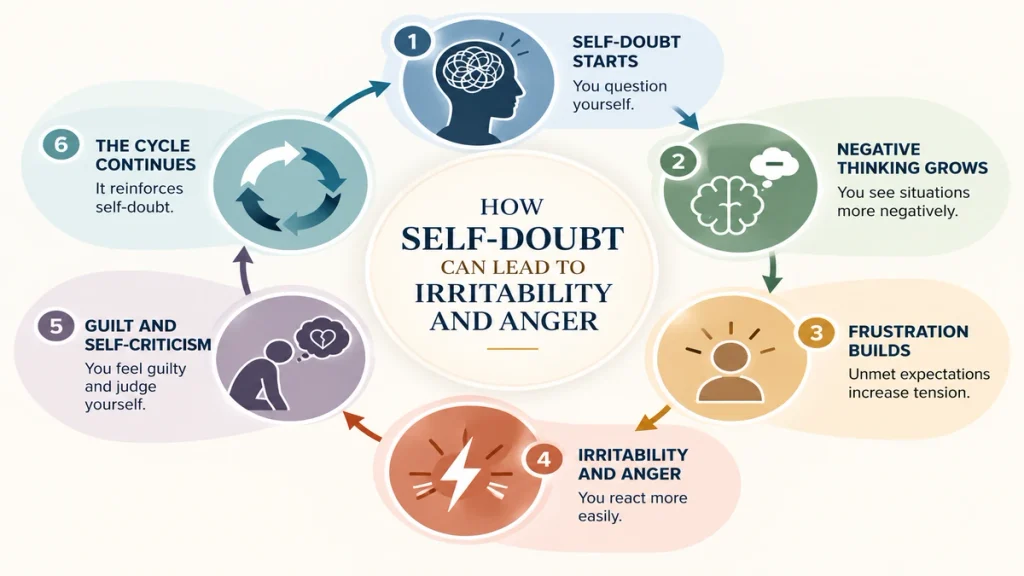
The hardest part is that the outcome may seem to confirm the belief that started it. If you already worry that you are bad at relationships, an argument can feel like proof. If you believe you are incompetent, becoming defensive at work may leave you even less confident. This is why simply telling yourself to stop being angry may not be enough. It helps to understand what happened before the anger appeared and what keeps the pattern going.
How Negative Self-Talk Makes Frustration Harder to Manage
Think about how you speak to yourself after making a mistake. Would you tell a friend, “You’re useless. You always mess things up. You’ll never learn”? Most people would hesitate to speak to someone they care about in that way. Yet they may repeat those same words internally every day, often without noticing how harsh they have become.
Negative self-talk can turn an ordinary setback into a prolonged struggle. Instead of correcting the mistake and moving forward, you keep reviewing what happened and criticising yourself. This can leave you mentally tired and tense. When another problem appears, you may have less patience available to deal with it.
Self-criticism can also make feedback harder to accept. If every mistake feels like a judgement on your worth, you may focus on defending yourself rather than understanding what needs to change. You might reject useful suggestions, become irritated when someone points out a problem, or spend so much time blaming yourself that you struggle to take the next practical step.
Try replacing broad judgements with specific observations. Instead of I am hopeless at everything, try, I struggled with this task, and I need to understand where I got stuck. Instead of I always overreact, try, I reacted more strongly than I wanted to in that conversation. I can look at what upset me and practise responding differently.
This is not about pretending that everything is fine. It is about describing a problem accurately enough to do something about it. Self-compassion does not mean avoiding responsibility. You can acknowledge that your words hurt someone, apologise and work on your reactions without deciding that you are a bad person.
If you often feel that you are your own harshest critic, read our article on why you are so hard on yourself.
How to Respond Differently: The S.T.E.A.D.Y. Approach
Understanding why you feel irritable is an important first step. The next is learning how to respond when you notice the pattern beginning. You do not need to become perfectly calm overnight. Start with one situation in which you would normally react automatically, and practise making a little more room for thought before acting.
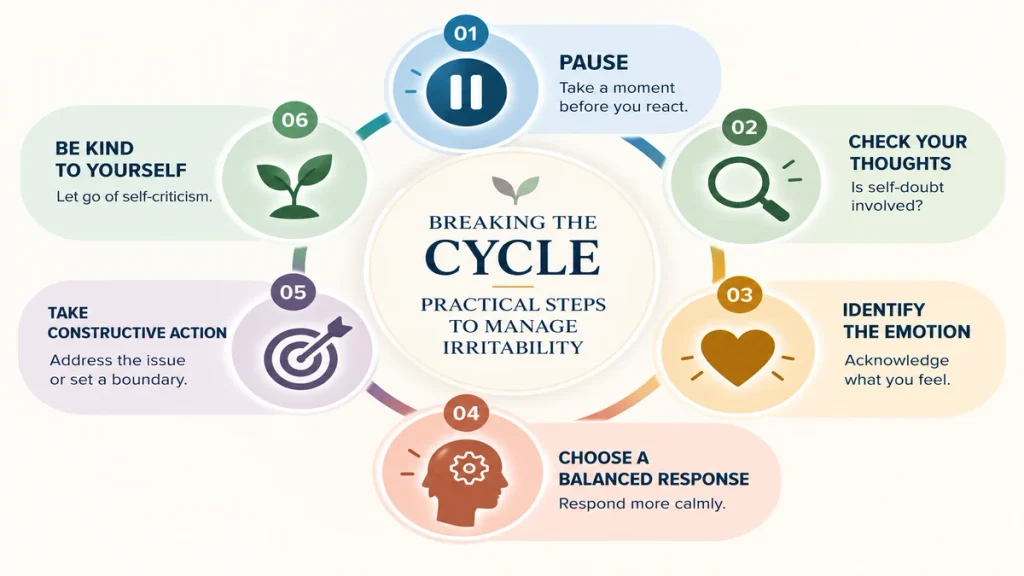
The S.T.E.A.D.Y. approach below is an educational framework designed to help you pause, reflect and choose a more constructive response. It is not a clinically validated treatment.
S — Spot the self-doubt
Notice what you were thinking about yourself before you became angry. Perhaps you were already feeling unsuccessful, ignored or inadequate. Maybe you were worried about disappointing someone or making another mistake. These feelings can be easy to overlook when your attention is fixed on what another person has said or done.
Ask yourself, Was I already feeling bad about myself before this happened? You do not need to find a deep explanation every time you feel irritated. Simply notice whether self-doubt may be adding to the situation.
T — Trace the interpretation
Separate what happened from what you believe it means. For example, your partner may not respond to your message for several hours. You interpret the silence as, They do not care about me. I am not important to them. But there may be other explanations: they could be busy, distracted or unable to respond.
There may be a genuine relationship issue that needs discussion, and you should not ignore a repeated pattern that concerns you. But the delay alone does not tell you everything about the other person’s feelings. Ask yourself, What do I know, and what am I assuming? This distinction can help prevent uncertainty from becoming a personal verdict.
E — Explore the emotion underneath
Before reacting, try to identify what you are feeling besides anger. Are you embarrassed, disappointed, afraid of rejection, feeling ignored or frustrated because something important to you has not worked out? Sometimes anger is the first emotion you notice, while the more specific feeling takes a little longer to recognise.
You might discover that the thought I am angry with him also contains I felt dismissed when he interrupted me. Naming the more specific feeling can help you understand what you need. Perhaps you need clarification, an apology, a boundary or simply some time to settle before continuing the conversation.
A — Allow space before reacting
When anger rises, give yourself time before continuing the conversation. You might say, “I’m getting frustrated, and I don’t want to say something hurtful. Can we take a short break and come back to this?” This gives you a chance to settle without pretending that the problem has disappeared.
If you are alone, step away from the immediate situation, relax your shoulders and breathe slowly. A short walk or a few quiet minutes may help you settle enough to think more clearly. The aim is not to suppress anger or pretend nothing happened. It is to avoid making the situation harder while you are highly upset. If the situation involves immediate danger or serious mistreatment, prioritise your safety rather than trying to manage the other person’s reaction.
D — Develop a balanced response
Once you feel calmer, look for a response that acknowledges both your feelings and the facts. Instead of saying, “You never respect my opinion,” you could say, “When my suggestion was dismissed earlier, I felt that my point had not been considered. Can we talk about it?” This communicates your experience without assuming that you know the other person’s intentions.
You can use the same approach with yourself. Instead of telling yourself, “I cannot do anything right,” try, “I’m disappointed with how I handled that task. I need to work out what went wrong and what I can do differently next time.” Balanced thinking does not require you to be endlessly positive. It asks you to be fair to yourself as well as to others.
Y — Yield to constructive action
Finally, decide what would genuinely help. Perhaps you need to correct an error, ask for feedback, set a boundary, apologise for speaking harshly or make a realistic plan for a task you have been avoiding. Choose one useful action rather than continuing to replay the situation in your mind.
For example, after snapping at a family member, you might say, “I’m sorry I spoke to you that way. I was frustrated, but that wasn’t a fair way to respond. I should have explained what was bothering me.” You can take responsibility for your behaviour without attacking your own character.
With practice, this approach may help you recognise the pattern earlier. You may not prevent every angry reaction, but you can learn to understand what is happening and make a different choice more often.
What If Your Irritability Is Not Caused by Self-Doubt?
It is important not to assume that every instance of anger is a sign of insecurity. You may be frustrated because your workload is unreasonable, your responsibilities are overwhelming, you are not getting enough rest or someone repeatedly ignores your boundaries. Anger can also be a response to unfairness, grief, past experiences or accumulated stress.
The NHS guide to anger explains that anger has different causes and that stress and the circumstances surrounding an event can influence how we respond. Sometimes, the situation really does need to change. The goal is not to convince yourself that your feelings are wrong, but to understand what they are telling you and decide what to do next.
You might ask yourself: Is something unfair happening that needs to be addressed? Have I been ignoring my own needs for too long? Am I exhausted or under more pressure than I can comfortably manage? Am I interpreting this situation through an existing fear about myself? What would a helpful response look like, even if my feelings are justified?
More than one answer may be true. You can be genuinely mistreated and still have self-doubt that makes the experience more painful. You can also feel insecure without the other person having done anything wrong. Understanding the difference helps you avoid two extremes: blaming yourself for everything or assuming that everyone else is responsible for how you feel.
When Should You Seek Professional Help?
Occasional frustration is part of everyday life. However, consider speaking with a qualified mental health professional if your anger is becoming difficult to control, affecting your relationships or work, or leaving you with persistent guilt and distress. It may also be helpful to seek support if you frequently feel worthless, struggle with ongoing anxiety or low mood, or find yourself caught in repetitive self-critical thoughts that interfere with daily life.
Counselling can provide a space to explore the experiences, beliefs and situations contributing to these patterns. Depending on your needs, a professional may help you practise more balanced thinking, manage emotional reactions, communicate boundaries and respond to conflict more constructively. Seeking help does not mean you have failed to manage your emotions. It means you are taking the difficulty seriously.
If you feel at risk of harming yourself or someone else, seek urgent local professional or emergency support.
A Final Thought: Understand Your Anger Without Turning Against Yourself
Perhaps you recognise yourself in some of these examples. You may have noticed how quickly a small mistake becomes a reason to criticise yourself, or how a disagreement leaves you feeling personally rejected. You may have regretted your words after becoming frustrated with someone you care about. Recognising this pattern is not another reason to judge yourself. It is an opportunity to understand yourself more honestly.
You do not have to defend every angry reaction. If you hurt someone, you can acknowledge it and make amends. If your thinking has become unfair or extreme, you can question it. If a situation is genuinely unhealthy, you can take steps to address it. The important thing is to stop treating every difficult moment as proof that something is wrong with you.
A mistake is something you can learn from. A disagreement is something you can work through. A difficult emotion is something you can listen to without allowing it to decide your next action. Taking responsibility for your behaviour and treating yourself with understanding can exist together.
The next time you wonder, Why am I so irritable?, try pausing long enough to ask yourself: What has upset me here—and what am I telling myself about who I am because of it? You may not find the answer immediately, but that question can be a useful beginning.
Frequently Asked Questions
Why am I so irritable lately?
Irritability can be associated with stress, tiredness, frustration, unresolved problems or feeling overwhelmed. For some people, negative self-talk and self-doubt also make everyday situations harder to manage. Consider what has changed recently and whether your irritability is affecting your relationships or daily life.
Why do I get angry over small things?
Small events can feel unusually upsetting when you are already stressed, tired or disappointed. Sometimes an incident brings up a larger concern, such as feeling ignored, inadequate or out of control. Looking at what happened just before your reaction may help you understand why it felt so significant.
Can self-doubt cause anger?
Self-doubt can contribute to anger for some people, particularly when criticism, mistakes or disagreements feel like evidence that they are not good enough. The resulting embarrassment, anxiety or frustration may lead to defensiveness or irritability. However, anger has many possible causes, and self-doubt is not always involved.
Why am I so frustrated with myself?
You may feel frustrated with yourself when your actions do not match your expectations, when you struggle to reach a goal or when you repeatedly criticise your own decisions. Try identifying the specific problem rather than making a judgement about your entire character. A clear, realistic next step is often more helpful than further self-criticism.
How can I stop negative thinking from affecting my behaviour?
Start by noticing the thought that appears before your emotional reaction. Separate the facts from your interpretation, consider other explanations and give yourself time to settle before responding. With practice, you can learn to express frustration more clearly and take constructive action instead of reacting automatically.
How do I know whether my anger is hiding another emotion?
There is no single sign that proves anger is covering another feeling. However, you might notice embarrassment, hurt, fear, disappointment or feeling misunderstood beneath the anger. Once you are calmer, reflect on what felt threatened or unmet. You may discover a need that is easier to address directly.
References and Further Reading
These sources provide background on self-esteem, anger and approaches to understanding thoughts and behaviour. The S.T.E.A.D.Y. framework in this article is an original educational synthesis, not a published clinical intervention.
- NHS — Raising low self-esteem. Practical guidance on understanding and improving self-esteem.
https://www.nhs.uk/mental-health/self-help/tips-and-support/raise-low-self-esteem/ - NHS — Anger. Information on recognising anger and finding healthier ways to manage it.
https://www.nhs.uk/mental-health/feelings-symptoms-behaviours/feelings-and-symptoms/anger/ - Clinical Psychology Review (2020) — Systematic review and meta-analysis of self-criticism and psychotherapy outcomes.
https://pubmed.ncbi.nlm.nih.gov/31864153/ - Clinical Psychology Review (2024) — Meta-analysis on anger management activities and arousal.
https://pubmed.ncbi.nlm.nih.gov/38518585/
These sources offer useful background, but they do not establish that self-doubt directly causes anger in every person. Individual experiences differ, and the relationship between thoughts, emotions and behaviour is influenced by context.