

“Why did I say that?”
It might have happened yesterday or five years ago. Maybe it was a presentation where you forgot your words, sending a message to the wrong person, tripping in public, or making an awkward joke that landed in complete silence. You haven’t thought about it all day. But the moment your head touches the pillow, your brain suddenly decides it’s time for the world’s most unwanted movie marathon and starts replaying embarrassing memories at night.
Every awkward moment, every cringe-worthy conversation, every mistake.
Playing in perfect high definition.
If this sounds familiar, you’re far from alone.
Millions of people experience what psychologists call rumination—the tendency to repeatedly think about distressing experiences without moving toward a solution. Nighttime often creates the perfect conditions for this mental replay because the distractions of the day fade away, leaving your mind with more room to wander.
The surprising part?
Your brain isn’t doing this because it wants to make you miserable.
It’s actually trying—although not very effectively—to protect you.
Understanding why this happens is the first step toward breaking the cycle.
Why Does This Happen Mostly at Night?
Have you ever noticed that problems that seem manageable during the day suddenly feel overwhelming at midnight?
There’s a reason for that.
During the day, your brain is busy.
You’re answering emails, commuting, working, studying, talking with people, cooking, scrolling through your phone, or simply reacting to everything happening around you.
Your attention is constantly occupied.
But nighttime changes the environment.
The room becomes quiet.
Notifications slow down.
Conversations end.
External stimulation fades.
Without those distractions, your brain naturally shifts its focus inward.
Think of your mind like a busy office.
Throughout the day, employees are rushing from one task to another.
When everyone leaves in the evening, the cleaning staff arrives and starts sorting through everything that was left behind.
Your brain does something similar.
While you sleep, it prepares to organize memories, emotions, and experiences from the day. Sometimes, however, emotionally significant memories—especially embarrassing ones—receive more attention than they deserve.
That’s when your thoughts begin to spiral.
Why Embarrassing Memories Feel Impossible to Forget
Not every memory returns at bedtime.
You probably don’t replay brushing your teeth last Tuesday or choosing what to eat for lunch.
Instead, your brain tends to revisit experiences that carried emotional weight.
Embarrassment is one of the strongest social emotions humans experience.
Thousands of years ago, belonging to a group was essential for survival. Being rejected by your community could have serious consequences.
Although modern life has changed dramatically, our brains still treat social mistakes as highly important information.
When you remember an embarrassing moment, your brain may interpret it as a lesson:
“Let’s review this so we don’t make the same mistake again.”
In theory, that’s useful.
In practice, it often backfires.
Rather than learning something new, your mind becomes stuck replaying the same scene without reaching a meaningful conclusion.
Psychologists refer to this repetitive cycle as rumination.
Unlike healthy reflection, rumination rarely solves problems.
It simply keeps emotional discomfort alive.
The Difference Between Reflection and Rumination
This distinction is one of the most important concepts in psychology, yet many people confuse the two.
Reflection asks:
“What can I learn from this experience?”
Rumination asks:
“Why am I like this?”
Reflection is curious.
Rumination is critical.
Reflection leads to growth.
Rumination keeps you emotionally trapped.
Imagine touching a bruise to see if it still hurts.
The first time tells you something useful.
Touching it another hundred times doesn’t help it heal.
Rumination works in much the same way.
The brain keeps checking the emotional wound, hoping for relief, but each replay often strengthens the memory instead.
The Science Behind the Midnight Replay
Although researchers are still uncovering the full picture, several well-established psychological and neuroscientific principles help explain why nighttime overthinking happens.
1. Your Brain Prioritizes Emotionally Significant Memories
Your brain is constantly deciding which experiences deserve long-term storage.
Events linked to strong emotions—whether joy, fear, embarrassment, or shame—are more likely to stand out than ordinary daily moments.
That’s why a five-second awkward interaction from years ago can feel more memorable than an entire routine afternoon.
2. Quiet Environments Increase Internal Attention
When external distractions decrease, your attention naturally shifts inward.
This isn’t a flaw.
It’s part of how the human mind works.
Without conversations, work tasks, or environmental stimulation competing for attention, unresolved thoughts become easier to notice.
3. Your Brain Prefers Unfinished Stories
Psychologists have long observed that unfinished or unresolved experiences tend to remain mentally active.
If an embarrassing event still feels emotionally unresolved—perhaps because you never forgave yourself or never gained perspective—your brain may continue bringing it back into awareness.
It isn’t necessarily trying to punish you. It’s searching for closure.
4. Self-Criticism Makes Memories Stick
Many people believe that criticizing themselves will prevent future mistakes.
Ironically, research suggests persistent self-criticism often increases distress instead of improving performance.
When every replay is followed by thoughts like
“I’m so stupid.”
“Everyone must still remember that.”
“Why can’t I stop embarrassing myself?”
The emotional intensity remains high, making the memory easier to retrieve the next time.
The cycle reinforces itself.
Here’s the good news.
If your brain learned this habit, it can also learn a healthier one.
Nighttime replay isn’t a sign that you’re broken, weak, or “too sensitive.”
It’s often the result of a brain that has become overly focused on protecting you from future social mistakes.
The goal isn’t to stop thinking altogether.
The goal is to teach your mind the difference between learning from the past and living inside it.
And that’s exactly what we’ll explore next.
The Midnight Replay Loop™ — Why Your Mind Won’t Let Go
“If I’ve already learned my lesson, why does my brain keep replaying the same embarrassing memory?”
This is one of the most common questions people ask themselves after reliving an embarrassing moment for what feels like the hundredth time.
The answer isn’t that your memory is unusually strong.
It’s that your brain has accidentally become trapped in a loop.
To understand why this happens, let’s look at a simple framework.
The Midnight Replay Loop™
A simple way to understand why embarrassing memories keep coming back.
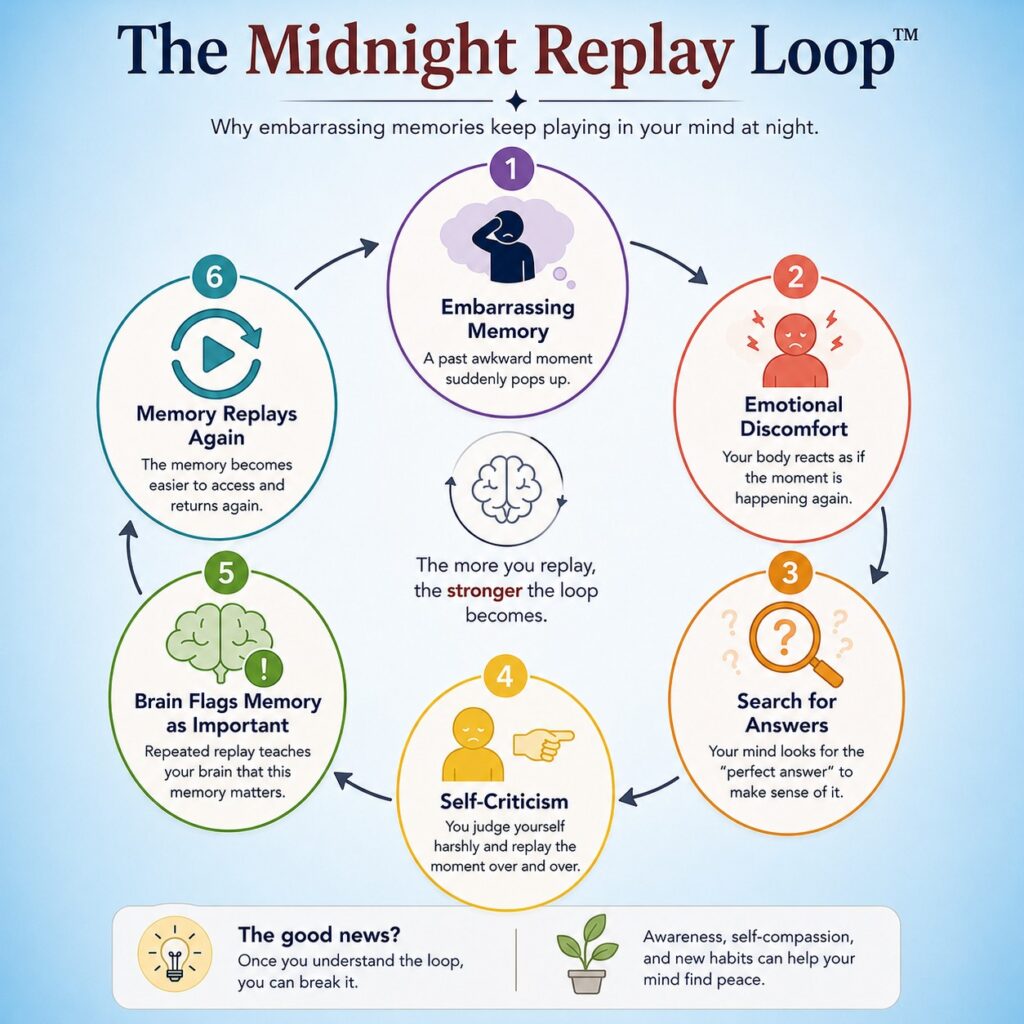
Step 1: An Embarrassing Memory Appears
It often starts without warning.
You’re lying in bed.
You’re almost asleep.
Then, out of nowhere, your mind pulls up an awkward conversation from years ago.
Not because you asked for it.
Not because you’re trying to remember it.
It simply arrives.
Most people assume the memory itself is the problem.
It isn’t. The real problem is what happens next.
Step 2: Your Brain Detects Emotional Discomfort
Within seconds, your body reacts as though the event is happening again.
Your stomach tightens, your heart beats a little faster, your face feels warm, and you cringe.
This happens because memories aren’t stored like videos in a folder.
When you vividly remember an emotionally charged experience, your brain can recreate some of the feelings associated with it.
In other words, your brain isn’t just remembering the event. It’s briefly re-experiencing it.
Step 3: Your Brain Starts Looking for the “Perfect Answer”
This is where many people become stuck.
Your brain dislikes uncertainty.
It wants a satisfying explanation.
So it begins asking questions like the following:
- Why did I say that?
- What must everyone have thought of me?
- Could I have prevented it?
- Why do I always embarrass myself?
- What if I do it again?
At first, these questions seem productive.
After all, solving problems is one of the brain’s greatest strengths.
But some experiences don’t have perfect answers.
Many embarrassing moments are simply part of being human. The more your brain searches for certainty where none exists, the more frustrated it becomes.
Step 4: Self-Criticism Enters the Conversation
This is often the turning point.
Instead of responding with curiosity, we respond with judgment.
Our inner dialogue changes.
Instead of saying
“That was an awkward moment.”
We tell ourselves:
“I’m awkward.”
Instead of thinking:
“I made a mistake.”
We conclude:
“I am the mistake.”
This shift—from evaluating an event to judging ourselves—is subtle but powerful.
Psychologists call this over-identification, where a single experience begins to define how we see ourselves.
One awkward presentation becomes the following:
“I’m terrible at public speaking.”
One rejected message becomes the following:
“Nobody likes me.”
One social mistake becomes the following:
“I’m always embarrassing.”
When that happens, the memory no longer represents something you experienced.
It starts feeling like proof of who you are.
Step 5: The Brain Mistakes Repetition for Importance
Here’s something fascinating about the human brain.
It tends to assume that whatever receives repeated attention must be important.
Imagine you check your front door lock once.
No problem.
Now imagine checking it twenty times before leaving.
Your brain begins to conclude the following:
“This door must be extremely important.”
The same principle applies to embarrassing memories.
Every replay sends an unintended message:
“Keep this memory easy to access. We seem to need it often.”
Without realizing it, repeated mental replay teaches the brain to retrieve the memory even faster the next night.
The cycle strengthens itself.
Why Some People Get Stuck in the Loop More Than Others
Not everyone experiences nighttime rumination to the same degree.
Some people can laugh off an awkward interaction before dinner.
Others replay it for months.
This difference isn’t about intelligence.
Nor is it a sign of weakness.
Instead, several factors can make the replay loop more likely.
You Care Deeply About What Others Think
Humans are social beings.
Wanting acceptance is normal.
But when your self-worth becomes closely tied to other people’s opinions, even small social mistakes can feel much larger than they really are.
Your brain begins treating every awkward moment as a potential threat to belonging.
You’re a perfectionist.
Perfectionism doesn’t always look like wanting everything to be flawless.
Sometimes it sounds like this:
“I should never have said that.”
“I should have known better.”
The problem is that human beings aren’t designed to live without mistakes.
When perfection becomes the standard, ordinary imperfections start feeling like personal failures.
You’re Emotionally Exhausted
Think back to the last time you were mentally drained.
Was it easier to stay positive?
Or did every small problem suddenly feel much bigger?
Emotional fatigue reduces our ability to keep thoughts in perspective.
That’s one reason embarrassing memories often feel louder after stressful days.
When your emotional energy is low, your mind has fewer resources to respond calmly.
You Never Truly Processed the Emotion
Many of us have learned to push uncomfortable emotions aside.
We distract ourselves.
Stay busy.
Tell ourselves to “move on.”
Sometimes that works—for a while.
But emotions that aren’t acknowledged don’t always disappear.
They often wait quietly until life slows down.
For many people, bedtime is exactly when that happens.
Introducing Emotional Fitness
This is where emotional fitness becomes so important.
Many people believe emotional strength means not feeling embarrassed.
It doesn’t.
Emotionally fit people still feel awkward.
They still make mistakes.
They still replay old memories from time to time.
The difference is what happens next.
Instead of getting trapped inside the replay, they recognize it.
They respond with awareness rather than panic.
They replace self-judgment with self-understanding.
Most importantly, they don’t mistake a passing thought for a permanent truth.
Emotional fitness isn’t about having fewer emotions.
It’s about building a healthier relationship with them.
That relationship can completely change how your brain responds when old memories resurface.
A Question Worth Asking Tonight
The next time an embarrassing memory appears before sleep, pause for just a moment.
Instead of asking:
“Why can’t I stop thinking about this?”
Try asking:
“What is my mind trying to protect me from?”
That small shift changes the conversation.
One question invites frustration.
The other invites understanding.
And sometimes, understanding is the first step toward letting go.
How to Stop the Midnight Replay — The Night Reset Method™
By now, you know something important:
Your brain isn’t replaying embarrassing memories because it enjoys making you suffer.
It’s replaying them because, somewhere deep inside, it believes those memories still need your attention.
Here’s the problem.
Most people respond by fighting their thoughts.
They try to force themselves not to think about the memory.
Ironically, that often makes it stronger.
Have you ever noticed that the harder you try not to think about something, the more persistent it becomes?
That’s because your brain has to keep checking whether you’re still thinking about it—which means it keeps bringing the embarrassing memories back.
Instead of fighting the replay, a more helpful approach is to change your relationship with it. That’s where the Night Reset Method™ comes in.
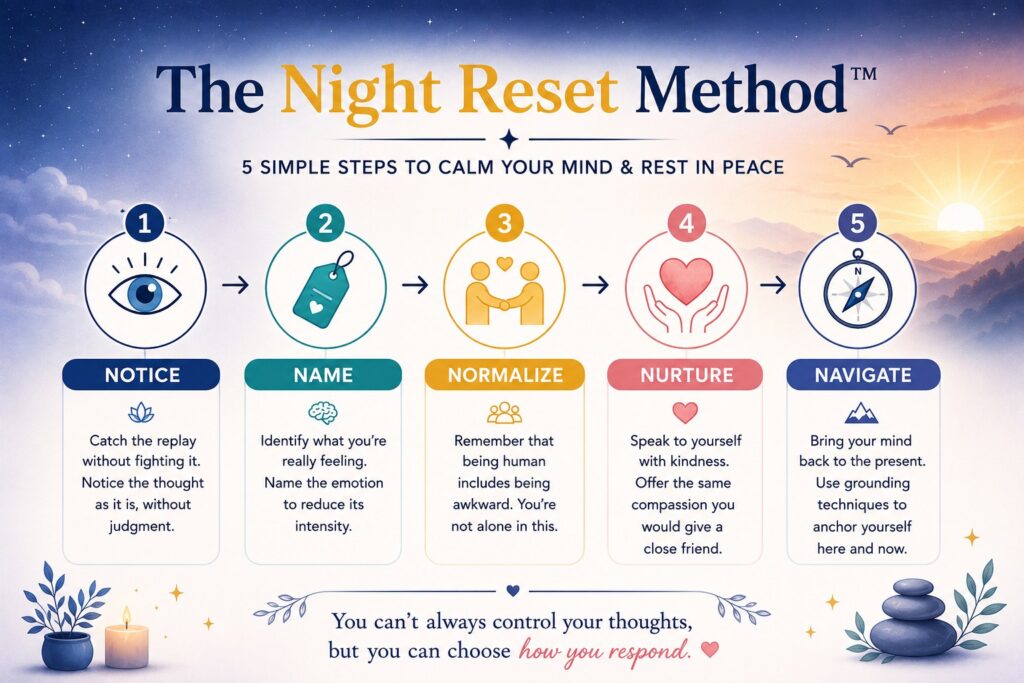
Step 1: Notice — Catch the Replay Without Fighting It
The first step isn’t to stop the thought.
It’s simply to notice it.
You might quietly say to yourself:
“I’m replaying that meeting again.”
or
“My mind has returned to that awkward conversation.”
This may seem too simple to matter, but it changes something important.
You’re no longer inside the thought.
You’re observing it.
That small shift creates psychological distance.
Instead of becoming the story, you become the person watching it unfold.
Awareness is often the beginning of emotional freedom.
Step 2: Name — Identify What You’re Really Feeling
Many people assume they’re only feeling embarrassment.
In reality, embarrassment is often covering something deeper.
Ask yourself:
- Am I feeling shame?
- Do I feel afraid of being judged?
- Am I disappointed in myself?
- Am I grieving an opportunity? I wish it had gone differently.
- Am I worried people won’t accept me?
Research in psychology suggests that putting emotions into words—a process sometimes called affect labeling—can reduce their emotional intensity.
When emotions remain vague, they tend to feel overwhelming.
When they’re named, they become easier to understand.
Sometimes the sentence that changes everything is simply, “I’m not just embarrassed. I’m afraid of being misunderstood.”
Step 3: Normalize — Remember That Being Human Includes Being Awkward
This may be the hardest step.
Not because it’s complicated.
Because we often believe our mistakes are unique.
They aren’t.
Think about the last time someone else stumbled over their words.
Forgot someone’s name.
Sent an accidental message.
Spilled coffee during a meeting.
Chances are, you didn’t spend weeks thinking about it.
In fact, you probably forgot within minutes.
This highlights something psychologists call the spotlight effect—our tendency to overestimate how much other people notice and remember our mistakes.
Most people are far more focused on their own lives than on your awkward moment.
The memory feels enormous because you’re seeing it from the inside. Everyone else saw only a brief moment in a much larger day.
Step 4: Nurture — Speak to Yourself the Way You Would Speak to Someone You Love
Imagine your closest friend came to you and said the following:
“I accidentally said something embarrassing during today’s meeting.”
Would you respond with:
“You’re hopeless.”
“You’ll never live this down.”
“Everyone probably thinks you’re ridiculous.”
Probably not.
You’d likely say something like
“That happens to everyone.”
“I know it feels awful now, but this won’t define you.”
“Be kind to yourself.”
Yet many of us reserve our harshest words for ourselves.
Self-compassion isn’t making excuses.
It’s choosing encouragement over condemnation.
Research consistently suggests that people who practice self-compassion are often more resilient after setbacks than those who rely on harsh self-criticism.
Being kind to yourself doesn’t lower your standards.
It helps you recover more effectively.
Step 5: Navigate — Bring Your Mind Back to the Present
The goal isn’t to erase the memory.
It’s to gently remind your brain that the event is over.
One simple grounding exercise is the 5-4-3-2-1 technique:
- 5 – things you can see.
- 4 – things you can touch.
- 3 – sounds you can hear.
- 2 – things you can smell.
- 1 – thing you can taste or appreciate in the moment.
This practice anchors your attention in the present instead of the past.
Your brain learns an important lesson:
“I can remember something without getting trapped inside it.”
Three Habits That Quiet the Mind Before Sleep
The Night Reset Method™ works best when supported by healthy evening habits.
1. Give Your Thoughts a Place to Land
If your mind feels crowded, spend five minutes writing down whatever is circling in your head.
Don’t worry about grammar or structure.
You’re not writing for anyone else.
You’re simply telling your brain:
“These thoughts have been acknowledged. I don’t need to keep carrying them tonight.”
2. Reduce Mental Stimulation Before Bed
Your brain doesn’t switch from high alert to deep rest instantly.
If you’ve spent the last hour reading emotionally charged news, arguing online, or endlessly scrolling through social media, your mind is likely to remain activated.
Creating even a short “wind-down” routine—reading a book, stretching, or listening to calming music—can help signal that the day is ending.
3. Build Emotional Fitness During the Day
Nighttime peace often begins long before bedtime.
People who regularly process their emotions during the day are less likely to carry unresolved emotional weight into the night.
That doesn’t mean talking about every feeling.
It means making space to notice, understand, and respond to your emotions instead of pushing them aside.
Emotional fitness isn’t a nighttime skill.
It’s a daily practice that makes nighttime gentler.
A Truth Most People Need to Hear
If you keep replaying an embarrassing memory, it doesn’t mean you’re weak.
It doesn’t mean you’re broken.
And it certainly doesn’t mean you’ll always feel this way.
It means you have a deeply human brain trying to protect you with an outdated strategy.
Your mind believes that replaying the past will prevent future pain.
But healing rarely comes from endless replay.
It comes from understanding, acceptance, and choosing a different response.
The goal isn’t to become someone who never feels embarrassed.
The goal is to become someone who no longer lets embarrassment write the story of who they are.
Emotional Fitness Reflection
Before you close your eyes tonight, ask yourself one gentle question:
“If someone I love had this exact memory, how would I comfort them?”
Now offer yourself that same compassion. You deserve it just as much.
Finding Peace with the Past
Imagine meeting your younger self.
The version of you who stumbled over those words.
The one who made the awkward joke.
The one who wished the ground would open up and swallow them.
Would you laugh at them?
Would you call them a failure?
Or would you tell them they’ll never recover from that one embarrassing moment?
Probably not.
You’d probably smile and say,
“One day, you’ll realize that almost nobody remembers this except you.”
And you’d be right.
One of the quiet truths about being human is that we’re often far kinder to others than we are to ourselves.
We forgive our friends, we understand their mistakes, and we remind them that they’re only human.
Yet when it’s our turn, we become our own harshest critic.
Perhaps it’s time to offer yourself the same understanding you’ve been giving everyone else.
Because you are not the worst moment of your life.
You are not one awkward conversation, not one failed presentation, and not even one embarrassing memory that keeps visiting after midnight. You are a person who is still learning, still growing, still becoming.
And that’s something worth being proud of.
Remember This the Next Time Your Mind Rewinds
When an embarrassing memory appears tonight, try not to see it as an enemy.
Instead, see it as a messenger.
Not every messenger carries a message you need to believe.
Sometimes it’s simply your brain saying,
“I’m trying to protect you.”
And you can gently respond,
“Thank you. But I don’t need protection from a memory anymore.”
That isn’t denial.
It’s emotional maturity.
It’s what emotional fitness looks like in everyday life.
The Takeaway
Your brain doesn’t replay embarrassing memories because you’re broken.
It replays them because it believes those memories still matter.
The more we respond with fear and self-criticism, the more important those memories become.
But when we respond with awareness, self-compassion, and perspective, we teach the brain a new lesson:
“I’ve learned from this. I don’t need to relive it.”
That lesson won’t erase the memory.
But it can soften its grip.
And sometimes, that’s all we need to finally sleep in peace.
Frequently Asked Questions
Why do embarrassing memories suddenly come back at night?
During the day, your attention is occupied by work, conversations, and daily responsibilities. At night, as distractions decrease, your mind has more space to process unresolved thoughts and emotions. If a memory still feels emotionally significant, it may naturally come back into awareness.
Is replaying embarrassing memories a sign of anxiety?
Not necessarily.
Occasionally replaying awkward experiences is a normal part of being human. However, if these thoughts become frequent, distressing, difficult to control, or begin interfering with your sleep, relationships, or daily life, they may be associated with anxiety, chronic stress, or persistent rumination. If they’re causing significant distress, consider speaking with a qualified mental health professional.
Why can’t I stop thinking about something that happened years ago?
The brain doesn’t organize memories only by age.
It also prioritizes emotional significance.
If an experience still feels unresolved or emotionally charged, your brain may continue revisiting it—even years later.
Do other people remember my embarrassing moments?
Usually far less than you imagine.
Psychologists describe a phenomenon called the spotlight effect, where we overestimate how much other people notice and remember our mistakes.
Most people are busy thinking about their own lives.
Can I train my brain to stop replaying embarrassing memories?
Yes.
While you can’t prevent every unwanted thought, you can change how you respond to those thoughts.
Practices such as mindfulness, self-compassion, emotional awareness, journaling, and grounding exercises can gradually reduce the intensity and frequency of rumination over time.
Your Emotional Fitness Challenge
Tonight, before you sleep, try this simple exercise.
When an embarrassing memory appears, don’t argue with it.
Instead, complete this sentence:
“That happened, but it doesn’t define who I am because…”
Write whatever comes naturally.
Perhaps it’s
- “…I’ve grown since then.”
- “…everyone makes mistakes.”
- “…one moment doesn’t decide my future.”
- “…I deserve the same kindness I offer others.”
Small changes in self-talk can become powerful changes in emotional well-being over time.
Final Thought
If this article helped you understand why your brain replays embarrassing memories at night, remember this:
The goal isn’t to have a perfect mind.
The goal is to build a kinder relationship with it.
Because peace doesn’t come from never making mistakes.
It comes from knowing that your mistakes no longer get the final word.
Continue Your Emotional Fitness Journey
If you enjoyed this article, you may also find these helpful:
- The Hidden Psychology of Overthinking: Why Your Mind Won’t Let Go (And How to Finally Find Peace) — Learn why overthinking feels impossible to stop and how to interrupt the cycle.
- Emotional Fitness vs. Emotional Suppression: Why Learning to Feel Is the Most Powerful Skill You Will Ever Learn — Discover why processing emotions is healthier than pushing them away.
These articles build on the same principles and provide practical tools for developing lasting emotional resilience.
Key Takeaways
✔ Embarrassing memories often return at night because your brain is processing emotionally significant experiences in a quieter environment.
✔ Rumination is different from reflection. Reflection helps you learn, while rumination keeps you emotionally stuck.
✔ The Midnight Replay Loop™ explains why self-criticism strengthens recurring memories instead of resolving them.
✔ The Night Reset Method™—Notice, Name, Normalize, Nurture, Navigate—offers a practical way to interrupt the cycle.
✔ Emotional fitness isn’t about avoiding uncomfortable emotions. It’s about responding to them with awareness, perspective, and self-compassion.
Note: “This article is intended for educational purposes and is not a substitute for professional mental health care. If persistent overthinking is causing significant distress or interfering with your daily life, consider speaking with a qualified mental health professional.“
2 thoughts on “Why Your Brain Replays Embarrassing Memories at Night (And How to Finally Find Peace)”