

You have finished work for the day. You have left the office or closed your laptop. Perhaps you are having dinner with your family, watching a film or finally sitting down after a long day.
But your mind is somewhere else.
You keep thinking about a conversation with your senior. You wonder whether your email sounded rude. You remember an unfinished task, then begin worrying about tomorrow’s workload. Even when nothing requires your immediate attention, your thoughts keep returning to work.
You tell yourself, “I’ll deal with this tomorrow.” A few minutes later, the same concerns return.
If this sounds familiar, you may have experienced the frustrating difference between finishing work physically and leaving it behind mentally.
Table of Contents
Over time, this can make your evenings feel less restful. You may become irritable over small things, struggle to enjoy time with people you care about or lie awake mentally preparing for the next working day.
You might even wonder why you cannot relax when other people seem to manage it.
Before blaming yourself, it helps to understand what may be happening. The difficulty is not necessarily that you think too much. It may involve unfinished responsibilities, uncertainty, repetitive thinking or working conditions that leave little opportunity for recovery.
What Is Psychological Detachment from Work?
Psychologists use the term psychological detachment from work to describe the experience of mentally disengaging from work during non-work time.
It does not mean forgetting your responsibilities, losing interest in your career or never thinking about your job after office hours. It means being able to spend time away from work without remaining mentally occupied by its demands.
In a 2007 study, occupational psychologists Sabine Sonnentag and Charlotte Fritz developed the Recovery Experience Questionnaire, which distinguishes four experiences associated with recovery: psychological detachment, relaxation, mastery and control. Their research helped establish a framework for understanding how people recover from work-related demands.
You can read their original research on the Recovery Experience Questionnaire.
Consider two employees who leave work with an unfinished report. The first employee writes down what remains to be done, identifies the next step and returns to their evening. They may remember the report later, but they do not feel compelled to keep reviewing it.
The second employee keeps wondering whether the report will disappoint their manager. They replay a conversation, imagine possible criticism and mentally rehearse how they will defend their decisions. Both employees care about their work. Both remember the unfinished task. But their responses differ.
Switching off does not require you to eliminate work-related thoughts. It means learning to respond to them without allowing them to occupy all your available attention.

Why Can’t I Switch Off After Work? 5 Psychological Reasons
There is rarely one explanation for difficulty switching off. Several psychological processes and workplace conditions may contribute, sometimes at the same time.
1. Unfinished Tasks Keep Your Mind at Work
Imagine that you have submitted an important report but are waiting for approval. You have checked the figures and completed everything required of you. The next step depends on your manager. Yet you keep wondering whether the report will be accepted, whether changes will be requested or whether you overlooked something.
When an outcome matters but remains uncertain, it is natural to think about what might happen. Sometimes this helps you prepare. At other times, you repeatedly imagine possibilities without gaining any useful information.
Unfinished responsibilities can also remain mentally important, particularly when they involve deadlines or depend on information you do not yet have. The problem is not that you remember your work. It is that you may keep trying to resolve something mentally when no further action is possible at that moment.
A useful question is, “Is there a practical step I can take now, or am I trying to obtain certainty that is not yet available?”
If an action is possible, identify it. If you have already done what you reasonably can, write down what needs to happen next and allow the matter to wait until the appropriate time.
2. Work-related Rumination Keeps You Emotionally Involved
One of the most important distinctions in understanding why you cannot switch off is the difference between useful reflection and repetitive rumination.
Suppose a colleague questions your recommendation during a meeting. Later, you consider what happened and realise that you could have explained your reasoning more clearly. You make a note to prepare your points before the next meeting.
This is purposeful reflection. It helps you learn and decide what to do differently.
Now imagine that you spend the entire evening replaying the same conversation. You feel embarrassed again, wonder what everyone thought of you and begin questioning your professional abilities.
You are no longer discovering much that is new. You are repeatedly revisiting the experience and its associated emotions.
Researchers distinguish forms of work-related thinking, including problem-solving, pondering and affective rumination. The former may help you work through a problem; the latter involves repetitive thinking accompanied by negative emotions.
These patterns are not identical, and not every work-related thought is harmful. The important question is whether your thinking is helping you understand or address something or repeatedly pulling you back into the same distress.
When you notice yourself replaying an event, ask:
“Am I finding a useful next step, or am I experiencing the same uncomfortable moment again?”
If you have identified what needs to be done, you may not need to keep reviewing the situation that evening.
3. Perfectionism Can Make Work Feel Never Truly Finished
Some people struggle to switch off because their internal standards leave little room for feeling satisfied.
You may complete a task accurately and on time but keep focusing on one small imperfection. You may receive positive feedback yet remember a single critical comment. Even when a project is finished, your mind immediately begins searching for what could have been better.
Wanting to do good work is not a problem in itself. Attention to detail, preparation and professional responsibility are valuable qualities. The difficulty arises when you expect yourself to avoid every mistake or interpret an imperfect result as evidence that you are not capable enough.
Try defining what finished means before you begin a task. For example, a report may be ready when the required sections are complete, the figures have been checked and the document has been reviewed. You can still correct genuine errors and improve your work. But you do not have to mentally review every completed task indefinitely to prove that you care.
4. Digital Connectivity Blurs the Boundary Between Work And Home
You return home, sit down for dinner and receive a message from a colleague about tomorrow’s work. You read it, respond and notice another notification. Even if each message takes only a minute, your attention keeps returning to work. Eventually, you put your phone away but continue thinking about the conversation.
Work-related messages can interrupt personal time and create an expectation that you should remain available. When you are uncertain about whether a message requires an immediate response, it may be difficult to disengage.
A systematic review by Agolli and Holtz examined 159 empirical studies on factors that facilitate or hinder psychological detachment. It considered job demands, communication technology and the boundaries between professional and private life.
The review is available here: Facilitating Detachment from Work: A Systematic Review.
Where your role permits, clearer communication boundaries may help. You might mute non-urgent notifications after work, check messages at agreed times or clarify which situations genuinely require an immediate response.
Some jobs involve on-call duties or operational responsibilities outside standard working hours. In those circumstances, predictable availability and protected periods of recovery may be more realistic than complete disconnection.
5. Sometimes, The Problem Is Excessive Workload—Not Your Thinking
There is another possibility worth considering.
You may have more work than you can reasonably complete during working hours. Deadlines may change without warning, responsibilities may be unclear, or you may be expected to remain available late into the evening.
In such circumstances, your concerns may reflect genuine problems rather than an unhelpful habit of overthinking.
The World Health Organization identifies excessive workloads, long or inflexible hours, limited control over work and unclear roles among the psychosocial risks that can affect mental health at work.
Its guidelines on mental health at work recommend a broad approach that includes organisational measures as well as individual support.
This distinction matters. If your working conditions leave important tasks unresolved every day, telling yourself to relax will not necessarily solve the underlying problem. You may need to clarify priorities, discuss realistic deadlines, request support or address recurring workplace difficulties through appropriate channels.
Individual coping strategies can be useful, but they cannot replace necessary changes to an unhealthy working environment.
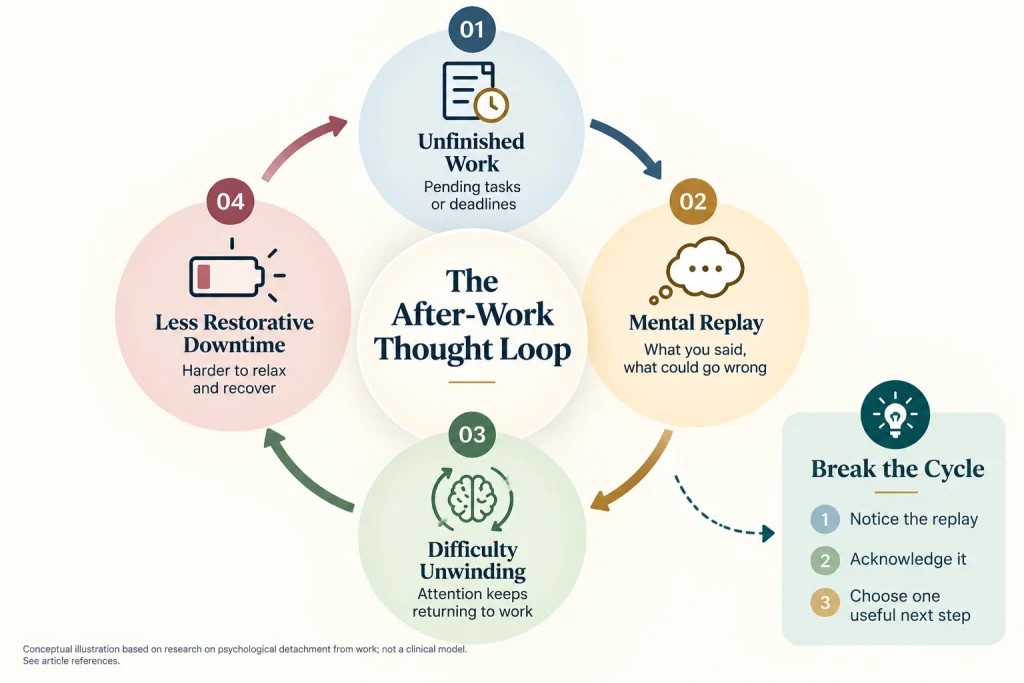
How Can Difficulty Switching Off Affect Your Wellbeing?
Occasionally thinking about work after office hours is common. The concern is a persistent pattern in which work-related thinking remains distressing, difficult to manage or disruptive to everyday life.
Mental exhaustion: You may finish a demanding day feeling depleted, then find it difficult to recover because your attention remains occupied by work. Psychological detachment is associated with better recovery and wellbeing, although the relationship varies across people and circumstances.
Sleep difficulties: You may lie awake reviewing unfinished tasks, anticipating tomorrow’s challenges or replaying a difficult conversation. Work-related rumination can be one contributor to sleep difficulties, but it is not the only possible cause.
Irritability: After a demanding day, you may have less patience for small inconveniences. You might respond sharply to a family member and regret it later. Recognising this pattern can help you pause before reacting.
Reduced attention to relationships: You may be physically present with your family but mentally occupied by an unresolved concern. This can create misunderstandings when other people interpret your distraction as a lack of interest.
Growing dissatisfaction with work: If you repeatedly feel exhausted and unable to recover, you may begin to dread the next working day. Persistent exhaustion, growing cynicism towards work and a reduced sense of professional effectiveness can be signs worth taking seriously.
The World Health Organization describes burnout in ICD-11 as an occupational phenomenon resulting from chronic workplace stress that has not been successfully managed. Its three dimensions are exhaustion, increased mental distance or cynicism towards one’s job, and reduced professional efficacy.
However, difficulty switching off alone does not mean you have burnout. Persistent distress can have several causes, and the overall pattern matters more than any single symptom.
How to Mentally Switch Off After Work: 5 Practical Strategies
You do not need to eliminate every work-related thought to begin recovering more effectively. Start with a few realistic changes and notice what helps.
1. Create A Clear Ending To Your Working Day
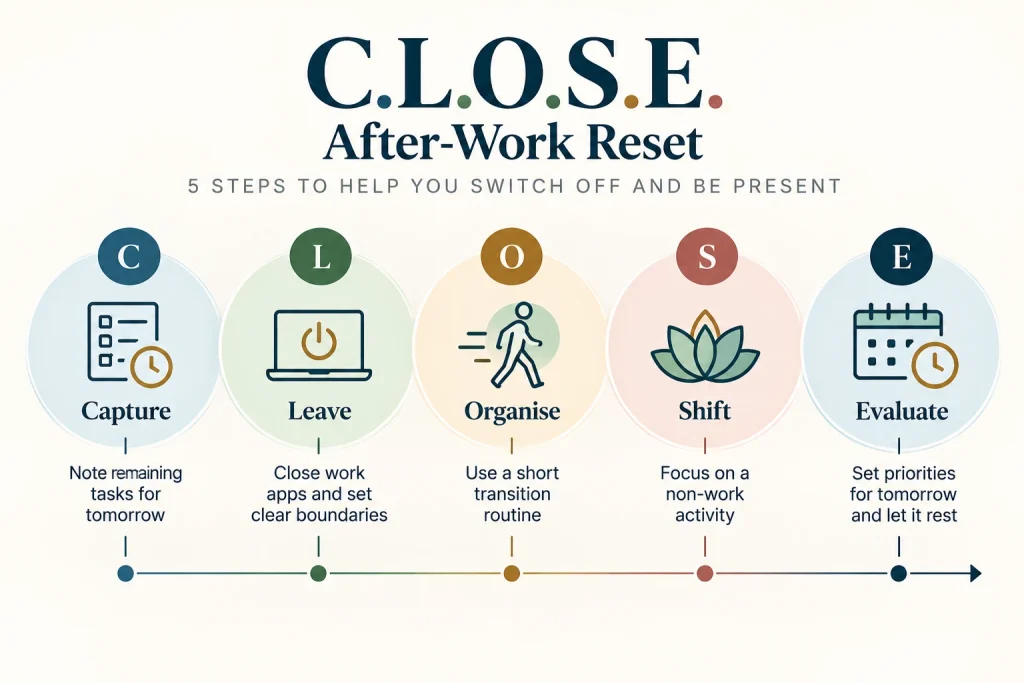
Before leaving the office or closing your laptop, spend five minutes reviewing what you have completed and what remains unfinished.
Write down the next action for important pending tasks. If something depends on another person’s response, record that too.
For example, instead of repeatedly thinking about a report that requires information from another department, write: “Follow up tomorrow morning and complete the report when the information arrives.”
You have not solved the entire problem, but you have clarified what happens next. This is a practical planning strategy, not a guarantee that every intrusive thought will disappear.
2. Separate Problem-solving From Repetitive Thinking
When a work-related thought returns, ask yourself:
- What exactly is bothering me?
- Is there a useful action I can take now?
- If not, when would it be appropriate to revisit this?
If action is needed, identify the next step. If you have already done what you reasonably can, acknowledge the concern and gently return to your evening. You may need to repeat this process. That does not mean you have failed.
A 2021 meta-analysis examined 30 studies involving 3,725 participants and found that interventions designed to improve psychological detachment had a positive average effect. The findings support the value of practical interventions, while recognising that results depend on the intervention and the circumstances.
Read the meta-analysis on interventions for psychological detachment.
3. Build A Transition Between Work And Home
If you move directly from a demanding working day into household responsibilities, you may carry the emotional tone of work into your evening.
Choose one simple activity that marks the transition. It could be a short walk, changing your clothes, listening to music or spending a few minutes away from work notifications. The activity does not need to make you feel completely relaxed. Its purpose is to give you an opportunity to redirect your attention towards personal life.
If you have been struggling with relaxation more generally, you may also find our article helpful: Why Can’t I Relax Even When Nothing Is Wrong?.
4. Practise Returning Your Attention To The Present
Suppose you are watching a film or talking to your family when an unfinished task comes to mind. Instead of arguing with yourself—“I must stop thinking about work”—try acknowledging the thought:
“I am remembering that task. I know what I need to do next, and I can return to it tomorrow.”
Then gently bring your attention back to what you were doing. The thought may return. You can acknowledge it again without treating it as an urgent problem that must be solved immediately.
A 2024 randomised controlled trial involving 393 participants found that both mindfulness-based and cognitive-behavioural interventions improved psychological detachment from work. This is encouraging evidence, although it does not mean that either approach will work equally well for everyone.
Read the 2024 study on mindfulness, cognitive-behavioural strategies and psychological detachment.
5. Protect Time For Life Outside Work
If you postpone every enjoyable activity until all your responsibilities are complete, you may rarely give yourself permission to recover. Work often leaves something unfinished. That does not mean personal life must always wait.
Make room for activities that matter to you, whether that means reading, walking, cooking, spending time with family or pursuing a hobby. You do not need to turn your evening into another productivity programme. An activity can be worthwhile simply because you enjoy it.
At the same time, examine whether the problem lies partly in your working conditions. If excessive demands or unclear expectations continue to prevent recovery, consider what workplace support or changes may be possible.
When Should You Seek Support for Persistent Work Stress?
A difficult working week does not automatically indicate a mental-health problem. However, persistent distress deserves attention, particularly when it affects your sleep, relationships or ability to manage everyday responsibilities.
Consider speaking with a qualified mental-health professional or healthcare provider if you regularly feel overwhelmed, struggle to sleep, lose interest in activities you previously enjoyed or find it increasingly difficult to function comfortably.
You do not need to wait until you feel completely exhausted before seeking help.
It is also important to examine your working environment. If excessive workload, bullying, unclear responsibilities or constant availability are contributing to your distress, individual coping techniques may not be enough. Appropriate organisational changes and support may be necessary.
The aim is not to become exceptionally good at coping with a situation that needs to change.
Frequently Asked Questions
Why can’t I stop thinking about work after I get home?
You may be preoccupied with unfinished tasks, uncertainty, difficult interactions or expectations about your performance. Work-related rumination and ongoing workplace demands can make psychological detachment difficult. Identifying what keeps your thoughts active can help you choose a more appropriate response.
Is it normal to think about work after office hours?
Yes. Occasional work-related thoughts are common, particularly during busy periods or before important deadlines. The concern is when thinking becomes repetitive, distressing or disruptive to sleep, relationships and other aspects of everyday life.
How can I stop overthinking about work at night?
Try writing down unfinished tasks and their next steps before ending your working day. If a concern returns, distinguish between something you can act on and something that must wait. A calming bedtime routine and reduced exposure to work notifications may also help. Persistent sleep difficulties deserve professional attention.
Does thinking about work after hours mean I have burnout?
No. Thinking about work after hours is not sufficient to identify burnout. The WHO describes burnout in relation to chronic workplace stress and specific dimensions including exhaustion, increased mental distance or cynicism towards work, and reduced professional efficacy. Persistent difficulties should be considered in context rather than self-diagnosed from one symptom.
Can mindfulness help me switch off after work?
Mindfulness may help you notice work-related thoughts without automatically following them. A 2024 randomised controlled trial found that both mindfulness-based and cognitive-behavioural interventions improved psychological detachment. Individual responses vary, and these approaches cannot replace necessary changes to excessive workloads or unhealthy working conditions.
A Final Thought
Learning to switch off after work does not mean caring less about your responsibilities. It means recognising when work-related thinking is useful, when it has become repetitive and when your working conditions are making recovery difficult.
You can take your work seriously without allowing every unfinished task to occupy your personal time. You can learn from mistakes without repeatedly punishing yourself for them. You can care about your career while making room for relationships, interests and experiences that matter beyond your professional life.
Some evenings will still be difficult. There will be deadlines, uncertain outcomes and problems that deserve further thought. The goal is not to control every thought or achieve perfect relaxation.
It is to build a more sustainable relationship with work—one in which your responsibilities matter, but your wellbeing matters too.
Your working day may end at a particular time. Your life, however, deserves your attention long after that.
Note: This article is intended for psychology education and general wellbeing awareness. It does not provide an individual diagnosis or replace professional assessment, counselling or medical care.