

Have you ever walked into a room and suddenly become very aware of yourself?
You notice how you are walking. You wonder whether your clothes look right. You become conscious of your face, your voice, or even the way you are sitting. Perhaps you make a small mistake while speaking. Someone looks in your direction, and your mind immediately starts asking:
Did everyone notice that?
Do they think I look awkward?
Are they judging me?
Nothing particularly significant may have happened. Yet, inside your mind, the moment feels much bigger than it probably appears to someone else. You might even think about it hours later. You replay what you said, remember someone’s expression and wonder what they must have thought about you.
This experience is more common than you may realise. Sometimes, the feeling that everyone is watching you has less to do with how much attention other people are paying and more to do with how closely you are watching yourself.
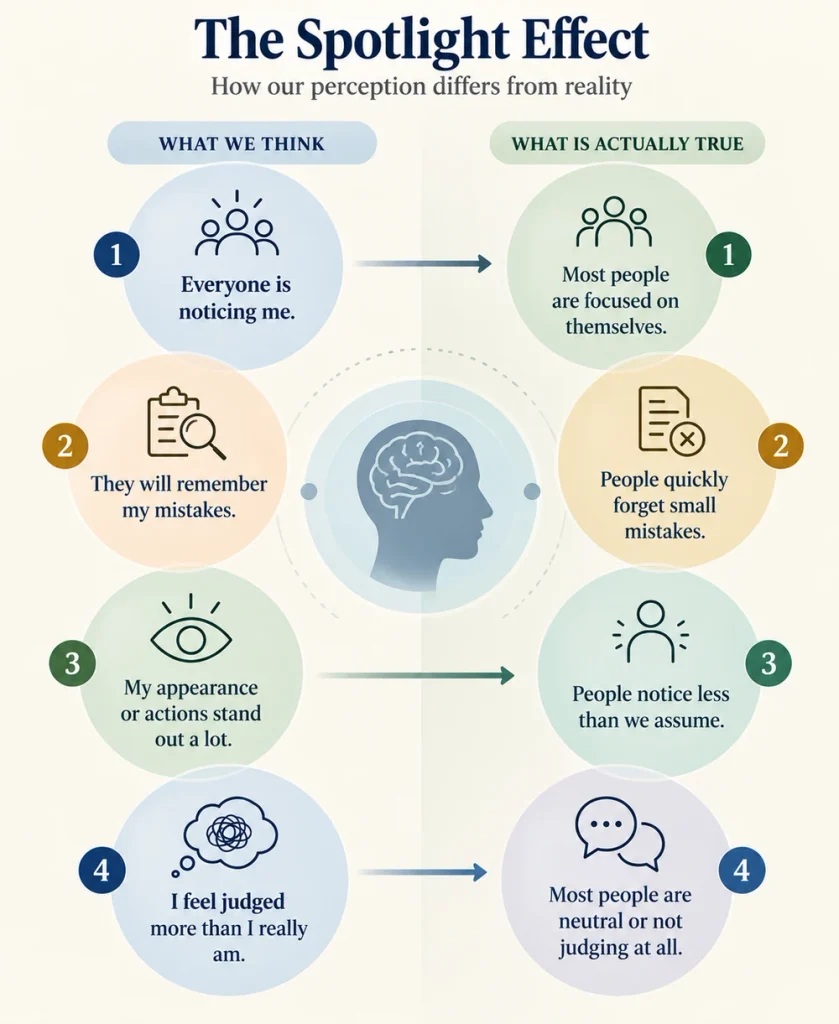
Psychologists call one part of this experience the spotlight effect. It describes our tendency to overestimate how much other people notice our appearance, actions and mistakes. Understanding this can be surprisingly freeing.
Table of Contents
The goal is not to convince yourself that nobody notices you. People sometimes do. The goal is to recognise that feeling intensely visible does not necessarily mean you are receiving that much attention.
And once you understand the difference, you may find it easier to participate in conversations, make mistakes without dwelling on them and spend less time worrying about how you appear to everyone else.
What Is the Spotlight Effect in Psychology?
Imagine arriving at work and discovering a small stain on your shirt. You notice it immediately. For the rest of the morning, you feel uncomfortable. You wonder whether your colleagues have noticed it too.
You may even assume that someone who looks in your direction is looking at the stain. But there is a good chance that most people have barely noticed it, if at all.
This is a simple example of the spotlight effect.
The concept became well known through research by psychologists Thomas Gilovich, Victoria Medvec and Kenneth Savitsky, published in 2000. In their experiments, participants tended to overestimate how many other people noticed aspects of their appearance and contributions during group interactions.
One explanation is that we experience our own behaviour from the inside. We know what we are wearing, what we intended to say, where we stumbled and how embarrassed we feel. Other people do not have access to all that information.
We may therefore use our own intense awareness as a guide to how noticeable we must be to others. But these are two different things.
Consider a presentation. You forget a sentence, pause for a moment and feel your face becoming warm. Inside your mind, the mistake may seem enormous. You might think, “Everyone must think I don’t know what I’m talking about.”
Someone listening may simply think that you lost your place for a moment and then continue following the presentation.
The mistake happened. Your embarrassment is real. But the attention other people gave the mistake may have been much smaller than you imagined. This does not mean people never notice our behaviour. It means we can overestimate how much attention they give it.
Your attention to yourself is not a measurement of other people’s attention to you.
Why Does It Feel Like Everyone Is Watching Me?
Knowing about the spotlight effect is helpful, but it leaves an important question: why does the feeling become so strong?
One reason is self-focused attention.
When you become self-conscious, your attention may shift away from what is happening around you and towards your own thoughts, appearance, feelings and behaviour.
Imagine that you are speaking in a meeting. At first, you are focused on explaining your point. Then you notice that your voice sounds slightly shaky. Your thoughts begin to change:
Can they hear that?
Do I look nervous?
What if they think I am not confident enough?
Now, part of your attention is on the conversation, while another part is monitoring how you appear during it.
Research on social anxiety has examined how excessive self-focused attention can increase awareness of negative thoughts and feelings. It may also make it harder to notice information from the environment that could challenge our fears.
For example, you might focus on your shaky voice while overlooking the fact that people are listening attentively and responding to what you are saying. The more you monitor yourself, the more things you may find to monitor.
A normal pause becomes evidence that you are awkward. A brief glance becomes evidence that someone is judging you. An ordinary conversation becomes an opportunity to evaluate your performance. Gradually, the situation can feel more threatening than it actually is.
The more intensely you notice yourself, the more noticeable you may feel to yourself. That does not mean everyone else is noticing you with the same intensity.
When Self-Awareness Turns Into Self-Monitoring
Being aware of yourself is not a problem.
Self-awareness helps you understand your emotions, recognise your behaviour and make adjustments when necessary. It allows you to reflect on your actions without automatically blaming yourself.
The difficulty begins when awareness turns into constant checking. You are no longer simply noticing yourself. You are evaluating yourself almost continuously.
Imagine meeting someone for the first time. You begin a conversation but soon become conscious of your facial expression, your posture and the way you speak. You wonder whether you are talking too much or whether your response sounded unintelligent. You start thinking about where to keep your hands instead of listening to what the other person is saying.
The conversation becomes exhausting because you are trying to participate and supervise your own performance at the same time. Sometimes, this monitoring continues long after the interaction ends. On your way home, you replay the conversation.
Why did I say that?
Did I make things awkward?
Why did she become quiet?
You may start reconstructing what the other person was thinking, even though you cannot know their thoughts with certainty. This is where self-consciousness can feed into overthinking. Possibilities begin to feel like facts, and ordinary social moments become problems that need to be solved.
If this pattern sounds familiar, our article on the hidden psychology of overthinking explores why the mind can become caught in repetitive thinking. The goal is not to stop being aware of yourself. It is to develop the ability to notice yourself without constantly judging yourself.

Why Does a Small Mistake Feel So Big?
Have you ever said something slightly awkward and thought about it for the rest of the day?
Perhaps you pronounced a word incorrectly, forgot someone’s name or stumbled while speaking. Maybe you sent a message with a small mistake and noticed it only after pressing send. To you, the moment may feel painfully obvious. You might think, “How could I have said that?” or “Everyone must think I am stupid.”
But there can be a considerable gap between how large a moment feels to you and how important it appears to someone else.
When you make a mistake, you know what you intended to say. You remember the pause before you corrected yourself. You felt the embarrassment in your body. Another person may have witnessed only a few seconds of the event before moving on to something else.
Embarrassment can keep the spotlight on, however. You replay the incident, examine someone’s reaction and imagine what they might have thought. Each time you revisit the memory, it can feel important all over again.
This is one reason a brief social mistake can occupy your mind long after the situation has ended. If you find yourself repeatedly revisiting uncomfortable moments, you may also find Why Your Brain Replays Embarrassing Memories helpful.
Try asking yourself two questions:
- What did the other person actually notice?
- What am I assuming they thought about it?
You may realise that you know what you felt, but you do not know exactly what was happening in someone else’s mind.
Being noticed is not the same as being judged. And being judged is not the same as being rejected.
A small mistake can be uncomfortable without defining who you are. You can stumble over a sentence and still be intelligent. You can feel nervous and still communicate well. You can say something awkward and still deserve connection.
Why Do I Feel Like Everyone Is Judging Me?
Sometimes the fear is not simply that people will notice you. It is that they will notice something and form a negative opinion.
Psychologists refer to this concern as fear of negative evaluation.
You might worry that people will see you as incompetent, unattractive, boring or strange. When this fear is strong, even an ordinary social cue can seem threatening.
Someone looks at you, and you wonder whether they disapprove. A colleague gives a brief response, and you assume you have irritated them. A friend becomes quiet, and you start questioning whether you have done something wrong.
The difficulty is that social cues are not always easy to interpret. A person may be quiet because they are tired. Someone may look away because they are distracted. A short message may reflect nothing more than a busy day. Yet, when you are worried about being judged, your mind may favour the explanation you fear most.
Consider the difference between these statements:
Fact: “My colleague did not respond when I greeted them.”
Interpretation: “My colleague is upset with me.”
Further assumption: “They must dislike me, and everyone else probably thinks the same.”
The first statement describes what happened. The others add explanations that may or may not be accurate.
This does not mean your interpretation is always wrong. Sometimes people are upset, and sometimes criticism is genuine. The point is to avoid treating uncertainty as proof.
When you feel judged, pause before reaching a conclusion. Ask yourself what you know, what you are assuming and whether another explanation is possible. You do not have to force yourself to think positively. You only need to leave room for more than one explanation.
Is Feeling Like Everyone Is Watching You Social Anxiety?
Not necessarily.
Feeling self-conscious from time to time is a normal human experience. You may feel nervous before a presentation, uncomfortable around unfamiliar people or embarrassed after making a mistake. These experiences alone do not mean you have social anxiety disorder.
Social anxiety disorder involves persistent and significant fear or anxiety in situations where a person may be scrutinised, evaluated or judged by others. It can lead to intense distress, avoidance and difficulties in everyday life.
According to the National Institute of Mental Health’s guidance on social anxiety disorder, the fear and anxiety must persist for at least six months and interfere with areas of life such as work, education or relationships for a diagnosis to be made.
For example, ordinary self-consciousness might mean feeling nervous before speaking at a meeting but still being able to participate. A more concerning pattern might involve repeatedly avoiding meetings, turning down opportunities or experiencing such intense fear of judgment that everyday activities become difficult.
The difference is not simply whether you feel nervous. It is the intensity, persistence and impact of that fear. An article cannot determine whether you have a mental-health condition. If the fear of being watched or judged is persistent, distressing or limiting your life, consider speaking with a qualified mental-health professional.
Social anxiety disorder is treatable. Cognitive behavioural therapy (CBT) is a well-studied psychological treatment, and a professional can help you understand which approach is appropriate for your circumstances. You do not have to wait until the problem becomes severe before asking for help.
Does Social Media Make Us More Self-Conscious?
Social media does not automatically cause the spotlight effect, but it can make concerns about being seen and evaluated more noticeable.
On many platforms, our posts, photographs, videos and comments receive visible feedback through likes, views, comments and shares. This can encourage us to think more carefully about how we present ourselves and how other people might respond.
Imagine posting a photograph and checking repeatedly to see how many people have liked it. If the response is lower than expected, you may begin wondering whether you looked awkward, whether people disliked the photograph or whether you should have posted something different. The number of reactions becomes a measure of how you think others see you, even though it cannot tell you exactly what they think.
Social comparison can add another layer. When you repeatedly compare your appearance, achievements or lifestyle with carefully selected images of other people, you may become more critical of yourself.
However, the effects of social media vary. The platform, the content you engage with, your reasons for using it and your existing concerns can all influence your experience. It would be inaccurate to suggest that social media affects everyone in the same way.
A useful question is whether your online activity leaves you feeling connected or leaves you constantly checking how you are perceived. You can enjoy sharing parts of your life without turning every post into a test of your worth.
You can share something without needing everyone to approve of it.
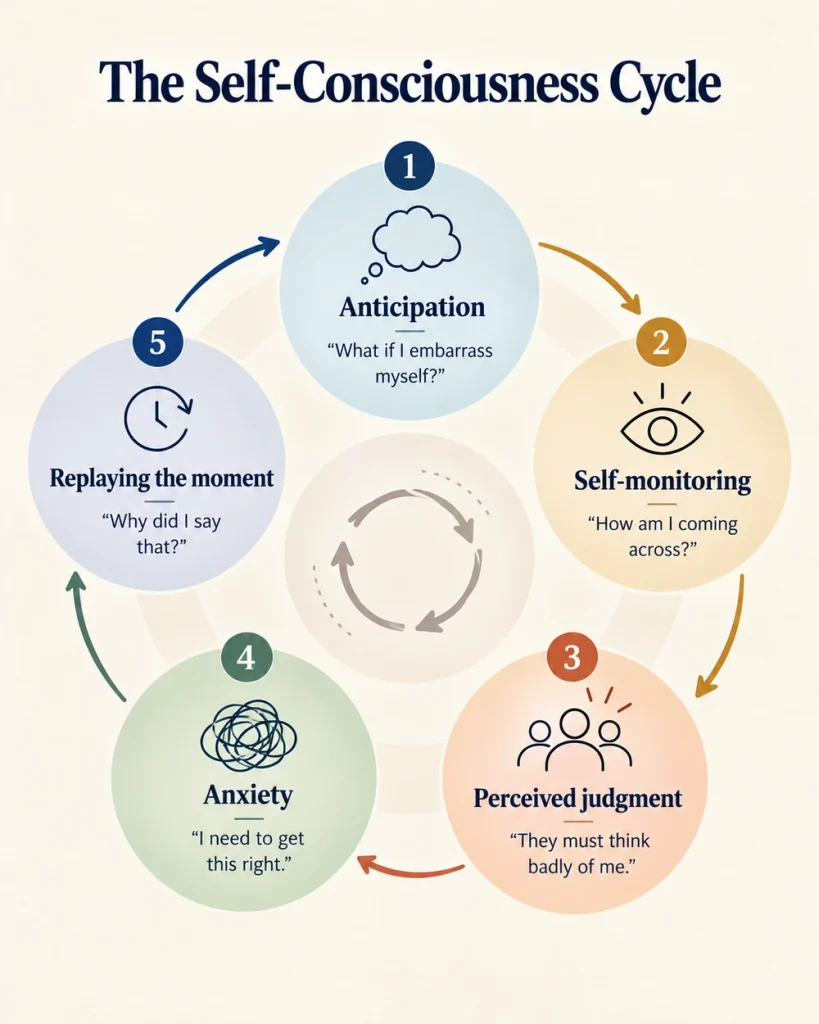
The Self-Consciousness Cycle: How Feeling Watched Can Feed Itself
The feeling of being watched can sometimes become a repeating cycle. It may begin before a social situation, continue while you are there and persist long after you have left.
Before the situation: You anticipate embarrassment.
What if I say something foolish?
During the situation: You monitor yourself.
Do I look nervous? Are they noticing?
After the situation: You replay what happened.
Why did I say that? Did they think I was strange?
As you review the interaction, you may focus mainly on moments that support your fear. You remember the awkward pause but overlook the friendly response. You recall the person who looked away but forget the people who continued the conversation normally.
Research on social anxiety has examined the roles of self-focused attention, anticipatory worry and post-event rumination in maintaining distress. When you repeatedly review an interaction through a negative lens, the next social situation may begin to feel threatening before anything has happened.
This cycle does not occur in everyone, and it is not a diagnosis. But recognising it can help you identify where you might respond differently.
Instead of asking, “How can I make sure I do not embarrass myself next time?” try asking:
“Am I responding to what actually happened, or am I replaying my fears about what it meant?”
That question can help you return to the present instead of preparing for another imagined judgment.
Signs You May Be Overestimating How Much Others Notice You
Sometimes, the feeling that everyone is watching you becomes visible in small, everyday habits. You may replay a conversation on your way home, worry about how you looked during a meeting, or wonder whether someone interpreted your words negatively.
These patterns do not automatically indicate a mental-health problem. They are simply opportunities to notice where your attention goes and how you interpret social situations.
You Keep Replaying Moments That Felt Awkward
Perhaps you stumbled over a sentence during a meeting or forgot someone’s name while introducing yourself. The conversation has moved on, but your mind keeps returning to that moment.
You begin wondering whether people noticed, what they thought and whether they will remember it tomorrow. Each time you replay the incident, the embarrassment feels fresh again. The difficulty is that you are revisiting the moment from your own perspective, with full awareness of what you felt and intended. You cannot know whether other people gave it the same importance.
A moment can feel significant to you without being equally significant to everyone who witnessed it.
You Constantly Monitor Yourself and Read Other People’s Reactions
You may find yourself checking your voice, facial expressions, clothes or posture while talking to someone. Instead of listening comfortably, part of your attention remains occupied with how you appear.
At the same time, you may become unusually alert to other people’s reactions. A brief glance, a quiet response or a distracted expression can leave you wondering whether you have done something wrong.
For example, if a colleague seems quiet during a conversation, you might immediately assume that you have said something inappropriate. Yet, the person could simply be tired or thinking about something unrelated.
This is where self-focused attention and fear of judgment can reinforce each other. You monitor yourself more closely, notice more details, and interpret those details through the possibility of being judged.
Noticing a reaction is one thing; knowing what it means is another.
You Hold Yourself Back Because You Fear How You Might Be Seen
Sometimes, the concern goes beyond what you think about yourself. It begins to influence what you allow yourself to do.
You may avoid asking a question because you do not want to sound uninformed. You may decline a social invitation because you are worried about appearing awkward. Even when you want to participate, you might stay quiet because you are trying to avoid making a poor impression.
Avoidance can bring temporary relief, but it can also prevent you from discovering that many situations are more manageable than you expected. You do not have to force yourself into every uncomfortable situation or pretend that judgment never happens. Start by noticing when fear is making a decision for you.
Ask yourself: “Am I choosing not to do this because I genuinely don’t want to, or because I’m afraid of how I might appear?”
If these patterns happen occasionally, they may simply reflect ordinary self-consciousness. If they repeatedly cause distress, limit your opportunities or interfere with daily life, consider discussing them with a qualified mental-health professional.
Are People Really Paying That Much Attention to You?
When you feel exposed or embarrassed, it is easy to confuse what you are experiencing with what other people can see. A simple exercise can help you separate the two.
Think of a recent moment when you felt watched or judged. Write down three things.
What happened?
“My colleague looked at me while I was speaking.”
What did I make it mean?
“They thought I sounded nervous.”
What else could be true?
“They were listening to what I said. They may not have thought much about my nervousness at all.”
Notice that the alternative explanation does not need to be positive. You do not have to convince yourself that everyone liked you or that nobody noticed anything. You are simply recognising that you do not have enough information to know exactly what another person thought.
This matters because feelings can be powerful without being accurate descriptions of the situation. You may feel certain that everyone noticed your mistake, but certainty is not the same as evidence.
Try asking yourself:
- What do I actually know?
- What am I assuming?
- What information might I be overlooking?
- Would I make the same judgment if someone else were in this situation?
The aim is not to prove that nobody is watching. It is to develop a more balanced understanding of what is happening.
Someone may notice me, and I can still be okay.
How to Stop Worrying About What People Think of You
You cannot control what other people think about you. Trying to control it can become exhausting. You may carefully choose your words, monitor your expressions, check your appearance and replay conversations to make sure you have not given the wrong impression.
A healthier goal is not to stop caring completely. It is to become less controlled by the fear of other people’s opinions.
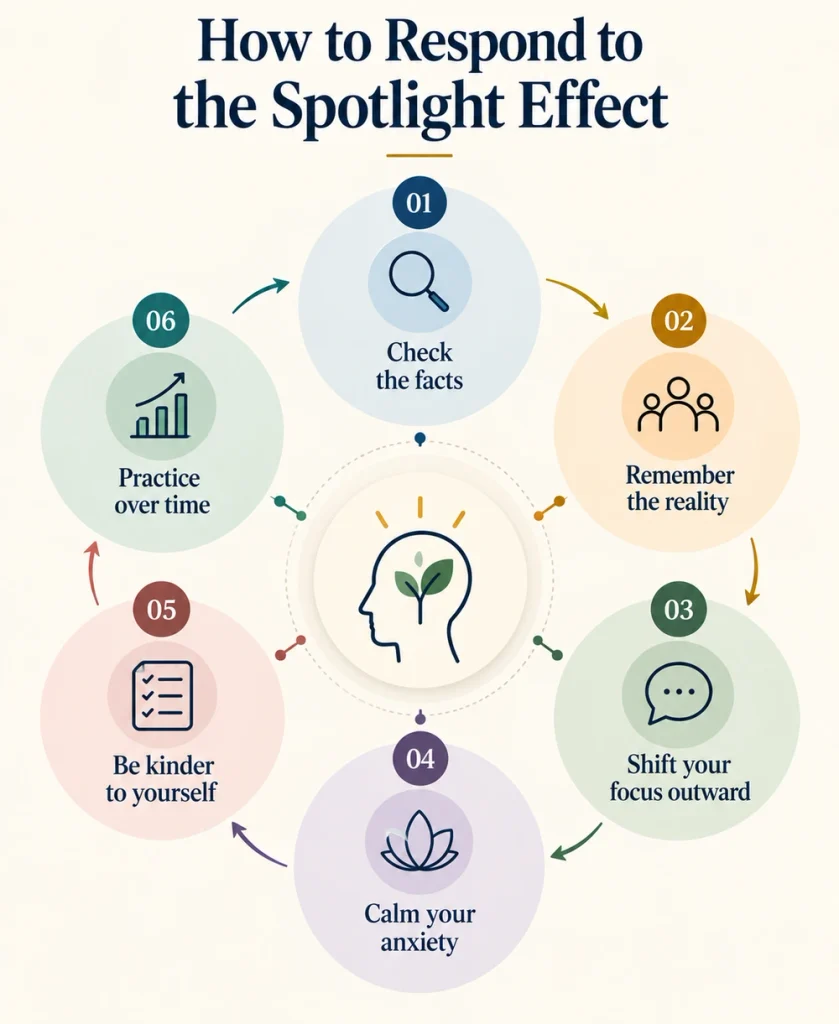
Move Your Attention Outward
When you become self-conscious, gently bring your attention back to the situation around you.
Listen to what the other person is saying. Notice the conversation. Ask a genuine question. Focus on the activity you are doing rather than checking how you appear while doing it.
You do not have to force every anxious thought to disappear. Simply give your attention something meaningful to engage with.
Separate Facts From Predictions
When you notice yourself assuming that someone is judging you, pause and identify what you actually know.
For example:
Fact: “She looked at me when I entered the room.”
Prediction: “She thinks I look awkward.”
Recognising the difference does not mean your prediction is impossible. It means you do not have to treat it as established fact.
Stop Trying to Read Minds
Facial expressions, pauses and short replies rarely tell the whole story.
You cannot reliably know another person’s thoughts from a single glance or a brief response. Sometimes, the most balanced answer is simply, “I don’t know what they thought.”
You can tolerate that uncertainty without investigating every possible explanation.
Allow Small Awkward Moments to Exist
You may stumble over a word, forget someone’s name or make a joke that does not land. Not every uncomfortable moment needs to be repaired. Instead of criticising yourself or repeatedly apologising, let the moment pass when it feels inappropriate. Try reminding yourself:
That was awkward. I can survive awkward.
Confidence does not mean never making mistakes. It includes being able to continue after an imperfect moment.
Reduce Repeated Reassurance-Seeking
Asking someone for reassurance can be helpful. But repeatedly asking whether you sounded strange, whether someone is upset or whether people noticed your mistake may provide only temporary relief. The doubt can return, leading you to seek reassurance again.
When you notice this pattern, try allowing some uncertainty to remain rather than checking immediately. You might say to yourself, “I don’t know exactly what they thought, and I can tolerate not knowing.”
If reassurance-seeking is a recurring difficulty, our article on Why Do I Need Constant Reassurance? explores the pattern in more detail.
Let Yourself Be Seen Without Performing
You do not have to look confident, intelligent, interesting or perfectly composed at every moment.
Instead of asking, “How can I make sure they like me?” try asking, “How can I be present in this moment?”
You may still feel nervous, but you can listen, contribute and connect without waiting for the perfect feeling to arrive.
Speak to Yourself With More Kindness
Think about how you respond when someone you care about makes a small mistake. You probably do not tell them that the mistake defines their character or that everyone must be judging them.
Offer yourself the same fairness. You can recognise what you would do differently next time without turning one uncomfortable moment into a judgment about your worth.
You can make a mistake without making yourself the mistake.
When Does Self-Consciousness Become a Problem?
Feeling self-conscious occasionally is part of being human. It becomes more concerning when the fear begins interfering with the life you want to live. You may start avoiding social gatherings, speaking in meetings, asking questions, pursuing opportunities or doing things you would otherwise enjoy.
Avoidance can bring immediate relief. But if it becomes a regular response, it may make feared situations feel even more difficult over time.
Consider seeking professional support if your fear of being watched or judged is persistent, causes significant distress, leads you to avoid important situations or affects your work, education, relationships or daily activities.
A qualified mental-health professional can help you understand what you are experiencing and whether a particular treatment or approach would be helpful. You do not need to diagnose yourself before asking for support.
It is also important to recognise that feeling watched can mean different things in different circumstances. This article focuses on ordinary self-consciousness and the tendency to overestimate other people’s attention. If you feel persistently watched or monitored in a way that feels literal, frightening or difficult to question, professional assessment can help clarify what is happening.
Seeking help is not an admission of weakness. It is a practical step towards understanding your experience and finding support.
A Gentle Reminder From a Counselling Perspective
Wanting to be accepted is not a weakness. Most of us care about how we are perceived, especially by people who matter to us. The difficulty begins when the wish to be accepted turns into a demand to appear perfect.
You may believe that if you choose the right words, never show nervousness and avoid every mistake, nobody will have a reason to judge you. But real connection does not require flawless performance. People hesitate, forget things, misunderstand each other and occasionally say something awkward. These moments do not make them unworthy of friendship, respect or belonging.
You cannot control every person’s opinion. Someone may misunderstand you. Someone may dislike you. Someone may judge you unfairly. You can, however, develop a more balanced relationship with yourself.
The next time you feel self-conscious, try asking not only, “How am I being seen?” but also, “How am I treating myself right now?”
You do not have to dismiss your feelings or pretend that judgment never happens. You can acknowledge discomfort without allowing it to decide what you are permitted to do. You may still feel nervous. You may still notice yourself. That is okay.
The aim is not to eliminate every uncomfortable feeling. It is to stop letting that feeling determine the size of your life.
You Are Probably Not Under the Spotlight as Much as You Think
The feeling can be convincing. You walk into a room, become aware of yourself and wonder whether everyone else is noticing you too. Sometimes people are. But your own intense awareness does not tell you how much attention they are paying.
The spotlight effect reminds us that we can overestimate how noticeable our appearance, actions and mistakes are to others. Self-focused attention and fear of judgment can make that experience more intense.
You can make a mistake without becoming the mistake. You can feel awkward without being an awkward person. You can be judged without being defined by someone’s judgment.
The next time your mind tells you that everyone is watching, return gently to the present. Listen to the conversation. Notice what is actually happening. Give yourself permission to participate without constantly evaluating your performance.
You were not born to spend your life standing under an imaginary spotlight. You are here to live—to speak, stumble, laugh, connect and be yourself. Let people see you. Let yourself be human. And then, gently, step out of the spotlight and back into your life.
Frequently Asked Questions
What is the spotlight effect in psychology?
The spotlight effect is our tendency to overestimate how much other people notice our appearance, behaviour, actions or mistakes. A moment that feels very noticeable to us may receive much less attention from others than we imagine.
Why do I feel like everyone is watching me?
Self-focused attention can make you intensely aware of your appearance, voice, expressions and behaviour. Because you notice yourself so closely, it may feel as though other people are paying the same amount of attention to you. That feeling does not necessarily reflect how much they notice.
Why do I feel like everyone is judging me?
Fear of negative evaluation can make uncertain social cues feel threatening. You may interpret a brief glance, a quiet response or a neutral expression as disapproval, even when other explanations are possible.
Is the spotlight effect the same as social anxiety?
No. The spotlight effect is a common psychological tendency. Social anxiety disorder involves persistent and significant fear of scrutiny or judgment that can cause distress, avoidance and interference with everyday life. Only a qualified professional can assess whether someone has the disorder.
How can I stop worrying about what people think of me?
Practise separating facts from assumptions, bringing your attention back to the situation around you and allowing small mistakes to pass without excessive self-criticism. The goal is not to stop caring about others but to become less controlled by the fear of their opinions.
Do people really remember my embarrassing mistakes?
Sometimes people notice and remember mistakes, but you cannot assume they give them the same importance you do. The spotlight effect suggests that we often overestimate how much attention others pay to our appearance and behaviour. A brief mistake does not automatically become a lasting impression.
When should I seek professional help for self-consciousness?
Consider speaking with a qualified mental-health professional when fear of being watched or judged is persistent, causes significant distress, leads to avoidance or interferes with everyday life. You do not have to wait until it becomes severe to seek support.
Disclaimer
This article is intended for general educational and mental-health awareness purposes only. It is not a substitute for individual psychological assessment, diagnosis or treatment. Experiences of self-consciousness and fear of judgment vary from person to person. If these experiences cause persistent distress or interfere with your daily life, consider consulting an appropriately qualified mental-health professional.
Sunil Prasad, M.A. Psychology (Counselling)
I write about emotional fitness, self-awareness, relationships and everyday psychological experiences at The Psyche Inspire. My aim is to make psychological concepts easier to understand through accessible explanations, research-informed perspectives and practical reflections.