

Have you ever spent hours replaying a conversation in your head, wondering whether you offended someone without realizing it? Perhaps a friend replied with a short text, your manager offered constructive feedback, or a family member seemed unusually quiet. Instead of moving on, your mind keeps searching for hidden meanings until you find yourself asking, “Why do I take everything so personally?”
Table of Contents
If this feels familiar, you’re far from alone.
Many of us have experienced moments when an ordinary situation suddenly feels deeply personal. A delayed reply begins to feel like rejection. A neutral facial expression seems like disappointment. A brief comment sounds like criticism. Before long, your mind has created an entire story—even though very little has actually happened.
The natural assumption is often, “I’m just too sensitive.” Others may even tell you to “stop overthinking” or “don’t take things so personally.” While these comments may be well intentioned, they rarely explain why your brain reacts this way in the first place.
The truth is far more interesting—and far more compassionate.
Your brain is not simply reacting to events. It is constantly trying to interpret them. Every day, it receives thousands of pieces of incomplete social information, such as facial expressions, tone of voice, body language, text messages, and silence. To make sense of this uncertainty, the brain automatically fills in the missing pieces using your past experiences, emotional memories, beliefs about yourself, and expectations of other people.
Sometimes those interpretations are accurate.
Sometimes they are not.
This automatic tendency to connect external events to ourselves is known in psychology as personalization—a common thinking pattern in which we assume that other people’s actions, words, or behaviors are directly related to us, even when there is little evidence to support that conclusion. While occasional personalization is a normal part of human thinking, relying on it too often can quietly increase anxiety, damage relationships, reduce self-confidence, and leave us emotionally exhausted.
What makes this pattern particularly challenging is that it rarely begins in adulthood. The meanings we attach to everyday situations are often shaped long before we become aware of them. Experiences of criticism, emotional invalidation, perfectionism, unpredictable relationships, or repeated rejection can teach the brain to stay alert for signs of social threat. If you’ve already explored how early emotional experiences shape lifelong emotional patterns, you’ll recognize how these early experiences continue to influence the way we interpret present-day interactions.
The encouraging news is that these interpretations are learned—and what is learned can also be reshaped. Modern psychology and neuroscience show that our brains remain capable of developing healthier thinking patterns throughout life. The goal is not to become emotionally detached or stop caring about other people. Instead, it is to learn how to separate what actually happened from the meaning your mind automatically assigns to it.
People don't experience life exactly as it happens—they experience the meaning their mind creates from it. Understanding that meaning is often the first step toward emotional freedom.
Why Does Your Brain Assume Everything Is About You?
If you’ve ever wondered why your mind quickly assumes that someone’s silence, criticism, or behavior is directed at you, the answer lies in how the human brain processes uncertainty.
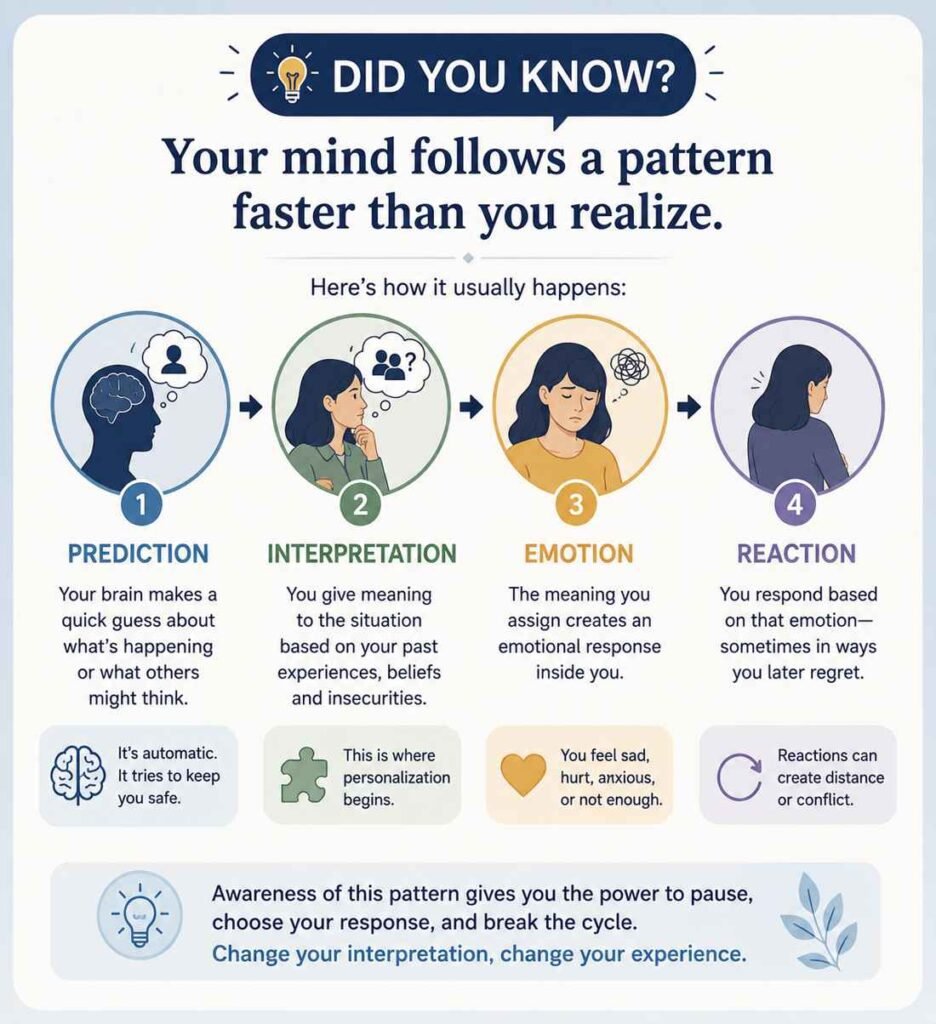
Contrary to what many people believe, your brain doesn’t experience the world like a video camera that records events exactly as they happen. Instead, it constantly predicts, interprets, and updates its understanding of reality using incomplete information. In other words, your brain is an active storyteller rather than a passive observer.
Imagine receiving a one-word text message that simply says, “Fine.”
Objectively, there is very little information in that message. Yet your mind may immediately begin asking questions:
- Are they angry with me?
- Did I say something wrong?
- Are they losing interest?
Within seconds, your brain has transformed a neutral event into a deeply personal experience. Interestingly, another person receiving the same message might simply assume the sender was busy. The event is identical, but the interpretation is completely different.
This difference highlights an important psychological truth: our emotions are often shaped more by our interpretations than by the events themselves.
Your Brain Is a Prediction Machine
One of the most significant discoveries in modern neuroscience is that the brain is constantly making predictions about the world around us. Rather than waiting for complete information, it uses previous experiences, memories, and expectations to anticipate what is most likely happening.
Researchers such as Lisa Feldman Barrett describe emotions as predictions constructed by the brain, while neuroscientist Karl Friston’s predictive processing theory suggests that perception itself is largely a process of educated guessing. Instead of asking, “What am I seeing?” the brain often asks, “Based on everything I’ve experienced before, what is most likely happening?”
This predictive system is remarkably efficient. It allows us to react quickly to our environment without analysing every detail from scratch. However, the same efficiency can sometimes work against us.
When previous experiences have taught the brain that criticism, rejection, or disappointment are likely, it may begin predicting these outcomes even when the available evidence is limited.
That is why a delayed reply may feel like rejection before you’ve considered more ordinary explanations.
Why Uncertainty Feels So Personal
Human beings naturally dislike uncertainty. From an evolutionary perspective, quickly identifying potential social threats helped our ancestors maintain safety and group belonging.
Our brains therefore prefer a quick explanation over no explanation at all.
Unfortunately, when information is missing, the explanation we generate is often influenced by our deepest emotional beliefs.
If you’ve experienced repeated criticism, emotional invalidation, or inconsistent relationships in the past, your brain may automatically assume that uncertainty means something is wrong with you.
This doesn’t happen because you’re irrational.
It happens because your brain is trying to protect you using information it learned long ago.
For example:
- Your colleague walks past without greeting you.
- Your partner seems unusually quiet.
- A friend cancels plans at the last minute.
Each of these situations is ambiguous. Yet the brain often fills in the missing information with the explanation that feels most familiar rather than the one that is most accurate. This tendency becomes even stronger when someone frequently experiences anxiety, perfectionism, or understanding why emotional triggers feel so intense.
The Spotlight Effect: Why We Think Others Notice Us More Than They Do

Another fascinating psychological phenomenon that contributes to taking things personally is the Spotlight Effect.
The Spotlight Effect refers to our tendency to overestimate how much other people notice our appearance, behavior, mistakes, or awkward moments.
Think about the last time you stumbled over your words during a presentation. Chances are you replayed that moment repeatedly in your mind. Meanwhile, many people in the audience may have forgotten it within minutes.
Why?
Because everyone else is usually focused on their own thoughts, concerns, and insecurities.
Research in social psychology consistently shows that people greatly overestimate how much attention others pay to them. While we naturally experience life from our own perspective, we often forget that everyone else is doing exactly the same.
Recognising the Spotlight Effect can be surprisingly liberating. It reminds us that many situations we interpret as deeply personal are simply ordinary moments in someone else’s day.
Personalization: When Interpretation Becomes Emotional Reality
Psychologists describe personalization as a cognitive distortion—a habitual thinking pattern in which people assume that external events are directly related to themselves without sufficient evidence.
This does not mean that your emotions are “wrong.”
Your feelings are real.
However, the explanation attached to those feelings may not always reflect reality.
For instance:
Event: Your friend hasn’t replied for several hours.
Automatic interpretation: They’re upset with me.
Emotion: Anxiety.
Behavior: Overthinking, repeatedly checking your phone, or sending multiple follow-up messages.
Yet there may be countless alternative explanations:
- They are busy at work.
- Their phone battery died.
- They haven’t seen the message.
- They’re resting.
- They’re dealing with their own challenges.
The emotional pain often comes not from the event itself, but from the meaning we assign to it.
This principle forms the foundation of Cognitive Behavioral Therapy (CBT) and explains why learning to question automatic interpretations can dramatically reduce unnecessary emotional suffering.
Pause & Reflect

Think about a recent situation that upset you.

Now ask yourself:

•	What actually happened?
•	What story did my mind immediately create?
•	What evidence supported that story?
•	Could there be another explanation that I hadn't considered?

Often, this small pause is enough to reveal the difference between reality and interpretation.
The Invisible Lens: How Core Beliefs Shape What You Take Personally
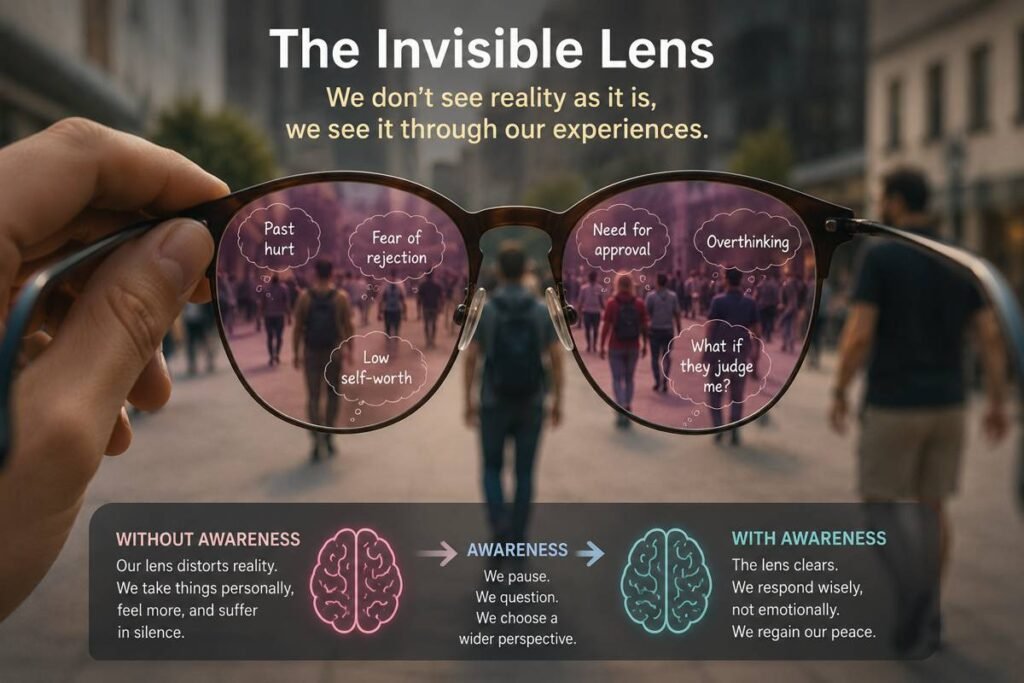
One of the biggest myths about taking things personally is the belief that it happens because someone is “too emotional.”
Psychology suggests something quite different.
In many cases, the intensity of your emotional reaction depends less on what happened and more on the beliefs through which you interpret what happened.
Think of your mind as wearing an invisible pair of glasses.
You rarely notice you’re wearing them, yet they quietly influence everything you see.
Two people can experience the exact same event.
One shrugs it off.
The other spends the next three days wondering what they did wrong.
The difference isn’t the event. It’s the lens.
What Are Core Beliefs?
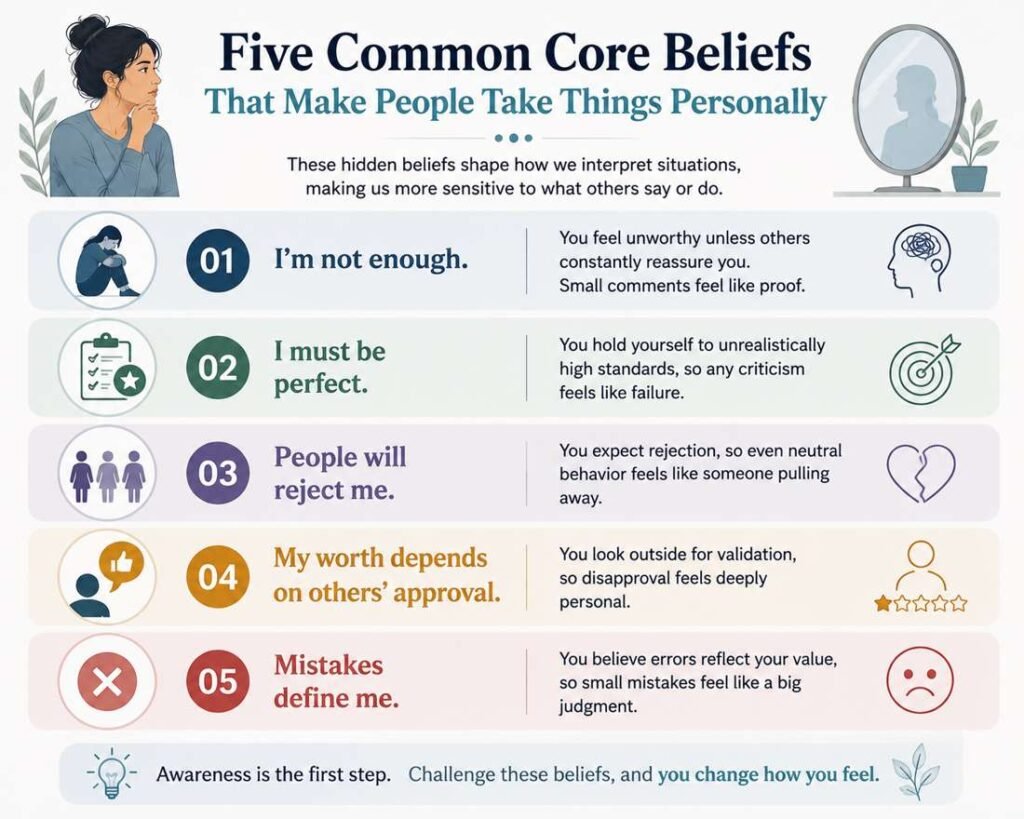
In cognitive psychology, core beliefs are deeply held assumptions we develop about ourselves, other people, and the world.
Unlike everyday thoughts, core beliefs operate quietly in the background.
They often feel so true that we mistake them for facts.
Examples include:
- “I’m not good enough.”
- “People eventually leave.”
- “I have to be perfect to be accepted.”
- “Making mistakes means I’m a failure.”
- “My needs don’t matter.”
These beliefs rarely appear as complete sentences in our minds.
Instead, they influence how we interpret everyday situations.
Imagine receiving constructive feedback from your manager.
If your underlying belief is:
“Feedback helps me improve.”
You’ll probably feel motivated.
But if your deeper belief is:
“I’m never good enough.”
The exact same feedback may feel like proof that you’ve failed.
The event hasn’t changed. Only the meaning attached to it has.
Your Brain Protects the Beliefs It Already Holds
One fascinating characteristic of the human mind is that it prefers consistency over accuracy.
Psychologists call this confirmation bias.
Once your brain develops a particular belief, it naturally begins collecting evidence that supports it while overlooking information that contradicts it.
For example, imagine someone secretly believes:
“People don’t really like me.”
Now consider two events happening on the same day.
Nine friends smile and greet them warmly.
One person forgets to reply to a message.
Which event will dominate their thoughts that evening?
Usually, the unanswered message.
Not because it is more important.
But because it fits the story their brain already believes.
In this way, core beliefs quietly shape what captures our attention, what we remember, and what we worry about long after the moment has passed.
Emotional Filters Are Learned—Not Fixed
The encouraging news is that these mental filters are not permanent personality traits.
They are patterns.
Patterns can be recognised.
Patterns can be questioned.
Patterns can change.
Modern neuroscience demonstrates that the brain remains adaptable throughout life—a concept known as neuroplasticity.
Each time you challenge an automatic interpretation with a more balanced perspective, you begin weakening old emotional pathways while strengthening healthier ones.
This process takes practice, but it is one of the reasons therapies such as Cognitive Behavioral Therapy (CBT) are so effective.
Rather than changing reality, CBT helps people change the lens through which they interpret reality.
Why Past Experiences Feel Like Present Reality
Imagine touching a hot stove as a child.
Your brain quickly learns:
“Hot stoves are dangerous.”
That lesson protects you.
Emotional learning works in a remarkably similar way.
If someone repeatedly experienced harsh criticism, emotional neglect, or unpredictable relationships, the brain may gradually learn:
“People are unsafe.”
Years later, a completely different person may offer gentle feedback.
Objectively, the situation is safe.
Emotionally, however, the old alarm system activates before the thinking part of the brain has fully evaluated the situation.
This doesn’t mean you’re living in the past.
It means your brain is using the past to predict the present.
Core Beliefs vs Reality
One of the most powerful questions you can ask yourself is:
“Am I reacting to what actually happened, or to what this situation reminds me of?”
That small distinction often changes everything.
When we confuse old beliefs with present reality, ordinary situations begin to feel much more personal than they truly are.
Learning to recognise this invisible lens doesn’t eliminate emotions.
Instead, it creates space between the event and your interpretation.
And in that small space lies the possibility of responding differently.
Pause & Reflect

Complete this sentence without overthinking:

"When someone criticises me, my first automatic thought is..."

Now ask yourself:

•	Where might that belief have come from?
•	Is it always true?
•	What evidence challenges it?

You don't have to answer immediately.

Simply becoming aware of the pattern is an important first step.
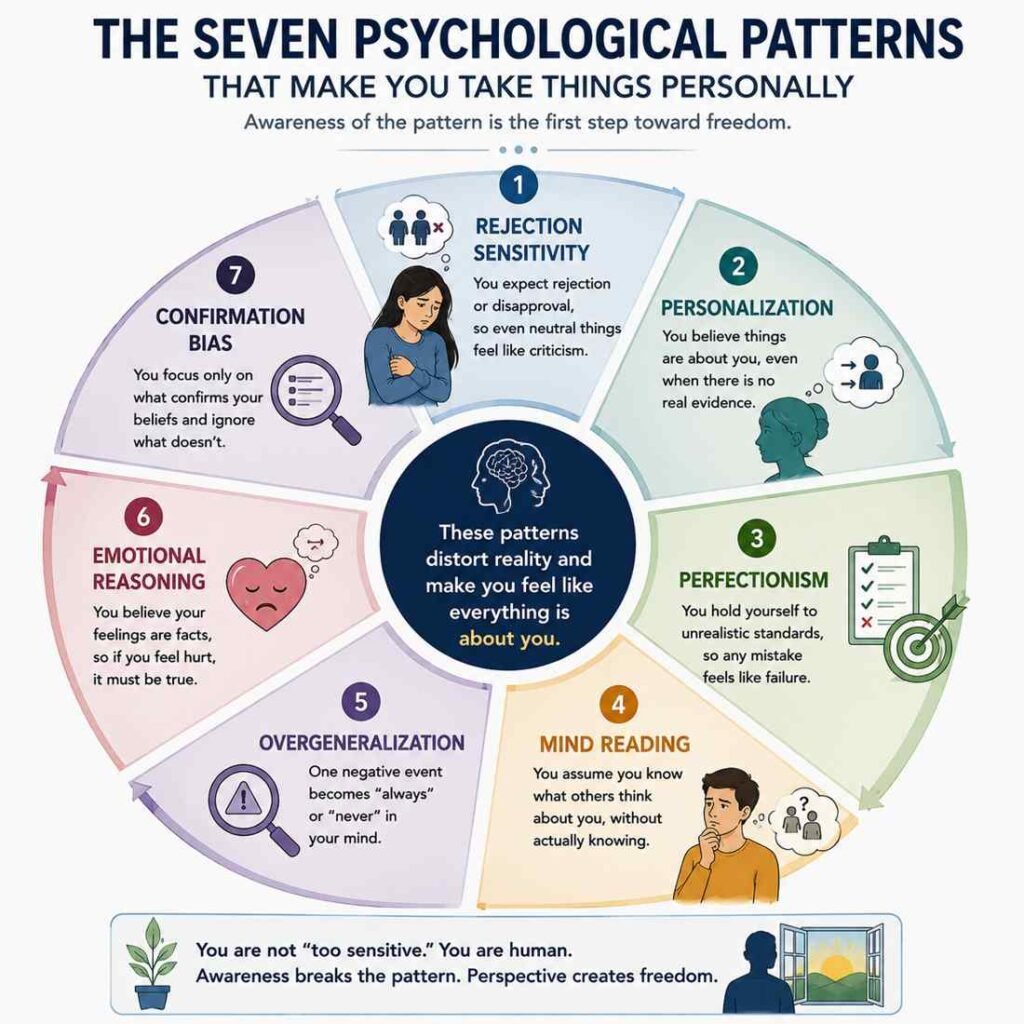
The Seven Psychological Patterns That Make You Take Things Personally
Rejection Sensitivity: When Your Brain Expects to Be Hurt
Imagine sending an important message to someone you care about.
An hour passes.
Then two.
Still no reply.
Almost immediately, your thoughts begin racing.
“Did I upset them?”
“Maybe they don’t want to talk to me anymore.”
“What if they’re pulling away?”
Objectively, nothing has happened except a delayed response.
Emotionally, however, it feels as though rejection has already occurred.
This experience is known as rejection sensitivity—the tendency to anxiously expect, quickly perceive, and strongly react to signs of possible rejection.
People with high rejection sensitivity are not “too emotional.” Instead, their brains become exceptionally alert to cues that might signal exclusion or disapproval. This heightened awareness often develops after repeated experiences of criticism, bullying, inconsistent relationships, or emotional invalidation, teaching the brain to monitor social situations for potential threats.
Because the brain is trying to protect you from future emotional pain, it sometimes mistakes uncertainty for rejection.
The result?
A neutral event begins to feel deeply personal.
Interestingly, research suggests that people who are highly sensitive to rejection may also interpret ambiguous social cues more negatively than others, even when no rejection was intended. That doesn’t mean their feelings are fake—it means their interpretations have become biased toward self-protection.
If you’ve noticed the lasting psychological effects of rejection, you may already recognize how past experiences can influence present reactions.
Personalization: Making Yourself the Centre of Every Story
Have you ever walked into a room and instantly felt that everyone noticed you?
Or assumed that two colleagues lowering their voices must have been talking about you?
This is one of the clearest examples of personalization—a cognitive distortion in which we automatically interpret external events as being directly related to ourselves without sufficient evidence.
Our brains naturally seek explanations for ambiguous situations. Unfortunately, when information is incomplete, personalization often provides the quickest answer.
For example:
- Your friend seems distracted.
Instead of thinking:
“They may be having a difficult day.”
Your mind immediately jumps to:
“They’re upset with me.”
Notice what happened.
The brain quietly transformed someone else’s behavior into a reflection of your own worth.
Personalization doesn’t occur because people are self-centered. In fact, it often develops in people who are highly conscientious, empathetic, or deeply concerned about maintaining relationships.
The challenge is that personalization narrows your perspective. Once your mind decides that everything is about you, it becomes difficult to notice alternative explanations.
One effective way to interrupt this pattern is to deliberately generate at least three possible reasons for another person’s behavior before settling on one conclusion. This simple exercise trains the brain to tolerate uncertainty instead of filling every gap with self-blame.
Did You Know?

Cognitive Behavioral Therapy (CBT) identifies personalization as one of the most common thinking traps contributing to anxiety, depression, and chronic self-criticism. Learning to recognize this distortion is often one of the earliest steps in cognitive restructuring.
Perfectionism: When Every Mistake Feels Like a Reflection of Your Worth
Perfectionism is often mistaken for having high standards.
In reality, unhealthy perfectionism is less about excellence and more about fear.
Fear of making mistakes.
Fear of disappointing others.
Fear of not being enough.
When your self-worth becomes closely tied to your performance, even gentle feedback can feel like a judgment of your entire identity.
Imagine completing a presentation at work.
Nine colleagues compliment your effort.
One person suggests a small improvement.
Which comment stays with you for the rest of the day?
For many perfectionists, the single criticism outweighs all the praise.
This happens because the brain selectively focuses on information that confirms its deepest fear:
“If I make mistakes, people will think less of me.”
Over time, this mindset creates a cycle where every comment feels intensely personal because it seems to threaten your identity rather than simply evaluate your work.
Learning to build emotional fitness for everyday challenges can gradually reduce this dependence on external validation by strengthening emotional resilience and self-awareness.
Pause & Reflect

Think about the last piece of feedback you received.

Ask yourself:

•	Was it truly a judgment of me?
•	Or was it feedback about one behavior, one decision, or one moment?

Separating identity from behavior is one of the most powerful psychological skills you can develop.
Low Emotional Boundaries: When Other People’s Emotions Become Your Responsibility
Have you ever noticed yourself feeling responsible for someone else’s mood?
Perhaps a colleague seems irritated, your partner is unusually quiet, or a friend sounds less enthusiastic than usual. Before long, you begin wondering:
“Did I do something wrong?”
“Is this because of me?”
“How can I fix it?”
For people with low emotional boundaries, another person’s emotions can quickly feel like a personal responsibility.
Healthy emotional boundaries allow us to care about others without assuming responsibility for everything they think or feel. When these boundaries are weak, however, the line between your emotions and someone else’s emotions becomes blurred.
Instead of recognising that people carry their own stress, disappointments, and struggles, the mind automatically concludes that their emotional state must somehow reflect something you have done.
This pattern is especially common among people who learned early in life to maintain harmony by pleasing others, avoiding conflict, or constantly monitoring other people’s reactions. Over time, the brain begins to equate emotional safety with keeping everyone around them happy.
The problem is that this creates an impossible task.
You cannot control another person’s thoughts, moods, or reactions.
Learning to recognise the hidden cost of suppressing emotions can also help explain why constantly managing other people’s feelings often comes at the expense of your own emotional well-being.
Negative Core Beliefs: When Your Mind Searches for Proof That You’re Not Enough
As we explored earlier, core beliefs act like invisible filters through which we interpret the world.
When those beliefs are negative, they quietly shape what we notice, remember, and expect.
Suppose someone believes:
“I’m not good enough.”
Even a balanced performance review may be interpreted as confirmation that they have failed.
Another person, holding a healthier belief about themselves, may receive exactly the same feedback yet view it as an opportunity to improve.
This happens because the brain naturally pays greater attention to information that supports existing beliefs while overlooking evidence that challenges them.
Psychologists refer to this tendency as confirmation bias.
The more often these beliefs go unquestioned, the stronger they become.
Over time, ordinary interactions begin to feel deeply personal—not because the world has become more critical, but because the mind has become more selective in what it notices.
Social Comparison: Measuring Your Worth Against Everyone Else
Social comparison is a natural part of being human.
It helps us learn, grow, and understand where we stand within a group.
The difficulty begins when comparison quietly turns into self-evaluation.
Imagine scrolling through social media after a challenging day.
You see promotions, vacations, happy relationships, fitness achievements, and smiling family photos.
Within minutes, your own life begins to feel inadequate.
Suddenly, a colleague’s success feels like your failure.
A friend’s compliment to someone else feels like evidence that you are being overlooked.
Psychologist Leon Festinger, who introduced Social Comparison Theory, proposed that people naturally evaluate themselves by comparing themselves with others.
While comparison can sometimes inspire growth, constant upward comparison often damages self-esteem and increases emotional sensitivity.
When your value depends on where you rank compared to others, even neutral events begin to feel personal because they seem to confirm that you are somehow falling behind.
One effective way to reduce this pattern is to replace comparison with curiosity.
Instead of asking:
“Why am I not like them?”
Ask:
“What can I learn from them without questioning my own worth?”
Identity Fusion: When Feedback Feels Like an Attack on Who You Are
Perhaps the deepest reason people take things personally is that they confuse what they do with who they are.
Psychologists sometimes refer to this as identity fusion, where our sense of self becomes tightly connected to our achievements, roles, or relationships.
For example:
Instead of thinking:
“I made a mistake.”
The mind concludes:
“I am a failure.”
Or instead of:
“Someone disagreed with my opinion.”
It becomes:
“They rejected me as a person.”
This fusion between identity and experience makes criticism feel overwhelmingly painful because the brain interprets it as a threat to the self rather than feedback about a specific behavior.
Developing resilience as a life skill helps create a healthier separation between self-worth and everyday setbacks.
Healthy self-esteem recognises that:
- Your mistakes are not your identity.
- Your performance is not your value.
- Your opinions are not your entire personality.
- One difficult interaction does not define who you are.
The more flexible your identity becomes, the less likely you are to experience ordinary feedback as a personal attack.
What Helps?
The next time you receive criticism, complete this sentence:
“This feedback is about one situation—not about my entire identity.”
This small shift creates emotional distance and allows learning to replace defensiveness.
Bringing the Seven Patterns Together
Although these seven psychological patterns appear different, they often work together.
For example, someone with a negative core belief such as “I’m not good enough” may become highly sensitive to rejection, struggle with emotional boundaries, compare themselves constantly with others, and interpret ordinary feedback as a threat to their identity.
The result is a cycle in which each experience seems to reinforce the next.
The encouraging news is that once you recognise these patterns, they become easier to interrupt.
Awareness doesn’t eliminate emotional reactions overnight, but it gives you something incredibly valuable:
Choice.
Instead of reacting automatically, you begin responding intentionally.
And that shift is where lasting emotional growth begins.
Did You Know?

Research in cognitive psychology suggests that changing deeply rooted thinking patterns doesn't require eliminating emotions. Instead, lasting change often begins by recognising automatic interpretations and replacing them with more balanced, evidence-based perspectives over time.
Pause & Reflect

Think about a recent situation that upset you.

Which of these seven patterns was most active?

•	Rejection Sensitivity
•	Personalization
•	Perfectionism
•	Low Emotional Boundaries
•	Negative Core Beliefs
•	Social Comparison
•	Identity Fusion

Recognising the pattern is not about labeling yourself. It's about understanding where your mind tends to go first, so you can gently guide it somewhere healthier.
The P.E.R.S.P.E.C.T.I.V.E. Model: A Psychology-Backed Way to Stop Taking Everything Personally
By now, you’ve seen that taking things personally isn’t caused by a single factor.
It’s influenced by the way your brain predicts social situations, the beliefs you hold about yourself, past emotional experiences, and the thinking patterns that quietly shape your interpretations.
The encouraging news is that none of these processes are fixed.
Every time you slow down long enough to examine an automatic interpretation, you’re giving your brain an opportunity to build a healthier pathway.
To make that process easier, here’s a practical framework that brings together the psychological principles discussed throughout this article.
Rather than asking you to ignore your emotions, the P.E.R.S.P.E.C.T.I.V.E. Model helps you understand them before deciding how to respond.
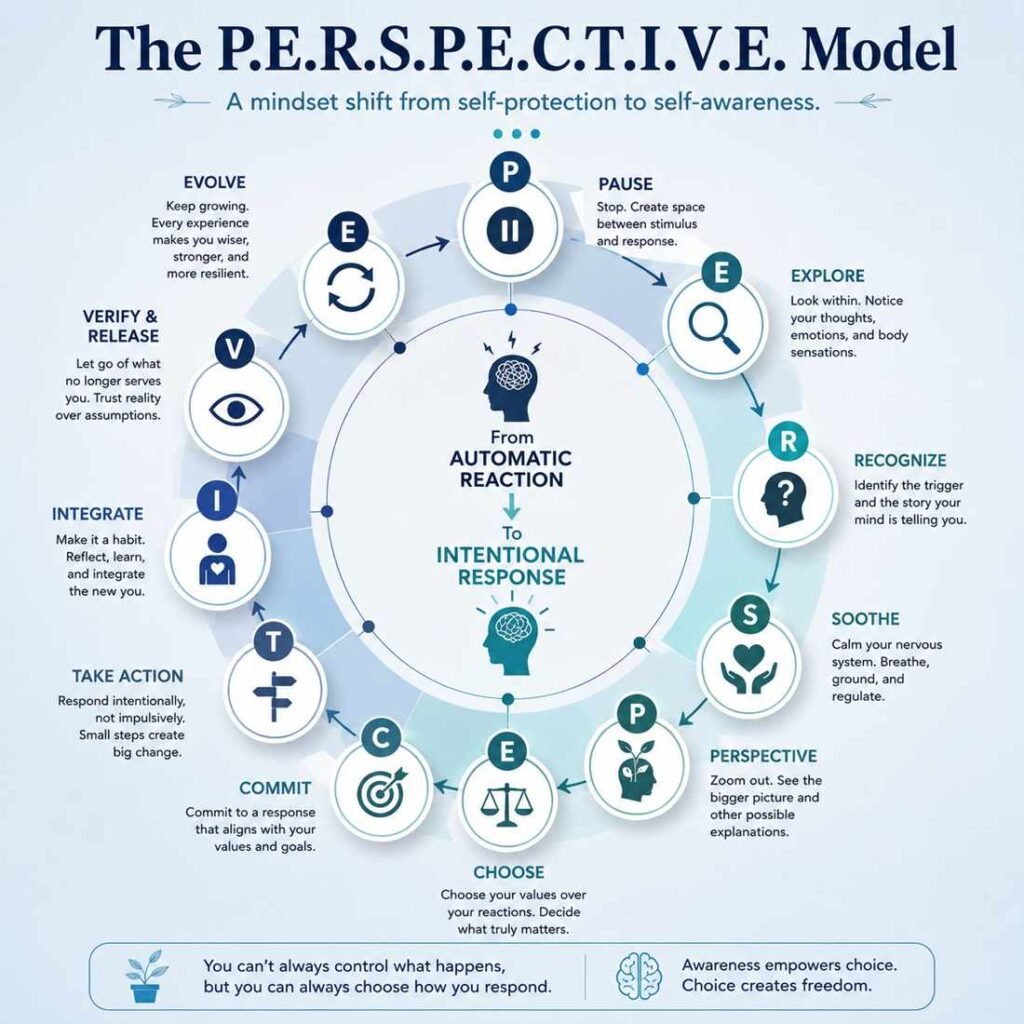
P — Pause Before Creating a Story
The human brain dislikes uncertainty.
When information is incomplete, it naturally fills the gaps.
Unfortunately, the first story your mind creates isn’t always the most accurate one.
Perhaps your friend hasn’t replied.
Your colleague seems distant.
Your partner appears unusually quiet.
Before your mind reaches a conclusion, simply pause.
That short pause creates space between the event and your interpretation.
It gives your thinking brain time to catch up with your emotional brain.
E — Examine the Facts
Ask yourself:
What do I actually know?
Not what I fear.
Not what I imagine.
Only what I know.
Example:
Fact:
“My manager asked to speak with me.”
Story:
“I’m probably in trouble.”
Separating facts from assumptions is one of the most powerful ways to reduce unnecessary emotional distress.
R — Recognise the Emotional Trigger
Sometimes today’s reaction isn’t only about today.
Ask yourself:
“What exactly about this situation feels familiar?”
Perhaps criticism reminds you of childhood perfectionism.
Silence reminds you of emotional neglect.
Conflict reminds you of previous rejection.
This isn’t about blaming the past. It’s about recognising when old emotional patterns are influencing present experiences.
S — Separate the Event From Your Identity
One conversation does not define you.
One disagreement does not define you.
One mistake does not define you.
One criticism does not define your worth.
A healthier question becomes:
“Is this feedback about my behavior—or am I treating it as a judgment about who I am?” Learning this distinction gradually weakens the cycle of identity fusion we discussed earlier.
P — Practice Alternative Perspectives
This is where flexibility replaces certainty.
Instead of asking:
“Why are they upset with me?”
Ask:
- Could they simply be tired?
- Could they be stressed?
- Could something unrelated be happening?
- What would an objective observer think?
The goal isn’t forced optimism.
The goal is balanced thinking.
Remember:
A different explanation doesn’t deny your feelings.
It simply widens your perspective.
E — Extend Yourself Compassion
Many people who take things personally speak to themselves in ways they would never speak to someone they love.
Imagine your closest friend made the same mistake.
Would you immediately call them a failure?
Probably not.
Research by Kristin Neff consistently shows that self-compassion helps people become more resilient, not less accountable.
Treating yourself with kindness doesn’t reduce growth.
It creates the emotional safety needed for growth to happen.
C — Choose Curiosity Instead of Certainty
Our minds often crave certainty.
Especially negative certainty.
Instead of thinking:
“I know they don’t like me.”
Try asking:
“What information might I still be missing?”
Curiosity interrupts personalization. Certainty strengthens it.
T — Test the Thought
This step draws directly from Cognitive Behavioral Therapy.
Ask yourself:
- What evidence supports this thought?
- What evidence challenges it?
- Am I assuming the worst?
- Would I reach the same conclusion if someone else were involved?
Testing thoughts doesn’t invalidate emotions.
It simply prevents automatic conclusions from becoming unquestioned facts.
I — Invest in Emotional Fitness
Changing long-standing thinking patterns isn’t about one perfect response.
It’s about repeated practice.
Each time you pause, question an interpretation, and respond intentionally, you strengthen your emotional fitness.
Much like physical fitness, emotional fitness develops gradually through consistent effort rather than dramatic breakthroughs.
V — Value Growth Over Being Right
Sometimes we become attached to our interpretations because they feel familiar.
Changing them can feel uncomfortable.
Instead of asking:
“Was I right?”
Ask:
“Did this interpretation help me?”
Growth often begins when protecting your peace becomes more important than protecting your assumptions.
E — Evolve Through Every Experience
The final step reminds us that emotional growth isn’t measured by never taking things personally again.
It is measured by noticing the pattern sooner.
Recovering faster.
Responding more thoughtfully.
And gradually choosing interpretations that are grounded in evidence rather than fear.
Each difficult interaction becomes an opportunity to strengthen a healthier relationship with yourself.
Pause & Reflect

The next time you catch yourself thinking,

"This must be about me."

Take one slow breath and ask:

"Which step of the P.E.R.S.P.E.C.T.I.V.E. Model do I need most right now?"

You don't have to complete every step.

Sometimes a single pause is enough to change the direction of the entire conversation—both with others and with yourself.
From Personalization to Perspective: What Emotional Growth Really Looks Like
By now, one thing should be clear:
Taking things personally isn’t a personality flaw.
It isn’t a sign that you’re weak.
And it certainly doesn’t mean you’re “too emotional.”
More often, it reflects a brain that has learned to interpret uncertainty through past experiences, deeply held beliefs, and automatic thinking patterns.
The encouraging news is that interpretation is a skill—not a life sentence.
Just as your mind learned to personalise situations over time, it can also learn to approach them with greater balance, flexibility, and self-awareness.
That process doesn’t happen overnight.
It happens one conversation, one thought, and one new perspective at a time.
Emotional Growth Doesn’t Mean You Stop Feeling
One of the biggest misconceptions about emotional maturity is that emotionally healthy people don’t get hurt.
In reality, they do.
The difference is what happens after the emotional reaction.
Instead of immediately believing every thought their mind produces, they become curious.
Instead of assuming the worst, they pause.
Instead of reacting automatically, they create space to respond intentionally.
Emotional growth is not measured by the absence of emotion.
It is measured by the quality of your relationship with your emotions.
You Can Care Deeply Without Taking Everything Personally
Many readers worry that becoming less reactive means becoming emotionally distant.
The opposite is usually true.
When you stop personalising every uncertain situation, you create more space for empathy, healthier communication, and genuine connection.
For example:
Instead of thinking,
“They seem upset because of me.”
you might ask,
“You seem quieter than usual. Is everything okay?”
Notice the difference.
The first response is driven by assumption.
The second is guided by curiosity.
One creates unnecessary emotional pressure. The other creates understanding.
Emotional Flexibility Is Stronger Than Emotional Control
For many years, emotional strength was misunderstood as staying calm at all costs or hiding uncomfortable feelings.
Modern psychology offers a different perspective.
Healthy emotional functioning is not about controlling every emotion.
It’s about becoming psychologically flexible—the ability to experience thoughts and emotions without allowing them to dictate every decision.
Psychological flexibility allows you to say:
“I’m feeling rejected right now, but that doesn’t necessarily mean I have been rejected.”
That small distinction creates room for wiser choices.
It allows emotions to become information rather than instructions.
This is one of the central ideas behind Acceptance and Commitment Therapy (ACT), which encourages people to notice their thoughts without automatically treating them as facts.
Small Changes Create Lasting Change
Many people hope for one breakthrough that permanently changes the way they think.
In reality, emotional growth is usually much quieter than that.
It looks like:
- Pausing before sending an emotional message.
- Asking a question instead of making an assumption.
- Accepting feedback without questioning your self-worth.
- Letting someone have a bad day without assuming it’s about you.
- Recovering from criticism in hours instead of days.
These moments may seem small, but over time they reshape the way your brain responds to uncertainty.
That’s how lasting emotional change happens—not through perfection, but through repeated practice.
When Should You Seek Additional Support?
Although taking things personally is a common human experience, there are times when it may cause significant distress or interfere with daily life.
Consider speaking with a qualified mental health professional if you notice that:
- You constantly fear rejection, even in supportive relationships.
- Small interactions trigger overwhelming anxiety or shame.
- You avoid opportunities because of fear of criticism.
- Relationships are repeatedly affected by misunderstandings or assumptions.
- Self-critical thoughts feel persistent, intense, or difficult to challenge on your own.
Seeking support isn’t a sign of weakness.
It’s an investment in understanding yourself more deeply and developing healthier ways of relating to others.
Frequently Asked Questions (FAQs)
1. Why do I take everything so personally?
Taking things personally usually happens because your brain automatically interprets other people’s words, behaviors, or reactions as reflections of your own worth. This pattern is often influenced by cognitive biases, past emotional experiences, low self-esteem, perfectionism, or rejection sensitivity. Rather than responding only to what actually happened, the brain fills in missing information using previous experiences. The good news is that these interpretations can change over time through greater self-awareness, emotional flexibility, and healthier thinking patterns.
2. Is taking things personally a trauma response?
It can be, but not always.
People who have experienced emotional neglect, bullying, repeated criticism, or unpredictable relationships may become more sensitive to perceived rejection because the brain learns to stay alert for possible emotional threats. However, taking things personally can also develop through perfectionism, anxiety, low self-confidence, or learned thinking patterns without being directly related to trauma. If this pattern causes significant distress or affects your relationships, speaking with a mental health professional can help identify the underlying factors.
3. Why does criticism hurt me so much?
Criticism often hurts because the brain may interpret feedback as a threat to self-worth rather than information about a specific behavior. This is especially common when a person’s identity becomes closely tied to achievement, approval, or perfection. Learning to separate what you did from who you are can make feedback feel less like a personal attack and more like an opportunity for growth.
4. Why do I assume everyone is judging me?
Many people overestimate how much others notice or evaluate them, a phenomenon known as the Spotlight Effect. In reality, most people are far more focused on their own thoughts, responsibilities, and concerns than on judging others. Anxiety, low self-esteem, and negative core beliefs can make this tendency stronger, causing ordinary social situations to feel more threatening than they actually are.
5. Can anxiety make you take things personally?
Yes.
Anxiety often increases the brain’s sensitivity to uncertainty and potential threats. As a result, neutral situations—such as delayed messages, brief conversations, or changes in someone’s tone of voice—may be interpreted as signs of rejection or criticism. Managing anxiety through evidence-based strategies, including Cognitive Behavioral Therapy (CBT), mindfulness, and emotional regulation skills, can reduce this tendency over time.
6. How do I stop taking things personally?
The goal isn’t to stop having emotional reactions but to become more aware of how your mind interprets situations. Start by pausing before reaching conclusions, separating facts from assumptions, considering alternative explanations, and practising self-compassion when self-critical thoughts arise. Frameworks such as the P.E.R.S.P.E.C.T.I.V.E. Model can help you respond with greater emotional balance instead of reacting automatically.
7. Is taking things personally a sign of low self-esteem?
Not necessarily, but low self-esteem can make the pattern more common.
When people doubt their own worth, they are more likely to interpret criticism, silence, or disagreement as confirmation of their negative beliefs. Building self-esteem involves recognising strengths, challenging harsh self-judgments, and learning to value yourself independently of other people’s opinions.
8. Why do I replay conversations over and over?
Replaying conversations is often a form of rumination—the mind repeatedly analyzing past events in an attempt to prevent future mistakes or gain certainty. While occasional reflection is normal, persistent rumination can increase anxiety and make everyday interactions feel more personal than they are. Focusing on what you can learn, rather than searching endlessly for certainty, is often more helpful.
9. Can therapy help me stop taking things personally?
Yes.
Therapies such as Cognitive Behavioral Therapy (CBT), Acceptance and Commitment Therapy (ACT), and Compassion-Focused Therapy (CFT) can help people identify unhelpful thinking patterns, challenge negative beliefs, strengthen emotional flexibility, and develop healthier ways of responding to criticism or rejection. Therapy is not about becoming emotionally detached—it is about learning to interpret situations more accurately and respond with greater confidence.
10. Can emotionally healthy people still take things personally?
Absolutely.
Emotional health doesn’t mean never feeling hurt.
It means recognising those feelings without immediately accepting every interpretation your mind creates. Emotionally healthy people still experience disappointment, rejection, and criticism, but they recover more quickly because they pause, reflect, and consider multiple perspectives before reacting.
Final Thoughts
Perhaps the most important lesson from this article is this:
People rarely intend to hurt us as often as our minds imagine.
The human brain evolved to detect patterns, predict outcomes, and protect us from emotional pain.
Sometimes it succeeds.
Sometimes it creates stories that feel convincing but aren’t entirely true.
The goal isn’t to silence that protective voice.
The goal is to listen to it with curiosity instead of unquestioned belief.
Every time you pause before assuming, question an automatic interpretation, or choose compassion over self-criticism, you strengthen a healthier relationship with yourself.
And that relationship becomes the foundation for healthier relationships with everyone else.
Because emotional freedom doesn’t begin when the world stops disappointing you.
It begins when you stop allowing every uncertain moment to define your worth.
One-Minute Reflection

Before you leave, think of one recent situation you've been replaying in your mind.
Now ask yourself:

•	What actually happened?
•	What meaning did I attach to it?
•	Which of the seven psychological patterns influenced my interpretation?
•	Which step of the P.E.R.S.P.E.C.T.I.V.E. Model could help me see it differently?

You don't need perfect answers.

Sometimes the willingness to ask better questions is the beginning of emotional growth.
1 thought on “Why Do I Take Everything So Personally? Understanding the Psychology Behind It”