

Sometimes, the hardest part of feeling lonely is believing you have no right to feel that way.
There are people in your life. You care about them. Some of them care deeply about you. Yet something still feels missing, and admitting it can seem unfair to everyone who has stayed.
So you question yourself. Perhaps you are expecting too much. Perhaps you should be more grateful. You may even struggle to finish the thought: I have people, but I still feel…
Lonely.
You do not have to dismiss that feeling to appreciate the relationships you have. Gratitude and loneliness can exist together. You can value someone’s presence and still wish they understood a part of your life that rarely comes into conversation.
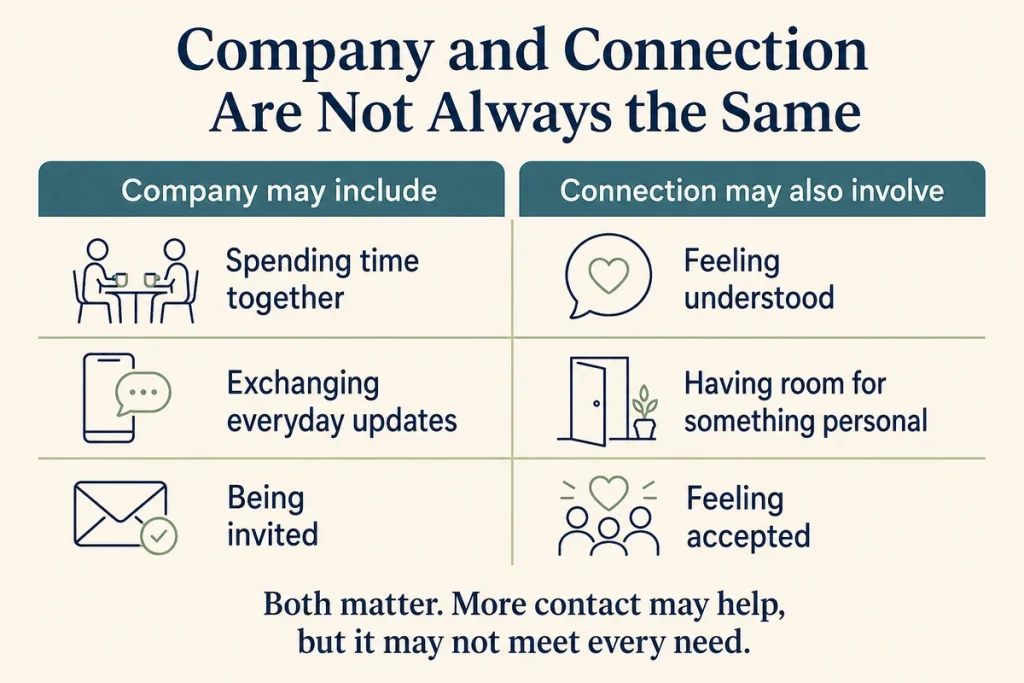
If you feel lonely even around people, the question is not simply how to become more sociable. It is worth asking what kind of connection you need—and whether your current relationships have room for it.
Quick answer: Why do I feel lonely even around people?
You may have regular company without enough closeness, understanding, belonging, or support. Loneliness reflects a gap between the connection you have and the connection you need. It does not automatically mean your relationships are uncaring or that something is wrong with you.
Table of Contents
You Can Have People in Your Life and Still Feel Lonely
Being included can matter enormously. But an invitation does not always bring the feeling that you belong. A conversation may be friendly without leaving space for something difficult you need to say.
This does not make everyday conversation meaningless. Shared jokes, familiar routines, and small check-ins are valuable parts of relationships. They simply may not meet every need.
The World Health Organization’s explanation of social connection looks beyond the number of people we know. It also considers the support exchanged and the quality of our interactions. Having company is one part of connection, not its whole meaning.
Sometimes, people care but do not know what you need. Sometimes, circumstances leave little time for closeness. In other situations, you may have good reasons to hold back, or the relationships available to you may genuinely lack acceptance.
We need to leave room for these differences. Loneliness is not always a confidence problem. Nor is it proof that you have chosen the wrong people.
Being Alone, Feeling Lonely, and Missing Emotional Closeness
These experiences can overlap, but they are not interchangeable.
| Experience | What it means |
| Solitude | Time spent alone. When welcomed, it may feel peaceful or restorative. |
| Social isolation | Having objectively limited relationships, contact, or social participation. |
| Loneliness | Feeling distressed because your connection with others does not meet your needs. |
| Emotional loneliness | Missing a close, trusted bond, even when other people are present in your life. |
Enjoying a quiet evening alone does not mean you are disconnected. Equally, a busy social calendar does not rule out loneliness.
WHO’s 2025 estimates suggest that around one in six people worldwide experiences loneliness. That figure concerns loneliness broadly, rather than loneliness specifically felt around other people. Still, it reminds us that this is a widespread human experience, not a personal failure. WHO: Social connection and loneliness
You may not yet know whether you need more companionship, a deeper conversation, greater acceptance, or support for something you are carrying. Understanding why your existing contact feels insufficient can help you decide where to begin.
7 Reasons You May Feel Lonely Even Around People
The following seven reasons are possible, overlapping explanations—not labels or a diagnostic test. Some concern the way relationships work. Others concern the circumstances that make connection difficult.
1. You Talk Often, but Rarely About What Matters to You
You may discuss work, children, bills, news, or weekend plans. But when something is troubling you, the conversation stays on the surface.
Perhaps you do not know how to begin. Perhaps the moment never feels right. Or you may have tried before and received advice when you needed understanding.
Psychologists use self-disclosure to describe sharing personal thoughts, feelings, or experiences. Another useful concept is perceived responsiveness: feeling that the person listening understands you, values what you have shared, and cares about your experience.
In two diary studies involving college students, Laurenceau and colleagues found that disclosure and perceived responsiveness were associated with greater intimacy during interactions. This supports the idea that closeness involves both sharing and how that sharing is received. It is not evidence that revealing more will always improve a relationship. Laurenceau and colleagues: Intimacy as an interpersonal process
You may finish a conversation having explained your circumstances without feeling that anyone understood how those circumstances affect you. The words were exchanged, but the understanding you hoped for was missing.
2. People Know the Role You Play, but Less of What You Need
You may be the dependable colleague, the friend who listens, or the family member who keeps everything organised. These qualities may be genuine parts of you. The difficulty begins when there seems to be no room for anything else.
Consider this fictional illustration. Naina is known at work for being calm and helpful. Her colleagues include her in tea breaks and often bring her their problems. One afternoon, someone says, “You’re lucky. Nothing ever seems to affect you.”
Naina smiles. She does not mention that she has been sleeping poorly or that she has begun dreading evenings alone. She worries that saying more would make everyone uncomfortable.
Her colleagues are responding to what they know of her. Whether they could respond differently has not yet become clear.
Sometimes, we conceal our needs because receiving care feels less familiar than giving it. We may also fear disappointing people who expect us to cope. If you have always been “the strong one”, admitting difficulty can feel like breaking an unspoken agreement.
Being appreciated for what you do is valuable. It is not always the same as feeling known beyond that role. A relationship may need room for your needs alongside the support you already give.
3. You Feel Included, but Not Fully Accepted
Inclusion answers one question: Am I allowed to be here? Belonging asks another: Can I be myself while I am here?
You can be invited into a group and still monitor every word. You may avoid discussing your values, relationships, health, or ambitions because you expect judgement. Part of your experience never enters the conversation.
Sometimes, earlier criticism makes acceptance difficult to trust. At other times, the lack of acceptance is real. A family may repeatedly dismiss your choices. A workplace may exclude people who seem different. A group may welcome you only when you hide something important.
It would be unfair to treat every experience of exclusion as negative thinking. WHO recognises marginalisation among the wider factors that can contribute to loneliness and social isolation. WHO guidance on social connection
Acceptance does not require everyone to agree. It means there is enough respect for differences to exist without humiliation or threats to your place in the relationship. Without that, being socially involved can still feel lonely.
4. You Want Closeness, but Letting Someone In Feels Risky
Wanting support and feeling comfortable receiving it are not always the same thing. You may hope someone notices you are struggling, then quickly say you are fine when they ask.
Previous experiences can shape these expectations. If someone dismissed your feelings, shared private information, or withdrew when you needed them, caution may feel reasonable.
Psychologists study some of these expectations through attachment: how we approach closeness, dependence, and possible rejection. A meta-analysis found that attachment anxiety and avoidance were associated with greater loneliness, among other difficulties. This association does not prove that an attachment pattern causes loneliness in every person. Zhang and colleagues’ review of adult attachment and mental health
You do not need to trace every hesitation back to childhood. Recent relationships and present circumstances matter too.
Privacy is also a choice you are allowed to make. The difficulty comes when you want someone to know you better, but fear makes that feel impossible—even with people who have shown care. Recognising this tension does not mean forcing yourself to open up before you feel ready.
5. You Are Carrying Something Your Usual Conversations Cannot Hold
Sometimes, your relationships have not changed much, but your life has. Grief, illness, separation, caregiving, or a major move can bring needs that familiar conversations no longer meet.
In this fictional illustration, Devansh begins caring for an older relative after an operation. His friends keep inviting him out, but he often cannot leave home. When they speak, they suggest that he needs a break.
He knows they mean well. What he finds hard to explain is that a break requires someone else to take over. He also wants to talk about the worry and exhaustion—not only arrange an evening away.
Here, there is a mismatch between the support offered and the support needed. Practical help, companionship, and emotional understanding serve different purposes. An invitation can offer company without making a difficult responsibility easier to manage.
This does not mean the friendships have failed. A changing situation may call for additional support, including people with shared experience. Your friends can remain important while being unable to understand every part of what you are going through.
6. There Is Contact, but Too Little Time or Attention for Connection
Your relationships may contain warmth and goodwill, yet little uninterrupted time. Conversations happen between tasks. Calls end because someone needs to leave. Messages receive brief replies, while the thoughtful response keeps getting postponed.
Over time, the relationship remains active, but opportunities for closeness become scarce.
This is not always a matter of misplaced priorities. Working hours, conflicting schedules, caring responsibilities, transport costs, and accessibility barriers can make connection genuinely difficult. Telling someone to make more effort overlooks how much effort their day already requires.
It is also too simple to blame online communication. A thoughtful voice message or regular video call may provide meaningful contact when meeting is impossible. Being in the same room, meanwhile, does not guarantee attention.
The useful question is whether your contact gives you enough opportunity to listen, respond, and feel involved in each other’s lives. You may be missing time together, not affection. That distinction matters when deciding what could realistically change.
7. Feeling Left Out Makes It Harder to Reach Out Again
After feeling overlooked, you may become more alert to signs that it will happen again. A short reply feels distant. A postponed plan seems to confirm that you are unwanted. You hesitate to send another message.
Researchers Louise Hawkley and John Cacioppo describe a possible loneliness cycle involving increased watchfulness for social threats and more self-protective behaviour. Pulling back may reduce opportunities for reassuring contact, allowing loneliness to continue. It is a research-informed model, not an explanation for everyone’s experience. Hawkley and Cacioppo: Loneliness Matters
Recognising this possibility does not mean distrusting your feelings. An uncertain interaction and repeated disregard are different things. One missed reply leaves room for several explanations. Consistent exclusion deserves attention.
If uncertainty often feels like a judgement about you, our article on why you take things personally explores that pattern further.
The aim is to understand what is happening without automatically blaming yourself or assuming the worst of others.
Before You Try to Socialise More, Ask What You Are Missing
Another gathering may help if you need company. It may not help if what you need is one thoughtful conversation. Before adding something to your calendar, ask:
What do I wish I could experience with another person that I am not experiencing enough right now?
You do not need a perfect answer. “Someone who listens without rushing” is enough to begin with. So is “a friend to spend an ordinary afternoon with” or “people who understand this stage of my life.”
The point is to give your need more clarity, without judging yourself for having it.
A Gentle Connection Check-In
This reflection exercise was created for this article. It is not a validated psychological test, and there is no score to calculate. Think about your life recently, rather than one unusually difficult interaction.
| Ask yourself | What your answer may point towards |
| Do I have enough chances to spend time with people? | More opportunities for regular companionship |
| Can I tell someone about something that genuinely matters to me? | Greater emotional closeness |
| Do I feel respected when I disagree, say no, or need support? | Acceptance and emotional safety |
| Is there someone who understands this particular part of my life? | Shared experience or more relevant support |
| Do our conversations leave room for both people’s experiences? | Mutual attention and care |
You may recognise several unmet needs. You may also notice that some relationships offer more connection than you initially thought.
Try not to turn this into a verdict on who cares about you. A person may care and still have limited time or capacity. Equally, caring about someone does not require you to overlook repeated dismissal.
Notice What Changes Across Relationships
Consider when you feel a little more at ease. Is speaking easier during a walk than at a crowded gathering? Does a follow-up question help you feel understood? Can you share an interest with one friend and discuss a difficult feeling with another?
These differences offer clues about the connection you find helpful. Also consider what gets in the way. You may know what you need but lack childcare, accessible transport, money, privacy, or time. That is a practical constraint, not a personal failure.
For now, finish this sentence privately: “I would feel a little more connected if…”
Let the answer be specific. It can help you choose a next step that addresses your actual need, rather than asking more of yourself simply because you feel lonely.
How to Feel More Connected Without Forcing Yourself to Be Someone Else
You do not have to become more outgoing or suddenly feel comfortable sharing everything. Start with the need you have identified and what is possible within your current life.
There is reason for hope, though no single approach works for everyone. A 2021 meta-analysis covering 28 studies and 3,039 participants found that psychological interventions reduced loneliness, with a small-to-medium average benefit. Results varied considerably, highlighting the importance of finding suitable support. Hickin and colleagues’ review of psychological interventions for loneliness
The suggestions below are practical starting points. They are not a substitute for those interventions or a promise of immediate relief.
Start with One Person Who Has Shown Care
Look at how someone behaves, not only how long you have known them. Have they respected something you shared privately? Can they listen or accept a small disagreement without becoming hurtful?
You are looking for reasonable signs of care, not a perfect listener. The person may be a friend, relative, colleague, or someone outside your usual circle.
Begin with an ordinary invitation: a short walk, a phone call, or time together without another task competing for attention. If nobody comes to mind, building new sources of support may be more appropriate than pushing harder within your existing relationships.
Share One Honest Thing—and Notice the Response
Opening up does not mean telling your whole story. You might mention that a recent change has been harder than expected or that you have missed having someone to talk with properly.
Choose something you feel willing to share. Then notice whether the other person shows curiosity, acknowledges what you said, or returns to the subject later. An awkward first response does not always mean they do not care.
Repeated ridicule, dismissal, or breaches of confidence are different. You do not need to disclose more to prove you deserve consideration. Closeness can develop gradually, and you are allowed to choose the pace.
Make the Kind of Support You Need Easier to Understand
Someone may hear a problem and immediately begin solving it. You may hear those solutions as a sign that they want the conversation to end. A clearer request can sometimes help both people.
Consider this fictional exchange between friends Jai and Anil. Jai mentions feeling unsettled since changing jobs. Anil begins suggesting other vacancies.
Jai pauses. “I appreciate you trying to help. I’m not ready to make another decision. Could you listen for a few minutes? I haven’t really talked about how lonely it’s been.”
Anil puts his phone down. “Of course. I thought you wanted ideas. What has been the hardest part?”
The request does not guarantee understanding. It gives the other person a clearer opportunity to respond. You can ask for listening, practical help, company, or a later check-in. Asking whether they have time now also leaves room for their needs.

Look for Regular Contact, Not Instant Intimacy
If you need companionship, consider a setting you can realistically return to. A shared activity, local group, class, or regular conversation can offer opportunities to become familiar with people.
The first meeting does not have to produce a close friend. A beginning might simply be recognising someone and feeling comfortable saying hello again.
Choose something that fits your interests and circumstances. An accessible online group or scheduled call may be more realistic than an event. Shared activity also gives you something to do together while you get acquainted, without requiring immediate personal disclosure.
Check an Uncertain Interpretation Without Ignoring a Real Pattern
When an interaction hurts, separate what happened from what you fear it means. “They have not replied since yesterday” is an observation. “They are tired of me” is one possible interpretation.
Consider other reasonable explanations and what the relationship has been like over time. If appropriate, one gentle follow-up may clarify things.
This is not about explaining away persistent disregard. If someone repeatedly ignores your needs or contacts you only when they want something, that pattern deserves attention. Leave room for uncertainty without abandoning your judgement or self-respect.
Make Room for More Than One Source of Connection
Different relationships can meet different needs. You can value a friendship for its humour without expecting it to hold every painful experience. A partner can be loving without sharing every interest.
Return to the check-in. If you miss everyday company, arrange something simple and repeatable. If you need understanding around caregiving or grief, consider an appropriate peer-support setting. If fear keeps stopping you from reaching out, professional support may help you explore it.
You do not need to attempt every suggestion. Choose one that feels possible. A conversation that is a little more honest, or a place you feel willing to return to, can be worth noticing even if loneliness has not disappeared.
When Loneliness Deserves More Support
You do not have to wait until you are overwhelmed to speak with someone. Consider professional support if loneliness persists, withdrawal is becoming your usual response, or distress affects your work, relationships, or everyday care.
Loneliness and depression are not the same, though they can occur together. Persistent low mood, loss of interest, hopelessness, or changes in sleep and appetite deserve attention. The National Institute of Mental Health recommends professional help for severe or distressing symptoms lasting two weeks or more. You can seek help sooner; this is not a waiting period.
A qualified mental health professional can help you explore what is contributing and what support might fit. Needing that support does not mean your efforts to connect have failed.
Questions You May Still Be Asking
Why do I feel lonely even though I have friends?
You may enjoy someone’s company while missing deeper conversation, shared experience, or consistent support. Notice what feels absent before concluding that you need more friends—or that your existing friendships do not matter.
Can I love my partner and still feel lonely?
Yes. You may care deeply about each other while struggling to communicate or find time together. Loneliness alone does not prove the relationship is over. It deserves attention, especially if attempts to discuss it repeatedly meet dismissal or hostility.
Does enjoying time alone mean something is wrong?
No. Chosen solitude can be welcome. Consider whether your time alone feels freely chosen and whether you can access connection when you want it. Enjoying quiet time and needing companionship are not contradictory.
What if I do not have anyone I feel safe opening up to?
You do not have to confide in someone who has treated you poorly. A qualified counsellor, a suitable moderated support group, or community service may offer a starting point. In India, the government’s Tele-MANAS service is available on 14416 for mental health support and guidance. National Mental Health Programme
You Do Not Have to Earn the Right to Need Connection
If you feel lonely even around people, you do not need to prove that your life is difficult enough for the feeling to count.
Perhaps you need more companionship. Perhaps you need one relationship where you can speak more honestly. Or perhaps your circumstances have changed, and the support around you has not yet changed with them.
Understanding that difference gives you somewhere to begin. You can appreciate the people in your life while acknowledging what you still need. Neither feeling cancels the other.
A Gentle Note
This article is intended for psychoeducational purposes and mental health awareness. It offers general information and reflection, not a diagnosis, personalised counselling, or treatment. It does not replace support from a qualified mental health professional.
The Connection Check-In is a reflection exercise, not a validated psychological test. The named situations are fictional illustrations, not client accounts.
If you feel unable to stay safe or may act on thoughts of harming yourself, contact local emergency services or go to the nearest emergency department. If possible, ask someone you trust to stay with you while you get help.
References and Further Reading
- World Health Organization: Social connection—definitions, evidence, and support
- Hawkley and Cacioppo: Loneliness Matters—A Theoretical and Empirical Review
- Zhang and colleagues: The relationship between adult attachment and mental health
- Hickin and colleagues: Psychological interventions for loneliness—a systematic review and meta-analysis
- National Institute of Mental Health: Caring for your mental health