

Have you ever returned home after meeting friends, attending a family gathering or spending time with colleagues and felt unusually tired? The conversation may have been enjoyable. Nobody may have upset you, and you may even have looked forward to the meeting. Yet, once you are alone, all you want is some quiet time.
This experience can be confusing. You may wonder why spending time with people you like leaves you feeling exhausted. You might even question whether you are becoming less sociable or whether something is wrong with you.
One possible explanation is social fatigue. Social interaction involves more than talking and listening. We continuously process information, interpret expressions, respond to others and adjust our behaviour to the situation. Depending on the circumstances and our individual needs, these demands can leave us feeling mentally or emotionally drained.
Table of Contents
Understanding why you feel drained after socialising can help you recognise your limits without judging yourself. It can also help you maintain meaningful relationships while making enough room for rest and recovery.
What Does It Mean to Feel Drained After Socialising?
Social fatigue refers to the tiredness or sense of depletion that some people experience after social interaction. It may involve mental tiredness, reduced concentration, irritability, a desire for silence or simply feeling that you have had enough conversation for the day. It is not a formal mental health diagnosis, but it can describe a genuine everyday experience.
The experience is not always related to whether you enjoyed the interaction. A person may have a wonderful evening with friends and still feel tired afterwards. Another person may feel comfortable during a family gathering but need some time alone before returning to their usual routine.
Social fatigue can also vary from one situation to another. A relaxed conversation with a close friend may feel easy, while a crowded gathering with several conversations happening at once may require much more effort. The duration, environment, expectations and people involved can all influence how you feel afterwards.
It is useful to distinguish social fatigue from simply disliking people. Feeling drained does not automatically mean you are antisocial, unfriendly or unable to form close relationships. Sometimes, it only means that the demands of a particular interaction have exceeded the energy you had available at that moment.
Why Can Social Interaction Feel So Exhausting?
Social interaction requires several mental processes to work together. While speaking with someone, you listen to their words, follow the conversation, notice their expressions and decide how to respond. You may also remember what they said earlier and consider whether your response is appropriate. Much of this happens quickly, without conscious effort.
Some situations require additional attention. For example, meeting unfamiliar people, participating in a formal discussion or trying to follow several conversations can increase the amount of information you need to process. If you are already tired or stressed, these demands may feel heavier.
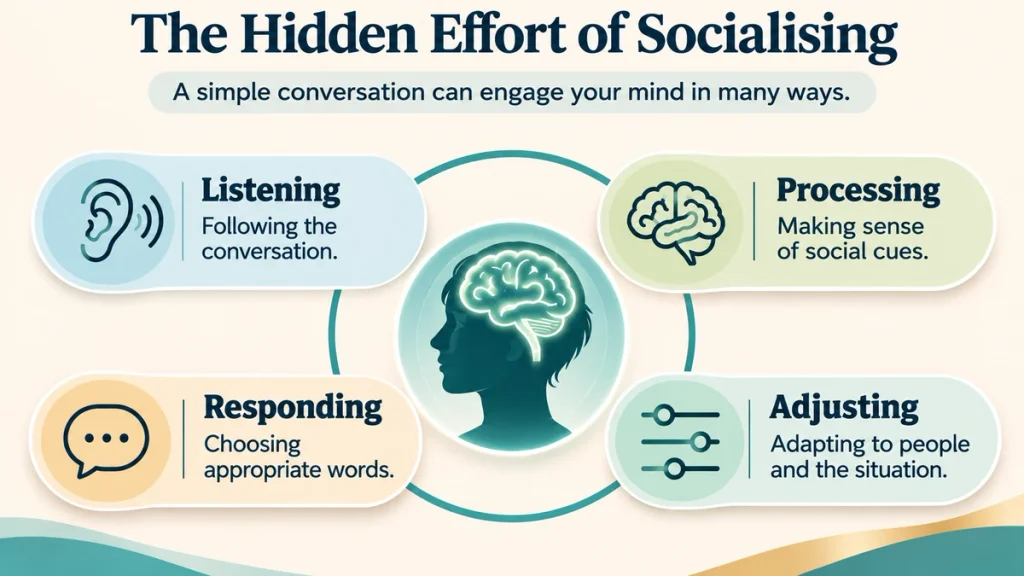
There can also be an emotional component. You may try to remain polite, avoid an uncomfortable subject, support someone who is upset or maintain a pleasant expression when you do not feel particularly energetic. These adjustments are part of ordinary social life, but they can become demanding when they happen continuously.
A small experience-sampling study by Sointu Leikas, published in Heliyon in 2020, offers one useful observation. It followed 74 participants across 1,046 observations and found that more sociable behaviour was associated with greater tiredness two to three hours later. The study was relatively small, so it should not be treated as proof that socialising is inherently exhausting. It does, however, illustrate how the effects of social activity may become noticeable after the interaction has ended.
Social interaction can also contribute to a wider sense of feeling mentally exhausted, particularly when several demands compete for your attention throughout the day. You may notice similar tiredness in other everyday situations, as explored in our article on Why Do I Feel Mentally Exhausted?.
The S.O.C.I.A.L. Load Map: Six Reasons Socialising Can Feel Draining
Social fatigue rarely has just one explanation. It may develop through a combination of sensory, cognitive and interpersonal demands. To make these influences easier to recognise, The Psyche Inspire uses the S.O.C.I.A.L. Load Map as an original explanatory framework. It is not a validated psychological scale or a diagnostic assessment; it is a practical way to reflect on what may be making an interaction tiring.
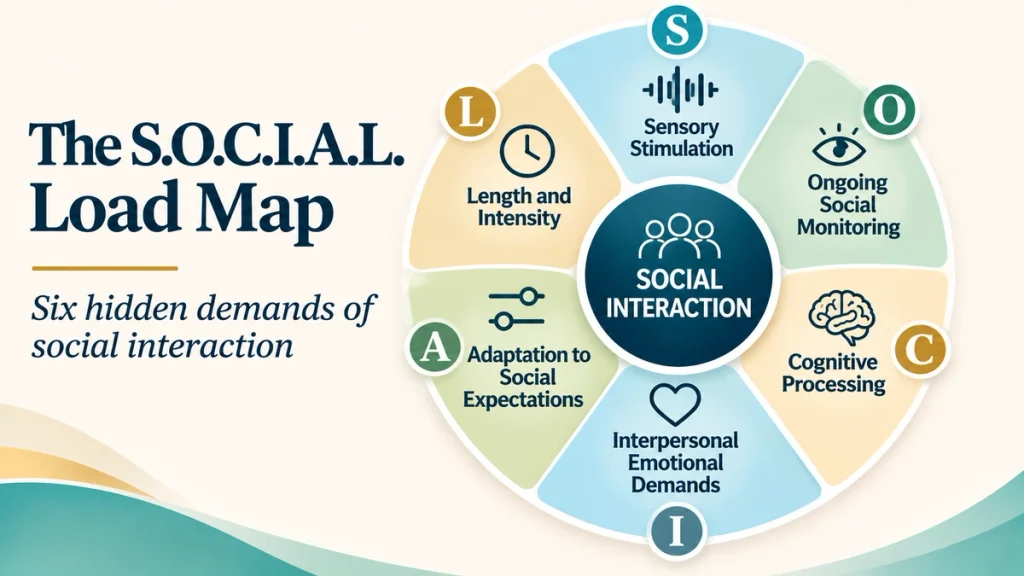
S – Sensory stimulation. Crowded rooms, background music, bright lights, movement and overlapping conversations can increase the amount of stimulation you need to manage. Even when you are enjoying the event, the environment may leave you feeling tired. This can be especially noticeable when you are sensitive to noise or other sensory input.
O – Ongoing social monitoring. You may pay close attention to how you speak, whether others are listening or how your behaviour is being received. Some self-monitoring is normal and helps conversations run smoothly. However, constantly checking how you are coming across can make an interaction feel effortful.
C – Cognitive processing. Following a conversation involves listening, understanding meaning, remembering details and preparing a response. Group discussions can make this more demanding because the topic and speaker may change quickly. When several people speak at once, keeping track of everything can become tiring.
I – Interpersonal emotional demands. Some interactions require you to listen patiently, respond sensitively or manage your own emotional reactions. You may also feel responsible for keeping the conversation comfortable. These demands can be more noticeable when someone is distressed or when the discussion involves a sensitive subject.
A – Adaptation to social expectations. Different settings often require different ways of communicating. You may speak more formally at work, behave differently around relatives or adjust your responses when meeting unfamiliar people. Adapting is a normal part of social life, but repeated adjustment can feel tiring when you have little opportunity to relax.
L – Length and intensity. Even comfortable interactions can become tiring when they continue for a long time or happen one after another. A full day of meetings, a lengthy family gathering or several social commitments over a weekend may leave little time to recover. The intensity of an interaction matters as much as its duration.
These six elements can overlap. For example, a crowded family event may involve sensory stimulation, several conversations, emotional expectations and a long period of interaction. Recognising which demands affect you most can help you understand your own experience more clearly.
Why Does Social Exhaustion Differ from Person to Person?
People do not experience social situations in the same way. One person may enjoy a busy gathering for several hours, while another may feel ready to leave after a shorter period. This difference does not necessarily indicate that one person has better social skills or greater emotional strength. Their preferences, circumstances and responses to stimulation may simply be different.
Personality can influence how people prefer to spend their time. Some people enjoy frequent interaction and feel energised by meeting others, while others prefer smaller groups, quieter settings or more time alone. Introversion and extraversion describe broad personality tendencies; they do not determine exactly how much social contact a person can manage.
Sensory preferences and communication styles may also matter. A person who finds background noise distracting may struggle in a busy restaurant but feel comfortable during a quiet one-to-one conversation. Someone who needs more time to process conversation may find fast-moving group discussions demanding. These differences should not be treated as weaknesses.
Current stress and fatigue can change the experience as well. A person who usually enjoys socialising may feel overwhelmed during a demanding work period, after poor sleep or when dealing with personal responsibilities. Social energy is not fixed, and what feels manageable on one day may feel difficult on another.
The quality of a social interaction matters too. When you feel accepted, understood and free to express yourself, being around others may feel less demanding. This connects with the psychological idea of emotional safety, which helps explain why some relationships feel more comfortable than others.
Why Do I Feel Drained After Being With Friends or People I Like?
It can be particularly confusing when you feel exhausted after spending time with people you genuinely enjoy. You may assume that if the company was pleasant, the experience should have left you feeling refreshed. But enjoyment and effort are not the same thing. You can value an interaction and still need time to recover from its demands.
Even close friendships involve attention and participation. You listen, share experiences, respond to questions and stay involved in the conversation. When the meeting lasts several hours or follows a busy day, these ordinary demands may be enough to leave you tired.
The nature of the relationship can also make a difference. With some people, you may feel comfortable speaking freely and allowing pauses in conversation. With others, you may feel pressure to keep the interaction going, avoid disagreement or manage their expectations. The emotional effort involved can vary even when you care about everyone present.
Social Baseline Theory offers one way of understanding why familiar and predictable relationships can sometimes feel less demanding. In their 2022 review, Lane Beckes and David Sbarra described how social proximity and supportive relationships may help people regulate effort and respond to challenges. This does not mean that being with others always reduces fatigue. It suggests that the quality and predictability of social connection can influence how demanding an experience feels.
If you often feel comfortable with certain people but drained after particular gatherings, pay attention to what differs between those situations. It may be the length of the meeting, the group size, the expectations placed on you or how freely you can express yourself. These observations are more useful than assuming that you simply do not enjoy socialising.
Social Fatigue, Social Anxiety or Something Else?
Social fatigue and social anxiety can sometimes feel similar, but they are not the same experience. Social fatigue mainly refers to feeling tired or depleted after interaction. Social anxiety involves significant fear or anxiety about being judged, embarrassed, rejected or scrutinised by others. A person can experience one without necessarily experiencing the other.
For example, you may enjoy meeting new people, participate comfortably in conversations and feel no particular fear during the interaction. Yet, afterwards, you may want to spend some time alone. This pattern may be more consistent with social fatigue than social anxiety. On the other hand, if you spend much of the interaction worrying about how others see you, anxiety may be contributing to the exhaustion.
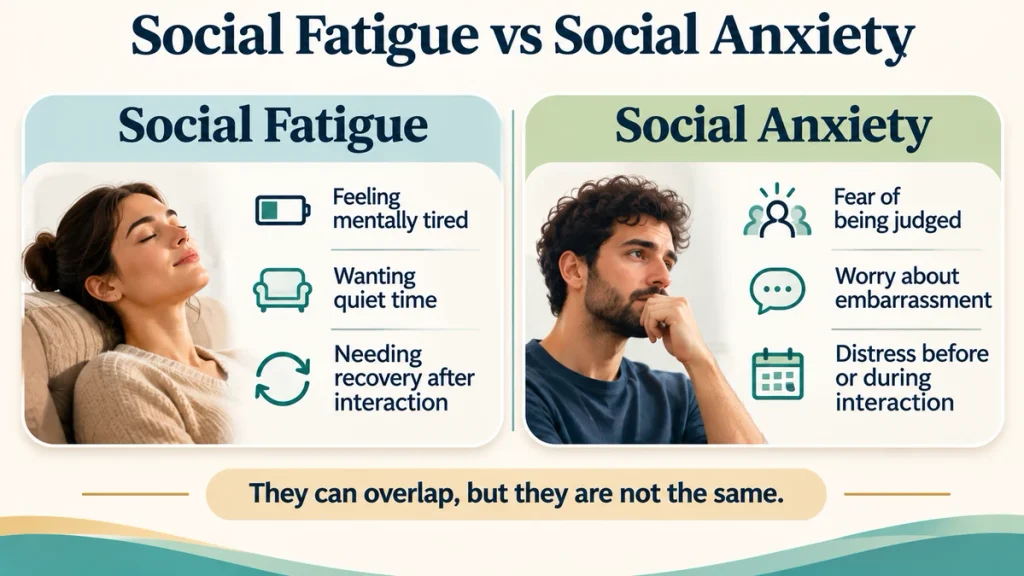
The National Institute of Mental Health explains that social anxiety disorder involves persistent fear in situations where a person may be evaluated or judged. It can lead to avoidance or significant distress and may interfere with everyday life. The concern is not simply feeling tired after meeting people; it is the intensity, persistence and impact of the fear.
Some neurodivergent people may experience additional social demands. For example, autistic people may consciously or unconsciously camouflage aspects of their behaviour to fit social expectations. A 2024 systematic review and meta-analysis by Khudiakova and colleagues found associations between camouflaging and higher anxiety, depression and social anxiety, as well as lower psychological well-being among autistic participants. These were correlational findings, and the authors highlighted the need for further longitudinal research. They should not be used to diagnose autism or explain every experience of social fatigue.
People with ADHD may also find some social situations demanding, particularly when conversations move quickly, several people speak at once or sustained attention is difficult. However, feeling tired after socialising is not, by itself, evidence of ADHD or autism. If social difficulties are persistent, affect several areas of life or cause significant distress, a qualified health professional can help explore the reasons.
Why Do I Need Time Alone After Socialising?
After a demanding interaction, you may want to sit quietly, listen to music, avoid messages or spend time without having to respond to anyone. This desire for solitude can be a normal way of reducing stimulation and allowing yourself to settle. It does not automatically mean that you are withdrawing from relationships.
The experience of being alone also depends on whether it is chosen. Time alone that feels voluntary and restorative can be different from unwanted isolation. Research published in the British Journal of Social Psychology in 2024 followed 178 adults over three weeks and found that autonomy and competence during solitude were associated with aspects of daily well-being. The findings suggest that the quality of time alone matters, not simply the number of hours spent alone.
A separate 2023 diary study of 178 adults found no single ideal balance between social time and solitude. It suggested that the relationship between time alone and well-being depended partly on whether solitude was chosen and how it fitted into a person’s daily life. This is an important distinction: needing quiet time is not automatically unhealthy, but prolonged unwanted isolation may affect well-being differently.
There is no universal recovery period after socialising. Some people feel refreshed after a short break, while others need a longer period of quiet, particularly after a demanding event or a stressful day. Rather than comparing your recovery time with someone else’s, notice whether rest helps you return to activities and relationships that matter to you.
Sometimes, the difficulty does not end when a social interaction is over. Your mind may continue thinking about conversations, responsibilities or things left unsaid. A similar experience can occur at the end of a working day, which we explore in Why Can’t I Switch Off After Work?.
How to Recover When You Feel Drained After Socialising
The first step is to give yourself a little time between social interaction and your next responsibility. You do not always have to move immediately from a gathering to household tasks, messages or another commitment. Even a short transition period can make the change feel more manageable.
Reducing stimulation may also help. You might prefer a quiet room, a short walk, a comfortable journey home or some time without background noise. Choose what helps you settle rather than following a strict routine. The purpose is not to avoid people, but to give yourself space after a demanding experience.
It can also help to reconsider how much responsibility you take during conversations. You do not have to fill every silence, keep everyone entertained or agree with every opinion. Allowing conversations to develop naturally can reduce the pressure to manage every moment. If a gathering is becoming tiring, it is reasonable to take a short break or leave when appropriate.
Planning social commitments with some flexibility can make a difference. If you have a busy week, consider whether every gathering needs to be attended or whether some plans can be shortened. You may also find that smaller groups, quieter places or one-to-one conversations suit you better. The aim is to make social connection more sustainable, not to remove it from your life.
When Should You Pay More Attention to Social Exhaustion?
Occasional tiredness after socialising is common and does not necessarily indicate a deeper problem. However, it is worth paying attention when the exhaustion becomes persistent, unusually intense or begins to interfere with your daily life. For example, you may find yourself regularly cancelling plans, struggling to concentrate at work or feeling unable to recover even after adequate rest.
Notice whether the experience is linked to particular situations. You may feel drained only in crowded environments, after emotionally difficult conversations or when you are worried about being judged. Alternatively, the tiredness may be present even when you are not socialising. Looking at the wider pattern can help distinguish social demands from other sources of fatigue.
If exhaustion is accompanied by persistent low mood, loss of interest, sleep difficulties, ongoing anxiety or significant changes in your ability to function, consider speaking with a qualified health professional. Physical health, sleep problems, stress and mental health difficulties can all contribute to tiredness. It is important not to assume that every form of exhaustion has a social or personality-based explanation.
Seeking support does not mean that your experience is abnormal. It can simply help you understand what is happening and identify appropriate ways to manage it. The most useful question is not whether you should be able to socialise for longer, but whether your current experience is affecting your well-being and everyday life.
Understanding Your Social Energy Without Avoiding Human Connection
Understanding social fatigue is not about labelling yourself as an introvert or deciding that social interaction is something you should avoid. It is about recognising that different situations require different amounts of attention, emotional effort and adjustment. Once you understand these demands, you can make choices that better support your well-being.
You might discover that you enjoy meaningful conversations but find large gatherings tiring. You may prefer meeting one person at a time, choosing quieter places or keeping some evenings free after a demanding day. These are practical adjustments, not signs that you are failing socially.
It is also worth remembering that relationships need room for ordinary, imperfect interaction. You do not have to be constantly entertaining, available or emotionally responsive to maintain a connection. Healthy relationships can allow for pauses, personal boundaries and different levels of social energy.
The aim is to find a balance that allows you to stay connected without repeatedly ignoring your own limits. You can make space for other people while also respecting the time and conditions you need to feel comfortable.
Conclusion: You Can Enjoy People’s Company and Still Need Time for Yourself
Perhaps you have wondered why a pleasant conversation leaves you tired, why you look forward to meeting people but feel relieved when you return home, or why even familiar company can sometimes feel overwhelming. These experiences do not necessarily mean that you dislike people or that something is wrong with you. They may simply reflect the effort involved in a particular interaction.
You can genuinely enjoy someone’s company and still need quiet time afterwards. You can value your relationships without being available all the time. And you can protect your energy without distancing yourself from the people who matter.
Instead of judging yourself for feeling drained after socialising, try to understand what makes certain interactions demanding. It may be the noise, the pace of conversation, the emotional expectations or the amount of time you spend adjusting to others. Recognising these patterns can help you make more comfortable choices.
You do not have to become endlessly sociable to build meaningful connections. A healthy social life also leaves room for rest, personal boundaries and the freedom to be yourself. Sometimes, the balance you need is not more socialising or less socialising, but a way of connecting with others that feels sustainable.
Frequently Asked Questions
1. Why do I feel drained after socialising even when I enjoy it?
Enjoying an interaction does not mean it requires no effort. Listening, responding, following conversations and adjusting to social expectations all involve attention. You can appreciate the time you spend with people and still need a break afterwards.
2. Why do I feel exhausted after being around people?
The reason may depend on the situation. Crowded environments, several conversations, unfamiliar people or emotionally demanding interactions can increase the effort involved. Your current stress level and quality of rest may also influence how you feel.
3. Is feeling drained after socialising a sign of introversion?
Not necessarily. Introversion describes a personality tendency, not a condition or a fixed limit on social interaction. People with different personality styles can experience social fatigue, depending on the demands of the situation.
4. How long does social exhaustion last?
There is no fixed recovery time. Some people feel better after a short period of quiet, while others need longer after a busy or emotionally demanding event. If exhaustion is persistent or affects everyday functioning, it is worth exploring other possible causes with a health professional.
5. Can ADHD or autism make socialising more tiring?
Some people with ADHD may find fast-moving conversations or sustained attention demanding. Some autistic people may experience additional effort related to sensory input, communication differences or camouflaging. However, social fatigue alone cannot establish either diagnosis.
6. Why do I feel drained after meeting friends?
Even enjoyable friendships involve attention, conversation and emotional participation. The length of the meeting, the size of the group and how comfortable you feel expressing yourself can all influence your energy. Needing time alone afterwards does not mean you value the friendship any less.
7. Is wanting to be alone after socialising unhealthy?
Not automatically. Chosen solitude can provide a welcome opportunity to rest and reduce stimulation. It becomes more concerning when isolation is unwanted, persistent or begins to interfere with relationships and everyday activities.
References and Further Reading
- Leikas, S. (2020). Sociable behavior is related to later fatigue: Moment-to-moment patterns of behavior and tiredness. Heliyon, 6(5), e04033. Read the open-access study.
- Beckes, L., & Sbarra, D. A. (2022). Social baseline theory: State of the science and new directions. Current Opinion in Psychology, 43, 36–41. Read the article record.
- Khudiakova, V., Russell, E., Sowden-Carvalho, S., & Surtees, A. D. R. (2024). A systematic review and meta-analysis of mental health outcomes associated with camouflaging in autistic people. Research in Autism Spectrum Disorders, 118, 102492. Read the study.
- Need satisfaction in daily well-being: Both social and solitude contexts contribute to well-being. British Journal of Social Psychology (2024). Read the research record.
- Balance between solitude and socializing: Everyday solitude time both benefits and harms well-being. Read the research record.
- National Institute of Mental Health. Social Anxiety Disorder: What You Need to Know. Read the NIMH guide.