
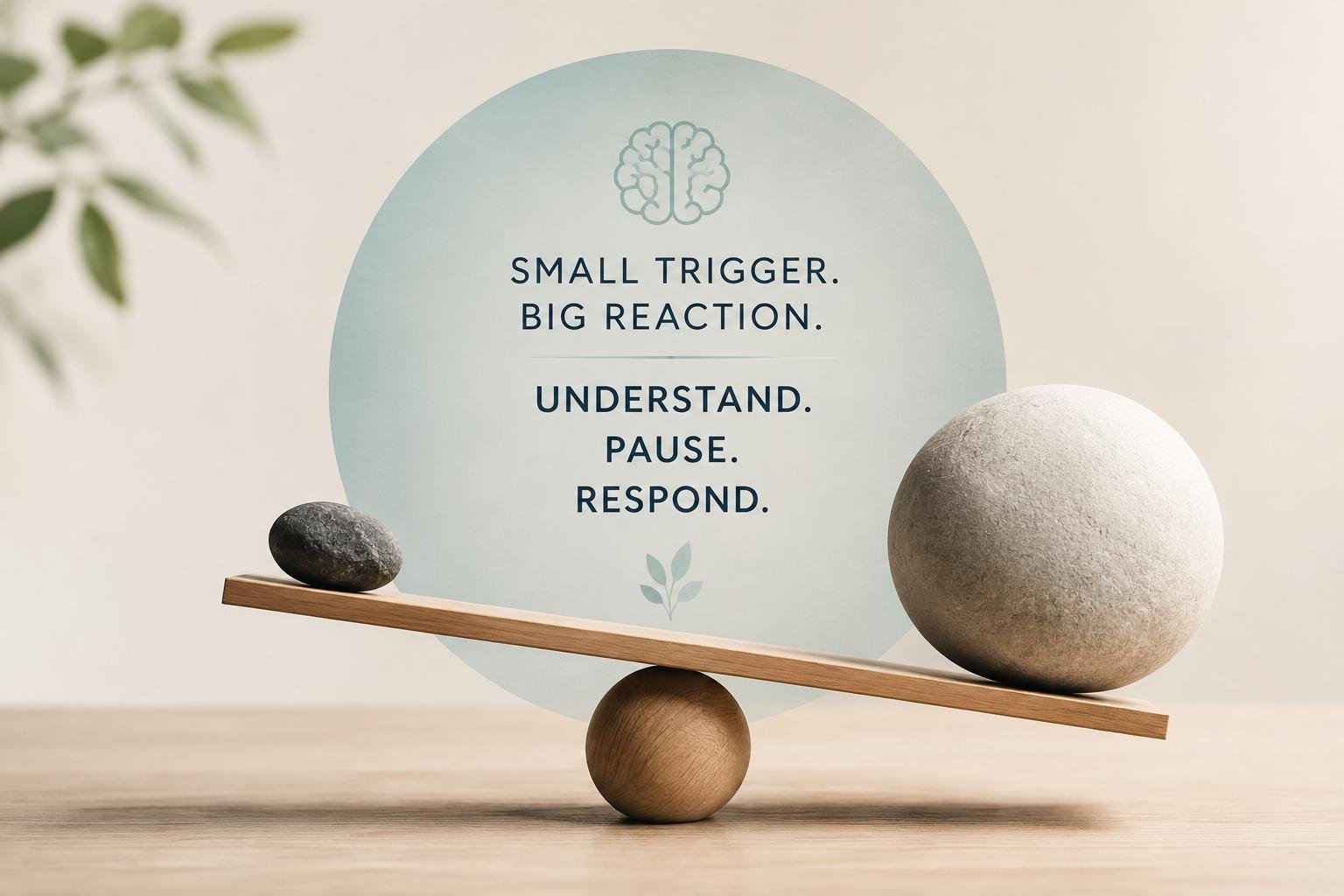
“Sometimes it isn’t the small thing that hurts—it’s everything that small thing silently represents.”
Have you ever found yourself reacting far more strongly than a situation seemed to deserve?
Perhaps a casual remark from a colleague ruined your entire day. A delayed text message left you feeling unexpectedly anxious. A loved one forgot something important, and you felt hurt long after the moment had passed. Looking back, you may even have wondered, “Why did I react like that?”
If you’ve ever asked yourself, “Why do I overreact to small things?”, you’re not alone. Many people experience moments where their emotional response feels much bigger than the event itself. These reactions can be confusing, especially when you recognize that your feelings seem disproportionate but still struggle to control them.
Table of Contents
The good news is that emotional overreactions are rarely random. They often reflect how our brain interprets experiences, how much emotional stress we are already carrying, and the personal meaning we assign to everyday situations. Understanding these processes doesn’t excuse harmful behavior, but it does help explain why some moments feel so overwhelming.
This article explores the psychology behind emotional overreactions, why seemingly minor events can trigger powerful feelings, and how developing emotional fitness can help you respond more thoughtfully over time.
What Does It Really Mean to “Overreact”?
The word “overreact” is commonly used in everyday conversations, but it can sometimes be misleading.
An emotional reaction is not “too much” simply because it is intense. Emotions themselves are not right or wrong—they are signals that tell us something feels important. The question is whether the intensity of the reaction matches the demands of the present situation.
Imagine two people receiving the same constructive feedback at work.
One person thinks,
“That’s useful. I’ll improve.”
The other immediately feels embarrassed, criticised, or deeply discouraged.
The situation is identical, yet the emotional experience is completely different.
Why?
Because our brains don’t react only to what happens—they react to what the event means to us.
Psychologists describe this process as cognitive appraisal, the way we evaluate and interpret an event before experiencing an emotional response. Two people can experience the same situation but arrive at very different emotional outcomes because their interpretations differ.
This is one reason emotional overreactions often surprise us. The reaction isn’t driven solely by the event itself; it’s influenced by our beliefs, expectations, previous experiences, and current emotional state.
Rather than asking,
“Why am I so emotional?”
a more helpful question is,
“What meaning did my mind attach to this situation?”
That shift in perspective is often the first step toward greater emotional awareness.
Why Small Things Can Feel So Big
One of the biggest misconceptions about emotional overreactions is that people are simply “too sensitive.”
Psychological research suggests something far more interesting.
Our emotional response is influenced less by the objective size of an event and more by the personal significance we assign to it.
For example:
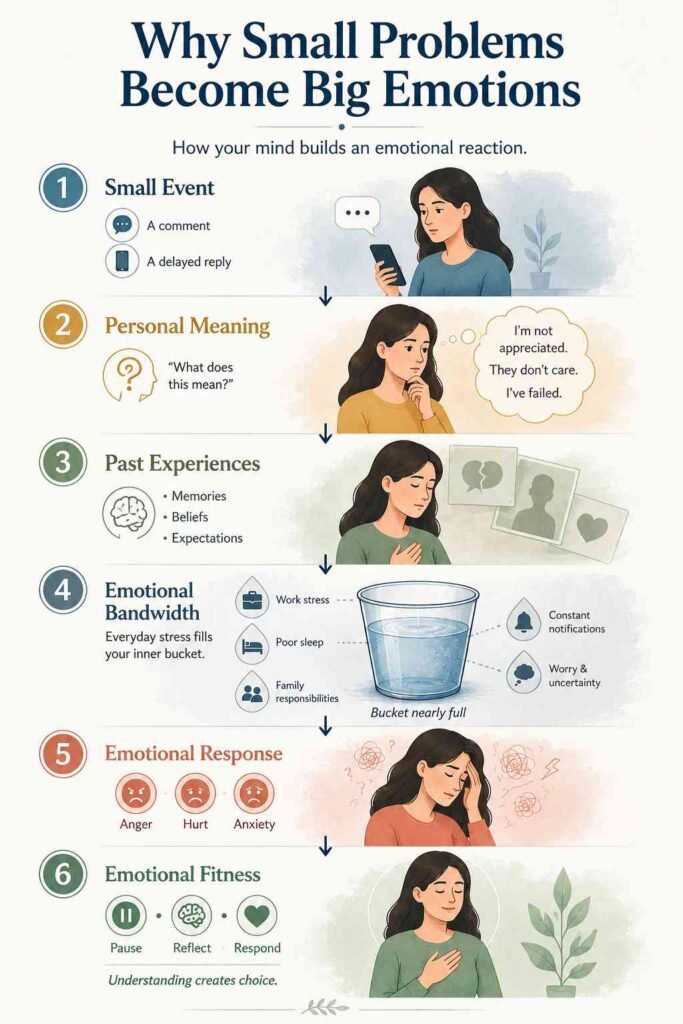
- A forgotten birthday may represent feeling unimportant.
- A short reply to a message may be interpreted as rejection.
- A small mistake at work may feel like proof of failure.
- A disagreement with a partner may awaken fears of losing the relationship.
Notice that the emotional pain doesn’t come only from the event itself. It comes from the story our mind tells us about the event.
This is where emotional overreactions begin.
A seemingly small experience can quickly become connected to deeper concerns about belonging, competence, safety, or self-worth. The stronger that connection, the stronger the emotional response is likely to be.
That doesn’t mean your feelings are irrational. It means your mind is trying to protect something that feels important.
Understanding this difference can reduce self-judgment.
Instead of saying,
“I’m overreacting again.”
you can begin asking,
“Why does this situation matter so much to me?”
Curiosity often leads to greater insight than criticism.
Your Emotional Bandwidth: Why Even Small Problems Can Feel Overwhelming
Have you ever noticed that the same situation can affect you very differently depending on the day?
Imagine this.
On a relaxed Sunday morning, someone accidentally spills coffee on your shirt. You laugh, change your clothes, and move on.
Now imagine the same incident after a week of poor sleep, work deadlines, family responsibilities, and emotional exhaustion. Suddenly, the spilled coffee feels like the final straw. You become frustrated, snap at someone nearby, or spend the next hour feeling overwhelmed.
The coffee didn’t change.
Your emotional bandwidth did.
Emotional bandwidth refers to your mind’s ability to process everyday challenges without becoming overwhelmed. Just as your phone battery drains throughout the day, your emotional resources also become depleted by stress, uncertainty, decision-making, and constant demands.
When those resources are running low, even minor inconveniences can feel much larger than they really are.
This doesn’t mean you’re weak or incapable. It means your emotional system has less capacity available in that moment.
Understanding this idea can help shift the conversation from self-criticism to self-awareness.
Instead of asking,
“Why am I so impatient?”
you might begin asking,
“How much emotional energy do I actually have available right now?”
That simple question often leads to greater compassion—and better emotional choices.
The Stress Bucket: Why Small Events Sometimes Overflow
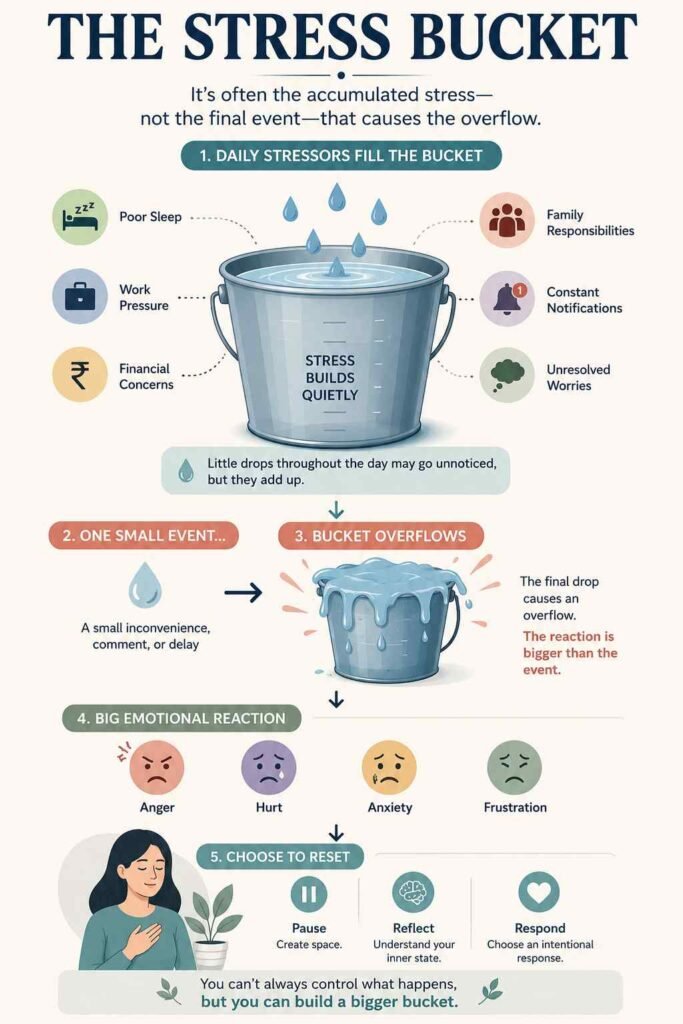
One of the simplest ways psychologists explain emotional overload is through the Stress Bucket Model.
Imagine that everyone carries an invisible bucket.
Throughout the day, different experiences gradually fill it.
Some of these experiences are obvious:
- Work pressure
- Financial worries
- Family responsibilities
Others are surprisingly subtle:
- Poor sleep
- Constant notifications
- Long commutes
- Feeling unheard
- Decision fatigue
- Background anxiety
Each one adds a little more water.
Most of the time, we continue functioning without noticing how full our bucket has become.
Then something seemingly insignificant happens.
Perhaps someone interrupts you during a meeting.
A family member forgets to reply.
Your internet stops working.
On the surface, these events appear trivial.
But emotionally, they become the final drop that causes the bucket to overflow.
The reaction isn’t only about that one moment.
It’s about everything that came before it.
This explains why people sometimes say,
“I don’t even know why I got so upset.”
The truth is, they weren’t reacting to one event—they were reacting to accumulated emotional load.
Recognizing this pattern can help reduce shame and encourage healthier coping before emotional overwhelm takes over.
Your Brain Reacts Faster Than Your Thinking Mind
When emotions run high, our brains naturally prioritize speed over accuracy.
This is an evolutionary advantage. In dangerous situations, reacting quickly could protect us from harm.
However, in everyday life, this fast response can sometimes create unnecessary emotional intensity.
For example:
A friend replies with a brief message.
Before you’ve had time to think, your mind may jump to conclusions:
“Are they upset with me?”
“Did I say something wrong?”
“Have I disappointed them?”
Within seconds, your body may respond with tension, a racing heart, or anxiety—even though you don’t yet have enough information to know what the message actually meant.
Psychologists refer to this as automatic appraisal.
Your brain rapidly evaluates situations based on previous learning, expectations, and emotional significance.
Most of the time, this process happens outside conscious awareness.
That’s why emotional overreactions often feel so immediate.
The emotional system acts first.
Conscious reasoning catches up later.
Developing emotional fitness doesn’t eliminate these automatic responses.
Instead, it strengthens your ability to pause long enough for your thoughtful brain to join the conversation.
Emotional Magnification: When the Mind Enlarges Small Events
Our minds naturally pay more attention to emotionally important information.
Sometimes, however, this protective tendency becomes exaggerated.
Psychologists often describe this pattern as magnification, where the emotional importance of a situation becomes much larger than its objective reality.
Consider these examples:
Situation
Your manager says,
“Can we talk later?”
Possible Interpretation
“I’m probably in trouble.”
Situation
A friend cancels dinner.
Possible Interpretation
“They don’t enjoy spending time with me anymore.”
Situation
Your partner seems unusually quiet.
Possible Interpretation
“Something must be wrong between us.”
In each example, the mind fills in missing information with emotionally meaningful assumptions.
Notice that the emotional reaction isn’t caused by facts alone.
It’s shaped by interpretation.
Learning to recognize these mental patterns doesn’t mean ignoring your emotions.
It means becoming curious about the story your mind is creating before accepting it as reality.
That curiosity is one of the strongest predictors of emotional resilience.
Emotionally Healthy People Still Overreact Sometimes
One of the biggest myths about emotional health is that emotionally mature people remain calm all the time.
They don’t.
Everyone has difficult days.
Everyone loses patience.
Everyone occasionally reacts more strongly than intended.
The difference isn’t perfection.
It’s recovery.
Research consistently shows that psychological well-being is less about avoiding difficult emotions and more about how effectively we recover from them.
Emotionally healthy people tend to:
- Notice their reactions sooner.
- Reflect rather than ruminate.
- Repair relationships after conflict.
- Learn from emotional experiences.
- Return to emotional balance more quickly.
This ability to recover is a central part of emotional fitness.
Just as physical fitness isn’t measured by never becoming tired, emotional fitness isn’t measured by never becoming emotional.
It’s measured by how effectively you regain balance after life’s inevitable emotional challenges.
How Emotional Overreactions Can Affect Daily Life
Emotional overreactions rarely stay limited to a single moment. A heated argument, an impulsive reply, or hours spent replaying a small incident can quietly ripple into different areas of life. What begins as an intense emotional response can gradually shape the way you think, communicate, and even see yourself.
In relationships, reacting more strongly than a situation calls for can lead to misunderstandings and unnecessary conflict. You may later realize that your partner, friend, or colleague was responding to the situation itself, while you were reacting to something much deeper. Over time, this pattern can make it difficult to feel truly heard, understood, or emotionally connected.
The same pattern often shows up at work or in everyday responsibilities. A simple piece of feedback may feel like harsh criticism, or a small setback may seem like a personal failure. Instead of responding thoughtfully, your mind may become caught in self-doubt, frustration, or overthinking, making it harder to focus on what really matters.
Your body feels the impact too. Frequent emotional overreactions keep your nervous system on high alert, leaving you mentally drained and physically exhausted. You may notice tension, restless sleep, headaches, or a constant feeling of being “on edge,” even when there is no real danger.
The good news is that emotional overreactions are not permanent parts of your personality. As you begin to understand your patterns, regulate your emotions, and create a small pause between trigger and response, everyday situations lose their power to overwhelm you. Over time, that pause becomes one of the strongest signs of emotional fitness—and one of the greatest gifts you can give yourself.
From Overreacting to Responding: Building Emotional Fitness One Moment at a Time
Understanding why emotional overreactions happen is important, but awareness alone doesn’t always change behavior.
Most of us don’t realize we’re overreacting until the moment has already passed.
We’ve raised our voice.
Sent the message.
Withdrawn from the conversation.
Or spent hours replaying the situation in our minds.
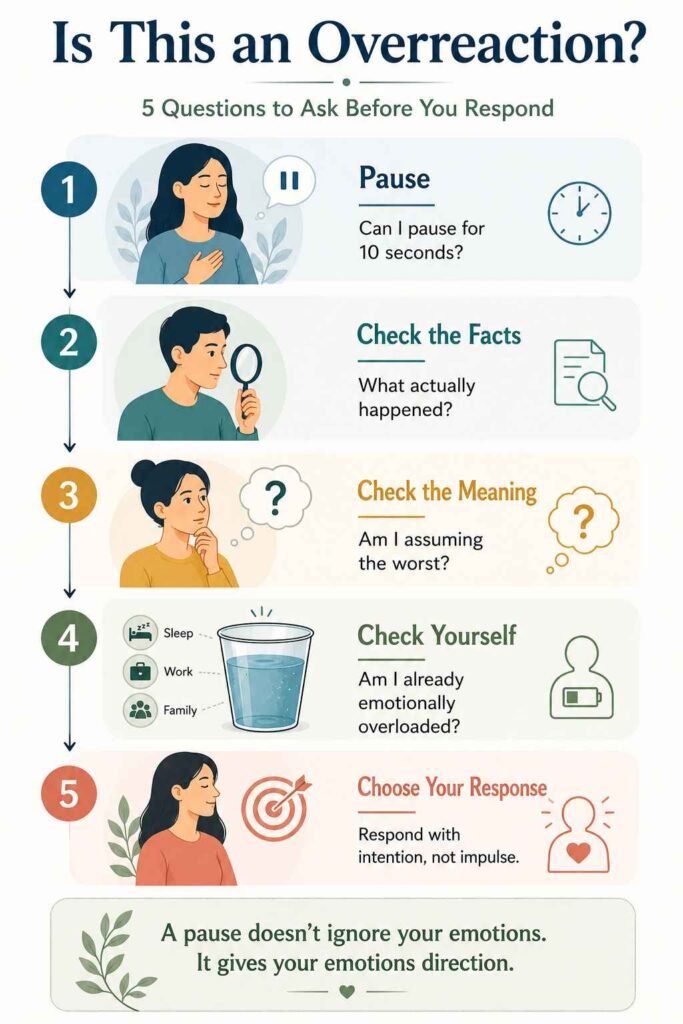
Real change begins when we create a small but powerful gap between what happens and how we respond.
Psychiatrist Viktor Frankl famously wrote:
“Between stimulus and response there is a space. In that space is our power to choose our response.”
That space may last only a few seconds, but it is where emotional fitness begins.
The S.P.A.C.E. Method
A Practical Framework for Responding Instead of Reacting
Most advice about emotions focuses on controlling feelings.
A healthier goal is learning how to guide your response.
The S.P.A.C.E. Method offers a simple way to do that.
S — Slow Down
Your first reaction doesn’t always need to become your first action.
Take one slow breath.
Relax your shoulders.
Give your brain a few extra seconds.
Those seconds allow your thinking mind to catch up with your emotional mind.
P — Pause and Notice
Instead of asking,
“Why am I like this?”
try asking,
“What am I feeling right now?”
Naming emotions increases awareness.
Sometimes you’re feeling disappointed rather than angry.
Or anxious rather than frustrated.
That distinction matters.
A — Ask What It Means
Emotions are influenced by interpretation.
Ask yourself:
- What am I assuming?
- What does this situation mean to me?
- Am I reacting to today’s event or to something older?
Curiosity often softens emotional intensity.
C — Choose a Helpful Perspective
Our first explanation isn’t always the most accurate one.
Perhaps your friend is busy.
Perhaps your colleague is distracted.
Perhaps the criticism was intended to help rather than hurt.
Choosing another perspective doesn’t deny your emotions.
It simply creates room for flexibility.
E — Engage with Intention
Now decide how you want to respond.
Sometimes the healthiest response is speaking calmly.
Sometimes it’s asking a question.
Sometimes it’s waiting until tomorrow.
Intentional responses strengthen trust—in yourself and in your relationships.
When Should You Seek Extra Support?
Occasionally reacting strongly is part of being human.
However, if emotional overreactions are becoming frequent, affecting your relationships, work, or daily life, or leaving you feeling persistently distressed, it may be helpful to speak with a qualified mental health professional.
Support can be especially valuable if your reactions are linked to unresolved trauma, chronic anxiety, depression, or other concerns that feel difficult to manage alone.
Seeking help is not a sign of weakness. It’s an investment in understanding yourself more deeply.
Frequently Asked Questions (FAQs)
Q1. Why do I overreact to small things?
Overreacting to small things often happens when the brain assigns deeper personal meaning to an event than it appears to have on the surface. Stress, emotional exhaustion, past experiences, and automatic thought patterns can all make minor situations feel much more significant than they objectively are.
Q2. Is overreacting a sign of emotional weakness?
No. Everyone overreacts occasionally. Emotional overreactions are usually linked to how we interpret situations, our current stress level, and our emotional regulation skills—not a lack of character or strength.
Q3. Can stress make me overreact?
Yes. Chronic stress reduces your emotional bandwidth, making it harder to respond calmly. When you’re mentally or physically exhausted, even small inconveniences can feel overwhelming.
Q4. Why do I overreact more with people I love?
Relationships often involve emotional needs, expectations, and vulnerability. Because these connections matter deeply, misunderstandings or disappointments may trigger stronger emotional responses than similar situations with strangers.
Q5. How can I stop overreacting?
Learning to pause before responding, identifying the meaning you’re assigning to the situation, calming your nervous system, and considering alternative perspectives can help you respond more thoughtfully over time. Emotional regulation is a skill that improves with consistent practice.
Q6. When should I seek professional help for emotional overreactions?
If emotional overreactions are frequent, difficult to control, affecting your relationships or work, or causing significant distress, consider speaking with a qualified mental health professional for personalized support.
Final Thoughts
If you’ve ever asked yourself, “Why do I overreact to small things?”, remember this:
Your emotions are not evidence that you are “too sensitive” or “too emotional.”
Often, they reflect the way your mind interprets experiences, the emotional load you’re already carrying, and the meaning you’ve learned to attach to certain situations.
The encouraging news is that these patterns are not fixed.
Every moment of awareness creates an opportunity for change.
Every thoughtful pause strengthens emotional fitness.
And every intentional response teaches your brain that it has more than one way to face life’s challenges.
Progress doesn’t come from never reacting.
It comes from recovering with greater understanding, responding with greater intention, and treating yourself with the same compassion you would offer someone you care about.
Because emotional strength isn’t about feeling less.
“It’s about understanding your emotions well enough that they no longer make every decision for you.”
1 thought on “Why Do I Overreact to Small Things? The Hidden Psychology Behind Emotional Overreactions”