

Have you ever wondered why two people can face the same difficult situation yet respond in completely different ways?
One person pauses, takes a deep breath, and thinks before speaking. Another becomes overwhelmed with anger. Someone else withdraws into silence. A fourth spends the next several days replaying the conversation in their mind, questioning every word they said.
At first glance, these reactions may seem like differences in personality. However, understanding how childhood shapes emotional regulation throughout life reveals that our emotional responses are influenced by something deeper than personality alone. From our earliest relationships and experiences, our brains begin learning how to understand, express, and regulate emotions, creating patterns that can influence us well into adulthood.
Long before we developed language, career ambitions, or personal goals, our brains were quietly learning important emotional lessons. Through thousands of everyday interactions—being comforted when we cried, encouraged when we struggled, listened to when we felt scared, or even ignored when we needed reassurance—we gradually developed an internal map for responding to the world around us.
These early experiences do not determine our future, nor do they define who we are forever. Human development is far more hopeful than that. While childhood plays an important role in shaping emotional regulation, the brain remains capable of learning healthier emotional patterns throughout life. This remarkable ability to adapt, often called neuroplasticity, reminds us that change is possible well beyond childhood.
Understanding where our emotional habits come from is not about assigning blame to parents, caregivers, or ourselves. Every family exists within its own circumstances, cultures, stresses, and strengths. Most caregivers do the best they can with the knowledge and resources available to them. Instead of searching for someone to blame, this article invites you to become curious about your own emotional history.
Curiosity creates space for understanding, and understanding creates space for change.
Throughout this guide, we’ll explore what emotional regulation really is, how childhood experiences influence the developing brain, why certain situations trigger intense reactions, and what modern psychological research tells us about building healthier emotional habits in adulthood. We’ll also introduce practical, evidence-informed strategies that can support greater emotional awareness, resilience, and self-compassion in everyday life.
Whether you’ve found yourself overthinking conversations, reacting strongly to criticism, struggling to calm down after conflict, or simply wondering why your emotions sometimes feel difficult to manage, you’re not alone. Many people ask these questions at different stages of life. Seeking to understand your mind is not a sign of weakness—it is often the first step toward greater emotional freedom.
This article is designed for anyone who wants to better understand the science of emotions while learning practical ways to strengthen emotional fitness. It is intended for educational purposes and should not be considered a substitute for personalized advice from a qualified mental health professional. If emotional distress is persistent, severe, or significantly affects your daily life, reaching out to a licensed psychologist, psychiatrist, or other qualified mental health professional is an important step.
Your childhood may have introduced you to your first emotional lessons.
But your future is still being written.
Let’s begin by understanding emotional regulation—the essential psychological skill at the heart of how childhood shapes emotional regulation throughout life and one that influences our relationships, well-being, and resilience every single day.
Note: How to Use This Guide

This is a comprehensive educational guide designed to be read at your own pace. Feel free to bookmark it and return to different sections as your understanding grows. While each section stands on its own, reading the guide from beginning to end will provide the clearest understanding of how emotional regulation develops and how it can continue to strengthen throughout life.
Table of Contents
What Is Emotional Regulation? (It’s More Than “Controlling Your Emotions”)
When people hear the term emotional regulation, they often imagine someone who never gets angry, never cries, and always stays calm under pressure.
In reality, emotional regulation has very little to do with becoming emotionless.
Instead, it is the ability to recognize, understand, express, and respond to emotions in ways that are appropriate for the situation and aligned with our values. It doesn’t mean avoiding sadness, suppressing anger, or pretending everything is fine. Rather, it means developing the flexibility to experience emotions without allowing them to completely dictate our thoughts or actions.
Imagine you’re driving a car during heavy rain. Emotional regulation isn’t about turning off the rain—it isn’t possible. Instead, it’s like learning to drive safely despite the changing weather. You may slow down, increase your awareness, or choose a different route, but you continue moving forward with intention rather than panic.
Our emotions work much the same way. We cannot prevent them from appearing, but we can gradually learn healthier ways to navigate them.
Psychologists describe emotional regulation as one of the most important life skills because it influences nearly every area of our lives—from relationships and parenting to work, decision-making, physical health, and overall well-being. People with stronger emotional regulation are not people who experience fewer emotions. They are people who have developed effective ways of responding to those emotions.
Research over the past several decades suggests that emotional regulation supports resilience, healthier relationships, improved psychological well-being, and better coping during stressful situations. Conversely, persistent difficulties with emotional regulation have been associated with greater emotional distress across a variety of psychological conditions. Importantly, emotional regulation challenges are not a diagnosis in themselves, and many people can strengthen these skills through learning, practice, and, when needed, professional support.
One of the biggest misconceptions is that emotional regulation means “staying positive.”
It doesn’t.
Healthy emotional regulation allows room for grief after loss, fear during uncertainty, frustration when something feels unfair, and joy during meaningful moments. Every emotion carries information. The goal is not to silence emotions but to understand what they may be communicating.
Think of emotions as the dashboard lights in a car. A warning light is not the problem itself—it is information that invites us to pay attention. Ignoring the light doesn’t fix the engine, and smashing the dashboard doesn’t remove the issue. In the same way, suppressing emotions may quiet them temporarily, but it rarely resolves the underlying experience that produced them.
Emotional regulation helps us respond thoughtfully instead of reacting automatically. That distinction is small in words but profound in everyday life.
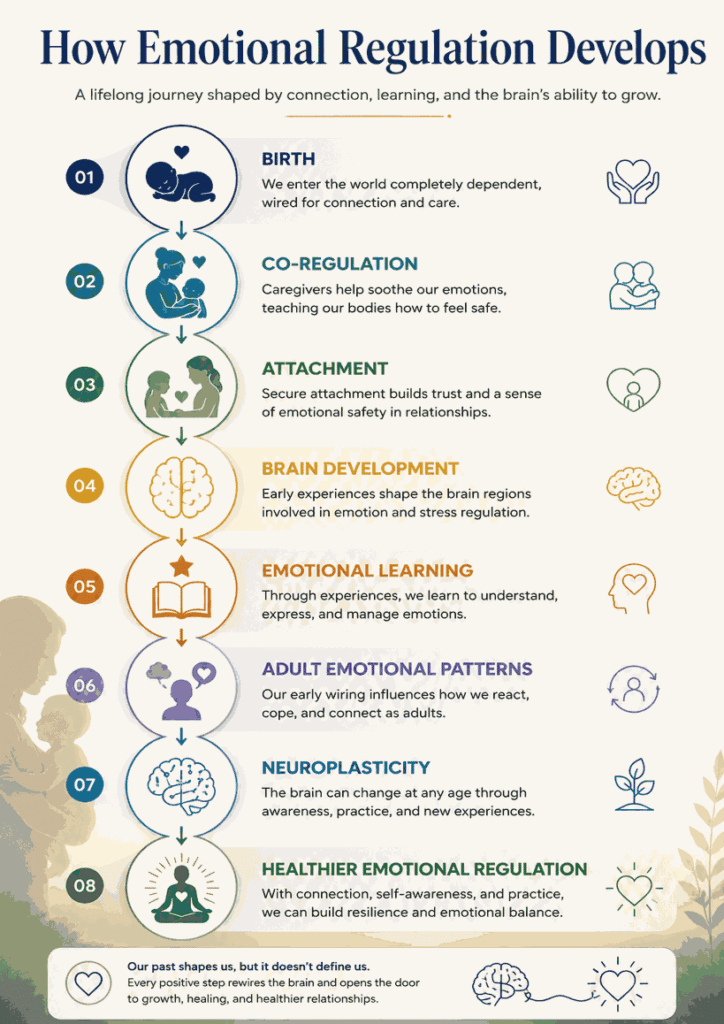
Why Do People React So Differently to the Same Situation?
Consider this everyday scenario.
Two colleagues receive identical constructive feedback from their manager.
One thinks, “That’s helpful. I’ll work on those points and improve.”
The other spends the entire evening replaying the conversation, wondering whether they are about to lose their job.
The event is the same.
The emotional experience is not.
Why?
Psychology suggests that our reactions are shaped by far more than the present moment. They are influenced by our previous experiences, beliefs, expectations, memories, current stress levels, personality traits, physical health, and the emotional patterns our brains have learned over many years.
Our brain is constantly asking one important question:
“Is this situation safe, or is it a threat?”
Remarkably, it answers this question long before we consciously begin analyzing what happened.
For someone who grew up in an emotionally supportive environment, constructive criticism may be interpreted as guidance and an opportunity to learn.
For someone whose early experiences involved frequent criticism, rejection, unpredictability, or emotional invalidation, similar feedback may feel deeply personal or emotionally unsafe—even when no harm is intended.
This doesn’t mean one person is “too sensitive” or another is “stronger.” It means their brains have learned different emotional expectations based on different life experiences.
Understanding this difference helps replace self-judgment with curiosity.
Instead of asking,
“Why am I like this?”
we can begin asking,
“What might my brain have learned that makes this situation feel so difficult?”
That question opens the door to self-understanding rather than self-criticism.
How Children Learn Emotions Before They Learn Words
One of the most fascinating discoveries in developmental psychology is that children begin learning about emotions long before they can explain them.
A newborn cannot say,
“I’m frightened.”
A toddler cannot explain,
“I’m feeling overwhelmed because my routine changed.”
Yet their brains are already absorbing thousands of emotional experiences every single day.
Every time a caregiver responds to a baby’s cry, smiles back during play, comforts them after a frightening experience, or helps them calm down after becoming overwhelmed, the child’s brain is quietly learning important lessons.
These repeated interactions teach questions such as:
- Is the world generally safe?
- Can I rely on other people when I need help?
- What happens when I feel afraid?
- Is it acceptable to express sadness?
- Will someone help me calm down when I become overwhelmed?
Children are not born knowing how to regulate intense emotions independently.
They first learn emotional regulation through co-regulation.
Co-regulation describes the process in which a calm, responsive adult helps a child move from emotional overwhelm toward a sense of safety and balance. Through consistent experiences of being soothed, understood, and comforted, children gradually begin developing the ability to regulate themselves.
Think about a young child who falls while learning to ride a bicycle.
Often, before deciding how badly they’re hurt, they instinctively look toward a trusted adult.
If the caregiver responds with calm reassurance—checking for injuries, offering comfort, and encouraging them—the child’s nervous system begins settling.
If the adult responds with panic or harsh criticism, the child’s emotional experience may become even more intense.
Over hundreds and eventually thousands of similar interactions, the brain starts recognizing emotional patterns.
Little by little, what was once borrowed from caregivers becomes an internal skill.
This is one reason psychologists often describe caregivers as a child’s first emotional teachers.
Importantly, perfection has never been the goal.
Children do not need flawless parents.
Developmental research consistently suggests that what matters most is not perfect parenting but “good enough” caregiving—relationships in which caregivers are responsive most of the time, repair misunderstandings after conflict, and provide a generally safe, predictable emotional environment. Moments of frustration, disagreement, or emotional missteps are a normal part of family life. In fact, healthy repair after conflict often teaches children that relationships can withstand mistakes and still remain secure.
The Brain’s First Emotional Classroom
Although emotional regulation continues developing throughout life, some of its most important foundations are built during childhood because the brain itself is still under construction.
You can think of a young child’s brain as a city that is gradually building its roads.
Every repeated emotional experience lays down another pathway.
Roads that are used frequently become stronger, wider, and easier to travel.
Roads that are rarely used may remain narrow or gradually fade.
The brain develops in much the same way.
Repeated experiences of safety, comfort, predictable routines, emotional validation, and supportive relationships strengthen networks involved in emotional learning.
Repeated experiences of chronic stress, unpredictability, or persistent fear can shape different patterns of responding.
This is not because the brain is “damaged” beyond repair.
It is because the developing brain is remarkably adaptable.
It learns from whatever environment it experiences most consistently.
That adaptability is one of childhood’s greatest strengths—but it is also why early experiences matter.
The encouraging news is that this same adaptability continues throughout adulthood.
The brain never completely loses its capacity to learn.
Understanding how emotional pathways were formed is not about becoming trapped in the past.
It is about recognizing that the pathways the brain once learned can also be strengthened, reshaped, and expanded through new experiences, supportive relationships, intentional practice, and, when appropriate, evidence-based psychological treatment.
That possibility for lifelong change is one of the most hopeful discoveries in modern psychology.
It reminds us that while childhood may influence the first chapters of our emotional story, it does not have to write the ending.
How the Brain Builds Emotional Patterns
Imagine visiting a forest where people have walked the same route every day for many years.
The main trail is wide, smooth, and easy to follow. Smaller paths exist, but they are overgrown and rarely used.
Our brain develops in a surprisingly similar way.
Every repeated emotional experience—whether comforting, frightening, encouraging, or dismissive—strengthens certain neural pathways. The experiences we encounter most often gradually become the brain’s preferred routes for interpreting and responding to the world.
If a child repeatedly experiences emotional safety, their brain becomes increasingly efficient at recognizing safety.
If a child repeatedly experiences unpredictability, criticism, or fear, the brain may become especially alert to possible threats.
Neither pattern develops because the child consciously chooses it.
They develop because the brain is designed to learn from repetition.
From an evolutionary perspective, this makes sense. A brain that quickly learns what keeps us safe has a better chance of helping us survive. The challenge is that emotional lessons learned in one environment may continue long after that environment has changed.
A child who learned to stay unusually quiet in a highly conflictual home may continue avoiding conflict decades later—even in healthy relationships where their thoughts and feelings are genuinely welcomed.
This isn’t a character flaw.
It’s an adaptation that once served a purpose.
Understanding this difference changes the question from:
“What’s wrong with me?”
to
“What helped me survive, and does it still serve me today?” That shift from judgment to understanding is one of the most powerful steps toward emotional growth.
Meet the Three Brain Regions That Shape Emotional Regulation
The human brain is extraordinarily complex, but understanding emotional regulation doesn’t require a neuroscience degree.
Three regions help explain much of what happens when we experience emotions.
The Amygdala: Your Brain’s Early Warning System
Imagine a smoke alarm in your home.
Its job isn’t to determine whether dinner is burning or whether there’s a serious fire.
Its job is to detect possible danger quickly.
The amygdala works in a similar way.
Located deep within the brain, it continuously scans our environment for signs of potential threat. Sometimes those threats are physical, such as hearing footsteps behind you in a dark parking lot. At other times, they are social or emotional, such as feeling rejected, criticized, embarrassed, or excluded.
When the amygdala detects something it interprets as significant, it prepares the body to respond. Your heart rate may increase, your muscles may tense, and your attention may narrow.
This rapid response is incredibly helpful during genuine emergencies.
However, the amygdala doesn’t always distinguish between present danger and reminders of past emotional experiences.
That is why a seemingly minor event—a delayed text message, constructive feedback at work, or a disagreement with a loved one—can sometimes feel much bigger than the situation itself.
The emotional intensity often reflects not only the present moment but also the brain’s history of learning.
The Prefrontal Cortex: Your Thoughtful Decision-Maker
Just behind your forehead lies an area known as the prefrontal cortex.
If the amygdala is the brain’s smoke alarm, the prefrontal cortex is the thoughtful investigator who asks:
“Let’s slow down for a moment. What’s actually happening here?”
This region helps us:
- pause before reacting,
- consider different perspectives,
- manage impulses,
- solve problems,
- make decisions,
- and align our behavior with our long-term values.
Importantly, the prefrontal cortex continues developing well into early adulthood. It strengthens through supportive relationships, learning, practice, sleep, and life experience.
Emotional regulation often improves not because emotions disappear, but because this part of the brain becomes increasingly effective at working together with our emotional systems. Rather than silencing emotions, it helps us respond wisely to them.
The Hippocampus: The Brain’s Memory Librarian
The hippocampus plays a crucial role in organizing memories and placing experiences into context.
Imagine an experienced librarian carefully labeling books and returning them to the correct shelves.
That is similar to what the hippocampus does with many of our experiences.
It helps distinguish between:
- then and now,
- past and present,
- memory and immediate reality.
When we remember a childhood birthday, a school performance, or an important life event, the hippocampus helps organize those memories into our personal life story.
During periods of overwhelming or prolonged stress, however, this process can become more difficult. Emotional memories may feel unusually vivid or easily triggered, making present situations seem more emotionally charged than they objectively are.
Understanding this doesn’t excuse harmful behavior, but it can explain why some emotional reactions seem disproportionate to the immediate event.
Often, the brain is responding not just to today’s situation but also to emotional lessons stored over many years.
How These Three Systems Work Together
Imagine receiving an unexpected email from your supervisor asking to meet tomorrow morning.
Within moments:
- Your amygdala asks, “Could something be wrong?”
- Your body begins preparing for action.
- Your hippocampus searches past experiences that feel similar.
- Your prefrontal cortex evaluates the available evidence and reminds you that meetings often happen for many reasons.
If these systems communicate effectively, you might feel some nervousness while remaining calm enough to wait for more information.
If previous experiences have taught your brain to expect criticism or rejection, the emotional alarm may become much louder, making it harder for the thinking parts of the brain to restore perspective.
This is one reason emotional regulation is less about “willpower” and more about how different parts of the brain communicate under stress.
The encouraging news is that these communication patterns are not fixed. Like any skill, they can be strengthened through repeated practice, supportive environments, and healthy coping strategies.
Eight Childhood Experiences That Can Shape Emotional Regulation
Every childhood is unique.
No single experience determines a person’s future, and many children show remarkable resilience even after significant adversity. At the same time, developmental psychology suggests that certain recurring experiences may influence how emotional regulation develops.
The following examples are not labels or diagnoses. Instead, they illustrate how repeated environments can shape emotional learning over time.
1. Emotional Responsiveness
Children whose feelings are generally acknowledged and responded to with warmth often learn that emotions are safe to experience and express.
This doesn’t require perfect parenting.
Simple moments of being comforted after disappointment or listened to during difficult times can gradually build emotional security.
2. Emotional Neglect
Emotional neglect doesn’t necessarily mean the absence of love.
Sometimes caregivers provide food, education, and physical care while unintentionally overlooking a child’s emotional needs because of stress, illness, work pressures, or limited emotional resources.
Children in these environments may quietly learn:
“My feelings don’t matter.” As adults, they may struggle to identify emotions, ask for support, or believe they deserve comfort.
3. Frequent Criticism
Constructive guidance helps children grow.
Constant criticism, ridicule, or humiliation teaches something different.
Instead of seeing mistakes as opportunities to learn, children may begin associating mistakes with shame.
Later in life, this pattern can contribute to perfectionism, fear of failure, or heightened sensitivity to feedback.
4. Unpredictable Environments
When emotional responses from caregivers change dramatically from one day to the next, children often become highly attentive to subtle changes in mood or behavior.
This heightened awareness may once have been protective.
In adulthood, it can appear as hypervigilance, excessive people-pleasing, or difficulty relaxing even in safe relationships.
5. Exposure to Chronic Conflict
Repeated exposure to unresolved family conflict can influence how children interpret disagreements.
Some grow up believing conflict should always be avoided.
Others learn that conflict is the primary way problems are solved.
Healthy emotional regulation involves learning that disagreements can be handled respectfully without threatening the relationship itself.
6. Emotional Modelling
Children watch far more than they are taught.
If caregivers regularly pause, apologize after mistakes, and talk openly about emotions, children observe practical examples of regulation.
If adults consistently respond with explosive anger, emotional withdrawal, or avoidance, those patterns may also become familiar.
Children learn emotional habits not only through instruction but also through observation.
7. Safe Independence
Supportive caregivers gradually encourage children to solve problems, tolerate manageable frustration, and recover from setbacks.
These everyday opportunities strengthen confidence and resilience.
Overprotection, although often motivated by love, may unintentionally limit opportunities for children to develop confidence in handling emotions independently.
8. Repair After Mistakes
Perhaps one of the most overlooked aspects of emotional development is repair.
Every family experiences misunderstandings.
What matters is what happens afterward.
A sincere apology.
A comforting conversation.
A willingness to reconnect.
These moments teach children one of life’s most important emotional lessons:
Relationships can survive mistakes.
That lesson often becomes the foundation for trust, forgiveness, and emotional resilience throughout adulthood.
Childhood Stress Is Not Always Childhood Trauma
One of the most important distinctions in modern psychology is the difference between stress and trauma.
Every child experiences stress.
Moving to a new school.
Losing a sports match.
Arguments with siblings.
Examinations.
Temporary disappointments.
These experiences, while uncomfortable, can support healthy development when children have caring adults who help them process and recover.
Trauma is different.
It generally involves experiences that overwhelm a person’s ability to cope and leave them feeling intensely helpless, frightened, or unsafe. Trauma can result from a single event, repeated experiences, or prolonged exposure to significant adversity.
Importantly, not everyone exposed to the same event develops trauma.
Individual differences, supportive relationships, community resources, temperament, and many other factors influence how people respond.
Recognizing this distinction helps us avoid two common misunderstandings:
First, not every difficult childhood experience should automatically be described as trauma.
Second, people who have experienced trauma should never be viewed as permanently damaged or incapable of healing.
Human beings are remarkably resilient.
Understanding our past is not about becoming defined by it.
It is about recognizing the experiences that shaped us while also appreciating our extraordinary capacity for growth, adaptation, and change.
Why Small Things Can Trigger Big Emotions
Have you ever found yourself wondering:
“Why did I get so upset over something so small?”
Perhaps a friend took longer than usual to reply to your message.
A colleague interrupted you during a meeting.
Someone forgot your birthday.
Your partner sounded unusually quiet after work.
Objectively, none of these situations necessarily mean that something is wrong. Yet sometimes they provoke emotions that feel surprisingly intense—anxiety, sadness, anger, embarrassment, or even panic.
Moments later, another thought often follows:
“Why am I reacting like this?”
This question carries an important assumption—that your reaction came out of nowhere.
Psychology suggests something different.
Most emotional reactions don’t appear without context. They emerge from a combination of the present situation, our previous experiences, our current stress level, our beliefs, and the emotional patterns our brain has learned over time.
The event may be happening today.
But the emotional meaning attached to that event may have been shaped over many years.
That doesn’t mean every strong emotion is rooted in childhood. Lack of sleep, ongoing stress, relationship difficulties, hormonal changes, physical illness, and recent life events can all influence how we respond. However, our earlier emotional learning often provides the framework through which present experiences are interpreted.
Understanding that framework can replace confusion with clarity.
What Is an Emotional Trigger?
An emotional trigger is anything that activates a strong emotional response because it carries personal meaning for us.
Triggers are not inherently good or bad.
They are simply signals that something important has been activated within our emotional system.
For one person, being corrected at work may feel like a normal part of learning.
For another, the same feedback may trigger shame because criticism was frequently associated with humiliation during childhood.
For someone else, it may trigger fear because mistakes once led to unpredictable consequences.
The situation is similar.
The meaning is different.
In many cases, emotional triggers are less about what is happening now and more about what our brain has learned to expect.
Your Brain Is Predicting, Not Just Reacting
One of the most fascinating discoveries in neuroscience is that the brain is not simply reacting to the world.
It is constantly making predictions.
Based on previous experiences, your brain continually asks questions such as:
- What is likely to happen next?
- Is this person trustworthy?
- Am I safe?
- Do I belong here?
- Could I be rejected?
- Should I prepare to protect myself?
Most of these predictions happen automatically and outside conscious awareness.
This predictive process helps explain why two people can interpret the same event in completely different ways.
If someone’s emotional history has repeatedly taught them that disagreements usually end in rejection, the brain may quickly interpret even a minor conflict as a sign that the relationship is in danger.
Another person whose experiences taught them that disagreements can strengthen relationships may feel uncomfortable but remain relatively calm.
The difference lies not in intelligence or willpower, but in the emotional expectations the brain has gradually developed.
When the Present Meets the Past
Imagine touching a bruise on your arm.
The touch itself isn’t unusually strong.
The bruise is what makes it painful.
Emotional triggers often work in a similar way.
The present event is the touch.
Past emotional learning is the bruise.
This doesn’t mean the present event is unimportant.
Rather, it means today’s experience may interact with older emotional memories, making the reaction feel larger than the situation alone would predict.
This is why a delayed reply to a text message may remind someone—without them consciously realizing it—of earlier experiences of emotional distance or uncertainty.
Or why constructive criticism may feel overwhelming for someone whose childhood mistakes were consistently met with ridicule rather than guidance.
The brain isn’t trying to make life difficult.
It’s trying to protect us using the information it learned in the past.
Sometimes that information remains useful.
Sometimes it needs updating.
The Emotional Learning Cycle™
One of the easiest ways to understand emotional regulation is to think of it as a cycle rather than a single moment.
Every emotional experience teaches the brain something.
Over time, those lessons can become automatic.
Experience
A meaningful event occurs.
↓
Interpretation
The brain rapidly asks:
“What does this mean?”
↓
Emotion
Feelings such as fear, sadness, joy, anger, shame, or relief arise.
↓
Response
We react through thoughts, behavior, body language, or physiological changes.
↓
Reinforcement
The brain learns from the outcome.
If the response seems to keep us safe, it becomes easier to repeat in the future.
↓
Future Expectations
The next similar situation is interpreted through the lens of previous learning.
The cycle begins again.
This process happens throughout life.
The encouraging news is that each cycle also creates opportunities for new learning.
When we respond differently, seek support, reflect on our experiences, or practice healthier coping strategies, the brain gathers new evidence.
Over time, these new experiences can gradually reshape old expectations.
Why We Sometimes React Before We Think
Have you ever spoken sharply during an argument and only later realized you didn’t truly mean what you said?
Or found yourself withdrawing from someone you care about before they had even finished speaking?
These moments are common because the brain processes emotional information remarkably quickly.
When something feels emotionally significant, the brain’s early warning systems begin preparing the body for action even before conscious reasoning has fully caught up.
You might notice:
- a racing heart,
- tense muscles,
- shallow breathing,
- difficulty concentrating,
- an urge to escape,
- or an impulse to defend yourself.
These reactions are not evidence that you’re weak.
They are signs that your nervous system believes something important is happening.
Fortunately, the thinking parts of the brain are not powerless.
Simple actions such as slowing your breathing, pausing before responding, naming your emotions, or taking a brief break from a heated conversation can create enough space for more thoughtful decision-making.
This is one reason emotional regulation is best understood as a skill rather than a personality trait.
Skills improve with practice.
Why Emotional Awareness Comes Before Emotional Change
Many people believe the first step toward emotional growth is trying to stop uncomfortable feelings.
Research suggests something different.
Before we can respond differently, we first need to recognize what we’re experiencing.
Imagine trying to solve a problem without knowing what the problem is.
The same principle applies to emotions.
Instead of immediately asking:
“How do I stop feeling this?”
It can be more helpful to ask:
- What am I feeling right now?
- What happened just before this emotion appeared?
- What need or value might this emotion be pointing toward?
- Does my reaction fit the present situation, or might older experiences be influencing it?
- What response would align with the kind of person I want to be?
These questions don’t eliminate emotions.
They help transform automatic reactions into intentional responses.
That shift is the foundation of emotional regulation.
Reflection: Becoming Curious About Your Emotional Patterns
Take a moment to think about a recent situation that stirred a strong emotional reaction.
Without judging yourself, consider the following questions:
- What happened?
- What emotion did you notice first?
- How did your body respond?
- What thoughts immediately entered your mind?
- Did the situation remind you of anything familiar?
- How did you respond?
- Looking back, is there another response you might like to practice next time?
There are no right or wrong answers.
The goal is not to criticize yourself.
It is to become more familiar with your own emotional landscape.
Self-awareness is not about discovering that something is “wrong” with you.
It is about understanding yourself well enough to respond with greater wisdom and compassion.
A Gentle Reminder Before Moving Forward
As you read this article, you may begin recognizing parts of your own emotional story.
Some memories may feel comforting.
Others may bring sadness, confusion, or unanswered questions.
That is completely understandable.
Remember that this article is intended to increase understanding—not to encourage self-diagnosis or to suggest that every current struggle has a single cause.
Human emotions are shaped by many influences, including biology, temperament, relationships, culture, physical health, present-day stress, and life experiences.
Childhood is an important chapter of that story.
It is not the entire story.
And no matter what your earlier chapters contained, new experiences, supportive relationships, and intentional practice can continue shaping your emotional life throughout adulthood.
Understanding where your emotional patterns came from is not about living in the past. It is about becoming more capable of choosing your future.
How Childhood Emotional Patterns Can Show Up in Adult Life
Most of us don’t walk through adulthood consciously thinking about the emotional lessons we learned as children.
We simply respond.
We trust—or struggle to trust.
We ask for help—or convince ourselves we shouldn’t need it.
We express our feelings—or keep them hidden.
We stay calm during disagreements—or feel overwhelmed by them.
These reactions often feel like permanent parts of our personality.
But psychology suggests something more hopeful.
Many of our emotional habits are not fixed personality traits. They are learned patterns that developed over time as our brain adapted to the environments in which we grew up.
Some of those patterns continue serving us well.
Others may have been incredibly useful during childhood but become less helpful in adulthood.
Recognizing these patterns is not about finding fault with ourselves or our families. It is about understanding how our emotional history continues to influence our present choices—and how awareness creates opportunities for change.
When Emotional Protection Becomes an Adult Habit
Children naturally adapt to the environments around them.
If speaking openly often led to criticism, a child might learn to stay quiet.
If expressing sadness was discouraged, they might learn to hide vulnerable feelings.
If family relationships felt unpredictable, they may become especially alert to changes in other people’s moods.
At the time, these responses often make sense.
They help children navigate the world available to them.
The challenge is that the brain doesn’t automatically update those emotional rules simply because we become adults.
A strategy that once protected us can quietly continue operating years later—even when our circumstances have completely changed.
The child who learned,
“Don’t make mistakes.”
may become the adult who feels anxious before every presentation.
The child who learned,
“Keep everyone happy.”
may become the adult who struggles to say no.
The child who learned,
“Handle everything yourself.”
may become the adult who finds it difficult to ask for support, even during overwhelming times.
These aren’t signs of weakness. They’re examples of emotional learning continuing into adulthood.
1. Why Some People Become Chronic Overthinkers
Almost everyone overthinks occasionally.
But for some people, overthinking becomes a habitual way of trying to feel emotionally safe.
After a difficult conversation, they replay every sentence.
Before sending a message, they rewrite it several times.
After making a small mistake, they imagine the worst possible outcome.
Why?
Often, the mind is attempting to reduce uncertainty.
If childhood experiences taught someone that mistakes carried significant emotional consequences—or that relationships felt unpredictable—the brain may begin believing that constant analysis can prevent future pain.
Ironically, overthinking usually creates more anxiety instead of more certainty.
Rather than solving problems, it often traps us in endless “what if” questions.
Understanding this can transform self-criticism into self-awareness.
Overthinking isn’t usually a lack of intelligence. It’s often an attempt to feel safe.
2. People-Pleasing: When Acceptance Feels Conditional
Wanting to be kind and cooperative is healthy.
People-pleasing is different.
It involves consistently placing other people’s needs, approval, or comfort above our own, even when doing so creates emotional exhaustion.
Some people learned early in life that harmony depended on keeping others happy.
Perhaps they were praised mainly when they behaved perfectly.
Perhaps family conflict made them feel responsible for maintaining peace.
Perhaps expressing their own needs felt risky.
Over time, the brain may begin linking acceptance with self-sacrifice.
As adults, this can sound like:
“If I disappoint them, they won’t like me.”
“I should say yes, even though I’m exhausted.”
“My needs aren’t as important.”
Healthy relationships allow room for kindness and healthy boundaries.
Learning to say no respectfully isn’t selfish.
It’s an important part of emotional regulation.
3. Perfectionism: The Fear Behind the High Standards
Perfectionism is often misunderstood.
From the outside, it may look like ambition.
Internally, it is frequently driven by fear.
Fear of making mistakes.
Fear of criticism.
Fear of rejection.
Fear of not being “good enough.”
Children who experienced frequent criticism or inconsistent praise sometimes learn that love, approval, or safety depends on flawless performance.
As adults, they may continue chasing impossible standards.
No matter how much they achieve, the finish line keeps moving.
Psychologists increasingly recognize that healthy growth comes not from demanding perfection but from developing self-compassion alongside personal responsibility.
Excellence encourages learning.
Perfectionism often prevents it.
4. Why Some People Fear Rejection So Deeply
Rejection is painful for nearly everyone.
Human beings are naturally social, and belonging has always been important for survival.
Yet some people experience rejection as emotionally devastating, even when the evidence is uncertain.
A delayed reply.
A cancelled plan.
A brief disagreement.
Silence after sending a message.
These situations can trigger powerful worries, such as:
“Did I do something wrong?”
“Are they angry with me?”
“What if they leave?”
This doesn’t mean someone is “too emotional.”
Sometimes the brain has simply become especially attentive to signs of possible disconnection because earlier experiences made relationships feel uncertain or unpredictable.
Recognizing this pattern creates an opportunity to pause before assuming the worst.
Not every silence is rejection.
Not every disagreement means a relationship is ending.
5. Emotional Withdrawal: When Distance Feels Safer Than Vulnerability
While some people become highly expressive under stress, others move in the opposite direction.
They withdraw.
They become quiet.
They avoid difficult conversations.
They convince themselves they don’t need anyone.
This response is often misunderstood as coldness or lack of caring.
Sometimes it reflects something very different.
For some individuals, emotional distance once served as protection.
If sharing feelings repeatedly led to disappointment, criticism, or dismissal, the brain may gradually learn that keeping emotions private feels safer.
As adults, these individuals often care deeply about others.
They simply find vulnerability more difficult. The encouraging news is that emotional openness, like any interpersonal skill, can be strengthened through trust, supportive relationships, and practice.
6. Anger: The Emotion That Often Protects Other Emotions
Anger has a complicated reputation.
Many people think of it as a “bad” emotion.
Psychology suggests otherwise.
Anger is neither good nor bad.
It is information.
Sometimes anger points to unfairness.
Sometimes it signals that a boundary has been crossed.
Sometimes, however, anger protects emotions that feel more vulnerable.
Beneath anger there may be:
- fear,
- sadness,
- shame,
- disappointment,
- loneliness,
- or hurt.
Imagine an iceberg.
The visible tip represents anger.
Hidden beneath the surface are the emotions that the anger may be protecting.
Understanding this doesn’t excuse harmful behavior.
It simply reminds us that responding to anger effectively often requires asking:
“What emotion might be underneath?”
That question often leads to deeper understanding than asking,
“Why are they so angry?”
7. Why Trust Feels Easy for Some People—and Difficult for Others
Trust is rarely built in a single moment.
It develops gradually through repeated experiences.
When early relationships were generally consistent, respectful, and emotionally responsive, many people develop an underlying expectation that others can be trusted.
When relationships are unpredictable, trust may feel much more complicated.
Some adults find themselves:
- expecting disappointment,
- preparing for rejection,
- testing relationships repeatedly,
- struggling to believe compliments,
- or assuming people will eventually leave.
These expectations are understandable.
But expectations are not destiny.
Every healthy relationship offers opportunities for the brain to gather new evidence.
Little by little, trustworthy experiences can challenge old assumptions and help create new emotional expectations.
This process takes time.
Real trust grows through repeated experiences of honesty, consistency, respect, and repair.
Self-Reflection: Which Emotional Patterns Do You Recognize?
As you read these examples, you may have recognized parts of yourself.
Perhaps you identified with one pattern.
Perhaps several felt familiar.
Or perhaps none of them did.
All of those responses are perfectly valid.
Instead of asking,
“Which one is wrong with me?”
Consider asking:
- Which situations tend to bring out my strongest emotional reactions?
- What emotion do I find most difficult to express?
- What emotion do I find most difficult to tolerate in other people?
- What usually helps me feel emotionally safe?
- Which emotional habits serve me well today?
- Which ones might I be ready to gently outgrow?
These questions are invitations—not judgments.
Self-awareness grows through curiosity, not criticism.
The goal of this article is not to encourage readers to fit themselves into categories.
It is to help them understand that emotional patterns are often learned, deeply human, and capable of changing over time. The moment we become aware of an old emotional pattern is often the moment a new one becomes possible.
Can Emotional Regulation Be Relearned?
If you’ve recognized yourself in parts of this article, you may be wondering:
“Have these emotional patterns become permanent?”
It’s an understandable question.
After all, if the brain began learning emotional habits during childhood, does that mean those habits remain fixed for the rest of life?
Modern psychology and neuroscience offer a reassuring answer.
No.
While childhood lays the foundation for emotional development, it does not permanently determine how we will think, feel, or respond as adults.
Our emotional habits are influenced by our past, but they continue to evolve throughout life.
One of the most remarkable discoveries in neuroscience is that the human brain remains capable of change well into adulthood. This lifelong ability to adapt is known as neuroplasticity.
Neuroplasticity simply means that the brain can strengthen existing neural connections, weaken patterns that are no longer useful, and develop new pathways through repeated experiences, learning, and practice.
In other words, the brain is not a finished building.
It is more like a living garden.
The pathways we walk most often become easier to follow.
The pathways we stop using gradually become less dominant.
And with patience, entirely new paths can emerge.
This process does not happen overnight.
But it does happen.
Every time we pause before reacting, express a feeling honestly, practice self-compassion, seek healthy support, or respond differently than we did in the past, we give the brain new experiences from which to learn.
Change is rarely dramatic.
More often, it is gradual.
One thoughtful response at a time.
Your Brain Is Designed to Keep Learning
Think back to the first time you learned to ride a bicycle.
At first, every movement required conscious attention.
Balancing felt awkward.
Steering demanded concentration.
Small mistakes were common.
With repeated practice, however, the brain gradually built stronger neural pathways until riding became almost automatic.
Emotional regulation develops in much the same way.
Many of our current emotional habits became automatic because they were practiced repeatedly—often without our awareness.
The encouraging news is that new emotional habits can also become more natural through repetition.
This doesn’t mean replacing every emotional response.
It means expanding your range of responses.
Instead of always reacting with anger, perhaps you gradually learn to pause.
Instead of automatically expecting rejection, perhaps you begin collecting evidence that many relationships are trustworthy.
Instead of criticizing yourself after every mistake, perhaps you learn to respond with the same kindness you would offer a close friend.
Each new experience teaches the brain something different.
Over time, those lessons begin reshaping emotional expectations.
Healing Is Not Erasing the Past
Many people imagine healing as reaching a point where painful memories disappear completely.
That isn’t how emotional growth usually works.
Healing does not mean forgetting.
It does not mean pretending difficult experiences never happened.
Nor does it require becoming positive all the time.
Instead, healing often means changing our relationship with those experiences.
A painful memory may still exist.
But it no longer controls every decision.
A difficult conversation may still feel uncomfortable.
But it no longer overwhelms the entire nervous system.
Criticism may still sting.
But it no longer defines our self-worth.
In psychology, progress is often measured not by the absence of emotion but by increased flexibility.
Can you pause before reacting?
Can you recover more quickly after disappointment?
Can you express your feelings more openly than you could a year ago?
Can you remain connected to your values even during emotional moments?
These small changes represent profound emotional growth.
Safe Relationships Help the Brain Learn Again
One of the most powerful ways emotional regulation develops is through relationships.
As children, we first learn emotional regulation through co-regulation—the calming presence of a trusted caregiver.
Interestingly, this process doesn’t end in childhood.
Supportive adult relationships continue shaping the brain throughout life.
A trusted friend who listens without judgment.
A partner who remains calm during disagreement.
A mentor who encourages growth instead of criticism.
A therapist who creates a safe space to explore difficult emotions.
These relationships provide new emotional experiences.
Gradually, they teach the brain that not every disagreement ends in rejection.
Not every mistake leads to shame.
Not every vulnerable conversation results in criticism.
Little by little, new emotional expectations begin replacing older ones.
This is one reason healthy relationships are not simply comforting.
They are deeply educational.
Why Therapy Can Support Emotional Regulation
Many people assume therapy is only for moments of crisis.
In reality, therapy is also a place for learning.
Evidence-based approaches such as Cognitive Behavioral Therapy (CBT), Acceptance and Commitment Therapy (ACT), Dialectical Behavioral Therapy (DBT), and several trauma-informed approaches can help people understand emotional patterns, strengthen coping skills, and respond more flexibly to difficult experiences.
Therapy does not erase the past.
Instead, it helps people make sense of their experiences while developing healthier ways of responding in the present.
For many individuals, therapy becomes an opportunity to experience something they may not have consistently experienced earlier in life:
Being heard.
Being understood.
Being accepted without judgment.
Those experiences can become powerful catalysts for emotional learning.
Seeking professional support is not a sign of weakness.
It is often a sign of courage and commitment to personal growth.
Small Daily Experiences Shape the Brain More Than Occasional Breakthroughs
People often wait for a single life-changing moment.
A perfect book.
One powerful conversation.
An inspirational video.
While these moments can certainly spark change, lasting emotional growth usually happens differently.
The brain learns through repetition.
Small experiences repeated consistently often have a greater impact than dramatic experiences that happen only once.
Consider these examples:
- Taking three slow breaths before responding during conflict.
- Naming your emotions instead of immediately acting on them.
- Going for a short walk after a stressful day.
- Asking for support instead of struggling alone.
- Practicing gratitude without ignoring difficult emotions.
- Getting enough sleep to help the brain process emotional experiences.
- Returning to a difficult conversation after you’ve had time to calm down.
Individually, these actions may seem ordinary.
Repeated over weeks and months, they become powerful lessons for the brain.
Growth is often built through ordinary moments repeated consistently.
Progress Is Not Linear
One of the biggest misconceptions about emotional growth is that improvement should happen in a straight line.
Real life rarely works that way.
Some weeks you’ll notice meaningful progress.
Other weeks you may feel as though you’ve returned to old habits.
That doesn’t mean you’ve failed.
Learning rarely follows a perfectly smooth path.
Think about learning a new language.
Some days you remember every word.
Other days you forget vocabulary you thought you’d mastered.
Yet over time, your overall ability continues improving.
Emotional regulation follows a similar pattern.
Occasional setbacks do not erase previous growth.
They simply provide another opportunity to practice. Progress is measured over months and years—not by a single difficult day.
From Self-Judgment to Self-Compassion
Perhaps the most important shift in emotional regulation isn’t learning to suppress difficult emotions.
It is learning to respond to yourself differently when those emotions appear.
Imagine two people making the same mistake.
The first says to themselves:
“I’m hopeless. I always mess everything up.”
The second pauses and thinks:
“That was difficult. I made a mistake, but mistakes are part of learning. What can I do differently next time?”
Both experienced disappointment.
Only one responded with self-compassion.
Research increasingly suggests that self-compassion is associated with greater emotional resilience, healthier coping, and reduced self-criticism. Rather than lowering standards, self-compassion helps create the emotional safety needed for learning and growth.
Treating yourself with kindness is not about avoiding responsibility. It is about creating the conditions in which meaningful change becomes possible.
Hope Is Supported by Science
If there is one message to carry forward from this section, let it be this:
Your emotional patterns are part of your story.
They are not the whole story.
The brain that once learned to protect you through certain emotional habits is the same brain that can continue learning throughout your life.
Every moment of awareness becomes an opportunity for new learning.
Every healthy relationship provides new emotional experiences.
Every intentional pause weakens automatic reactions and strengthens thoughtful responses.
You cannot rewrite your childhood.
But you can influence what your brain learns next.
And that possibility is one of the most hopeful discoveries in modern psychology.
The R.E.S.T.O.R.E.™ Framework
A Practical Guide to Building Emotional Regulation One Step at a Time
By now, we’ve explored how emotional regulation develops, why childhood experiences matter, and how the brain continues learning throughout life.
Understanding these ideas is important.
But understanding alone rarely changes long-standing emotional patterns.
Real change happens when knowledge is translated into everyday practice.
That is why I’d like to introduce the R.E.S.T.O.R.E.™ Framework—an educational guide developed for readers of The Psyche Inspire.
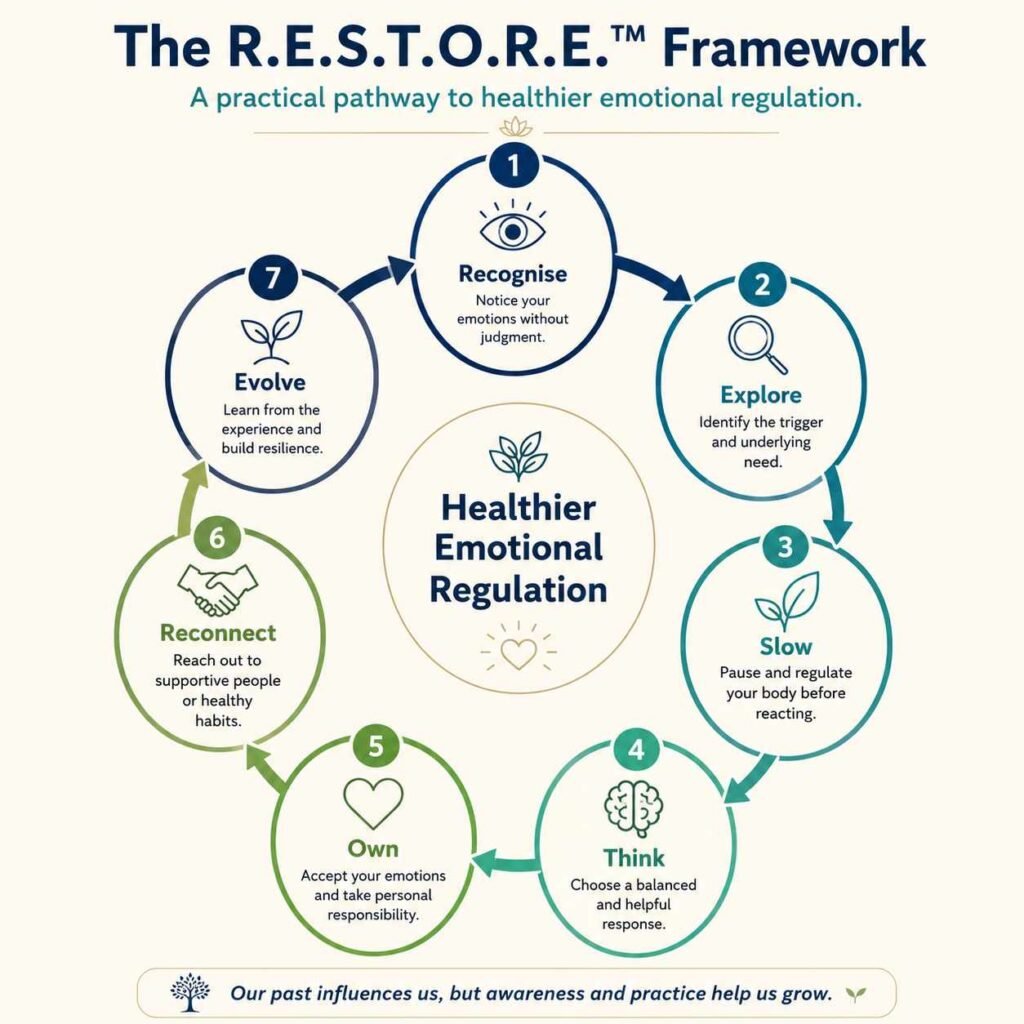
Rather than promising quick fixes, this framework brings together well-established psychological principles into a simple sequence that can be practiced in daily life.
Think of it as a compass rather than a destination.
There is no perfect way to follow these steps.
Some days you’ll move through them naturally.
Other days you’ll return to the beginning.
That’s completely normal.
Emotional regulation is not about becoming perfect.
It is about becoming more aware, more flexible, and more compassionate with yourself over time.
R — Recognise Your Emotional Experience
“You cannot respond wisely to an emotion you haven’t noticed.”
Every emotional journey begins with awareness.
Yet many of us move through our day so quickly that we don’t realize what we’re feeling until the emotion has already taken over.
Perhaps someone interrupts you during a meeting.
You become unusually irritated.
Hours later, you realize the interruption reminded you of experiences in which your opinions weren’t valued.
Recognition creates space between the event and your reaction.
Instead of automatically thinking,
“I’m just an angry person,”
you begin asking,
“What am I feeling right now?”
Try naming the emotion as specifically as possible.
Instead of simply saying,
“I feel bad”
consider:
- disappointed
- embarrassed
- overwhelmed
- anxious
- lonely
- frustrated
- ashamed
- disappointed
- grateful
- hopeful
Research suggests that accurately identifying emotions can reduce emotional intensity and improve self-awareness.
Reflection
What emotion am I experiencing right now?
E — Explore the Story Behind the Feeling
“Every emotion has a story worth understanding.”
Emotions don’t appear randomly.
They usually emerge because the brain has interpreted something as meaningful.
Sometimes that meaning belongs entirely to the present.
Sometimes older emotional learning quietly influences today’s reaction.
This step is not about searching for childhood memories in every situation.
It is simply about becoming curious.
Ask yourself:
- What happened just before I felt this?
- What did this situation mean to me?
- What fear or hope might this emotion be protecting?
- Does this remind me of something familiar?
Curiosity is different from rumination.
Rumination circles endlessly around problems.
Curiosity moves gently toward understanding.
Reflection
What might this emotion be trying to tell me?
S — Slow Your Nervous System
“A calm body helps create a calmer mind.”
When emotions become intense, the nervous system often shifts into protection mode.
Your breathing becomes shallow.
Your muscles tighten.
Your thoughts race.
At these moments, logical thinking becomes much more difficult.
Before solving the emotional problem, help your body feel safer.
Simple practices may include:
- slowing your breathing,
- placing both feet firmly on the ground,
- relaxing your shoulders,
- taking a brief walk,
- drinking water,
- or stepping outside for fresh air.
These small actions don’t remove difficult emotions.
They create enough space for clearer thinking.
Reflection
What does my body need right now in order to feel a little safer?
T — Think With Curiosity Instead of Certainty
“Our first interpretation isn’t always the most accurate one.”
The brain naturally fills gaps in information.
If someone doesn’t reply to your message, your mind may immediately assume they are upset with you.
But is that the only explanation?
Perhaps they are working.
Driving.
Sleeping.
Caring for a family member.
Thinking with curiosity means gently questioning automatic conclusions.
Instead of asking,
“Why are they ignoring me?”
try asking,
“What are several possible explanations?”
This simple shift reduces emotional rigidity and encourages psychological flexibility.
Curiosity expands possibilities.
Certainty often narrows them.
Reflection
What evidence supports my interpretation? What evidence might suggest another explanation?
O — Own the Response You Want to Practice
“Your emotions arrive automatically. Your response is where choice begins.”
We cannot always choose what we feel.
We can gradually influence how we respond.
This step asks an important question:
“What kind of person do I want to be in this moment?”
Perhaps you choose to:
- speak honestly instead of withdrawing,
- apologise instead of becoming defensive,
- set a respectful boundary,
- ask for clarification,
- delay an important conversation until you’re calmer.
Each intentional response becomes new learning for the brain.
Over time, these responses become increasingly familiar.
Reflection
Which response reflects my values rather than my immediate impulse?
R — Reconnect Through Safe Relationships
“Healing rarely happens in complete isolation.”
Humans are social beings.
Many emotional patterns developed within relationships.
Many are strengthened through relationships as well.
“Reconnect” doesn’t mean depending on everyone around you.
It means identifying people who help you feel heard, respected, and emotionally safe.
That may include:
- a trusted friend,
- a supportive family member,
- a mentor,
- a partner,
- a support group,
- or a qualified mental health professional.
Healthy relationships don’t remove life’s difficulties.
They remind us that we don’t have to face them alone.
Reflection
Who helps me feel emotionally safe enough to be myself?
E — Evolve Through Consistent Practice
“Lasting change is built through repetition, not perfection.”
Many people abandon emotional growth because they expect immediate transformation.
The brain doesn’t usually change that way.
Imagine planting a tree.
You don’t expect deep roots after watering it once.
Growth happens gradually through repeated care.
The same principle applies to emotional regulation.
Every small act of awareness strengthens new emotional pathways.
Every compassionate response teaches the brain something new.
Some days you’ll respond beautifully.
Other days you’ll fall back into familiar habits.
Neither day defines your progress.
Growth is measured across months and years—not moments.
Reflection
What is one small emotional skill I can practice consistently this week?
Bringing the Framework Together
Imagine receiving unexpected criticism from a colleague.
Instead of reacting immediately, you move through the framework:
Recognise
“I notice I’m feeling embarrassed and defensive.”
↓
Explore
“This reminds me of how mistakes were handled when I was younger.”
↓
Slow
You pause, breathe slowly, and allow your body to settle.
↓
Think
“Could this feedback be intended to help rather than harm?”
↓
Own
You decide to ask clarifying questions instead of arguing.
↓
Reconnect
Later, you discuss the experience with someone you trust.
↓
Evolve
The next time feedback arrives, your brain already has a healthier emotional pathway to follow.
Notice what changed.
The criticism didn’t disappear.
Your emotional experience became more flexible.
And that flexibility is one of the clearest signs of emotional regulation.
A Gentle Reminder

The R.E.S.T.O.R.E.™ Framework is an educational tool designed to help readers better understand emotional regulation and build healthier habits over time. It is inspired by established psychological principles, including emotional awareness, cognitive flexibility, self-compassion, nervous system regulation, and the importance of supportive relationships.

It is not a substitute for individualized mental health assessment or treatment.
If intense emotions, traumatic experiences, or persistent psychological distress are interfering with daily life, seeking support from a qualified mental health professional can provide personalized guidance and evidence-based care.

The goal of this framework is not perfection.
It is progress.
Because emotional regulation is not about becoming someone else.
It is about becoming more fully—and more compassionately—yourself.
Emotional Regulation Across the Lifespan: A Skill That Continues to Grow
When people think about emotional regulation, they often imagine it as a fixed personality trait.
Some people are “naturally calm.”
Others are “too emotional.”
Modern psychology paints a very different picture.
Emotional regulation is better understood as a lifelong developmental skill—one that begins before we can speak and continues evolving throughout our lives.
Just as our bodies grow and change over time, our emotional abilities also develop through relationships, experiences, learning, and practice.
Understanding this broader perspective helps us replace labels with curiosity.
Rather than asking,
“Am I emotionally strong?”
we can begin asking,
“What emotional skills am I still learning?”
Let’s explore how emotional regulation typically develops across different stages of life.
Infancy: Borrowing Calm Before Creating It
A newborn cannot regulate intense emotions independently.
When a baby cries, they are not manipulating adults or seeking attention.
They are communicating the only way they know how.
During infancy, emotional regulation depends almost entirely on co-regulation—the process through which a calm and responsive caregiver helps the baby’s nervous system settle.
Every time a caregiver gently rocks a crying infant, speaks with a soothing voice, feeds them when hungry, or comforts them after a frightening experience, the baby’s brain receives an important message:
“When I become overwhelmed, safety and comfort are possible.”
These thousands of everyday interactions gradually shape the developing nervous system.
This does not require perfect parenting.
In fact, developmental psychologists have long emphasized that children benefit most from consistent, responsive, “good enough” caregiving rather than perfection.
Small moments of repair after misunderstandings often teach children just as much as moments of harmony.
Childhood: Learning the Emotional Language of Life
As children grow, they begin developing words for their emotional experiences.
They learn the difference between feeling disappointed and feeling angry.
Between excitement and nervousness.
Between loneliness and boredom.
Much of this learning happens through observation.
Children notice:
- how adults handle disappointment,
- whether family members apologize after arguments,
- how emotions are talked about,
- whether mistakes are treated as opportunities to learn or reasons for shame.
Parents, teachers, grandparents, siblings, coaches, and other caregivers all contribute to this emotional education.
Children are not simply taught emotions.
They absorb them.
This is why psychologists often describe adults as children’s emotional role models, whether intentionally or unintentionally.
Adolescence: When Emotions Often Feel Bigger
Many parents notice that adolescence can be an emotionally intense period.
There are good reasons for this.
During adolescence, the brain undergoes significant development.
Regions involved in emotional processing often mature earlier than areas responsible for long-term planning, impulse control, and decision-making.
As a result, teenagers may experience emotions with remarkable intensity while still developing the skills needed to regulate those emotions consistently.
At the same time, adolescents are navigating:
- changing friendships,
- academic expectations,
- identity formation,
- increasing independence,
- social media,
- body image,
- and the desire to belong.
These challenges make adolescence an important period for developing emotional awareness, healthy coping skills, and supportive relationships.
Importantly, emotional intensity during adolescence is not automatically a sign that something is wrong. For many young people, it reflects a normal stage of development.
Adulthood: Turning Awareness Into Choice
By adulthood, most people have developed familiar emotional habits.
Some habits support healthy relationships and resilience.
Others may create unnecessary suffering.
The encouraging news is that adulthood also offers something childhood cannot:
choice.
Adults can intentionally seek experiences that support emotional growth.
They can:
- build healthier relationships,
- learn communication skills,
- establish boundaries,
- seek therapy when needed,
- practice self-reflection,
- and consciously challenge emotional habits that no longer serve them.
Adulthood is often the stage where emotional regulation becomes less about what happened to us and more about what we choose to practice moving forward.
That shift doesn’t erase the past.
It expands our possibilities for the future.
Parenthood: Becoming an Emotional Teacher
For many people, becoming a parent creates a new level of emotional awareness.
Children observe far more than they are told.
They notice how adults respond to stress.
How they apologize.
How they handle disappointment.
How they speak about themselves.
Parents sometimes worry about making mistakes.
The reassuring news is that children do not need perfect parents.
What they benefit from most is a caregiver who is willing to:
- listen,
- repair after conflict,
- acknowledge mistakes,
- and model healthy emotional responses.
One sincere apology from a parent can teach emotional responsibility more effectively than dozens of lectures.
In this way, emotional regulation becomes something that is passed from one generation to the next—not through perfection, but through everyday example.
Older Adulthood: Emotional Wisdom and Perspective
Contrary to common stereotypes, many older adults demonstrate remarkable emotional resilience.
Life experience often brings a broader perspective.
After navigating decades of successes, disappointments, relationships, and losses, many people become more selective about where they invest their emotional energy.
Research suggests that, for many individuals, emotional well-being can remain stable—or even improve—in later life.
Many older adults report:
- greater appreciation for meaningful relationships,
- increased gratitude,
- improved emotional perspective,
- and less concern about minor frustrations.
Of course, aging also brings challenges, including changes in health, bereavement, caregiving responsibilities, and major life transitions.
Yet emotional regulation continues to evolve, reminding us once again that growth does not end at a particular age.
Emotional Growth Has No Deadline
One of the most harmful myths about emotional development is the belief that people stop changing after childhood.
Modern neuroscience strongly challenges this idea.
The adult brain remains capable of learning.
Relationships continue shaping us.
Experiences continue teaching us.
Practice continues strengthening emotional skills.
Whether you are twenty-five, forty, sixty, or eighty years old, your emotional life is still unfolding.
Some lessons may take longer than others.
Some emotional habits may require patience, support, and repeated effort.
But growth remains possible.
Every stage of life offers new opportunities to understand yourself more deeply.
Every meaningful relationship teaches something about connection.
Every challenge offers another chance to practice responding with greater wisdom.
Emotional regulation is not a destination that we reach once and keep forever.
It is a lifelong conversation between our experiences, our relationships, our brain, and the choices we make each day.
Reflection: Where Are You in Your Emotional Journey?
Before moving to the final sections of this guide, pause for a moment.
Ask yourself:
- What emotional lessons have served me well throughout my life?
- Which emotional habits no longer reflect the person I want to become?
- What relationships have helped me grow emotionally?
- What strengths have I developed through life’s challenges?
- What is one emotional skill I would like to strengthen over the next year?
You don’t need to answer every question today.
Sometimes the most important step is simply becoming willing to ask them.
Because emotional growth does not begin when life becomes easier.
It begins the moment we become curious enough to understand ourselves with honesty, compassion, and hope.
Signs Your Emotional Regulation Is Improving (Even If Life Still Feels Difficult)
After reading this guide, you might wonder:
“How will I know if I’m actually making progress?”
It’s a thoughtful question.
Many people expect emotional growth to arrive as one dramatic breakthrough—a day when anxiety disappears, relationships become effortless, and difficult emotions never return.
Real life rarely works that way.
In psychology, progress is usually quieter.
More gradual.
Sometimes so subtle that we overlook it.
One of the greatest mistakes people make is believing that healing means never struggling again.
In reality, emotional regulation is not measured by the absence of difficult emotions.
It is measured by how we relate to those emotions.
Do we notice them sooner?
Recover more quickly?
Respond more intentionally?
Treat ourselves with greater kindness.
These changes may seem small, but together they represent meaningful psychological growth.
Here are some evidence-informed signs that your emotional regulation may be strengthening—even if life still feels challenging.
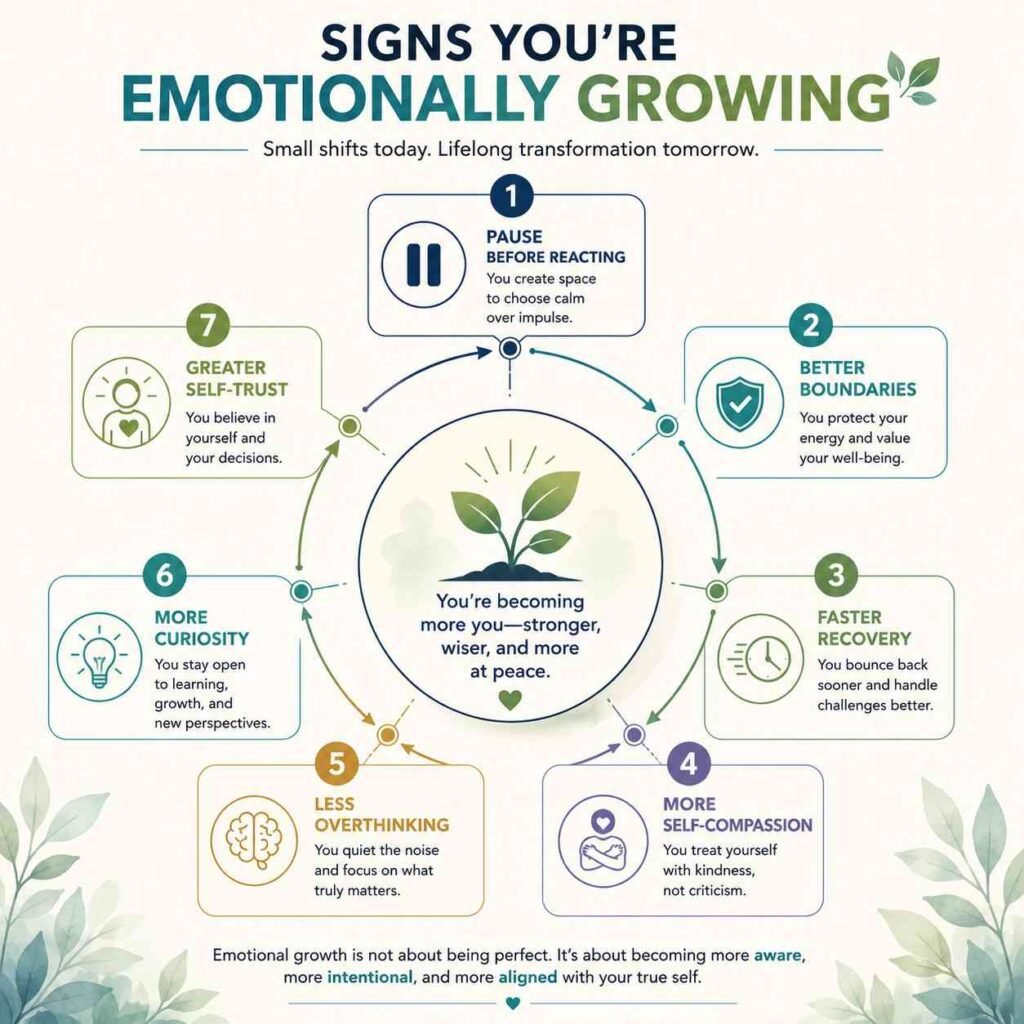
1. You Notice Your Emotions Earlier
In the past, you may have realized you were overwhelmed only after an argument, an emotional outburst, or a sleepless night.
Now, you begin noticing subtle signals sooner.
Perhaps you recognize tension in your shoulders.
A racing heart.
A change in your breathing.
A growing sense of irritability.
Instead of being surprised by your emotions, you begin recognizing them as they develop.
This earlier awareness creates something incredibly valuable:
choice.
You have more opportunity to respond thoughtfully before emotions become overwhelming.
That isn’t perfection.
It’s progress.
2. You Pause More Often Before Reacting
Emotions still arrive automatically.
But your reactions become less automatic.
Perhaps someone criticizes you.
Instead of responding immediately, you pause.
You take a breath.
You ask a question.
Or you simply give yourself time before replying.
That brief pause may last only a few seconds.
Yet it reflects significant emotional growth.
It means your thinking brain is increasingly working together with your emotional brain.
3. You Recover More Quickly After Difficult Moments
Emotionally healthy people are not people who never become upset.
They are often people who recover more efficiently.
A disappointment that once affected you for several days may now take several hours.
A disagreement that once dominated your entire week may become one meaningful conversation. Recovery—not constant happiness—is one of the strongest indicators of resilience.
4. You Become More Curious Than Critical
Imagine making a mistake.
Your old response may have sounded like:
“I always ruin everything.”
Now, you notice a different voice emerging.
“That didn’t go as I hoped. What can I learn from it?”
This shift from harsh self-judgment to curious self-reflection is one of the clearest signs of emotional maturity.
Curiosity supports learning. Self-criticism often keeps us emotionally stuck.
5. You Feel Your Emotions Without Being Controlled by Them
One of the biggest misconceptions about emotional regulation is that strong emotions disappear.
They don’t.
You may still feel sadness.
Fear.
Anger.
Disappointment.
The difference is that these emotions become experiences rather than identities.
Instead of thinking,
“I am an anxious person,”
you begin saying,
“I’m noticing anxiety right now.”
That small change in language reflects a profound change in perspective. Emotions become visitors rather than permanent definitions of who you are.
6. You Set Boundaries With Greater Confidence
Emotional regulation often changes the way we relate to other people.
Perhaps you begin saying:
“I can’t commit to that right now.”
“I need some time to think before responding.”
“That comment hurt me.”
“I appreciate your opinion, but I see it differently.”
Healthy boundaries are not walls that keep people out.
They are guidelines that help relationships remain respectful and emotionally safe.
Learning to express boundaries calmly is often a sign that emotional regulation is becoming stronger.
7. You Stop Assuming the Worst
Imagine sending an important message.
Hours pass without a reply.
Previously, your mind might have immediately concluded:
“They’re upset with me.”
“I must have done something wrong.”
Now, another possibility appears.
“There could be many reasons they haven’t responded.”
You haven’t become emotionally detached.
You’ve become psychologically flexible. The brain is learning to tolerate uncertainty instead of automatically expecting danger.
8. Your Relationships Feel More Authentic
As emotional regulation improves, relationships often begin changing as well.
You may notice yourself:
- listening more carefully,
- apologizing more sincerely,
- expressing appreciation more openly,
- asking for support when needed,
- accepting feedback without immediately becoming defensive.
Healthy relationships don’t require perfect emotional regulation.
They benefit from people who are willing to understand themselves and each other with honesty and respect.
9. You Accept That Growth Isn’t Linear
Perhaps one of the most encouraging signs of emotional growth is this:
You stop expecting yourself to be emotionally perfect.
Some days still feel difficult.
Old patterns occasionally return.
Stress still affects you.
The difference is that setbacks no longer convince you that you’ve failed.
Instead, they become opportunities to practice the skills you’ve been building.
This mindset reflects resilience.
Progress is no longer measured by never struggling. It is measured by continuing to learn.
10. You Begin Trusting Yourself
At the beginning of this guide, we discussed how emotional regulation often begins through co-regulation—borrowing calm from trusted caregivers.
As emotional skills strengthen, something remarkable begins happening.
Gradually, you become someone your own nervous system can trust.
You know that difficult emotions will eventually pass.
You know that mistakes can be repaired.
You know that asking for help is a strength rather than a weakness.
You know that uncertainty doesn’t always mean danger.
This growing sense of self-trust becomes one of the strongest foundations of emotional well-being.
Progress Is Often Invisible While It’s Happening
Think about learning a new language.
On any given day, improvement feels almost impossible to notice.
Then one day you realize you’re understanding conversations that once seemed impossible.
Emotional growth often unfolds in exactly the same way.
The changes are small.
Quiet.
Almost invisible.
Until one day you respond to a familiar situation in a completely different way.
Perhaps you stay calm during a disagreement that would once have overwhelmed you.
Perhaps you forgive yourself more quickly after making a mistake.
Perhaps you ask for support instead of suffering in silence.
These moments may seem ordinary.
In reality, they represent years of emotional learning coming together.
A Gentle Reminder for Anyone Reading This
If you don’t recognize many of these signs yet, please don’t interpret that as failure.
Everyone’s emotional journey is different.
Some people have experienced significant adversity.
Others are navigating ongoing stress, grief, health challenges, financial pressures, or relationship difficulties.
Growth is not a race.
Nor is it a competition.
The goal is not to become emotionally perfect.
The goal is to become a little more aware, a little more compassionate, and a little more intentional than you were yesterday.
Every small step matters.
Every moment of awareness teaches the brain something new.
Every healthy choice strengthens emotional resilience.
And every act of kindness toward yourself creates another opportunity for growth.
Perhaps the most hopeful truth in modern psychology is this:
You don’t have to become a different person to build a healthier emotional life.
You simply need to keep helping your brain learn that safety, connection, and growth are still possible.
Because emotional regulation is not about eliminating your humanity. It is about learning to live your humanity with greater wisdom, balance, and compassion.
Helping the Next Generation Build Healthy Emotional Regulation
One of the most hopeful lessons in psychology is this:
Every emotionally supportive interaction has the potential to shape a developing brain.
That doesn’t mean adults must always know the perfect thing to say.
It doesn’t mean parents need to remain calm every moment of every day.
And it certainly doesn’t mean that one difficult day or one parenting mistake determines a child’s future.
Children develop through thousands of everyday interactions, not isolated moments.
Small experiences repeated consistently often matter far more than dramatic gestures.
A comforting conversation after a difficult day.
A sincere apology after losing patience.
Listening without immediately offering advice.
Helping a child name what they’re feeling.
These ordinary moments quietly become extraordinary lessons in emotional regulation.
Whether you are a parent, grandparent, teacher, coach, caregiver, or simply an important adult in a child’s life, your emotional presence matters more than perfection.
1. Help Children Name Their Feelings
Children cannot regulate emotions they cannot identify.
Imagine trying to solve a puzzle without knowing what the pieces represent.
The same challenge exists with emotions.
Instead of asking only,
“What’s wrong?”
Consider asking:
- “How are you feeling right now?”
- “Can you tell me more about what happened?”
- “Where do you notice that feeling in your body?”
Young children often need help expanding their emotional vocabulary.
Rather than describing everything as “good,” “bad,” or “fine,” they gradually learn words such as:
- frustrated,
- disappointed,
- excited,
- worried,
- embarrassed,
- confused,
- proud,
- lonely,
- hopeful,
- relieved.
The more accurately children learn to identify emotions, the easier it becomes for them to communicate their needs instead of acting them out.
Remember:
Every emotion deserves understanding.
Not every behavior does.
Children can learn that all feelings are acceptable while also learning that some behaviors require healthier alternatives.
2. Validate Feelings Before Solving Problems
When adults see a child upset, the natural instinct is often to fix the problem immediately.
Sometimes, however, children first need to feel understood.
Consider the difference between these responses:
“Don’t cry. It’s not a big deal.”
versus
“I can see you’re really disappointed. Tell me what happened.”
The second response doesn’t necessarily agree with the child’s interpretation of the event.
It simply acknowledges their emotional experience.
Validation is not the same as approval.
It is the act of communicating:
“Your feelings make sense, and I’m here with you.”
Feeling understood often helps children become calm enough to think more clearly.
3. Remember That Children Learn More From What We Do Than What We Say
Children are remarkably observant.
They notice how adults speak to themselves.
How they handle mistakes.
How they respond when frustrated.
How they apologize.
How they repair relationships.
Adults sometimes tell children:
“Use your words.”
Meanwhile, they respond to stress by shouting, withdrawing, or criticizing themselves harshly.
Children naturally pay attention to behavior.
When adults model calm problem-solving, respectful disagreement, healthy boundaries, and self-compassion, they provide lessons that no lecture can replace.
One genuine apology from an adult often teaches emotional responsibility more effectively than many reminders about good behavior.
4. Create Emotional Safety, Not Emotional Perfection
Many parents quietly worry:
“What if I make mistakes?”
The reassuring answer from developmental psychology is that mistakes are inevitable.
In fact, children benefit from seeing adults recover from mistakes in healthy ways.
Imagine a parent who loses patience after a stressful day.
Later they return and say:
“I’m sorry I raised my voice earlier. I was feeling overwhelmed, but that wasn’t the right way to respond. Let’s talk about what happened.”
This interaction teaches several powerful lessons:
- Adults make mistakes.
- Mistakes can be repaired.
- Apologies matter.
- Relationships can recover after conflict.
Children do not need flawless caregivers.
They need adults who are willing to reconnect after difficult moments. Repair builds trust.
5. Encourage Problem-Solving Instead of Rescuing
Every loving adult wants to protect children from pain.
Yet when adults solve every problem immediately, children lose valuable opportunities to build emotional confidence.
This doesn’t mean leaving children alone with overwhelming situations.
It means supporting them while allowing them to develop age-appropriate coping skills.
Instead of immediately providing every answer, consider asking:
- “What do you think might help?”
- “What have you tried already?”
- “Would you like to think through some options together?”
This approach communicates an important message:
“I believe you are capable, and I’ll support you while you learn.”
Confidence grows through supported practice.
Not through never facing challenges.
6. Teach That Every Emotion Has a Purpose
Many children begin believing that some emotions are “good” while others are “bad.”
Psychology suggests a more balanced perspective.
Every emotion carries information.
Fear may signal possible danger.
Anger may point toward unfairness or crossed boundaries.
Sadness often reflects loss.
Joy strengthens connection.
Helping children understand the purpose of emotions reduces shame and encourages emotional curiosity.
The goal isn’t to eliminate emotions. The goal is to understand what they might be communicating.
7. Make Repair a Family Habit
Every family experiences misunderstandings.
Arguments happen.
Patience runs out.
Feelings get hurt.
What children remember most is often not the conflict itself but what happened afterward.
Families that practice repair teach emotional resilience.
Repair may sound like:
- “I’m sorry.”
- “Can we try that conversation again?”
- “Help me understand how you felt.”
- “Thank you for telling me.”
- “Let’s figure this out together.”
These simple conversations teach children that healthy relationships are not conflict-free.
They are relationships where people remain willing to reconnect.
8. Support Your Own Emotional Well-Being
Perhaps the most overlooked aspect of helping children regulate emotions is this:
Adults also need emotional support.
Parents, teachers, and caregivers carry significant responsibilities.
Stress, exhaustion, financial pressures, illness, and major life changes all influence emotional availability.
Seeking support for yourself is not selfish.
It benefits everyone around you.
Sometimes the most powerful gift we give children is showing them that asking for help is a normal part of being human.
When adults care for their own emotional health, they become better equipped to support the emotional development of others.
Emotional Regulation Is a Gift That Can Be Passed Forward
Every generation inherits emotional lessons from the generation before it.
Some of those lessons strengthen resilience.
Others may quietly create unnecessary struggles.
The encouraging news is that emotional learning never has to stop.
Every time an adult chooses to:
- listen instead of dismiss,
- comfort instead of shame,
- apologize instead of defend,
- encourage instead of criticize,
- remain curious instead of judgmental,
A new emotional lesson is being taught.
Not only through words.
But through lived experience.
Children may not remember every conversation.
But they often remember how the important adults in their lives made them feel.
That feeling becomes part of the emotional blueprint they carry into adulthood.
Perhaps that is one of the greatest opportunities any of us has.
Not to become perfect emotional role models.
But to become emotionally available enough that the people around us feel safer, more understood, and more connected than they did before. Because every compassionate interaction has the potential to influence not only one person’s emotional life—but also the generations that follow.
Frequently Asked Questions (FAQ) About Childhood and Emotional Regulation
1. What is emotional regulation?
Emotional regulation is the ability to recognize, understand, express, and respond to emotions in healthy and flexible ways. It does not mean suppressing emotions or staying calm all the time. Instead, it involves learning how to experience emotions without allowing them to completely control our thoughts or actions. Emotional regulation develops throughout life and can continue improving with practice and supportive experiences.
2. At what age does emotional regulation begin?
Emotional regulation begins in infancy through co-regulation, where caregivers help babies feel safe and calm during moments of distress. Young children gradually develop the ability to regulate emotions independently as their brains mature and they experience consistent emotional support. Development continues throughout childhood, adolescence, and adulthood.
3. Does childhood really affect emotional regulation in adulthood?
Research suggests that early experiences can influence how the brain learns to respond to stress, relationships, and emotions. However, childhood is only one part of the picture. Genetics, temperament, culture, physical health, current relationships, and life experiences also contribute to emotional regulation throughout life.
4. Can emotional regulation be improved as an adult?
Yes.
The adult brain remains capable of learning through a process called neuroplasticity. While changing long-standing emotional habits takes time, new experiences, healthy relationships, self-awareness, and evidence-based psychological strategies can strengthen emotional regulation throughout adulthood.
5. What causes poor emotional regulation?
There is no single cause.
Emotional regulation difficulties may be influenced by early life experiences, chronic stress, trauma, mental health conditions, physical illness, sleep problems, substance use, or ongoing life challenges. Sometimes several factors interact rather than one single cause.
6. Is emotional dysregulation a mental illness?
No.
Emotional dysregulation is not a mental illness by itself.
It is a description of difficulty managing emotional responses. Emotional dysregulation may occur in many situations and can also be associated with certain mental health conditions. A qualified mental health professional can provide an appropriate assessment when emotional difficulties become persistent or significantly affect daily life.
7. What’s the difference between emotional regulation and emotional suppression?
Emotional regulation involves understanding and responding to emotions in healthy ways.
Emotional suppression involves pushing emotions away or hiding them without addressing their underlying cause.
Suppressing emotions may provide temporary relief but often does not resolve the emotional experience itself.
8. Can emotionally unavailable parents affect emotional development?
Parents and caregivers play an important role in emotional development, particularly during childhood. However, emotional development is influenced by many factors, including extended family, teachers, peers, community, temperament, and later life experiences. Early challenges do not determine a person’s future emotional well-being.
9. What are emotional triggers?
Emotional triggers are situations, words, memories, or experiences that activate a strong emotional response because they carry personal meaning.
Triggers are not signs of weakness.
They often reflect the brain’s previous learning and its attempts to protect us.
10. Why do small things sometimes upset me so much?
Sometimes a present-day event connects with older emotional learning, current stress, or personal beliefs.
The situation itself may be small, but the emotional meaning attached to it can feel much larger.
Understanding these patterns can help people respond with greater awareness instead of self-criticism.
11. Does childhood trauma always cause emotional problems?
No.
Many people who experience adversity develop remarkable resilience.
Likewise, people without obvious childhood trauma may still struggle with emotional regulation because of present-day stress, health conditions, or other life experiences.
Every person’s emotional journey is unique.
12. What is co-regulation?
Co-regulation is the process through which a calm, supportive adult helps another person—especially a child—manage overwhelming emotions.
Through repeated experiences of feeling safe and understood, children gradually develop stronger self-regulation skills.
13. Can emotional regulation improve without therapy?
Many people strengthen emotional regulation through supportive relationships, self-reflection, healthy routines, mindfulness, stress management, and learning new coping skills.
However, therapy can be especially valuable when emotional difficulties are persistent, overwhelming, or interfering with daily life.
14. How does stress affect emotional regulation?
Stress temporarily reduces the brain’s capacity for thoughtful decision-making.
When people are chronically stressed, emotionally exhausted, or sleep-deprived, they often react more quickly and recover more slowly from difficult emotions.
Reducing stress supports healthier emotional regulation.
15. Does sleep influence emotional regulation?
Yes.
Sleep plays an important role in emotional processing, attention, memory, and decision-making.
Insufficient or poor-quality sleep may make emotional reactions more intense and reduce the brain’s ability to regulate emotions effectively.
16. Can mindfulness improve emotional regulation?
Research suggests that mindfulness practices may improve emotional awareness and reduce automatic emotional reactions for many people.
Mindfulness does not eliminate difficult emotions.
It helps people notice emotions with greater awareness before deciding how to respond.
17. What role does self-compassion play in emotional regulation?
Self-compassion involves responding to personal difficulties with understanding rather than harsh self-criticism.
Research has linked self-compassion with greater emotional resilience, healthier coping, and improved psychological well-being.
It supports learning because people feel safer acknowledging mistakes instead of fearing them.
18. Why do I overthink after emotional situations?
Overthinking often develops as the mind attempts to reduce uncertainty or prevent future emotional pain.
Although it may feel protective, excessive overthinking usually increases anxiety rather than providing lasting certainty.
Learning emotional regulation helps reduce the need for constant mental replay.
19. Are emotional reactions inherited or learned?
Both.
Genetics and temperament influence emotional tendencies, while life experiences teach the brain how to interpret and respond to emotions.
Emotional regulation develops through the interaction of biology and experience rather than either factor alone.
20. Can parents help children develop emotional regulation?
Absolutely.
Parents and caregivers can support emotional development by listening, validating emotions, modeling healthy coping, repairing after conflict, encouraging problem-solving, and creating emotionally safe relationships.
Children benefit far more from consistent emotional availability than from perfection.
21. Is it normal to still struggle with emotions as an adult?
Yes.
Everyone experiences emotional challenges at different stages of life.
Emotional regulation is a lifelong skill rather than something people permanently master.
Seeking support when needed is a healthy part of emotional growth.
22. How long does it take to improve emotional regulation?
There is no universal timeline.
Some people notice small changes within weeks of practising new skills, while others require longer periods depending on their experiences, current stress, available support, and individual circumstances.
Meaningful progress is usually gradual rather than immediate.
23. When should someone seek professional help?
Consider speaking with a qualified mental health professional if emotional difficulties become persistent; feel overwhelming; interfere with work, relationships, sleep, or daily functioning; or if emotions become difficult to manage despite self-help efforts.
Seeking help early often supports better outcomes.
24. Can emotional regulation improve relationships?
Yes.
Improved emotional regulation often supports healthier communication, better conflict resolution, stronger boundaries, greater empathy, and increased trust.
Healthy relationships are strengthened not because difficult emotions disappear, but because people become better able to respond to them thoughtfully.
25. What is the most important message to remember?
Your emotional patterns tell part of your story.
They do not define your future.
Childhood experiences may influence how emotional regulation develops, but the brain continues learning throughout life.
With awareness, supportive relationships, intentional practice, and—when needed—professional guidance, people can continue developing healthier emotional skills at every stage of life.
Your Childhood Is a Chapter—Not Your Destiny
If you’ve reached this point, you’ve travelled through one of the most fascinating discoveries in modern psychology.
You’ve seen how the human brain begins learning emotional patterns long before we fully understand what emotions are.
You’ve learned that emotional regulation isn’t simply about “staying calm.” It’s about recognizing emotions, understanding their purpose, responding with flexibility, and gradually building the capacity to navigate life’s challenges with greater wisdom.
Perhaps you’ve recognized parts of your own story.
Maybe you’ve remembered moments from childhood that suddenly make more sense.
Perhaps you’ve identified patterns in your relationships, your reactions, or the way you speak to yourself during difficult moments.
If so, pause for a moment.
Not to judge yourself.
But to appreciate your willingness to understand yourself more deeply. Because self-understanding is often where meaningful change begins.
You Are More Than Your Past
One of the greatest misconceptions about psychology is that understanding our past means becoming trapped by it.
Nothing could be further from the truth.
Understanding the past does not mean living there.
It means recognizing how earlier experiences may have influenced the emotional habits we carry today.
Some of those habits continue serving us well.
Others may have once protected us but no longer reflect the life we want to build.
Awareness gives us something incredibly valuable:
choice.
The ability to pause before reacting.
The ability to question old assumptions.
The ability to practise new emotional responses.
The ability to become increasingly aligned with our values rather than our automatic patterns.
This is where emotional regulation becomes more than a psychological concept.
It becomes a daily practice.
Healing Is Not Becoming a Different Person
Many people begin a journey of personal growth believing they need to completely change who they are.
Psychology offers a gentler perspective.
Healthy emotional growth is rarely about replacing your personality.
It is about expanding your emotional flexibility.
You may still feel sadness.
You may still experience fear.
You may still become frustrated.
Being emotionally healthy does not mean becoming emotionally unaffected.
Instead, it means developing the confidence that you can experience difficult emotions without being completely controlled by them.
You begin trusting your ability to recover.
To repair relationships.
To learn from mistakes.
To ask for help when needed.
To extend compassion to yourself as readily as you offer it to others.
That quiet confidence is one of the strongest signs of emotional resilience.
Small Changes Create Lasting Transformation
Throughout this guide, one idea has appeared again and again.
The brain learns through repetition.
Not through perfection.
Every time you:
- pause before reacting,
- identify an emotion instead of suppressing it,
- listen with curiosity,
- establish a healthy boundary,
- apologize sincerely,
- accept support,
- practice self-compassion,
- or respond differently than you did yesterday,
Your brain gathers new evidence.
One decision may seem insignificant.
Repeated over weeks, months, and years, those decisions gradually reshape emotional habits.
Real transformation is often built from ordinary moments.
Small Changes Create Lasting Transformation
Throughout this guide, one idea has appeared again and again.
The brain learns through repetition.
Not through perfection.
Every time you:
- pause before reacting,
- identify an emotion instead of suppressing it,
- listen with curiosity,
- establish a healthy boundary,
- apologize sincerely,
- accept support,
- practise self-compassion,
- or respond differently than you did yesterday,
your brain gathers new evidence.
One decision may seem insignificant.
Repeated over weeks, months, and years, those decisions gradually reshape emotional habits.
Real transformation is often built from ordinary moments.
Emotional Growth Is a Lifelong Journey
Perhaps the most encouraging message in developmental psychology is that emotional development does not end in childhood.
It continues throughout life.
Every meaningful relationship teaches us something.
Every challenge stretches us.
Every mistake offers another opportunity to learn.
Every season of life invites us to become a little wiser than before.
Whether you are reading this as a young adult trying to understand overwhelming emotions, a parent hoping to support your child, a teacher encouraging emotional resilience, or someone simply searching for greater peace, the journey remains open.
Growth has no age limit.
Learning has no deadline.
Hope has no expiration date.
What You Can Do Today
You do not need to transform your emotional life overnight.
You do not need to understand every psychological theory.
You do not need to have all the answers.
You simply need to take the next helpful step.
Perhaps today that step is:
- noticing one emotion with greater awareness,
- having an honest conversation,
- apologizing after a misunderstanding,
- setting one respectful boundary,
- taking a mindful walk,
- writing down your thoughts,
- or reaching out to someone you trust.
Small actions often become the foundation of meaningful change.
Key Takeaways

Before you leave, remember these essential ideas:

✓ Emotional regulation is a skill—not a personality trait.

✓ Childhood influences emotional development, but it does not permanently define your future.

✓ The brain continues learning throughout life through neuroplasticity.

✓ Emotional awareness comes before emotional change.

✓ Supportive relationships remain powerful teachers of emotional regulation in adulthood.

✓ Progress is measured by greater flexibility and recovery—not by emotional perfection.

✓ Self-compassion strengthens learning far more effectively than harsh self-criticism.

✓ Every emotionally healthy choice teaches the brain something new.

✓ Growth is rarely dramatic—but it is often deeply transformative over time.
When Professional Support Can Help
Self-understanding is a valuable first step, but sometimes it is not enough on its own.
If emotional difficulties are becoming persistent, feel overwhelming, interfere with work, relationships, sleep, or daily functioning, or if you find yourself struggling to cope despite your best efforts, consider reaching out to a qualified mental health professional.
Seeking support is not a sign of weakness.
It is a meaningful investment in your well-being.
Therapists, counsellors, psychologists, psychiatrists, and other trained mental health professionals can offer evidence-based guidance tailored to your individual needs and circumstances.
No article—even a comprehensive one—can replace personalized assessment or treatment. But an article can help you ask better questions, understand yourself more clearly, and recognize when additional support may be beneficial.
About This Guide
This guide was created to help readers understand the psychology of emotional regulation through current research, developmental psychology, and neuroscience presented in accessible language.
Its purpose is educational.
It is not intended to diagnose, treat, or replace professional mental health care.
If this article has helped you better understand yourself, consider returning to it from time to time.
Emotional growth rarely happens after reading something once.
Like any meaningful skill, it develops through reflection, practice, and experience.
A Final Thought
Long before you learned to speak, your brain was learning how to feel.
Long before you understood the word emotion, your nervous system was learning about safety, connection, trust, and belonging.
Those early lessons became part of your story.
But they were never meant to become the whole story.
Every day your brain continues learning.
Every healthy relationship continues teaching.
Every act of self-awareness creates another opportunity for growth.
You cannot change the experiences that shaped your earliest chapters.
But you can influence the chapters that come next.
And perhaps that is the most hopeful lesson psychology has to offer:
Your childhood may explain parts of your emotional story—but it does not write the ending.
The next chapter is still being written.
And with awareness, compassion, supportive relationships, and intentional practice, you have the opportunity to help shape it.
Author Bio

Sunil Prasad is a Counselling Psychology post graduate with professional experience in psychological counselling and mental health education. Through The Psyche Inspire, he translates research from psychology and neuroscience into practical, evidence-informed guidance that helps readers better understand emotions, relationships, and personal growth. His writing emphasizes scientific accuracy, compassion, and everyday application while encouraging readers to seek professional support when needed.