

Have you ever tried to explain something important, only to realise that the other person understood it differently from what you intended? Perhaps you offered a suggestion, but it was taken as criticism. You asked a question out of concern, but the other person felt judged. You knew what you meant, yet the conversation ended with both of you feeling misunderstood.
Such experiences are common in everyday life. They occur between partners, family members, friends, and colleagues. Sometimes, a conversation begins with an ordinary remark but gradually turns into an argument. One person feels unfairly blamed, while the other wonders why their intentions were interpreted so differently.
Why do people misunderstand each other, even when they believe they are communicating clearly?
The answer is not always poor communication or a lack of listening. Much depends on how people interpret information. We do not understand another person’s words in isolation. Our experiences, expectations, emotions, beliefs, and previous interactions influence the meaning we attach to what we hear.
Consider a simple example. Someone asks their partner, “Why didn’t you tell me earlier?” The question may be intended to express concern or surprise. However, the partner might hear an accusation and respond defensively. The conversation is no longer about sharing information. It has become a discussion about blame and intention.
Table of Contents
This is where the psychology of everyday miscommunication becomes important. What we intend to communicate and what another person understands are not always the same. Between these two points, our minds interpret messages, fill gaps, make assumptions, and sometimes react emotionally.
Understanding this process can help us approach difficult conversations differently. Instead of immediately deciding that someone is deliberately taking our words the wrong way, we can examine what might have influenced their interpretation. The same awareness can also help us recognise when we have misunderstood someone else.
What Does It Mean to Misunderstand Someone?
A misunderstanding occurs when the meaning a person intends to communicate differs from the meaning another person receives or interprets. It may happen because the message is unclear, the listener lacks context, or both people approach the conversation with different expectations. Sometimes, the words are understandable, but their emotional meaning is interpreted differently.
To understand this, consider four elements of communication:
- Intention: What the speaker wants to communicate.
- Message: The words, tone, gestures, or behaviour used to express that intention.
- Interpretation: What the listener believes the message means.
- Response: How the listener reacts to the meaning they have understood.
These elements do not always align. Someone may intend to offer advice, communicate it in a direct tone, and unintentionally leave the listener feeling criticised. The speaker may then become confused because they believe they were only trying to help.

Understanding someone’s words does not always mean understanding their feelings
A person may understand the literal meaning of what someone says but still miss the emotion or concern behind those words.
Imagine someone telling a friend, “You never have time for me these days.” The literal message concerns spending time together. However, the feeling behind it may be loneliness, disappointment, or a desire to feel valued. If the friend responds only by explaining how busy they have been, the practical question may be answered, but the emotional concern remains unaddressed.
This distinction matters in close relationships. People do not always communicate their emotional needs directly. Sometimes, they express disappointment through complaints, concern through repeated questions, or hurt through silence. Understanding the words is only one part of understanding the person.
Is every disagreement a misunderstanding?
Not necessarily. A misunderstanding occurs when the intended meaning is not accurately received or interpreted. A disagreement occurs when two people understand each other’s positions but have different opinions, priorities, expectations, or values.
For example, two colleagues may understand exactly what each person wants but disagree about how a task should be completed. Explaining the same position repeatedly will not necessarily resolve that difference.
There are also situations in which someone dismisses another person’s feelings or deliberately misrepresents what they have said. These should not automatically be treated as innocent communication errors. Better communication can help people understand each other, but it cannot guarantee mutual respect or agreement.
Recognising this distinction matters because the appropriate response changes with the situation. A misunderstanding may need clarification, a disagreement may need discussion, while repeated disrespect may require clearer boundaries.
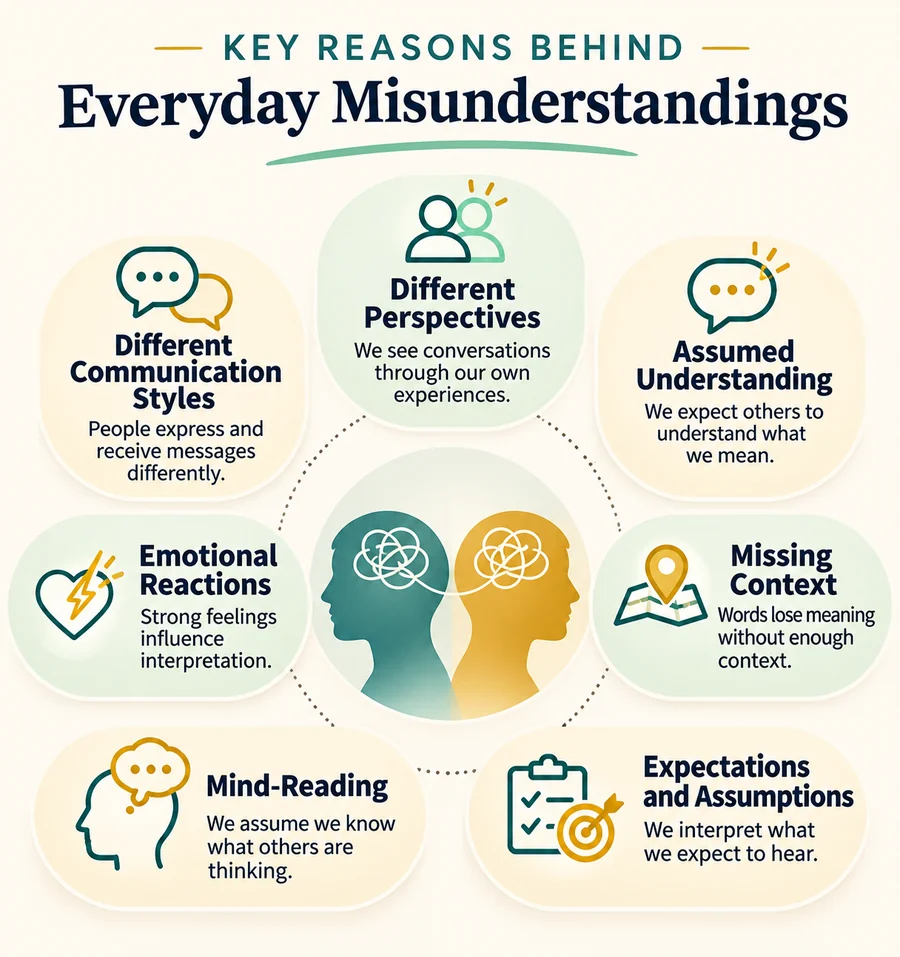
Why Do People Misunderstand Each Other? 7 Psychological Reasons
1. We interpret conversations from our own perspective
When we speak, we naturally begin with what we know, what we have experienced, and what we intend to communicate. We may forget that the other person does not have access to the same background information. As a result, we sometimes leave out explanations that seem unnecessary to us but are important to the listener.
Imagine telling a colleague, “I thought we had already discussed this.” You may be referring to a conversation from the previous week. However, your colleague may not remember that discussion or may have understood it differently. You believe you are referring to something established, while the other person feels that an important point has been introduced without explanation.
Psychologist Boaz Keysar’s 2007 paper, Communication and Miscommunication: The Role of Egocentric Processes, explains how speakers and listeners often rely on their own perspectives when producing and interpreting messages. This does not mean people are deliberately self-centred. Rather, our own knowledge and perspective can influence what we say and how we interpret what we hear, sometimes without our awareness.
Read Keysar’s research on egocentric processes in communication.
2. We assume that our meaning is obvious
Another reason misunderstandings occur is that we often know exactly what we intend to say. Because the meaning is clear in our own minds, we may assume that it is equally clear to the person listening. But knowing what we mean is different from communicating it successfully.
In a 2002 study published in Psychological Science, Boaz Keysar and Anne Henly examined how accurately speakers could judge whether listeners understood their intended meanings. Their experiments found that speakers tended to overestimate their communication effectiveness. They expected listeners to understand ambiguous statements more often than they actually did.
This has an important everyday implication. We may believe that our tone, facial expression, or additional explanation makes our intention obvious, while the listener may not receive those cues in the way we expect. For example, saying “Do whatever you think is right” may genuinely be intended as permission. However, depending on the situation and tone, the listener may interpret it as frustration or disappointment.
The problem is not necessarily that someone failed to listen. Sometimes, the speaker simply did not realise how differently their words could be understood.
Read the original Keysar and Henly study.
3. Missing context changes the meaning of words
Words rarely communicate meaning on their own. The situation in which they are spoken also matters. A short response may sound perfectly normal between two people who understand each other’s communication habits, but it may appear dismissive when the same words are exchanged during an argument.
Consider someone replying, “Fine, it’s okay.” In one situation, this may be a genuine expression of agreement. In another, it may communicate disappointment or a wish to end an uncomfortable discussion. Without understanding the surrounding situation, the listener may struggle to know which meaning was intended.
Context also includes timing, previous conversations, facial expressions, tone of voice, and the relationship between the people involved. When important details are missing, the listener may try to fill the gaps using their own assumptions.
This is particularly relevant in written communication, where gestures and tone of voice are unavailable. However, it would be inaccurate to assume that text messages are always misunderstood. A 2025 study by Monique Pollmann and Carla Roos examined real-life text messages and emails by comparing the emotional tone intended by senders with how receivers understood it. Their findings showed substantial agreement between the two, challenging the assumption that everyday digital communication is necessarily interpreted more negatively.
Read the 2025 research on interpreting text messages and emails.
The important lesson is that context matters, but people can also learn to communicate effectively within different settings.
4. Expectations and assumptions influence what we notice
Our minds do not process every detail of a conversation with equal attention. We naturally focus on information that seems relevant to our concerns, expectations, and current emotional state. When we already anticipate a particular outcome, we may become especially attentive to words or expressions that appear to support it.
Imagine that you are worried your manager is unhappy with your work. During a meeting, the manager says, “We need to improve the presentation next time.” The comment may refer to a specific task, but you might interpret it as evidence that your overall performance is disappointing.
The statement alone does not establish that your entire performance is being judged negatively. The manager may simply be offering feedback about one piece of work. Recognising this difference gives you an opportunity to seek clarification rather than immediately accepting the most worrying interpretation.
5. Mind-reading and personalisation create unnecessary confusion
One common thinking pattern is mind-reading. It occurs when we assume we know another person’s thoughts or intentions without having enough information to establish them.
A friend may see your message but respond several hours later. You might immediately think, “They are avoiding me,” or “I must have said something wrong.” Yet there could be several other explanations. They may be occupied, distracted, unsure how to respond, or simply unable to check their phone.
Another pattern is personalisation. This involves assuming that another person’s behaviour or emotional state is mainly about us, even when other explanations may exist.
Imagine entering your home and noticing that a family member is unusually quiet. You may immediately wonder whether they are upset with you. Perhaps you begin reviewing your recent conversations, trying to identify what you might have done wrong. However, their silence may have nothing to do with you. They could be tired, worried about work, or occupied with a personal concern.
When we automatically connect another person’s mood to our own behaviour, we may create unnecessary tension. We might ask repeated questions, become defensive, or withdraw because we believe we have already been judged.
If you recognise this pattern, you may also find it helpful to explore why you sometimes take everything so personally.
6. Emotional reactions influence how we interpret messages
Emotions are an important part of communication. When we feel anxious, hurt, embarrassed, or frustrated, we may interpret a conversation differently from how we would understand it when feeling calm.
For example, imagine a friend saying, “You have changed a lot recently.” Depending on the relationship and context, this could be an expression of concern, curiosity, admiration, or criticism. If you are already worried about losing the friendship, you may immediately interpret the statement negatively and respond with irritation.
Strong emotional reactions can sometimes make ordinary comments feel more personal or threatening than they were intended to be. If you often experience this, read Why Do I Get Triggered So Easily?.
Another relevant thinking pattern is emotional reasoning. This occurs when we treat a feeling as proof that our interpretation must be correct. Feeling rejected may lead someone to conclude that another person deliberately excluded them. Feeling embarrassed may make a neutral comment seem humiliating.
Emotions deserve attention, but they do not always provide complete information about another person’s intentions. We can acknowledge that something feels hurtful while remaining open to the possibility that we have not understood the situation fully.
This becomes particularly important when previous experiences influence present conversations. Someone who has repeatedly experienced criticism may become sensitive to feedback, even when it is offered constructively. A person who has experienced rejection may become particularly concerned about changes in someone’s availability or attention.
The aim is not to dismiss past experiences or ignore genuine patterns of hurtful behaviour. It is to distinguish between what is happening now and what an earlier experience may have led us to expect.
7. Different communication styles create different expectations
Not everyone expresses concern, affection, disappointment, or disagreement in the same way. Some people prefer to discuss problems immediately, while others need time to organise their thoughts. One person may consider direct feedback helpful, whereas another may experience the same approach as harsh or discouraging.
These differences become particularly noticeable in close relationships. A person who wants reassurance may interpret silence as a lack of interest. Someone who needs personal space may interpret repeated questions as pressure.
Familiarity can also create assumptions. We may believe that people close to us should automatically understand our feelings because they know us well. However, knowing someone for many years does not mean we can accurately predict everything they think or feel. People change, circumstances change, and emotional needs can change over time.
This is why curiosity remains important even in familiar relationships. Asking what someone means, how they feel, or whether something has changed can prevent assumptions from replacing genuine understanding.
Why Does Being Misunderstood Hurt So Much?
Sometimes, what hurts most in a conversation is not the disagreement itself but the feeling that the other person has failed to understand what we were trying to express. You may be explaining something important, yet the other person responds as though you meant something entirely different. The conversation leaves you feeling unheard, judged, or emotionally distant.
This experience can be particularly difficult when it involves someone whose understanding matters to us. We may not expect everyone to agree with our opinions, but we often hope that people close to us will at least try to understand where we are coming from.
We want to feel heard, not just listened to
There is a difference between hearing someone’s words and making them feel understood. A person may listen to everything we say and remember the details, but we may still feel that they have missed the emotional meaning behind our message.
Imagine sharing a difficult experience with a friend. You are hoping for some understanding or reassurance, but the friend immediately starts offering solutions. Their intention may be helpful, yet you may feel disappointed because you wanted them to recognise how difficult the experience had been before suggesting what you should do.
Understanding involves more than receiving information. It also requires recognising another person’s perspective and responding in a way that makes them feel acknowledged.
Repeated misunderstandings can affect emotional well-being
When we repeatedly feel that our words are being interpreted incorrectly, we may begin to question whether the other person understands us at all. This can create emotional distance, particularly in relationships where mutual understanding is important. We may stop sharing certain thoughts, avoid difficult conversations, or become increasingly careful about expressing our feelings.
A 2017 review by Harry Reis, Edward Lemay Jr., and Catrin Finkenauer examined the importance of feeling understood in relationships. The researchers highlighted that people’s perceptions of being understood are only modestly related to how accurately others actually understand them. Their review also explained how personal, situational, and relationship-related factors influence this experience and why feeling understood matters for personal and relationship well-being.
Read the research review: Toward Understanding Understanding.
A 2022 study by Erin Crockett, Monique Pollmann, and Ana Olvera examined the effects of feeling understood and misunderstood through an experiment involving 72 participants and a diary study involving 86 participants. The experimental findings linked misunderstanding interactions with lower interaction satisfaction and motivation. In the diary study, feeling misunderstood was associated with greater perceived stress, lower life satisfaction and motivation, and less favourable daily cortisol patterns.
These findings help explain why feeling misunderstood should not be dismissed as a trivial experience. However, they do not establish that every misunderstanding causes lasting stress or physical illness. The research examined particular interaction and relationship contexts, and its findings should be understood within those limitations.
Read the original research on misunderstanding and psychological well-being.
Why do we keep explaining ourselves?
When someone misunderstands us, our first reaction may be to explain again. We add more details, repeat our intentions, and try to correct every part of what the other person has understood incorrectly.
However, repeated explanations can become emotionally exhausting when the conversation does not seem to move forward. The more we feel misunderstood, the more strongly we may try to defend our intentions. The other person may then feel blamed for interpreting things differently, and both people can become increasingly frustrated.
Sometimes, what we need is not another explanation but a different kind of conversation. Instead of repeating what we meant, we can ask what the other person understood from our words. This helps identify where the two interpretations separated and gives both people an opportunity to clarify their perspectives.
Why Do Small Misunderstandings Turn Into Big Arguments?
A conversation can begin with a simple question and end in an argument that neither person expected. One person feels criticised, the other feels unfairly blamed, and both begin defending their intentions. Before long, the original issue becomes less important than the frustration of not being understood.
Once someone feels hurt or accused, their emotional response may shape what they say next. The other person then reacts to that response, sometimes without recognising the misunderstanding that started the exchange.
Defensiveness makes it harder to understand each other
Imagine a partner asking, “Why didn’t you call me when you reached?” The question may come from concern or a wish to stay connected. However, the other person may hear it as criticism and respond, “I was busy. Why do you always question me?”
Now the first person may feel dismissed and reply, “I was only asking because I was worried.” The second person may interpret this as another attempt to justify the criticism. Neither person is necessarily discussing the original concern anymore.
When people feel blamed or judged, they may become more concerned with protecting themselves than understanding the other person’s perspective. They may explain why they acted as they did, point out the other person’s mistakes, or bring up previous incidents. Although these responses can feel necessary, they often make the conversation more difficult.
Sometimes, our emotional response becomes stronger than the situation itself. Explore Why Do I Overreact to Small Things? to understand why this happens.
The demand-withdraw pattern in relationships
An important pattern in relationship research is known as the demand-withdraw pattern. It occurs when one person repeatedly pushes for discussion, explanation, or change, while the other responds by avoiding the conversation, becoming defensive, or withdrawing.
For example, one partner may repeatedly ask, “Why aren’t you talking to me? We need to sort this out.” The other may feel overwhelmed and say, “I don’t want to discuss this right now.” The first person may interpret the silence as indifference and become more persistent. The second may experience that persistence as pressure and withdraw further.
A 2014 meta-analysis by Paul Schrodt, Paul L. Witt, and Jenna R. Shimkowski reviewed 74 studies involving 14,255 participants. It found a moderate association between demand-withdraw interaction patterns and poorer individual, relational, and communication outcomes.
Read the demand-withdraw meta-analysis.
Not every pause or withdrawal is unhealthy. Taking time to calm down can be constructive when someone communicates that they need a break and intends to return to the discussion. The difficulty arises when avoidance becomes a repeated way of preventing important concerns from being addressed.

How one interpretation leads to another: The Misunderstanding Cycle
A misunderstanding is not always a single moment in which someone interprets a sentence incorrectly. It can develop into a sequence of thoughts, emotions, and responses that gradually changes the nature of an interaction.
Consider what happens when one person makes a comment, the other interprets it negatively, and their response creates a new misunderstanding. The first person may then react to that response rather than to the original situation. Without clarification, both people can become increasingly convinced that the other has misunderstood them.
The following Misunderstanding Cycle is an explanatory model developed for this article. It brings together the psychological processes discussed above. It is not a validated clinical theory or diagnostic tool.
The Misunderstanding Cycle
- Words or behaviour: Someone says or does something.
- Personal interpretation: The listener attaches meaning to the message.
- Emotional reaction: Hurt, anger, anxiety, or defensiveness develops.
- Response: The person argues, explains, withdraws, or becomes silent.
- A new interpretation: The other person gives that response a different meaning.
- The cycle continues: Both people may feel increasingly misunderstood.
Imagine a parent telling an adult child, “You don’t spend enough time with the family these days.” The parent may be expressing loneliness or a desire to reconnect. However, the child may interpret the statement as criticism of their priorities and respond, “I have responsibilities. You never understand how busy I am.”
The parent may now feel rejected and conclude that the child does not value family relationships. In response, the parent may repeat the complaint. The child, feeling increasingly pressured, may withdraw from the conversation. Both end up feeling hurt, although neither may have intended to create that situation.
The original concern gradually disappears. The parent wanted connection, while the child wanted their responsibilities to be recognised. But because each person responded to the meaning they attached to the other’s words, neither fully addressed the underlying concern.
Research by Jessica S. Robles (2017) offers another perspective on misunderstanding. Her study examined how misunderstandings can function within conversations, including how people use them to manage disagreement and social tension. This reminds us that communication is not simply about transmitting information. People also negotiate meaning and manage their relationships while talking.
Read Robles’ research on misunderstanding in interaction.
The cycle can sometimes be interrupted by pausing before treating our first interpretation as the complete truth. We can ask ourselves what was actually said, what we assumed it meant, and whether there might be another reasonable explanation.
For example, saying, “I may have understood that differently from how you intended it. Could you explain what you meant?” creates more room for clarification than saying, “You always make me feel unwanted.”
The other person also needs an opportunity to explain their experience without immediately being corrected. Understanding does not require accepting every interpretation as accurate. It simply means giving both perspectives enough space to be examined before reaching a conclusion.
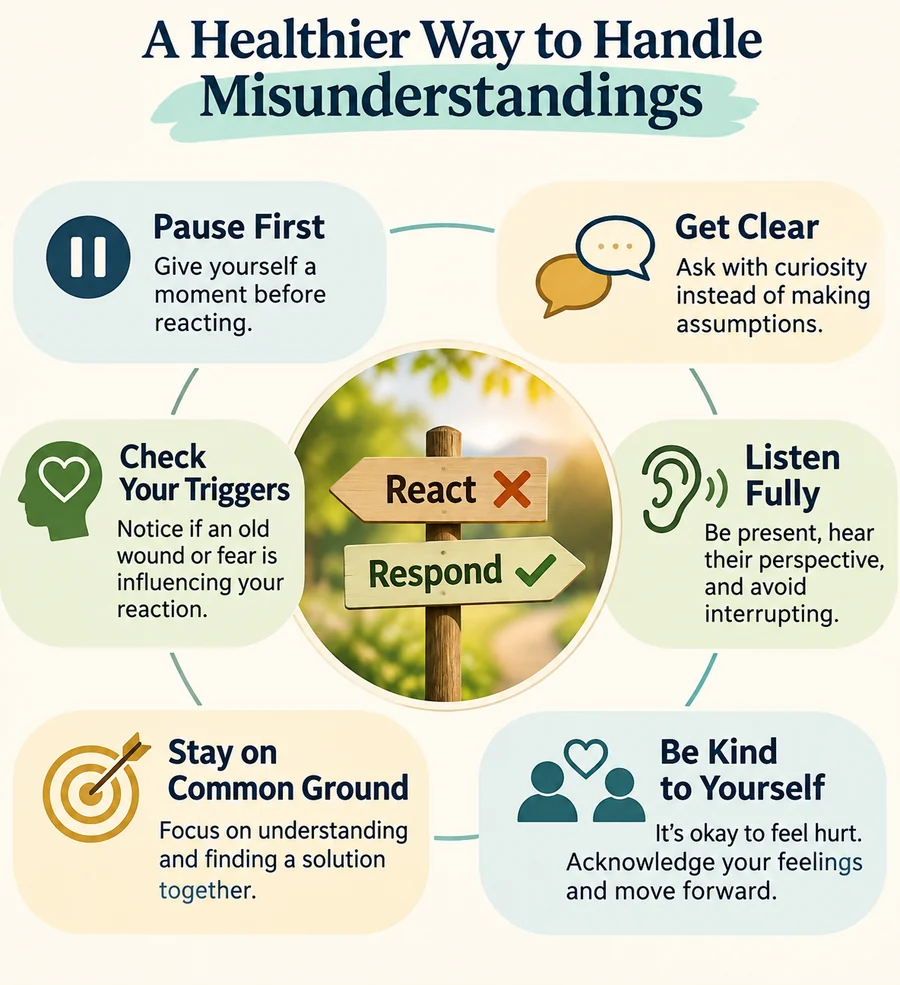
How Can We Reduce Everyday Misunderstandings?
We cannot prevent every misunderstanding. People have different experiences, communication styles, expectations, and emotional needs. Even when we are careful with our words, another person may understand something differently from what we intended.
However, we can develop habits that make misunderstandings less frequent and easier to resolve. The aim is not to communicate perfectly or control how others interpret everything we say. It is to become more aware of our assumptions, express ourselves clearly, and remain willing to clarify when something does not feel right.
Listen to understand before preparing your response
When someone is explaining a concern, give them enough time to complete their thoughts. Try not to interrupt immediately with an explanation or defence, even if you feel that they have misunderstood you. Sometimes, the most important information comes after the first sentence, when the person begins explaining why something affected them.
You can also check your understanding by briefly reflecting what you have heard. For example, saying, “If I understand correctly, you felt disappointed because I did not inform you earlier. Is that right?” gives the other person an opportunity to confirm or correct your interpretation.
Ask for clarification instead of assuming intentions
When someone’s words seem confusing or uncomfortable, try asking what they meant before deciding why they said them. A question such as “What did you mean when you said that?” can be more useful than immediately responding with an accusation.
This becomes especially important when the conversation involves short replies, indirect comments, or unfamiliar expressions. We may be tempted to fill the gaps with our own explanations, but a brief clarification can prevent unnecessary emotional reactions.
Express your feelings without turning them into accusations
People sometimes struggle to communicate hurt or disappointment because they express their feelings through criticism. Statements such as “You never listen to me” or “You always misunderstand everything” can make the other person feel attacked, even when the underlying concern is genuine.
A more constructive approach is to describe the situation, explain how it affected you, and communicate what you would prefer. For example, instead of saying, “You never take my opinion seriously,” you might say, “When my suggestion was interrupted, I felt that I hadn’t been given a chance to explain it. Could you hear me out before responding?”
This approach does not guarantee that the other person will agree. However, it gives them a clearer understanding of your experience without immediately assigning blame.
Recognise when emotions are influencing your interpretation
Before responding to a difficult remark, take a moment to notice what you are feeling. Are you angry because the person actually criticised you, or are you worried that they might be judging you? Are you feeling rejected because someone deliberately excluded you, or because their behaviour reminded you of an earlier experience?
You do not need to analyse every conversation in detail. The important thing is to recognise when an emotional reaction is encouraging you to accept one interpretation too quickly.
A short pause, a few slow breaths, or a decision to ask for clarification can help create space between the initial thought and your response.
Allow people to have different communication styles
Not everyone expresses themselves in the same way. Some people need time to think before answering, while others prefer to discuss concerns immediately. Some communicate directly, whereas others take longer to express uncomfortable feelings.
Instead of assuming that a different communication style indicates a lack of interest or respect, try understanding what works for the other person. You can also explain your own preferences so that communication becomes more comfortable for both of you.
This does not mean tolerating repeated disrespect, dismissive behaviour, or harmful communication. Understanding differences should create mutual consideration, not an expectation that one person must continually adjust while the other makes no effort.
Use a CBT-informed reflection before reacting
Cognitive Behavioural Therapy (CBT) offers a practical way to examine how thoughts, emotions, and behaviours influence one another. One important CBT technique is cognitive restructuring, which involves identifying automatic thoughts, examining the available evidence, and considering more balanced interpretations.
For example, if a friend has not replied to your message, your immediate thought might be, “They are ignoring me because I am no longer important to them.” Rather than accepting this conclusion immediately, you can examine what you actually know and what you are assuming.
The NHS describes thought records as a structured CBT exercise that helps people examine a situation, their thoughts and feelings, evidence supporting and challenging those thoughts, and alternative interpretations.
Read the NHS guide to completing a CBT thought record.
The Meaning Check: Five Questions Before You React
The following exercise adapts CBT-informed reflection to everyday communication. It is an original educational exercise for this article, not a validated psychological assessment or a substitute for therapy.
1. What actually happened?
Describe what the other person said or did without adding your interpretation.
2. What meaning did I give it?
Identify your immediate thought. Did you assume criticism, rejection, indifference, or disrespect?
3. What emotion followed?
Recognise whether you felt hurt, anxious, angry, embarrassed, or disappointed.
4. What else could it mean?
Consider other reasonable explanations. What evidence supports your first interpretation, and what information might you be missing?
5. What could I ask or say next?
Choose a response that communicates your concern without immediately accusing the other person.
An everyday example
Someone responds to your message with a short “Okay.”
- Initial interpretation: “They are angry with me.”
- Emotion: Anxiety and disappointment.
- Alternative possibility: They may be occupied or simply acknowledging the message.
- Constructive response: “Just checking, is everything okay? I wasn’t sure how to understand your reply.”
The purpose of this exercise is not to convince ourselves that every uncomfortable interaction has an innocent explanation. Sometimes, our concerns are justified, and another person’s behaviour genuinely needs to be addressed. The aim is to distinguish what we know from what we assume, so that our response is based on a clearer understanding of the situation.
When Can Counselling Help With Repeated Misunderstandings?
Most misunderstandings do not require professional help. People occasionally interpret words differently, react emotionally, or struggle to express what they really mean. In many situations, patience, clarification, and willingness to listen are enough to resolve the difficulty.
However, sometimes the same communication problems keep returning. A person may repeatedly feel unheard, become anxious before difficult conversations, withdraw to avoid arguments, or find themselves defending their intentions even when they are trying to explain something important. When these experiences begin affecting emotional well-being or relationships, it may be useful to look beyond individual conversations and understand the patterns developing over time.
Recognising when communication difficulties affect emotional well-being
One isolated misunderstanding is different from a repeated pattern that leaves someone emotionally exhausted. A person may gradually become hesitant to express their opinions because they expect their words to be criticised or misinterpreted. Another may constantly worry about how others will react, replay conversations afterwards, or feel responsible for keeping every interaction peaceful.
Over time, these patterns can affect confidence, emotional comfort, and the quality of relationships. Some people begin avoiding difficult discussions altogether, while others repeatedly explain themselves because they fear being misunderstood.
It is also important to recognise that repeated misunderstandings are not always caused by one person’s thinking patterns. Sometimes, there are genuine differences in expectations, unresolved relationship concerns, unequal communication efforts, or repeated disrespect. Understanding the situation requires looking at the interaction as a whole rather than automatically placing responsibility on the person who feels hurt.
How counselling can help people understand communication patterns
Counselling provides a supportive space where people can explore their experiences without immediately judging themselves or blaming others. A counsellor may help them examine recurring situations, identify emotional responses, recognise unhelpful interpretations, and understand how their communication habits influence relationships.
For example, someone who frequently feels criticised may begin recognising that certain comments activate an automatic expectation of rejection. Through guided reflection, they can learn to distinguish between what another person actually said and what they feared the statement meant.
Depending on the person’s concerns and the counsellor’s therapeutic approach, CBT-informed techniques may help examine automatic thoughts, consider alternative explanations, and practise more balanced responses. Other counselling approaches may focus on emotional awareness, relationship patterns, assertiveness, or experiences that have influenced how someone communicates.
The purpose is not to make someone communicate perfectly. It is to help them develop greater awareness of their thoughts, feelings, needs, and responses.
Can relationship counselling help?
Relationship or couples counselling may be helpful when recurring communication difficulties affect both people and they are willing to work towards healthier interaction. Individual counselling can help someone understand their own emotional reactions and communication habits. Couples counselling can provide an opportunity for both people to explore recurring disagreements, understand different perspectives, and develop more constructive ways of addressing concerns.
For instance, a couple who repeatedly argue because one partner seeks immediate discussion while the other needs time to process emotions may benefit from understanding this interaction pattern. Instead of treating one person as demanding and the other as uncaring, they can explore what each person needs during difficult conversations.
The American Psychological Association describes evidence-based psychological practice as the integration of the best available research with clinical expertise and the individual’s characteristics, culture, and preferences. This is important because counselling should be guided by the person’s actual circumstances rather than a one-size-fits-all communication formula.
Read the APA policy on evidence-based practice in psychology.
Counselling is not a guarantee that every relationship difficulty will disappear. Both people’s willingness, the nature of the problem, and the presence of respect and emotional safety matter. Where there is intimidation, coercion, or abuse, the priority should be safety and appropriate individual support rather than simply encouraging better communication.
When should you consider seeking professional support?
You may consider speaking with a qualified mental health professional when:
- Repeated misunderstandings are causing significant emotional distress.
- Conversations frequently turn into arguments despite genuine efforts to resolve them.
- You constantly worry about being judged, rejected, or misunderstood.
- You avoid expressing your feelings because you fear the other person’s reaction.
- Communication difficulties are affecting your relationships, confidence, or everyday functioning.
- You find it difficult to recognise or manage your emotional reactions during disagreements.
Seeking counselling does not mean that something is wrong with you. It can simply be an opportunity to understand yourself better and develop healthier ways of relating to others.
Understanding Begins With Curiosity
We often enter conversations believing that the meaning behind our words should be obvious. When someone interprets them differently, we may feel frustrated, misunderstood, or unfairly judged. Yet the other person may be experiencing the same frustration because they too believe their words have been interpreted incorrectly.
Two people can have different experiences of the same conversation without either person deliberately trying to create a misunderstanding. We all bring our own experiences, expectations, emotions, and ways of interpreting the world into our interactions. Sometimes these differences help us understand each other. At other times, they create assumptions that neither person realises they are making.
Learning to communicate better does not mean choosing every word perfectly or agreeing with everyone. It means becoming willing to pause when something feels unclear, ask rather than assume, and listen without immediately preparing a defence. It also means recognising that our feelings deserve attention, while our interpretations sometimes need to be examined.
Not every misunderstanding can be resolved through better communication. Some differences are genuine, some expectations cannot be fulfilled, and some relationships lack the mutual respect necessary for healthy conversations. Understanding another person’s perspective should never require ignoring our own feelings, boundaries, or dignity.
Perhaps the next time a conversation leaves you feeling misunderstood, you can ask yourself two simple questions:
What was I trying to communicate?
And what might the other person have understood instead?
That small moment of curiosity may not solve every disagreement, but it can create an opportunity for a more thoughtful conversation.
Because communication is not only about making ourselves understood. It is also about remaining open to understanding someone whose perspective may be different from our own.
Frequently Asked Questions
Why do people misunderstand what I say?
People may misunderstand your words because they interpret them through their own experiences, expectations, emotions, and assumptions. Sometimes, the context or tone of a conversation is unclear. In other situations, the listener may attach a meaning to your words that you never intended.
Why do people take things the wrong way?
People sometimes interpret neutral or ambiguous statements negatively because of their existing concerns, emotional sensitivities, or previous experiences. However, the situation and the speaker’s communication style also matter. Clarifying what someone meant is often more useful than immediately assuming their intention.
Why do misunderstandings happen in relationships?
Relationships involve shared expectations, emotional needs, previous experiences, and different communication styles. When people assume that their partner should automatically understand their feelings, unspoken expectations can create frustration. Regular clarification and mutual listening can help reduce these difficulties.
Can anxiety make you misunderstand others?
Anxiety can make uncertain situations feel more threatening. Someone who is worried about rejection or criticism may interpret an ambiguous message more negatively than the available evidence supports. Recognising automatic thoughts and considering alternative explanations can help develop a more balanced response.
How can I stop making assumptions about what people mean?
Start by separating what someone actually said from what you believe they meant. Notice your immediate emotional reaction, consider other reasonable explanations, and ask for clarification when necessary. With practice, this can help you respond more thoughtfully instead of reacting to an unverified interpretation.
Disclaimer: This article is intended for psychological education and general self-reflection. It does not replace individual assessment, diagnosis, or professional mental health care.