

A secure job, a regular income and a respectable professional position are things many people work hard to achieve. Yet, not everyone who has these things feels satisfied with their career. Some people continue working in jobs they no longer enjoy, quietly wondering whether their professional lives could have turned out differently.
They may have once dreamed of becoming a doctor, civil servant, teacher, entrepreneur or something entirely different. Life, circumstances, family responsibilities or personal decisions took them in another direction. They built a career, became financially independent and learned to fulfil their responsibilities. Still, a part of them remains attached to the professional life they once imagined.
This creates a difficult emotional situation. They may not be unhappy enough to leave their present job, but they are not fulfilled enough to feel genuinely engaged with it. They may feel grateful for their stability while simultaneously experiencing disappointment about the opportunities they missed.
This behaviour is increasingly discussed through the term job hugging. But there is a deeper psychological question worth exploring: why do some people continue holding on to a job they no longer enjoy, and why does an unfulfilled career ambition sometimes affect their confidence, relationships and overall happiness?
Table of Contents
The answer is not always about job security. Sometimes, it is about fear, identity, social expectations and the difficulty of accepting a life that looks different from the one we once planned.
What Is Job Hugging? Understanding the Growing Workplace Trend
Job hugging describes the tendency to remain in an existing job, often because it feels safer than exploring new opportunities. A person may have limited job satisfaction, fewer opportunities for growth or little enthusiasm for their daily responsibilities, yet prefer the familiarity and security of their current position.
The term has gained attention as employees reassess the risks of changing jobs. Economic uncertainty, concerns about layoffs, financial commitments and competition for suitable opportunities can make people more cautious about leaving a stable position. In such circumstances, staying may be a sensible decision rather than a sign of weakness or lack of ambition.
The trend received attention in India’s India in Search 2026 report by Kantar. According to the report, Google searches related to job hugging increased by 2,300% year-on-year. The figure reflects a rise in search interest during the period covered by the report, not the proportion of employees who are practising job hugging. It indicates growing curiosity about the phenomenon, rather than proving how widespread the behaviour is.
Read the reporting on Kantar’s India in Search 2026 findings.
It is important to understand that staying in a job is not automatically unhealthy. People have financial responsibilities, family commitments and practical limitations. A stable job may provide benefits that are difficult to replace, particularly when the employment market is uncertain. The concern arises when someone feels trapped, loses confidence in their ability to make choices or remains in a situation that persistently affects their well-being.
Job hugging is therefore best understood as a workplace behaviour, not a psychological diagnosis. To understand why it happens, we need to look beyond the decision to stay and explore what the job represents in a person’s life.
Why People Stay in Jobs They No Longer Enjoy?
There is rarely one explanation for remaining in an unsatisfying job. Practical circumstances and psychological experiences often overlap. A person may genuinely need financial stability while also fearing the uncertainty of starting again.

Fear of uncertainty and losing stability
A familiar job offers predictability. Even when the work feels monotonous, a person knows what is expected, understands the workplace and has a reasonably clear idea of what the next month will look like. A new job, in contrast, brings questions about the employer, colleagues, responsibilities, performance expectations and long-term security.
For someone with family responsibilities or financial commitments, these uncertainties can feel overwhelming. The person may prefer a known dissatisfaction to an unknown risk. This does not necessarily mean they lack courage; it may reflect a genuine need to protect the stability they have worked hard to build.
Financial dependence and family responsibilities
A regular salary often supports more than one individual. Housing expenses, children’s education, loan repayments, healthcare and family responsibilities can make changing jobs difficult. Even when someone wants a different professional direction, the possibility of reduced income or an employment gap may prevent them from acting.
This is particularly relevant when a person has spent years building financial security. The decision to stay may be a practical choice made in the interest of family stability. It becomes psychologically difficult when the individual feels that personal aspirations must always be sacrificed and sees no realistic opportunity to improve the situation.
Loss aversion: Why leaving feels harder than staying
Behavioural economics offers another useful perspective. The concept of loss aversion, associated with the work of Daniel Kahneman and Amos Tversky, describes the tendency for potential losses to carry greater psychological weight than equivalent gains.
Applied to career decisions, a person may focus more on what they could lose by leaving than on what they might gain. They may worry about losing seniority, a regular income, established relationships, benefits or professional recognition. Even when a new opportunity appears attractive, the possible losses can feel more immediate and emotionally powerful.
Loss aversion does not explain every decision to stay, but it helps us understand why the security of an existing position can feel difficult to give up.
Professional identity and social recognition
For many people, a profession becomes an important part of their identity. Their designation influences how they introduce themselves, how others perceive them and how they evaluate their own achievements. A job may represent years of education, effort, sacrifice and family expectations.
Leaving such a position can therefore feel like losing more than employment. It may create questions about status, recognition and personal identity. Someone who once imagined becoming a highly respected professional may struggle to accept a different career, even after building a stable and meaningful working life.
Social expectations and comparison
Career decisions rarely happen in isolation. Family members, friends and society often have strong opinions about what constitutes a successful profession. People may remain in jobs because they fear criticism, disappointing their parents or being judged for making a change after years of effort.
Comparison can make this pressure stronger. Seeing former classmates achieve positions that were once personal ambitions may bring back feelings of disappointment. Instead of evaluating their own circumstances realistically, individuals may begin measuring their lives against someone else’s professional journey.
The sunk cost effect
Another factor is the amount of time, effort and money already invested in a career. Someone may think, “I have spent fifteen years building this position. How can I leave now?” The years already invested cannot be recovered, but they can influence present decisions.
Past effort deserves respect, but it should not be the only reason for continuing in an unsatisfying situation. A more useful question is whether staying still serves the person’s present needs and future direction. Career decisions should consider current circumstances, not only the cost of reaching this point.
These reasons often operate together. A person may remain in a job because of financial responsibilities, fear of uncertainty and attachment to professional identity. Understanding which factors matter most is the first step towards making a thoughtful decision.
When the Real Problem Is an Unfulfilled Career Dream
For some people, dissatisfaction is not limited to their current workplace. The deeper difficulty comes from a career they once wanted but could not achieve. They may have entered a different profession because of family circumstances, examination results, financial pressure, limited opportunities or decisions made at an earlier stage of life.
Years later, they may still wonder what would have happened if they had chosen differently. They imagine the professional recognition, satisfaction or lifestyle they might have experienced. The career they did not pursue can gradually become an emotional reference point against which their present life is judged.
This experience can be understood as career regret. It refers to distress associated with a career decision, an unrealised professional goal or a path that a person wishes had been different. It is not the same as ordinary job dissatisfaction, and it does not necessarily mean that the original decision was wrong.

A 2022 qualitative study by Alexandra Budjanovcanin and Chris Woodrow, published in the Journal of Vocational Behavior, explored occupational regret through interviews with 51 individuals. The researchers found that career regret can occur in cycles and that people respond to it in different ways. Some responses can support exploration and future decisions, while others may contribute to stagnation.
A later qualitative study by Claire Schulze Schleithoff, Evgenia Lysova, Svetlana Khapova and Konstantin Korotov, published in Career Development International in 2026, explored how career decisions develop into career regret. Drawing on interviews and retrospective narratives from professionals, the researchers identified the importance of perceived loss, low career agency and feeling trapped. Their findings suggest that regret can become more persistent when people remain inactive while feeling unable to influence their career direction.
Read the 2022 study on occupational regret.
Read the 2026 qualitative exploration of career regret.
The imagined career may become more attractive than reality
One reason career regret can become emotionally powerful is that people often compare their actual lives with an imagined alternative. Their present career includes routine responsibilities, workplace difficulties, limitations and everyday frustrations. The career they did not achieve, however, may be remembered mainly through its imagined benefits.
Someone who wanted to become a doctor may imagine the respect, purpose and professional identity associated with that role. Someone who wanted to become a civil servant may focus on the authority, recognition or social contribution they believe they would have experienced. These aspirations may have been genuine, but the imagined career is not a complete picture of what that professional life would have involved.
This does not mean that the original dream was unrealistic or unimportant. It means that the mind may be comparing two unequal versions of life: the difficulties of the present with the possibilities of an idealised alternative.
When regret becomes self-blame
A person may repeatedly ask, “Why did I not work harder?” “Why did I make that decision?” or “Why did I not take the opportunity when I had it?” Such questions may initially appear to be attempts to understand the past, but they can gradually become a form of self-criticism.
Looking back with today’s knowledge can make earlier decisions appear easier than they actually were. At the time, the person may have faced financial limitations, family pressure, incomplete information or uncertainty about the future. Judging those decisions without considering the circumstances can create unnecessary guilt.
A more balanced approach is to recognise that the past cannot be changed, but its meaning can be reconsidered. A missed ambition may be a source of disappointment, but it does not have to become proof of personal failure.
How Career Regret Can Affect Self-Worth and Emotional Well-Being
A person’s profession can influence how they see themselves. Work provides opportunities to develop skills, contribute to society, earn recognition and experience a sense of competence. When professional achievement becomes the main measure of personal worth, however, an unfulfilled ambition can affect much more than career satisfaction.
Some people begin to believe that they are less successful, less capable or less valuable because they did not achieve a particular professional position. They may overlook their abilities and accomplishments because these do not match the standard they once set for themselves. This is especially difficult when their self-esteem depends heavily on achievement or external approval.
Psychologists have explored this through the idea of contingent self-worth: self-esteem can become dependent on particular areas of life, such as academic performance, appearance, approval or professional success. When a person relies heavily on one area to feel valuable, setbacks in that area can have a disproportionate emotional impact.
The gap between the actual self and the ideal self
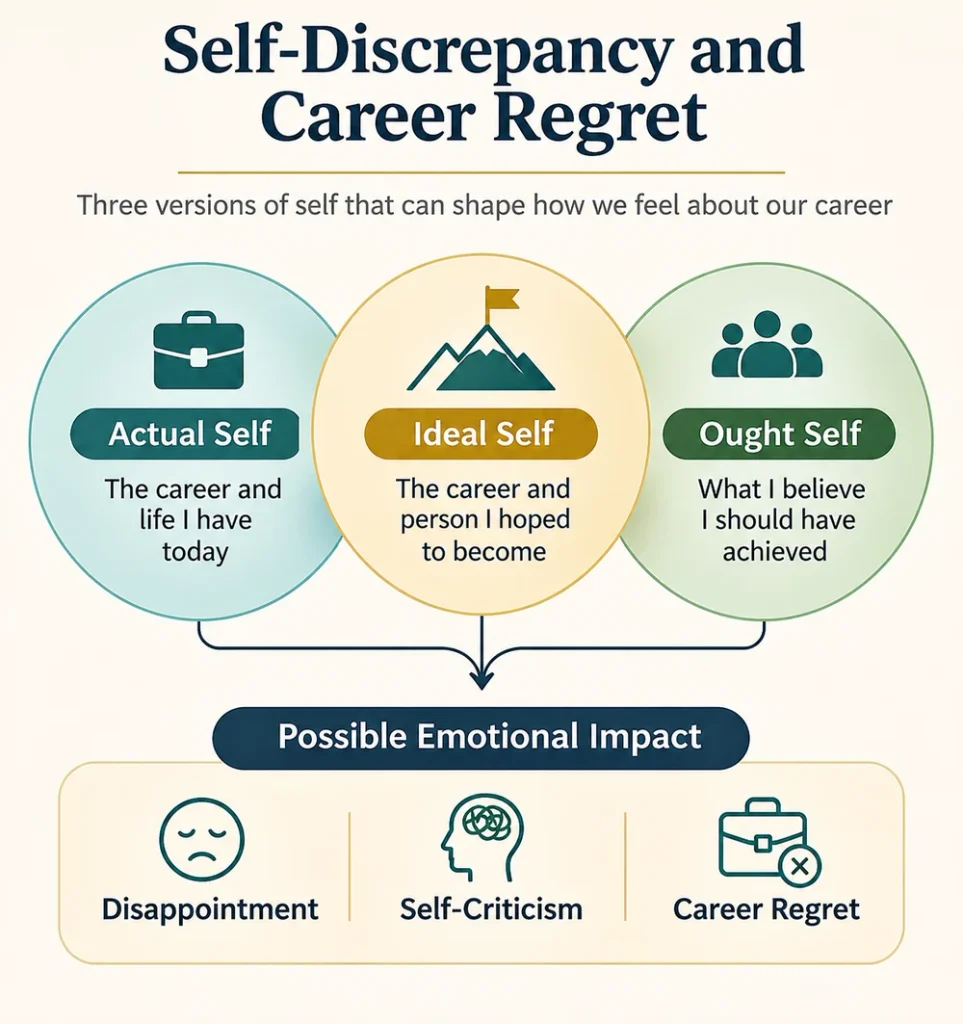
Self-discrepancy theory, developed by psychologist E. Tory Higgins, offers another way to understand this experience. It describes how differences between the way people see themselves, the way they would ideally like to be and the way they believe they ought to be can be associated with emotional discomfort.
For example, someone may see their actual self as a professional in one field while their ideal self remains attached to a different career. They may also carry an internal expectation that they should have achieved more by a certain age. The distance between these expectations and present reality can contribute to disappointment and self-criticism.
The problem is not having ambitions. Ambition can provide direction and motivation. The difficulty arises when a person treats one unrealised ambition as the only acceptable version of a successful life.
Emotional consequences of unresolved disappointment
Career-related disappointment may appear in different ways. Some individuals become frustrated or irritable, while others withdraw socially or lose interest in activities they previously enjoyed. They may find it difficult to celebrate other people’s achievements because these experiences remind them of what they believe they have missed.
Some may also experience persistent worry, reduced motivation or difficulty concentrating. These experiences can have several possible causes and should not automatically be attributed to career regret. However, when professional dissatisfaction occupies a large part of someone’s thinking, it is worth paying attention to its effect on everyday functioning.
It is also possible to have a stable job and still feel emotionally unfulfilled. Financial security and professional recognition are important, but they do not automatically meet every psychological need.
Self-Determination Theory, developed by Edward Deci and Richard Ryan, highlights three basic psychological needs: autonomy, competence and relatedness. People generally benefit when they have some sense of choice, feel capable of using and developing their abilities, and experience meaningful connection with others.
A 2026 meta-analysis of workplace research, published in Stress and Health, synthesised findings from 192 studies and examined relationships between these psychological needs, motivation and workplace outcomes. Its findings supported associations between need satisfaction, autonomous motivation and more adaptive workplace outcomes, although the strength of relationships varied across contexts.
Read the 2026 meta-analysis on Self-Determination Theory and workplace outcomes.
This helps explain why a person may have a secure position yet still feel dissatisfied. A job can provide income and status without offering enough autonomy, meaningful development or connection.
How Career Dissatisfaction Can Affect Relationships and Family Life
Professional dissatisfaction does not always remain at the workplace. When someone carries unresolved frustration throughout the day, it can influence how they interact with family members, friends and colleagues. They may become distracted during conversations, react impatiently to small disagreements or withdraw from activities they once enjoyed.
A partner may find it difficult to understand why someone who appears professionally settled remains unhappy. The person experiencing career regret may also struggle to explain their feelings. They may feel guilty about expressing dissatisfaction because they believe they should be grateful for their circumstances.
Over time, this emotional distance can affect relationships. Family members may begin to feel that the person is physically present but mentally occupied elsewhere. Career concerns can become a recurring subject of conversation, while shared experiences and emotional connection receive less attention.
There is another dimension worth considering: parents sometimes transfer their own unfulfilled ambitions to their children. A parent who could not enter a preferred profession may place strong expectations on a child to achieve what they once wanted. The intention may come from love and concern for the child’s future, but excessive pressure can make the child feel that parental approval depends on academic or professional achievement.
Children need guidance, encouragement and realistic support. They also need the freedom to discover their own interests and abilities. A healthy approach to parenting recognises that a child’s future should not become a second opportunity for a parent to complete an unfinished dream.
For readers interested in how family experiences influence emotional development, see how childhood shapes emotional regulation and positive parenting and nurturing children.
Should You Change Jobs or Change Your Relationship with Your Career?
One of the most important questions is whether the person genuinely needs a different job or needs to understand their relationship with work more clearly. These are not the same problem, and treating them as identical can lead to decisions that do not resolve the underlying dissatisfaction.
Changing jobs may be appropriate when the workplace is consistently unhealthy, the role offers no reasonable opportunity for development, the work conflicts with important personal values or the person’s well-being is being seriously affected. In such circumstances, exploring alternatives can be a constructive step.
However, if the main source of distress is an unfulfilled career dream, changing employers may not resolve the emotional conflict. A person may move to another organisation and discover that the same comparisons, self-doubt and regret continue. The job has changed, but the internal standard against which life is judged has remained the same.
Before making a major decision, consider the following questions:
- Am I dissatisfied with my present work, workplace or professional identity?
- If I received a better position in the same field, would I feel more satisfied?
- Am I genuinely interested in another career, or do I mainly want the recognition associated with it?
- What practical responsibilities must I consider before changing jobs?
- Is there a realistic way to explore a new direction without putting my financial stability at unnecessary risk?
It may help to explore options gradually. Career counselling, skill development, mentoring, additional training or a carefully planned transition can provide more information before a person makes an irreversible decision.
The goal is not to remain in an unsatisfying job at any cost. Nor is it to leave simply because another career appears more attractive. The goal is to make a decision that reflects present circumstances, personal values and realistic opportunities.
The R.E.C.L.A.I.M. Framework: A Practical Way to Rebuild Career Identity
Understanding career regret is important, but people also need a way to respond to it. The following R.E.C.L.A.I.M. Framework is an original educational framework designed to help individuals reflect on career dissatisfaction, recognise unhelpful thinking patterns and identify meaningful steps forward.
It is not a clinically validated treatment or a substitute for professional counselling. It brings together ideas from career development, self-reflection, self-compassion and psychological well-being in a practical sequence.
R – Recognise the real source of dissatisfaction
Begin by identifying what is actually troubling you. Is it the nature of your work, the workplace environment, limited growth, financial pressure, social comparison or disappointment about a career you could not pursue?
These experiences can feel similar, but they may require different responses. Writing down the situations that trigger dissatisfaction can help you understand whether the problem is primarily practical, emotional or a combination of both.
E – Explore what your unfulfilled dream represented
A career ambition often carries meanings beyond the job itself. Perhaps you wanted recognition, independence, social contribution, creativity, financial freedom or a sense of achievement.
Ask yourself what attracted you to that profession. Which of those needs remain important today? You may discover that some parts of your original ambition can still be pursued through your present career, voluntary work, learning or other meaningful activities.
C – Challenge the imagined alternative
When regret becomes repetitive, the career you did not achieve may begin to look perfect. Try to compare your present circumstances with a realistic alternative rather than an idealised picture.
Consider the responsibilities, challenges and uncertainties that the other career might also have involved. This does not invalidate your dream; it simply helps you evaluate it more fairly.
L – Let go of unnecessary self-blame
You cannot make decisions today with the knowledge you have gained over the years. Your earlier choices were influenced by the circumstances, opportunities and limitations that existed at that time.
Practising self-compassion means recognising this without pretending that every decision was perfect. Instead of repeatedly asking why you failed, consider what the experience taught you and what you can do differently now.
A – Align your life with your values
Identify what matters to you at this stage of life. It may include family, meaningful work, learning, financial independence, service, creativity or personal freedom.
A satisfying life does not require every value to be fulfilled through one job. You may find greater balance by allowing different areas of life to contribute to your sense of meaning.
I – Initiate meaningful action
Regret can become more difficult when a person feels unable to influence their future. Begin with small actions that restore a sense of agency.
You might explore a new skill, speak to a mentor, take on a meaningful project, investigate a career transition or reconnect with an interest that has been neglected. Progress does not have to be dramatic to be valuable.
M – Make peace with the past
Making peace does not mean forgetting your ambition or denying your disappointment. It means accepting that your life took a different direction and recognising that meaningful possibilities still exist.
You can respect the person you once wanted to become without treating that imagined future as the only life worth living. The past can remain part of your story without controlling every decision you make today.
How Counselling Can Help When Career Regret Feels Difficult to Resolve
Sometimes, people understand their dissatisfaction but struggle to move beyond it. They may repeatedly revisit the same decisions, feel guilty about their choices or find it difficult to identify what they genuinely want. When these concerns begin affecting confidence, relationships, motivation or everyday functioning, speaking with a counsellor may provide a helpful space to explore them.
Counselling is not simply about receiving advice or being told to change jobs. It is a structured, supportive process in which a person can understand their concerns, examine their thinking patterns and consider possible ways forward. A counsellor may help the individual distinguish between practical career problems and emotional difficulties connected with identity, regret, expectations or self-worth.
What happens during counselling?
The process generally begins with understanding the person’s concerns and background. The counsellor may explore the individual’s career journey, important decisions, present work situation, family expectations and the experiences that trigger dissatisfaction. The purpose is to understand the person’s perspective rather than judge their decisions.
Subsequent conversations may focus on identifying recurring thoughts, examining unrealistic comparisons, developing healthier ways of responding to disappointment and clarifying personal values. Depending on the person’s needs and the counsellor’s training and scope of practice, approaches may include reflective counselling, cognitive and behavioural strategies, self-compassion exercises, goal-setting and career exploration.
The process is collaborative. The person is not expected to make an immediate career decision or follow instructions without question. Instead, counselling can help them develop greater clarity, recognise their options and make decisions that are more consistent with their circumstances and values.
When should you consider professional support?
Consider seeking support if career-related thoughts are persistently affecting your mood, sleep, relationships, concentration or ability to enjoy everyday activities. It may also be helpful when self-blame, anxiety, hopelessness or emotional exhaustion becomes difficult to manage independently.
Career dissatisfaction does not automatically indicate a mental health disorder. However, persistent low mood, loss of interest, severe anxiety or significant difficulty functioning deserve appropriate attention. A qualified mental health professional can help assess whether additional support or treatment is needed.
Counselling should be provided within the professional’s training and competence. A counsellor is not automatically a clinical psychologist or psychiatrist, and a person experiencing significant or persistent symptoms may need assessment by an appropriately qualified mental health professional.
If you are looking for emotional or career-related support, consider speaking with a qualified counsellor who can explain their qualifications, approach, confidentiality practices and professional boundaries before you begin. The purpose of seeking help is not to label yourself as unsuccessful or incapable. It is to give yourself a supportive space to understand what is happening and decide what may help.
In India, the Government’s Tele-MANAS service also provides 24-hour tele-mental-health support through 14416. It can be a starting point for people seeking mental health assistance or guidance about available services. Read the official Tele-MANAS information.
Daily Habits That Can Help You Rebuild Emotional Fitness
A better relationship with your career is not built through one decision alone. It develops through everyday choices that support emotional awareness, personal confidence and a balanced sense of identity.
Start the day with your own priorities. Before checking professional updates or comparing your achievements with others, identify what matters for the day. It may be completing a responsibility, learning something new or spending time with family. This helps you begin with personal direction rather than external comparison.
Recognise emotions instead of suppressing them. If a professional achievement by someone else makes you feel disappointed, try to understand what it reminds you of. Acknowledge the emotion without criticising yourself for having it. Emotional awareness can help you respond thoughtfully rather than react automatically.
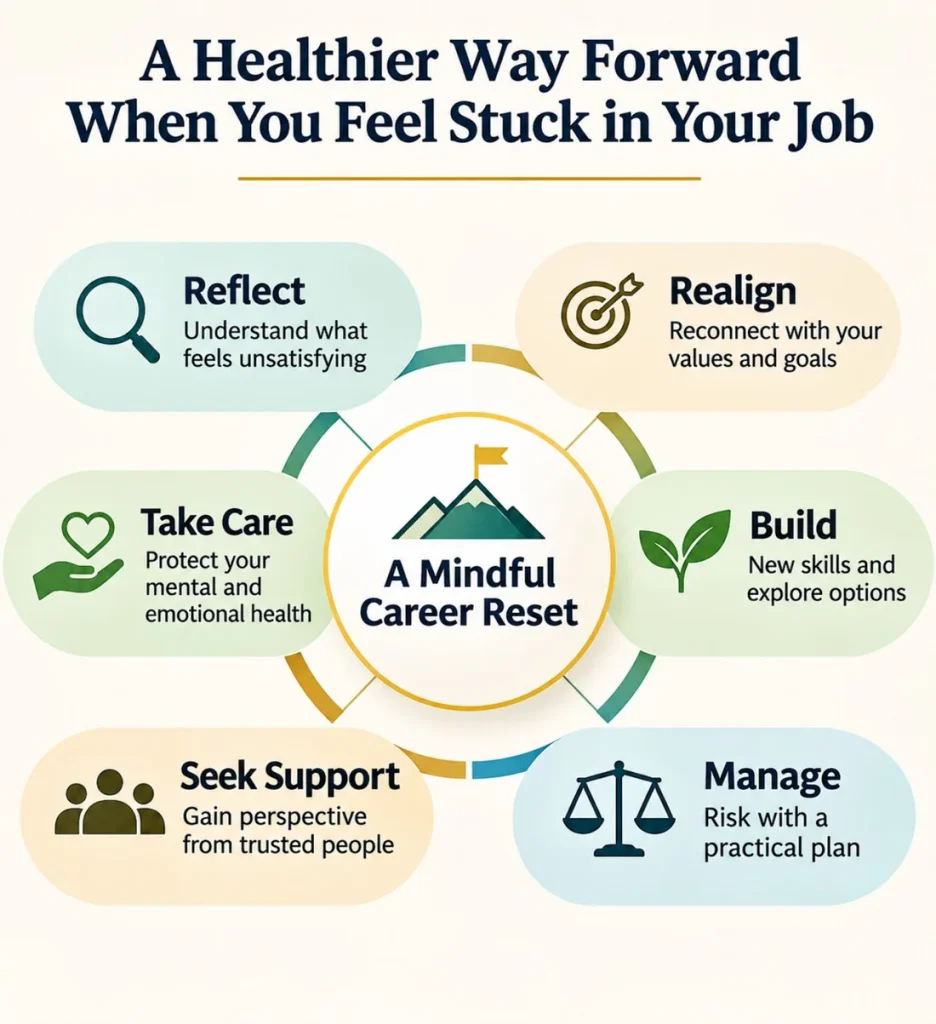
Replace repetitive regret with useful reflection. Ask whether thinking about a past decision is helping you understand something new. If the same thoughts keep returning without leading to insight or action, gently redirect your attention towards something within your control. For more on repetitive thinking, see the hidden psychology of overthinking.
Set small, achievable goals. Completing a course, developing a skill, contributing to a project or exploring a new interest can help restore confidence. Small experiences of progress can strengthen the belief that you still have the ability to learn and influence your future.
Build an identity beyond your job title. Make time for relationships, hobbies, physical activity, learning and contribution to others. These areas of life provide meaning that cannot always be found through professional recognition alone.
Protect time for rest and relationships. Regular sleep, physical activity and meaningful social interaction support general well-being. They are not cures for career regret, but they can provide a healthier foundation for managing everyday stress.
Review your progress without judging yourself. Once a week, ask what situations affected your mood, what you handled well and what you would like to change. The purpose is to notice patterns and make thoughtful adjustments, not to create another performance target.
For more on developing a balanced relationship with emotions, read Emotional Fitness vs. Emotional Suppression and Resilience as a Life Skill.
Your Career Is Part of Your Identity, Not the Entirety of Who You Are
A secure job can provide stability, recognition and a sense of responsibility. Yet, these achievements do not automatically guarantee emotional fulfilment. Some people continue to feel dissatisfied because their present professional identity does not match the future they once imagined.
This is one of the deeper psychological dimensions of job hugging. Sometimes, people stay because changing careers feels financially risky or practically difficult. At other times, they remain emotionally attached to a career they could not achieve, making it difficult to appreciate the professional life they have built.
An unfulfilled ambition can be painful, particularly when it represents years of effort, family expectations or a deeply held vision of personal success. But the career you did not achieve should not become the standard by which you judge everything you have accomplished. Your earlier decisions were made within particular circumstances, with the knowledge and opportunities available at that time. You deserve the opportunity to learn from those decisions without spending the rest of your life punishing yourself for them.
This does not mean that you must remain in a job that makes you unhappy. If your work offers no meaningful growth, damages your well-being or conflicts with your values, exploring another direction may be necessary. But make that decision with clarity rather than desperation. Understand whether you genuinely want a different career, need a healthier working environment or are trying to resolve an emotional disappointment that may follow you even after changing jobs.
There is also an important lesson for parents. A child’s career should not become an extension of a parent’s unfulfilled ambition. Children need guidance, encouragement and opportunities to develop their abilities, but they also need the freedom to discover their own interests and make decisions. Their worth should never depend on securing a particular position or fulfilling someone else’s definition of success.
Perhaps the most important realisation is that professional success and personal fulfilment are related, but they are not identical. Your job may describe what you do, your designation may reflect your professional position, and your achievements may represent years of effort. But none of these can fully describe your relationships, values, kindness, resilience, experiences or contribution to the lives of others.
You do not have to achieve every dream you once had to build a life worth appreciating. You can honour the person you once wanted to become while learning to value the person you are today.
Sometimes, moving forward does not begin with finding a better job. It begins with making peace with the life you have lived, recognising the possibilities that still remain and giving yourself permission to experience happiness without waiting for an unfulfilled dream to come true.
Your career is an important chapter of your life, but it is not the whole story. Do not allow one unfulfilled ambition to make you overlook the many ways in which your life can still grow, contribute and become meaningful.