

Have you ever had an argument with someone and spent the rest of the day wondering whether everything was your fault? Perhaps a conversation went badly, someone became upset, or a relationship felt different after a disagreement. Even when the situation involved more than one person, your mind kept returning to the same conclusion: “Maybe I am the reason everything went wrong.”
If you often ask yourself, “Why do I blame myself for everything?” especially after an argument or misunderstanding, you may be experiencing excessive self-blame. It can make you question your words, decisions and even your personality. You might apologise when you have done nothing wrong, take responsibility for other people’s reactions or feel guilty about situations you could not control.
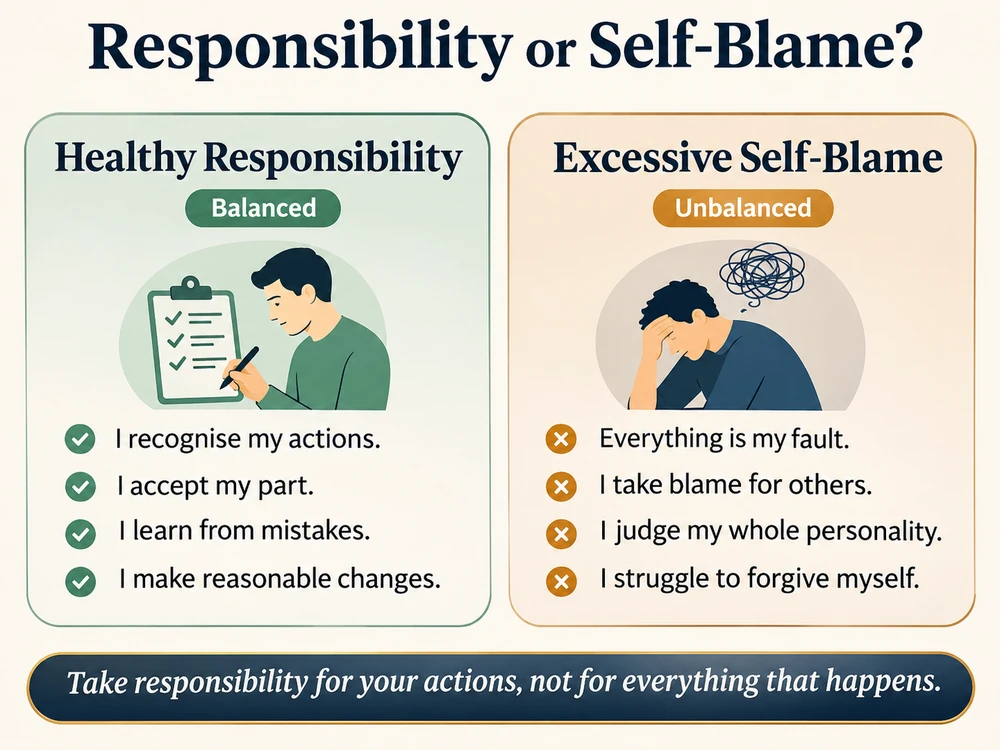
There is an important difference between accepting responsibility and blaming yourself for everything. Healthy responsibility helps you recognise mistakes and learn from them. Excessive self-blame makes you feel personally responsible for almost every negative experience.
Table of Contents
Psychology offers several ways to understand this pattern, including personalisation, self-critical thinking, shame and an exaggerated sense of responsibility. Understanding these processes can help you respond to difficult situations more fairly.
Let’s explore why you may blame yourself so often, how this pattern affects your emotional wellbeing and what you can do to develop a healthier relationship with yourself.
Why Do I Always Blame Myself for Everything?
For some people, self-blame is not a deliberate decision. It happens almost automatically whenever something goes wrong. Instead of first considering what happened, they immediately examine their own behaviour for something they might have done incorrectly.
Imagine sending a message to a friend who usually replies quickly. This time, there is no response for several hours. You begin wondering whether your last conversation sounded rude or whether you said something that upset them. You may have no evidence of a problem, yet your mind has already started looking for your mistake.
This pattern can become particularly noticeable after arguments, misunderstandings and uncomfortable conversations.
When something goes wrong, why do I automatically think it is my fault?
One possible explanation is a habitual way of interpreting negative events. If you have repeatedly learned to question yourself whenever someone is unhappy, you may begin treating your own behaviour as the first place to look for an explanation.
For example, a colleague may seem unusually quiet, or a family member may disagree with your decision. Rather than considering other possibilities, you immediately wonder what you did wrong. The situation becomes a judgement about your behaviour before you have enough information to understand it.
This does not mean that self-reflection is harmful. It becomes difficult when you examine your own mistakes but rarely consider other people’s contributions or circumstances.
Why do I feel responsible even when other people make mistakes?
You may be focusing so strongly on your own behaviour that you overlook the choices other people make. This can happen when you feel responsible for maintaining peace, avoiding conflict or keeping everyone around you happy.
For instance, if a family member becomes angry, you may immediately wonder how you could have prevented it. You might even apologise simply to make the situation comfortable again. However, another person’s feelings and behaviour are influenced by their own thoughts, expectations and decisions.
You can acknowledge your part in a disagreement without accepting responsibility for everything that happened.
Why does one argument make me question my entire personality?
An argument can sometimes feel much bigger than the disagreement itself. You may begin with the thought, “I should not have spoken that way,” and end with, “I am a terrible person.”
This shift from judging an action to judging your entire identity is important. Making a mistake does not establish that you are always wrong, difficult or incapable of maintaining healthy relationships.
A more balanced response would be, “I could have handled that conversation better. I can understand what happened and decide what to do differently next time.”
What Is It Called When You Blame Yourself for Everything?
There is no single psychological diagnosis for blaming yourself for everything. However, several psychological concepts help explain why a person may repeatedly assume responsibility for negative situations.
Understanding these terms can help you recognise your thinking patterns without treating them as permanent personality traits.
Personalisation: When Everything Feels Like Your Fault
Personalisation is a cognitive distortion in which someone assumes that an event is connected to them or caused by them without sufficient evidence. For example, if two friends stop talking while you are present, you may assume that you somehow caused the disagreement.
The problem is not that you consider your own contribution. It is that you may overlook other explanations and treat your assumption as a fact. Someone else’s disappointment, silence or frustration does not automatically mean you have done something wrong.
Excessive Self-Blame and Inflated Responsibility
Excessive self-blame occurs when you repeatedly take more responsibility than the situation reasonably calls for. You may feel accountable for another person’s happiness, a relationship’s difficulties or outcomes that were never entirely within your control.
In clinical psychology, the term inflated responsibility is also discussed in relation to obsessive-compulsive disorder (OCD). However, experiencing excessive responsibility in everyday life does not mean that you have OCD. The context, intensity and impact of the thoughts matter.
Self-Criticism Versus Healthy Self-Reflection
Healthy self-reflection helps you recognise mistakes and improve your behaviour. Self-criticism becomes unhelpful when it turns a specific mistake into a broad judgement about your worth.
Consider the difference between “I did not listen carefully during that conversation” and “I am always a bad friend.” The first statement identifies something you can change. The second attacks your identity without helping you understand what to do next.
Researcher Ronnie Janoff-Bulman distinguished between behavioural and characterological self-blame in a 1979 study. Behavioural self-blame focuses on a particular action that may be changed, while characterological self-blame attributes a negative experience to something fixed about the self. This distinction is useful when understanding why some forms of self-reflection can support change while others reinforce negative self-judgement.
Why Do I Blame Myself for Everything? Understanding the Psychology
Excessive self-blame is not always caused by one experience or one way of thinking. It can involve several psychological processes working together. Your past experiences, beliefs about yourself and responses to conflict may influence how you interpret what happens.
The following concepts offer a clearer understanding of why you may repeatedly take the blame, even when the situation is more complicated.
Behavioural Versus Characterological Self-Blame
Janoff-Bulman’s research helps explain an important difference in the way people interpret negative experiences. Behavioural self-blame focuses on a specific action: “I should have communicated more clearly.” Characterological self-blame focuses on the person: “I am incapable of having a good relationship.”
The first interpretation leaves room for learning and improvement. The second can make a person feel that something is fundamentally wrong with them. When you blame yourself, try to notice whether you are examining a particular behaviour or making a judgement about your entire identity.
Internal, Stable and Global Thinking
Psychologists have also studied how people explain negative events through attributional styles. One influential model examines whether someone sees a problem as internal, stable and global.
An internal explanation means believing that the problem is caused by something about yourself. A stable explanation means believing it will continue, while a global explanation means assuming it affects many areas of your life.
For example, after one disagreement, you might think, “I caused this, I always behave this way, and I cannot maintain any relationship.” The conclusion moves far beyond the actual event. Recognising this pattern can help you return to the specific facts instead of treating one difficult experience as proof of a permanent problem.
Self-Critical Rumination: Replaying Your Mistakes
Sometimes self-blame continues long after the situation has ended. You may replay the same conversation, remember a particular expression or imagine what you should have said differently. Instead of finding a useful lesson, you keep returning to the same painful conclusions.
This is related to self-critical rumination: repeatedly thinking about perceived failures and inadequacies without moving towards problem-solving. A 2021 experimental study by Milia, Kolubinski and Spada found that self-critical rumination, particularly alongside high performance expectations, was associated with greater reported shame and stress following a perceived failure.
This helps explain why repeatedly criticising yourself may leave you feeling worse rather than helping you improve. If you want to explore the separate experience of repeatedly revisiting conversations, read our article on why you take everything so personally.
Shame Versus Guilt: Why a Mistake Can Feel Like a Personal Failure
Guilt and shame are related, but they are not identical. Guilt is often connected to something you believe you have done wrong: “I hurt someone, and I should make it right.” Shame tends to involve a broader negative judgement about the self: “There is something wrong with me.”
This difference matters because guilt can sometimes encourage repair, while persistent shame can make you withdraw, hide or criticise yourself. If every disagreement leaves you feeling like a bad person, you may be experiencing more than regret about a particular action.
A study by Orth, Berking and Burkhardt (2006) examined the relationship between shame, guilt, rumination and depression in parents experiencing marital separation. Its findings highlight the importance of rumination in understanding the relationship between shame and emotional distress. The study does not mean that every experience of shame leads to depression, but it offers a useful perspective on why harsh self-evaluation can become emotionally exhausting.
The Need to Feel in Control
Sometimes blaming yourself can create an uncomfortable sense of control over an unpredictable situation. If you believe that everything happened because of something you did, you may also believe that you can prevent similar situations by behaving differently next time.
For example, after a relationship disagreement, you might think, “If only I had chosen my words more carefully, none of this would have happened.” This may feel more manageable than accepting that relationships involve another person’s choices, misunderstandings and circumstances you cannot fully control.
This is only one possible explanation, not a universal cause of self-blame. However, recognising the limits of your control can help you stop carrying responsibility for outcomes you could not determine alone.
Why Do I Blame Myself for Other People’s Actions and Problems?
Some people do not only blame themselves for their own mistakes. They also feel responsible for the emotions, decisions and difficulties of people around them. This can be especially common in close relationships, where caring about someone may gradually become confused with feeling responsible for their happiness.
Imagine that someone you care about is having a difficult day. You may feel uncomfortable seeing them upset and start wondering what you should do to make everything better. Supporting them is a caring response. Believing that their emotional state is entirely your responsibility is something different.
Feeling Responsible for Other People’s Emotions
You may find yourself monitoring people’s moods, adjusting your behaviour and avoiding topics that could upset them. When someone is unhappy, you immediately look for something you could change.
This pattern can become emotionally tiring because other people’s feelings are influenced by many things, including their personal experiences, expectations and circumstances. You can listen, offer support and show consideration without taking ownership of every emotion they experience.
Why Do I Apologise Even When I Have Done Nothing Wrong?
An unnecessary apology can sometimes be an attempt to end tension rather than an acknowledgement of genuine responsibility. You may say sorry because silence feels uncomfortable, someone appears disappointed or you fear that a disagreement could damage the relationship.
Although apologising can help repair a genuine mistake, doing it automatically may make it harder to express your needs. Before saying sorry, pause and consider whether you actually did something that requires an apology. You can acknowledge another person’s feelings without accepting blame for something you did not do.
When Keeping Everyone Happy Becomes Your Responsibility
Some people become so focused on avoiding conflict that they gradually ignore their own needs. They agree when they disagree, accept requests they cannot manage and feel guilty whenever they disappoint someone.
This can create an unequal pattern in relationships. You may become responsible for maintaining peace while other people are not expected to consider your feelings to the same extent. Healthy relationships allow room for different opinions, personal boundaries and shared responsibility.
Empathy Versus Excessive Emotional Responsibility
Empathy means trying to understand another person’s feelings. Excessive emotional responsibility means believing that you must prevent or fix those feelings, even when they are not yours to control.
For example, you can understand why a friend feels disappointed without agreeing to something that makes you uncomfortable. You can care about your partner’s worries without accepting blame for every difficult emotion they experience.
A useful question is: “Am I supporting this person, or am I taking responsibility for something they need to manage themselves?” The distinction can help you remain caring without losing your own emotional balance.

Is Blaming Yourself for Everything a Trauma Response?
Sometimes excessive self-blame is connected to difficult or painful experiences. A person who grew up with repeated criticism, unpredictable reactions or little emotional support may learn to question their own behaviour whenever conflict occurs.
However, it is important not to assume that every person who blames themselves has experienced trauma. Self-blame can develop through many influences, including perfectionism, anxiety, relationship experiences, low self-esteem and learned ways of handling disagreement.
How Childhood Experiences May Shape Self-Blame
Children depend on adults to help them understand emotions, conflict and responsibility. When a child is repeatedly criticised, blamed or made to feel responsible for an adult’s mood, they may begin to believe that keeping others happy is their job.
For example, a child who is frequently told that they are the reason for family tension may grow into an adult who automatically apologises during disagreements. They may find it difficult to recognise that other people are responsible for their own behaviour.
Early experiences can influence later emotional patterns, but they do not determine a person’s future. Supportive relationships and new ways of understanding responsibility can help people develop healthier responses.
When Taking Responsibility Becomes a Learned Protective Pattern
In some environments, accepting blame may have felt like the safest way to avoid further criticism or conflict. A child may learn to agree quickly, apologise or stay quiet because challenging someone feels emotionally risky.
Later in life, this response may continue even when the original circumstances have changed. An adult may accept unfair blame simply because disagreement brings back an uncomfortable sense of insecurity.
Recognising this pattern can help you understand why you respond automatically. It also creates an opportunity to practise expressing yourself without assuming that every disagreement will lead to rejection or conflict.
Does Fear of Rejection or Conflict Make You Blame Yourself?
For some people, the possibility of disappointing someone feels especially threatening. They may interpret a change in someone’s tone, a delayed reply or a disagreement as a sign that the relationship is in danger.
Research on rejection sensitivity by Downey and Feldman (1996) explored how people who anxiously expect rejection may interpret and respond to situations in close relationships. This offers one possible explanation for why some individuals become highly alert to signs of disapproval.
However, fear of rejection is not the only reason for self-blame. The important thing is to notice whether you are responding to what actually happened or to what you fear might happen.
Why Not Every Pattern of Self-Blame Is Caused by Trauma
It is tempting to search for one explanation for every emotional difficulty, but human behaviour is rarely that simple. Some people develop self-blaming habits through high personal expectations, repeated criticism at work, difficult relationships or a strong desire to avoid mistakes.
You do not need to label your experience as trauma to take it seriously. What matters is understanding how the pattern affects your life and finding healthier ways to respond.
How Chronic Self-Blame Affects Your Emotional Wellbeing and Relationships
Occasional self-reflection can be useful, but repeated self-blame may gradually affect how you see yourself and interact with other people. You may become more cautious, avoid difficult conversations or spend too much time thinking about what you should have done differently.
Over time, this pattern can make ordinary disagreements feel emotionally exhausting. It may also become harder to distinguish between a genuine mistake and an unfair sense of responsibility.
It Can Gradually Affect Your Self-Esteem
When you repeatedly interpret problems as evidence of your inadequacy, your confidence may begin to suffer. You may hesitate before making decisions, doubt your opinions or assume that other people are more capable of handling situations than you are.
The difficulty is that you stop evaluating individual actions and start judging your overall worth through them. A healthier approach is to recognise that your behaviour can improve without making your value as a person dependent on getting everything right.
It Can Make Disagreement Difficult
If you believe that conflict means you have done something wrong, you may avoid expressing your genuine feelings. You might agree with others to prevent tension, even when their expectations are unreasonable.
This can make relationships feel one-sided. Healthy relationships do not require people to agree all the time; they require the ability to listen, communicate and take responsibility when necessary.
It Can Create a Cycle of Guilt and Rumination
After a difficult conversation, you may keep revisiting the same details. You wonder whether your words sounded rude, whether your expression hurt someone or whether you should have remained silent.
This repeated thinking can make it harder to concentrate on everyday responsibilities and move on from an uncomfortable experience. Research on self-critical rumination suggests that repeatedly focusing on perceived failures can be associated with greater shame and stress in certain circumstances.
It Can Make Unhealthy Relationship Patterns Harder to Recognise
When you automatically accept blame, you may overlook behaviour that deserves attention. You might excuse repeated disrespect, take responsibility for another person’s anger or believe that you must change everything about yourself to keep a relationship stable.
Not every disagreement indicates an unhealthy relationship, and both people can make mistakes. However, a relationship should allow both individuals to express concerns, acknowledge their behaviour and respect each other’s boundaries.
If you find it difficult to recognise or communicate your emotional needs, our article on understanding emotional safety may help you explore what makes relationships feel supportive and respectful.
How to Stop Blaming Yourself for Everything
Understanding why you blame yourself is an important first step, but changing the pattern takes practice. You may know that an argument was not entirely your fault and still find yourself replaying it later.
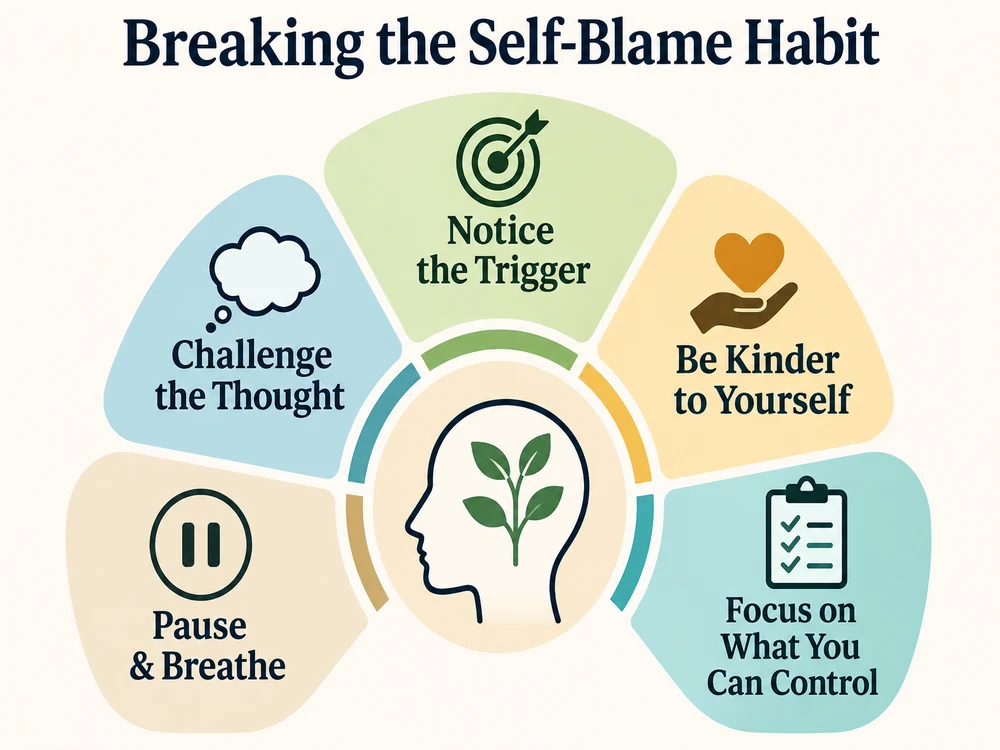
The goal is not to convince yourself that you are never wrong. It is to learn how to recognise your actual contribution, respond to mistakes constructively and stop accepting responsibility for everything around you.
Separate What Happened from What You Assume About Yourself
When something goes wrong, your first interpretation may not represent the complete situation. After an argument, for example, you may conclude that you have ruined the relationship, even though both people contributed to the disagreement.
Try separating observable facts from your conclusions. Ask yourself what was actually said or done, what you know for certain and what you are assuming because you feel guilty.
This approach is related to cognitive restructuring, a technique used in cognitive behavioural therapy (CBT). It encourages you to examine unhelpful thoughts and consider more balanced interpretations rather than automatically accepting your first conclusion.
Identify Your Actual Responsibility
You are responsible for your words, decisions and behaviour. You are not automatically responsible for another person’s reactions, choices or expectations.
Consider what genuinely belonged to you in the situation. Did you speak harshly, misunderstand someone or fail to keep a commitment? If so, acknowledge it and consider how you can make things right.
At the same time, recognise the other person’s contribution and any circumstances beyond your control. Accountability does not require you to accept all the blame.
Challenge the Belief That Everything Is Your Fault
Excessive self-blame can become automatic when certain negative beliefs are repeated often. You may tell yourself, “I am always the problem,” “People become unhappy because of me” or “I cannot do anything right.”
When these thoughts appear, pause and ask what evidence supports them. Is there another explanation? Are you assuming responsibility without knowing the full circumstances? Would you judge someone else as harshly for the same mistake?
The purpose is not to replace every negative thought with a positive one. It is to give yourself a fair opportunity to examine what happened before reaching a conclusion.
Stop Turning Mistakes into Judgements About Your Identity
A mistake is an experience, not a complete description of your personality. Forgetting an important commitment may mean you need a better reminder system; it does not prove that you are an irresponsible person in every area of life.
Try to describe the behaviour you want to change rather than labelling yourself. For example, “I did not communicate clearly, and I can work on that” is more useful than “I ruin everything.”
This shift allows you to learn without attacking your self-worth. It also makes it easier to take practical steps towards improvement.
Learn to Tolerate Disagreement Without Automatically Apologising
If you frequently blame yourself after arguments, you may have become uncomfortable with disagreement itself. You might apologise quickly, withdraw your opinion or agree with someone simply because you want the uncomfortable situation to end.
Remember that two people can have different opinions without either person being entirely wrong. Someone can feel disappointed without you necessarily having behaved unfairly.
Before apologising, ask yourself whether you genuinely did something that requires an apology. If you made a mistake, acknowledge it sincerely. If you simply expressed a different opinion, you do not need to apologise for having one.
Practise Self-Compassion Instead of Self-Punishment
When something goes wrong, you may instinctively become your own harshest critic. You replay the situation, remind yourself of what you should have done and struggle to move forward.
Psychologist Kristin Neff’s research describes self-compassion through three elements: self-kindness, common humanity and mindfulness. In simple terms, this means treating yourself with understanding, recognising that mistakes are part of being human and acknowledging difficult feelings without becoming completely absorbed by them.
Instead of saying, “I am a terrible person,” try saying, “I wish I had handled that differently. I can acknowledge my mistake and learn from it.” Self-compassion does not mean making excuses for harmful behaviour; it means allowing yourself to improve without constant self-punishment.
The R.E.A.L. Responsibility Check: A Simple Way to Stop Excessive Self-Blame
When you blame yourself for everything, it can become difficult to see a situation clearly. Your emotions may tell you that you are entirely responsible, even when several people or circumstances contributed to what happened.
The R.E.A.L. Responsibility Check is a practical self-reflection exercise developed for this article. It helps you pause after an argument or difficult situation, examine your actual contribution and respond without unnecessary self-judgement.
R.E.A.L. stands for Recognise, Examine, Acknowledge and Learn.
R – Recognise What Happened
Before blaming yourself, describe the situation as objectively as possible. Separate what actually happened from what you feel it means about you.
For example, instead of thinking, “I have ruined everything,” you might say, “We had a disagreement, both of us became upset and the conversation ended badly.” The second description focuses on the event rather than making a judgement about your personality.
Ask yourself: What exactly happened? What do I know for certain? What am I assuming because I feel guilty?
E – Examine Your Actual Contribution
Now consider your own behaviour honestly. Did you say something hurtful, misunderstand the other person or handle the conversation in a way you would like to change?
If you made a mistake, acknowledge it without exaggerating its meaning. Saying, “I interrupted the other person and should have listened more carefully” is different from saying, “I am a terrible person.”
Focus on specific actions rather than attacking your identity. This is how you take responsibility while keeping self-blame in proportion.
A – Acknowledge Other People’s Roles and External Circumstances
A difficult situation rarely exists in isolation. Other people’s decisions, reactions, expectations and circumstances may also influence what happens.
Ask yourself what choices the other person made and whether external pressures or misunderstandings played a role. You can acknowledge your own behaviour without assuming responsibility for everything that followed.
This is particularly important if you regularly feel responsible for keeping everyone happy. You can care about someone’s feelings without assuming that every negative emotion they experience is your fault.
L – Learn Without Labelling Yourself
Once you understand your role, decide what you can learn from the experience. Perhaps you need to communicate more calmly, listen more carefully, establish a boundary or clarify a misunderstanding.
Choose one realistic change instead of repeatedly punishing yourself for the situation. For example, you might decide to pause before responding when you feel angry.
The aim is to turn an uncomfortable experience into an opportunity for learning, not another reason to dislike yourself.
Try the R.E.A.L. Responsibility Check After Your Next Difficult Situation
Imagine that a close friend becomes upset after a conversation with you. You immediately begin thinking, “I must have done something wrong. I should have behaved differently.”
Use the four steps to examine the situation:
- Recognise: We had a disagreement, and both of us became upset.
- Examine: I could have expressed my opinion more calmly.
- Acknowledge: My friend also made their own choices during the conversation.
- Learn: I can communicate more thoughtfully without accepting responsibility for everything.
You may not reach a perfect conclusion immediately, and that is perfectly normal. The purpose is to create a pause between feeling guilty and deciding that everything is your fault.
Remember: you can accept responsibility for your actions without accepting blame for everything that happens around you.
When Should You Seek Professional Support?
Blaming yourself occasionally after an argument or mistake does not necessarily indicate a psychological problem. Most people experience guilt, regret or self-doubt at different points in their lives.
However, when self-blame becomes persistent, intense or difficult to manage, it can begin affecting your emotional wellbeing, relationships and everyday decisions.
Consider speaking with a qualified mental health professional if you constantly feel guilty, repeatedly question your worth, struggle to express your opinions or cannot move on from past mistakes. Support may also be helpful if self-criticism, anxiety or sadness begins interfering with your sleep, concentration, work or relationships.
How Can Counselling or Therapy Help?
A qualified counsellor or mental health professional can help you explore why you repeatedly take responsibility for situations and how this pattern affects your thoughts, emotions and relationships.
Approaches such as cognitive behavioural therapy (CBT) may help you identify unhelpful thinking patterns, examine assumptions and develop more balanced responses. Counselling can also help you practise healthier communication, build self-compassion and establish boundaries without feeling unnecessarily guilty.
You do not need to wait until your distress becomes overwhelming before seeking support. If self-blame is accompanied by thoughts of harming yourself or feeling that you do not deserve to live, seek immediate help from a mental health professional, emergency service or trusted person.
Seeking support is not an admission of weakness. It is a way of understanding yourself better and learning healthier ways to respond to life’s difficult situations.
Frequently Asked Questions About Blaming Yourself for Everything
Why do I always think I am the problem?
You may automatically think you are the problem because you have developed a habit of taking responsibility when something goes wrong. Previous criticism, fear of rejection, low self-esteem or difficult relationship experiences may contribute to this pattern. Learning to examine the facts rather than immediately accepting blame can help you develop a more balanced perspective.
What do you call someone who blames themselves for everything?
A person who repeatedly assumes responsibility for negative situations may be experiencing excessive self-blame. Related psychological concepts include personalisation, self-critical thinking and inflated responsibility. These terms describe different thinking patterns; they are not diagnoses by themselves.
Why do I feel guilty after every argument?
You may feel guilty after arguments because conflict makes you uncomfortable or creates a fear of rejection, disapproval or losing the relationship. You might also believe that maintaining harmony is your responsibility. However, feeling guilty does not automatically mean you have done something wrong.
How do I stop blaming myself for other people’s actions?
Start by recognising that other people are responsible for their own choices and behaviour. You can care about their feelings, listen to their concerns and acknowledge your mistakes without taking responsibility for everything they do. Healthy emotional boundaries can help you distinguish between supporting someone and carrying their responsibilities.
Can childhood experiences cause excessive self-blame?
Yes, certain childhood experiences may contribute to excessive self-blame later in life. Repeated criticism, harsh punishment, emotional invalidation or growing up in an unpredictable environment may influence how someone understands conflict and responsibility. However, childhood experiences are only one possible influence; not everyone who struggles with self-blame has experienced trauma.
Is self-blame the same as low self-esteem?
No. Low self-esteem refers to a negative evaluation of your overall worth or abilities. Self-blame involves attributing responsibility to yourself when something goes wrong. However, repeated self-blame can gradually affect self-esteem, particularly when you interpret individual mistakes as evidence that something is fundamentally wrong with you.
Is blaming yourself for everything a trauma response?
It can be associated with difficult or traumatic experiences, but it is not always a trauma response. Some people develop excessive self-blame through repeated criticism, fear of conflict, perfectionism, anxiety or relationship experiences. Understanding an individual’s history and present circumstances is important before drawing conclusions.
For some people, the fear of conflict goes beyond the disagreement itself. A raised voice, a change in someone’s tone or the possibility of disappointing someone can bring up strong emotional reactions. You may start blaming yourself simply to restore peace or avoid further tension. If you often find yourself reacting strongly during disagreements, you may also find it helpful to understand why you get triggered so easily and what may be happening beneath those emotional reactions.
How can I tell the difference between taking responsibility and blaming myself?
Healthy responsibility focuses on specific actions and what you can do to improve. Excessive self-blame turns those actions into harsh judgements about your entire personality. Saying, “I could have communicated more clearly” is an acknowledgement of responsibility. Saying, “I ruin every relationship” is a much broader and more damaging conclusion.
You Are Responsible for Your Actions, Not Everything That Goes Wrong
If you often blame yourself for everything, remember that feeling responsible and actually being responsible are not always the same thing.
You may have made mistakes. You may have said something you regret or handled a difficult situation differently than you would have liked. That is part of being human.
But one mistake does not make you a bad person. One argument does not make you responsible for an entire relationship. And someone else’s disappointment does not automatically mean you have done something wrong.
Learning to stop excessive self-blame does not mean avoiding accountability. It means recognising your actual contribution without carrying responsibility that does not belong to you.
The next time something goes wrong, give yourself a moment before deciding that everything is your fault. Look at what happened, examine your role and acknowledge the part played by others and the circumstances.
Most importantly, allow yourself to learn without constantly punishing yourself.
You can take responsibility without taking all the blame. You can care about others without carrying all their emotions. And you can make mistakes without losing respect for yourself.
That is an important part of developing emotional fitness.
About the Author

Sunil Prasad holds a Master's degree in Psychology (Counselling) and has counselling experience and training in several counselling approaches. He is the founder of The Psyche Inspire, where he writes research-informed articles on emotional fitness, relationships, human behaviour and personal growth. His aim is to make psychology understandable and relevant to everyday life through clear explanations, practical examples and compassionate guidance.