

Have you ever received a compliment and immediately brushed it aside? Someone says, “You did a great job,” and you reply, “It was nothing,” or “Anyone could have done it.” Perhaps you smile awkwardly, point out what went wrong, or wonder whether the person really means it.
If this sounds familiar, you may have wondered, why do I struggle to accept compliments even when someone is being kind?
Table of Contents
The answer is not always low self-esteem. Sometimes, praise conflicts with how you see yourself. Sometimes, you worry about appearing arrogant, feel uncomfortable being noticed, or find it difficult to trust positive feedback. Your response may also reflect what you learned about praise and modesty while growing up.
Understanding this pattern can help you respond to appreciation more comfortably—not by forcing yourself to believe every compliment, but by allowing positive feedback the same fair consideration you give criticism.
Why Does Accepting a Compliment Feel So Uncomfortable?
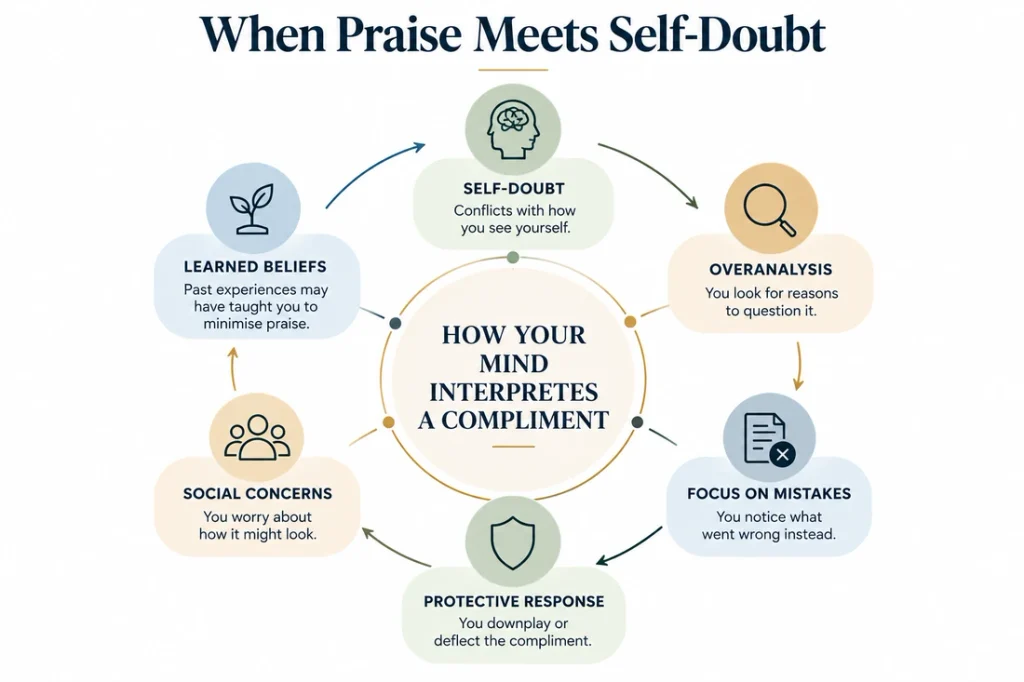
A compliment is more than a pleasant remark. It offers another person’s view of you, and that view may not match your own.
Imagine that you have worked hard on a project but remain dissatisfied with the result. When a colleague praises your work, you may immediately think about the mistakes you made. Instead of hearing the appreciation, you focus on everything the person has overlooked.
This reaction can happen because we do not evaluate feedback in isolation. We interpret it through our existing beliefs, expectations and experiences. Research on self-esteem and responses to positive feedback suggests that accepting praise can be more complicated when it does not fit a person’s existing self-view.
That does not mean everyone who feels awkward receiving compliments has low self-esteem. The discomfort can have different causes, and identifying your own pattern is more useful than assuming there is one explanation.
7 Reasons You May Struggle to Accept Compliments
1. The Compliment Conflicts With How You See Yourself
If you are used to noticing your shortcomings, praise may feel difficult to believe. Someone calls you capable, but you remember the task you struggled with. Someone appreciates your kindness, but you recall a moment when you were impatient.
Your attention moves towards the evidence that supports your existing self-image, while positive feedback feels less convincing. You may even assume that the other person has misunderstood you.
Over time, this can become a familiar pattern: you acknowledge your mistakes readily but question praise even when it is sincere. If you recognise this tendency, you may find it helpful to explore why you are so hard on yourself.
2. You Worry That Accepting Praise Will Make You Look Arrogant
Some people associate acknowledging their strengths with showing off. They may believe that a modest response requires downplaying their achievements or giving credit entirely to someone else.
For example, when a colleague says, “Your presentation was excellent,” you might respond, “It wasn’t that good. I just got lucky.”
You may intend to sound humble, but repeatedly dismissing your contribution can make it difficult to acknowledge your own effort. There is a difference between being arrogant and recognising something you did well. You can appreciate a compliment without claiming to be better than everyone else.
Research on humblebragging examines how people try to present themselves favourably while appearing modest. It is relevant to understanding the social complexities of self-presentation, although it does not directly establish why everyone deflects compliments.
3. Being Noticed Makes You Feel Exposed
Not everyone enjoys being the centre of attention. Even positive attention can make a person feel self-conscious, especially when others are listening.
A compliment may leave you wondering how to react, whether people are watching you, or whether you are expected to say something equally appreciative in return. You might laugh, change the subject or minimise what you did simply to move past the moment.
In this case, the difficulty may be less about believing the praise and more about feeling uncomfortable under someone’s attention. If particular comments or interactions often produce a strong emotional reaction, understanding why certain situations trigger you may offer another useful perspective.
4. You Feel Pressure to Keep Living Up to the Praise
Sometimes, a compliment feels less like appreciation and more like a new expectation.
If someone calls you dependable, you may worry about disappointing them the next time you need help. If your manager praises your performance, you may feel that every future task must meet the same standard.
Instead of enjoying the recognition, you begin thinking about the responsibility that comes with it. Rejecting the compliment can seem like a way to lower expectations before they become overwhelming.
This response may be particularly familiar if you are a perfectionist or feel that your worth depends on consistently performing well. A compliment, however, recognises something about a particular moment; it does not require you to be exceptional all the time.
5. You Notice What Went Wrong More Than What Went Well
You might receive praise for an assignment and immediately remember the section you could have improved. Someone appreciates your help, but you focus on the one thing you forgot to do.
Your attention is drawn towards the gap between what you achieved and what you believe you should have achieved. As a result, positive feedback can feel incomplete or undeserved.
Reflecting on mistakes can help you learn, but it becomes limiting when every success is dismissed because it was not perfect. A fairer assessment allows both things to be true: you could have done some things better, and you still did something worth appreciating.
6. You Doubt the Other Person’s Sincerity
A compliment may feel uncomfortable when you are unsure why it was given. You might wonder whether the person is being polite, trying to gain your favour, or expecting something in return.
Past experiences can influence how you interpret present interactions. If praise has previously been used to manipulate, embarrass or pressure you, it is understandable that you may approach it cautiously.
Of course, not every compliment is sincere, and you do not have to accept every positive statement as fact. The important distinction is between considering the available evidence and automatically assuming that praise must have a hidden motive.
7. You Learned to Minimise Your Achievements
Your response to compliments may also reflect the environment in which you grew up.
Perhaps your family valued modesty and discouraged talking about personal achievements. Maybe praise was rare, quickly followed by criticism, or accompanied by reminders that you could have done better. You may have learned to avoid drawing attention to yourself or to treat acknowledgement as something uncomfortable.
These experiences do not determine how you will respond for the rest of your life. They may, however, help explain why accepting praise feels unfamiliar. Recognising a learned response gives you an opportunity to decide whether it still serves you.
Why Can Criticism Feel More Believable Than Praise?
For some people, one critical remark can outweigh several positive comments. They may replay the criticism, search for evidence that it is true and dismiss praise as politeness or exaggeration.
One possible explanation is that criticism fits an existing negative belief. If you already suspect that you are not good enough, a critical comment may seem to confirm what you fear, while a compliment challenges that belief.
This can also become a habit of attention. You may examine positive feedback for reasons to doubt it while accepting negative feedback without the same scrutiny. Over time, your view of yourself can become shaped more by what you believe is wrong than by a balanced picture of your strengths and limitations.
The aim is not to replace every negative thought with a positive one. It is to evaluate both kinds of feedback fairly. A criticism may contain useful information without defining your worth, and a compliment may reflect something genuine without proving that you are flawless.
If you often revisit conversations or question how others perceive you, our article on the hidden psychology of overthinking explores how these thought patterns can keep self-doubt going.
How Deflecting a Compliment Can Affect a Relationship
When someone offers sincere appreciation, they may be trying to communicate respect, warmth or gratitude. If the compliment is repeatedly dismissed, the exchange can become awkward, even when neither person intends harm.
The person giving the compliment might feel that their words were rejected or that their appreciation did not reach you. They may become less comfortable expressing it in the future.
Emerging research by Prinsloo and Moon, published in the 2026 Academy of Management Proceedings, examined the social consequences of accepting or deflecting praise. Across four preregistered studies involving 2,056 participants, deflecting praise was associated with less favourable perceptions on several social dimensions, including warmth, competence and likability. In one study, people were also less likely to choose someone who deflected praise as a future work partner.
These findings are worth noting, but they should be interpreted carefully: this is conference-proceedings research, not definitive evidence that every modest response harms a relationship.
You do not need to change your personality or become comfortable with public attention. The practical point is simpler: when someone offers genuine appreciation, acknowledging it can help the exchange feel more mutual.
You Do Not Have to Believe Every Compliment to Receive It
One common misconception is that accepting praise means agreeing completely with what someone says about you.
It does not.
If someone says you are an excellent speaker, you can appreciate their feedback while recognising that public speaking still makes you nervous. If a friend calls you thoughtful, you can acknowledge their kindness without believing that you always get things right.
Receiving a compliment simply means allowing another person’s perspective to be heard. You can consider it without treating it as an unquestionable truth.
A simple “Thank you, I appreciate that” is often enough. You do not have to prove the compliment, return it immediately, or explain why you think it is inaccurate.
If receiving support or acknowledgement feels uncomfortable more generally, you may also find it useful to explore why asking for help can be difficult.
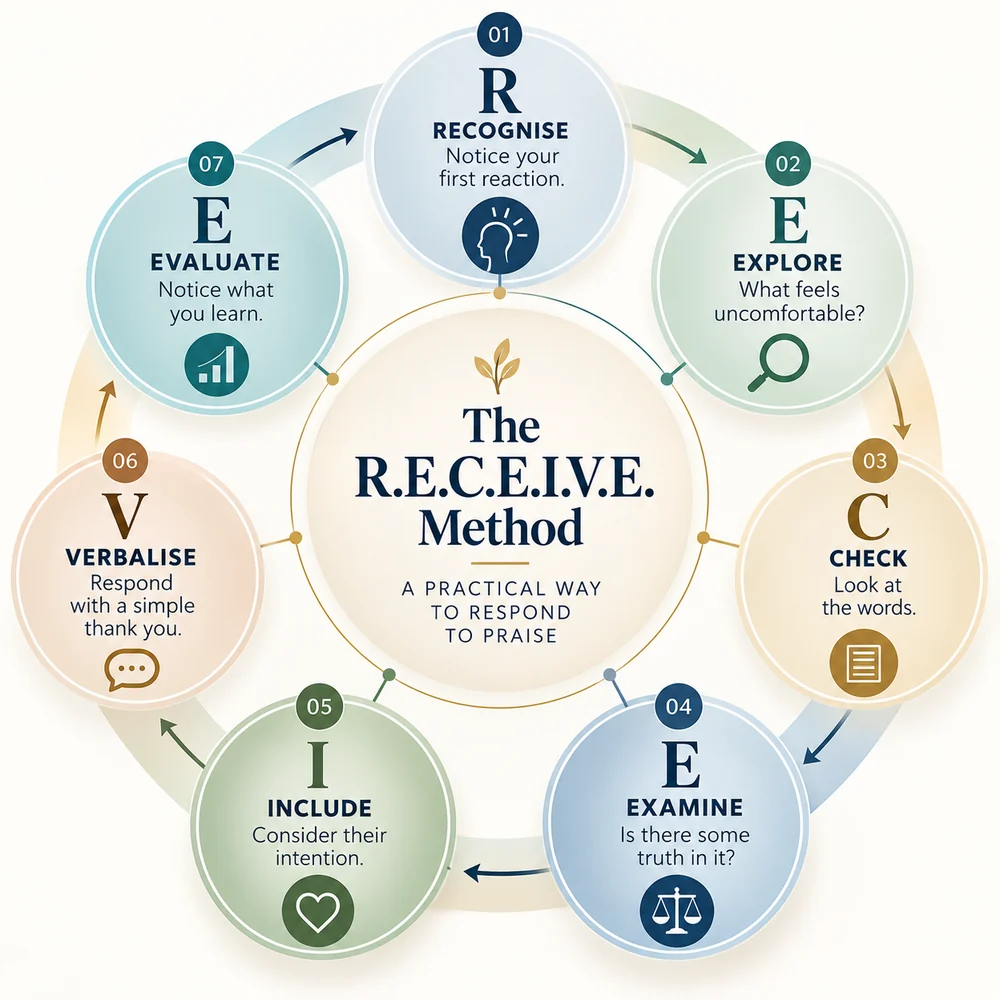
The R.E.C.E.I.V.E. Method: A Practical Way to Respond to Praise
The R.E.C.E.I.V.E. Method is an educational reflection tool designed to help you pause before automatically dismissing a compliment. It is not a clinically validated intervention or diagnostic test. Think of it as a simple sequence to practise when praise makes you uncomfortable.
R — Recognise your first reaction.
Notice what happens when someone compliments you. Do you feel embarrassed, doubtful, anxious or eager to disagree? You do not have to change the reaction immediately. Simply notice it.
E — Explore what feels uncomfortable.
Ask yourself what is making the compliment difficult to receive. Are you worried about appearing arrogant? Does the praise conflict with your self-image? Are you afraid of being expected to perform at the same level again?
C — Check what was actually said.
Separate the person’s words from the meaning you immediately assign to them. “You handled that meeting well” does not mean “You must never make a mistake again.” Try not to add expectations that the speaker did not express.
E — Examine the evidence fairly.
Consider whether the compliment has some basis in what happened. You do not have to agree with every word. Look at the situation as a whole rather than focusing only on what went wrong.
I — Include the speaker’s possible intention.
Consider whether the person may simply be expressing appreciation. You cannot know another person’s motives with certainty, but you do not need to assume insincerity without a reason.
V — Verbalise a response.
Try a straightforward response such as “Thank you,” “I’m glad it was helpful,” or “I appreciate you saying that.” You can acknowledge the other person’s kindness without exaggerating your own achievement.
E — Evaluate what you learn.
Afterwards, reflect on the experience. Was the interaction as uncomfortable as you expected? Did you feel a need to justify yourself? With practice, you may begin to understand which situations make accepting compliments particularly difficult.
The goal is not to make every compliment feel wonderful. It is to create a little space between receiving praise and automatically rejecting it.
Small Changes That Can Make Accepting Compliments Easier
You do not have to transform the way you respond overnight. Start with a few manageable changes.
- Pause before responding. Give yourself a moment instead of immediately dismissing the compliment.
- Practise saying “thank you.” Keep your response simple. You do not need to add a criticism of yourself afterwards.
- Avoid turning praise into a debate. Unless there is a good reason to clarify something, you do not have to persuade the other person that their view is wrong.
- Acknowledge your contribution accurately. If someone appreciates your work, you can recognise your effort while also acknowledging help from others.
- Notice the pattern without judging yourself. If you deflect a compliment again, treat it as information about a familiar response—not as another personal failure.
These are small opportunities to practise a more balanced response. You can remain humble, realistic and open to improvement while learning to acknowledge what went well.
When Should You Pay More Attention to This Pattern?
Occasional awkwardness around compliments is common and does not automatically indicate a psychological problem. However, it may be worth exploring further if you consistently dismiss positive feedback, feel intense shame when appreciated, or find that self-criticism affects your relationships, work or everyday decisions.
You may also notice that the difficulty extends beyond compliments: perhaps you struggle to accept help, feel undeserving of kindness, or repeatedly seek reassurance because you cannot trust positive feedback.
If these patterns cause significant distress or interfere with daily life, speaking with a qualified mental-health professional can help you explore their origins and find appropriate ways to address them. You do not need to wait until the problem becomes severe to seek support.
Frequently Asked Questions
Why can’t I accept compliments even when I know they are genuine?
You may intellectually recognise that someone means well while still feeling uncomfortable receiving praise. The compliment might conflict with your self-image, make you feel exposed, or trigger concerns about expectations. Understanding the specific discomfort can be more useful than trying to force yourself to feel differently.
Is struggling to accept compliments a sign of low self-esteem?
Not necessarily. Low self-esteem can be one factor, but discomfort may also arise from perfectionism, social unease, cultural expectations, past experiences or a fear of appearing arrogant. Your response to compliments alone cannot establish your level of self-esteem or indicate a diagnosis.
How do I accept compliments without sounding arrogant?
Acknowledge the compliment simply and naturally. Saying “Thank you, I appreciate that” does not mean you believe you are better than other people. It means you are recognising someone’s positive feedback without dismissing it or exaggerating your achievements.
Why do I focus on criticism but dismiss praise?
Negative feedback may seem more convincing when it matches something you already fear about yourself. You may also be more practised at identifying mistakes than recognising strengths. Try evaluating both criticism and praise with the same care, rather than assuming one is automatically more accurate than the other.
Final Thoughts
Struggling to accept compliments does not mean you are ungrateful, arrogant or incapable of recognising your strengths. It may mean that praise touches a sensitive part of how you see yourself, how you handle attention, or what you have learned to expect from others.
You do not have to believe every compliment, and you do not have to become someone who enjoys being praised. You can begin by allowing a kind remark to stand without immediately arguing against it.
The next time someone appreciates something you have done, try pausing before you explain it away. A simple “Thank you” can be enough. You can reflect on the compliment later, decide what feels true, and still give yourself permission to receive the appreciation in the moment.
Sometimes, learning to accept a compliment begins with something small: not rejecting a kind word before you have had a chance to consider it.
References and Further Reading
- Kille, D. R., Eibach, R. P., Wood, J. V., & Holmes, J. G. (2017). Who can’t take a compliment? The role of construal level and self-esteem in accepting positive feedback from close others. Journal of Experimental Social Psychology, 68, 40–49. https://doi.org/10.1016/j.jesp.2016.05.003
- Kwang, T., & Swann, W. B. (2010). Do people embrace praise even when they feel unworthy? A review of self-enhancement and self-verification research. https://doi.org/10.1177/1088868310365876
- Zhao, X., & Epley, N. (2021). Insufficiently complimentary? Underestimating the positive impact of compliments creates a barrier to expressing them. Journal of Personality and Social Psychology, 121(2), 239–256. https://doi.org/10.1037/pspa0000277
- Sezer, O., Gino, F., & Norton, M. I. (2018). Humblebragging: A distinct—and ineffective—self-presentation strategy. Journal of Personality and Social Psychology, 114(1), 52–74. https://doi.org/10.1037/pspi0000108
- Prinsloo, T., & Moon, H. (2026). To Accept or Deflect Praise? Examining the Social Consequences of Compliment Responses. Academy of Management Proceedings. https://doi.org/10.5465/AMPROC.2026.427bp
Educational note: This article is for psychology education and general information. It is not a substitute for individual assessment, diagnosis or professional mental-health care. The R.E.C.E.I.V.E. Method is an educational framework created for this article and has not been clinically validated.