

Have you ever reached the end of an ordinary day and wondered why you feel so mentally tired?
You may have completed some routine work, answered messages, managed a few responsibilities and thought about what needs to happen tomorrow. Nothing particularly difficult may have happened. Yet, by evening, even a small task feels like too much.
You want to relax, but your mind does not seem ready to slow down.
If this sounds familiar, you may have asked yourself, Why do I feel mentally exhausted when I haven’t done that much?
Table of Contents
It is easy to interpret this feeling as laziness or a lack of discipline. You look at everything you accomplished and wonder whether you have any good reason to feel so drained.
But physical activity is only one part of our daily effort. Concentrating, making decisions, managing emotions and responding to competing demands also require mental effort. Sleep difficulties, stress and health-related factors can contribute to tiredness as well.
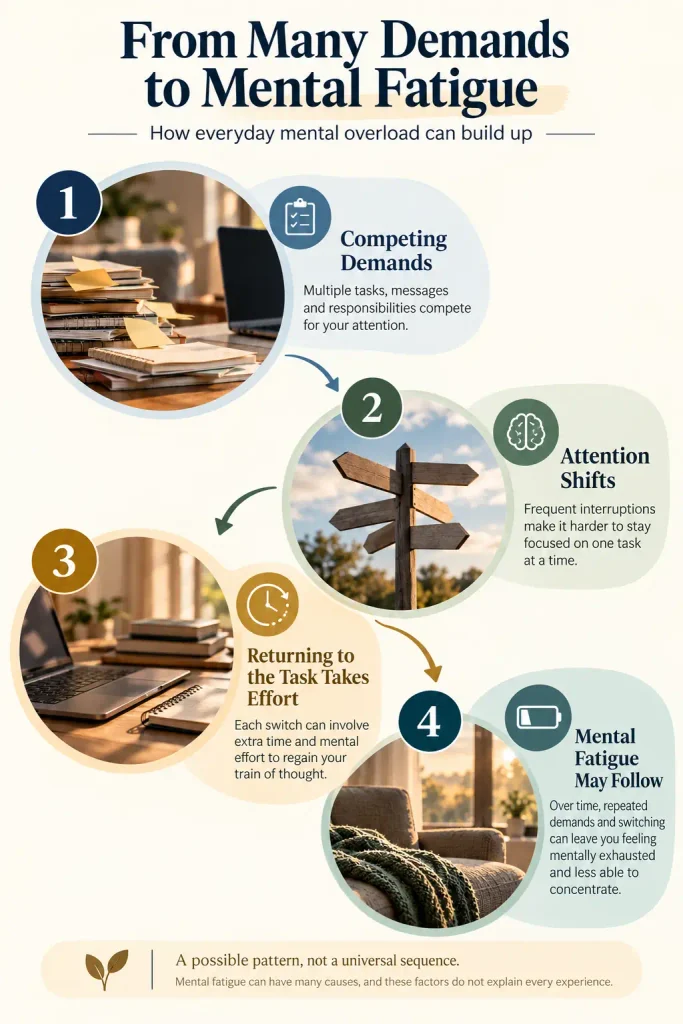
Sometimes, the difficulty is not one particularly demanding task. It is the accumulation of several things that require your attention, often without giving you much time to recover.
Imagine trying to complete an important task while messages keep arriving. You remember an unfinished responsibility, worry about an upcoming conversation and try to keep track of what you need to do tomorrow. Even when you return to your original task, your attention may still be occupied by everything else waiting for you.
From the outside, your day might look ordinary. From your perspective, it may have involved considerable effort.
Psychological research on cognitive fatigue and task switching helps us understand some of these experiences. However, scientists are still investigating precisely how cognitive fatigue develops and why it affects people differently. Not every episode of mental exhaustion is caused by cognitive overload, and feeling mentally tired does not automatically indicate a mental health condition.
The aim of this article is to help you understand what might be contributing to the experience, recognise practical ways to make everyday demands more manageable, and know when persistent fatigue deserves further attention.
What Does It Mean to Feel Mentally Exhausted?
Mental exhaustion is an everyday description of feeling mentally tired, strained or less able to manage further demands. You might find it harder to concentrate, organise your thoughts, make decisions or begin a task that would usually feel manageable.
Researchers study related experiences using terms such as mental fatigue and cognitive fatigue. These concepts are related, but they are not always defined or measured in the same way.
A 2025 review by Pessiglione and colleagues examined different explanations for cognitive fatigue and highlighted important unanswered questions about its underlying mechanisms. This is a useful reminder that mental fatigue is a genuine subject of scientific investigation, but it cannot yet be explained by one simple theory.
You might recognise the experience in ordinary moments:
- You read the same paragraph several times because you are struggling to concentrate.
- A simple decision feels more demanding than usual.
- You find it difficult to begin a task even though you know what needs to be done.
- You feel unusually irritable after a day of managing several responsibilities.
- You want to rest, but unfinished tasks or worries keep returning to your attention.
These experiences can occur for different reasons. They do not, individually, establish that you have burnout, anxiety or depression. It is also useful to distinguish mental tiredness from physical fatigue. Both can occur together, and physical health conditions, inadequate sleep and medication effects can contribute to either experience.
The important questions are what may be contributing to the tiredness, how long it has lasted and how much it is affecting your daily life.
7 Possible Reasons You Feel Mentally Exhausted
There is rarely one explanation that applies to everyone. The following possibilities can help you identify patterns in your own circumstances without turning the article into a diagnostic checklist.
1. Your Attention Keeps Switching Between Tasks
You begin writing an email. A notification appears, so you respond to it. Then you remember an appointment, check another message and return to the email. You know what you were doing, but you need a moment to recover your train of thought.
Research on task switching has found that changing between tasks can involve additional time and cognitive effort. The effects depend on factors such as task complexity, familiarity and the demands of the interruption.
When interruptions happen repeatedly, it may become harder to maintain a smooth period of concentration. This does not mean that every interruption is harmful or that task switching inevitably causes mental exhaustion. It means that the conditions in which you work can affect how demanding a task feels.
If your day is full of messages, changing priorities and competing requests, try protecting a short period of uninterrupted attention when practical. You might also leave yourself a brief note about where you stopped before moving to another task.
The aim is not to eliminate every distraction. It is to make it easier to concentrate when concentration matters.
2. You Are Carrying Too Many Unfinished Responsibilities in Your Mind
Sometimes, the task in front of you is not the only thing occupying your attention.
You might be preparing a report while remembering an appointment you need to arrange. You may be spending time with your family while thinking about an unfinished responsibility at work. Even when you sit down to rest, your mind keeps returning to what remains to be done.
Research on prospective memory—the ability to remember to carry out an intention in the future—helps explain why remembering pending responsibilities matters. Competing demands can make it harder to keep track of intentions and return to them at the right time.
However, it would be too simplistic to say that every unfinished task continuously consumes a fixed amount of mental energy. The experience varies with the situation and the demands involved.
A practical response is to give pending responsibilities a place outside your mind. Write them down, identify the next action and decide when you will return to them. You may not be able to finish everything today. But you can reduce the need to keep reminding yourself about everything simultaneously.

3. Worry Keeps Returning Without Helping You Solve the Problem
There is a difference between thinking carefully about a problem and repeatedly revisiting it without reaching a useful conclusion.
You may be worried about an upcoming conversation, a financial responsibility or something that happened earlier in the day. You replay what you said, imagine what might happen next and wonder whether you should have responded differently.
Each time you return to the worry, you hope that a little more thinking will finally make you feel certain. But the certainty does not arrive.
Worry can help us anticipate difficulties and prepare for them. The problem arises when thinking becomes repetitive, distressing and difficult to redirect, particularly when it no longer produces useful information or a realistic next step.
If you recognise this pattern, you may find it helpful to read The Hidden Psychology of Overthinking, which explores repetitive thinking in greater detail. For now, try asking yourself: Is this thought helping me solve something, or am I returning to the same uncertainty again?
If there is an action you can take, identify one realistic next step. If the situation cannot be resolved immediately, acknowledge that uncertainty and consider when it would be useful to revisit the issue. You do not need to force yourself to stop thinking. The aim is to recognise when further thinking is no longer helping.
4. Everyday Decisions Become Harder When You Are Already Tired
What should you do first? Which message needs a reply? What should you prepare for dinner? Should you accept an invitation or postpone a task?
Individually, these decisions may be simple. But when you face several competing demands, deciding what deserves your attention can become more difficult.
This is sometimes described as decision fatigue in everyday conversation. However, research on decision-making and cognitive fatigue is more complex than the popular claim that every decision depletes a limited supply of willpower.
A more careful explanation is that decision-making can become harder when you are already tired, distracted, under pressure or trying to weigh too many competing priorities.
For example, after a demanding workday, you may still need to organise household responsibilities and plan for tomorrow. The difficulty may lie not in any one choice, but in managing several decisions when your attention is already stretched.
You might benefit from simplifying routine choices, keeping a short priority list or planning recurring tasks in advance. If difficulty choosing is a persistent pattern in your life, Why Can’t I Make Decisions? The Psychology of Decision Paralysis explores uncertainty, fear of regret and repeated reconsideration in more detail.
5. Managing Emotions and Other People’s Expectations Takes Effort
Not all mental effort is visible.
You may spend the day appearing calm while feeling frustrated. You may listen patiently when someone needs support, even though you are dealing with your own worries. Perhaps you avoid expressing disagreement because you do not want to upset anyone.
These experiences can involve emotional labour: managing feelings or emotional expressions to meet the demands of a role or situation. Research, particularly in workplace settings, has examined how sustained emotional demands may relate to well-being and emotional exhaustion.
Being considerate, supporting others and regulating your emotions are not inherently harmful. The difficulty may arise when these demands are persistent and leave little room for your own needs or recovery.
You might notice that, after a day of being available to others, even a friendly conversation feels demanding. You may need some quiet—not because you dislike the people around you, but because you have little emotional energy left.
Where possible, practise communicating your limits. You might delay a response until you have time to consider it, ask for help or explain that you need a little time before discussing something difficult.
You are allowed to care for others without being endlessly available.
6. You Are Not Getting Enough Restorative Sleep
Sometimes, the explanation is more straightforward: your mind and body may not be recovering adequately.
You might spend enough hours in bed but wake frequently during the night. Perhaps your sleep schedule changes from day to day, or you continue thinking about work long after you intended to stop.
Sleep loss can affect attention, memory, mood and daytime alertness. Improving sleep habits may help when sleep difficulties are contributing to fatigue, although persistent sleep problems may need professional assessment.
Try to maintain a reasonably consistent sleep schedule, give yourself time to wind down and make your sleeping environment as comfortable as circumstances allow.
It is also worth noticing whether your evenings are filled with activities that keep you mentally engaged. For example, repeated exposure to distressing news may leave you feeling more unsettled rather than refreshed. If this is familiar, Why Can’t I Stop Doomscrolling? explores how repeated exposure to negative online content may relate to stress, uncertainty and sleep difficulties.
If you remain tired despite adequate opportunities for sleep, do not assume that you simply need a better routine. Sleep disorders, medication effects and physical health conditions can also contribute.
7. Ongoing Stress or an Underlying Health Concern May Be Contributing
Sometimes, mental exhaustion cannot be adequately explained by a busy schedule, interruptions or everyday worries.
You may feel persistently tired even when you have reduced your workload. Concentrating may remain difficult, your sleep may change or ordinary activities may require more effort than they used to.
Ongoing stress can contribute to fatigue, but persistent tiredness can also be associated with depression, sleep disorders, anaemia, thyroid problems, medication effects and other health concerns.
The NHS advises seeking medical assessment when fatigue continues for several weeks, affects daily life or occurs alongside other concerning symptoms. The NHS guidance on tiredness and fatigue explains when persistent tiredness may need medical attention.
This is important because not every form of exhaustion should be approached as a productivity problem. If you assume that your tiredness is caused by poor time management, you may keep changing your routine without addressing the actual cause.
Notice the pattern instead. Has the exhaustion persisted? Is it affecting your work, relationships or ability to manage everyday activities? Have you experienced significant changes in sleep, mood or physical well-being?
These questions cannot establish a diagnosis, but they can help you recognise when further assessment is appropriate. If fatigue is persistent, unexplained or interfering with your daily life, speak with a qualified healthcare professional. You do not need to wait until you are unable to function before asking for help.
How Cognitive Overload Can Leave You Feeling Mentally Drained
The seven possibilities above can overlap. One useful way of understanding some of them is through the concept of cognitive load.
Cognitive load refers broadly to the demands placed on mental processes when we take in information, hold it in mind and work with it. Cognitive load theory, developed through research on learning and working memory, helps explain why complex information and competing demands can affect our ability to concentrate and solve problems.
Consider a day when you are trying to finish an important task while remembering several unfinished responsibilities, responding to interruptions and worrying about an uncertain outcome. Your attention is not devoted entirely to the task in front of you. You may need to keep returning to it, remembering where you stopped and deciding what deserves your attention next.
These conditions can make the task more demanding.
However, cognitive overload and mental exhaustion are not interchangeable terms. Overload describes demands that may exceed what you can comfortably manage in a particular situation. Mental exhaustion describes an experience of feeling mentally tired or depleted. One may contribute to the other, but neither automatically proves the presence of the other.
The research on cognitive fatigue also remains developing. Scientists continue to investigate its mechanisms, how it is measured and why it affects people differently. The practical lesson is modest but useful: when you feel mentally drained, consider not only the task itself but also the conditions in which you are trying to complete it.
Mental Exhaustion, Burnout, Anxiety or Depression: What Is the Difference?
Feeling mentally exhausted does not, by itself, tell you whether you are experiencing ordinary tiredness, prolonged stress or a mental health condition.
The broader pattern matters.
Mental exhaustion describes the experience of feeling mentally tired or depleted. It may occur after demanding work, inadequate rest or periods of stress, but it can have other explanations too.
Burnout has a more specific meaning in the World Health Organization’s ICD-11 classification. It refers to chronic workplace stress that has not been successfully managed and is characterised by exhaustion, increased mental distance or cynicism towards one’s job, and reduced professional efficacy. The WHO classifies burnout as an occupational phenomenon, not a medical condition, and does not use the term to describe every form of life-related exhaustion.
Anxiety may involve persistent worry, apprehension or tension that becomes difficult to control. Some anxiety conditions can also involve difficulty concentrating, sleep problems and fatigue. These symptoms alone are not sufficient to establish a diagnosis.
Depression can affect mood, interest, energy, concentration, sleep and everyday functioning. Fatigue may be one part of the experience, but it needs to be considered alongside other symptoms and the overall pattern.
These experiences can overlap. A person dealing with chronic workplace stress may also experience anxiety or depression, while a physical health problem may contribute to fatigue and concentration difficulties.
If exhaustion persists, worsens or interferes with daily functioning, consider speaking with a qualified healthcare professional. The aim is not to find a label for yourself, but to understand what is happening and identify appropriate support.
How to Recover From Mental Exhaustion: Practical Steps That May Help
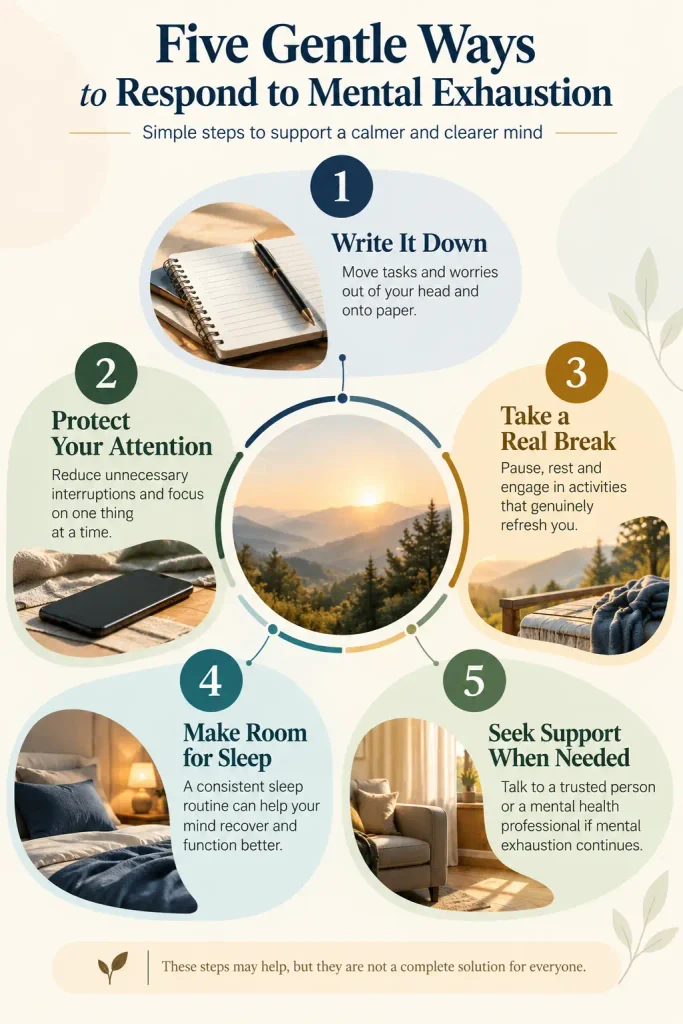
You do not need to reorganise your entire life overnight. Start by identifying what may be contributing to the tiredness and choose one or two realistic changes.
Get unfinished tasks out of your head
Write down pending responsibilities, identify the next action and decide when you will return to them. This can reduce the need to keep mentally rehearsing everything you must remember.
Reduce avoidable interruptions
When a task requires concentration, try protecting a short period of uninterrupted time. Silence non-urgent notifications where practical, and leave yourself a brief note before switching to another task.
Take genuinely restorative breaks
A break does not need to be elaborate. You might walk outside, stretch, listen to music or spend a few minutes away from information and demands.
Notice what helps you feel more settled rather than turning rest into another task to complete perfectly.
Pay attention to sleep
Try to maintain a reasonably consistent sleep schedule and allow time to wind down. If you continue to feel tired despite adequate opportunities for sleep, consider whether a sleep problem or another health concern may be contributing.
Notice when thinking stops helping
If you keep returning to the same worry, ask whether there is a practical action you can take. If there is, identify one next step. If there is not, acknowledge the uncertainty and decide when it would be useful to revisit the issue.
Set realistic emotional boundaries
You may not be able to remove every responsibility, but you can sometimes delay a response, ask for help or explain that you need time before taking on another demand.
Being responsible does not require you to be available at every moment.
Make room for activities that are enjoyable in themselves
Read because you want to read. Listen to music without turning it into a concentration exercise. Spend time with someone you trust or return to a hobby without demanding that you improve at it.
Recovery is not only about preparing yourself to work again. It is also about making room for connection, interest and enjoyment in everyday life.
Seek support if the exhaustion continues
Self-help strategies can be useful, but they are not a substitute for understanding persistent or unexplained fatigue.
If tiredness lasts for several weeks, affects your daily life or occurs alongside significant changes in mood, sleep or physical well-being, consult a healthcare professional. The appropriate response depends on what is contributing to the problem.
You do not need to wait until you have tried every possible technique before asking for assistance.
Frequently Asked Questions About Mental Exhaustion
Why do I feel mentally exhausted even when I haven’t done much?
Physical activity is only one source of effort. Concentrating, managing emotions, worrying about responsibilities and responding to interruptions can also be demanding. However, sleep difficulties, stress, medication effects and physical health conditions can also contribute to fatigue.
Can overthinking make you mentally tired?
Repeatedly worrying about the same situation or replaying conversations can occupy your attention and interfere with concentration or rest. The aim is not to stop every unwanted thought, but to recognise when repeated thinking is no longer helping you understand a problem or identify a useful next step.
What is the difference between mental fatigue and burnout?
Mental fatigue describes an experience of mental tiredness. Burnout, as defined by the WHO, concerns chronic workplace stress that has not been successfully managed and involves exhaustion, increased mental distance or cynicism towards work, and reduced professional efficacy.
How can I recover from mental exhaustion?
Start by identifying what may be contributing to the tiredness. Reducing avoidable interruptions, writing down pending tasks, taking restorative breaks and protecting sleep may help in some circumstances. Persistent or unexplained fatigue may require professional assessment.
Why do small tasks feel overwhelming when I’m already tired?
When you are tired, distracted or under stress, a task that usually feels manageable may require more effort. Competing demands can also make it harder to organise your attention. Try reducing the task to one realistic next step, and seek support if the difficulty persists or worsens.
When should I seek professional help for mental exhaustion?
Consider consulting a healthcare professional if fatigue lasts for several weeks, affects your work or relationships, does not improve despite adequate rest, or occurs alongside other concerning symptoms. Fatigue can have psychological and physical causes, and the appropriate response depends on the underlying factors.
A Final Thought: You Do Not Have to Earn the Right to Rest
Sometimes, the hardest part of feeling mentally exhausted is not the tiredness itself. It is the belief that you should not feel this way.
You look at your day and tell yourself that you have not done enough to justify feeling drained. You compare yourself with others, question your discipline and wonder why ordinary responsibilities seem so difficult.
But the effort involved in living is not always visible.
You may be managing uncertainty, remembering unfinished tasks, trying to meet expectations or carrying concerns that you have not had the opportunity to address. And sometimes, your exhaustion may have a cause that cannot be explained by everyday stress alone.
Understanding these possibilities is more useful than immediately blaming yourself.
You do not need to change your entire routine overnight. Start by noticing when the tiredness appears, what tends to make it worse and what genuinely helps you recover. Give yourself permission to simplify an unnecessary demand, ask for support or take a break without treating rest as a reward for productivity.
If the exhaustion continues, do not assume that you simply need to try harder. Persistent fatigue deserves attention, and seeking help can be an important step towards understanding what your mind and body need.
You are not required to prove that you have done enough to deserve rest. You are allowed to take your well-being seriously, even when your day looks ordinary from the outside.
A gentle note: This article is intended for psychoeducation and general well-being awareness. It does not diagnose mental health conditions or replace medical assessment, counselling or other professional care. If persistent fatigue is affecting your daily life, consider seeking advice from a qualified healthcare professional.