

Nothing has happened yet. Still, your mind is already preparing for what might go wrong.
Perhaps your manager has asked to speak with you tomorrow. A medical report is due next week. Someone you care about has not replied. Or an important decision is waiting to be made.
Within minutes, your thoughts begin moving ahead.
What if the news is bad? What if I say the wrong thing? What if this relationship changes? What if I make a choice I later regret?
You try to reason with yourself. You know you do not have all the facts. Yet your body feels tense, and your mind keeps returning to the same possibilities.
Table of Contents
If you often worry about things that have not happened, you may wonder why you cannot simply stay in the present. But this pattern does not mean you are weak, negative or looking for problems. More often, your mind is trying to protect you from uncertainty. It believes that if it thinks far enough ahead, you will be less likely to feel surprised, hurt or unprepared.
The trouble is that this protection can become exhausting. You may spend hours emotionally responding to situations that exist only as possibilities.
Quick Answer: Why Do I Worry About Things That Have Not Happened?
You may worry about things that have not happened because your brain naturally tries to predict danger and prepare for uncertainty. When not knowing feels uncomfortable, the mind may imagine possible outcomes again and again. This can create a temporary sense of preparation or control. Psychologists often describe this future-focused fear as anticipatory anxiety. It does not mean your thoughts are predictions. It means your mind is reacting to what could happen as though it needs your attention right now.
When a Future Possibility Starts Affecting the Present
Thinking about the future is not a problem by itself. It helps us plan, prepare and make thoughtful decisions.
You check the weather before travelling. You revise before an examination. You consider your expenses before making a large purchase. You think about what you want to say before an important conversation.
These are useful forms of preparation. They usually lead to a decision, an action or a reasonable stopping point.
Future worry feels different.
Instead of helping you decide what to do, it keeps producing more questions. Every answer creates another possibility.
You prepare for a meeting but then wonder whether you have missed something. You reread a message but still worry that it could be misunderstood. You receive reassurance from a doctor but later search for another explanation online.
The mind says, “Think a little more, and then you will feel certain.”
But certainty rarely arrives. The future has not happened, so there is always another possibility to consider.
This is one reason worry can continue even after you have done everything reasonably possible.
What Is Anticipatory Anxiety?
Anticipatory anxiety is the fear, worry or uneasiness that appears before an expected event or uncertain outcome. It may begin a few minutes before something happens. It can also start days or weeks earlier.
You may experience it before:
- A job interview or presentation
- An examination
- A medical appointment
- A journey
- A difficult conversation
- A social event
- Receiving important results
- Starting a new role
- Making a financial decision
- Waiting for someone’s response
Sometimes the upcoming event is genuinely important. At other times, it may be something you have handled many times before.
The American Psychological Association explains that anticipatory anxiety can become especially difficult when it leads to avoidance. A person may cancel, delay, overprepare or mentally rehearse the situation in an effort to reduce fear.
Anticipatory anxiety is not a separate mental health diagnosis. It is a way of describing anxiety about something expected in the future. Many people experience it occasionally. It deserves closer attention when it becomes persistent, difficult to control or begins interfering with daily life.
Worry, Fear, Anxiety and Rumination Are Not Quite the Same
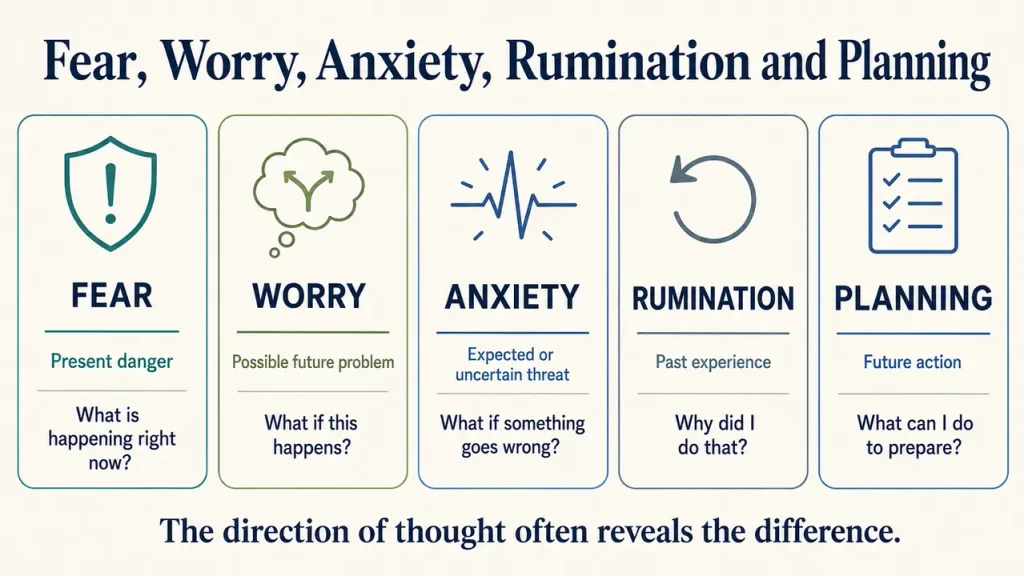
These experiences can overlap, but they usually point in different directions.
| Experience | Where attention goes | A common inner question |
| Fear | A clear danger in the present | “What is happening right now?” |
| Worry | A possible future problem | “What if this happens?” |
| Anxiety | An expected or uncertain threat | “What if something goes wrong?” |
| Rumination | Something that happened in the past | “Why did I do that?” |
| Planning | A future situation you can act on | “What can I do to prepare?” |
For example, repeatedly thinking about an awkward conversation from last week is closer to rumination. You can read more about this pattern in why your brain replays embarrassing memories at night.
Imagining that tomorrow’s conversation will end badly is future worry. Preparing two points you want to discuss is planning.
The difference is not always found in the topic. It is often found in what the thinking produces.
Helpful planning moves towards action. Repetitive worry moves towards another “what if”.
Is Worrying About the Future Always Unhealthy?
No. A certain amount of worry is part of being human.
It can remind you that something matters. It can help you notice a risk, seek information or prepare for a difficult situation. A parent may worry about a child travelling alone and agree on a sensible check-in time. An employee may feel concerned about a presentation and practise beforehand.
In both cases, the concern leads to a proportionate response.
Worry becomes less helpful when it continues after reasonable preparation is complete. It may also become harmful when it makes you avoid ordinary situations, repeatedly seek certainty or live through the same feared event many times in your imagination.
A useful question is:
Is this thought helping me respond to a real possibility, or is it asking me to guarantee an outcome that no one can guarantee?
You do not need to criticise yourself if the answer is unclear. Future worry often feels responsible. It may even feel necessary. To understand why it becomes so convincing, we first need to look at how the mind responds when the future feels uncertain.
Why Can an Imagined Future Feel So Real?
Your mind does not wait for life to happen before thinking about it. It constantly uses past experience and present information to imagine what may happen next.
This ability helps you plan. It allows you to prepare for an interview, anticipate another person’s needs or notice a possible risk. Without it, even simple decisions would become difficult.
But the same ability can also create anxiety.
When the future is uncertain, your mind may give more attention to what could go wrong than to what could go well. A possibility begins to feel urgent. Your body responds with tension, restlessness or a racing heartbeat. Those feelings can then make the thought seem more believable.
You may begin with:
“Something could go wrong.”
A little later, it feels more like:
“Something is probably going to go wrong.”
Nothing outside you has changed. But the possibility now feels emotionally real.
Researchers Dan Grupe and Jack Nitschke describe anxiety as a response to uncertainty about a possible future threat. Their review in Nature Reviews Neuroscience explains that uncertainty can affect how we estimate danger, direct attention and prepare for possible outcomes.
In simple words, your mind is trying to answer two questions:
What might happen?
Will I be able to handle it?
When neither answer feels certain, worry may step in.
The Future-Worry Cycle: Why One “What If” Leads to Another
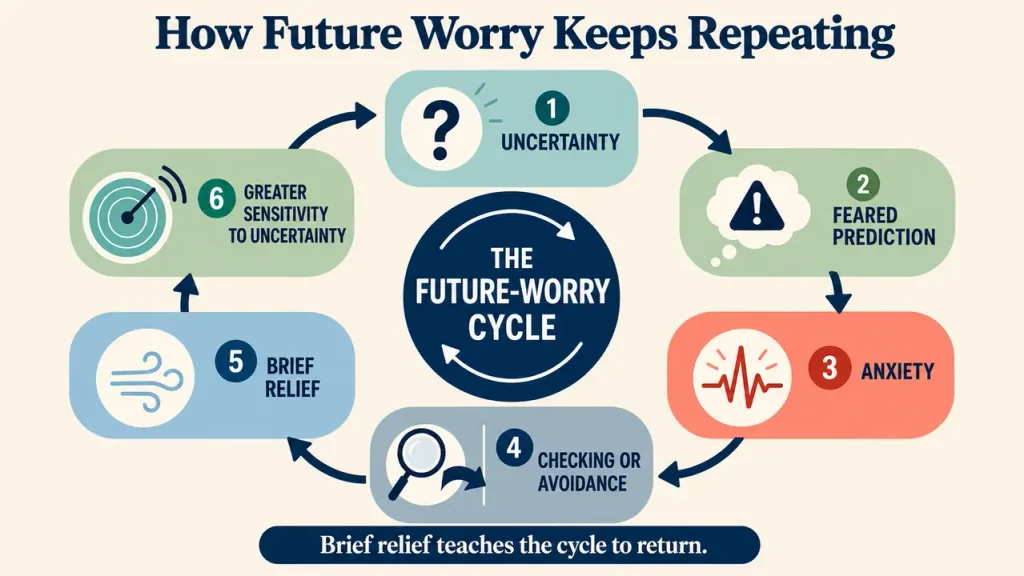
Future worry often follows a quiet but repeating cycle.
1. Something uncertain enters your mind
It may begin with an unanswered message, an upcoming meeting or a physical sensation you do not understand.
At this point, several explanations may be possible. But the mind becomes drawn towards the one that feels most threatening.
2. Your mind creates a feared outcome
A delayed reply becomes:
“Perhaps they are upset with me.”
A request to meet becomes:
“Maybe I have done something wrong.”
A headache becomes:
“What if this is something serious?”
The thought may be possible. But possibility alone does not tell you how likely it is.
3. Your body reacts to the thought
You may notice a tight chest, an unsettled stomach or difficulty concentrating. You might feel restless or unable to continue what you were doing.
This reaction is real. But it is a response to the meaning your mind has given the situation. It is not proof that the feared event is already unfolding.
4. The feeling makes the thought seem more convincing
When anxiety rises, people often assume there must be a good reason for it.
You may think:
“I would not feel this worried if nothing were wrong.”
This is called emotional reasoning. It happens when a feeling is treated as evidence about reality.
The emotion tells you that something feels threatening. It cannot tell you with certainty what will happen.
5. You try to find certainty
You may check your phone again. Search online. Rehearse a conversation. Ask someone what they think. Review every detail or avoid the situation completely.
These actions can bring brief relief.
The message has not arrived, but checking makes you feel active. The medical result is not available, but searching makes you feel less passive. The meeting has not happened, but rehearsing every response feels like preparation.
6. The relief teaches the mind to repeat the pattern
Because checking or reassurance reduces anxiety for a moment, your mind learns:
“When uncertainty feels uncomfortable, I must do something immediately.”
The next time uncertainty appears, the urge becomes stronger. This is how a protective response can gradually become a cycle.
Research on worry suggests that it may function as a way of trying to prevent bad events or prepare for them. But repeated worry can also stop a person from fully processing uncertainty. This may help the pattern continue. A detailed review of this process is available through the US National Library of Medicine.
The cycle often looks like this:
Uncertainty → feared prediction → anxiety → checking, avoidance or reassurance → temporary relief → more sensitivity to uncertainty
The problem is not that you care too much. It is that your mind has begun treating certainty as the only reliable route to safety.
Why Anxiety Can Feel Like Intuition
Many people become confused at this point.
They wonder:
“Is this anxiety, or is my intuition warning me?”
There is no simple test that can answer this in every situation. Genuine concerns should not be dismissed simply because anxiety is present. But strong emotion can make a thought feel more accurate than the available evidence supports.
Anxiety often has a few recognisable qualities:
- It repeats the same warning without adding useful information
- It demands an answer immediately
- It moves quickly towards the worst outcome
- It struggles to accept neutral explanations
- It creates an urge to check, avoid or seek reassurance
- Relief does not last after an answer is received
A grounded concern is more likely to respond to new information. It can consider several explanations. It may still feel uncomfortable, but it usually allows you to take a proportionate step and then pause.
For example, imagine that a close friend has not replied since morning.
A grounded concern may say:
“This is unusual. I will call once this evening and check whether everything is okay.”
Anxiety may say:
“Something must be wrong. Call again. Check when they were last online. Contact someone else. Think through every possible reason.”
The first response notices the concern and chooses an action. The second tries to remove every remaining uncertainty.
The difference is not whether the thought feels powerful. It is whether the thought stays connected to evidence, proportion and what you can reasonably do.
Your Mind May Be Trying to Protect You, Not Predict the Future
Future worry often carries a protective intention.
Your mind may be trying to prevent disappointment. It may want to make sure you never overlook a warning sign or make an avoidable mistake. It may believe that expecting the worst will soften the impact if something difficult happens.
But worrying in advance does not always reduce future pain. Sometimes it only brings that pain into the present.
You may suffer before the event, during the event and again afterward—even if the outcome is manageable.
Understanding this does not make worry disappear. But it changes the question.
Instead of asking:
“Why am I doing this to myself?”
You can begin asking:
“What is my mind trying to protect me from right now?”
That question creates curiosity. It also prepares us to look more closely at the psychological reasons some minds stay several steps ahead of life.
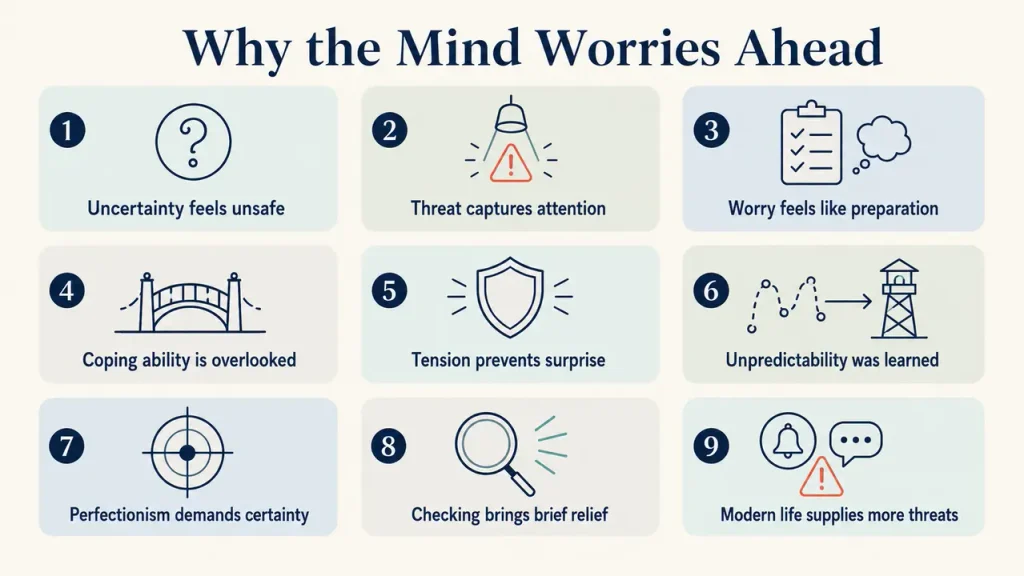
9 Psychological Reasons You Worry About Things That Have Not Happened
Two people can face the same uncertain situation and respond very differently.
One may think, “I will deal with it when I know more.” The other may spend hours imagining what could happen.
This does not mean one person is stronger. People differ in what uncertainty means to them, what they have learned from earlier experiences and how much responsibility they feel for preventing negative outcomes.
The following reasons often overlap. You may recognise several of them or only one.
1. Not Knowing Feels Harder Than the Answer Itself
For some people, uncertainty is not an empty space. It feels like a threat that must be resolved.
Imagine that you have attended a job interview. The result will arrive next week. Until then, several outcomes remain possible.
If you can tolerate uncertainty, you may feel nervous but continue with daily life. If uncertainty feels unbearable, your mind may keep reviewing the interview:
“Was that answer good enough?”
“Why did the interviewer look serious?”
“What if I misunderstood the question?”
Psychologists call this pattern intolerance of uncertainty. It does not mean that you are incapable of handling an uncertain situation. It means your mind reacts strongly when important information is unavailable.
Research suggests that intolerance of uncertainty is closely connected with worry and appears across several anxiety-related difficulties. It can make an unknown outcome feel unacceptable, even when there is no useful way to obtain an answer yet. You can read more in this research review from PubMed Central.
Sometimes the mind would rather imagine a bad answer than remain without one. At least a feared answer feels definite.
2. Your Attention Moves Quickly Towards Possible Danger
The mind does not give equal attention to every possible outcome.
Suppose your manager says:
“Your work looks good. There is one point I would like to discuss tomorrow.”
You may barely register the praise. Your attention stays with “one point”.
By evening, that point has become a serious problem in your imagination.
This does not mean you deliberately ignore positive information. When you are anxious, ambiguous details can feel more important because they might contain a warning.
Your mind is trying to keep you safe. But it may begin confusing “needs attention” with “something bad is likely”.
A more balanced response does not ignore the concerning detail. It keeps that detail beside the rest of the evidence.
3. Worry Feels Like Preparation
Many people worry because doing nothing feels irresponsible.
You may believe:
“If I think through every possibility, I will be ready.”
This can be useful for a short time. Preparing documents before an appointment or planning what to say in a difficult conversation may help.
But worry has no clear finishing point. Once one problem has been considered, the mind finds another.
“What if they ask something unexpected?”
“What if I forget what I planned?”
“What if I become anxious?”
Researchers have proposed that worry can act as a cognitive attempt to prevent bad events or prepare for them. The difficulty is that thinking starts to replace living. Preparation ends in action. Worry often ends in more worry.
4. You Overestimate the Threat and Forget Your Ability to Cope
An anxious prediction often contains two hidden beliefs:
- Something bad is likely to happen
- I will not be able to handle it
The first belief enlarges the danger. The second makes you feel smaller.
For example, before travelling alone, you may imagine missing your train. Your mind then jumps directly to being stranded, helpless and unable to decide what to do.
It leaves out your phone, station staff, alternative trains, people you could call and your own ability to ask for help.
This does not mean difficult events are impossible. It means anxiety often imagines the problem in great detail while leaving coping ability out of the picture.
A fuller question is:
“If this happened, what choices and support would still be available to me?”
5. Staying Worried Feels Safer Than Being Surprised
Some people remain worried because calmness feels emotionally risky.
They may think:
“If I expect the worst, it will hurt less.”
This pattern is explained by the Contrast Avoidance Model of Worry. It suggests that some people use worry to stay emotionally prepared. Remaining tense may seem safer than relaxing and then being suddenly shocked by bad news.
This can create a painful rule:
Do not feel too hopeful. Do not relax too soon. Stay ready.
The mind may believe it is protecting you from disappointment. But it also prevents you from feeling settled when nothing currently requires action.
Sometimes worry remains because caution feels safer than hope.
6. Earlier Unpredictability Taught You to Look Ahead
Your response to uncertainty may also reflect what you learned in the past.
Perhaps moods changed quickly in your home. Criticism arrived without warning. A small mistake sometimes led to a strong reaction. Or you had to notice other people’s needs before they expressed them.
You may have learnt to watch closely, think ahead and prepare for changes.
This does not automatically mean you experienced trauma. Families and environments can be unpredictable in many ways. But repeated uncertainty may teach a child that being prepared is safer than being surprised.
The same habit can continue in adulthood, even when the present situation is different.
Understanding how childhood shapes emotional regulation can help you recognise these learned responses without blaming yourself or your family for every current difficulty.
7. Perfectionism Makes Uncertainty Feel Like a Test
Perfectionism is not only about wanting excellent results. It can also involve believing that you should prevent mistakes, predict problems and make the correct choice every time.
An uncertain decision may therefore feel like a test of your worth:
“What if I choose badly?”
“What if people think I was careless?”
“What if I should have known better?”
Instead of asking which option fits your values and available information, you search for the option that carries no risk.
That option rarely exists.
This can lead to overthinking, delayed decisions and procrastination even when you genuinely want to act.
Sometimes you are not afraid of the decision itself. You are afraid of what an imperfect outcome might make you believe about yourself.
8. Checking and Reassurance Bring Relief—But Only Briefly
When uncertainty becomes uncomfortable, you naturally look for relief.
You might:
- Check your messages repeatedly
- Search the same question online
- Ask several people for their opinion
- Review a conversation again
- Avoid making a decision
- Look for signs that confirm everything is fine
These responses are understandable. They may reduce anxiety for a few minutes.
But short-lived relief can teach the mind that uncertainty is dangerous and checking is what kept you safe. When doubt returns, you feel the need to check again.
Support from other people is healthy. The concern arises when no answer feels sufficient for long. This is the same pattern explored in why you may need constant reassurance.
The long-term goal is not to stop seeking support. It is to stop making complete certainty a condition for feeling okay.
9. Modern Life Keeps the Mind Surrounded by Possible Threats
Today, uncertainty rarely stays in one area of life.
News alerts bring distant crises into your day. Work messages arrive after office hours. Social media shows other people’s achievements, losses and warnings. Health information is always available, but often without enough context.
You may begin by checking one concern and end up discovering five more.
Modern life also creates pressure to remain informed, responsive and prepared. Stepping away can feel careless, even when staying connected is making you more anxious.
Technology does not cause every pattern of future worry. But constant exposure can keep the mind in a state of unfinished attention.
Sometimes protecting your mental space means accepting that you cannot monitor every risk, solve every possibility or stay updated about everything at once.
What These Nine Reasons Have in Common
Although these reasons appear different, they share one underlying wish:
You want to feel safe enough to face what comes next.
Your mind may search for safety through prediction, preparation, perfection, checking or emotional bracing. These strategies are not foolish. Most of them developed because they offered some sense of control.
The problem begins when safety seems possible only after every uncertainty has been removed.
Life rarely offers that guarantee.
The aim is not to stop caring about the future. It is to learn when thinking is helping you prepare—and when it is taking you away from the life that is happening now.
When Worrying About Tomorrow Starts Taking Away Today
Future worry does not always look dramatic.
You may continue working, caring for your family and completing daily responsibilities. From the outside, everything appears normal. Inside, part of your attention is always somewhere else.
You are having dinner but mentally preparing for tomorrow’s meeting. You are spending time with someone you love but wondering whether the relationship might change. You receive good news, yet immediately think about how it could go wrong.
The future begins occupying moments that were meant for the present.
What Future Worry Can Look Like in Daily Life
You may notice that you:
- Mentally rehearse conversations that may never happen
- Read hidden meanings into short messages or changes in tone
- Struggle to sleep before an appointment or important event
- Keep searching after receiving a reasonable answer
- Avoid opportunities because too many things could go wrong
- Delay decisions until you feel completely certain
- Overprepare for ordinary situations
- Feel tired before the event has even begun
- Find it difficult to enjoy something good without imagining its end
- Become irritable when others tell you to “just relax”
These patterns do not mean you enjoy worrying. They often mean your mind has confused staying mentally busy with staying prepared.
Helpful Planning or Repetitive Worry?
Planning and worry can begin with the same concern. The difference lies in where the thinking takes you.
| Helpful planning | Repetitive worry |
| Focuses on a specific concern | Moves across many possible threats |
| Uses the information currently available | Keeps searching for complete certainty |
| Leads to a reasonable action | Leads to another “what if” |
| Accepts that some risk will remain | Treats uncertainty as unacceptable |
| Has a natural stopping point | Never feels fully finished |
| Helps you return to daily life | Continues after preparation is complete |
Imagine that you have an important presentation on Monday.
Helpful planning may involve preparing your slides, practising twice and checking the time and location.
Repetitive worry begins after that preparation:
“What if the presentation does not open?”
“What if I forget everything?”
“What if someone asks a question I cannot answer?”
“What if they think I am incompetent?”
Planning asks what you can do. Worry asks you to control how every moment will unfold.
A useful test is:
Has my thinking produced a reasonable next step, or only another frightening possibility?
Why More Worry Does Not Always Mean More Preparation
Worry can create a strong feeling of effort. You may spend hours thinking and end the day exhausted.
But mental effort is not always the same as useful preparation.
Research on worry suggests that repetitive negative thinking can affect concentration and make it harder to direct attention towards the task in front of you. A review in Clinical Psychology Review describes how habitual worry can be maintained by automatic threat-related thoughts and unhelpful thinking patterns.
Future worry may also affect:
- Sleep: Your mind keeps treating bedtime as extra problem-solving time.
- Concentration: Part of your attention remains with imagined outcomes.
- Decision-making: Every option seems to contain a risk you should eliminate.
- Relationships: Repeated checking or reassurance may leave both people tired.
- Confidence: Avoidance can strengthen the belief that you cannot cope.
- Enjoyment: Positive moments feel temporary or unsafe to trust.
Sometimes people believe that worry is the reason bad things have not happened.
They may think:
“I worried, I prepared, and everything went well. So worrying must have protected me.”
But it may have been the practical preparation that helped—not the hours of suffering around it.
Worry Can Make Life Smaller Before Anything Goes Wrong
One of the quietest costs of future worry is avoidance.
You may turn down an opportunity because failure is possible. Avoid a conversation because it may feel uncomfortable. Delay a medical appointment because you fear the result. Or stay in a familiar situation because change offers no guarantees.
Avoidance brings immediate relief. But it can also teach the mind that the situation was too dangerous to face.
Over time, you may feel safe only when life remains predictable.
The goal is not to become careless or take every risk. It is to notice when worry is helping you protect something important—and when it is preventing you from participating in your own life.
Once you can recognise that difference, you can respond to future worry without either obeying it or fighting with it.
How to Stop Living Through Problems Before They Happen
You cannot remove every uncertain thought from your mind. Nor do you need to.
The aim is to notice when worry has stopped helping. You can then return to what is real, what is actionable and what can safely remain unanswered for now.
These steps are not about convincing yourself that nothing difficult will happen. They are about learning that you do not have to experience every possible difficulty in advance.
1. Ask: Is This Happening, Possible or Actionable?
When a frightening thought appears, pause and place it in one of three groups:
- Happening: Is this problem occurring now?
- Possible: Is this something that might happen?
- Actionable: Is there a useful step I can take today?
Suppose you are waiting for medical results.
The appointment is real. Feeling concerned is understandable. But imagining every possible diagnosis does not provide new information.
An actionable step might be writing down your symptoms and questions for the doctor. Repeated online searching may only create more uncertainty.
If there is a reasonable action, take it. If there is no action available yet, acknowledge that further thinking cannot produce the missing answer.
2. Put the Fear Into Clear Words
Future worry often arrives as a vague feeling:
“Something is wrong.”
“I have a bad feeling.”
“I do not know what to do.”
Try naming the actual prediction:
“I am afraid my manager will criticise my work.”
“I am worried that this person is losing interest in me.”
“I fear that I will make the wrong decision.”
Clear words make the worry easier to examine. They help you separate what you know from what your mind is adding.
Ask:
- What happened?
- What am I predicting?
- What evidence supports that prediction?
- What other outcomes remain possible?
This is not about arguing with yourself. It is about seeing the complete picture.
3. Separate What Is Possible From What Is Probable
Many feared outcomes are possible. Possibility alone does not tell you how likely they are.
If a friend takes longer than usual to reply, they could be upset. They could also be busy, tired, travelling or away from their phone.
Anxious thinking often selects the most threatening explanation and treats it as the leading one.
Try saying:
“This is one possible explanation. It is not the only explanation, and I do not yet know which one is true.”
This sentence does not offer false reassurance. It makes room for uncertainty without turning uncertainty into danger.
4. Put Your Coping Ability Back Into the Picture
Worry shows you the feared event in detail. It often leaves out everything you might do next.
Ask yourself:
- If this happened, what would my first step be?
- Who could support me?
- What choices would still remain?
- Have I handled something uncertain before?
- What would I tell someone I care about in this situation?
You do not need to prove that the outcome will be easy. You are reminding yourself that a difficult outcome and complete helplessness are not the same thing.
5. Reduce Checking and Reassurance Gradually
Repeated checking can make a concern feel important every time you return to it.
You do not have to stop abruptly. Begin with a small delay.
If you normally check your phone every five minutes, wait ten. If you usually ask three people for reassurance, speak to one trusted person and notice the urge to ask again.
You might tell yourself:
“I have already checked. The uncertainty is uncomfortable, but another check will not change the information available.”
This is not about refusing support. It is about learning that you can experience some uncertainty without immediately trying to remove it.
6. Give Worry a Boundary
If worry interrupts you throughout the day, write the concern down and choose a short time to revisit it later.
During that period, ask:
- Is there a real problem to solve?
- What is within my control?
- What can wait?
- What am I repeatedly trying to predict?
This practice is sometimes called scheduled worry time. Guidance from the UK’s Every Mind Matters programme recommends separating worries you can act on from hypothetical worries outside your control.
The purpose is not to suppress the thought. It is to stop every anxious possibility from demanding immediate attention.
7. Practise Small Moments of Safe Uncertainty
Tolerance for uncertainty grows through experience.
Choose low-risk situations where you usually overcheck or overprepare:
- Send an ordinary message without rereading it repeatedly
- Make a small choice without asking several people
- Leave a minor task “good enough”
- Wait before checking for a reply
- Allow someone else to choose the plan
- Attend a familiar event without rehearsing every conversation
Start gently. The aim is not to overwhelm yourself. It is to discover that discomfort can rise and fall without always requiring a certainty-seeking response.
The P.R.E.S.E.N.T. Response to Future Worry
When your mind moves too far ahead, use these steps:
P — Pause the Future Story
Notice that your mind has begun predicting. You do not have to complete the story immediately.
R — Recognise What You Are Afraid Of
Name the feared outcome clearly. A specific worry is easier to examine than a general sense of dread.
E — Examine What You Actually Know
Separate facts from assumptions, imagined meanings and missing information.
S — Separate Possibility From Probability
A thought may describe something possible without describing what is likely.
E — Establish What Is Actionable
Choose one proportionate step. Do not turn preparation into an attempt to control every outcome.
N — Notice What Is Happening Now
Feel your feet on the floor. Look around the room. Return to the conversation, task or person in front of you.
Grounding does not prove that the future will be easy. It reminds you that you are not living that future at this moment.
T — Tolerate What Cannot Yet Be Known
Some answers arrive only with time. You can dislike uncertainty without treating it as an emergency.
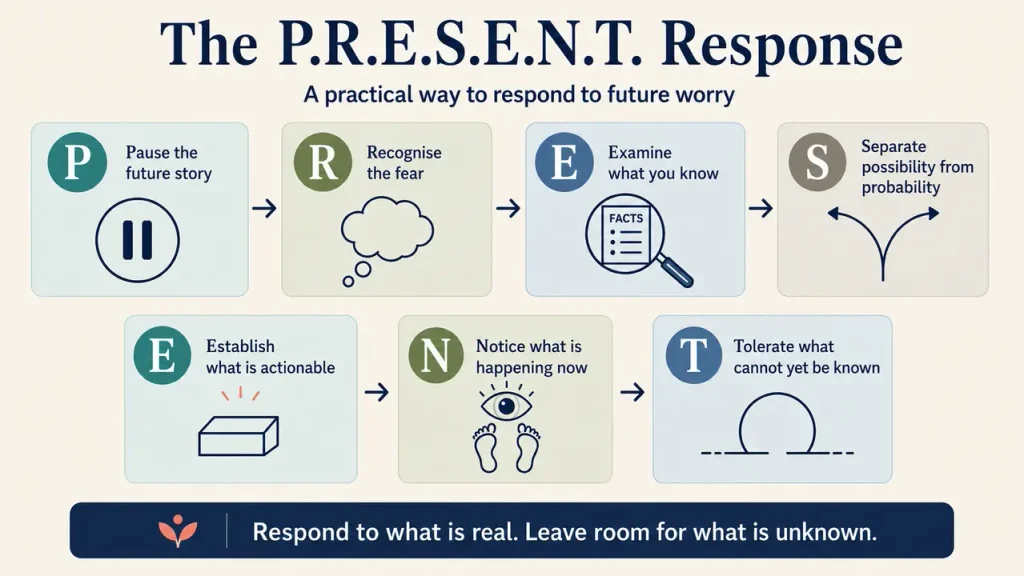
The P.R.E.S.E.N.T. response is not meant to make every anxious thought disappear. It gives you a way to decide whether the thought needs action, reflection or permission to remain unanswered.
Protect Your Mind From Unnecessary Threat Overload
Sometimes the worry is not coming from one event. Your mind is simply receiving too many warnings.
Consider:
- Turning off non-essential alerts
- Choosing limited times to read the news
- Avoiding health searches late at night
- Creating a clear end to the working day
- Stepping away from content that repeatedly increases fear
- Protecting sleep as much as possible
Staying informed can be useful. Staying emotionally connected to every possible threat is not the same as being prepared.
You do not need to solve the whole future. You only need to decide what this moment reasonably asks of you.
When Does Future Worry Need More Support?
Worrying about an upcoming event does not automatically mean you have an anxiety disorder.
Most people worry when something important feels uncertain. The worry may settle once they receive more information, make a decision or move through the event.
It may be time to seek professional support when worry:
- Feels difficult to control on most days
- Regularly interrupts sleep
- Affects concentration or work
- Creates conflict in relationships
- Leads to repeated checking or reassurance
- Makes you avoid appointments, people or opportunities
- Causes frequent physical anxiety symptoms
- Moves quickly from one area of life to another
- Leaves you feeling persistently overwhelmed or hopeless
Persistent worry can appear in different mental health conditions, including generalised anxiety disorder, health anxiety, social anxiety, panic disorder and obsessive-compulsive disorder. However, similar patterns can also occur without a diagnosis.
A qualified mental health professional can look at the complete picture. This includes how long the worry has been present, how strongly it affects daily life and whether something else may be contributing to it.
The American Psychological Association describes anxiety as involving worried thoughts, tension and physical changes. It recommends seeking help when anxiety becomes persistent or begins interfering with everyday functioning.
If you ever feel unable to keep yourself safe or experience thoughts of harming yourself, contact your local emergency service or an appropriate crisis-support service immediately.
Frequently Asked Questions
Why do I worry about things that have not happened?
You may worry about things that have not happened because your mind is trying to predict danger, reduce uncertainty or prepare you for a difficult outcome. Worry can create a temporary sense of control. However, it may become repetitive when no amount of thinking can provide the certainty you want.
What is anticipatory anxiety?
Anticipatory anxiety is fear or uneasiness about an event or outcome that has not happened yet. It can occur before an interview, journey, medical appointment, social situation or difficult conversation. It is a description of future-focused anxiety, not a separate diagnosis.
Why does worrying make me feel temporarily safer?
Worry can feel like preparation. Checking, rehearsing or imagining different outcomes may briefly reduce the discomfort of not knowing. That relief can teach your mind to worry again whenever uncertainty appears, even when the worry is not producing useful action.
Is worrying about the future the same as overthinking?
They overlap, but they are not identical. Overthinking can involve the past, present or future. Future worry focuses mainly on possible problems and uncertain outcomes. Both can become repetitive and continue after useful reflection is complete.
Why do I always assume the worst will happen?
Your attention may be drawn towards threatening possibilities because they seem important to notice. Past unpredictability, perfectionism, stress and difficulty tolerating uncertainty can strengthen this pattern. Assuming the worst may feel protective, but a possibility is not automatically the most likely outcome.
How can I tell the difference between intuition and anxiety?
There is no perfect test. Anxiety often repeats urgently, moves towards the worst outcome and demands immediate certainty. A grounded concern is usually more responsive to evidence and leads to a proportionate action. Instead of relying only on how strong the feeling is, consider the facts, alternative explanations and what you can reasonably do.
How do I stop worrying about things I cannot control?
Begin by identifying whether there is one useful action you can take. If there is, take that step. If there is not, name what remains uncertain and return your attention to the present. Reducing repeated checking, setting boundaries around worry and practising small moments of uncertainty can gradually help.
Final Perspective: You Do Not Have to Solve Tomorrow Today
If your mind keeps travelling towards problems that have not happened, it may be trying to protect you.
It may believe that enough thinking will prevent surprise. Expecting the worst will soften disappointment. Or that staying tense will help you notice danger before it arrives.
These patterns can make sense, especially if uncertainty has felt difficult in the past.
But not every possibility is a warning. Not every anxious feeling is a prediction. And not every future problem needs an answer today.
You can prepare for what is reasonable. You can ask for support when you need it. You can take concerns seriously without allowing them to occupy every part of the present.
Sometimes courage does not feel like complete confidence.
Sometimes it sounds like:
“I do not know what will happen yet. But I will respond when I know more.”
The future will always contain some uncertainty. Your peace cannot depend on removing all of it.
It can begin with trusting that when life asks something of you, you will not have to face it all at once.
A Gentle Note

This article is intended for education and self-reflection. It cannot diagnose an anxiety disorder or replace personalised care from a qualified mental health professional. If worry is persistent, distressing or interfering with your daily life, consider speaking with an appropriately qualified professional who can understand your circumstances and support you safely.