

You are trying to explain why something hurt you.
You know what you want to say. You may even have rehearsed the conversation beforehand. But as soon as your voice becomes firm—or the other person interrupts you—your throat tightens. Your eyes begin to fill. Within moments, you are crying.
Now the conversation is no longer only about what made you angry. You are also trying to hide your tears, steady your voice and convince the other person that you are not “being too emotional”.
Later, you may replay the moment and wonder:
Why do I cry when I am angry? Why couldn’t I just say what I needed to say?
If this happens to you, it does not mean your anger was false. It does not mean you are emotionally weak, dramatic or unable to handle conflict. Angry tears often appear when several powerful emotions and bodily reactions arrive at the same time.
Sometimes there is anger.
Sometimes there is hurt beneath it.
And sometimes there is the unbearable frustration of knowing exactly what you feel but being unable to make the other person understand.
Quick Answer: Why Do I Cry When I Am Angry?
You may cry when you are angry because anger can activate intense emotional and physical arousal. At the same time, you may also feel hurt, frustrated, powerless, rejected or misunderstood. When these experiences exceed what you can comfortably process or express in that moment, tears may become part of your body’s response.
Crying does not cancel your anger. You can be genuinely angry and tearful at the same time.
Angry tears are not a diagnosis or proof of a particular mental health condition. They are one of the many ways human beings may respond when an emotionally important situation becomes overwhelming.
Table of Contents
Anger and Tears Are Not Opposite Reactions
We often talk about emotions as if each one belongs in a separate box.
Anger is imagined as a raised voice, a firm expression or an urge to confront someone. Sadness is associated with tears, withdrawal and vulnerability. Because of these assumptions, crying while angry can feel confusing. Your inner experience says, “I am furious,” while your tears seem to communicate something different.
But emotions do not always appear one at a time.
You can feel angry because someone treated you unfairly and hurt because the behaviour came from someone you trusted. You can feel frustrated that your words are being dismissed and frightened that speaking honestly could damage the relationship. You can want to defend yourself while also wanting the conversation to stop.
Psychological research recognises that emotions can coexist and influence how one another is expressed. Studies of anger have found that sadness, disappointment and other emotions can occur alongside it rather than simply replacing it. Research on co-occurring emotions and anger.
Imagine that you have repeatedly asked a colleague not to take credit for your work. During a meeting, it happens again. You decide to address it privately.
At first, you feel angry. But when your colleague dismisses the concern and says you are “making a big deal out of nothing”, something else enters the moment. You feel humiliated. You feel unheard. Perhaps you also feel trapped because reacting strongly could affect your professional reputation.
The tears that follow are not necessarily sadness instead of anger. They may reflect the entire emotional weight of the situation: injustice, frustration, vulnerability and the effort of trying to remain composed.
Your Body May React Before You Find the Words
Anger is not only a thought. It is also a bodily experience.
When something feels unfair, threatening or obstructive, your body can prepare you to respond. Your heart may beat faster. Your muscles may tighten. Your breathing may become shallow, and your attention may narrow around whatever feels wrong.
The American Psychological Association describes anger as a normal emotion that can arise in response to a moment that feels threatening and can motivate constructive action. Anger may tell you that a boundary has been crossed, something important has been dismissed or a situation needs to change.
However, the greater the emotional intensity, the harder it can become to organise your thoughts and communicate them clearly. You may know what you mean internally but struggle to turn it into a calm sentence. Your voice shakes. Your mind goes blank. The tears begin before you have consciously decided to cry.
This reaction can be especially strong when the situation matters deeply. A casual disagreement with a stranger may be irritating, but being dismissed by a partner, parent, close friend or supervisor can carry a much greater emotional meaning.
The body is not only responding to the words being spoken. It may also be responding to what those words seem to mean:
- My feelings do not matter.
- I am not being treated fairly.
- I cannot make them understand me.
- If I speak honestly, I may lose this connection.
- I am not safe enough to express my anger here.
When several of these meanings arrive together, crying can become an involuntary response to emotional intensity.

Angry Tears Do Not Mean You Are Weak
Many people are less distressed by the tears themselves than by what they believe the tears say about them.
You might worry that others will stop taking you seriously. You may feel embarrassed because you wanted to appear confident. You might become angry with yourself for crying, which adds a second layer of emotional pressure to an already difficult moment.
But crying is not a reliable measure of strength, maturity or competence.
Research suggests that emotional tears can serve interpersonal functions, including signalling distress, vulnerability or a need for support. Their precise biological and psychological effects remain complex, and crying does not make everyone feel better immediately. It should not be reduced to the popular but unproven claim that tears simply “flush stress hormones” from the body. Scientific review of human emotional crying, research on crying and mood regulation.
What matters is not whether tears appear. What matters is whether you can eventually understand what triggered the reaction and communicate what you need.
You can cry and still hold a boundary.
You can cry and still disagree.
You can cry and still deserve to be heard.
The tears are part of your emotional response—not the final verdict on whether your feelings are valid.
The next step is to look beneath the moment itself. Although angry tears can appear for many reasons, several psychological patterns help explain why this response happens more readily for some people and in certain situations.
Seven Psychological Reasons You May Cry When You are Angry
Angry tears rarely have one simple explanation.
Your response may be shaped by what is happening in the present, how much stress you are already carrying and what you learnt about anger earlier in life. One person may cry when they feel powerless. Another may cry because conflict awakens a fear of rejection. For someone else, tears appear only after they have been holding everything together for too long.
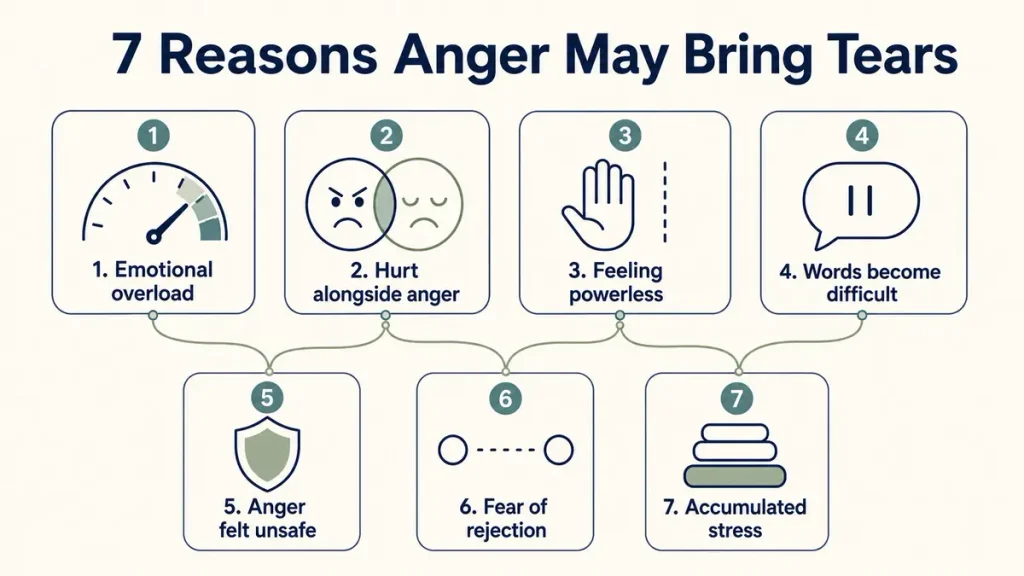
The following reasons are possibilities—not diagnoses. You may recognise yourself in one, several or none of them.
1. Your Emotional Intensity Has Crossed Its Current Threshold
Think of your emotional capacity as a glass.
On a relatively peaceful day, there may be plenty of room for an unexpected problem. But if the glass is already filled with deadlines, family responsibilities, poor sleep, financial concerns or unresolved tension, one more difficult interaction can cause it to overflow.
The final incident may appear small from the outside. Yet your reaction is not necessarily about that moment alone. It may include everything your nervous system has been trying to carry.
For example, imagine reaching home after a demanding day. You have managed work pressure, traffic and several unanswered messages. When someone casually criticises something you forgot to do, tears suddenly appear alongside anger.
You may think, Why am I reacting so strongly to one comment?
But your body may not be responding to only one comment. It may be responding to an entire day of emotional effort.
This does not mean every intense reaction is helpful or proportionate. It means that understanding your accumulated stress can be more constructive than shaming yourself for “overreacting“.
2. Hurt Is Present Alongside the Anger
Anger is sometimes described as a “secondary emotion” covering sadness or fear. That explanation can be helpful, but it is not universally true. Anger is also a legitimate primary emotion in its own right.
A more accurate way to understand angry tears is that anger and hurt can coexist.
Suppose a close friend forgets something important to you. You may be angry because their behaviour felt careless. At the same time, you may feel hurt because you expected to matter to them.
The anger says:
This was not acceptable.
The hurt says:
I did not expect this from you.
Both feelings can be real.
Tears may emerge when the anger opens the door to disappointment, betrayal, loneliness or grief. This is particularly likely when the person who upset you is someone whose care and approval are emotionally important.
Rather than asking, “Am I angry or sad?”, it may be more useful to ask:
“What else am I feeling at the same time?”
Naming the additional emotion does not weaken your anger. It helps you understand the full message behind it.
3. You Feel Powerless, Trapped or Unable to Change the Situation
Anger often carries an impulse to act. It may motivate you to confront unfairness, protect a boundary or correct something that feels wrong.
But what happens when you cannot act?
Perhaps the person has more authority than you. Maybe speaking honestly feels unsafe. You might depend on the relationship or worry that defending yourself will make matters worse. Sometimes you have explained yourself repeatedly, but the other person continues to dismiss what you are saying.
In these situations, anger can become mixed with helplessness.
Consider an employee who is unfairly blamed by a senior colleague. They want to defend themselves, but they also know that responding too forcefully could be viewed as disrespectful. They try to remain calm. Their jaw tightens, their words become difficult to organise, and tears begin to form.
Those tears do not necessarily mean the person cannot handle criticism. They may reflect the strain of experiencing injustice while feeling unable to respond freely.
When you repeatedly cry in situations like this, ask:
- Do I feel permitted to speak?
- Am I afraid of what will happen if I disagree?
- Do I believe anything I say will make a difference?
- Is there a power imbalance affecting my response?
Sometimes angry tears are less about excessive sensitivity and more about feeling unable to speak freely or change what is happening.
4. Your Body Reacts Faster Than You Can Put the Experience Into Words
During a calm moment, you may express yourself clearly. But emotionally charged conversations demand several abilities at once.
You have to listen, interpret the other person’s intentions, manage your physical arousal, organise your thoughts and decide what is safe to say. If the conversation moves quickly, these demands can become overwhelming.
You may suddenly lose access to the words you had prepared.
Your thoughts become scattered. Your voice shakes. You remember your strongest point only after the conversation has ended.
This can feel especially frustrating when you understand yourself well but struggle to communicate under pressure. The tears may then arise from both the original anger and the frustration of being unable to express it.
If this pattern frequently occurs during disagreements, it may also connect with shutting down during arguments. A pause is not necessarily avoidance. Sometimes it gives your body enough time to settle so that your thinking and language can return.
5. You Learned That Expressing Anger Was Unsafe or Unacceptable
The way you respond to anger today may have been shaped long before you consciously understood the emotion.
Perhaps anger was punished in your childhood home. You may have been told not to answer back, raise your voice or challenge an adult—even when something felt unfair. Maybe anger around you was loud, frightening or unpredictable, so you learned to distance yourself from anything that resembled it.
You might also have received different messages according to your gender, family role or cultural environment:
- “Good children don’t get angry.”
- “Don’t create a scene.”
- “Respect means remaining silent.”
- “You are too sensitive.”
- “Why can’t you just adjust?”
Over time, you may have learned to redirect anger into a response that felt less dangerous. Instead of speaking firmly, you became quiet. Instead of protesting, you apologised. Instead of showing anger openly, you cried.
This does not mean every person who cries when angry has a traumatic childhood. Nor does it mean that crying is merely “suppressed anger”. It means that we often learn—quietly and over time—which emotions feel safe to show.
If anger was never welcomed, you may still be discovering how to express it without feeling guilty, frightened or ashamed.
6. Conflict Activates a Fear of Rejection or Disconnection
Not every disagreement feels like an ordinary difference of opinion.
For some people, conflict feels like evidence that a relationship is becoming unsafe. A partner’s irritated voice may sound like rejection. A friend’s disagreement may create a fear that the friendship is ending. Constructive feedback may feel like proof that someone has lost respect for you.
When connection feels threatened, anger can quickly become mixed with anxiety.
You may be angry about how you were treated but also afraid of losing the person. One part of you wants to stand your ground. Another wants to restore closeness immediately. Tears can emerge within that emotional conflict.
For example, you might begin by saying:
“I didn’t like the way you spoke to me.”
But when the other person becomes defensive, your attention shifts from the original boundary to the stability of the relationship:
What if they leave? What if they stop talking to me? Should I take back what I said?
This pattern can be influenced by rejection sensitivity, previous relationship experiences or an anxious attachment style. However, crying during conflict alone is not enough to conclude that you have any particular attachment style.
The more useful question is:
“Am I responding only to this disagreement, or am I also afraid of what the disagreement could mean for our relationship?”
Recognising that fear can help you protect the relationship without abandoning the issue that needs to be discussed.
7. You Have Been Holding Back Emotion for Too Long
Angry tears sometimes appear after a long period of being “fine”.
You may have ignored several small disappointments, agreed when you wanted to say no or remained silent to keep the peace. Perhaps you believed that raising a concern would make you difficult, demanding or ungrateful.
Each experience seemed manageable on its own, so you pushed it aside.
But emotions do not always disappear simply because they are not expressed. The tension may accumulate until one more incident makes continued restraint impossible.
Imagine someone who repeatedly takes on extra responsibilities at work. They do not want to disappoint anyone, so they keep agreeing. When another task is added at the end of an exhausting week, they begin crying while trying to say, “I can’t do this.”
The tears may look sudden to everyone else. Internally, however, they have been building for weeks.
If this sounds familiar, the deeper issue may not be how to stop crying. It may be learning to notice discomfort sooner—before resentment, exhaustion and anger reach their limit.
Ask yourself:
- What have I been tolerating without acknowledging?
- Did I express my concern when it first appeared?
- Have I been saying yes when I want to say no?
- Am I expecting myself to cope without support?
- What boundary has remained unspoken?
Sometimes the most effective way to reduce angry tears is not to become better at suppressing them. It is to become earlier and clearer in expressing what is not working.
A Compassionate Way to Understand Your Pattern
You may not find yourself in only one of these explanations. Perhaps you were already exhausted, the conversation made you feel dismissed, and speaking up also awakened a fear of rejection. Our emotional reactions are rarely created by one feeling alone. They are often several experiences arriving together.
Perhaps stress lowers your threshold, criticism activates an old fear of rejection, and the conversation becomes harder because you never felt safe expressing anger. Human responses are often shaped by several factors working together.
Try recalling the last time you cried while angry and gently ask:
- What happened immediately before the tears?
- What meaning did I attach to that moment?
- What was I trying to say?
- What did I fear might happen?
- Besides anger, what else was I feeling?
- What had I already been carrying that day?
These questions are not meant to analyse your emotions until they disappear. They help turn an experience that feels embarrassing or uncontrollable into something understandable.
Once you can recognise the pattern, you can begin responding to what the tears are communicating—not merely fighting to make them stop.
Why You May Cry During Arguments
You might manage frustration reasonably well in everyday situations. A delayed appointment, an inconvenient mistake or an inconsiderate stranger may irritate you without bringing tears.
But conflict with someone important can feel completely different.
An argument is rarely just an exchange of words. You are also reading the other person’s expression, interpreting their tone, anticipating what they might say next and wondering what the disagreement means for your relationship.
At the same time, you are trying to manage your own anger and explain yourself clearly.
That is a great deal for the mind and body to process at once.
Your Nervous System May Experience Conflict as a Threat
Imagine that you calmly raise a concern with your partner:
“I felt hurt when you made that comment in front of everyone.”
Instead of listening, they sigh and reply:
“You always make everything into a problem.”
The conversation has changed. You are no longer discussing only the original comment. Now you may also feel dismissed, criticised and misunderstood.
Your body can react quickly.
Your heart begins to race. Your face feels warm. Your breathing becomes shorter. Your muscles tighten, and your thoughts become harder to organise. You want to defend yourself, but the words seem to disappear just when you need them most.
This is sometimes described as a threat response.
A threat response does not mean that you are necessarily in physical danger. The human nervous system can also react strongly to social and emotional threats, such as humiliation, rejection, criticism, powerlessness or the possibility of losing an important connection.
The body may prepare to:
- confront the problem;
- leave or avoid it;
- become still and mentally blank;
- appease the other person to restore safety.
These responses are often referred to as fight, flight, freeze and fawn. They can be useful descriptions of common patterns, but they should not be treated as diagnoses or rigid personality types.
You might also experience more than one response during the same argument. You begin in “fight” mode, trying to defend yourself. When the other person becomes louder, you freeze and lose your words. Then you start apologising, even though your original concern remains unresolved.
Tears can appear anywhere within this sequence.
Why Feeling Unheard Can Be So Emotionally Painful
Many angry tears are not caused by disagreement alone. They appear when you feel that the other person is not genuinely trying to understand you.
You may be able to tolerate someone saying:
“I see it differently.”
But it can be much harder to hear:
“You are imagining things.”
“You are too sensitive.”
“That never happened.”
“You always do this.”
These responses do not merely challenge your opinion. They can make you feel as though your emotional experience is being erased.
You may try harder to explain. You add details, repeat yourself or speak more forcefully. Yet the more urgently you try to be understood, the more emotional you become. When the conversation still goes nowhere, frustration turns into tears.
This creates a painful loop:
- You feel misunderstood.
- You explain yourself more intensely.
- Your emotional arousal increases.
- Your words become less organised.
- The other person focuses on your tears or tone.
- Your original concern receives even less attention.
You may leave the conversation thinking, I should have stayed calmer.
Remaining regulated can certainly help communication. But responsibility does not belong only to the person who cried. Healthy conflict also requires the other person to listen, avoid contempt and respond to the concern rather than using visible emotion to dismiss it.
Why Your Mind May Go Blank When You Are Upset
One of the most frustrating parts of angry crying is knowing that you had something important to say but suddenly being unable to say it.
Before the conversation, your thoughts may have been clear:
- what happened;
- why it affected you;
- what you wanted the other person to understand;
- what needed to change.
During the argument, however, your attention may shift from thoughtful communication to emotional protection. You become preoccupied with the other person’s voice, facial expression or next response.
As arousal rises, it can become harder to hold several ideas in mind, select your words and evaluate what you want to say next. Emotional intensity also affects which regulation strategies feel available in the moment. Research on everyday emotion regulation suggests that the intensity of emotional arousal can influence how people respond to and manage an emotional experience. Research on emotion intensity and regulation.
This may explain why the perfect response arrives ten minutes—or three hours—after the conversation ends. Once your body settles, your ability to think flexibly returns.
Going blank does not mean you had no valid point. It may mean that your current level of activation temporarily exceeded your ability to communicate it.
If this happens repeatedly, a planned pause can be more productive than forcing yourself to continue.
You might say:
“I know what I want to discuss, but I’m too overwhelmed to explain it clearly right now. I need a short break, and I want us to return to this conversation.”
The commitment to return is important. A pause is different from using silence to punish someone or indefinitely avoiding every difficult conversation.
When a Raised Voice Changes the Meaning of the Conversation
For some people, a raised voice is simply a sign that the other person is frustrated. For others, it immediately changes how safe the interaction feels.
You may become tearful when someone raises their voice even if you were speaking confidently a moment earlier. The reaction may be influenced by:
- sensitivity to conflict;
- earlier experiences of shouting or unpredictable anger;
- fear of being punished or humiliated;
- previous emotionally unsafe relationships;
- the power the other person holds;
- accumulated stress and exhaustion.
It is important not to assume that every strong response to shouting is automatically a trauma response. The term “trauma” should not be used casually to explain every uncomfortable emotional reaction.
At the same time, your reaction deserves curiosity.
If yelling was associated with fear, punishment or instability earlier in life, your body may respond to a raised voice before you consciously assess the present situation. The current conversation can begin to feel connected to an older pattern of powerlessness.
You may know intellectually that you are an adult who can leave the room, set a boundary or disagree. Emotionally, however, a part of you may still feel that remaining quiet is the safest option.
This is one way childhood experiences can shape emotional regulation without determining your entire future.
Does Crying Mean You Are Losing the Argument?
No.
Tears do not determine whose interpretation is correct, whether a boundary is reasonable or whether harm occurred.
You can cry while expressing a legitimate concern. You can remain completely calm and still be mistaken. Emotional appearance is not the same as factual accuracy.
However, tears can affect how an argument unfolds.
A caring person may stop listening to the issue and focus entirely on comforting you. A defensive person may use the tears to label you as irrational. You may also become so embarrassed that you withdraw your concern simply to end the conversation.
This is why it helps to separate two different needs:
- Regulating the emotional intensity
- Resolving the original problem
Comfort may help with the first need, but it does not automatically address the second.
Suppose you are crying because your partner repeatedly makes jokes at your expense. They hug you and say, “Please don’t cry.” The comfort may be genuine, but the original issue still requires discussion.
Once you feel steadier, you might say:
“I appreciate that you’re trying to comfort me. I also need us to return to what I was saying about those comments.”
Your tears deserve care. Your concern deserves a response.
Crying Does Not Automatically Make You Manipulative
Some people worry that crying during conflict is emotionally manipulative.
Manipulation involves using behaviour deliberately—or sometimes habitually—to pressure, control or avoid accountability. Involuntary tears are not automatically manipulation simply because they influence the other person’s emotions.
You may be crying while still trying to listen, accept responsibility and communicate fairly. That is different from using tears to prevent the other person from speaking, make them feel guilty or escape every discussion about your own behaviour.
A useful self-check is:
- Am I still willing to hear the other person’s perspective?
- Can I return to the conversation after calming down?
- Am I using my distress to avoid taking responsibility?
- Can both our feelings and concerns remain present?
These questions should be asked with honesty, not self-accusation.
It is equally important to notice when someone routinely labels your tears “manipulative” simply to avoid addressing your concern. Visible emotion does not remove your right to be treated respectfully.
When the Conversation Itself Is Not Emotionally Safe
Emotional regulation techniques can help during ordinary disagreements. They cannot make an abusive interaction healthy.
Pay attention if the other person repeatedly:
- screams at or intimidates you;
- insults, mocks or humiliates you;
- blocks you from leaving;
- threatens you or damages property;
- deliberately provokes you and then criticises your reaction;
- denies events in ways that make you doubt your basic perception;
- punishes you for raising reasonable concerns.
In such situations, the priority is not learning how to cry less convincingly. It is recognising the pattern, protecting your safety and seeking appropriate support.
A healthy disagreement can be uncomfortable, but both people remain entitled to dignity, space and physical safety.
What to Do When Angry Tears Begin
When tears start rising during an argument, your first instinct may be to fight them.
You look away. You hold your breath. You speak faster, hoping to finish the sentence before your voice breaks. At the same time, another voice appears inside:
Don’t cry. Not now. They won’t take you seriously.
But struggling against the tears can add embarrassment and self-criticism to an already intense emotional experience. Now you are managing the disagreement, your physical reaction and the fear of being judged—all at once.

The immediate goal does not have to be “stop crying”.
A more realistic goal is to lower the emotional intensity enough to understand what you feel, choose what you want to say and protect the original purpose of the conversation.
1. Pause Before Forcing Yourself to Continue
When your body is highly activated, pushing harder does not always make communication clearer.
You may speak impulsively, repeat the same point or say something harsher than you intend. Alternatively, your mind may go blank and leave you feeling even more powerless.
Give yourself permission to pause.
If the interaction is respectful enough to continue later, you might say:
“I want to talk about this, but I’m becoming overwhelmed. Give me a few minutes to collect my thoughts.”
Or:
“I’m not walking away from the issue. I need a short pause so I can explain myself properly.”
This language does two things. It protects your immediate emotional capacity while reassuring the other person that you are not abandoning the conversation.
A pause could last five minutes, twenty minutes or longer, depending on the intensity and circumstances. Where possible, agree on when you will return:
“Can we continue after dinner?”
“I need half an hour. Let’s come back to this at seven.”
Without a plan to return, repeated pauses can quietly become avoidance. With a clear commitment, they can become a healthy regulation tool.
2. Help Your Body Come Down From High Arousal
Angry tears are not occurring only in your thoughts. Your whole body may be involved.
Before trying to analyse the situation, begin with something simple and physical:
- Place both feet firmly on the floor.
- Release your jaw and lower your shoulders.
- Breathe out a little longer than you breathe in.
- Unclench your hands.
- Take a slow sip of water.
- Look at a neutral object in the room.
- Briefly step into a quieter space if it is safe to do so.
Do not turn breathing into another performance you must get “right”. You do not need a complicated counting pattern. A slow, comfortable exhale can be enough to signal that you are no longer required to respond immediately.
Evidence on anger-management strategies indicates that approaches which reduce physiological arousal are more useful for lowering anger and aggression than activities that intensify arousal. The American Psychological Association’s guidance on anger similarly recommends calming strategies such as slow breathing and relaxing imagery.
This is one reason why aggressively “venting” by shouting, hitting objects or repeatedly replaying the injustice may not calm you. It can keep the body activated and make thoughtful communication more difficult.
3. Use One Clear Sentence Instead of Explaining Everything
When you feel misunderstood, you may try to explain every detail.
You bring up earlier examples, defend your intentions and anticipate every possible objection. Unfortunately, the more overwhelmed you become, the harder it is for either person to identify the central issue.
Try reducing your message to one clear sentence:
“I am angry because my concern is being dismissed.”
“I felt disrespected when you spoke about me that way.”
“I need you to let me finish before responding.”
“I am willing to discuss the mistake, but I am not comfortable being shouted at.”
“I need time to think before I agree to this.”
You do not have to make your entire case while your nervous system is overloaded. Begin with the core message. Details can follow when you feel steadier.
If speaking becomes too difficult, write down three points:
- What happened?
- How did it affect me?
- What am I asking for now?
This can prevent the conversation from drifting away from the actual concern.
4. Acknowledge the Tears Without Apologising for Existing
Many people automatically say:
“I’m sorry. I don’t know why I’m crying.”
Sometimes an apology is appropriate for something you said or did. But tears alone are not misconduct.
Instead of apologising for the emotional response, describe it:
“I cry when conversations become intense, but I still want to finish what I’m saying.”
“These tears are frustration. They don’t mean I no longer want to discuss this.”
“I’m emotional because this matters to me. Please listen to the point I’m trying to make.”
“I may need a moment, but my concern hasn’t changed.”
These phrases reduce confusion without making you ashamed of your reaction.
They also help redirect attention. The other person does not have to guess whether you need comfort, a pause or an opportunity to finish speaking.
5. Decide Whether to Continue, Pause or Leave
Not every conversation should be handled in the same way.
Continue when:
- Both people remain respectful.
- You can still understand what is being said.
- The tears are present but manageable.
- The other person allows you time to speak.
- The discussion is moving toward clarity.
Pause when:
- You are repeating yourself.
- Your mind has gone blank.
- You cannot hear the other person’s perspective.
- Your breathing or physical tension is escalating.
- Either person is saying things they may regret.
Leave or seek support when:
- Someone is threatening or intimidating you.
- You are being prevented from leaving.
- Objects are being thrown or damaged.
- The other person is deliberately humiliating you.
- You fear for your physical safety.
No communication technique requires you to remain in an unsafe situation.
6. Return to the Original Issue After You Calm Down
The conversation is not resolved simply because the tears stop.
Sometimes, when the other person comforts you, the tension decreases, and both of you quietly avoid the subject. This may bring temporary relief, but the same resentment is likely to return if the original issue remains unaddressed.
When you are ready, return to it:
“I’m feeling calmer now. I want to continue discussing what happened.”
“Thank you for giving me time. What I need you to understand is…”
“The conversation became emotional, but the boundary I mentioned is still important.”
This step teaches you something valuable: you can become overwhelmed without abandoning yourself.
Each time you return and express the concern more clearly, you build confidence in your capacity to manage difficult emotions. You are no longer relying on perfect composure before allowing yourself to speak.
What Not to Do When You Cry From Anger
Do not shame yourself
Calling yourself weak, dramatic or childish intensifies distress without improving communication. Speak to yourself as you would speak to someone you respect.
Do not make important decisions at while you are most upset
If possible, avoid ending relationships, resigning from work or sending a long confrontational message while highly activated. Give yourself time to evaluate the situation more fully.
Do not rehearse the argument endlessly
Reflection can help you understand what happened. Rumination keeps the body and mind tied to the conflict. Research has associated anger rumination with greater aggression and slower physiological recovery. Meta-analysis of anger and emotion-regulation strategies.
Ask whether your thinking is helping you prepare for a constructive next step—or merely replaying the injury.
Do not force the other person to provide immediate reassurance
If your tears are connected to fear of rejection, you may urgently ask:
“Are we okay?”
“Are you going to leave?”
“Do you still care about me?”
Some reassurance may be appropriate. But if the need for certainty replaces the original conversation, neither issue is fully resolved.
Use the skills discussed in breaking the reassurance-seeking cycle before repeatedly asking for confirmation.
Do not suppress the boundary to restore peace
You may feel tempted to say, “Forget it” or “It doesn’t matter” simply because you want the discomfort to end.
If it genuinely matters, give yourself time and return to it later. Peace created by silencing yourself often becomes resentment.
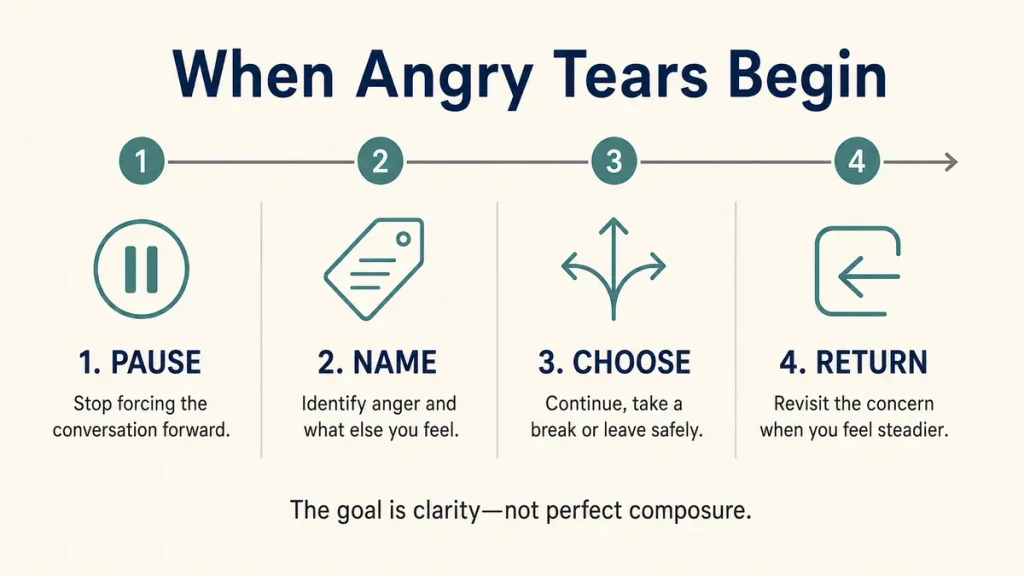
A Simple In-the-Moment Sequence
When angry tears begin, remember four actions:
- Pause: Stop forcing the conversation forward.
- Name: Identify anger and any emotion accompanying it.
- Choose: Decide whether to continue, take a break or leave.
- Return: Revisit the concern when you can communicate more clearly.
This is not a technique for becoming perfectly calm. It is a way of remaining connected to yourself while the emotion moves through you.
You may still cry. Your voice may still shake. But you can learn to protect your message without turning the tears into another reason to criticise yourself.
Do You Need to Stop Crying When You are Angry?
Not necessarily.
If tears occasionally appear during an intense conversation but you can still communicate, recover and return to the issue, they may simply be part of your emotional expression.
The more useful goals are to:
- reduce unnecessary shame;
- understand what activates the reaction;
- remain respectful toward yourself and others;
- communicate your concern clearly;
- avoid impulsive or harmful behaviour;
- recover after the interaction;
- notice when the situation itself is unsafe.
You might still prefer to become less tearful in professional or public settings. That is understandable. Skills for lowering the body’s level of activation and preparing concise statements can help.
But progress should not be measured only by whether your eyes remain dry.
Progress may look like crying but no longer apologising for having a feeling. It may mean asking for a pause instead of saying something hurtful. It may mean returning to a difficult conversation rather than withdrawing your boundary.
When Professional Support May Be Helpful
Crying when angry does not, by itself, indicate a mental health disorder.
Consider speaking with a qualified mental health professional if the pattern:
- occurs frequently and causes significant distress;
- makes ordinary disagreements feel unbearable;
- prevents you from speaking up at home or work;
- is accompanied by panic, dissociation or feeling unreal;
- connects with memories of abuse, intimidation or earlier unsafe experiences;
- leads you to avoid relationships or necessary conversations;
- involves persistent low mood, anxiety or uncontrollable crying;
- is contributing to repeated relationship or workplace difficulties.
Professional support can help you explore what activates the response, develop emotional-regulation skills and practise communicating anger in a safe environment.
Approaches such as cognitive behavioural therapy may help with thoughts that intensify anger, shame or fear. Emotion-focused and attachment-informed approaches may help when conflict activates deeper feelings involving vulnerability or disconnection. Trauma-focused treatment may be appropriate when the response is connected to traumatic experiences—but only after careful assessment by a suitably qualified professional.
Seeking help does not mean your emotions are excessive. It means the pattern is affecting your life enough to deserve thoughtful attention.
If arguments involve threats, coercion or physical violence, prioritise safety and contact appropriate local support rather than relying only on communication techniques.
Key Takeaways

•	Crying when angry is a possible human response to intense emotional and physiological arousal.
•	Angry tears may contain frustration, hurt, helplessness, fear or disappointment alongside anger.
•	Tears do not prove that your anger is invalid or that you are emotionally weak.
•	Stress and exhaustion can lower your emotional threshold.
•	Earlier experiences may influence whether anger feels safe to express.
•	During conflict, pause and lower your arousal before forcing yourself to continue.
•	Name the central concern and express it in one clear sentence.
•	Return to the original issue after calming down.
•	Long-term progress involves recognising anger earlier and practising assertiveness.
•	Professional support may help when the pattern is persistent, distressing or connected with unsafe experiences.
Frequently Asked Questions
Is it normal to cry when you’re angry?
Yes. Some people cry when anger becomes intense or combines with hurt, frustration, helplessness or fear. Human emotional responses vary, and tears are not limited to sadness. Occasional angry crying is not, by itself, evidence of a psychological disorder.
Why do I cry when someone raises their voice at me?
A raised voice can be experienced as criticism, intimidation or a moment that feels threatening to the relationship. Your body may respond with tears, freezing, anxiety or an urge to leave. Earlier experiences of shouting may intensify this reaction, but not every response to a raised voice is automatically a trauma response.
How can I stop crying during an argument?
Try pausing, slowing your breathing, relaxing physical tension and identifying the main point you want to communicate. Use a prepared statement such as, “I’m becoming overwhelmed, but I want to return to this conversation.” The goal is not to force the tears away; it is to regain enough steadiness to respond intentionally.
Are angry tears a sign of trauma?
They can sometimes be connected with earlier frightening or emotionally unsafe experiences, but angry tears alone cannot establish trauma or any diagnosis. Many people cry when angry for reasons involving stress, emotional intensity, frustration or learned patterns of expression.
Is crying during conflict manipulative?
Involuntary crying is not automatically manipulative. The important question is how the tears function within the interaction. You can be tearful while still listening, taking responsibility and allowing the other person to speak. Deliberately using distress to control the other person or prevent accountability is a different pattern.
Final Perspective
If you cry when you’re angry, the tears are not necessarily your enemy.
They may be showing you that something matters, that a boundary has been crossed or that you are carrying more emotion than you can express in that moment. They may also reveal how strongly you want to be understood by the person in front of you.
You do not have to become emotionless to become emotionally stronger.
Strength may look like pausing before reacting. It may mean saying, “I need a moment,” without abandoning the conversation. It may mean recognising the hurt within your anger or expressing a boundary before resentment has time to build.
And sometimes, strength looks like speaking while your voice is still shaking:
“I am emotional, but what I am saying still matters.”
Your tears do not take away your voice. With awareness, practice and self-compassion, you can learn to use that voice more clearly—even in moments when the words do not come easily.
A Gentle Note:

This article is intended for psychological education and self-reflection. It is not a substitute for personalised diagnosis, treatment or crisis support from a qualified mental health professional.