

When Nothing Is Wrong, Why Does It Still Feel Like Something Is?
Have you ever noticed how your mind sometimes refuses to relax—even when life appears to be going well?
Perhaps you finally receive the promotion you worked hard for, yet a quiet voice inside whispers, “What if I can’t live up to expectations?” Maybe your partner says, “Everything is fine,” but you spend the rest of the evening wondering whether they’re secretly upset. Or perhaps you sit down to enjoy a peaceful Sunday afternoon, only to find yourself anticipating bad news that never arrives.
From the outside, everything seems safe.
Inside, however, your body behaves as though danger is just around the corner.
If this feels familiar, you are not alone.
Table of Contents
Many people live with an ongoing sense of unease without understanding why. They may describe themselves as chronic overthinkers, people pleasers, perfectionists, or individuals who struggle to trust others. They often assume these are simply personality traits. Yet beneath many of these patterns lies something more fundamental:
A nervous system that has not fully learned what emotional safety feels like.
Contrary to popular belief, emotional safety is not merely about avoiding conflict or surrounding yourself with kind people. It is a deeper psychological experience—a quiet, often invisible feeling that allows your mind and body to believe:
“I can be myself here.”
“I don’t have to stay on guard.”
“I don’t need to earn my worth every moment.”
“It’s safe to rest.”
When that inner sense of safety is present, relationships become easier to navigate. Mistakes feel less threatening. Feedback becomes easier to receive. Even uncertainty becomes more manageable because the brain no longer interprets every unknown situation as a potential threat.
When emotional safety is missing, however, the world can feel unpredictable even in objectively secure environments. Small disagreements may feel overwhelming. Silence may be mistaken for rejection. Success may bring anxiety instead of satisfaction because the mind immediately begins preparing for what could go wrong next.
This is not a sign of weakness, nor does it mean something is “wrong” with you.
In many cases, it reflects how the brain learned to protect you based on earlier experiences. Our nervous system is designed to remember what helped us survive, often long before we are old enough to understand why. Those early lessons can quietly shape how we experience relationships, trust, stress, and even our own emotions decades later.
The encouraging news is that these patterns are not permanent.
Modern psychology and neuroscience increasingly show that the brain remains capable of change throughout life. Through supportive relationships, emotional awareness, and intentional practice, our nervous system can learn a new experience of safety. This remarkable capacity for lifelong adaptation is known as neuroplasticity, and it offers hope to anyone who has ever wondered whether emotional healing is truly possible.
That journey begins with understanding one important truth:
Your brain is not trying to make you anxious. It is trying to keep you safe.
Sometimes, however, the strategies it learned in the past continue operating long after the original danger has disappeared.
Understanding this hidden process is the first step toward changing it.
In this article, we’ll explore what emotional safety really is, how the brain decides whether the world is safe or threatening, why childhood experiences often leave lasting emotional fingerprints, and—most importantly—how science shows we can continue building emotional safety throughout adulthood.
Because healing doesn’t begin when your past disappears.
It begins when your nervous system slowly learns that the present is different from the past.
 Reader Reflection

Before you continue, pause for a moment and ask yourself:

•	Do I often expect the worst, even when things are going well?
•	Do I find it difficult to fully relax without feeling guilty or restless?
•	Do I frequently worry about being misunderstood, rejected, or abandoned?
•	When someone becomes quiet, does my mind immediately assume something is wrong?

If you answered "yes" to any of these questions, don't rush to judge yourself. Instead, stay curious. These experiences may not simply reflect your personality—they may be clues about how your nervous system has learned to search for safety.
The Brain’s Hidden Safety System
Have you ever wondered why two people can experience the same situation so differently?
One person sees constructive feedback as an opportunity to grow. Another experiences the same conversation as personal rejection. One partner views silence as a sign that the other needs space, while another immediately fears something is wrong.
The difference often isn’t the situation itself.
It’s how the brain interprets safety.
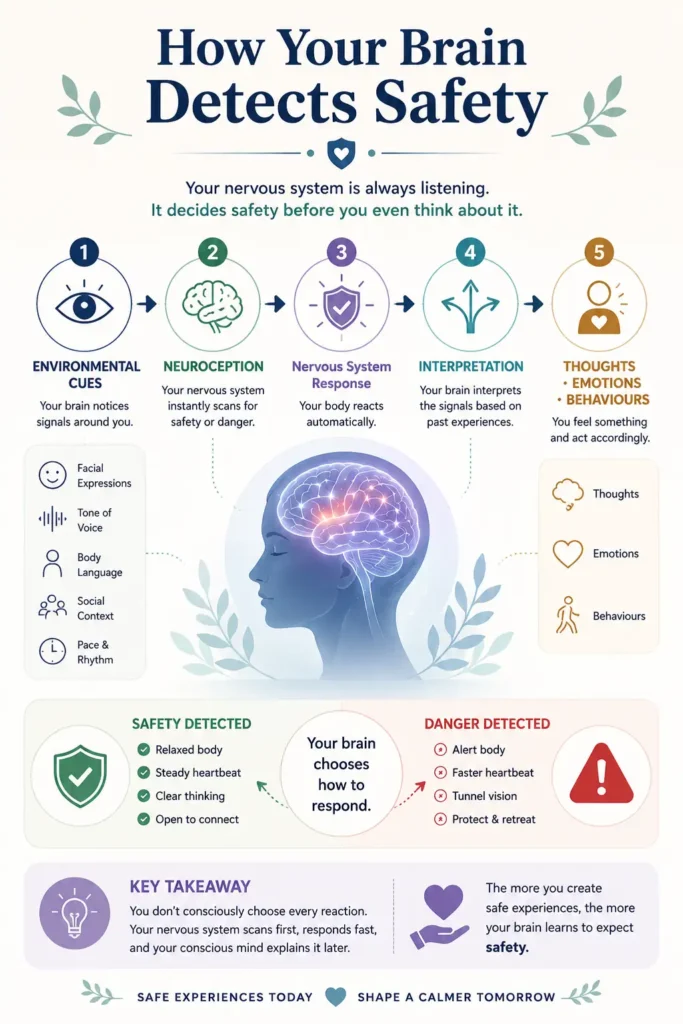
Long before we consciously evaluate what’s happening around us, our brain is quietly asking one important question:
“Am I safe here?” The answer to that question influences how we think, feel, and respond.
Your Brain Is Constantly Scanning for Safety
The human brain evolved with one primary goal: to protect us from danger.
Today, most of the threats we encounter are emotional rather than physical. Fear of rejection, criticism, uncertainty, conflict, or being excluded can activate the same protective systems that once helped our ancestors survive physical dangers.
This doesn’t mean the brain is malfunctioning.
It means it is doing exactly what it was designed to do—anticipate potential threats before they become overwhelming.
When the brain perceives safety, we can think clearly, connect with others, and regulate our emotions more effectively.
When it senses danger, even if that danger is emotional, our attention naturally shifts toward protection.
Three Brain Systems Behind Emotional Safety
Rather than one “emotion center,” emotional safety depends on several brain systems working together.
The Amygdala—Detects Possible Threats
The amygdala acts like an internal alarm system. It rapidly notices experiences that resemble past emotional or physical danger and prepares the body to respond.
The Prefrontal Cortex Brings Perspective
This part of the brain helps us pause, reflect, regulate emotions, and make thoughtful decisions. When we feel emotionally safe, it can reassure the brain that not every challenge is a threat.
The Nervous System—Feels Safety in the Body
Emotional safety isn’t only a thought—it’s also a physical experience. When the nervous system senses safety, breathing becomes calmer, muscles relax, and connecting with others feels easier. When it senses danger, we may become tense, hypervigilant, or withdrawn.
Together, these systems continuously shape our emotional responses, often before we’re consciously aware of them.
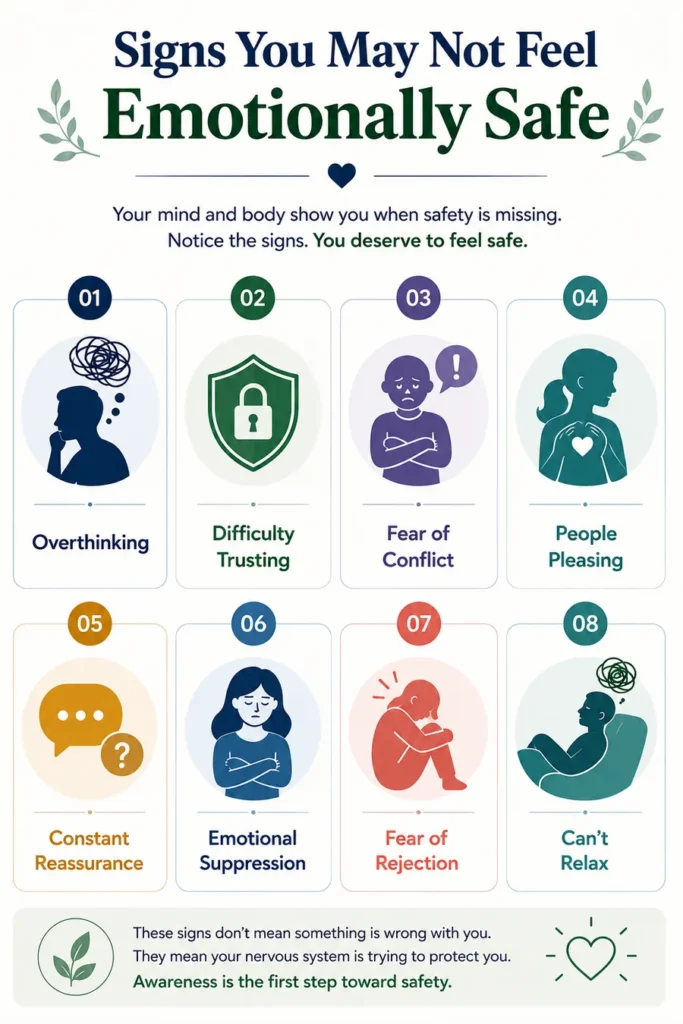
Emotional Safety Is Learned, Not Fixed
One of the most encouraging discoveries in modern psychology is that our sense of emotional safety can change.
The brain continually updates itself through experience. Every supportive relationship, emotionally validating conversation, healthy boundary, and moment of self-compassion teaches the nervous system something new.
Over time, these repeated experiences can help shift the brain’s expectations from:
“Something might go wrong.”
to
“Maybe I am safe here.”
This lifelong ability to adapt is one of the reasons emotional healing remains possible at any age.
A Hidden Process Called Neuroception
If the brain is always scanning for safety, how does it make those decisions so quickly?
Often, it happens before conscious thought begins.
Neuroscientist Dr. Stephen Porges calls this process neuroception—the nervous system’s automatic ability to detect cues of safety or danger through facial expressions, tone of voice, body language, and other subtle signals.
Understanding neuroception helps explain why emotional safety is more than a mindset. It is a whole-body experience shaped by both our past and our present.
We’ll explore this fascinating concept in greater depth later in the article. Your nervous system notices safety before your conscious mind does.
How Childhood Teaches the Brain What Safety Feels Like
No child is born knowing how to calm overwhelming emotions, trust other people, or understand difficult feelings.
These are skills we gradually learn through our earliest relationships.
Long before children can explain their emotions with words, their brains are already learning an important lesson:
“Is the world a safe place for me?”
The answer isn’t formed from a single experience. It develops through thousands of everyday interactions with parents, caregivers, teachers, siblings, and other trusted adults.
Every comforting hug after a frightening moment…
Every patient response to a tantrum…
Every smile that says, “I’m here with you.”
These seemingly ordinary moments become powerful emotional lessons.
Over time, the brain begins building an internal expectation about relationships, emotions, and safety. This is why childhood is often described as the foundation of emotional development—not because it determines our future, but because it provides our earliest emotional blueprint.
Emotional Safety Begins with Co-Regulation
One of the most important concepts in developmental psychology is co-regulation.
Before children learn to regulate their own emotions, they rely on calm, supportive adults to help regulate them.
Imagine a toddler frightened by a loud thunderstorm.
A caring adult picks them up, speaks gently, and reassures them that they are safe.
Although the child may not fully understand the words, their nervous system begins learning something far more important:
“When I feel overwhelmed, someone helps me feel safe again.”
Repeated experiences like these gradually teach the brain that difficult emotions can be tolerated rather than feared.
Over time, this external support slowly becomes self-regulation—the ability to calm ourselves during stressful moments.
If you’d like to explore this developmental journey in greater depth, read our guide on how childhood shapes emotional regulation, where we explain how early caregiving influences lifelong emotional development.
Attachment: The Brain’s First Experience of Safety
Psychologist John Bowlby proposed that children are biologically wired to seek closeness with trusted caregivers because connection supports survival.
Building on this work, Mary Ainsworth’s research showed that the quality of these early relationships influences how children respond to stress, uncertainty, and connection.
When caregivers are generally responsive, emotionally available, and reasonably consistent, children are more likely to develop a secure attachment. They gradually learn that:
- Their emotions matter.
- Asking for help is safe.
- Relationships can be trusted.
- Difficult feelings eventually pass.
These early experiences don’t create perfect adults, but they often provide a stable emotional foundation for future relationships.
When caregiving is inconsistent, emotionally unavailable, frightening, or unpredictable, children adapt in remarkable ways to cope with their environment. Some become highly independent. Others become exceptionally sensitive to rejection or constantly seek reassurance.
These responses are not character flaws.
They are often adaptive strategies developed to feel as safe as possible in the circumstances available to them.
Childhood Experiences Shape Expectations—Not Destiny
It’s important to understand what psychology does—and does not—say about childhood.
Early experiences can influence how we perceive ourselves, other people, and the world around us.
They may increase our sensitivity to criticism, uncertainty, or emotional distance.
But they do not permanently define who we become.
Many people who experienced difficult childhoods go on to build deeply trusting relationships, become emotionally resilient, and create safe environments for others.
Likewise, people who experienced loving childhoods can still face anxiety, grief, trauma, or major life challenges later in life.
Human development is influenced by many factors, including temperament, culture, relationships, life experiences, community support, and opportunities for healing.
Childhood is an important chapter. It is not the entire story.
Small Moments Matter More Than Perfect Parenting
One of the biggest misconceptions about emotional safety is the belief that children need perfect parents.
Developmental research suggests otherwise.
Children benefit most from caregivers who are “good enough”—adults who respond with warmth, repair misunderstandings, and remain emotionally available most of the time rather than all of the time.
Every family experiences moments of stress, misunderstanding, and conflict.
What helps children feel emotionally safe isn’t the absence of mistakes.
It’s experiencing repair after those mistakes.
A sincere apology…
A comforting conversation…
A parent saying,
“I’m sorry I raised my voice. Let’s talk about what happened.”
These moments teach children another essential lesson:
Relationships can recover after difficult moments.
That lesson often becomes one of the strongest foundations for emotional resilience throughout adulthood.
Emotional Safety Continues to Be Learned Throughout Life
Although childhood provides our first lessons about safety, learning doesn’t stop when we become adults.
Every emotionally supportive friendship…
Every healthy romantic relationship…
Every mentor who believes in us…
Every therapist who listens without judgment…
Every moment of self-compassion…
…offers the brain another opportunity to update its understanding of what safety feels like.
This is one of the most hopeful findings in modern psychology.
The brain continues learning throughout life.
And that means emotional safety can continue growing throughout life, too.
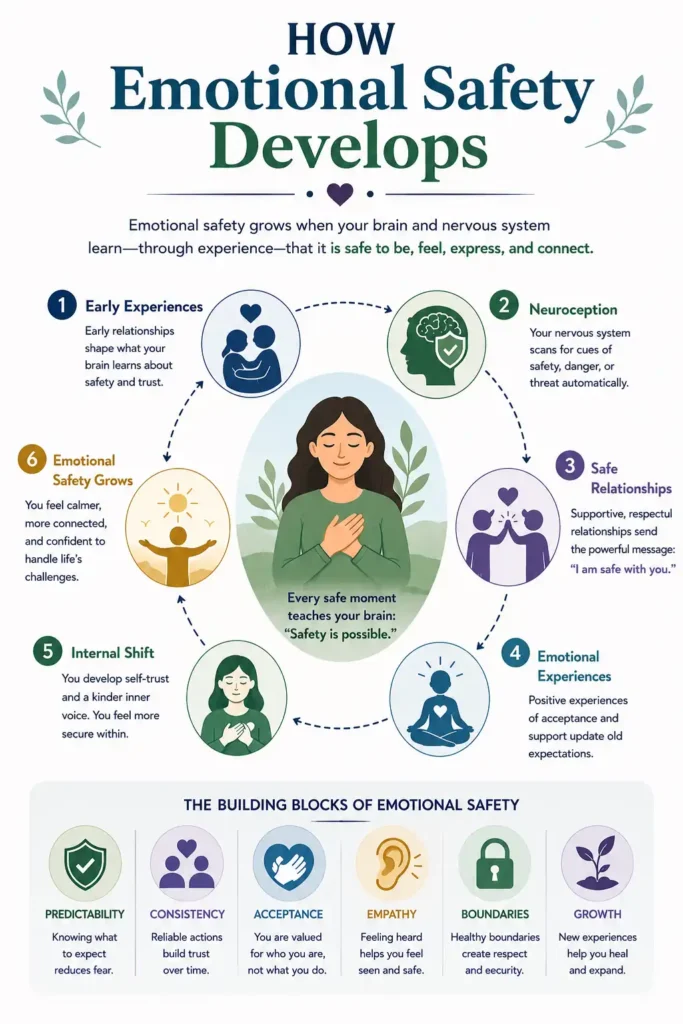
Eight Signs You May Not Feel Emotionally Safe
Emotional safety isn’t always something we consciously think about.
More often, it quietly influences our daily thoughts, relationships, and reactions. Many people who lack a deep sense of emotional safety don’t describe themselves as “emotionally unsafe.” Instead, they might say:
“I overthink everything.”
“I find it hard to trust people.”
“I can’t seem to relax.”
“I always expect something to go wrong.”
These experiences don’t automatically mean you have an emotional safety issue. They can arise for many different reasons, including stress, personality, life experiences, or mental health conditions. However, when several of these patterns occur together and persist over time, they may suggest that your nervous system has learned to stay on guard.
Let’s explore some common signs.
1. You Overthink Even Small Situations
A brief text message.
A delayed reply.
A change in someone’s tone of voice.
For some people, these are minor events. For others, they can trigger an endless stream of questions:
“Did I say something wrong?”
“Are they upset with me?”
“What if I’ve damaged the relationship?”
When emotional safety feels uncertain, the brain often tries to reduce uncertainty by analyzing every possible outcome. Unfortunately, overthinking rarely creates certainty—it usually creates more anxiety.
If this pattern feels familiar, you may find our guide on the hidden psychology of overthinking helpful in understanding why the mind struggles to let go.
2. You Find It Difficult to Trust Others
Trust isn’t simply believing that someone is a good person.
It’s feeling safe enough to be emotionally vulnerable.
People who have experienced inconsistent support, repeated disappointment, or emotionally unpredictable relationships may find themselves constantly waiting for signs that others will eventually leave, reject, or disappoint them.
This doesn’t mean they don’t want close relationships. Often, it means their nervous system is trying to prevent future emotional pain.
3. You Avoid Conflict at Any Cost
Disagreements are a normal part of healthy relationships.
Yet for some people, even minor conflict feels deeply threatening.
Instead of expressing their needs, they may:
- Stay silent to keep the peace.
- Apologize even when they haven’t done anything wrong.
- Suppress emotions to avoid upsetting others.
- Agree with opinions they don’t actually share.
While these strategies may reduce short-term discomfort, they often come at the cost of authenticity and emotional well-being.
4. You Constantly Seek Reassurance
Do you frequently ask questions like:
“Are you sure everything’s okay?”
“Do you still love me?”
“Was my work good enough?”
Seeking reassurance occasionally is completely normal.
However, when reassurance provides only temporary relief before doubts return, it may indicate that the brain is searching for an internal sense of safety that external validation alone cannot provide.
5. You Feel Guilty When You Rest
For some people, slowing down feels surprisingly uncomfortable.
A quiet afternoon can trigger thoughts such as:
“I should be doing something productive.”
“I’m wasting time.”
“I haven’t earned this break.”
This constant drive to stay busy is sometimes less about ambition and more about feeling safe through achievement.
When self-worth becomes closely tied to performance, rest can begin to feel undeserved rather than restorative.
6. You Hide Your Feelings
Many people learn early in life that expressing emotions leads to criticism, rejection, or misunderstanding.
As adults, they may instinctively say,
“I’m fine.”
even when they’re struggling.
Over time, hiding emotions can create emotional distance—not only from other people but also from ourselves.
Learning to regulate emotions is very different from suppressing them. If you’d like to explore this distinction further, our article on emotional suppression explains why pushing feelings away often increases emotional stress rather than reducing it.
7. You Expect Rejection Before It Happens
Perhaps you hesitate to apply for a new opportunity because you assume you’ll fail.
Maybe you hold back in relationships because you’re convinced people will eventually leave.
Or perhaps you avoid sharing your ideas because you expect criticism before anyone has spoken.
When emotional safety feels fragile, the brain often prepares for rejection before it has any evidence that rejection is actually coming.
Ironically, these protective strategies can sometimes prevent the very connection we long for.
8. You Struggle to Relax—Even When Life Is Going Well
One of the clearest signs of emotional unsafety is finding it difficult to fully enjoy peaceful moments.
Even during periods of stability, your mind may continue searching for the next problem to solve.
You may notice yourself:
- Constantly checking messages.
- Mentally preparing for worst-case scenarios.
- Feeling restless when everything seems calm.
- Waiting for “something bad” to happen.
This doesn’t mean your brain enjoys worry.
It means it has become accustomed to staying prepared.
Over time, the nervous system can mistake constant vigilance for safety.
A Gentle Reminder
Reading these signs can be emotional.
You may recognize several of them—or none at all.
Remember that these experiences are not a diagnosis, and they don’t define who you are. They are simply patterns that can help you better understand how your nervous system has learned to respond to the world.
Awareness is not about judging yourself.
It’s about noticing your patterns with curiosity rather than criticism.
Because once we understand why our mind responds the way it does, we are in a much stronger position to help it learn something new.
Reader Reflection

Take a moment to pause and reflect.

Ask yourself:

•	Which of these patterns feels most familiar?
•	When do I notice these reactions most often?
•	What situations help me feel calmer and more secure?
•	If my nervous system has been trying to protect me, what might it be protecting me from?

There are no right or wrong answers.

Sometimes, the first step toward emotional safety is simply becoming aware of how we've been trying to stay safe all along.
How Emotional Safety Shapes Your Everyday Life
Emotional safety isn’t something we notice only during major life events.
It quietly influences the way we think, communicate, work, build relationships, and even the way we speak to ourselves.
When we feel emotionally safe, our energy is directed toward learning, connecting, and growing.
When we don’t, much of that energy is spent trying to anticipate, avoid, or manage perceived threats.
Over time, this can affect many areas of life in ways we rarely recognize.
Relationships Become a Place of Connection—or Protection
Healthy relationships thrive when people feel emotionally safe enough to be honest, vulnerable, and imperfect.
When that sense of safety is present, disagreements become opportunities for understanding rather than evidence that the relationship is failing.
Without emotional safety, however, even caring relationships can become exhausting.
You might:
- Read too much into silence.
- Constantly seek reassurance.
- Avoid expressing your real needs.
- Keep people at a distance to avoid getting hurt.
- Assume rejection before it actually happens.
These reactions are often attempts to protect ourselves from emotional pain.
If you’ve ever wondered why being ignored hurts so much or why rejection can seem to change your personality, emotional safety provides an important part of the answer. When our nervous system interprets connection as uncertain, even small moments of distance can feel disproportionately painful.
Emotional Safety Influences the Way We Work
Many people believe workplace stress comes only from deadlines or heavy workloads.
In reality, emotional safety also shapes how we experience our professional lives.
When people feel psychologically safe, they are more likely to:
- Share ideas confidently.
- Ask questions without fear of embarrassment.
- Learn from mistakes.
- Accept constructive feedback.
- Collaborate effectively.
When emotional safety is lacking, the opposite often happens.
A simple suggestion from a colleague may feel like criticism.
A minor mistake may trigger excessive self-doubt.
Feedback becomes something to fear rather than an opportunity to grow. The result isn’t necessarily lower ability—it is often higher mental effort spent protecting ourselves instead of focusing on the task.
It Shapes the Relationship You Have With Yourself
One of the most overlooked aspects of emotional safety is that it doesn’t only exist between people.
It also exists within ourselves.
Notice the voice that appears after making a mistake.
Does it say:
“Everyone makes mistakes. I’ll learn from this.”
Or does it immediately become harsh and critical?
Many of us speak to ourselves in ways we would never speak to someone we love.
Over time, this constant inner criticism can make our own mind feel like an unsafe place.
Developing emotional fitness isn’t about becoming positive all the time. It’s about gradually replacing self-judgment with greater self-awareness, self-compassion, and emotional resilience.
When we feel emotionally safe within ourselves, we become less dependent on external approval to feel secure.
Emotional Safety Changes How We Respond to Stress
Stress is an unavoidable part of life.
The difference often lies in how supported and safe we feel while experiencing it.
Imagine two people facing the same challenge—perhaps preparing for an important presentation.
One experiences nervousness but believes,
“I can handle this.”
The other immediately thinks,
“If I make one mistake, everyone will think I’m incompetent.”
The situation is identical.
The emotional experience is completely different.
When emotional safety is stronger, stress becomes something we move through.
When it is weaker, stress can begin to define how we see ourselves.
Why Emotional Safety Matters for Families
Children don’t only learn emotional safety from what adults say.
They learn it from what adults consistently do.
A parent who listens patiently after a difficult day…
A teacher who responds calmly to mistakes…
A grandparent who offers reassurance during moments of fear…
These everyday interactions teach children that emotions can be expressed without shame.
Perhaps one of the greatest gifts adults can offer the next generation is not perfection, but the experience of being accepted, understood, and emotionally supported.
In this way, emotional safety doesn’t stop with one person.
It has the potential to influence families across generations.
Emotional Safety Is the Foundation of Emotional Growth
Many people begin their healing journey believing they need to become more confident, less anxious, or stop overthinking.
While those are meaningful goals, they often become easier when something deeper begins to change.
A growing sense of emotional safety.
When the nervous system no longer feels the need to stay constantly alert, the mind has more space for curiosity, creativity, healthy relationships, and personal growth.
Confidence becomes less about proving yourself.
Resilience becomes less about enduring everything alone.
And emotional regulation becomes less about controlling feelings and more about responding to them with awareness.
That is why emotional safety is not simply another psychological concept.
It is the quiet foundation upon which emotional well-being is built.
Reader Reflection

Think about one area of your life where you feel genuinely safe.

•	Is it with a particular person?
•	During a meaningful activity?
•	In a certain place?
•	Or perhaps when you're alone with your thoughts?

Now ask yourself:

What is it about that experience that helps your nervous system relax?

Understanding your existing sources of emotional safety is often the first step toward creating more of them.
Why Overthinking Is Really a Search for Safety
Imagine sending an important message to someone you care about.
Minutes pass.
Then an hour.
Still no reply.
Almost automatically, your mind begins filling the silence.
“Did I say something wrong?”
“Are they upset with me?”
“What if I’ve damaged the relationship?”
“Should I send another message?”
Nothing has actually happened.
Yet your mind has already created dozens of possible explanations.
If you’ve experienced this, you may have wondered why your brain seems unable to simply wait.
The answer often has less to do with overthinking itself and more to do with emotional safety.
The Brain Doesn’t Like Uncertainty
Human beings naturally prefer predictability.
When the future feels uncertain, the brain begins searching for information that can help restore a sense of control.
Sometimes this process is useful.
It helps us solve problems, prepare for challenges, and make thoughtful decisions.
But when emotional safety feels fragile, the search for certainty can become endless.
Instead of finding answers, the mind keeps asking new questions.
Instead of calming down, it keeps preparing for possibilities that may never happen.
In many cases, overthinking is not the problem itself—it is the brain’s attempt to feel safe.
Why the Mind Replays Conversations
Have you ever replayed a conversation long after it ended?
Perhaps you analyzed every sentence you spoke.
Wondered whether someone misunderstood you.
Or imagined how you should have responded differently.
This mental replay often isn’t about perfection.
It’s about protection.
The brain hopes that if it can analyze the situation thoroughly enough, it can prevent future rejection, embarrassment, or disappointment.
Ironically, the more we search for complete certainty, the more uncertain we often become.
When Safety Depends on Other People’s Reactions
For many people, emotional safety becomes closely tied to external responses.
A delayed reply may feel like rejection.
Constructive feedback may feel like failure.
A disagreement may feel like the relationship is ending.
This doesn’t happen because the situation is objectively dangerous.
It happens because the nervous system has learned to treat uncertainty as something that requires immediate attention.
Overthinking then becomes a coping strategy—an attempt to predict outcomes before they happen.
Although exhausting, its purpose is surprisingly understandable:
The mind is trying to prevent emotional pain before it occurs.
Why Overthinking Rarely Creates Peace
If overthinking truly created safety, it would eventually help us relax.
Instead, it often has the opposite effect.
The more we search for absolute certainty, the more new possibilities the brain discovers.
One question becomes five.
Five become twenty.
The mind mistakes constant analysis for preparation, while the nervous system remains in a state of vigilance.
This is why overthinking can feel impossible to switch off.
It isn’t simply a thinking habit.
It’s often a nervous system habit.
Emotional Safety Changes the Question
One of the most powerful shifts in emotional healing happens when we stop asking,
“How can I eliminate every possible risk?”
and begin asking,
“Can I handle uncertainty, even if I don’t have all the answers?”
That change reflects growing emotional safety.
Instead of demanding certainty before feeling calm, the nervous system gradually learns that uncertainty itself is not always dangerous.
This doesn’t happen overnight.
It develops through repeated experiences of trust, self-compassion, supportive relationships, and healthy emotional regulation.
Little by little, the brain discovers something new:
Safety doesn’t come from predicting everything. It comes from believing that we can cope with whatever happens.
Overthinking Isn’t Your Enemy
Many people become frustrated with themselves for overthinking.
They call themselves weak, overly sensitive, or “too emotional.”
Yet viewed through the lens of emotional safety, overthinking often looks very different.
It becomes evidence of a brain that has been working hard to protect its owner.
The goal, then, isn’t to fight the mind.
It’s to gently teach it that constant vigilance is no longer the only way to stay safe.
That shift doesn’t begin by thinking harder.
It begins by helping the nervous system experience safety more consistently.
Reader Reflection

The next time you notice yourself overthinking, pause before trying to solve the problem.

Instead, ask yourself:

•	Am I looking for an answer—or am I looking for safety?
•	What emotion am I trying to protect myself from right now?
•	What would help me feel supported in this moment, even if the uncertainty remains?

Sometimes, these questions reveal that what we truly need isn't another explanation.
It's a greater sense of emotional safety.
Neuroception: How Your Nervous System Detects Safety Before You Think
Have you ever met someone who instantly made you feel comfortable?
Perhaps their smile felt genuine.
Their voice was calm.
You found yourself speaking openly without knowing exactly why.
Now think of the opposite experience.
Someone hasn’t said anything hurtful, yet something feels “off.” You become quieter, more cautious, or strangely tense.
How can two similar situations create such different emotional experiences?
One answer lies in a remarkable process called neuroception.
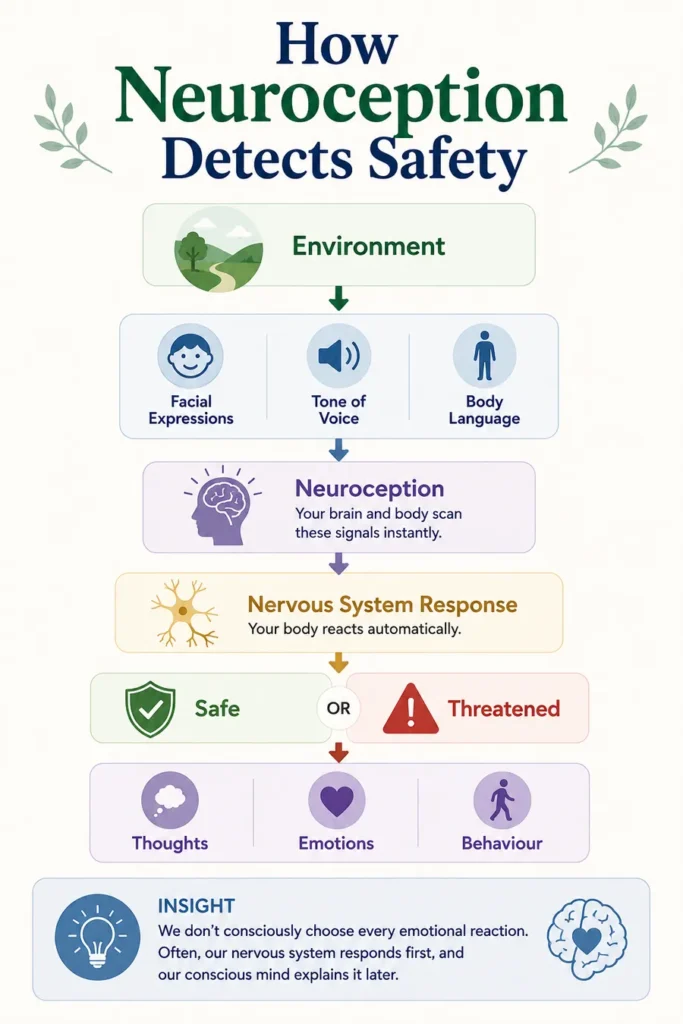
Unlike conscious thinking, neuroception happens automatically. It is the nervous system’s continuous process of scanning the environment for cues of safety, danger, or life threat—often before we are aware of it.
This concept was introduced by neuroscientist Dr. Stephen Porges as part of Polyvagal Theory, which has influenced how many clinicians think about stress, trauma, and emotional regulation.
Your Nervous System Is Always Listening
Most of us believe we consciously decide whether we trust someone.
In reality, the nervous system begins gathering information long before we make that decision.
Without any deliberate effort, it notices subtle signals such as:
- Facial expressions
- Tone of voice
- Eye contact
- Body language
- Pace of movement
- Physical proximity
- The predictability of another person’s behaviour
Within moments, the brain and nervous system begin asking:
“Is this person safe?”
“Can I relax here?”
“Do I need to stay alert?”
This process happens so quickly that we often experience only the result—a feeling of comfort, caution, or unease—without recognizing the hidden evaluation taking place beneath our awareness.
Why the Same Situation Feels Different to Different People
Imagine two colleagues receiving identical feedback from their manager.
One hears:
“Here’s how you can improve.”
The other hears:
“I’m not good enough.”
The words are the same.
The emotional experience is completely different.
This doesn’t necessarily happen because one person is more sensitive than the other.
Rather, each person’s nervous system interprets the situation through the lens of previous experiences, expectations, and current emotional state.
Our nervous system is influenced not only by the present moment but also by what it has learned over time.
This is why emotional safety is deeply personal.
When the Nervous System Misreads Safety
Neuroception is designed to protect us.
Like any protective system, however, it sometimes becomes overly cautious.
A person who has experienced repeated criticism may become highly sensitive to neutral feedback.
Someone who grew up with emotional unpredictability may interpret silence as rejection.
A person who has experienced betrayal may struggle to trust even trustworthy people.
In these situations, the nervous system isn’t trying to create suffering.
It is trying to prevent the possibility of being hurt again.
Recognizing this can replace self-criticism with compassion.
Instead of asking,
“Why am I like this?”
we can begin asking,
“What has my nervous system learned to expect?”
That shift changes the conversation from blame to understanding.
Safety Is Communicated Through Relationships
One of the most encouraging aspects of neuroception is that it continues learning throughout life.
Every interaction that communicates consistency, respect, empathy, and emotional presence becomes new information for the nervous system.
A friend who listens without interrupting.
A partner who responds calmly during disagreement.
A mentor who encourages rather than judges.
A therapist who creates a space where difficult emotions can be expressed safely.
Even small, repeated experiences like these can gradually reshape how the nervous system interprets the world.
Over time, it begins updating its expectations.
The question slowly changes from:
“How do I protect myself from everyone?”
to
“Who helps me feel safe enough to be myself?”
Emotional Safety Is Something We Experience—Not Simply Think About
Many people believe emotional healing happens only by changing thoughts.
Thoughts certainly matter.
But emotional safety is also experienced through the body.
It is reflected in slower breathing.
Relaxed muscles.
A calmer heartbeat.
The ability to stay present during difficult conversations.
The courage to express emotions without feeling overwhelmed.
This is why lasting emotional growth often involves more than positive thinking.
It involves helping the nervous system repeatedly experience that the present is not always as dangerous as the past once taught it to be.
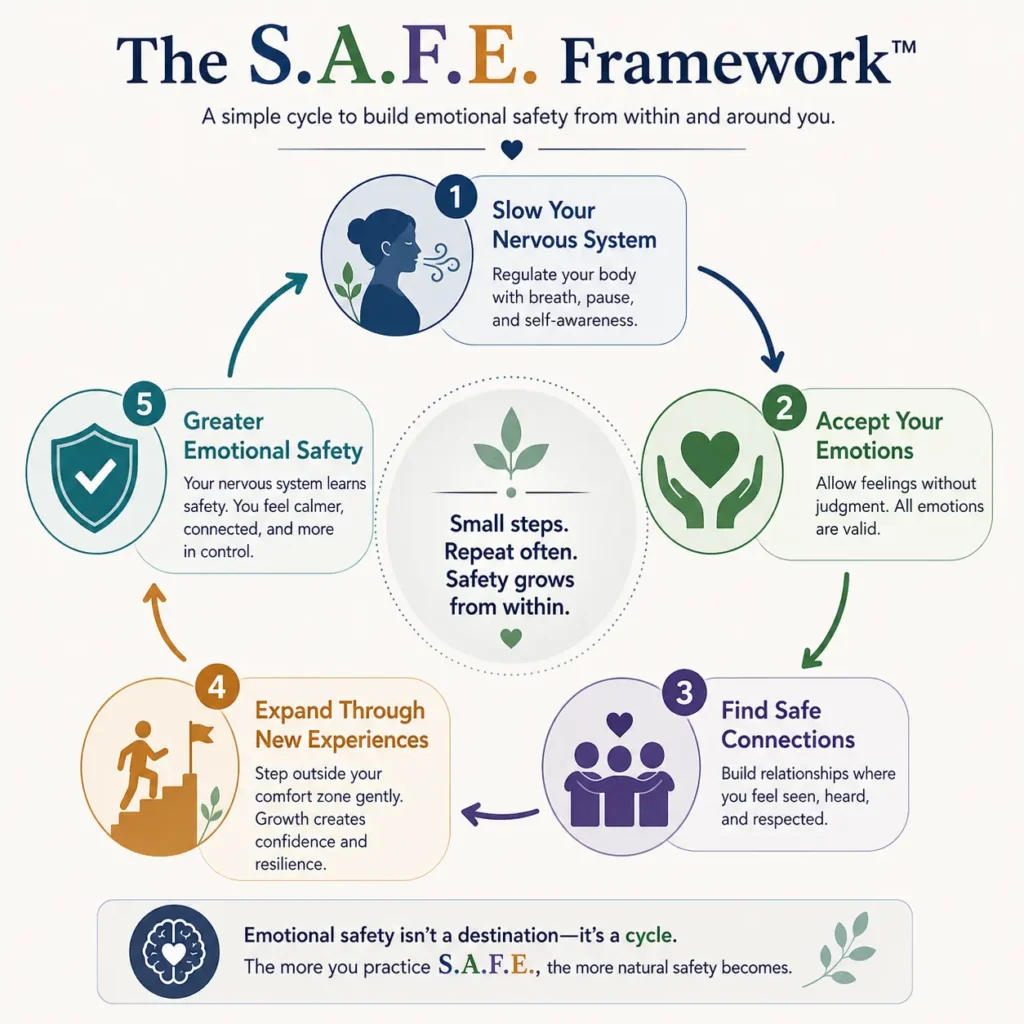
The S.A.F.E. Framework™: Four Steps to Build Emotional Safety
Healing rarely happens through one life-changing moment.
More often, it happens through small, consistent experiences that gradually teach the brain and nervous system a new lesson:
“I don’t have to stay in survival mode all the time.”
Building emotional safety doesn’t mean eliminating stress, conflict, or uncertainty. Instead, it means developing the confidence that you can respond to life’s challenges without constantly feeling overwhelmed.
To make this process practical, let’s explore the S.A.F.E. Framework™—a four-step approach grounded in psychology, neuroscience, and emotional learning.
S — Slow Your Nervous System
When we feel emotionally unsafe, our first instinct is often to solve the problem as quickly as possible.
Ironically, the brain makes its best decisions after the nervous system begins to calm down—not before.
Slowing your nervous system doesn’t mean ignoring difficult emotions. It means creating enough internal space to respond thoughtfully instead of reacting automatically.
Simple practices can help:
- Take a few slow, steady breaths, allowing the exhale to be slightly longer than the inhale.
- Notice five things you can see, four you can touch, three you can hear, two you can smell, and one you can taste to gently reconnect with the present moment.
- Spend a few minutes walking outdoors while paying attention to your surroundings rather than your worries.
- Reduce unnecessary stimulation by taking short breaks from constant notifications or scrolling.
These practices won’t remove every challenge, but they can signal to your nervous system that this moment is different from moments of genuine danger.
A — Accept Your Emotional Experience
Many of us have been taught to judge our emotions.
“I shouldn’t feel anxious.”
“I need to stop worrying.”
“Why can’t I just get over this?”
Although understandable, this inner struggle often increases emotional distress.
Acceptance is not the same as giving up.
It simply means acknowledging what you’re experiencing without immediately criticizing yourself for having those feelings.
You might begin by saying:
“I’m noticing that I feel anxious right now.”
“My body feels tense because something feels uncertain.”
This small shift—from judgment to observation—creates room for curiosity and self-compassion.
Research consistently suggests that acknowledging emotions is generally more helpful than suppressing or avoiding them.
If you’d like to understand why pushing emotions away often backfires, you may find our article on emotional suppression helpful.
F — Find Safe Connections
Human beings regulate emotions most effectively in relationships built on trust, respect, and consistency.
Emotional safety grows when we spend time with people who help us feel accepted rather than evaluated.
A safe connection doesn’t require someone to solve all of our problems.
Sometimes, it simply means being with someone who listens without rushing to judge, criticize, or “fix” us.
Safe connections may include:
- A trusted friend.
- A supportive family member.
- A caring mentor.
- A partner who communicates with respect.
- A mental health professional when additional support is needed.
Just as difficult relationships can increase emotional vigilance, supportive relationships can gradually teach the nervous system that connection is not always something to fear.
E — Expand Safety Through New Experiences
Perhaps the most hopeful discovery in neuroscience is that the brain continues learning throughout life.
Every time we experience a situation that once felt threatening—but now ends safely—we create an opportunity for new emotional learning.
This doesn’t require dramatic changes.
In fact, small, repeated experiences are often the most powerful.
You might:
- Express an honest opinion during a conversation.
- Set a healthy boundary without apologizing for it.
- Accept constructive feedback without assuming personal failure.
- Reach out to someone you trust instead of withdrawing.
- Allow yourself to rest without feeling guilty.
Each of these moments gently teaches the nervous system:
“I can experience discomfort without being in danger.”
Over time, these experiences accumulate, gradually strengthening emotional resilience and reducing the need for constant self-protection.
Progress Is Measured by Safety, Not Perfection
Many people begin healing with the hope that anxiety, self-doubt, or overthinking will disappear completely.
Real growth usually looks different.
You may still feel nervous before an important conversation.
You may still experience moments of uncertainty.
The difference is that those feelings no longer control every decision.
Instead of reacting automatically, you begin responding with greater awareness.
Instead of avoiding discomfort, you learn that you can move through it.
That is emotional growth.
Not because life has become perfectly safe—
but because your relationship with yourself has become safer.
A Gentle Daily Practice
At the end of each day, take a few quiet moments and ask yourself:
- When did I feel most emotionally safe today?
- What helped me feel calm, connected, or understood?
- When did my nervous system become activated?
- What small step can I take tomorrow to create a little more emotional safety?
These questions aren’t about finding perfect answers.
They’re about helping your brain notice moments of safety that it might otherwise overlook.
Over time, this simple habit can strengthen self-awareness and reinforce the experiences that support emotional well-being.
Reader Reflection

If you remember only one idea from this article, let it be this:

You don't have to convince yourself that the world is perfectly safe.

You only need to give your brain enough repeated experiences to discover that you are becoming more capable of meeting life's uncertainties with courage and compassion.

That is how emotional safety grows—one safe experience at a time.
Moving Forward: Emotional Safety Is a Lifelong Journey
Emotional safety isn’t something we achieve once and keep forever.
Like physical fitness, it grows through everyday experiences, supportive relationships, and the way we respond to life’s challenges.
Some days you’ll feel calm and confident.
Other days, old patterns may reappear—especially during stress, uncertainty, or significant life changes.
That’s a normal part of being human.
The goal isn’t to eliminate every uncomfortable emotion.
It’s to gradually build enough inner safety that difficult emotions no longer control your life.
If this article helped you understand your emotional patterns, you may enjoy exploring these related guides:
- How Childhood Shapes Emotional Regulation — Understand how early experiences influence emotional development.
- Emotional Fitness — Learn practical habits that strengthen emotional resilience.
- The Hidden Psychology of Overthinking — Discover why the mind struggles with uncertainty.
- Emotional Suppression — Understand why avoiding emotions often makes them stronger.
- Why Being Ignored Hurts So Much — Explore the psychology behind social pain and rejection.
- Why Rejection Changes Your Personality — Learn how repeated rejection influences self-belief and emotional well-being.
- The Psychology of Closure — Understand why unresolved experiences can continue affecting emotional health.
Together, these articles form a practical roadmap for understanding the mind, strengthening emotional resilience, and building healthier relationships.
Frequently Asked Questions (FAQs)
1. What is emotional safety?
Emotional safety is the feeling that you can express your thoughts, emotions, and needs without constant fear of rejection, humiliation, or criticism. It allows your brain and nervous system to relax, making it easier to connect with others, regulate emotions, and respond thoughtfully to life’s challenges.
2. Why do I feel emotionally unsafe even when nothing is wrong?
Your nervous system may be responding to past experiences rather than present circumstances. Previous experiences of criticism, unpredictability, emotional neglect, or stressful relationships can make the brain become more alert to potential threats, even in safe environments.
3. Can emotional safety be learned as an adult?
Yes. Research on neuroplasticity suggests that the brain remains capable of learning throughout life. Supportive relationships, emotional awareness, healthy coping skills, and repeated positive experiences can gradually strengthen a person’s sense of emotional safety.
4. How does childhood influence emotional safety?
Childhood provides many of our earliest experiences of trust, comfort, and emotional regulation. Responsive caregiving can support a stronger sense of emotional safety, while difficult experiences may increase emotional vigilance. However, childhood influences us—it does not define our future.
5. Is emotional safety the same as emotional regulation?
No. They are closely connected but not identical.
Emotional safety is the feeling that it is safe to experience and express emotions.
Emotional regulation is the ability to manage and respond to emotions effectively.
Feeling emotionally safe often makes emotional regulation easier.
6. Can emotional safety improve relationships?
Yes. Emotional safety encourages open communication, trust, healthy boundaries, and mutual respect. When people feel emotionally safe, they are generally more comfortable expressing emotions, resolving conflicts, and building meaningful connections.
7. Why do I overthink when I feel emotionally unsafe?
Overthinking is often the mind’s attempt to reduce uncertainty and prevent emotional pain. Rather than a personal weakness, it can be understood as a protective strategy that seeks certainty when the nervous system doesn’t fully feel safe.
8. What are simple ways to build emotional safety?
You can begin by:
Practicing calming techniques such as slow breathing or grounding.
Acknowledging emotions without judging yourself.
Spending time with supportive and trustworthy people.
Setting healthy boundaries.
Developing self-compassion through small, consistent daily habits.
Building emotional safety is usually a gradual process rather than an overnight change.
Final Reflection
Your emotional patterns are not a measure of your worth.
More often, they reflect how your mind and nervous system have learned to protect you over time.
The encouraging news is that the same brain capable of learning fear is also capable of learning trust, connection, and resilience.
Perhaps the most important takeaway from this article is this:
Emotional safety doesn’t begin when life becomes perfect. It begins when we gently teach our mind and body that safety can be experienced, one relationship, one choice, and one moment at a time.
1 thought on “Why Do I Feel Emotionally Unsafe? The Hidden Psychology of Emotional Safety”