

“Sometimes, the deepest wound isn’t what happened—it’s never knowing why.”
Have you ever noticed how some experiences quietly fade into memory while others continue living rent-free in your mind?
A conversation that ended too abruptly.
A relationship that disappeared without an explanation.
A job interview that was followed by complete silence.
A friendship that slowly dissolved, leaving behind more questions than answers.
You tell yourself you’ve moved on. Life becomes busy again. Days turn into weeks, and weeks into months. Yet, without warning, your mind returns to the same moment as if it happened yesterday.
“Why did they leave?”
“Did I do something wrong?”
“Was there something I missed?”
“Will I ever know the truth?”
These questions often arrive uninvited—while driving home, lying awake at night, or standing in the shower. They interrupt your peace not because the event is still happening, but because your mind feels that the story never truly ended.
This is where the psychology of closure begins.
Table of Contents
Contrary to popular belief, closure is not merely about receiving an apology, getting an explanation, or having one final conversation. Those things may help, but they are not the whole story.
Psychology suggests something far more fascinating.
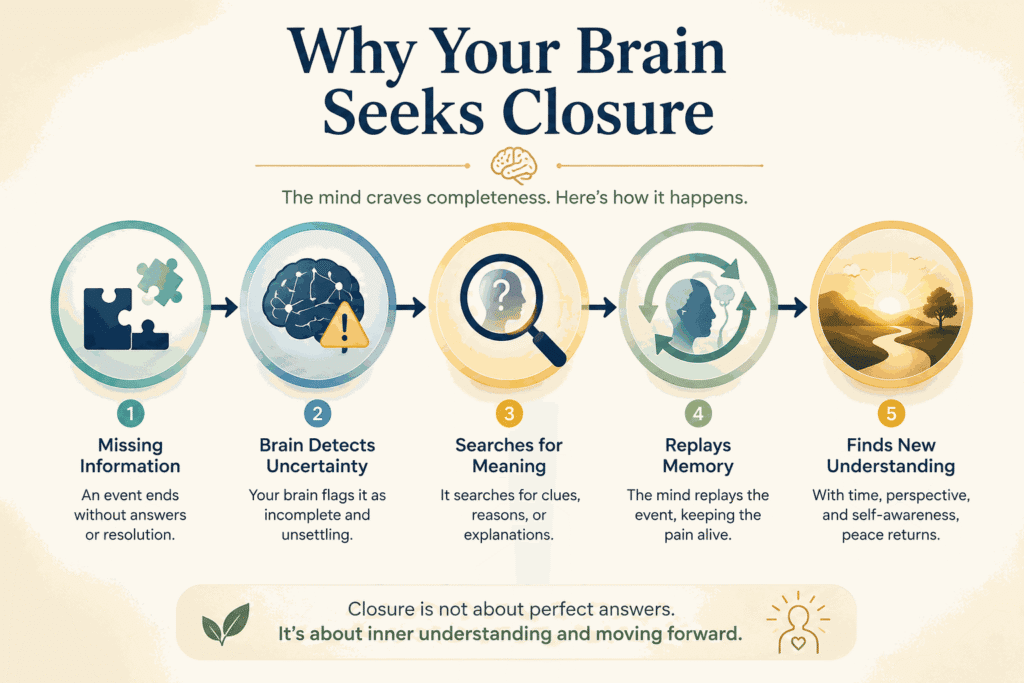
The human brain is naturally wired to seek completion. It prefers certainty over ambiguity, answers over silence, and meaning over confusion. When an emotionally significant experience ends without a clear resolution, the brain often refuses to file it away as “finished.”
Instead, it keeps searching.
Not because you’re weak.
Not because you’re obsessive.
But because your mind is trying to complete something it believes is still unfinished.
Understanding this simple truth changes the way we look at emotional pain.
Instead of asking,
“Why can’t I stop thinking about it?”
we begin asking,
“What unfinished question is my brain still trying to answer?” That question opens the door to understanding one of the most powerful—and often misunderstood—processes in human psychology.
Why the Psychology of Closure Matters More Than Ever
Never before have people lived with so many unfinished endings.
Messages remain on “seen.”
Phone calls are never returned.
Job applications disappear into automated systems without feedback.
Relationships end through ghosting instead of honest conversations.
Friendships quietly fade without either person acknowledging what changed.
Even after someone leaves our life, social media allows us to witness fragments of their new one.
A photograph appears.
A story gets posted.
A mutual friend tags them.
An old memory unexpectedly resurfaces.
The relationship may be over, but psychologically, the ending often remains incomplete.
This constant exposure creates something previous generations experienced far less frequently: prolonged emotional ambiguity.
Instead of receiving clear endings, many people live with unanswered questions.
That uncertainty quietly becomes emotional baggage.
It influences future relationships, decision-making, confidence, and even how safe we feel trusting other people again. The result is that many individuals spend years trying to heal from events that never felt emotionally complete.
Why Your Brain Can’t Let Go of Unanswered Questions
Imagine reading an exciting novel.
You’re completely invested in the story.
Then, just before the final chapter, someone tears out the last twenty pages.
You know the characters.
You understand the plot.
But you’ll never discover how the story ends.
Most people wouldn’t simply shrug and move on.
Their mind would continue imagining possible endings.
They would wonder what happened.
They might even search online for spoilers or discuss theories with others.
Why?
Because the human mind naturally dislikes incomplete stories.
Now replace the novel with your own life.
An unexpected breakup.
A betrayal.
A resignation without explanation.
A family conflict that was never resolved.
The brain reacts in surprisingly similar ways.
It continues searching because unfinished emotional experiences feel psychologically incomplete.
From an evolutionary perspective, this makes sense.
For thousands of years, uncertainty often carried danger.
If someone suddenly disappeared from the tribe…
If food became scarce…
If an unfamiliar sound echoed through the forest…
Failing to understand why could threaten survival.
The safest brain was not necessarily the strongest one.
It was often the one that kept searching until uncertainty was reduced.
Although modern life looks very different, many of these ancient survival systems remain remarkably active.
Today, the threats are usually emotional rather than physical.
But the brain still asks the same fundamental question: “What happened, and how do I make sense of it?”
Emotional Pain Is Difficult. Emotional Uncertainty Is Often Harder.
Many people assume they are struggling because the event itself was painful.
Sometimes that’s true.
But psychology shows us something important:
Pain and uncertainty are not the same experience.
Imagine two different situations.
In the first, someone honestly says,
“Our relationship isn’t working because we want different futures.”
The truth hurts.
You may cry.
You may grieve.
But your brain has information.
Now imagine hearing nothing at all.
No explanation.
No conversation.
No goodbye.
Only silence.
Suddenly, your mind has two burdens instead of one.
The pain of losing someone.
And the uncertainty of never knowing why.
That uncertainty quietly consumes mental energy.
Instead of processing reality, the brain repeatedly searches for missing information.
It asks:
“Maybe I misunderstood.”
“Perhaps they’ll come back.”
“What if I had said something differently?”
“Was there another reason?” Without realizing it, many people spend months—or even years—trying to solve an emotional mystery that has no guaranteed answer.
Why Your Mind Keeps Replaying the Same Event
If you’ve read our guide on The Complete Guide to Overthinking, you’ll recognize that uncertainty often acts as fuel for repetitive thinking.
Overthinking is not always the root problem.
Quite often, it is the brain’s attempt to solve an unanswered emotional question.
Every replay feels like another opportunity to discover the missing piece.
Every imagined conversation feels like another chance to understand what happened.
Every “what if” feels as though it might finally deliver certainty.
Yet the opposite usually happens.
The more possibilities we create, the more uncertainty we generate.
Instead of finding closure, the mind becomes trapped in an endless search for explanations.
This is one reason emotionally unresolved experiences often remain vivid long after objectively bigger life events have faded.
The brain is not replaying the past simply because it hurts.
It is replaying the past because, from its perspective, the story is still unfinished.
One of the Biggest Myths About Emotional Closure
Perhaps the most common misunderstanding about emotional closure is believing that another person must give it to us.
We wait for an apology.
We wait for an explanation.
We wait for one final conversation.
We wait for the message that finally makes everything make sense.
Sometimes that conversation happens.
Many times, it never does.
If our emotional healing depends entirely on another person’s willingness to explain themselves, we unknowingly hand them control over our future peace of mind.
Healthy psychological closure works differently.
While answers can certainly help, lasting closure comes from something deeper:
The ability to understand what happened, accept what cannot be known, and gradually stop demanding certainty from experiences that may never provide it.
This doesn’t happen overnight.
It isn’t forced positivity.
And it certainly isn’t pretending the experience never mattered.
It is a gradual psychological shift where the brain stops treating the event as an unfinished emergency and begins storing it as a completed life experience.
That is the true goal of closure.
Not forgetting.
Not denying.
Not erasing.
But finally allowing the mind to rest.
Why Your Brain Refuses to Leave Unfinished Stories Behind
Your Brain Was Never Designed to Tolerate Uncertainty
Imagine walking into your home and discovering that your front door is slightly open.
Nothing appears stolen.
Nothing looks damaged.
Yet, something immediately feels wrong.
Within seconds, your mind begins generating possibilities.
“Did I forget to lock it?”
“Did someone come inside?”
“Is someone still here?”
Notice what happens.
Your brain doesn’t wait for complete information before reacting.
It starts searching for explanations.
This instinct has protected human beings for thousands of years.
Our ancestors who quickly investigated uncertainty were more likely to survive than those who ignored it. An unexplained sound in the forest, unusual footprints near the camp, or the sudden disappearance of another tribe member demanded immediate attention.
Although modern life has changed dramatically, your nervous system still responds to uncertainty as though it might signal danger.
Today, the “open door” is rarely physical.
Instead, it becomes emotional.
An unexpected breakup.
A message that never receives a reply.
A promotion that goes to someone else without explanation.
A close friend suddenly becoming distant.
These situations leave the brain asking the same ancient question:
“What happened?”
Until it feels reasonably answered, your mind often keeps returning to the experience.
This is one of the foundations of the psychology of closure. The brain seeks certainty not because it enjoys control—but because certainty helps it predict the future.
The Zeigarnik Effect — Why Incomplete Experiences Stay in Your Mind
More than a century ago, psychologist Bluma Zeigarnik made an observation that continues to influence modern psychology.
She noticed that waiters in busy restaurants remembered unpaid orders remarkably well.
The moment customers settled the bill, those same details became much easier to forget.
Why?
Because unfinished tasks remained mentally active.
Completed tasks no longer demanded attention.
“This phenomenon later became known as the Zeigarnik Effect—our tendency to remember incomplete experiences more vividly than completed ones” (Zeigarnik, 1927)
Although the original research focused on tasks, later psychological research suggested that the same principle often extends to emotionally meaningful experiences.
Think about your own life.
You probably don’t spend much time wondering why an old colleague politely resigned after explaining their reasons.
But you may still remember someone who disappeared without saying goodbye.
Or the interview where you never received feedback.
Or the friendship that simply faded without a conversation.
The difference isn’t always the intensity of the event.
It’s the absence of completion.
Your brain treats emotionally unfinished experiences like open tabs in a browser.
Each one quietly consumes mental resources in the background.
Some barely affect you. Others continue running for years.
Why Your Brain Keeps Searching for “The Missing Piece”
One of the remarkable abilities of the human brain is its talent for finding patterns.
It constantly connects information, predicts outcomes, and builds stories that help make sense of the world.
Most of the time, this ability serves us well.
It helps us recognize faces, learn languages, avoid danger, and make decisions.
But when important pieces of information are missing, this same system creates a problem.
The brain dislikes blank spaces.
So it begins filling them.
“Maybe they stopped loving me.”
“Perhaps I wasn’t good enough.”
“Maybe I should have tried harder.”
“What if everything was my fault?”
Notice something important.
These aren’t facts.
They’re hypotheses.
Yet repeated often enough, the brain may gradually begin treating them as reality.
This is one reason unanswered questions can become emotionally exhausting.
The mind doesn’t simply remember what happened.
It continuously creates new versions of what might have happened.
Ironically, the search for certainty often produces even greater uncertainty.
The Need for Closure — Why Some People Struggle More Than Others
Have you ever noticed that two people can experience the same situation but respond very differently?
After the end of a relationship, one person accepts the uncertainty and slowly moves forward.
Another spends months analysing every conversation, every message, and every possibility.
The event may be identical.
The psychological experience is not.
“Researchers describe this difference using the concept known as the Need for Cognitive Closure” (Kruglanski & Webster, 1996).
Simply put, some people have a stronger desire for clear answers, predictability, and certainty.
When situations remain ambiguous, they often experience greater psychological discomfort.
This isn’t a personality flaw.
Nor does it mean someone is emotionally weak.
It reflects individual differences in how the brain responds to uncertainty.
Several factors may influence this need, including:
- Early attachment experiences.
- Personality traits.
- Past emotional losses.
- Chronic stress.
- Life experiences that made unpredictability feel unsafe.
Understanding this helps us replace self-criticism with self-awareness.
Instead of thinking,
“Why can’t I just get over this?”
we begin asking,
“What is my mind trying so hard to resolve?”
That question often leads to far greater healing.
Why Emotional Memories Feel Stronger Than Ordinary Memories
Have you ever forgotten where you parked your car yesterday…
…yet vividly remembered a painful conversation from ten years ago?
This isn’t simply because negative experiences are more important.
Emotion changes the way memories are stored.
When an experience carries strong emotional significance, the brain treats it as valuable information.
From an evolutionary perspective, remembering emotionally important events helped our ancestors avoid repeating costly mistakes.
Unfortunately, the brain doesn’t always distinguish between physical danger and emotional pain.
As a result, emotionally unresolved experiences often receive repeated attention.
Each replay strengthens the emotional pathway.
Each unanswered question signals,
“Keep this memory accessible—we may still need it.”
The memory isn’t replayed because the brain wants you to suffer.
It is replayed because the brain believes the lesson is incomplete.
Why Closure Isn’t About Finding Every Answer
Many people spend years searching for the one explanation that will finally make everything okay.
But psychological healing rarely works that way.
Imagine reading a detective novel where every mystery is solved.
That feels satisfying.
Real life is different.
Sometimes people leave without explaining themselves.
Sometimes opportunities disappear for reasons we’ll never know.
Sometimes even the people involved don’t fully understand their own behaviour.
Waiting for perfect certainty can quietly become another form of emotional imprisonment.
Healthy emotional closure doesn’t require knowing everything.
It requires reaching the point where unanswered questions no longer control your emotional life.
That shift marks one of the most important turning points in psychological healing.
And surprisingly, it begins not by chasing more answers—
but by changing the relationship you have with uncertainty itself.
The Hidden Emotional Forces That Make Letting Go So Difficult
Why the Same Goodbye Doesn’t Affect Everyone Equally
Imagine two colleagues losing the same job on the same day.
One feels disappointed but begins applying for new opportunities within a week.
The other spends months replaying every meeting, questioning every decision, and wondering what they could have done differently.
Or consider two people going through similar breakups.
One grieves, heals, and slowly embraces a new chapter.
The other remains emotionally attached years later, still searching for answers that may never come.
If the event was similar, why was the emotional outcome so different?
The answer lies in a truth that modern psychology has repeatedly confirmed:
We don’t respond to events alone—we respond to what those events mean to us.
An unanswered question is rarely just an unanswered question.
It often touches something much deeper:
Our need to feel loved.
Our desire to belong.
Our sense of identity.
Our belief that the world is predictable and safe.
This is why the psychology of closure cannot be understood by looking only at the event itself. We must also understand the emotional meaning our brain attached to it.
Attachment Theory—The Invisible Lens Through Which We Experience Loss
Long before we learn mathematics or language, we begin learning something even more fundamental:
“Can I trust the people I depend on?”
This early emotional learning forms the foundation of what psychologists call attachment.
“Attachment is not simply about romantic relationships” (Bowlby, 1988).
It shapes how we experience friendship, family, trust, conflict, separation, and emotional safety throughout life.
People who generally experience relationships as secure often find uncertainty painful—but manageable.
They may seek answers, yet they gradually accept that not every question has one.
Others experience uncertainty very differently.
For them, silence can feel like rejection.
Distance can feel like abandonment.
An unanswered message can feel far more significant than the message itself.
Their nervous system doesn’t simply interpret uncertainty as missing information.
It experiences uncertainty as a possible threat to emotional security.
This doesn’t make them “too emotional.”
It means their brain is working harder to restore a sense of safety.
Understanding this difference replaces judgment with compassion.
Sometimes people are not holding on because they refuse to let go.
They are holding on because their emotional system is still searching for reassurance.
Your Brain Doesn’t Miss Only People—It Misses Predictability
Many people believe they miss a particular person.
Sometimes they do.
But often, they are grieving something much larger.
The future they imagined.
The routines they shared.
The version of themselves that existed within that relationship.
The plans that now have nowhere to go.
Psychologists sometimes describe this as grieving the loss of an expected future.
Our brains constantly build predictions about what tomorrow will look like.
We imagine birthdays.
Vacations.
Career milestones.
Growing old with someone.
Future conversations.
When those expectations suddenly disappear, the brain doesn’t simply lose a relationship.
It loses an entire mental model of the future.
That disruption creates uncertainty.
And uncertainty naturally activates the brain’s search for closure.
In many cases, people are not trying to recover from yesterday. They are trying to rebuild tomorrow.
Why Hope Can Sometimes Keep Emotional Wounds Open
Hope is one of humanity’s greatest strengths.
It helps us survive adversity, persist through challenges, and believe that difficult seasons will eventually change.
But hope has another side that is rarely discussed.
When hope becomes attached to uncertainty, it can quietly delay emotional healing.
“Maybe they’ll text tomorrow.”
“Perhaps they just need time.”
“What if this isn’t really over?”
As long as the possibility of a different ending remains alive, the brain often postpones acceptance.
This is not irrational.
From the brain’s perspective, the story is still unfolding.
Acceptance feels premature.
Closure feels impossible.
Hope, in these situations, becomes emotionally complicated.
It protects us from immediate pain.
Yet it may also prevent us from fully processing reality.
Healthy healing doesn’t require abandoning hope altogether.
It requires gently redirecting hope.
Not toward changing the past—
but toward creating a meaningful future.
The Reward System That Keeps You Looking Back
Have you ever found yourself checking your phone, even though you know no message is likely to appear?
Or reopening an old conversation, hoping to notice something you missed?
These behaviours are not simply habits.
They are influenced by the brain’s reward system.
Our brains are naturally motivated by uncertain rewards.
Interestingly, rewards that arrive unpredictably often hold our attention more strongly than rewards that are completely predictable.
This principle helps explain why uncertain situations can become emotionally absorbing.
Occasional signs—a social media update, an unexpected memory, or hearing someone’s name—can briefly reactivate hope and curiosity.
The brain thinks,
“Maybe this time I’ll finally get the answer.”
Each search promises relief.
Yet when no meaningful resolution arrives, the cycle begins again.
Over time, the person may become attached not only to the memory—
but also to the search itself.
Recognising this pattern is not about blaming yourself.
It is about understanding that your brain is following psychological processes designed to seek information and reduce uncertainty. Awareness is the first step toward changing the cycle.
When Unanswered Questions Become Part of Your Identity
One of the quietest effects of unresolved experiences is that they gradually shape the stories we tell ourselves.
At first, the question is external.
“Why did this happen?”
Eventually, it can become internal.
“Maybe I’m not enough.”
“Maybe people always leave.”
“Perhaps I can’t trust anyone.”
Without noticing it, a single unanswered experience begins influencing how we interpret future relationships, opportunities, and challenges.
Psychologists often describe this process as meaning-making.
Human beings naturally create personal narratives to explain their lives.
These narratives help us organise our experiences.
But when they are built on incomplete information, they can become unnecessarily harsh.
An unanswered breakup becomes evidence that you’re unlovable.
One rejection becomes proof that you’ll always fail.
One betrayal becomes a reason never to trust again.
The original event ends.
The story continues.
This is why healing is not only about understanding what happened.
It is also about examining the conclusions we quietly drew about ourselves.
Sometimes the greatest emotional burden isn’t the unanswered question.
It’s the identity we built around it.
The First Step Toward Real Closure
Many people believe closure begins when someone else finally explains themselves.
Psychology points in another direction.
Closure often begins much earlier.
It begins the moment we become curious about our own reactions instead of judging them.
Instead of asking,
“Why am I still thinking about this?”
we begin asking,
“What need, fear, or belief is this experience still touching inside me?”
That question changes everything.
Because lasting emotional closure isn’t found by endlessly analysing another person’s behaviour.
It grows from understanding your own mind with honesty, patience, and compassion. And once that shift begins, the search for answers slowly becomes a journey of self-understanding.
The Biggest Myth About Closure—Why Waiting for Someone Else to Heal You Keeps You Stuck
We’ve Been Taught to Look for Closure in the Wrong Place
Think about the advice people often receive after a painful ending.
“You just need one last conversation.”
“Get the answers you deserve.”
“Ask them why they did it.”
“Once they explain themselves, you’ll finally move on.”
At first, this sounds reasonable.
After all, if unanswered questions create emotional pain, then receiving answers should solve the problem.
Sometimes, it does.
An honest conversation can reduce misunderstanding, provide reassurance, and make it easier for the brain to organise what happened.
But life rarely follows the script we hope for.
Not everyone is willing to apologize.
Not everyone understands their own behaviour.
Not everyone communicates honestly.
And sometimes, the person you’re waiting for has already moved on.
If your peace depends entirely on another person’s willingness to provide answers, your emotional well-being remains tied to something you cannot control.
This is where many people unknowingly become trapped.
They are no longer waiting for an explanation.
They are waiting for permission to heal.
One of the most important lessons in the psychology of closure is this:
Understanding another person’s behaviour can help your healing, but it should never become a requirement for it.
Why Even Honest Answers Don’t Always Bring Emotional Closure
Imagine someone finally agrees to meet you after months of silence.
You ask the questions that have lived in your mind for so long.
“Why did you leave?”
“Did I do something wrong?”
“Was any of it real?”
Now imagine they answer every question honestly.
Would your pain disappear immediately?
For most people, the answer is no.
Because information and emotional healing are not the same process.
You may finally understand what happened.
But your nervous system still needs time to adjust to the new reality.
You still have to grieve.
You still have to rebuild trust.
You still have to redefine your future.
In other words, answers may close the chapter intellectually.
Healing closes it emotionally.
The two often happen at different speeds.
This is why some people receive every explanation they wanted and still struggle to move forward.
Their mind has information.
Their heart is still adapting.
The Difference Between Explanation and Acceptance
One of the most profound shifts in emotional healing occurs when we stop confusing explanation with acceptance.
An explanation answers a question.
Acceptance changes your relationship with reality.
Imagine standing outside during a sudden rainstorm.
You may never know exactly why it started raining at that particular moment.
But you can still choose whether to stand in the rain or find shelter.
Life works similarly.
There are experiences we’ll never fully understand.
Why someone stopped loving us.
Why a trusted friend betrayed us.
Why an opportunity disappeared.
Why life unfolded differently from what we imagined.
The absence of perfect explanations does not prevent us from accepting reality.
Acceptance isn’t saying,
“I’m glad this happened.”
It isn’t pretending the pain didn’t matter.
Acceptance simply means recognising what is already true, even when we wish it were different.
Paradoxically, this willingness to stop arguing with reality often becomes the beginning of genuine emotional closure.
Your Brain Doesn’t Need Every Answer—It Needs a Story That Makes Sense
Human beings are natural storytellers.
Long before psychology existed as a science, people used stories to understand loss, change, uncertainty, and hope.
Your brain does something similar every day.
It continuously builds narratives that answer three fundamental questions:
What happened?
Why did it happen?
What does this mean for my future?
When one of those questions remains unanswered, the mind often keeps searching.
But here’s something remarkable.
Research in psychology suggests that people do not always need complete certainty to move forward.
They need a coherent meaning.
Consider two individuals who experience the same rejection.
One concludes,
“This proves I’ll never be enough.”
The other concludes,
“This was painful, but one event does not define my worth.”
Neither person knows every reason behind the rejection.
Yet the stories they create lead to very different emotional futures.
Healing is influenced not only by the facts of an experience but also by the meaning we attach to those facts.
This doesn’t mean inventing comforting fantasies.
It means building interpretations that are balanced, realistic, and compassionate.
Why Chasing Closure Can Accidentally Keep You Stuck
This may sound surprising.
Sometimes, the search for closure becomes the very thing preventing it.
Imagine repeatedly checking someone’s social media.
Reading old conversations.
Replaying the same memories.
Asking mutual friends for updates.
Searching for hidden meanings in every past interaction.
From the outside, these behaviours appear to be attempts at finding answers.
Psychologically, they often have a different effect.
Each search tells the brain,
“This situation is still unfinished.”
As a result, the brain continues allocating attention to it.
The emotional file remains open.
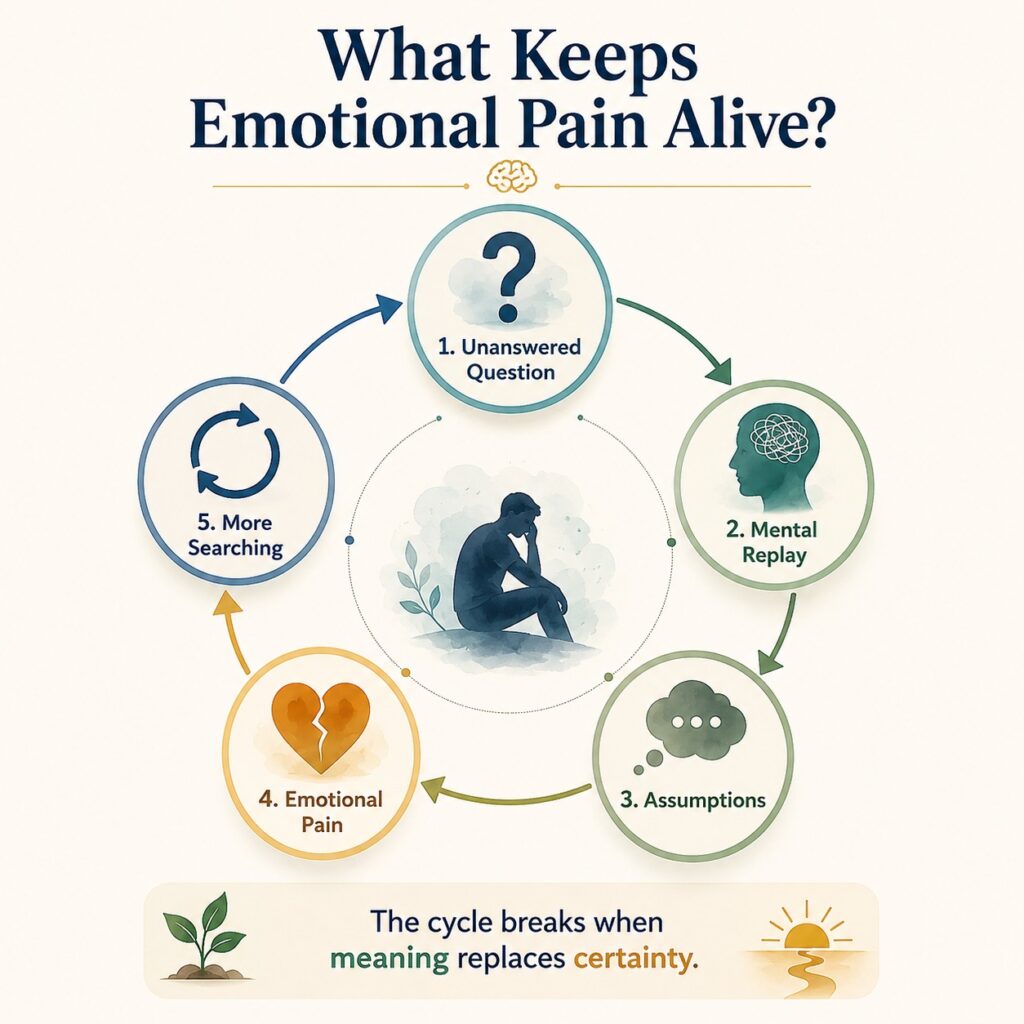
This creates a cycle.
You search because you don’t have closure.
But the repeated searching reinforces the feeling that closure has not yet arrived.
Recognising this pattern isn’t about blaming yourself.
It’s about understanding how beautifully—and sometimes stubbornly—the human mind works.
The brain follows where attention repeatedly goes. If we continuously revisit the unanswered question, we unintentionally teach the brain that it is still today’s most important problem.
The Quiet Power of Self-Compassion
When people cannot find answers, many turn their questions inward.
“Why wasn’t I enough?”
“Why didn’t I see it coming?”
“Why do I always end up here?”
These questions often sound like self-reflection.
In reality, they frequently become a self-judgment.
“One of the strongest findings in contemporary psychology is that people recover more effectively from emotional setbacks when they respond to themselves with compassion rather than criticism” (Neff, 2003).
Self-compassion does not remove accountability.
If we made mistakes, we can acknowledge them.
If we hurt someone, we can learn from it.
But self-compassion also recognises another truth:
Every human being makes decisions with the knowledge, emotional capacity, and resources available to them at that moment.
Looking back with today’s wisdom and condemning yesterday’s self rarely leads to healing.
Growth begins when understanding replaces punishment.
The First Real Step Toward Emotional Freedom
Many people believe closure begins with another person’s final words.
More often, it begins with your own.
The moment you gently say,
“I may never know every answer, but I don’t need every answer to build a meaningful life.”
Something begins to change.
The unanswered questions don’t disappear overnight.
The memories don’t vanish.
But they slowly lose the power to control your present.
This is not resignation.
It is psychological freedom.
Because genuine closure psychology teaches us something profoundly hopeful:
Healing is not waiting for life to become perfectly explained.
Healing is learning to move forward even when parts of the story remain unfinished.
How to Find Emotional Closure When Life Doesn’t Give You the Answers
Closure Is Something You Build, Not Something You Wait For
If you’ve read this far, one truth has probably become clear.
The greatest obstacle to emotional closure is rarely the absence of answers.
It’s the belief that someone else must provide them.
That belief keeps many people emotionally waiting.
Waiting for an apology.
Waiting for an explanation.
Waiting for a message.
Waiting for justice.
Waiting for the day when everything finally makes sense.
Unfortunately, life doesn’t always offer those moments.
Sometimes people disappear without warning.
Sometimes they never acknowledge the pain they caused.
Sometimes the chapter ends without a satisfying conclusion.
If healing depended entirely on receiving answers, countless people would remain emotionally trapped forever.
Thankfully, psychology offers a more hopeful perspective.
Closure is not an event.
It is a psychological process.
It is something your mind gradually constructs through understanding, acceptance, and intentional emotional growth.
This doesn’t happen in a single day.
Nor does it require forgetting the past.
Instead, it involves teaching the brain that the search for certainty is no longer necessary for living a meaningful life.
That process begins with a different question.
Not,
“How do I get them to explain?”
But,
“How do I help my own mind feel safe enough to stop searching?”
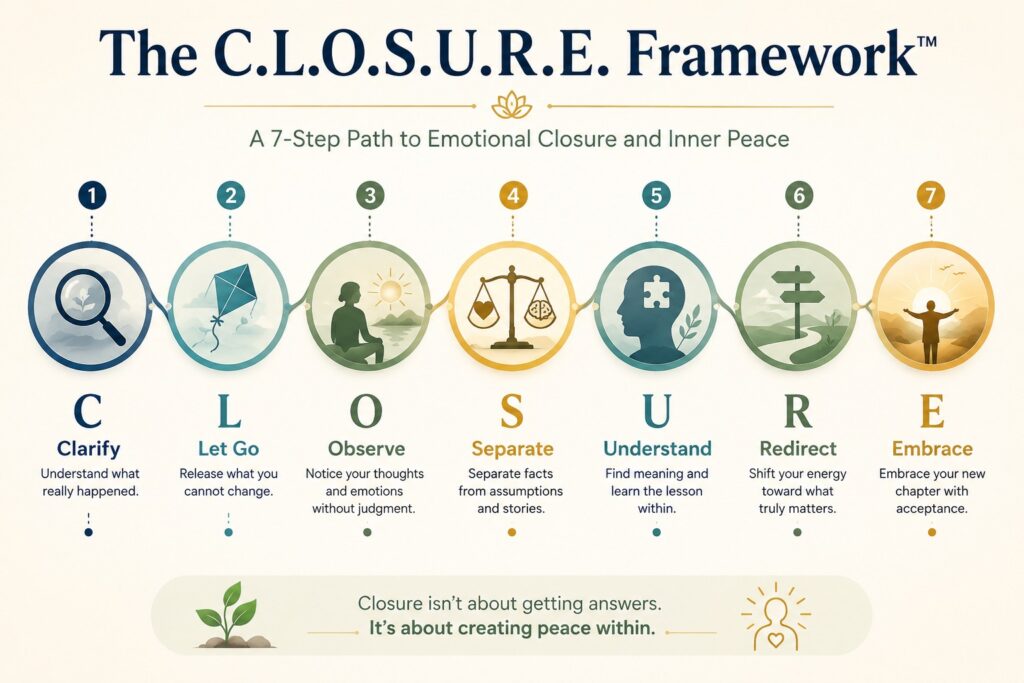
The C.L.O.S.U.R.E. Framework
A Psychology-Based Path to Emotional Closure
The following framework brings together many of the psychological principles we’ve explored throughout this article.
It isn’t about suppressing emotions or pretending painful experiences never happened. Instead, it helps the brain gradually shift from searching for certainty to creating emotional stability.
C — Clarify What You Actually Lost
One of the biggest mistakes people make is believing they only lost a person.
Often, the loss is much bigger.
You may have lost:
- A future you imagined.
- A sense of belonging.
- Daily routines.
- Shared dreams.
- Trust.
- A version of yourself.
When everything is mixed together, emotional pain feels overwhelming.
Clarifying what was truly lost makes grief more understandable.
Ask yourself:
“Am I grieving the person… or the future I expected to have?”
That single question often brings remarkable insight.
L — Let Go of Imaginary Conversations
The human mind has an extraordinary imagination.
When real answers are unavailable, it creates fictional ones.
You replay arguments.
Rewrite conversations.
Imagine different endings.
Picture what you “should have” said.
Although this feels productive, it usually strengthens emotional attachment rather than resolving it.
Imaginary conversations rarely provide certainty.
They simply create new versions of the same unanswered story.
Letting go doesn’t mean stopping thoughts by force.
It means recognising that imagined answers cannot replace reality.
O — Observe Your Emotional Triggers Without Judgment
Healing begins with awareness.
Notice what reactivates the emotional wound.
A song.
A location.
Social media.
Certain dates.
Loneliness.
Unexpected silence.
These triggers are not signs that you’re moving backwards.
They are reminders that your nervous system still associates certain experiences with unfinished emotions.
Instead of criticising yourself for feeling emotional, become curious.
Ask:
“What is this trigger reminding my brain of?” Curiosity creates space where self-judgment once lived.
S — Separate Facts from the Stories Your Mind Creates
One of the brain’s greatest strengths is making meaning.
Unfortunately, it also means we sometimes confuse assumptions with facts.
Fact:
“They stopped communicating.”
Story:
“Nobody ever truly cares about me.”
Fact:
“I wasn’t selected for the position.”
Story:
“I’ll never succeed.”
The event happened.
The interpretation is something your mind created to explain it.
Learning to separate these two dramatically reduces emotional suffering.
Not because the pain disappears—
but because unnecessary conclusions stop multiplying it.
U — Understand That Uncertainty Is Part of Every Human Life
Perhaps the hardest lesson in the psychology of closure is accepting that some questions never receive complete answers.
Why did they change?
Why didn’t they apologize?
What were they really thinking?
Sometimes we simply don’t know.
Even the people involved may not fully understand their own behaviour.
Our desire for certainty is deeply human.
But demanding certainty from an uncertain world creates endless frustration.
“Psychological resilience grows when we learn to tolerate uncertainty rather than constantly trying to eliminate it” (Hayes et al., 2006).
R — Redirect Emotional Energy Toward the Life You Are Still Living
Healing is not only about releasing the past.
It is equally about investing in the present.
Ask yourself:
Where is my attention going each day?
Am I feeding unanswered questions—
or nurturing meaningful experiences?
Every hour spent building relationships, learning new skills, pursuing purpose, caring for your health, or contributing to others quietly teaches the brain something powerful:
“Life is continuing.”
The emotional wound no longer becomes the center of your identity.
It becomes one chapter in a much larger story.
E — Embrace Growth Instead of Perfect Endings
Many people spend years searching for the perfect ending.
Life rarely offers one.
What it does offer is the opportunity to become wiser because of what happened.
The experience may not have been fair.
It may never completely make sense.
But it can still deepen your empathy.
Strengthen your boundaries.
Clarify your values.
Teach you what truly matters.
Growth doesn’t justify painful experiences.
It transforms them.
And that transformation is one of the deepest forms of emotional closure.
Why This Framework Works
Each step of the C.L.O.S.U.R.E. Framework reflects well-established psychological principles.
Clarifying loss reduces emotional confusion.
Observing triggers increases emotional awareness.
Separating facts from interpretations helps challenge cognitive distortions.
Accepting uncertainty builds psychological flexibility.
Redirecting attention supports healthier neural pathways.
Finding meaning encourages post-traumatic growth and resilience.
Notice something important.
None of these steps require another person’s cooperation.
They place healing back where it has always belonged—
within your own capacity to grow.
That doesn’t make healing easy. But it makes it possible.
A Gentle Reminder Before You Continue
If you’re reading this while carrying unanswered questions from your own life, remember this:
Your mind isn’t broken because it keeps searching.
It is doing what human brains have evolved to do.
The goal is not to stop caring.
The goal is to gently teach your brain that your future no longer depends on solving every mystery from your past.
That lesson doesn’t arrive all at once.
It is built through small moments of understanding, repeated over time. And those moments, more than any final conversation, are what gradually create lasting emotional closure.
Why Emotional Pain Sometimes Comes Back—Even After You Thought You Had Moved On
Healing Rarely Moves in a Straight Line
One morning, you wake up feeling surprisingly peaceful.
The memories don’t seem as heavy.
You smile more easily.
You begin making plans again.
For the first time in weeks—or perhaps months—you quietly think,
“Maybe I’m finally moving on.”
Then, without warning, something unexpected happens.
A familiar song begins playing in a café.
Someone mentions their name in conversation.
An old photograph appears while scrolling through your phone.
You walk past a place that once meant everything.
Suddenly, emotions return with surprising intensity.
Your chest feels heavy.
The memories become vivid again.
The unanswered questions briefly return.
Almost immediately, another thought appears.
“I thought I was over this.”
“Have I lost all my progress?”
This is one of the most common fears people experience during emotional healing.
Fortunately, psychological science offers reassuring news.
In most cases, feeling emotional again does not mean you are starting over.
It often means your brain is doing exactly what healthy brains are designed to do.
Your Brain Doesn’t Erase Emotional Memories—It Learns New Ways to Respond
Many people imagine healing as pressing a “delete” button.
As though one day the painful memories simply disappear forever.
The brain doesn’t work that way.
Memories are remarkably durable.
Especially those connected with strong emotions.
From an evolutionary perspective, this makes sense.
Remembering emotionally significant experiences helped our ancestors avoid repeating dangerous situations.
Rather than deleting memories, the brain usually does something much more sophisticated.
It learns.
Over time, your nervous system gradually discovers that remembering an event is not the same as reliving it.
The memory remains.
But the emotional alarm attached to it slowly becomes quieter.
Psychologists often describe this process as extinction learning.
The original memory is still there.
What changes is the brain’s prediction.
Instead of assuming,
“This memory means danger,”
it gradually learns,
“This memory belongs to the past.”
That distinction marks an important milestone in emotional closure.
Why One Memory Can Suddenly Bring Everything Back
Have you ever noticed how a particular smell instantly reminds you of childhood?
Or how hearing an old song transports you to a specific moment in your life?
This happens because memories are stored as interconnected networks rather than isolated files.
A single reminder can activate an entire emotional system.
Psychologists call these reminders retrieval cues.
They can include:
- A familiar voice.
- A place you once visited together.
- An anniversary date.
- A particular perfume.
- A favourite movie.
- Even a specific season of the year.
When these cues appear, the brain briefly reactivates the emotional memory associated with them.
This is completely normal.
The important question is not whether the memory returns.
The important question is how your brain responds when it does.
Years ago, the memory may have triggered panic, self-blame, or endless rumination.
Today, perhaps it brings sadness for a few minutes before gradually fading.
The memory returned.
But your relationship with it has changed.
That is progress.
Emotional Triggers Are Not the Same as Emotional Relapse
One of the biggest misunderstandings about healing is believing that every emotional trigger means failure.
Imagine recovering from a physical injury.
Months later, you lift something heavy and notice mild discomfort.
You probably wouldn’t conclude that the bone never healed.
You would recognise that healing tissue can remain sensitive for some time.
Emotional recovery works similarly.
A trigger simply means that an old emotional network has been activated.
It does not automatically mean the wound is as deep as it once was.
Consider the difference.
Earlier in your healing journey:
- You thought about the event every hour.
- Sleep became difficult.
- Daily functioning felt overwhelming.
- Every reminder consumed your attention.
Months later:
- A memory appears unexpectedly.
- You feel emotional for a while.
- You acknowledge the feeling.
- Then your attention gradually returns to the present.
Those experiences are psychologically very different.
The trigger may feel familiar.
Your response has evolved. That evolution is one of the clearest signs that healing is taking place.
Why Fighting Your Feelings Often Makes Them Last Longer
When painful memories appear, our first instinct is often to push them away.
“Don’t think about it.”
“Stay busy.”
“Forget it.”
Ironically, the brain rarely responds well to this strategy.
Try a simple experiment.
For the next ten seconds, promise yourself that you will not think about a white elephant.
Most people immediately picture one.
This illustrates an important psychological principle.
The harder we force certain thoughts away, the more attention the brain gives them.
Emotions work similarly.
Ignoring sadness doesn’t teach the brain that the experience is safe.
It often teaches the brain that the emotion itself is dangerous.
Healthy emotional regulation follows a different path.
Notice the emotion.
Name it.
Allow it to exist without immediately reacting to it.
Then gently return your attention to what matters in the present moment.
This approach doesn’t eliminate emotional pain overnight. But it prevents unnecessary suffering from growing around it.
Every Time You Respond Differently, Your Brain Learns Something New
One of the most hopeful discoveries in modern neuroscience is that the brain remains adaptable throughout life.
Each time you experience an old trigger without becoming trapped in the old cycle, your brain updates its expectations.
Perhaps months ago, seeing an old photograph led to hours of rumination.
Today, you notice the memory, feel the emotion, take a deep breath, and continue with your day.
That seemingly ordinary moment is psychologically extraordinary.
Your brain is learning.
Not that the past never happened.
But that remembering it no longer requires becoming emotionally overwhelmed.
This gradual updating of emotional responses is one reason healing often feels slow.
The brain learns through repetition.
Small moments.
Consistent experiences.
Gentle corrections.
Over time, these moments reshape emotional habits that once felt permanent.
Emotional Closure Is Measured by Your Response—Not by the Absence of Memory
Many people ask,
“How will I know if I’ve finally found closure?”
A common misconception is that closure means never thinking about the experience again.
Psychology suggests a different answer.
Closure is reflected less in what you remember and more in how you respond when you remember it.
You may still recall the relationship.
The rejection.
The unanswered message.
The painful goodbye.
But the memory no longer dictates your day.
It no longer defines your identity.
It no longer controls your future decisions.
The story remains part of your life.
It simply stops being the chapter you’re still living.
That is one of the clearest signs that genuine emotional healing has begun.
The Real Meaning of Closure—When Peace No Longer Depends on Answers
One Day, You’ll Notice Something Has Changed
Healing rarely announces its arrival.
There is no morning when you wake up and suddenly realise every painful memory has disappeared.
There is no dramatic moment when the past completely stops existing.
Instead, something quieter begins to happen.
One day, you hear their name, and your heartbeat stays steady.
You pass the place that once reminded you of what you lost, yet you continue walking without carrying it for the rest of the day.
A memory visits your mind, but it no longer takes over your evening.
Without consciously noticing it, your attention begins spending less time in yesterday and more time in today.
That is how emotional closure often arrives.
Not as an event.
But as a gradual change in your relationship with the past.
The memories remain.
The emotional grip slowly loosens.
And one ordinary day, you realise the story no longer controls the way you live.
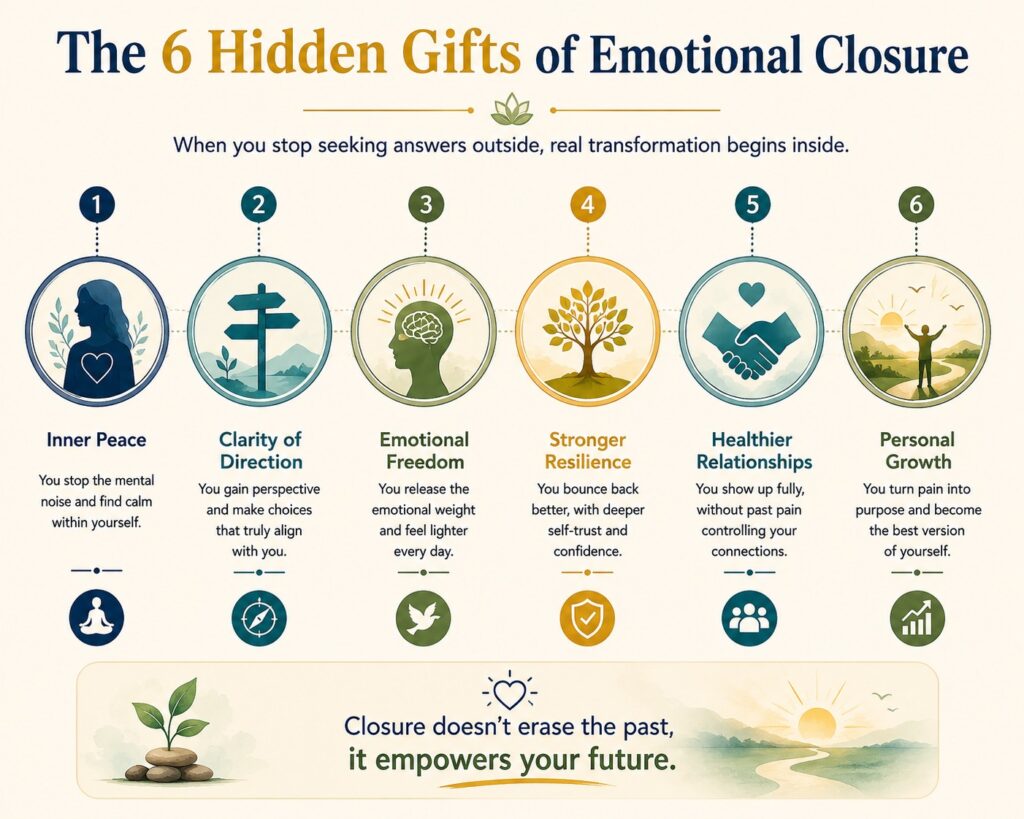
The Greatest Sign of Closure Is Not Forgetting—It’s Freedom
Throughout this article, we’ve explored the psychology of closure from many different angles.
We’ve learned that your brain naturally seeks certainty.
We’ve seen why unanswered questions remain mentally active.
We’ve discovered how attachment, uncertainty, memory, and emotional learning influence the healing process.
Most importantly, we’ve challenged one of the biggest myths about emotional healing:
Closure is not something another person gives you.
Because if peace depends entirely on another person’s apology, explanation, or return, your emotional life remains tied to circumstances you cannot control.
True closure changes that relationship.
It allows your well-being to become rooted in something far more stable:
Your understanding.
Your resilience.
Your values.
Your capacity to move forward despite uncertainty.
The greatest evidence of healing is not that you stop remembering.
It is that remembering no longer prevents you from living.
Every Unanswered Question Leaves You with Two Choices
Life will never answer every question.
Some relationships will end without explanation.
Some dreams will quietly disappear.
Some betrayals will never make complete sense.
Some opportunities will always remain “what ifs.”
When those moments arrive, we usually face two very different paths.
The first is to spend years waiting for certainty.
Waiting for the conversation.
Waiting for justice.
Waiting for someone else’s understanding.
Waiting for the ending we imagined.
The second path is more difficult—but ultimately more freeing.
It is choosing to build a meaningful life even while accepting that some questions may remain unanswered.
Psychological resilience does not come from eliminating uncertainty.
It grows from learning that uncertainty does not have to control our future. That is one of the deepest lessons hidden within closure psychology.
The Most Important Relationship You’ll Ever Repair
Many people begin searching for closure because they want to repair a broken relationship with someone else.
Yet along the way, they discover something unexpected.
The relationship that suffered most was often the one they had with themselves.
Painful experiences can quietly damage self-trust.
You begin questioning your judgment.
Your worth.
Your ability to recognise healthy people.
Your confidence in making future decisions.
Gradually, the search for answers becomes a search for yourself.
Healthy healing restores more than emotional peace.
It rebuilds self-respect.
It teaches you that one rejection does not define your worth.
One betrayal does not define your future.
One unanswered question does not define your identity.
Perhaps the most valuable form of closure is rediscovering the person you were before self-doubt convinced you otherwise.
Emotional Fitness Means Living Well Despite Uncertainty
Throughout life, uncertainty will continue appearing in different forms.
Career changes.
Family conflicts.
Health challenges.
Unexpected losses.
New beginnings.
No amount of psychological knowledge can remove uncertainty from human life.
What it can do is transform how we respond to it.
This is where emotional fitness becomes far more valuable than emotional certainty.
Just as physical fitness does not prevent every illness, emotional fitness does not prevent every painful experience.
Instead, it strengthens your ability to recover.
To adapt.
To remain compassionate toward yourself.
To make thoughtful decisions instead of fear-driven ones.
To continue building a meaningful life, even when life feels incomplete.
Emotional fitness isn’t about becoming emotionally unaffected.
It’s about becoming emotionally adaptable.
And adaptability has always been one of humanity’s greatest strengths.
When Finding Closure Feels Impossible—Knowing When It’s Time to Seek Professional Support
Sometimes the Real Challenge Isn’t Finding Closure—It’s Carrying Too Much Pain Alone
Throughout this article, we’ve explored how the human mind naturally searches for answers after emotionally significant experiences.
We’ve seen that the psychology of closure is not about forgetting the past but about gradually changing our relationship with it.
For many people, understanding these psychological processes, practicing self-compassion, and applying healthy coping strategies are enough to help them move forward over time.
But not every emotional wound heals in the same way.
Sometimes the pain runs much deeper than an unanswered question.
Sometimes the experience overwhelms the brain’s natural ability to process it.
Recognising this difference is not a sign of weakness.
It is a sign of emotional wisdom.
Just as we wouldn’t expect a broken bone to heal without proper care, there are times when emotional injuries deserve professional attention.
Seeking help is not giving up on yourself. It is giving yourself access to the support your mind may genuinely need.
How Do You Know If You’re Stuck Rather Than Simply Healing?
Healing is rarely a straight line.
Good days and difficult days naturally coexist.
Feeling emotional after hearing a familiar song or remembering an important person does not automatically mean something is wrong.
However, psychology suggests paying attention to a different question:
Is the pain gradually becoming easier to carry, or has it remained just as overwhelming for a long time?
Everyone heals at a different pace, so there is no universal timeline.
Instead of measuring recovery by the number of weeks or months that have passed, consider how the experience is affecting your daily life. If the emotional pain continues to dominate your thoughts, relationships, work, or physical health despite your genuine efforts to heal, it may be time to seek additional support.
Signs That Professional Support May Be Helpful
While occasional sadness, grief, or unanswered questions are part of being human, certain experiences deserve more specialised care.
Consider speaking with a qualified mental health professional if you notice patterns such as:
Persistent Rumination That Doesn’t Ease Over Time
Your mind repeatedly returns to the same memories for months or even years.
No matter how much you analyse the situation, it never feels resolved.
Instead of bringing clarity, the thinking becomes increasingly exhausting.
Emotional Pain That Interferes With Daily Life
You struggle to concentrate at work.
Your sleep is regularly disrupted.
You withdraw from family or friends.
Activities that once brought joy now feel meaningless.
The emotional burden begins affecting multiple areas of your life rather than remaining limited to one experience.
Feeling Unable to Trust or Connect With Others
After a painful relationship, betrayal, or rejection, you find yourself avoiding emotional closeness altogether.
You may desperately want connection while simultaneously fearing it. Over time, unresolved emotional wounds can quietly influence future relationships.
Intense Feelings of Hopelessness or Worthlessness
If painful experiences gradually convince you that you are fundamentally unlovable, permanently broken, or without hope, those beliefs deserve compassionate attention.
Sometimes the deepest injury is not the event itself—but the conclusions we begin drawing about ourselves.
Symptoms Following a Traumatic Experience
Some experiences overwhelm the brain’s normal coping systems.
If you experience persistent nightmares, flashbacks, heightened fear, emotional numbness, severe avoidance, or constant hypervigilance after a traumatic event, professional assessment is strongly recommended.
Trauma is different from ordinary emotional pain, and it often requires specialised approaches to healing.
Therapy Doesn’t Give You Closure—It Helps You Build It
One of the biggest misconceptions about therapy is that the therapist somehow “fixes” emotional pain.
In reality, therapy is a collaborative process.
A skilled psychologist or therapist doesn’t erase your past.
Instead, they help you understand it differently.
They provide a safe space to explore painful experiences without judgment.
They help identify unhelpful thinking patterns.
They teach practical emotional regulation skills.
Most importantly, they help your brain process experiences that may have remained emotionally unfinished for years.
Rather than giving you closure, therapy helps you create the conditions in which emotional closure becomes possible.
Evidence-Based Therapies That Can Support Emotional Healing
Modern psychology offers several well-researched approaches that may help people struggling with unresolved emotional experiences.
The most appropriate approach depends on the individual and the nature of the difficulties they are facing.
Some of the most widely supported approaches include:
Cognitive Behavioural Therapy (CBT)
CBT helps identify unhelpful thinking patterns that may keep emotional wounds active. For example, it encourages people to examine whether conclusions such as “This happened because I’m not good enough” are supported by evidence or shaped by painful assumptions.
Acceptance and Commitment Therapy (ACT)
Rather than trying to eliminate painful thoughts completely, ACT teaches psychological flexibility.
It helps people acknowledge difficult emotions while continuing to live according to their personal values.
This approach is particularly helpful when life offers uncertainty rather than clear answers.
Compassion-Focused Therapy (CFT)
Many people searching for closure become their own harshest critics.
Compassion-Focused Therapy encourages replacing chronic self-criticism with kindness, understanding, and emotional safety.
Research suggests that self-compassion can reduce shame and support emotional resilience.
Trauma-Informed Therapies
When unresolved experiences involve significant trauma, therapists may recommend specialised approaches that help the brain process traumatic memories in a safe and structured way.
The specific approach depends on each person’s experiences and clinical needs.
Asking for Help Is a Sign of Emotional Strength
Unfortunately, many cultures still treat emotional struggles differently from physical ones.
People often encourage someone with a physical injury to see a doctor without hesitation.
Yet the same person may feel embarrassed about speaking with a mental health professional after months of emotional suffering.
This double standard serves no one.
Seeking support is not an admission that you have failed.
It is an acknowledgement that healing sometimes happens more effectively with guidance.
In fact, recognising when you need help is one of the clearest signs of emotional fitness. It reflects self-awareness rather than weakness.
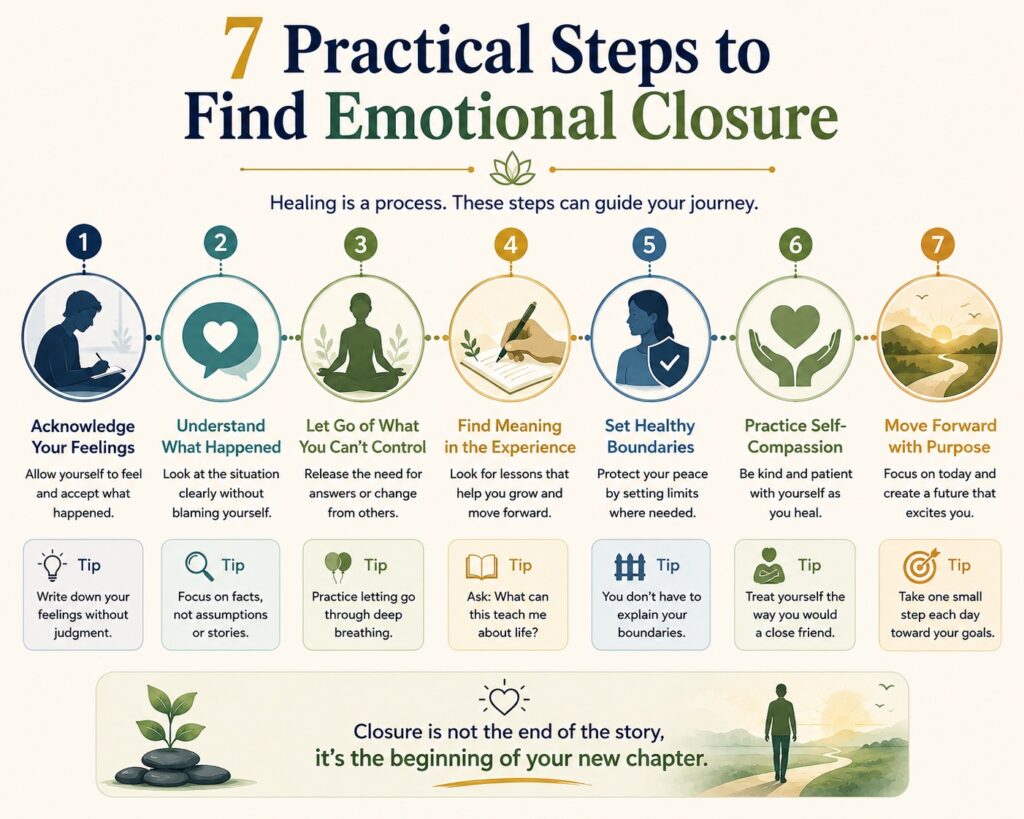
A Final Thought Before You Leave
If there is one idea I hope stays with you, it is this:
Your brain was never trying to make you suffer.
It was trying to protect you.
Every unanswered question…
Every replayed memory…
Every search for meaning…
Every attempt to understand what happened…
These were not signs that something was wrong with you.
They were signs that your mind was doing what human minds have always done:
Searching for enough understanding to feel safe again.
The beautiful truth is that safety doesn’t always arrive through perfect answers.
Sometimes it arrives through self-understanding.
Sometimes through acceptance.
Sometimes through growth.
And sometimes through the quiet realisation that your future deserves more attention than questions your past can no longer answer.
Key Takeaways

As you continue your journey, remember these evidence-informed principles:

•	Your brain naturally seeks closure because certainty helps it predict and adapt to the future.
•	Unanswered questions often remain emotionally active because the mind treats them as unfinished experiences rather than completed memories.
•	Attachment patterns, personal meaning, and emotional investment influence how strongly we seek closure.
•	Healing does not require forgetting the past—it requires changing your relationship with it.
•	Waiting for another person's explanation may delay recovery if your peace depends entirely on their actions.
•	The C.L.O.S.U.R.E. Framework™ offers a practical, psychology-based approach to building emotional closure from within.
•	Emotional triggers are not evidence that healing has failed. They are opportunities for the brain to practise new responses.
•	The strongest sign of closure is not the absence of memory, but the return of freedom, self-trust, and emotional flexibility.
Frequently Asked Questions (FAQ)
What is closure in psychology?
In psychology, closure refers to the process of emotionally making sense of a significant experience so it no longer dominates your thoughts, emotions, or daily life. Contrary to popular belief, closure does not always require an apology or explanation from another person. It often develops through understanding, acceptance, and emotional healing.
Why can’t my brain let go of unanswered questions?
Your brain naturally seeks certainty and meaning. When an important experience ends without clear resolution, it may continue searching for answers because it treats the event as psychologically unfinished. This is one reason unanswered questions can remain mentally active for a long time.
Can you find closure without talking to the other person?
Yes. While honest conversations can sometimes help, psychological research suggests that lasting emotional closure does not always depend on another person’s explanation. Many people heal by accepting uncertainty, processing their emotions, and creating their own understanding of what happened.
Why do I keep thinking about someone who is no longer in my life?
Strong emotional bonds, attachment, and unresolved questions can keep memories active. This does not necessarily mean you should return to the relationship. It often means your brain is still processing the emotional significance of the experience.
Is closure the same as forgiveness?
No. Closure and forgiveness are related but different concepts. Closure is about finding emotional peace and moving forward. Forgiveness involves releasing resentment toward someone who has hurt you. It is possible to experience closure without forgiving, and it is also possible to forgive without feeling complete emotional closure.
Why do emotional memories return after months or years?
Emotional memories can be reactivated by reminders such as places, songs, anniversaries, or familiar situations. These emotional triggers do not necessarily mean you are moving backwards. Often, they simply reflect how memory works. Over time, your response to these memories usually becomes less intense.
How long does it take to find emotional closure?
There is no fixed timeline. The healing process depends on factors such as the nature of the experience, emotional support, personality, attachment patterns, and coping strategies. Progress is better measured by how your relationship with the memory changes than by the amount of time that has passed.
What are the signs that I have found closure?
Healthy signs of closure include thinking about the experience less often, feeling less emotionally overwhelmed when memories arise, rebuilding trust in yourself, engaging with the present, and no longer needing constant answers to move forward.
Can therapy help me find closure?
Yes. Therapy can help you understand unresolved emotions, challenge unhelpful thought patterns, strengthen emotional regulation, and develop healthier ways of responding to uncertainty. Rather than giving you closure, therapy supports you in building it.
What is the healthiest way to deal with unanswered questions?
The healthiest approach is to acknowledge your emotions, separate facts from assumptions, practise self-compassion, accept that some uncertainty is unavoidable, and focus your energy on building a meaningful present rather than repeatedly searching for explanations that may never come.
Final Reflection
Perhaps someone reading this article is still waiting for a message that may never arrive.
Perhaps someone is hoping for an apology that was never offered.
Perhaps someone is carrying a question that has quietly followed them for years.
If that someone is you, remember this:
Not every chapter in life ends with an explanation.
But every chapter still has the possibility of becoming part of a meaningful story.
The past may always be a page in your life.
It does not have to remain the chapter you are living.
And sometimes, the truest form of closure is not finally hearing the words you waited for— but discovering that your life has grown so full of purpose, connection, and self-understanding that you no longer need to hear them at all.
“Closure is not the moment every question is answered. It is the moment your future no longer depends on the answers.”
A Gentle Note

This article is intended to educate and inform, not to replace professional mental health care. If emotional or psychological concerns are affecting your well-being or daily life, please seek guidance from a qualified mental health professional.

At The Psyche Inspire, we believe that understanding your mind is the first step toward caring for it.
References

Bowlby, J. (1988). A Secure Base: Parent-Child Attachment and Healthy Human Development. Basic Books.

Hayes, S. C., Luoma, J. B., Bond, F. W., Masuda, A., & Lillis, J. (2006). Acceptance and Commitment Therapy: Model, Processes and Outcomes. Behaviour Research and Therapy, 44(1), 1–25.

Kruglanski, A. W., & Webster, D. M. (1996). Motivated Closing of the Mind: "Seizing" and "Freezing". Psychological Review.

Processes,Neff, K. D. (2003). Self-Compassion: An Alternative Conceptualization of a Healthy Attitude Toward Oneself.

Zeigarnik, B. (1927). On Finished and Unfinished Tasks.
Further Reading

•	Why Your Brain Replays Embarrassing Memories at Night
•	The Hidden Psychology of Overthinking
•	Why Being Ignored Hurts So Much
•	Emotional Fitness vs. Emotional Suppression
•	Why Rejection Changes Your Personality
1 thought on “The Psychology of Closure: Why Your Brain Can’t Let Go of Unanswered Questions”