

There are moments when someone you deliberately walked away from suddenly comes back to your mind. Perhaps you hear a familiar song, pass a place you once visited together or remember an ordinary conversation. For a few moments, you find yourself missing their presence, even though you know that having them in your life again may not be right for you.
Why do I miss someone I don’t want back anymore? Why do old feelings return when you have already decided to move forward? And why can you miss someone while remembering exactly why you needed distance from them?
This experience can be surprisingly confusing. You may question whether you have truly moved on, whether you made the right decision or whether a part of you still wants the relationship to return. Sometimes, you even feel guilty for missing someone who disappointed you, hurt you or made you emotionally exhausted.
But there is something important to understand: Missing someone and wanting them back are not necessarily the same thing.
Table of Contents
Human emotions do not always follow the decisions we make. You may consciously recognise that a relationship was unhealthy, emotionally unfulfilling or simply no longer right for you. However, the memories, familiar routines and emotional connections associated with that person may continue to hold meaning.
This is not limited to romantic relationships. You may miss an old friend with whom you no longer share the same values, a family member from whom you have created distance or someone whose presence once brought comfort but eventually became emotionally draining.
Sometimes, what we miss is not the complete person or the relationship as it actually existed. We may miss the companionship, familiarity, emotional security we once experienced or even the version of ourselves we remember from that period of life.
Understanding this distinction can change how you respond to your feelings. Instead of judging yourself for missing someone, you can begin exploring what that feeling actually represents.
Why Do I Miss Someone I Don’t Want Back? Understanding Conflicting Feelings
It is possible to miss someone and still feel certain that you do not want to rebuild the relationship. You may remember their kindness, enjoy recalling certain experiences, or occasionally wish you could speak to them. At the same time, you may remember the repeated disagreements, emotional distance, broken trust, or unmet needs that made you walk away.
These feelings do not automatically contradict each other.
Consider a person who leaves a workplace after years of dissatisfaction. They may have been unhappy with the working environment but still miss their colleagues, familiar routines, and the sense of belonging they experienced there. Missing those parts does not mean leaving was a mistake.
Relationships can create a similar emotional experience. A person may have been an important part of your life without being the right person to continue sharing it with.
The important distinction is between what you feel and what you choose. Your feelings may tell you that something once mattered, but your decisions need to consider what is healthy, respectful, and suitable for your life today.
Ending a relationship and emotionally adjusting to its absence are two different experiences.
7 Psychological Reasons You Miss Someone You No Longer Want in Your Life
There is rarely just one explanation for missing someone after deciding to walk away. Often, several psychological and emotional processes overlap, making the experience feel more complicated than it actually is.
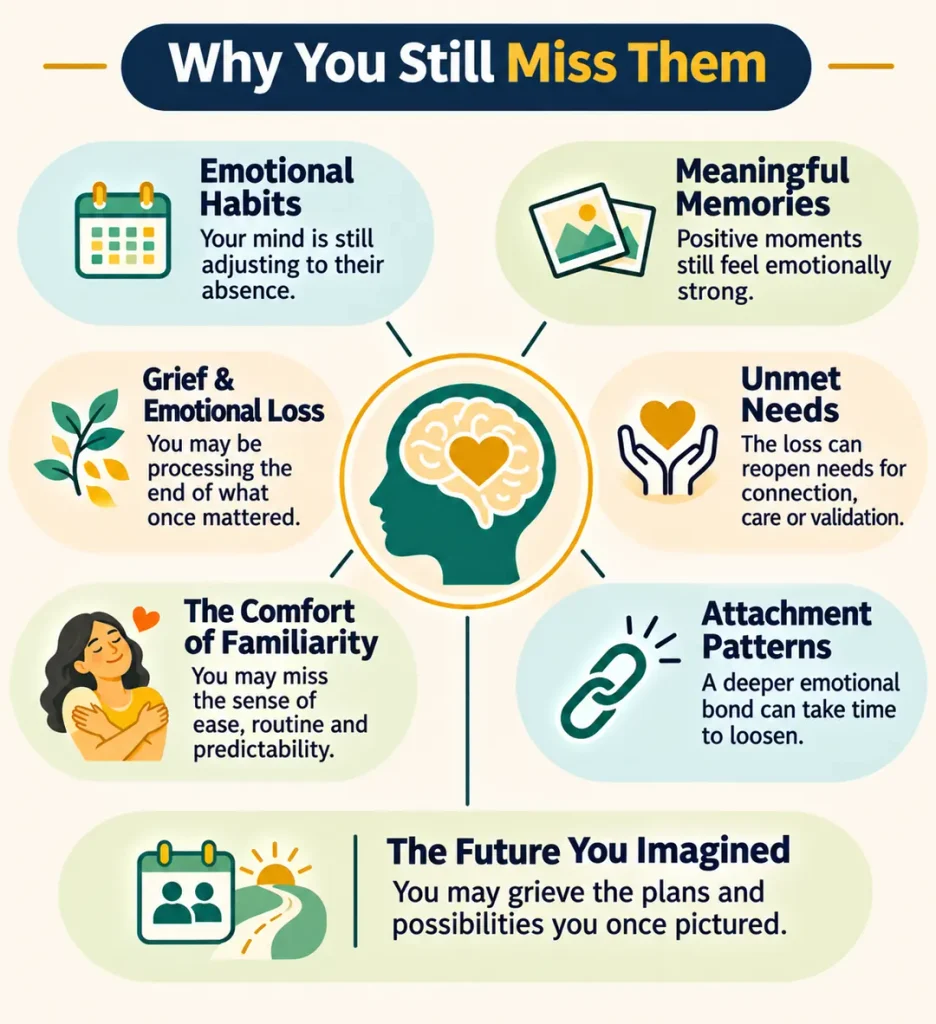
Here are seven reasons that may help you understand what is happening.
Emotional Attachment Does Not Disappear Immediately
When someone becomes important in your life, they gradually become part of your emotional world. You may become accustomed to sharing your thoughts with them, seeking their opinion, discussing everyday events, or turning to them when something goes wrong. Over time, these interactions become familiar emotional patterns.
When the relationship ends, the person may no longer be available, but the habits associated with that connection do not necessarily disappear at the same time. You might still feel the urge to tell them something interesting that happened during your day. You may instinctively reach for your phone when you need comfort, even though you know that contacting them may not be right.
Research offers an interesting perspective on this connection. A 2023 systematic review by Lau-Zhu, Williams, and Steel examined 33 studies exploring the relationship between adult attachment patterns and autobiographical memory. The researchers found associations between attachment patterns and different features of personal memories, including emotional intensity, vividness, detail, and the way memories are recalled. You can read the systematic review of attachment patterns and autobiographical memory.
This does not mean attachment determines whom you miss or that everyone experiences separation in the same way. It does, however, help us understand why emotionally significant relationships can continue to influence the way we remember our past.
If you often find yourself forming strong emotional bonds, you may also find it useful to understand why you get emotionally attached so easily. The important point is that an emotional connection does not always end at the same moment as a relationship.
You Remember the Good Moments More Than the Difficult Ones
Have you ever found yourself remembering a beautiful conversation while temporarily overlooking the arguments that followed it? Perhaps you remember how someone supported you during a difficult period, how comfortable their presence once felt, or how happy you were during a particular experience.
Meanwhile, the repeated misunderstandings, disappointments, or emotional distance may feel less immediate in that moment. This can make you wonder whether the relationship was really as difficult as you remember it being when you decided to leave.
Human memory is not a perfect recording of everything that happened. Emotional memories can remain vivid while also changing over time, as certain details fade and others become more prominent. A 2024 review by Wardell and Palombo in Nature Reviews Psychology explains how emotional autobiographical memories persist and transform and how the stories we construct around our experiences influence the way we understand our past.
You can explore their research review on the stability and malleability of emotional autobiographical memories.
This is why it helps to remember the relationship as a whole rather than judging it through one beautiful memory. The good moments may have been genuine, but they do not cancel the experiences that made the relationship difficult.
A useful question to ask yourself is, ‘Am I missing the complete relationship, or am I remembering only the moments when it felt good?’
You Miss the Familiarity and Routine
Sometimes, what you miss is not entirely the person. You miss the place they occupied in your everyday life.
Perhaps you used to speak every evening, share your worries before going to sleep, or discuss even the smallest details of your day. Maybe you had a familiar weekend routine or a particular habit that involved both of you. When the relationship ends, these ordinary patterns disappear too.
The resulting emptiness can feel like missing the person, even when part of what you are experiencing is the absence of a familiar routine. You may still feel an urge to make that evening call or share something that would once have become a conversation between you.
Familiarity offers predictability. When it disappears, you may feel unsettled while adjusting to a different routine, especially if the person was part of your life for a long time.
This is one reason why missing someone can become more noticeable at night. The day may have kept you occupied, but quieter hours can bring back familiar habits, memories, and the absence of conversations you once expected.
Try asking yourself: Do I miss this person, or do I miss having someone in that particular part of my day?
Sometimes, rebuilding your daily routine is an important part of emotionally adjusting to someone’s absence.
Unfinished Conversations Keep the Relationship in Your Mind
Not every relationship ends with a clear explanation or a satisfying conversation. Some end with unanswered questions, while others fade through silence, misunderstandings, or repeated attempts to resolve problems that never seem to reach a conclusion.
You may continue thinking about what happened. Why did they behave that way? Did they understand how much they hurt me? Could I have handled things differently? Would the relationship have survived if we had communicated better?
When these questions remain unresolved, you may find yourself mentally rehearsing conversations that never happened or imagining what you would say if you met again. Sometimes, the mind keeps returning to an experience because you are still trying to make sense of it.
But there is an important difference between understanding the past and repeatedly trying to rewrite it. You may never receive the explanation or apology you hoped for, and that can be painful. However, you can still develop your own understanding of what happened and decide what you need going forward.
You do not always need another conversation with someone to recognise what an experience taught you.
You Miss Who You Were When That Person Was in Your Life
This is one of the more overlooked reasons people struggle to let go. Sometimes, what you miss is not entirely the other person; you miss the version of yourself associated with that period of life.
Perhaps you were more adventurous, confident, hopeful, or emotionally supported. You may remember the excitement of making plans together or the feeling that someone understood your ambitions. When the relationship ends, you can feel as though you have lost a part of your identity.
This can make the absence particularly difficult because you are not only adjusting to life without someone. You are also trying to understand who you are without that relationship.
Take a moment to consider what you enjoyed about yourself during that period. Which parts of your life became connected to this person? Have you stopped doing things that once made you feel confident or fulfilled?
You may discover that what you miss is a feeling you can gradually rebuild through friendships, meaningful activities, personal goals, and a renewed sense of independence. Your past relationship may have been part of your story, but it does not own the qualities you developed during it.
You Miss Someone More When You Feel Lonely
Have you noticed that you miss someone more intensely on certain days than others? Perhaps you have had a difficult day and wish you had someone to talk to. Maybe you see other people spending time with their partners or friends, or a quiet weekend reminds you of the companionship you once had.
During such moments, your mind may return to someone who previously occupied that emotional space. It can feel as though you miss that particular person, when what you are experiencing may also be a need for connection, affection, reassurance, or belonging.
Research on nostalgia offers an interesting perspective here. In their 2023 review, Nostalgia: An Impactful Social Emotion, Juhl and Biskas describe nostalgia as a social emotion that can strengthen feelings of connection, meaning, and continuity with one’s past. Their review helps explain why memories of relationships can feel especially meaningful when we reflect on belonging and connection.
You can read the research review on nostalgia as a social emotion.
However, feeling lonely does not necessarily mean that the person you miss is the right person to reconnect with. Sometimes, the emotional need is for companionship, understanding, affection, or reassurance—not for that particular relationship.
Try asking yourself: If I felt connected, supported, and emotionally fulfilled in my present life, would I miss this person in the same way?
The answer may help you understand what your feelings are asking for.
You Miss the Future You Imagined Together
Relationships are not built only around what has already happened. They also involve expectations, plans, and imagined possibilities.
Perhaps you thought you would grow old together. Maybe you imagined travelling, building a home, supporting each other’s careers, or sharing important milestones. When a relationship ends, those imagined possibilities can disappear too.
This creates a particular kind of sadness. You are not only adjusting to the absence of someone; you are also letting go of a future you once believed might happen.
Sometimes, the person you miss is closely connected to the life you hoped to build with them. You may find yourself remembering not only what you shared, but what you thought the relationship would eventually become.
It is important to recognise the difference between someone’s actual behaviour and the future you imagined they might offer. A relationship should be understood through what both people consistently contribute, not only through what you hoped it could become.
You can grieve an imagined future without deciding that you should return to the past.
Do I Really Miss My Ex or Am I Just Lonely?
This is an important question because loneliness and emotional attachment can sometimes feel similar. Both may make you think about someone who is no longer part of your life, but the emotional need underneath them may be different.
When you miss a particular person, you may remember their individual qualities, conversations, personality, or the experiences you shared. When loneliness is more prominent, you may find yourself longing for companionship in general—the feeling of having someone to talk to, someone who notices your absence, or someone with whom you can share everyday experiences.

Of course, these feelings can overlap. You may genuinely miss someone and also feel lonely without them. The purpose of distinguishing between them is not to decide which feeling is real, but to understand what you need at that moment.
Try reflecting on these questions:
- Do I miss this person’s actual qualities, or do I mainly miss having someone around?
- Am I remembering the complete relationship or only the comforting moments?
- Would I want the relationship back if the same problems remained?
- Am I thinking about reconnecting because I believe things could genuinely improve, or because I am struggling with loneliness?
- What kind of connection am I missing in my present life?
Your answers may help you recognise whether you are longing for the person, the relationship, or the emotional comfort associated with it.
Why Do I Miss Someone Who Hurt Me?
Missing someone who hurt you can feel especially confusing. You may remember how they disappointed you, the way they treated you, or the emotional pain you experienced, yet still find yourself thinking about them.
This does not mean you wanted to be hurt, that the behaviour was acceptable, or that you should return to the relationship. Emotional attachment does not always disappear simply because you recognise that someone treated you badly.
You may still remember the affection they showed, the moments when things felt good, or the emotional closeness you once experienced. You may also be struggling with unanswered questions or hoping that the person would eventually understand the impact of their behaviour.
It is important not to romanticise this experience. If a relationship involved repeated disrespect, manipulation, intimidation, or abuse, missing the person is not a reason to minimise the harm or put yourself back in an unsafe situation.
You can acknowledge that someone mattered to you while also recognising that their behaviour was harmful. Both truths can exist without cancelling each other.
If the relationship has affected your sense of safety or self-worth, speaking with a qualified mental health professional can help you understand the attachment and strengthen boundaries.
What Is Emotional Ambivalence? Why Can You Have Two Opposite Feelings at Once?
The experience of missing someone while not wanting them back is closely related to a psychological concept called emotional ambivalence. It refers to experiencing mixed or conflicting feelings towards the same person, relationship, or situation.
For example, you may feel affection and disappointment towards someone at the same time. You may appreciate the good experiences while feeling relieved that the relationship has ended. You may wish someone well without wanting them to return to your life.
These feelings can coexist, particularly when a relationship has included both meaningful experiences and painful ones.
Research has examined ambivalence in close relationships directly. Zoppolat and colleagues, in a study published in Social Psychological and Personality Science, investigated different forms of ambivalence across four intensive studies involving 1,134 participants. They found that explicitly experienced mixed feelings were associated with lower personal and relationship well-being, particularly when people felt subjectively conflicted. You can read the research on ambivalence and well-being in romantic relationships.
Another study by Zoppolat and colleagues, published in Emotion in 2024, examined the positive and negative sides of ambivalence in romantic relationships. Across three studies, greater subjective ambivalence was associated with thinking about both relationship difficulties and ways to improve the relationship, alongside constructive and destructive behaviours. The findings are discussed in research on the complicated sides of ambivalence in romantic relationships.
These studies concern people in romantic relationships, so they should not be treated as direct evidence about every post-breakup experience. However, they demonstrate that mixed feelings in close relationships are a recognised subject of psychological research.
In everyday life, the distinction is simple:
- I cared about this person.
- I remember some good experiences.
- I also recognise what was painful or unhealthy.
- I do not want the relationship back.
Neither statement cancels the other.
Does Missing Someone Mean You Made the Wrong Decision?
After ending a relationship, people sometimes interpret sadness as evidence that they should reconsider their decision. But emotional discomfort does not automatically mean a decision was wrong.
You may have left because your values were different, trust had been damaged, respect was missing, or the relationship repeatedly affected your well-being. Those reasons do not disappear simply because you occasionally feel nostalgic.
Instead of asking only, Why do I miss them?, consider asking:
- What were the reasons I decided to step away?
- Were my emotional needs being respected?
- Did the relationship allow me to feel safe and valued?
- What would realistically change if we reconnected?
- Am I considering returning because the relationship was healthy, or because being without it feels difficult?
These questions help you evaluate the relationship through a wider lens. You do not have to turn someone into a bad person to accept that the relationship was not right for you.
How to Stop Missing Someone You No Longer Want in Your Life
You cannot always control when a memory appears or when a wave of sadness arrives. Trying to force yourself to stop feeling anything can sometimes add frustration to an already difficult experience.
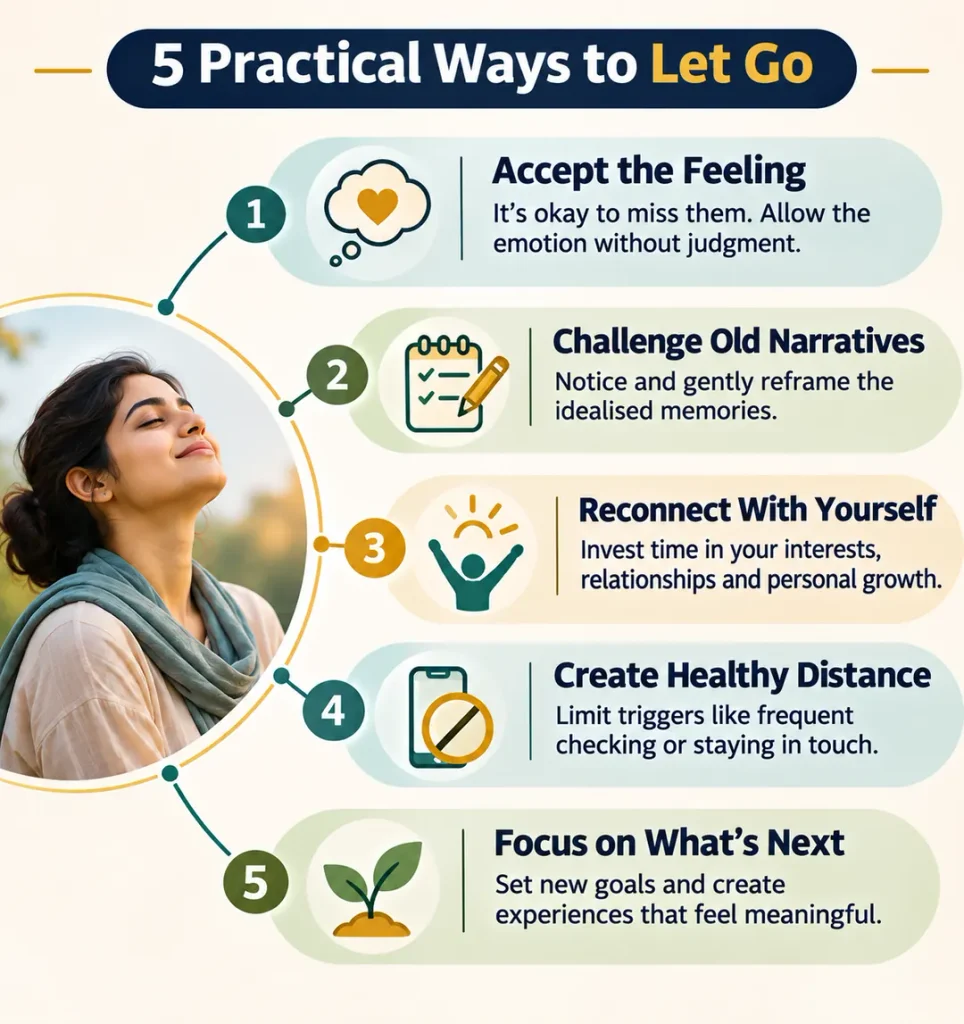
A more helpful approach is to understand the emotion, reduce the habits that keep you emotionally stuck, and gradually build a life that feels meaningful in the present.
Separate the Person From the Feeling
When you miss someone, pause and identify what you are actually longing for. Is it affection, companionship, reassurance, familiarity, or feeling understood?
These needs are valid, but they do not necessarily require the same person to fulfil them. For example, if you miss having someone to share your day with, you might reconnect with a trusted friend or make space for meaningful conversations in your present life.
Understanding the need beneath the feeling can help you respond more constructively.
Remember the Complete Relationship
Nostalgic memories can be comforting, but they do not always provide the complete picture. When you find yourself remembering only the good moments, gently remind yourself of the wider experience.
You might write down what you genuinely valued about the relationship, what repeatedly hurt or disappointed you, what you needed but did not receive, and why you decided that distance was necessary.
This is not an exercise in blaming the other person. It is a way of maintaining perspective when emotions make the past look simpler than it was.
Allow Yourself to Feel Without Acting on Every Emotion
You may miss someone today and feel perfectly comfortable with your decision tomorrow. Emotional experiences can fluctuate, and you do not need to contact someone every time you remember them.
Try acknowledging the feeling: I am missing this person right now. It is uncomfortable, but I do not have to act on it.
If reminders repeatedly bring back strong reactions, understanding why emotional triggers can affect you so strongly may also help you recognise the difference between a present situation and an emotionally significant memory.
Rebuild the Parts of Life That Became Connected to Them
When someone has been part of your everyday routine, their absence can leave practical and emotional gaps. Rather than trying to fill every gap immediately, begin creating new routines.
Spend time with people who make you feel comfortable. Return to interests you may have neglected. Make plans that give your week structure and purpose.
The aim is not to distract yourself constantly. It is to develop a present life that does not revolve around the absence of someone.
Set Boundaries That Protect Your Emotional Well-being
Repeatedly checking someone’s social media, rereading old conversations, or looking for updates can keep the relationship active in your daily thoughts. If these habits make it harder to move forward, consider creating some distance.
You might mute or unfollow their account, archive old conversations, or avoid asking mutual friends for regular updates. These steps are not about punishment; they are about recognising what helps you regain emotional space.
Boundaries can be especially important when the relationship involved repeated disrespect, manipulation, or emotional harm.
Stop Expecting Closure to Come Only From the Other Person
A conversation can sometimes help clarify what happened. But not every relationship ends with an explanation that feels complete.
You may never receive an apology. You may not understand every decision the other person made. Even so, you can decide what the experience means for your future.
You can acknowledge what happened, recognise what you learned, and choose not to repeat patterns that were harmful to you. Closure does not require you to approve of what happened; it means gradually accepting that the past cannot be changed, even when some questions remain unanswered.

The S.E.P.A.R.A.T.E. Approach: 8 Steps to Move Forward Emotionally
Moving forward is not always about forgetting someone. It is often about changing the place that person occupies in your emotional life.
The following S.E.P.A.R.A.T.E. approach is an educational reflection framework developed for The Psyche Inspire. It is not a clinically validated treatment or a substitute for counselling. Its purpose is to help you reflect on your feelings and make thoughtful choices.
S — Separate the Person From the Feeling
Identify what you miss. Is it the individual, the companionship, the routine, or the emotional security you associated with the relationship? Understanding the difference helps you identify the need beneath the longing.
E — Examine the Complete Relationship
Remember the good experiences without ignoring the difficult ones. Consider whether the relationship consistently offered respect, trust, emotional safety, and mutual effort. A balanced view is more helpful than remembering only the happiest or most painful moments.
P — Permit Yourself to Feel
Do not treat sadness, nostalgia, or longing as personal failure. Allow emotions to arise without immediately acting on them. You can feel something deeply and still make a decision that protects your well-being.
A — Acknowledge Your Unmet Emotional Needs
Ask what you were hoping the relationship would provide. Perhaps it was acceptance, reassurance, affection, stability, or a sense of belonging. Once you recognise the need, you can explore healthier ways of meeting it.
R — Rebuild Your Present Life
Invest in friendships, meaningful activities, personal interests, and goals that give your present life direction. You are not replacing a person; you are rebuilding a sense of fulfilment that does not depend on their presence.
A — Affirm Your Boundaries
Remind yourself why you chose distance. Maintain boundaries that protect your emotional and practical well-being. If reconnecting repeatedly brings back distress or harmful patterns, you are allowed to maintain that distance.
T — Tolerate Emotional Waves
Some days will feel easier than others. A familiar song, a place, or an unexpected reminder may bring back old feelings. Try to see these moments as emotional experiences rather than instructions to return to the relationship.
E — Engage With the Future
Begin making plans that reflect the person you are becoming. Give yourself opportunities to experience new relationships, interests, and possibilities. Moving forward does not require you to erase your past; it requires you to remain open to a life beyond it.
When Should You Seek Emotional Support?
Missing someone after a relationship ends is not automatically a sign of a mental health problem. However, if the experience begins to affect your everyday functioning or emotional well-being, additional support may be helpful.
Consider speaking with a qualified mental health professional if thoughts about the person are interfering with your work, sleep, or daily responsibilities. Support may also be useful if you feel persistently low or anxious, repeatedly return to a relationship despite recognising that it is harmful, or find it difficult to maintain boundaries.
Counselling can provide a supportive space to explore attachment patterns, unresolved feelings, relationship experiences, and unmet emotional needs. A counsellor may help you understand why certain memories remain powerful, identify patterns that influence your decisions, and develop healthier ways of responding to emotional distress.
Seeking support does not mean you are weak or incapable of moving forward independently. Sometimes, having a safe and non-judgemental space to understand your experience can make the process less overwhelming.
You Can Miss Someone and Still Choose Yourself
Perhaps the most important thing to remember is that missing someone does not erase everything you learned from the relationship. You can remember the laughter without forgetting the disappointment. You can appreciate what someone once meant to you without giving them the same place in your present life.
Emotional healing does not always mean reaching a point where you never think about someone again. Sometimes, it means remembering them without feeling compelled to return. It means allowing a memory to exist without letting it decide your next step.
So, if you are missing someone you no longer want in your life, try not to turn that feeling into a reason to question your worth or your decision. You are allowed to miss what was meaningful, and you are also allowed to choose what is healthier for you now.
You do not have to stop missing someone before you begin moving forward.
Frequently Asked Questions
1. Why do I miss someone but don’t want them back?
You may miss the emotional attachment, familiar routines, shared memories, or companionship associated with that person. Missing someone does not necessarily mean you want the relationship to return. It can simply mean that the relationship was once an important part of your life.
2. Is it normal to miss someone who hurt you?
Yes. Emotional attachment and painful experiences can coexist. You may remember the positive parts of a relationship while also recognising that the person hurt you. Missing them does not mean the hurt was acceptable or that you should return to the relationship.
3. Why do I miss someone even when I know they were not good for me?
You may be emotionally attached to the familiar aspects of the relationship, the positive memories, or the future you once imagined. Your conscious understanding of a relationship and your emotional adjustment to its ending may take different amounts of time.
4. Does missing someone mean I still love them?
Not necessarily. Missing someone can reflect affection, nostalgia, familiarity, loneliness, or an unmet emotional need. Love is only one possible explanation, and missing someone alone cannot tell you whether a relationship should continue.
5. Why do I miss someone more at night?
Night-time can bring fewer distractions and more opportunities for reflection. If you previously spoke to someone before sleeping or shared evening routines, the absence may feel more noticeable during those hours. This does not necessarily mean your feelings are getting stronger; the quiet may simply make them more noticeable.
6. How do I stop thinking about someone I no longer want in my life?
Rather than forcing yourself not to think about them, try reducing habits that repeatedly bring your attention back to the relationship. Maintain healthy boundaries, build new routines, reconnect with supportive people, and identify the emotional needs beneath your thoughts. If the thoughts are persistent and distressing, counselling may help.
7. Why do I miss someone after choosing to walk away?
Making a decision to leave does not instantly remove emotional attachment. You may still grieve the good memories, the familiar routine, or the future you expected. It is possible to feel sadness about what ended while remaining confident that leaving was the right choice.
8. How long does it take to stop missing someone?
There is no fixed timeline. It depends on the length and significance of the relationship, the circumstances of its ending, your emotional support, and your personal experiences. Rather than measuring progress by how quickly you forget someone, notice whether the memories gradually have less influence over your everyday decisions.
A Note to Our Readers

At The Psyche Inspire, we aim to explain everyday emotional experiences through established psychological concepts and research-informed perspectives. This article is intended for education and self-reflection, not diagnosis or treatment. The S.E.P.A.R.A.T.E. approach is an original educational framework, not a clinically validated intervention. If emotional distress is persistent or significantly affecting your life, consider seeking support from a qualified mental health professional.