

Life finally feels easier.
Your relationship is going well. Work feels manageable. Your family is safe. A problem that occupied your mind has been resolved. Perhaps you have even received some genuinely good news.
Yet instead of feeling relieved, you become uneasy.
Your mind searches for what could go wrong. You wonder how long the peaceful period will last. A small change in someone’s tone suddenly feels important. Even while enjoying something, part of you remains emotionally prepared for it to end.
This can leave you wondering, “Why do I feel anxious when things are going well?”
The experience is confusing because there may be no obvious danger. You may criticise yourself for being negative or ungrateful.
Table of Contents
But anxiety during good times does not necessarily mean that you dislike happiness. It may mean that happiness feels vulnerable. Once something becomes meaningful, there is also something you could lose.
For some people, worry becomes a way of staying prepared. Calm asks them to lower a guard that once felt necessary.
Quick Answer: Why Do I Feel Anxious When Things Are Going Well?
You may feel anxious when things are going well because your mind has learned to associate calm, happiness or uncertainty with possible disappointment. If you are accustomed to anticipating problems, a peaceful period can feel unfamiliar. Your mind may start waiting for something bad to happen, not because danger is certain, but because worry creates a temporary sense of readiness and control.
This does not mean that your anxiety is predicting the future. It may be repeating an old form of emotional protection.
What Anxiety During Good Times Can Feel Like
Anxiety does not always appear during an obvious crisis. Sometimes it enters the moments in which you expected to feel the happiest.
You may notice it after receiving a compliment, beginning a healthy relationship or completing something important. A pleasant moment is quickly followed by the thought, “This will not last.”
Someone who receives a promotion may immediately worry about failing in the new role. A person in a caring relationship may begin looking for signs that their partner is losing interest. A parent enjoying a peaceful family evening may suddenly imagine everything that could disrupt it.
The positive event is real. But the mind moves away from experiencing it and begins preparing for its possible loss.
You may notice yourself:
- feeling restless when life becomes quiet;
- expecting bad news after something good happens;
- downplaying achievements or compliments;
- finding a new problem as soon as another one is resolved;
- repeatedly checking whether everything is still okay;
- feeling guilty or exposed when you are happy;
- struggling to celebrate without imagining disappointment;
- becoming emotionally distant during positive moments;
- creating worry when there is no immediate problem to solve.
Sometimes thoughts race into imagined situations. At other times, your chest tightens or you feel unsettled without knowing why.
If peaceful situations regularly create tension, the related article on why you can’t relax explains how prolonged responsibility, vigilance and productivity-based self-worth can make slowing down difficult.
Are You Sensing Real Danger – or Experiencing a Protective Prediction?
Not every uneasy feeling should be dismissed. Sometimes concern draws attention to a real issue. A relationship may contain troubling behaviour. A financial decision may require careful thought. A physical symptom may need medical attention.
The goal is not to label every concern as overthinking. It is to notice whether your response is based on present evidence or on a prediction created by fear.
A concern based on evidence points to a specific problem and a proportionate action. A protective prediction produces a vague sense that something is wrong. Reassurance helps only briefly.
A protective prediction can feel like intuition because it arrives with strong emotion. But emotional intensity is not the same as reliable evidence.
If you have spent a long time anticipating rejection, conflict or sudden problems, your mind may have become skilled at detecting possible danger. That skill can remain active even when your present environment is safer. Learning about emotional safety can help explain why being objectively safe and experiencing safety internally are not always the same.
Is This the Same as a Fear of Happiness?
Researchers use the term ‘fear of happiness’ to describe beliefs or emotional reactions in which happiness feels risky, undeserved or likely to be followed by something negative.
This does not mean that a person consciously refuses to be happy. They may want joy and connection deeply. The difficulty appears when positive emotion activates fear, guilt or an urge to reduce the feeling.
Research has found meaningful associations between fear of happiness and anxiety, stress, self-criticism and difficulty processing positive emotions. However, fear of happiness is not, by itself, a standalone mental-health diagnosis. It is better understood as a psychological pattern that can occur for different reasons. Research by Gilbert and colleagues helps explain these connections.
The most helpful question may not be, “What is wrong with me?” It may be, “What does my mind believe it is protecting me from when life feels good?”
5 Psychology Reasons You Feel Anxious When Things Are Going Well
These patterns can overlap. Understanding them is not about finding another label. It is about noticing what your anxiety may be trying to accomplish.
1. Past Experience Taught You That Good Moments May Not Last
Your mind learns from emotional patterns.
If peaceful periods in your life were often interrupted by conflict, criticism, loss or sudden change, you may have learnt not to settle too deeply into them. Part of you remains attentive even when everything appears fine.
This learning does not require one dramatic event. A parent’s mood changed without warning. Praise was followed by criticism. A close relationship felt secure one day and distant the next.
Over time, your mind may have formed a quiet rule: “Do not become too comfortable. Things can change quickly.”
Imagine that you are spending a relaxed evening with your partner. Nothing is wrong. But when they become quiet for a few minutes, you immediately wonder whether their feelings have changed. Your reaction is not based only on the present silence. It may also be influenced by earlier experiences in which silence meant withdrawal, anger or rejection.
This is one way calm feels unsafe. The current moment may be peaceful, but your mind interprets unfamiliar peace through familiar emotional memories.
Childhood does not determine everything. Yet early relationships can provide an emotional template that may need updating. You can explore that connection further in how childhood shapes emotional regulation.
A useful question is: “Is this moment actually repeating my past, or does it only feel familiar?”
2. Worry Makes You Feel Prepared for Disappointment
Worry can feel useful even when it is exhausting.
If you imagine every problem beforehand, you may believe nothing can catch you off guard. Expecting disappointment can seem safer than hope.
Your mind may say, “If I expect the worst, it will hurt less,” or, “If I relax, I will miss an important warning.” This helps explain why you may begin waiting for something bad to happen precisely when life becomes peaceful.
Psychologists studying the Contrast Avoidance Model propose that some people use worry to avoid a sharp emotional shift from feeling good to feeling distressed. Remaining worried is unpleasant, but it may feel less vulnerable.
Consider someone waiting for the result of a job interview that went well. They feel hopeful for a moment. Then they list everything they may have said incorrectly. They imagine receiving a rejection email and tell themselves not to expect too much.
The worry does not change the result. It reduces hope, which creates a temporary sense of protection.
Unfortunately, anticipatory worry creates distress before anything bad has happened. It rarely removes the impact if something difficult does occur.
This process is closely connected with the hidden psychology of overthinking. Overthinking often continues because it creates an impression of problem-solving, even after useful thinking has ended.
Preparation responds to a specific possibility and leads to action. Protective worry keeps producing possibilities without allowing the mind to feel finished.
3. Happiness Makes You Aware of What You Could Lose
Good experiences do not only create pleasure. They also reveal what matters to you.
A loving relationship can awaken fear of separation. Improved health can bring fear of illness returning. An achievement can create pressure to maintain it.
In these situations, anxiety may not mean that you are resisting happiness. It may mean that happiness has made you emotionally invested.
Someone who has wanted a secure relationship for years may finally meet a kind and available partner. Instead of feeling completely reassured, they analyse messages, notice minor changes in tone and seek confirmation that the relationship is still safe.
The closeness has not created a problem. It has created vulnerability.
This can lead people to ask, “Why can’t I enjoy good things?” Often, they can enjoy them, but only briefly. Their attention quickly moves from appreciation to preservation: “How do I make sure this lasts?”
A desire for certainty begins to replace connection. This can be especially strong after rejection or loss. If earlier rejection influences how you interpret closeness, why rejection changes your personality explains how self-protection can continue in everyday behaviour.
Caring about something will always involve uncertainty. Emotional security does not require believing that nothing difficult will happen. It means learning that you can value the present without living inside its possible ending.
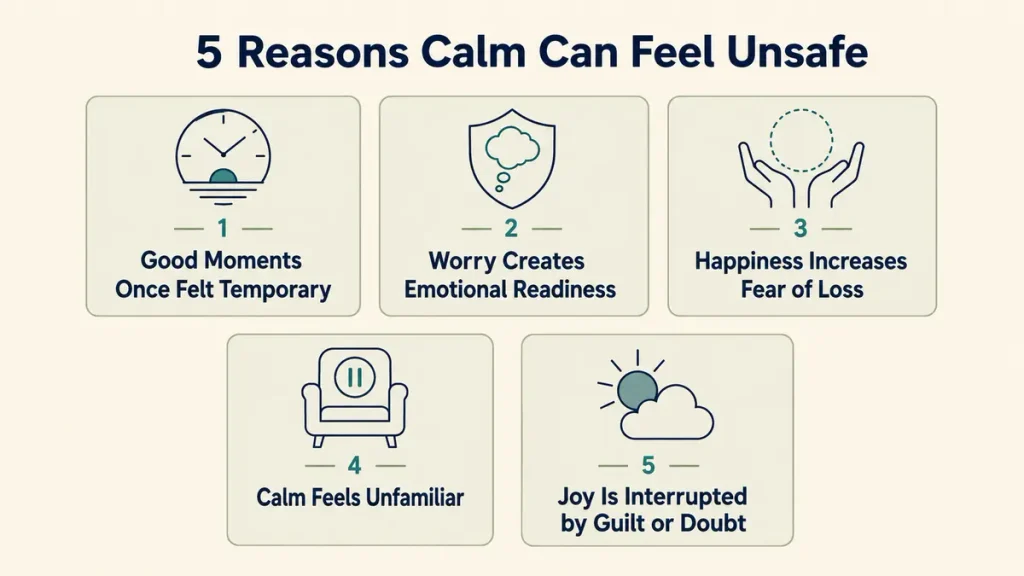
4. Calm or Positive Change Feels Unfamiliar and Uncertain
The mind often confuses what is familiar with what is safe.
If you have spent years responding to pressure or responsibility, being alert may feel normal. You know how to function when something needs to be solved. You may even feel capable during a crisis. When there is no immediate problem, you lose the familiar role of preparing, fixing or managing.
Imagine someone who has worked for months on a demanding project. When it ends, they expect relief. Instead, they feel restless. Within a day, they are worrying about the next responsibility. Their mind may simply be trying to return to a familiar level of activity.
Positive changes contain uncertainty too. A better job, peaceful home or healthier relationship changes what is expected of you. New routines are not yet familiar.
An anxious mind may prefer a familiar difficulty to an unfamiliar possibility. At least the old problem feels predictable.
This helps explain why some people become anxious when good things happen. The positive event may be safe, but it is still new. Your emotional system may need repeated experience before the situation begins to feel trustworthy.
Anxiety should not automatically be treated as proof that a decision is wrong. Sometimes discomfort is a warning. At other times, it is the sensation of adjusting to something different.
Ask yourself: “Is this situation unsafe, or is it simply unfamiliar?” Then give present evidence enough weight before allowing fear alone to answer.
5. Guilt, Unworthiness or Emotional Dampening Interrupts Joy
Some people recognise a good moment but struggle to let themselves experience it fully.
A compliment is dismissed. An achievement is minimised. A peaceful afternoon produces guilt about unfinished work. Happiness around other people’s suffering feels selfish. Celebration creates fear of appearing arrogant.
The mind may say, “I have not done enough to deserve this” or “If I become too excited, something will go wrong.” It then reduces the positive feeling before it has time to settle.
Psychologists describe this response as positive-affect dampening. It involves thoughts or behaviours that shorten or interrupt positive emotion. Instead of remaining with a good experience, the mind argues against it.
Research involving people with worry and symptoms of generalised anxiety found an association between anxiety, less frequent savouring and greater dampening of positive emotions. Research on dampening and savouring helps explain why someone may experience something positive yet struggle to absorb it emotionally.
Consider someone who receives sincere praise at work. For a moment, they feel proud. Almost immediately, they think, “They are only being polite. The work was not that difficult.”
Dampening is not humility. You can recognise an achievement without feeling superior. You can appreciate your circumstances without denying another person’s suffering.
Some people also suppress positive emotions because strong feelings of any kind seem unsafe. If emotional control has helped you feel protected, even happiness may feel too exposing. The article on emotional fitness versus emotional suppression explains why strength involves experiencing emotions with awareness, not eliminating them.
The goal is not constant positivity. It is allowing an appropriate good feeling to exist without immediately proving why it should not.
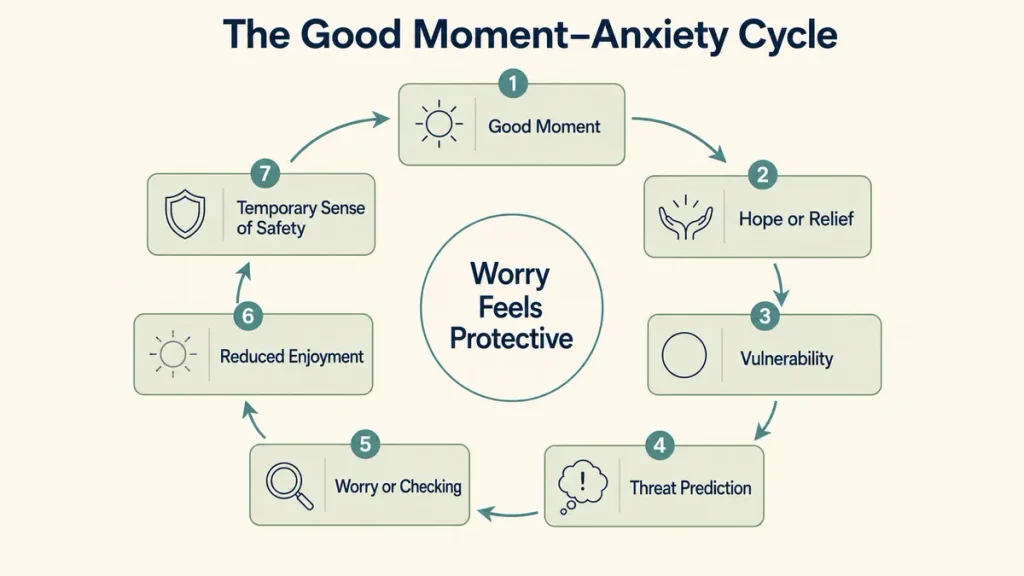
The Good Moment-Anxiety Cycle
These five reasons often form a cycle. Something positive creates vulnerability. The mind predicts loss or disappointment. You worry, check or minimise. The positive feeling weakens, and that reduction feels safer.
The relief is important. When worry reduces vulnerability, the mind may conclude that worry helped. It is then more likely to return during the next peaceful moment.
Recognising the cycle gives you a place to intervene. You may not control the first anxious thought, but you can learn not to treat every protective prediction as an instruction.
How to Stop Feeling Anxious When Things Are Going Well
You may not be able to prevent the first anxious thought. But you can change what happens next.
The aim is to experience what is good now without suffering in preparation for every possible ending.
If worry has protected you for years, telling yourself to relax may not help. Your mind needs small, repeated experiences of calm that do not immediately become another problem to solve.
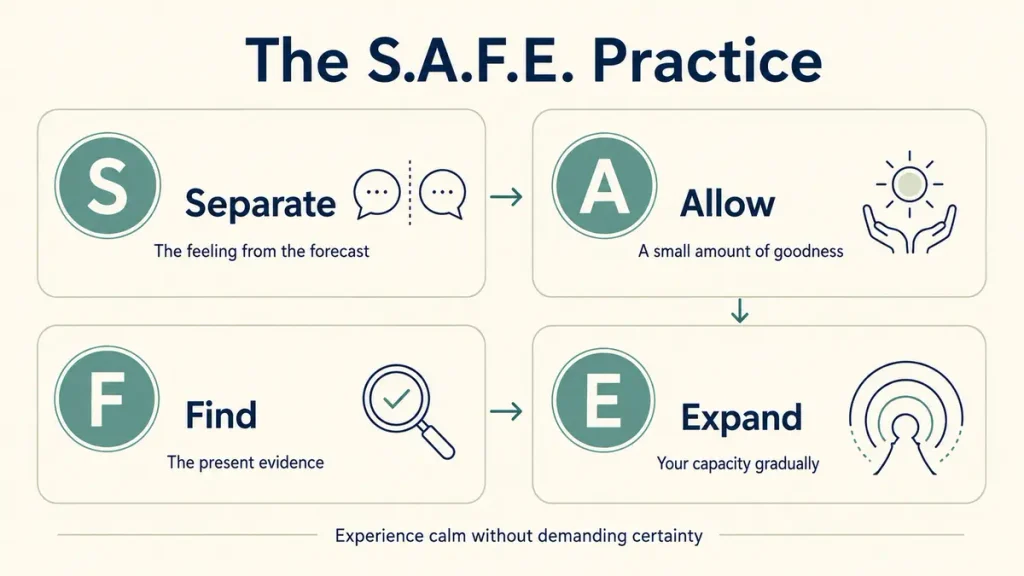
The S.A.F.E. Practice
S – Separate the Feeling From the Forecast
Begin by naming what is happening.
Try putting the experience into two sentences: “I feel anxious right now” and “My mind is predicting that something bad will happen.”
The first sentence describes a real feeling. The second describes a forecast. “I feel unsafe” and “I am unsafe” do not always mean the same thing.
Suppose your partner takes longer than usual to reply. Your mind predicts that they are losing interest. Before reacting, you might say, “I feel afraid of disconnection. My mind is interpreting one delayed reply as rejection.”
This does not dismiss your fear. It prevents fear from becoming an unquestioned conclusion. These emotional regulation skills can also help you pause before reacting.
A – Allow a Small Amount of Goodness
You do not have to feel completely happy. Allow a small amount of what is good.
Pause for 10 or 20 seconds. Notice one detail: warmth in someone’s voice, relief after completing a task, comfort in a peaceful room or pride after receiving appreciation.
Do not explain the feeling or predict how long it will last. You might simply say, “This is good right now. I am allowed to notice it.”
This is a form of savouring. It involves attending to a positive experience rather than immediately dampening it. Research on savouring and worry supports practising positive emotion instead of treating it as unsafe.
Savouring is not forced gratitude. It does not deny difficulty. It allows a real positive experience to receive some attention.
F – Find the Present Evidence
Anxiety pulls attention towards what might happen. Bring some attention back to what is happening.
Ask: What facts are available? Is there a specific problem requiring action? Am I responding to this situation or remembering another one? What would a proportionate response look like?
Imagine that work is going well, but you fear being dismissed. Your recent work was appreciated, and no concern has been raised. The fear may remain, but present evidence does not support it.
This should not become compulsive checking. You do not need perfect proof that everything is safe. Look for enough information to decide whether action is required. If no action is needed, allow some uncertainty to remain.
Repeatedly asking others to guarantee that everything is fine may bring short relief but make uncertainty harder to tolerate. The psychology behind constant reassurance seeking explains why.
E – Expand Your Capacity Gradually
Feeling safer during good times rarely comes from one powerful insight. It develops through small experiences that challenge the old emotional rule.
Accept a compliment without minimising it. Share good news with someone you trust. Celebrate a small achievement before discussing the next goal. Enjoy closeness without asking for repeated guarantees. Notice an anxious prediction without cancelling a meaningful plan.
The purpose is not permanent positivity. It is showing your mind that happiness, calm and uncertainty can exist together.
Recent research found that greater psychological flexibility was associated with lower fear of happiness. Being able to experience thoughts and emotions without rigidly avoiding them may make positive feelings less threatening. Read the 2026 study in Frontiers in Psychology.
Progress may look modest. You remain with a happy moment a little longer, notice a catastrophic prediction without checking your phone, or allow someone’s affection to feel genuine for today. These are meaningful changes.
What Not to Do When Happiness Makes You Anxious
Do not force yourself to feel grateful. Gratitude becomes another burden when it is used to silence anxiety.
Do not shame yourself for “ruining” a good moment. Self-criticism adds another layer of distress.
Try not to demand absolute certainty from other people. No amount of reassurance can permanently settle a fear built around uncertainty.
Do not treat every uneasy feeling as intuition. Anxiety often creates possibilities without enough present evidence.
Most importantly, do not make perfect enjoyment your new goal. You are allowed to feel happiness and apprehension together. Emotional growth is the ability to remain connected with your life even when anxiety briefly appears.
When Anxiety During Good Times May Need More Attention
Consider professional support when anxiety repeatedly disrupts meaningful experiences, affects sleep or concentration, leads to persistent checking, makes you avoid opportunities or connects with painful memories.
A qualified mental-health professional can explore whether the pattern is related to chronic anxiety, unresolved grief, trauma, depression or another concern. Cognitive behavioural therapy may help with catastrophic predictions. Acceptance-based approaches can build psychological flexibility. Trauma-informed therapy may be appropriate when present calm activates specific past experiences.
Not everyone who feels uneasy during happiness has a mental-health condition. The level of distress and disruption matters more than the occasional presence of an anxious thought.
Frequently Asked Questions
Is it normal to feel anxious when things are going well?
Yes. Occasional anxiety during a peaceful or positive period can happen. Happiness may create uncertainty, vulnerability or fear of loss. The reaction deserves more attention when it becomes persistent or interferes with relationships, work, sleep or daily life.
Why am I always waiting for something bad to happen?
Anticipation may feel safer than being emotionally surprised. Past unpredictability, chronic worry or fear of disappointment can teach the mind to remain prepared. The feeling of danger is real, but it does not necessarily mean that danger is present.
Does feeling anxious during happiness mean I have trauma?
Not necessarily. Trauma can make calm feel unsafe, but it is only one possible explanation. General anxiety, recent stress, fear of loss, perfectionism and unfamiliar change can also contribute. A single reaction cannot establish whether someone has experienced psychological trauma.
Is fear of happiness a mental illness?
Fear of happiness is a researched psychological pattern, but it is not a standalone diagnosis in major diagnostic manuals. It describes discomfort, guilt or anxiety associated with positive feelings. Its meaning differs from one person to another.
How can I stop feeling anxious when good things happen?
Separate your emotion from its prediction. Notice a good experience in small amounts. Check present evidence without demanding complete certainty. Then practise receiving compliments, enjoying calm and celebrating progress without immediately minimising them. The S.A.F.E. Practice can guide these steps.
Final Perspective: Calm Does Not Require a Guarantee
If you keep asking, “Why do I feel anxious when things are going well?”, the answer may not be that you are incapable of happiness. Your mind may be trying to protect you from uncertainty, disappointment or loss.
You do not need to guarantee that a good moment will last forever before allowing yourself to experience it.
Something can be meaningful even if it is temporary. Calm can be real even when the future remains uncertain. You can remain thoughtful and prepared without living as though trouble has already arrived.
Learning to trust peaceful moments takes time. Begin with this one. Let something good be good for today.
A Gentle Note

This article is intended for psychological education and self-reflection. It does not provide a diagnosis or replace personalised advice, assessment or treatment from a qualified mental-health professional. If anxiety is persistent, distressing or interfering with daily life, consider seeking appropriate professional support.