
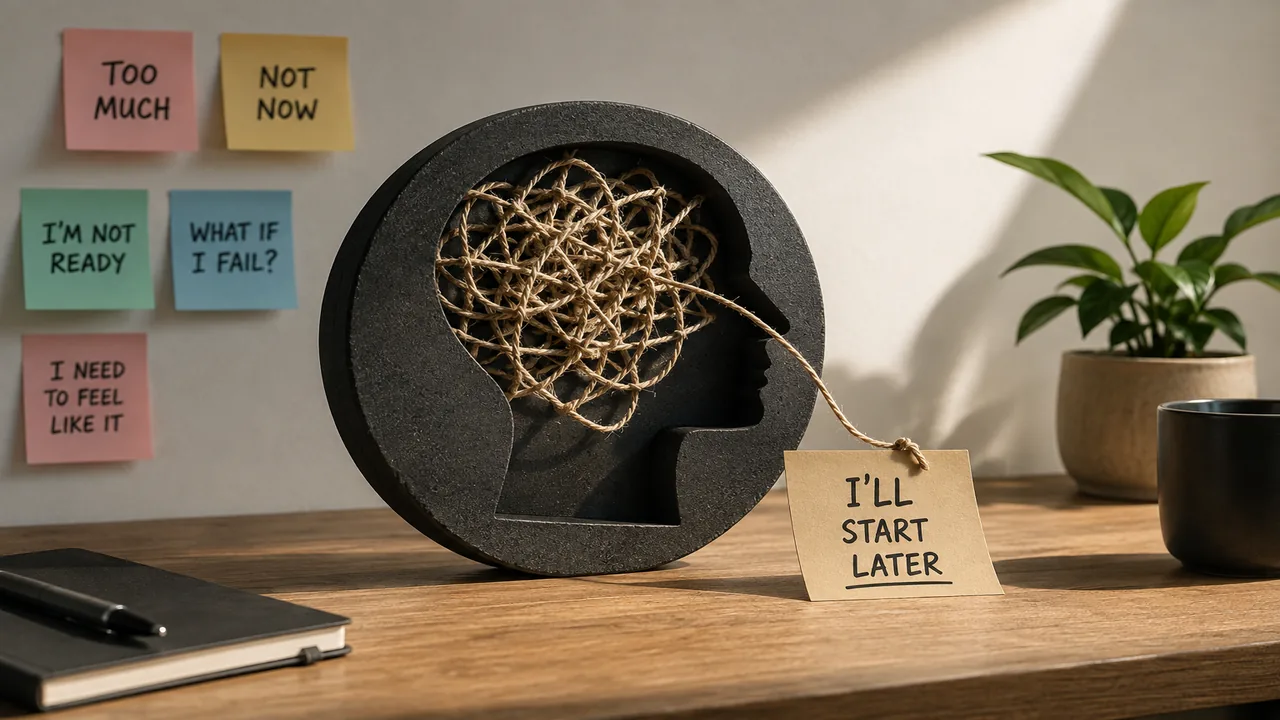
You sit down knowing exactly what needs to be done. Maybe there is a report waiting on your laptop, an exam you genuinely want to prepare for, an email you have been meaning to answer, or a personal project you were once excited to begin.
You open the document. Read the first few lines. Then, almost without thinking, you check a notification. While you’re there, you remember another small task that suddenly seems surprisingly important. Perhaps you tell yourself you’ll start properly after lunch, after another cup of tea, or when your mind feels a little clearer.
And somehow, another hour disappears.
The frustrating part is that you wanted to get the work done. You haven’t forgotten the deadline. You understand the consequences. You may even have spent much of the day thinking about the task you weren’t doing.
That’s when procrastination can become personal.
Why do I procrastinate when I genuinely want to get things done? Why can’t I just start? Am I lazy, undisciplined—or simply bad at managing my time?
Psychology offers a more useful answer.
Table of Contents
You can be ambitious and still procrastinate. You can care deeply about a goal and avoid working toward it. In fact, sometimes the things that matter most are difficult to begin precisely because they matter. They bring expectations, uncertainty, the possibility of failure, or pressure to perform well.
That contradiction sits at the heart of the psychology of procrastination: wanting the result doesn’t automatically make the process of getting there feel easy.
Sometimes the real obstacle isn’t the task sitting in front of you.
It’s what happens inside you when you think about starting it.
Quick Answer: Why Do I Procrastinate Even When I Want to Get Things Done?
Procrastination often happens because your long-term goals compete with immediate discomfort or reward. A task may matter deeply while still feeling boring, overwhelming, uncertain or emotionally threatening. Delaying it can provide temporary relief, which is why psychologists often understand procrastination as a self-regulation problem rather than simply laziness, poor discipline or bad time management.
Factors such as task aversiveness, low confidence in your ability to succeed, impulsiveness, distant rewards, emotional avoidance and difficulty tolerating task-related discomfort can all contribute.
So, if you keep procrastinating despite genuinely wanting to change, a more useful question may be, ‘What makes starting this particular task psychologically difficult for me?’
The answer can tell you much more than blaming yourself for not having enough willpower.
What Procrastination Really Means
We often use procrastination to describe almost any delay. Psychologically, however, postponing something is not automatically procrastination.
Suppose you have an important financial decision to make but deliberately wait because additional information is arriving. Or perhaps you postpone a difficult conversation until tomorrow because you are angry and want to approach it more thoughtfully. These can be sensible forms of delay because waiting serves a purpose.
So where does ordinary delay become procrastination? One influential psychological definition describes procrastination as voluntarily delaying an intended action despite expecting to be worse off because of the delay. Put more simply: you meant to do something; you know postponing it probably isn’t helping—and you postpone it anyway.
Consider a presentation due next week. If you deliberately schedule Wednesday afternoon to work on it because Monday and Tuesday contain more urgent responsibilities, that is planning. But if Wednesday arrives, you open the presentation, feel uncomfortable about where to begin, close it and spend the next hour doing less important things while telling yourself you will feel more prepared tomorrow; the psychology has changed.
The delay may now be helping you escape the discomfort associated with beginning.
You can even procrastinate while appearing extremely productive. Clearing your inbox, organising files, answering routine messages or cleaning your workspace may all be useful activities. But if they repeatedly replace the more important task you intended to complete, busyness can become another form of avoidance.
This is one reason procrastination can be surprisingly difficult to notice. You may reach the end of the day having done twelve things and still feel uneasy because you know the one thing that really mattered is still untouched.
Procrastination Is Not the Same as Laziness
People who repeatedly procrastinate often use surprisingly harsh language about themselves: I’m lazy. I have no discipline. I always waste time.
Yet procrastination and laziness are not the same experience. Procrastination frequently contains a noticeable gap between intention and behaviour. You want to act and believe you should act and may continuously worry about not acting—yet you still delay.
Imagine two people who have not started exercising. One thinks, Exercise isn’t something I want to prioritise right now. The other has been planning to exercise for weeks, feels disappointed each evening for not starting and repeatedly promises that tomorrow will be different. Their outward behaviour may look similar, but internally they are experiencing very different conflicts.
Calling yourself lazy can therefore close the door on useful self-understanding. A label tells you what you supposedly are. Psychology asks what processes are influencing what you do.
Understanding this doesn’t mean giving yourself a free pass. The report still needs writing. The application still needs to be submitted. But there is a big difference between saying “I’m lazy” and understanding “I keep avoiding this because I’m afraid I’ll get it wrong.” The second gives you something you can actually work with.
The Procrastination Paradox: Wanting the Result but Avoiding the Process
Here lies the central puzzle: if something genuinely matters to us, why would we behave in ways that make achieving it more difficult?
Part of the answer involves self-regulation—our ability to guide thoughts, emotions and behaviour toward goals that may not provide immediate rewards. We rely on self-regulation whenever we study instead of choosing entertainment, save rather than spend immediately, or finish tedious work because its longer-term consequences matter.
Psychologist Piers Steel’s influential meta-analysis of procrastination research described procrastination as a form of self-regulatory failure. Across 691 correlations, the review identified factors including task aversiveness, task delay, self-efficacy and impulsiveness among the stronger and more consistent predictors of procrastination.
But sometimes the immediate reward for procrastinating isn’t entertainment at all. It is relief.
Researchers Fuschia Sirois and Timothy Pychyl have examined the relationship between procrastination and short-term mood regulation. Their work suggests that when a task feels aversive, procrastination can serve as a way of regulating unpleasant feelings in the short term—even though the consequences are eventually passed on to our future selves.
Imagine opening an application for a job you genuinely want. Almost immediately, you wonder whether your experience is good enough. You struggle with what to write and think about possible rejection. You close the application and decide to finish tomorrow. Your career goal has not changed, but your immediate discomfort has.
This gives us an important starting point: sometimes we are not simply avoiding work. We are trying to change how the work makes us feel.
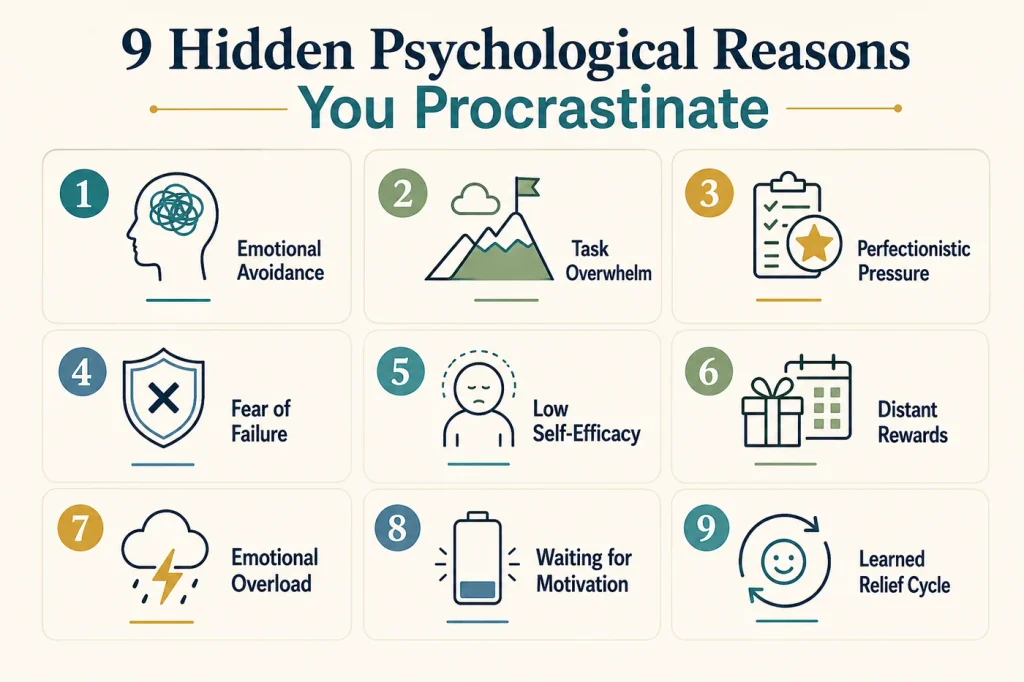
9 Hidden Psychological Reasons You Procrastinate
The same behaviour can serve very different psychological purposes. You might postpone one task because it is boring, another because it is overwhelming, and another because completing it exposes you to judgement.
You may recognise several of the following patterns rather than just one.
1. You May Be Avoiding the Feeling, Not the Task
Consider an important email you have postponed for three days. Writing it might take ten minutes, yet every time you see it, you decide to answer later. Perhaps it requires you to explain a mistake, set a boundary or deal with someone’s possible disappointment.
You may not really be avoiding ten minutes of typing. You may be avoiding anxiety, embarrassment or uncertainty.
Tasks are rarely emotionally neutral. Studying can remind you how much you don’t know. Applying for a job creates the possibility of rejection. Beginning a personal project can expose the gap between what you imagine creating and what you can produce today.
When avoidance reduces those feelings temporarily, procrastination can function as short-term mood repair. The cost is postponed rather than removed. Tomorrow, the task remains, often carrying additional guilt or urgency.
The next time this happens, don’t immediately ask yourself why you are being so unproductive. Try a different question: “What feeling appears when I imagine beginning?”
You might be surprised by the answer. Sometimes beneath “I don’t feel like doing it” sits something much more specific: I’m afraid I’ll do it badly. I don’t know where to begin. I don’t want to deal with that conversation. I feel overwhelmed.
Now you have something more useful than a label.
2. The Task Feels Too Big, Vague or Overwhelming
There is a psychological difference between “finish this project” and “write the first three bullet points”.
The first forces your mind to represent an entire project at once: research, decisions, writing, revisions and possible problems. The second gives your brain a concrete action.
This connects with task aversiveness, or how unpleasant and undesirable a task feels. Steel’s meta-analysis identified task aversiveness as one of the important predictors of procrastination. An objectively simple task can still become aversive because it is boring, confusing, emotionally uncomfortable or poorly defined.
Consider “I need to sort out my finances.” Does that mean checking accounts, creating a budget, paying bills, reviewing investments or cancelling subscriptions? Several actions have been compressed into one vague instruction.
This happens with everyday tasks too. ‘Clean the house’ sounds like one task until your mind starts calculating the kitchen, laundry, cupboards, paperwork and everything else you’ve been postponing. Suddenly, sitting down for five minutes feels strangely appealing.
When you don’t know where to begin, sometimes you simply don’t begin anywhere.
Often, you don’t need to make the whole task easy. You need to make the first action visible.
3. Perfectionism Can Make Starting Feel Risky
The relationship between perfectionism and procrastination is more complicated than simply saying that perfectionists delay everything.
A meta-analysis examining multidimensional perfectionism and procrastination found an important distinction: perfectionistic concerns were positively associated with procrastination, while perfectionistic strivings showed a negative association. In other words, wanting to do something well is not necessarily the problem; excessive concern about mistakes, judgement and not being good enough may be more relevant.
Imagine trying to write something important while expecting the opening paragraph to be excellent immediately. The blank page is no longer simply somewhere to begin; it becomes somewhere you can fail.
So you research more, rearrange notes, improve the formatting or wait for the right mood. Preparation is often useful, but sometimes it becomes a comfortable way of remaining close to a task without risking an imperfect attempt.
A useful question is: “Am I avoiding the work, or am I avoiding seeing myself do it imperfectly?”
Your first attempt is allowed to look like a first attempt. Sometimes that permission is exactly what gets the work moving.
4. Fear of Failure Can Make Delay Feel Safer
Suppose you want to apply for a promotion but repeatedly delay submitting the application. Beneath “I need more time to improve it” may sit another possibility: submitting means allowing someone else to decide whether you are good enough.
As long as the application remains unfinished, rejection remains hypothetical.
And there is a strange kind of safety in almost trying. You can still imagine that you might have succeeded if you’d really gone for it.
Procrastination can sometimes provide another form of psychological protection. If you study at the last minute and perform badly, you can tell yourself, I would have done better if I’d started earlier. Your ability was never completely tested.
A related psychological concept is self-handicapping, in which obstacles can provide an alternative explanation for disappointing performance. This does not mean procrastinators consciously manufacture excuses. The process can be subtle and coexist with genuine frustration about delaying.
Fear becomes especially powerful when performance and identity become fused. ‘I didn’t succeed at this’ turns into ‘I am not capable’.
A healthier distinction is to allow an outcome to provide information about your preparation, strategy or developing skills without turning it into a verdict on your worth.
5. Low Self-Efficacy Can Make Starting Feel Pointless
Psychologist Albert Bandura developed the concept of self-efficacy to describe beliefs about our capacity to carry out actions needed to produce particular outcomes. His foundational paper on self-efficacy and behavioural change became an important part of how psychology understands the relationship between perceived capability, effort and persistence.
In everyday language, self-efficacy asks, ‘Do I believe I can handle this?’
Think about the difference between approaching a difficult assignment with “This is going to take some work, but I’ll figure it out” and approaching it with “I’m terrible at this; I’ll probably mess it up anyway.”
Same assignment. Very different starting point.
The task hasn’t changed. Their expectation of themselves has.
Lower self-efficacy has also been associated with greater procrastination in the broader procrastination literature. Unfortunately, delay can then reinforce the original belief. You postpone studying, prepare hurriedly, perform below your potential and conclude that you are bad at the subject. The next assignment arrives carrying even less confidence.
The cycle becomes:
Low confidence → avoidance → rushed performance → disappointing result → lower confidence
Credible confidence doesn’t require telling yourself that you can do anything. It grows from evidence. Completing one manageable action can begin changing “I can’t handle this” into “I’ve already started handling this.”
6. Immediate Relief Can Beat Distant Rewards
Imagine an exam three weeks from now. Studying tonight contributes to a future result. Your phone or favourite show provides enjoyment within seconds.
Intellectually, you know which choice serves your long-term goal. Psychologically, immediate and delayed rewards do not always carry equal weight.
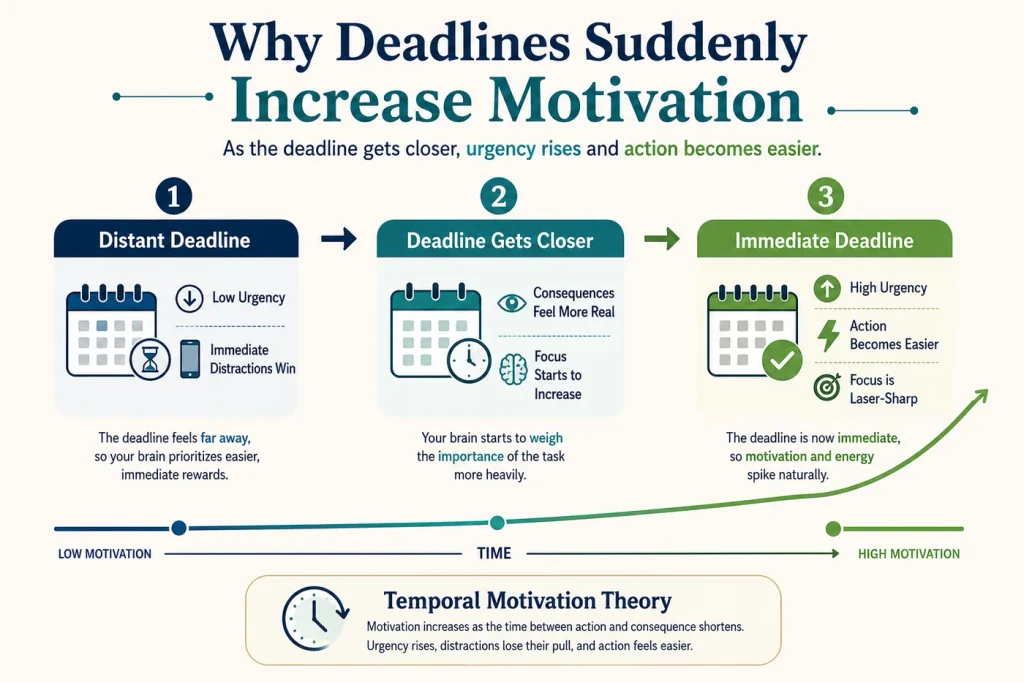
This relates to temporal discounting and temporal motivation theory. Steel’s meta-analytic review found its overall pattern of results consistent with temporal motivation theory, which integrates factors such as expectancy, value, delay and sensitivity to immediate alternatives.
This helps explain a familiar mystery. You make little progress for two weeks and then, the night before the deadline, suddenly concentrate for hours.
You haven’t acquired a different personality overnight. What changed was the psychological distance of the consequence. Three weeks ago, the exam belonged to your future self. Tonight, it belongs very much to you.
This is why “I work better under pressure” can sometimes be misleading. You may not actually perform better under pressure. You may simply find it much easier to start once the consequences become impossible to ignore.
7. Stress and Emotional Overload Can Make Small Tasks Feel Heavy
There are days when a normally manageable task feels unusually difficult. You may already have spent hours making decisions, responding to other people’s needs and carrying several unresolved concerns in the background.
Then another responsibility appears, and your mind responds, ‘Not one more thing.’
It might even be something tiny—booking an appointment, replying to a message, completing a form. On another day, you would probably finish it without thinking. Today it somehow feels enormous.
Procrastination does not occur separately from the rest of our emotional lives. Research has linked difficulties with emotion regulation to procrastination. More importantly, a randomised controlled study found that strengthening emotion-regulation skills to address procrastination reduced subsequent procrastination among the university students studied.
This doesn’t mean every difficult day should become an excuse for avoidance, nor does ordinary procrastination automatically indicate a psychological condition. It simply means context matters.
If tasks that are usually manageable suddenly feel impossible to approach, it may be worth asking not only “Why am I so undisciplined?” but also “How much psychological load am I already carrying?”
8. You May Be Waiting for Motivation Before You Begin
One of procrastination’s most convincing promises is ‘I will do it when I feel more motivated.’
Unfortunately, motivation doesn’t always arrive before action. Sometimes action helps create motivation.
Getting dressed for exercise may feel difficult, but continuing after ten minutes of walking can feel easier. The blank page can be intimidating, while editing three sentences you have already written feels more manageable.
We often imagine motivation as fuel that must fill the tank before the journey begins. In reality, behaviour and motivation can influence each other. Small progress provides feedback, creates momentum and makes the next action easier to see.
This doesn’t mean emotions should be ignored. It means ordinary boredom, uncertainty or lack of enthusiasm does not always need to disappear before action becomes possible.
You don’t necessarily need enough motivation to finish. Sometimes you need only enough to begin.
9. Procrastination Can Become a Learned Relief Cycle
You open a difficult document and immediately feel uncomfortable. Before you’ve consciously decided to stop working, your hand is already reaching for your phone. Ten minutes later, you’re watching something completely unrelated—and you feel a little better. A few minutes later, the anxiety decreases because your attention has shifted elsewhere.
Something important has happened: avoidance removed an unpleasant experience.
Behavioural psychology describes this mechanism as negative reinforcement. Here, “negative” doesn’t mean bad; it means that something unpleasant has been removed. When a behaviour reliably reduces discomfort, that behaviour can become more likely to occur again.
Over time, you may not consciously decide to procrastinate. You open the document, feel familiar discomfort and find yourself checking messages almost automatically.
The long-term consequences—stress, rushed work and guilt—arrive later. The emotional reward for avoiding the task arrives immediately.
That is how procrastination can gradually become a learned behavioural loop.
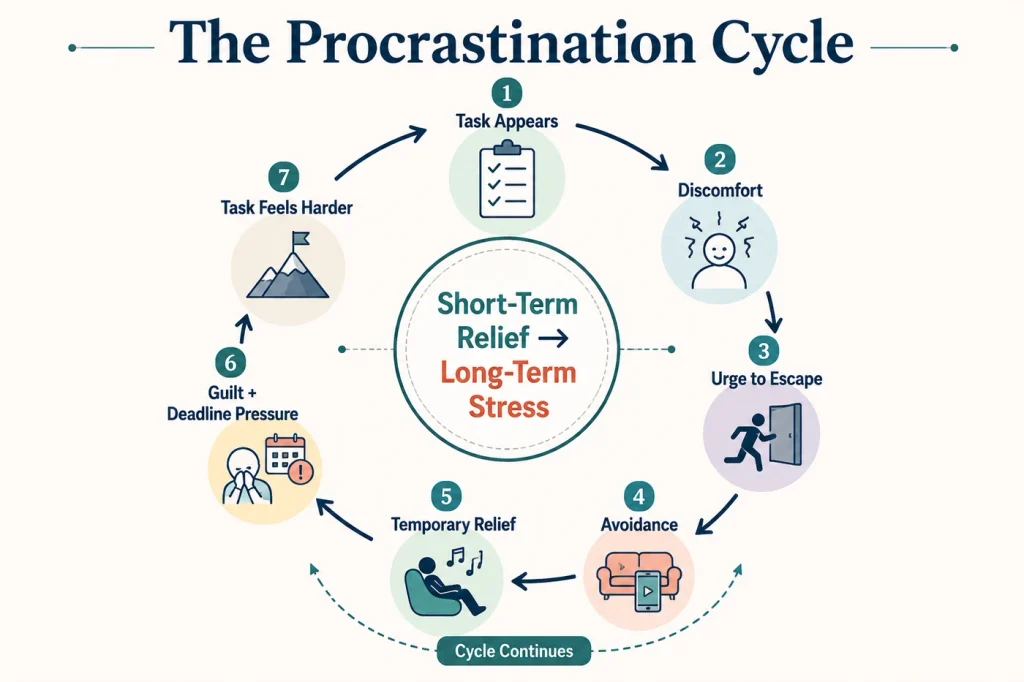
The Hidden Procrastination Cycle
We can now put these processes together.
A task appears and creates discomfort. Perhaps it feels overwhelming, boring, uncertain or threatening. You experience an urge to escape and move toward something easier. The discomfort decreases, producing temporary relief.
But the unfinished task remains.
When you return later, there is less time available. Guilt, self-criticism or deadline pressure may have been added to the original difficulty. The task now feels even more aversive, increasing the temptation to avoid it again.
The pattern becomes:
Task → Discomfort → Urge to Escape → Avoidance → Temporary Relief → Guilt or Deadline Pressure → Greater Task Aversiveness → Stronger Urge to Avoid
And this is the frustrating logic of procrastination: in the moment, avoiding the task can actually work.
You feel better.
The problem is that tomorrow you inherit both the original task and the consequences of today’s relief.
It also explains why harsh self-criticism may not solve it. If “Why do I always do this? I’m hopeless” adds more unpleasant emotion to the task; it can unintentionally make approaching the task even harder.
The useful question becomes, ‘Where can I interrupt the cycle?’
Why Deadlines Suddenly Make You Productive
For days or weeks, you struggle to make progress. Then the deadline becomes dangerously close, and suddenly you can focus for hours.
As we saw through temporal motivation theory, one reason is that the consequences have moved psychologically closer. The presentation is no longer something your future self needs to finish. It needs to be finished tonight.
Urgency increases motivation.
The danger comes when successful last-minute rescues teach us that the strategy works. You delay, panic, finish just in time and experience enormous relief. When the next deadline arrives, part of you remembers that you survived last time.
But repeatedly depending on crisis-level urgency can come at a cost: greater stress, disrupted sleep, inconsistent quality and little room for unexpected problems.
There is an important difference between benefiting from a reasonable deadline and needing panic before you can act.
The Emotional Cost of Repeated Procrastination
One of the less obvious costs of procrastination is that postponing a task doesn’t necessarily make it disappear from your mind.
You can be watching a film and still remember the report. You can go out for dinner and suddenly think about the email you haven’t answered. You can spend Sunday trying to relax while Monday’s unfinished work quietly follows you around.
So procrastination can steal time twice: first from the task itself, and then from the moments that were supposed to be free from it.
Repeated delay can also affect self-trust. Each morning you say, I’ll start today, and each evening you discover that you didn’t. Eventually, your own promises may stop feeling credible.
That erosion matters because what began as a behaviour can slowly become a belief: I never finish things. I can’t stay consistent. I’m terrible at managing my time.
Breaking procrastination is therefore not simply about extracting more productivity from your day. It is also about rebuilding a dependable relationship between intention and action.
Procrastination vs. Laziness vs. Low Motivation vs. Task Paralysis
By this point, you may recognise yourself in several of these patterns. But there is another distinction worth making, because “I can’t get started” doesn’t always mean the same thing.
These terms are often used interchangeably, even though they may describe different experiences.
| Experience | What It May Feel Like | What May Be Happening Underneath |
| Procrastination | “I want or need to do this, but I keep putting it off.” | An intended action is repeatedly delayed despite expected consequences. Emotional avoidance, task aversiveness or other self-regulation difficulties may contribute. |
| Laziness or unwillingness to exert effort | “I could do it, but I don’t want to put effort into it.” | There may be relatively little intention or internal conflict about pursuing the task. “Laziness” is an everyday description, not a diagnosis. |
| Low motivation | “I know what needs to be done, but I feel little reason or energy to do it.” | The goal may currently feel low in value, reward, meaning or urgency, although many other factors can contribute. |
| Task paralysis | “I want to start, but I feel unable to move.” | The task may feel cognitively or emotionally overwhelming, unclear or difficult to organise into a manageable first action. The term is descriptive rather than diagnostic. |
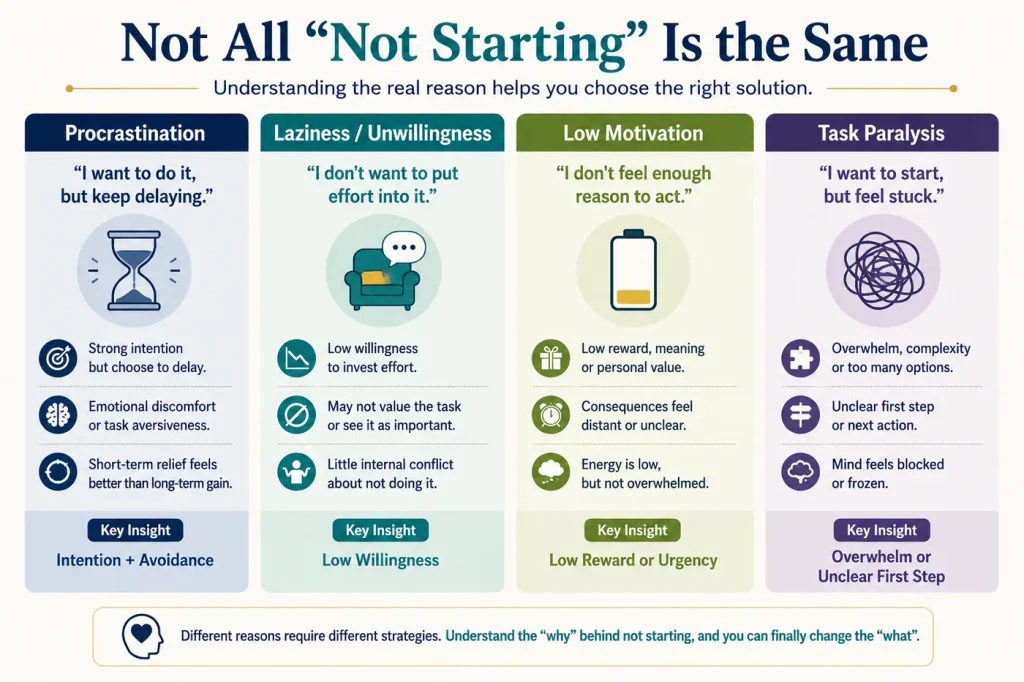
These aren’t rigid categories. Several processes can operate together. A vague task can create overwhelm, repeated avoidance can increase anxiety, and growing anxiety can make the task even harder to approach.
The visible behaviour—not starting—is only the surface. What makes starting difficult determines what is most likely to help.
When Procrastination May Need More Attention
Occasional procrastination is a common human experience. It deserves closer attention when it becomes persistent, difficult to control and repeatedly interferes with daily functioning—for example, when deadlines are routinely missed, academic or professional performance suffers, important financial responsibilities remain unattended, or sleep is repeatedly sacrificed to last-minute work.
Procrastination can occur alongside difficulties involving anxiety, mood, attention or executive functioning. People with ADHD, for example, may experience challenges involving task initiation, attention regulation, organisation and sensitivity to immediate rewards. Significant anxiety may also encourage avoidance of tasks associated with uncertainty or evaluation.
But procrastination by itself does not establish ADHD, an anxiety disorder, depression or any other psychological condition.
Online discussions sometimes turn common behaviours into informal diagnostic checklists. A proper assessment considers a much broader pattern, including severity, duration, developmental history and how difficulties affect different areas of life.
If procrastination is causing substantial distress or persistently disrupting work, studies, relationships, finances or everyday responsibilities despite serious efforts to change it, discussing the pattern with a qualified mental health professional may be worthwhile.
For many people, however, the next step is simpler: stop treating procrastination solely as a battle of willpower and start changing the conditions that make avoidance so attractive.
How to Stop Procrastinating Without Fighting Yourself
Once you understand the mechanism, the practical question changes from “How can I force myself to work?” to “What would make this task easier to approach and harder to avoid?”
That sounds like a small shift, but it changes the tone of the conversation you are having with yourself. You are no longer standing over yourself demanding productivity. You are looking at the situation more like a problem to solve.
The strategy should match the reason. If the task is vague, create clarity. If perfectionism is keeping you stuck, lower the standard required for the first attempt. If you are avoiding anxiety, a better calendar alone may not solve the problem.
Identify What You Are Actually Avoiding
Before trying to become more productive, notice what happens when you think about the task.
Ask yourself: “If I had to begin this right now, what would feel most uncomfortable?”
Don’t rush the answer. Perhaps it is boredom. Perhaps you don’t understand what to do first. Maybe you’re worried someone will judge the result. Or perhaps the task itself is manageable, but one uncomfortable part—a phone call, a decision, a difficult paragraph—is holding up everything else.
Make the Starting Point Smaller Than the Goal
Large goals often make poor instructions.
Finish the report. Prepare for the exam. Organise my finances.
Instead, define one action: create the document and write three headings, answer five practice questions, and download last month’s bank statement.
You are not pretending that the entire project is small. You are separating starting from completion.
Before you begin, your mind is dealing with an imagined task containing every possible difficulty. Once you begin, you are dealing with something concrete.
Ask: “What is the smallest meaningful action that would count as beginning?”
Want to finish the tax return—find the documents.
Want to write the article—open the document and sketch three headings.
Want to get fit—put on your shoes and walk for ten minutes.
Small doesn’t mean meaningless. It means easy enough to enter.
Stop Waiting for Motivation
If action depends on feeling sufficiently motivated beforehand, your emotional state becomes the gatekeeper of your behaviour.
Lower the motivation required to start. You may not feel ready for two hours of study, but perhaps you can begin with ten minutes. You may not feel capable of writing the whole section, but you can produce a rough paragraph.
Progress itself can create engagement.
Don’t ask for motivation to carry out the entire task. Ask it only to help you cross the starting line.
Make Progress More Immediate
Many important goals reward us slowly while distractions reward us immediately.
Make smaller accomplishments visible. Define what a successful work session means before beginning. Reduce effortless distractions by moving your phone away, closing unnecessary tabs or turning off non-essential notifications.
The aim is not to create a perfectly controlled environment. It is to give the behaviour you value a slightly better chance of competing with the easy reward available now.
Use Time as an Entry Point, Not a Threat
Rather than “I must finish this tonight”, try “I’ll work on the first section for 15 minutes.”
A defined period has a visible end. An entire unfinished project may not.
If momentum develops, continue. If you stop after the agreed period, you have still practised beginning without waiting for emergency-level urgency.
Learn to Stay With Some Discomfort
When discomfort appears, notice it without automatically treating it as an instruction to leave.
‘I am feeling uncertain’ is different from ‘I can’t work while I feel uncertain. Similarly, ‘This is boring’ is different from ‘I have to stop because I’m bored.’
The goal isn’t to push through overwhelming distress. It is to build tolerance for the ordinary discomfort that accompanies meaningful effort. Each time you remain engaged a little longer instead of immediately escaping, you weaken the automatic connection between discomfort and avoidance.
Developing these kinds of emotional regulation skills can be useful far beyond procrastination because the ability to notice and manage difficult emotions influences how we respond across many everyday situations.
Replace Self-Criticism With Useful Accountability
There is a difference between accountability and attacking yourself.
“I wasted another evening because I’m hopeless” is criticism.
“I kept avoiding the report because I didn’t understand how to structure the first section” is information.
Information gives you somewhere to go next.
Useful accountability asks what happened, what maintained the behaviour and what you can modify next time. This isn’t an excuse. It is a more practical form of responsibility.
Build Self-Trust Through Small Follow-Through
If repeated procrastination has weakened trust in your own intentions, don’t try to repair it with bigger promises.
Make smaller promises that you actually keep.
Twenty minutes of work you genuinely complete provides more useful evidence than promising yourself four perfect hours tomorrow and avoiding the task again.
Over time, small experiences of follow-through can rebuild the connection between “I intend to do this” and “I actually began”.
Learning to recover from difficult experiences, adjust your approach and keep moving forward is also part of developing resilience as a life skill.
The S.T.A.R.T. Method: A Psychology-Based Way to Break Procrastination
By now, you have probably noticed that stopping procrastination rarely comes down to one magical productivity trick. Different situations require different responses.
Still, when you’re actually caught in the moment—staring at the task and feeling yourself wanting to escape—you need something simpler than an entire psychology article to remember.
That’s what the S.T.A.R.T. method is for.
It brings the key ideas we’ve explored into five steps you can use when resistance appears.
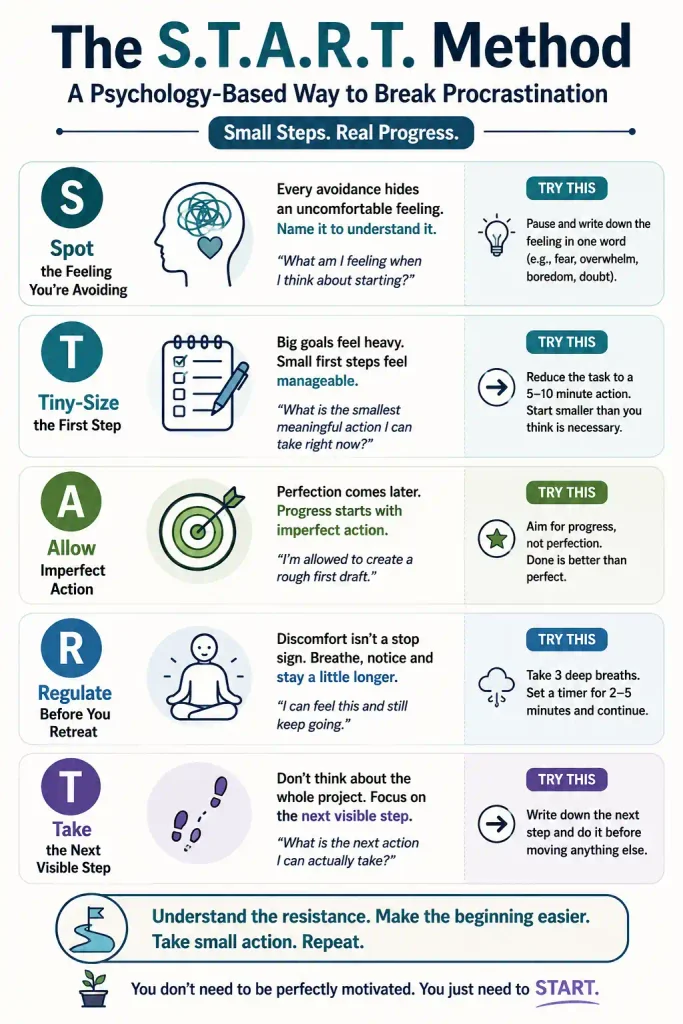
S — Spot the Feeling You’re Avoiding
Ask: “What am I feeling when I think about starting?”
Instead of “I don’t feel like doing this,” you might discover, “I’m worried I won’t do this well enough.” That difference matters because a specific emotion gives you something you can respond to.
T—Tiny-Size the First Step
Reduce the task until the first action becomes concrete.
“Prepare the presentation” might become “Write three headings.” “Study for the exam” might become “answer five questions”.
Tiny-sizing doesn’t lower your ambition. It separates beginning from completing.
A — Allow Imperfect Action
A rough paragraph is allowed to be rough. Your first solution can be wrong. Your initial outline does not need to impress anyone.
Perfectionism often demands final-quality performance during the stage where exploration and mistakes are necessary.
Replace “I need to do this well” with “I need to create something I can improve.”
R — Regulate Before You Retreat
When discomfort appears, pause before automatically escaping.
Notice the tension. Name the emotion. Slow your breathing if helpful, and remain with the task for a little longer.
The aim isn’t to suppress discomfort. It is to experience some discomfort without immediately converting it into avoidance.
T — Take the Next Visible Step
Once you begin, don’t mentally return to the entire project.
Ask: “What is the next action I can actually take?”
“Improve my career” is not visible. “Update the experience section of my resume” is.
“Get healthier” isn’t visible. “Walk for twenty minutes after dinner.”
Progress becomes easier to continue when the next behaviour can be clearly imagined.
What the S.T.A.R.T. Method Looks Like in Real Life
Suppose you have been postponing an important report. You spot the feeling and recognise that you are worried your analysis won’t be good enough. You tiny-size the task to three rough points for the opening section and allow them to be imperfect working notes.
When self-doubt appears and you feel the urge to check your phone, you regulate before retreating by acknowledging the discomfort and remaining with the document for a few more minutes. Then you take the next visible step by turning the first rough point into a paragraph.
You still have work left, but something psychologically important has changed: discomfort appeared, and this time it didn’t automatically end in avoidance.
Repeated often enough, that experience begins teaching a different lesson. Instead of “When this feels uncomfortable, escape”, the new response becomes:
Understand the resistance, make the beginning manageable, and take the next step anyway.
Before we finish, a few questions tend to come up whenever procrastination is discussed—especially around anxiety, ADHD and why some of us seem to need a deadline before our brain finally cooperates.
Frequently Asked Questions About Procrastination
Why do I procrastinate even when something is important to me?
Something can matter deeply and still feel difficult to approach. Important tasks may carry uncertainty, fear of failure, perfectionistic pressure, boredom or concern about judgement. Avoidance can temporarily reduce those feelings, which helps explain why importance alone doesn’t guarantee action.
Sometimes importance actually increases the emotional stakes. Instead of questioning whether you care enough, consider asking what makes starting that particular task uncomfortable.
Is procrastination caused by anxiety?
Anxiety can contribute to procrastination, particularly when a task involves uncertainty, evaluation, difficult decisions or possible failure. Avoidance may temporarily reduce anxious feelings and therefore become tempting.
But not everyone who procrastinates has anxiety. Task aversiveness, low self-efficacy, distant rewards, overwhelm, impulsiveness and learned avoidance can also contribute. Procrastination itself does not establish an anxiety disorder.
Why do I procrastinate until the last minute?
One explanation involves the way motivation changes as consequences become more immediate. A distant deadline may have relatively little motivational pull while immediate distractions remain attractive.
As the deadline approaches, urgency increases and the cost of doing nothing becomes harder to ignore. This can create the feeling that you “work better under pressure”, although depending on last-minute urgency repeatedly can produce significant stress and inconsistent performance.
Is procrastination a sign of ADHD?
Procrastination alone is not enough to determine whether someone has ADHD. ADHD can involve difficulties with attention regulation, executive functioning, organisation, time management and task initiation, which may contribute to procrastination. But people without ADHD procrastinate too.
Diagnosis requires consideration of a much broader and persistent pattern of symptoms, developmental history and impact across different areas of life. Persistent concerns about attention or executive functioning are better discussed with an appropriately qualified professional than inferred from procrastination alone.
How do I stop procrastinating when I feel overwhelmed?
When overwhelm is driving procrastination, trying to mentally complete the entire task can make starting harder. Identify one concrete action that can be performed now.
Instead of “finish the presentation”, try “write the three main headings”. Instead of “study for the exam”, choose one topic or a small set of questions.
You don’t have to convince yourself that the entire project is easy. You need to make the entry point manageable enough to begin.
Conclusion: You Don’t Have to Wait Until You Feel Ready
If you came here asking, “Why do I procrastinate even when I want to get things done?”, I hope one thing is clearer by now: procrastination is rarely explained well by simply calling yourself lazy.
Sometimes you are avoiding the feeling attached to the task. Sometimes the first step is too vague. Sometimes you care so much about doing something well that beginning imperfectly feels uncomfortable. And sometimes your brain simply finds today’s easy reward more convincing than next month’s important outcome.
Knowing the reason doesn’t magically finish the task for you.
But it changes what you can do next.
Instead of “What’s wrong with me?”, you can ask “What am I avoiding here?”
Instead of “I need to finish everything”, you can ask “What’s the next visible step?”
And instead of waiting to feel completely motivated, confident or ready, you can begin while some hesitation is still there.
That may be the most useful lesson in the psychology of procrastination: action and discomfort are allowed to exist at the same time.
You don’t need to become a person who never procrastinates. Most of us will still occasionally postpone something difficult, boring or uncomfortable.
A better goal is to notice the pattern sooner.
Understand what is driving it.
And know how to start again.
Because motivation doesn’t always arrive first.
Sometimes it catches up with you once you’re already moving.
A Gentle Note

The information in this article is intended for educational and informational purposes and is not a substitute for professional mental health assessment, diagnosis or treatment. If procrastination, anxiety, low mood, attention difficulties or emotional distress are significantly affecting your daily life, consider seeking guidance from a qualified mental health professional.
1 thought on “Why Do I Procrastinate Even When I Want to Get Things Done? 9 Hidden Psychological Reasons”