

Work is supposed to provide more than a salary. It can give us purpose, professional identity, financial security and a sense of achievement. Through our work, we develop skills, build relationships and contribute to something that may feel meaningful.
But what happens when this important part of life gradually becomes a source of anxiety?
You may wake up worrying about the day ahead. A simple message from your manager may make you uncomfortable, or a routine assignment may leave you questioning your abilities. You might spend hours thinking about a mistake, replaying a difficult conversation or wondering what your colleagues think about your performance.
Even after leaving the workplace, your mind may remain occupied with unfinished tasks and possible problems. The working day ends, but the emotional pressure continues.
If this experience feels familiar, you are not alone. Workplace anxiety can affect people across professions, experience levels and organisational settings. It does not necessarily mean that someone is weak, incapable or unsuitable for their job.
Table of Contents
Sometimes, anxiety develops through fear of failure, uncertainty or previous negative experiences. At other times, excessive workload, difficult relationships, poor management or job insecurity contribute to the problem. Often, several of these factors interact.
Understanding these influences is an important first step towards managing workplace anxiety. In this article, we will explore its symptoms, psychological causes, effects on professional and personal life, practical coping strategies and the situations in which professional support may be helpful.
What Is Workplace Anxiety?
Workplace anxiety refers to feelings of worry, apprehension, nervousness or fear associated with one’s job, responsibilities or working environment. It may develop around a specific situation, such as an important meeting, performance evaluation or interaction with a manager. For some people, however, the anxiety becomes more persistent and begins affecting their everyday working experience.
Consider two employees preparing for the same performance review. One feels slightly nervous but can prepare and participate comfortably. The other spends several days imagining criticism, questioning their abilities and worrying about possible negative consequences.
The difference is not necessarily their professional competence. It may reflect how they interpret the situation, what they expect to happen and how capable they believe themselves to be of handling the outcome.
Workplace anxiety is a descriptive term, not a clinical diagnosis. Experiencing it does not automatically mean that someone has an anxiety disorder. It is also important to recognise that anxiety can be influenced by both personal psychological processes and actual workplace conditions.
Workplace Anxiety Symptoms: How It Affects Your Mind and Body
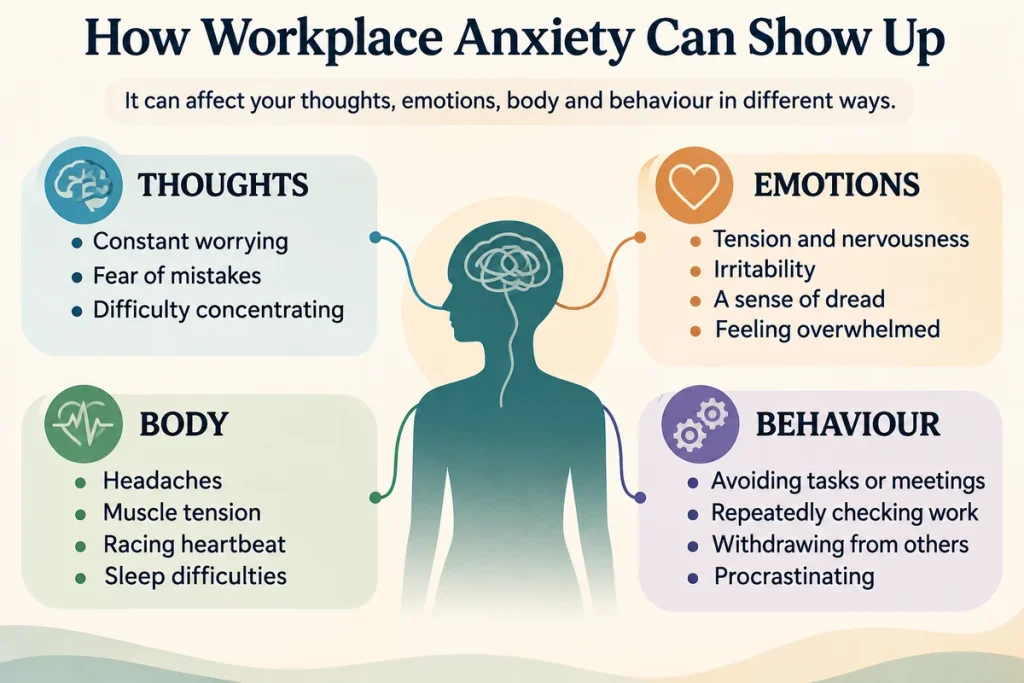
Workplace anxiety does not look the same for everyone. Some people experience obvious nervousness, while others continue working normally but privately struggle with persistent worry. Its effects can appear emotionally, cognitively, physically and behaviourally.
Recognising these different signs can help you understand what is happening rather than dismissing every experience as ordinary work pressure.
Emotional symptoms
You may experience frequent nervousness or apprehension before work, irritability, unusual emotional sensitivity or a persistent fear of criticism and judgement. Some people begin to feel less confident about their professional abilities, while others experience frustration about their responsibilities or relationships.
At times, these emotions appear even when there is no immediate problem. You may find yourself expecting something to go wrong without being able to identify a clear reason.
Cognitive symptoms
Anxiety can influence how you think, concentrate and interpret workplace situations. You may repeatedly worry about possible mistakes, imagine negative outcomes before they happen or find it difficult to make even relatively simple decisions.
Some people replay conversations after meetings, overanalyse emails and messages or repeatedly question whether they have handled a task correctly. For example, a manager may ask you to correct a report. Instead of viewing this as ordinary feedback, you may begin thinking that your professional ability is being questioned.
The original situation may be relatively minor, but the meaning you attach to it can make the experience much more stressful.
Physical symptoms
Workplace anxiety can also be accompanied by physical discomfort. Common experiences include muscle tension, headaches, sweating, trembling, a faster heartbeat, stomach discomfort, restlessness and fatigue. Some people also experience difficulty sleeping, particularly before an important working day.
These symptoms are not specific to anxiety and may have other causes. Persistent, unexplained or concerning physical symptoms should be assessed by a healthcare professional rather than automatically attributed to workplace stress.
Behavioural symptoms
Sometimes, workplace anxiety becomes visible through changes in behaviour. You may begin avoiding meetings or difficult conversations, delaying tasks because you fear making mistakes or checking completed work repeatedly.
Other changes may include seeking constant reassurance, becoming unusually quiet around colleagues, avoiding questions or working excessively to prevent criticism. You may also withdraw from professional opportunities that you would previously have considered.
These behaviours can provide temporary relief. However, when they become repeated responses to anxiety, they may sometimes reinforce the fear and make similar situations more difficult to handle in the future.
Subtle signs people often overlook
Workplace anxiety is not always obvious. You may continue attending meetings, completing assignments and fulfilling your responsibilities while privately experiencing considerable emotional pressure.
For example, you might check work messages repeatedly even when there is no particular reason to do so. You may feel uncomfortable taking breaks, rehearse conversations before speaking or experience unusual relief when a meeting is cancelled.
Another subtle sign is finding it difficult to enjoy weekends because Monday is approaching. You may also continue thinking about work long after the working day has ended.
These experiences do not establish a diagnosis. However, when they become frequent or begin interfering with everyday life, they deserve attention.
Why Do I Feel Anxious About Going to Work Every Day? Anticipatory Anxiety
One particularly difficult experience is feeling anxious before the working day even begins. You may wake up thinking about an upcoming meeting, a difficult colleague, unfinished responsibilities or the possibility of receiving criticism.
This experience is closely related to anticipatory anxiety, which refers to apprehension about something that might happen in the future. Instead of responding only to what is happening in the present, the mind begins preparing for a possible threat before the situation actually occurs.
Imagine that you had an uncomfortable conversation with your manager yesterday. Today, even before reaching the office, you may start wondering whether another confrontation will occur. Your mind might repeatedly ask: What if my manager criticises me again? What if I cannot complete the assignment? What if I make a mistake or something goes wrong during the meeting?
The difficulty is that an imagined situation can begin influencing your emotions as though the threat were already present. You may feel tense, distracted or uncomfortable even though the event you fear has not happened.
How anticipatory anxiety develops
A possible pattern begins with an uncomfortable workplace experience. You remember what happened and start anticipating that a similar situation may occur again. As the next working day approaches, you become increasingly worried, making it harder to relax and recover.
You may then return to work already feeling tense and more sensitive to possible problems. This can make ordinary workplace interactions feel more threatening than they otherwise might.
This pattern does not occur in everyone, but it helps explain why anxiety sometimes begins long before a particular workplace situation.
Why Sundays can feel uncomfortable
Some people experience increased anxiety on Sunday evenings because they are anticipating Monday’s responsibilities. This feeling is often called the Sunday scaries.
It may be associated with unfinished tasks, uncertainty about the week ahead, difficult working relationships or dissatisfaction with the working environment. For some, the discomfort is relatively mild. For others, it becomes a recurring experience that affects their ability to enjoy personal time.
Feeling anxious on Sunday does not automatically mean that you dislike your profession or have a mental health disorder. However, if the feeling becomes intense and recurring, it may be useful to examine what you are anticipating and whether the underlying concerns can be addressed.
What Causes Workplace Anxiety? 6 Psychological and Organisational Factors
There is rarely one explanation for workplace anxiety. A person may experience it because of their thoughts, previous experiences, personal tendencies, working conditions or a combination of these factors.
Two psychological perspectives help explain this relationship. The Transactional Model of Stress and Coping, associated with Richard Lazarus and Susan Folkman, explains how people evaluate potentially stressful situations and their perceived ability to cope with them. The Job Demands–Resources (JD-R) Model examines how demanding working conditions and available workplace resources can influence employee well-being.
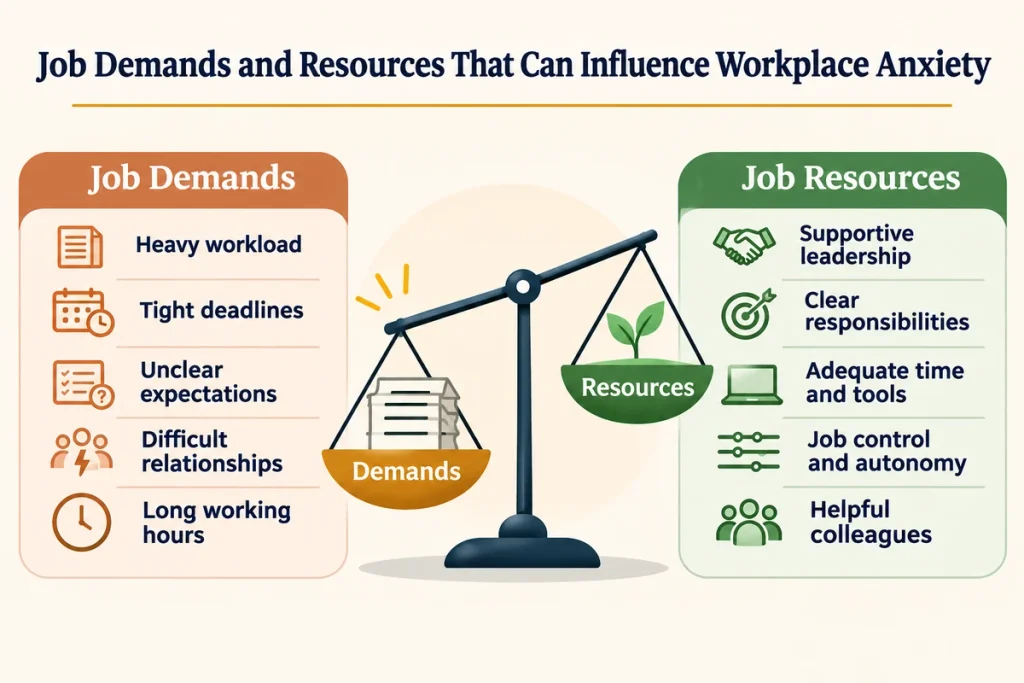
Together, these perspectives help us understand why workplace anxiety should not be treated only as an individual problem. The way a person interprets a situation matters, but the conditions in which they are expected to work matter too.
Excessive workload and lack of control
Imagine having several urgent assignments, limited time and little influence over how your work is organised. Even when you are capable of completing the tasks, the combination of pressure and limited control may create considerable anxiety.
Unrealistic deadlines, insufficient staffing, long working hours, conflicting responsibilities and constant interruptions can all contribute to this experience. Unclear priorities and limited control over workload may make the situation even more difficult.
The JD-R model suggests that sustained job demands require effort and can gradually deplete emotional, physical and cognitive resources. When demands remain high and resources are inadequate, employees may become increasingly vulnerable to strain and exhaustion.
Fear of failure, perfectionism and performance pressure
Some employees experience anxiety because they feel they must perform exceptionally well at all times. They may believe that one mistake will damage their reputation or that receiving criticism means they are professionally inadequate.
This can be connected with perfectionistic thinking and fear of negative evaluation. For example, an employee may spend excessive time checking a routine assignment because they are afraid of making even a minor error.
The problem becomes more complicated when personal perfectionism exists alongside a genuinely punitive workplace culture. An employee who already fears mistakes may experience even greater pressure in an environment where errors are treated as opportunities to humiliate people rather than occasions for learning and improvement.
Difficult relationships, criticism and authority
Workplace relationships can strongly influence emotional well-being. A manager who communicates aggressively, a colleague who repeatedly creates conflict or a team that discourages questions can make ordinary responsibilities feel threatening.
Some people also become especially anxious around authority figures because they associate criticism with rejection, punishment or loss of professional standing. Their reaction may be influenced by previous experiences, current workplace behaviour or both.
This is where psychological safety becomes relevant. Organisational researcher Amy Edmondson describes psychological safety as a shared belief that a team is safe for interpersonal risk-taking. When employees feel unable to ask questions, admit mistakes or express concerns without humiliation, communication and learning can suffer.
It is important to distinguish ordinary workplace disagreement from repeated bullying, intimidation or harassment. These are not simply differences in personality or communication style. Repeated mistreatment may require formal intervention and appropriate protection.
Job insecurity and uncertainty about the future
Uncertainty can be a powerful source of anxiety. Employees may worry about organisational restructuring, possible transfers, contract renewal, promotion opportunities or the long-term stability of their profession.
These concerns can become more intense when people have financial responsibilities, family commitments or limited alternative employment opportunities. The anxiety may not be about the work itself. It may be about what losing the job could mean for the rest of life.
When the future feels uncertain, even routine workplace decisions can begin to carry greater emotional weight.
Organisational culture, poor leadership and lack of support
The wider workplace environment also matters. An organisation may unintentionally create conditions that increase anxiety through poor communication, unclear responsibilities, authoritarian supervision, unfair treatment or inconsistent decision-making.
Limited recognition, inadequate support during difficult periods and restricted opportunities for professional development can also contribute to dissatisfaction and emotional strain.
The WHO’s guidance on mental health at work identifies many of these conditions as potential psychosocial risks. This is an important distinction: employees should not automatically blame themselves for feeling anxious in an environment that repeatedly creates uncertainty, pressure or a lack of support.
Why workplace anxiety can have several causes
These factors frequently interact. For example, an employee may already fear making mistakes. If they are also given excessive work, receive unclear instructions and have little support from their manager, their anxiety may become more difficult to manage.
A useful way to understand this relationship is:
High job demands + insufficient resources → increased strain → possible exhaustion and reduced engagement.
This is an explanatory model, not a prediction that every demanding job will cause anxiety. The availability of resources such as autonomy, feedback, social support and clear expectations can influence how employees experience workplace demands.
For a deeper explanation, see Bakker, Demerouti and Sanz-Vergel’s 2023 review, Job Demands–Resources Theory: Ten Years Later.
How Workplace Anxiety Affects Work Performance and Personal Life
Workplace anxiety does not always remain an uncomfortable feeling in the background. When it continues over time, it may influence how a person thinks, makes decisions, approaches responsibilities and interacts with others.
The effects are not identical for everyone. They depend on the nature of the anxiety, the demands of the job, the support available and the person’s circumstances.
Difficulty concentrating and remembering information
Imagine preparing an important report while repeatedly thinking about whether your manager will approve it. Your attention is divided between the task itself and the worry surrounding it.
Working memory helps us temporarily hold and use information while performing mental activities. Anxiety can sometimes compete with these task-related processes, making it harder to concentrate or organise information.
A 2016 meta-analysis by Tim P. Moran examined research on anxiety and working-memory capacity. It found evidence of an association, although the findings varied across studies and circumstances.
In everyday work, this may appear as reading the same email several times, forgetting a recently discussed detail, losing concentration during meetings or taking longer to complete familiar tasks. These experiences do not automatically indicate a lack of professional ability. They may reflect the mental effort being used to manage persistent worry.
Overthinking can make decisions more difficult
Work often requires decisions without complete information. You may need to respond to an email, clarify an assignment or communicate a concern without knowing exactly how another person will react.
Workplace anxiety can make these decisions feel unusually risky. A person may repeatedly check a message before sending it or spend too much time imagining how a colleague will interpret a simple statement.
Over time, this can create a cycle: fear of a negative outcome leads to hesitation, hesitation causes delay, and the resulting pressure creates even more anxiety. The difficulty is no longer limited to the original decision. The worry surrounding it begins to make the task harder to complete.
Fear of mistakes can make work harder
An employee who is afraid of criticism may begin checking every task repeatedly. Initially, this may provide reassurance. But excessive checking consumes time and energy, while avoiding questions may leave uncertainties unresolved.
Delaying tasks can create additional pressure, making the original fear even stronger. Fear of mistakes can therefore become self-reinforcing.
However, anxiety does not affect everyone in the same way. Some people respond to moderate anxiety by preparing more carefully. The difficulty arises when worry becomes excessive or interferes with effective functioning.
Research by McCarthy, Trougakos and Cheng (2016) found that emotional exhaustion helped explain the relationship between workplace anxiety and job performance in a study of police officers. The findings also highlighted the importance of supportive relationships.
A separate study using British employee–employer data found a clearer association between psychological ill-health and absence than with labour productivity. Its productivity findings varied according to the measures and circumstances examined.
Professional confidence may gradually decline
Repeated anxiety can change how people evaluate their abilities. A small correction may feel like evidence of incompetence, while a difficult meeting may lead to doubts about overall professional suitability.
This can affect self-efficacy, which refers to a person’s belief in their ability to organise and carry out the actions required for a particular task. When confidence decreases, people may hesitate to accept new responsibilities, express opinions or explore opportunities.
Feeling incompetent, however, does not necessarily mean being incompetent. Sometimes, the problem lies in the way a person interprets feedback or evaluates their own performance. At other times, unclear expectations, inadequate training or an unsupportive environment may be contributing to the experience.
Work anxiety can affect relationships and personal life
Workplace anxiety may continue after the working day ends. You may become less emotionally available to family members, lose interest in social activities or find it difficult to enjoy time away from work.
This is an example of work-to-home spillover, in which experiences in one area of life influence emotions, behaviour and functioning in another.
For example, emotional spillover may make you unusually irritable at home. Cognitive spillover may keep your mind occupied with unfinished work, while behavioural spillover may lead you to withdraw from social activities. Difficulty recovering may also leave you feeling tired before the next working day begins.
The cycle between work anxiety and personal well-being
Workplace anxiety can sometimes become part of a repeating pattern. Pressure at work leads to worry, which may affect concentration or increase hesitation. This can create more pressure and self-doubt, making it harder to recover after work.
Over time, reduced recovery may leave a person more vulnerable to anxiety during the next working day.
Workplace pressure → anxiety and worry → reduced concentration or increased hesitation → more pressure and self-doubt → difficulty recovering after work → greater vulnerability to anxiety.
This pattern is not inevitable, but it illustrates why workplace anxiety deserves attention beyond productivity alone.
The W.O.R.K. RESET Framework: A Practical Way to Manage Workplace Anxiety
When workplace anxiety becomes part of everyday life, people often look for one solution that will make everything better. Some try to think positively, while others work harder, avoid difficult conversations or convince themselves that they should simply become stronger.
But workplace anxiety rarely has just one cause. A more useful approach is to understand what is contributing to the experience before deciding how to respond.
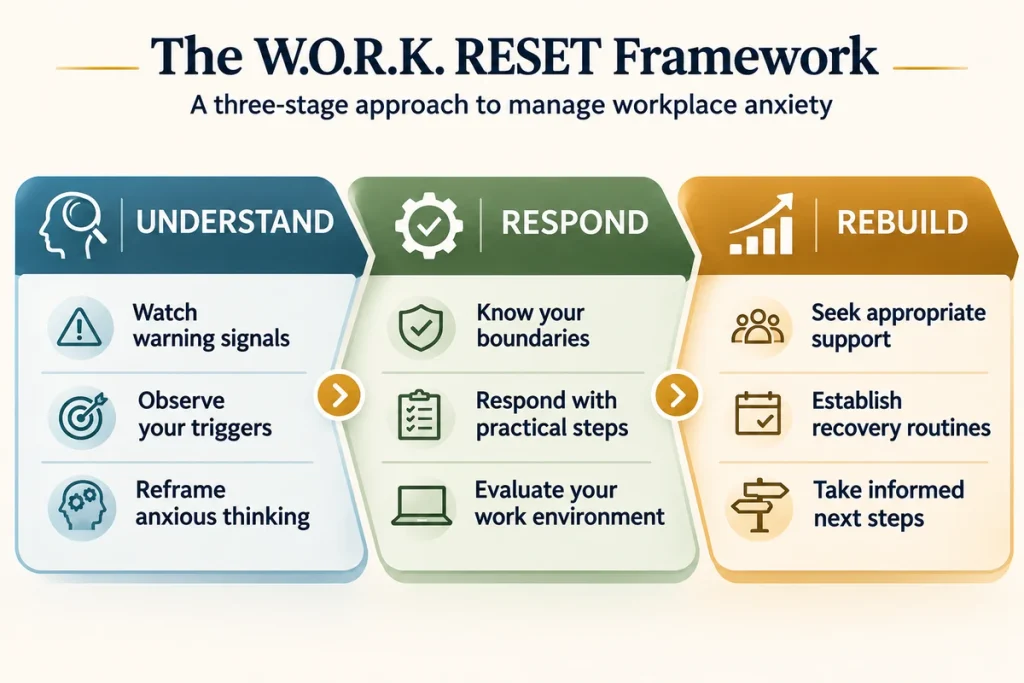
To make this process easier, The Psyche Inspire introduces the W.O.R.K. RESET framework. This is an original practical reflection and action framework developed for this article. It is not a diagnostic tool or a clinically validated treatment method.
The framework has three stages: Understand, Respond and Rebuild. Each stage contains practical steps that can help you examine your experience, identify possible changes and consider the support you may need.
Stage 1: UNDERSTAND — Recognise what is happening
W — Watch your warning signals
Begin by noticing when anxiety appears and how it affects you. Does it increase before meetings? Does it become stronger when your manager asks for an update? Do you feel uncomfortable whenever you receive a work-related message?
Pay attention to emotional, cognitive, physical and behavioural changes. Recognising these patterns can help you understand when your anxiety is most likely to occur.
O — Observe your underlying triggers
Try to identify what may be contributing to your anxiety. Is your workload consistently beyond what you can manage? Are you afraid of making mistakes or receiving criticism? Is a difficult relationship affecting your working day? Do you feel uncertain about your job security, or are expectations unclear and constantly changing?
It is also important to distinguish between an internal fear and an external problem. Fear of criticism may come from self-doubt, but it may also be reinforced by genuinely humiliating management practices. Understanding the difference can help you choose a more appropriate response.
R — Reframe anxious thinking
Anxiety can make uncertain situations appear more threatening than they actually are. A delayed reply from your manager may lead you to assume that something is wrong, while a small mistake may feel like a threat to your entire career.
Try examining the thought rather than accepting it immediately.
| Anxious thought | More balanced perspective |
| One mistake will ruin my career. | A mistake may need correction, but it does not define my entire career. |
| My manager has not replied. I must have done something wrong. | I do not yet know why there has been no reply. |
| Everyone is better than me. | I may be comparing my difficulties with what others show externally. |
| I cannot handle this responsibility. | I can identify what I know, what I need to learn and where I need support. |
The purpose is not forced positivity. It is to develop a more realistic interpretation of the situation while remaining open to genuine problems that may require action.
Stage 2: RESPOND — Take practical and meaningful action
K — Know your needs and boundaries
Recognise what you can reasonably manage and communicate your needs appropriately. For example, if several deadlines conflict, ask which task should receive priority. Seek clarification when instructions are unclear and protect reasonable periods of rest outside working hours.
Boundaries do not mean refusing responsibility. They help make responsibility sustainable by creating a clearer understanding of what can realistically be managed.
R — Respond with practical strategies
Choose a response that addresses the actual difficulty. If you fear making mistakes, use a reasonable checking process. If meetings create anxiety, prepare a few key points beforehand. If uncertainty is the problem, ask for clearer expectations.
You may also practise grounding, gentle breathing or brief movement when you feel overwhelmed. The most useful strategy is one that responds to your particular difficulty rather than adding another demanding routine to your day.
E — Evaluate your working environment
Consider whether the workplace itself is contributing to your anxiety. Are responsibilities clear? Is the workload manageable? Are relationships respectful? Can employees raise concerns without fear of humiliation or retaliation?
If the problem is excessive workload, repeated mistreatment or an unhealthy organisational culture, individual coping techniques alone will not address its source. The working conditions may also need to change.
Stage 3: REBUILD — Restore balance and make informed decisions
S — Seek appropriate support
Support may come from a trusted colleague, an appropriate supervisor, an employee assistance programme, a counsellor or a qualified mental health professional. The right source depends on the nature and intensity of the problem.
You do not have to manage every difficulty alone. Sometimes, discussing the situation with someone who can listen objectively helps you identify options that were difficult to see while feeling overwhelmed.
E — Establish recovery routines
Create regular opportunities for recovery through adequate sleep, physical activity suited to your circumstances, meaningful social connections and time for hobbies or personal interests. Reasonable breaks during work and a clearer transition between professional and personal time can also help.
Recovery should not be something you postpone until you are completely exhausted. It is part of maintaining well-being while meeting everyday responsibilities.
T — Take informed next steps
Ask yourself whether the situation is improving and what needs to change. Sometimes the next step is better communication or workplace support. At other times, it may involve a transfer, a different role or a planned career transition.
You do not have to complete all nine steps at once. Begin with the one that best reflects your current difficulty.
The central message of W.O.R.K. RESET is simple: understand the source of your anxiety before deciding how to respond.
9 Practical Ways to Deal With Workplace Anxiety
Understanding anxiety is important, but when you experience it every day, you also need practical ways to respond. The most useful approach depends on what is contributing to your anxiety.
The following strategies can help you manage common workplace difficulties. They are not a substitute for addressing harmful working conditions or seeking professional support when necessary.
Identify what is actually making you anxious
Instead of describing the entire job as the problem, try identifying the situations in which your anxiety increases. Is it associated with deadlines, meetings, criticism, a particular colleague or uncertainty about your responsibilities?
For a few working days, note what was happening, what you were thinking, what you felt and how you responded. You can also record what might have helped in that situation.
This simple reflection can help distinguish workload pressure from fear of criticism, uncertainty or difficult relationships. Once you understand the pattern more clearly, it becomes easier to decide what needs attention.
Challenge thoughts that make work feel more threatening
When you notice an anxious thought, pause before treating it as a fact. Ask yourself what evidence supports it, whether you are making assumptions without knowing the facts and whether you are imagining the worst possible outcome.
You can also consider whether another reasonable explanation exists and what you would tell a colleague facing the same situation.
The objective is not to force positive thinking. It is to prevent fear from becoming the only way you interpret workplace situations. A more balanced perspective can help you respond thoughtfully without dismissing genuine concerns.
Break overwhelming responsibilities into manageable tasks
When a large assignment feels overwhelming, identify the next action you can realistically complete. For example, divide a report into collecting information, organising material, drafting, reviewing and submitting.
You can also identify three priorities at the beginning of the day. This gives your attention a clearer direction instead of allowing every unfinished task to compete for it at once.
However, prioritisation cannot solve an objectively excessive workload. If demands consistently exceed available time and resources, discuss capacity and priorities with the appropriate person. The solution should not depend entirely on working longer hours.
Use grounding and breathing techniques during anxious moments
A simple grounding exercise may help redirect your attention towards the present when you feel overwhelmed. One commonly used approach is the 5–4–3–2–1 exercise.
Notice five things you can see, four things you can physically feel, three things you can hear, two things you can smell and one thing you can taste. Take your time rather than rushing through the exercise.
You can also try gentle, unforced breathing, allowing your exhalation to be slightly slower than your inhalation. These techniques may help during an anxious moment, but they are not treatments for an unhealthy workplace or a substitute for professional care when needed.
Prepare for situations that commonly trigger anxiety
If meetings make you anxious, review the agenda and prepare a few points. If you fear mistakes, make sure you understand the requirements and use a reasonable review process. If difficult conversations make you uncomfortable, identify the issue and the outcome you want before speaking.
Preparation can help you feel more organised and confident. However, it should support effective action rather than become another form of excessive checking or perfectionism.
If the situation involves bullying, harassment or a genuine safety concern, seek appropriate support rather than feeling obliged to confront the person alone.
Communicate your workload and boundaries
Instead of automatically accepting every additional responsibility, try communicating clearly about your existing commitments. You might say:
“I am currently working on these two priorities. Could you help me understand which one should take precedence if I am expected to take on this additional assignment?”
Similarly, ask for clarification when instructions are unclear. This can prevent unnecessary assumptions and help establish realistic expectations.
Assertive communication means expressing your needs respectfully without being unnecessarily aggressive or apologetic. It is not about avoiding responsibility; it is about communicating what is required to manage that responsibility effectively.
Create a transition between work and personal life
Before leaving work or closing your laptop, take a few minutes to review what you have completed. Write down unfinished tasks, identify the next action for important assignments and note any issues that require clarification.
This gives your mind a practical record instead of relying on repeated mental reminders. It can also make it easier to recognise that the working day has reached a reasonable stopping point.
After work, shift towards an activity different from your professional responsibilities, such as walking, exercising, reading or spending time with family. The objective is not to stop every work-related thought. It is to create space for recovery.
Strengthen recovery through sleep, physical activity and social support
Regular physical activity, sufficient sleep and supportive relationships can contribute to better mental well-being. These habits may help you manage everyday pressure and maintain a healthier balance between professional and personal responsibilities.
Start with manageable habits rather than an elaborate routine. A short walk, a regular sleep schedule or a meaningful conversation with someone you trust may be a more realistic beginning than trying to change everything at once.
Remember, however, that rest and exercise cannot compensate for persistent harassment, unreasonable workloads or unsafe working conditions. Recovery habits are important, but they do not remove the need for appropriate workplace changes.
Seek support when anxiety becomes difficult to manage
If workplace anxiety continues to affect your sleep, relationships, concentration or everyday functioning, consider professional support. Depending on your circumstances, this may involve a counsellor, psychologist, psychiatrist or doctor.
You may benefit from having a space to discuss your experiences, understand recurring patterns and explore suitable ways forward. If the workplace itself is contributing to the problem, you may also need support in addressing those conditions.
Seeking help is not a sign of professional weakness. It is a reasonable response to a problem affecting your well-being.

When Does Workplace Anxiety Become Serious? 8 Warning Signs You Should Not Ignore
Feeling anxious about work occasionally is understandable. But when anxiety becomes persistent, affects everyday functioning or begins influencing several areas of life, it deserves closer attention.
The following signs are not a diagnostic checklist. They are reasons to pause and consider whether the situation is affecting your well-being more seriously.
You feel anxious before the working day begins
You may experience apprehension the previous evening, struggle to sleep before a working day or wake up with a strong sense of dread. The anxiety may appear even before you begin thinking about your actual responsibilities.
Occasional nervousness before an important event is understandable. The concern arises when anticipation becomes persistent and affects your everyday routine.
Your anxiety affects sleep and physical well-being
You may repeatedly wake during the night, struggle to relax or feel exhausted despite spending enough time in bed. Some people also notice recurring headaches, muscle tension or stomach discomfort.
Persistent physical symptoms should be discussed with a healthcare professional rather than automatically attributed to anxiety. Understanding their cause is important for choosing appropriate support.
You have started avoiding work responsibilities
You may delay opening emails, avoid meetings, hesitate to ask questions or postpone tasks involving evaluation. These behaviours can gradually restrict your professional participation.
Avoidance can provide temporary relief, but it may also make certain situations more difficult to approach over time. However, avoiding an unsafe or abusive situation can be a reasonable protective response. The context matters.
Your confidence is declining
You may begin questioning decisions you previously made confidently. A small correction may feel like a major failure, while positive feedback may provide only temporary reassurance.
It is important to distinguish genuine performance difficulties from anxiety-driven self-doubt. Sometimes, people need additional training or clearer expectations. At other times, their abilities are being underestimated because worry has changed how they evaluate themselves.
Work is affecting your relationships and personal life
You may become unusually irritable, withdraw from conversations or lose interest in activities you previously enjoyed. You may also find it difficult to be emotionally present with family and friends because your attention remains occupied with work-related concerns.
When this continues, workplace anxiety can affect much more than professional satisfaction.
You feel emotionally exhausted or detached from work
Persistent workplace pressure may overlap with occupational burnout. According to the WHO’s ICD-11, burnout is an occupational phenomenon resulting from chronic workplace stress that has not been successfully managed.
It is characterised by three dimensions:
- Energy depletion or exhaustion.
- Increased mental distance from one’s job, or feelings of negativity or cynicism towards it.
- Reduced professional efficacy.
Burnout is not classified by WHO as a medical condition in itself. It specifically relates to the occupational context. Workplace anxiety and burnout can occur together, but they are not the same experience.
Your anxiety extends beyond work
Initially, you may feel anxious only before meetings or when interacting with a particular supervisor. Over time, worry may begin affecting several areas of life.
Persistent, difficult-to-control worry across different areas may warrant professional assessment. It does not automatically mean that you have an anxiety disorder, but it may indicate that the problem deserves attention beyond the workplace.
You feel trapped and cannot see a way forward
You may dislike going to work but feel unable to leave because of financial responsibilities, family expectations, job security or limited alternatives. This can create a sense of helplessness, particularly when the working environment does not seem likely to improve.
Feeling trapped does not mean that you have no options. It may mean you need time, support and a realistic plan to identify them.
When should you seek professional help?
Consider professional support when anxiety is persistent, difficult to manage or significantly affecting sleep, relationships, health or everyday functioning. You do not need to wait until your situation becomes unbearable before discussing it with someone qualified to help.
If you experience thoughts of harming yourself, feel unable to keep yourself safe or are in immediate danger, seek urgent help through local emergency services or the nearest emergency department.
Should You Quit Your Job Because of Anxiety?
One of the most difficult questions a person can ask is whether leaving a job is the right decision when it is affecting their mental health. The answer depends on what is causing the anxiety, how seriously it is affecting your well-being and whether the situation can realistically improve.
Before making a decision, consider the following questions:
- Identify the actual problem. Is it workload, a manager, difficult relationships, organisational culture or the nature of the job?
- Distinguish temporary pressure from a persistent problem. Is this a difficult phase or a recurring pattern?
- Consider possible changes. Could clearer expectations, additional support, a transfer or reasonable adjustments help?
- Assess the impact on your health. Is your sleep, confidence, physical well-being or personal life being affected?
- Consider financial responsibilities. What would leaving mean for your income, family and future opportunities?
- Evaluate whether the organisation is willing to change. Are your concerns being heard and addressed?
- Make an informed decision. Consider your options rather than allowing fear or exhaustion alone to determine your future.
Leaving does not automatically mean that you are weak or incapable of handling pressure. Sometimes, a different working environment may be the healthier choice. At the same time, not every difficult phase requires resignation.
The decision deserves careful consideration because your well-being, financial responsibilities and professional future all matter. For a more detailed decision-making guide, see our supporting article: My Job Gives Me Anxiety: Should I Quit? 7 Questions to Ask Before Leaving.
What Can Employers and Managers Do to Reduce Workplace Anxiety?
Workplace anxiety is not always an individual coping problem. An employee may practise relaxation techniques every evening, but those techniques cannot solve an unreasonable workload, repeated humiliation or an organisational culture that discourages people from raising concerns.
Employers and managers also influence workload, communication, fairness, psychological safety and access to support. Creating healthier working conditions is therefore an important part of workplace well-being.
Some important steps include:
- Create realistic workloads: Set reasonable deadlines, clarify priorities and provide adequate resources.
- Develop supportive managers: Encourage empathetic communication, constructive feedback and appropriate support.
- Build psychological safety: Allow employees to raise concerns, ask questions and discuss mistakes without fear of humiliation or retaliation.
- Address bullying and unfair treatment: Establish accessible reporting mechanisms and fair procedures to protect employees.
- Respect work-life boundaries: Promote reasonable working hours, adequate breaks and opportunities for recovery.
- Provide accessible support: Make appropriate mental health resources available without stigma or discrimination.
- Involve employees in decisions: Encourage feedback and participation when identifying workplace problems and improving working conditions.
The NICE guideline on Mental Wellbeing at Work emphasises the importance of organisational action alongside individual support. A healthier workplace requires more than asking employees to manage stress; it also requires addressing the conditions that contribute to it.
For a detailed discussion, see our supporting article: How Employers Can Reduce Workplace Anxiety: 7 Practical Changes That Matter.
Frequently Asked Questions About Workplace Anxiety
1. Is workplace anxiety normal?
Occasional nervousness or worry at work is common. An important meeting, a new responsibility or an unfamiliar situation may naturally create some apprehension.
However, persistent anxiety that affects sleep, concentration, relationships or everyday functioning should not be dismissed as simply part of having a job. The frequency, intensity and impact of the experience matter.
2. Why do I feel anxious about going to work every day?
Daily anxiety may be associated with excessive workload, fear of criticism, difficult relationships, job insecurity or previous negative experiences. Anticipatory anxiety can make people worry about workplace situations before they occur.
Understanding what you are expecting or trying to avoid may help identify the source of the discomfort. If the feeling continues, consider whether workplace conditions or personal concerns need additional attention.
3. How can I stop being so anxious at work?
Begin by identifying your triggers and examining the thoughts that make situations feel more threatening. Breaking overwhelming tasks into smaller steps, preparing for difficult situations and communicating workload concerns may also help.
You can use grounding techniques during anxious moments and seek support when necessary. Remember that individual coping strategies should not replace changes to unhealthy working conditions.
4. What is the 3-3-3 rule for anxiety?
The 3-3-3 rule is a simple grounding exercise that may help redirect attention towards the present moment.
- Name three things you can see.
- Identify three things you can hear.
- Move three parts of your body.
It is a self-help technique rather than a clinically established treatment for anxiety disorders. Some people find it useful during moments of heightened worry, although its usefulness may vary.
5. Can workplace anxiety cause physical symptoms?
Anxiety can be accompanied by muscle tension, headaches, sweating, stomach discomfort, restlessness, a faster heartbeat and sleep difficulties.
These symptoms can also have other medical causes. Persistent or unexplained symptoms should therefore be assessed by a healthcare professional rather than automatically attributed to workplace anxiety.
6. Can workplace anxiety lead to depression?
Persistent workplace stress and anxiety may contribute to emotional difficulties and can coexist with depression. However, workplace anxiety does not automatically develop into depression.
Persistent sadness, hopelessness or loss of interest in activities deserves professional attention, particularly when these experiences begin affecting everyday functioning.
7. Is workplace anxiety the same as burnout?
No. Workplace anxiety generally involves worry, fear or apprehension associated with work. Burnout, as described by the WHO, is characterised by exhaustion, mental distance or cynicism towards one’s job, and reduced professional efficacy.
The two experiences can overlap, but they are not interchangeable. Understanding the difference can help identify what kind of support may be appropriate.
8. Can workplace anxiety affect job performance?
Yes. Persistent anxiety may affect concentration, working memory, decision-making and professional confidence. However, it does not automatically make someone less capable or unproductive.
Its effects vary according to the individual, the task and the working environment. Supportive conditions and appropriate resources can make a meaningful difference.
Final Thoughts: You Deserve a Working Life That Protects Your Well-Being
Work is an important part of life. It provides financial security, opportunities for growth, professional identity and a sense of contribution. But when work becomes a constant source of anxiety, it can gradually affect much more than professional performance.
You may begin questioning your abilities, worrying about ordinary responsibilities, losing confidence or finding it difficult to enjoy life outside the workplace. Experiences that once felt manageable may begin to demand more emotional energy than you can comfortably give.
As we have explored throughout this article, workplace anxiety does not always have a single cause. It may arise from fear of failure, excessive workload, difficult relationships, job insecurity, unclear expectations or an organisational culture that leaves employees feeling unsupported.
Understanding these influences is an important first step. You can begin by recognising your triggers, examining anxious thoughts, developing healthier boundaries and finding practical ways to manage demanding situations.
But remember something equally important: not every workplace problem can be solved through individual effort. Sometimes, you need better communication and support. Sometimes, the organisation needs to change. And sometimes, protecting your well-being may require reconsidering your professional future.
There is no shame in seeking help, asking for reasonable support or choosing a different working environment when necessary. You do not have to become emotionally unaffected by everything that happens at work. You do not have to prove your professional worth by accepting constant pressure, and you do not have to ignore your emotional needs to be considered a committed employee.
A healthy workplace is not one where employees never experience stress. It is one where people have the resources, support, dignity and psychological safety needed to manage challenges and perform their responsibilities.
Your work matters. Your career matters. But your mental well-being matters just as much.
A successful working life should not be measured only by what you achieve professionally, but also by whether you can live that life with a reasonable sense of balance, confidence and emotional well-being.
Note: This article is intended for psychological education and self-reflection. It does not provide a diagnosis or replace individual advice from a qualified mental-health professional.