

Have you ever read a message, thought about what you wanted to say, and decided to reply later? Perhaps you were busy at the time. But even after finishing your work, you still did not respond. Hours passed, sometimes even days, and the longer you waited, the more awkward replying began to feel.
The confusing part is that you might genuinely care about the person. You may want to talk to them, have a response in mind, and have no intention of ignoring them. Yet, something keeps you from replying.
Why do I avoid replying to messages even when I want to respond?
Sometimes, the difficulty has less to do with the person who messaged you and more to do with what replying feels like in that moment. You may be mentally tired, unsure what to say, worried about the other person’s reaction, or reluctant to begin a conversation you do not have the energy to continue.
Table of Contents
This does not automatically mean you are careless, uninterested or bad at maintaining relationships. Understanding why you put off replying to messages can help you recognise the pattern without blaming yourself for every unanswered message.
Why Do I Put Off Replying to Messages?
Wanting to respond and feeling ready to respond are not always the same thing. You may value a relationship while finding a particular conversation emotionally demanding or difficult to begin.
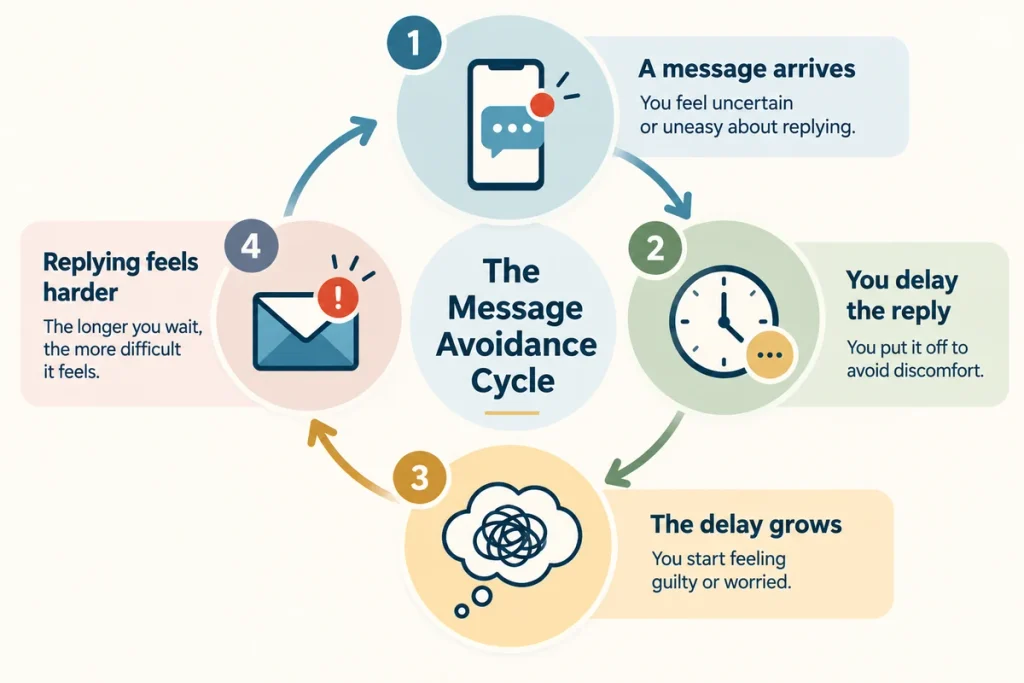
Putting off the message can provide temporary relief because you do not have to deal with that discomfort immediately. However, if you repeatedly postpone the reply, you may eventually feel guilty or awkward about the delay itself, making the conversation harder to approach.
Not every delayed reply has a psychological explanation. Sometimes you are busy, distracted or simply unavailable, but a recurring pattern deserves closer attention when it causes distress or affects relationships.
7 Psychological Reasons You Keep Putting Off Replies
There is no single explanation for why people avoid replying to texts. The reasons can differ according to the message, the relationship, your current circumstances and what you anticipate will happen after you respond.
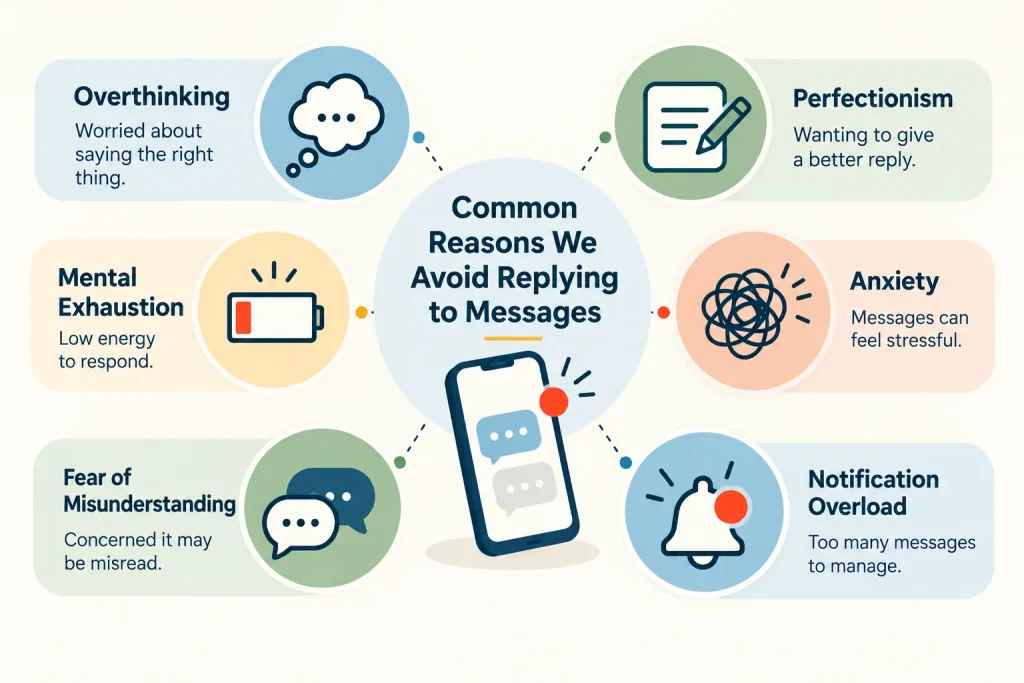
1. You Feel Mentally Overwhelmed by Messages
Even a short message requires some attention: you need to understand it, decide what to say and sometimes prepare for a longer conversation. When work, family responsibilities or other demands have already occupied your attention, another interaction may feel like one more task.
This may explain why you struggle to reply to messages even when you technically have enough time. The obstacle may be your current mental capacity rather than the number of minutes required to respond.
Ask yourself whether you tend to postpone messages from almost everyone when you are tired, or whether the difficulty occurs mainly with particular people. The answer may help you distinguish general overload from discomfort associated with a specific conversation.
2. You Overthink What to Say
You may worry that your reply sounds rude, cold, uninterested or inappropriate. You write something, reconsider the wording, delete it and decide to finish the message later.
When you expect every response to be just right, an ordinary interaction can begin to feel like a test. This is especially difficult when you are worried about being misunderstood or disappointing someone whose opinion matters to you.
A useful reminder is that most everyday messages do not require perfect wording. A simple, sincere response is often enough, and you can explain more when you feel ready. When you keep searching for the perfect response, understanding the psychology of overthinking can help you recognise why a simple reply begins to feel complicated.
3. You Are Avoiding the Conversation, Not the Message
Sometimes, you already know what the message requires: declining an invitation, answering an uncomfortable question or discussing a sensitive issue. The difficulty is anticipating the other person’s reaction.
A study of 329 texting interactions found that delayed responses to requests and invitations were more likely to be refusals than acceptances. This offers a useful example of how people may delay an unwelcome answer, although it does not explain all delayed replies (Rendle-Short, 2015).
If this sounds familiar, ask whether you are struggling to reply or struggling to communicate something difficult. Learning to express a boundary or decline a request respectfully may help more than simply trying to respond faster.
Sometimes, it is not the message itself but the feelings associated with the conversation that make responding difficult. Understanding why certain situations trigger strong emotional reactions may help you recognise what you are trying to avoid.
4. You Worry About Disappointing People
A friend asks for help, a colleague makes a request, or a relative expects you to attend an event. You may want to maintain the relationship but feel uncomfortable giving an answer that might disappoint the other person.
When saying no feels difficult, postponing the reply can seem easier than dealing with the anticipated reaction. However, leaving someone waiting indefinitely may create uncertainty that an honest answer could have avoided.
You can care about another person’s feelings without being responsible for preventing every disappointment. A respectful response may feel uncomfortable, but it can still be kinder than prolonged silence.
If you repeatedly worry about how someone will interpret your words or whether they are upset with you, the need for constant reassurance may be another pattern worth understanding.
5. You Do Not Have the Energy for Another Conversation
You may receive a message from someone you genuinely like and think, “I’ll reply when I have more energy.” The problem may not be the relationship itself, but the possibility that answering will lead to a longer conversation.
A 2019 qualitative study of people with depression and anxiety documented difficulties around online communication, including the effort involved in direct contact and the pressure some participants felt to respond immediately. Its findings offer useful context, but they should not be treated as evidence that everyone who delays a reply has a mental-health condition (original study).
Needing time to rest is not inherently a problem. If you cannot manage a full conversation, a brief acknowledgement or an honest explanation that you will respond later may help you maintain contact without promising more energy than you have.
6. Avoiding the Reply Gives You Temporary Relief
When a message makes you uncomfortable, putting your phone away can provide immediate relief. You no longer have to decide what to say or anticipate the conversation, so postponement becomes an appealing response.
This resembles negative reinforcement: a behaviour becomes more likely when it removes or reduces an unpleasant experience. If delaying a message repeatedly reduces discomfort in the short term, you may find yourself using the same response the next time a difficult message arrives.
The difficulty is that the original concern remains unresolved. Guilt, awkwardness or worry about the delay can then make replying feel even harder, creating a cycle of postponement.
7. You Feel Differently About Different Relationships
You may respond quickly to practical messages but postpone replying to a close friend or someone you are romantically interested in. Conversations differ in their emotional demands, and the more a person’s opinion matters to you, the more carefully you may consider your response.
Research involving 302 romantically partnered university students found associations between attachment dimensions and electronic messaging behaviour. The study provides useful context for understanding differences in relationship communication, but it does not mean that delayed replies reveal someone’s attachment style (Patel, Mahar and Webster, 2022).
Rather than labelling yourself, notice whether your behaviour changes according to the person, the subject or the expectations attached to the conversation. That distinction can help you identify what makes replying difficult in your own circumstances.
Why Does Avoiding a Message Make Replying Harder?
Imagine that a friend messages you on Monday, and you decide to reply later because you feel tired. By Tuesday, you have forgotten once or twice, and by Wednesday, you feel awkward about the delay itself.
Now, you are not just responding to the original message. You are also thinking about how long you have waited and whether you need to explain yourself.
This can create a cycle: a message brings discomfort, postponement provides temporary relief, the delay creates additional worry, and replying becomes harder to approach. This is one possible pattern, not a universal explanation for every unanswered message.
The way out is not to criticise yourself for delaying. It is to notice the moment when postponement stops being a deliberate choice and becomes a repeated response to discomfort.
Why Do I Avoid Replying to Messages Even When I Have Time?
Having time available does not automatically mean feeling ready to communicate. You may have an hour free but still be reluctant to begin a conversation that requires emotional energy, a difficult decision or an explanation you have been putting off.
Sometimes, the issue is simply habit: you intend to reply later, become distracted and forget. In other cases, you may be anticipating a longer conversation or worrying about how your response will be interpreted.
Ask yourself, “What do I think will happen if I reply now?” Your answer may reveal whether you need a practical reminder, a clearer boundary, a simpler response or time to prepare for a difficult conversation.
Does Avoiding Messages Mean You Do Not Care?
Not necessarily. You can care about someone and still struggle to respond because you are tired, uncertain about what to say or reluctant to begin a conversation at that moment.
However, intentions and impact are different. Repeatedly leaving messages unanswered can make another person feel ignored or uncertain about the relationship, even when you did not intend to hurt them.
Because delayed replies can leave people wondering where they stand, it is also useful to understand why being ignored can hurt so much from the other person’s perspective.
You do not have to be constantly available to demonstrate that you care. But when a relationship matters to you, honest communication and reasonable efforts to repair a delayed conversation can make a meaningful difference.
Is Avoiding Messages a Sign of Anxiety or ADHD?
Avoiding messages can sometimes occur alongside anxiety, attention difficulties, low mood or stress. For example, someone who worries excessively about being misunderstood may find replying uncomfortable, while someone who struggles with organisation may intend to respond and then forget.
However, delayed replies alone do not establish anxiety, ADHD or any other psychological condition. These difficulties have many possible explanations, including ordinary distraction, fatigue and personal communication preferences.
If communication problems occur alongside persistent distress or difficulties affecting work, relationships or everyday functioning, consider discussing the broader pattern with a qualified mental-health professional.
How to Stop Putting Off Replies Without Forcing Yourself to Respond Immediately
The goal is not to reply to every message instantly. It is to make communication more manageable while respecting your own limits and the needs of people you care about.
1. Identify What Is Making the Reply Difficult
Before postponing a message, ask yourself whether you are tired, unsure what to say, worried about disappointing someone or avoiding an uncomfortable conversation. Identifying the actual obstacle helps you choose a useful response rather than relying on the same habit every time.
2. Stop Waiting for the Perfect Response
An everyday message does not need to be perfectly worded. If you are overthinking, try a brief, sincere answer rather than repeatedly editing the same response.
3. Make the First Step Smaller
If you cannot manage a full conversation, acknowledge the message or explain that you need more time. A small, honest response can help you avoid turning one unanswered message into a growing source of pressure.
4. Set Boundaries Without Disappearing
You are allowed to be unavailable. Let people know when you can talk, mute non-essential notifications if they overwhelm you, and avoid promising immediate replies if that is unrealistic for you.
5. Respond After a Long Delay
If you have left a message unanswered for several days, you do not always need a lengthy explanation. Acknowledge the delay, respond to the original message and apologise when your silence has caused inconvenience or hurt.
For example: “Sorry for the late reply. I meant to get back to you earlier. How have you been?” For an important conversation, a more direct apology and an answer to the original question may be appropriate.
When Should You Pay More Attention to This Pattern?
Occasionally delaying a reply is a normal part of life. It deserves closer attention when you repeatedly avoid people you want to connect with, experience significant distress about ordinary conversations or find that communication difficulties are affecting your daily functioning.
If message avoidance occurs alongside persistent anxiety, low mood, social withdrawal or difficulties with attention and organisation, professional guidance may help you understand the broader pattern. There is no need to assume that you have a disorder because you struggle to reply to texts.
Frequently Asked Questions
Why do I not want to reply to messages even when I care about the person?
You may care about someone while feeling mentally tired, uncertain about what to say or reluctant to begin a conversation. Your feelings towards a person and your readiness to communicate at a particular moment are not always the same.
Why am I so bad at replying to messages?
Being slow to reply does not necessarily mean you are bad at communication. You may struggle with initiating tasks, remembering messages, managing expectations or finding the right words, and identifying the difficulty is more useful than labelling yourself negatively.
Why do I avoid replying to people I like?
You may worry about making a good impression, being misunderstood or creating expectations you cannot meet. You may also simply lack the energy for a conversation at that moment, so it is important not to assume that avoidance automatically indicates fear of intimacy or a particular attachment style.
How do I reply to someone after ignoring their message?
Start with a simple, honest response. Acknowledge the delay when appropriate, answer the original message and apologise if your silence caused inconvenience or hurt.
Is it normal to need time away from messages?
Yes. People have different communication preferences and need time away from notifications. The important distinction is whether you are choosing to take space or repeatedly avoiding conversations you want or need to have.
Final Thoughts: You Can Care About People Without Being Available All the Time
If you often avoid replying to messages even when you want to respond, try to understand the pattern before judging yourself. Sometimes you need rest, sometimes you are unsure what to say, and sometimes postponement has become a way of avoiding discomfort.
You do not have to answer every message immediately. But when a relationship matters to you, learning to communicate your needs, respond honestly and repair a delayed conversation can make a meaningful difference.
The aim is not to become someone who replies instantly to everyone. It is to develop a way of communicating that respects both your emotional limits and your relationships.
Sometimes, the most helpful change is not replying faster. It is understanding why you keep putting the reply off—and finding a kinder, more practical way to respond.
References
- Rendle-Short, J. (2015). Dispreferred responses when texting: Delaying that ‘no’ response. Discourse & Communication, 9(6), 643–661. https://doi.org/10.1177/1750481315600309
- Patel, P. Y., Mahar, E. A., & Webster, G. D. (2022). Adult Romantic Attachment, Electronic Messaging, and Relationship Quality. Cyberpsychology, Behavior, and Social Networking, 25(3), 200–206. https://doi.org/10.1089/cyber.2021.0060
- Difficulties Encountered by People With Depression and Anxiety on the Web: Qualitative Study and Web-Based Expert Survey. Journal of Medical Internet Research (2019). https://doi.org/10.2196/12514