

Have you ever looked at someone else’s life and wondered, “Why am I not there yet?”
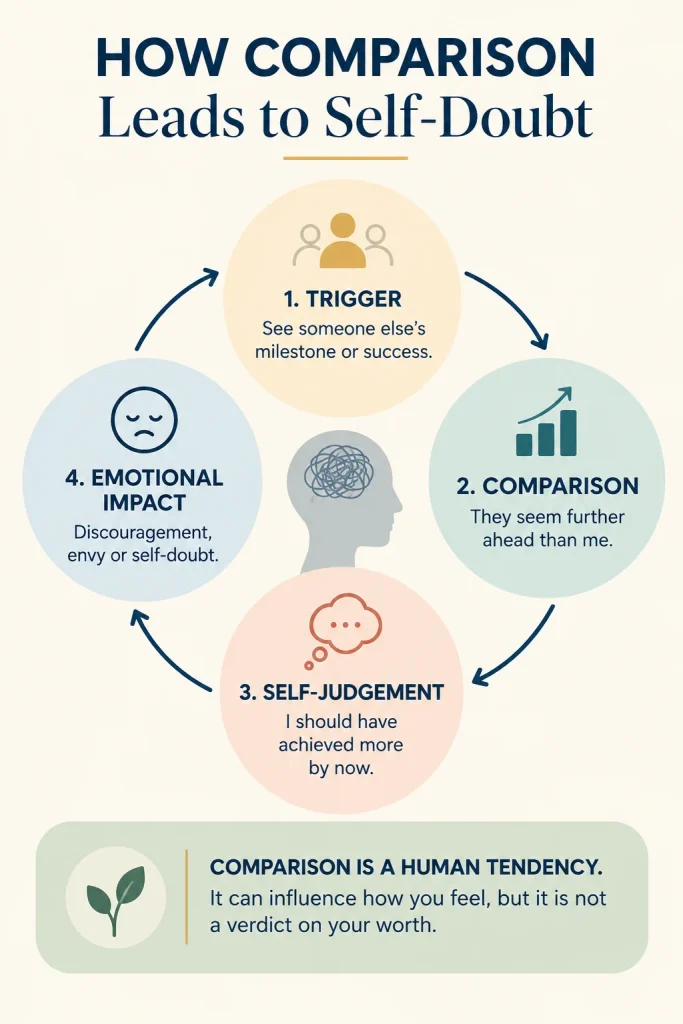
Perhaps a friend has been promoted at work, someone you studied with has bought a house, or people your age are getting married and starting families. You may genuinely feel happy for them, yet find yourself questioning your own progress later. You wonder whether you have wasted time, missed opportunities, or fallen behind where you should be by now.
If you have been wondering, “Why do I feel behind in life when everyone else seems to be moving forward?”, you may be comparing your present circumstances with other people’s achievements or with the expectations you once had for yourself.
Table of Contents
Perhaps you expected to feel more settled at this age, have a different career, or enjoy greater financial security. When life does not match those expectations, it is easy to wonder whether you have somehow fallen short.
Psychology offers useful ways to understand this experience. Let’s explore why comparison affects how you see yourself and what you can do to move forward without constantly measuring your life against someone else’s.
Why Do I Feel Behind in Life Even When I Am Trying My Best?
You may be working hard, improving your finances, or building a career and still feel that you are not moving forward fast enough. When someone your age achieves something you have been working towards, your own progress may suddenly seem less meaningful.
One reason is that we do not always evaluate our lives on their own terms. Sometimes, we judge our progress by looking at other people’s achievements.
The psychology of comparing yourself with others
Psychologists call this social comparison. It is the process of evaluating ourselves by looking at other people. Psychologist Leon Festinger introduced social comparison theory in 1954 to explain how people evaluate their abilities, opinions, and circumstances in relation to others.
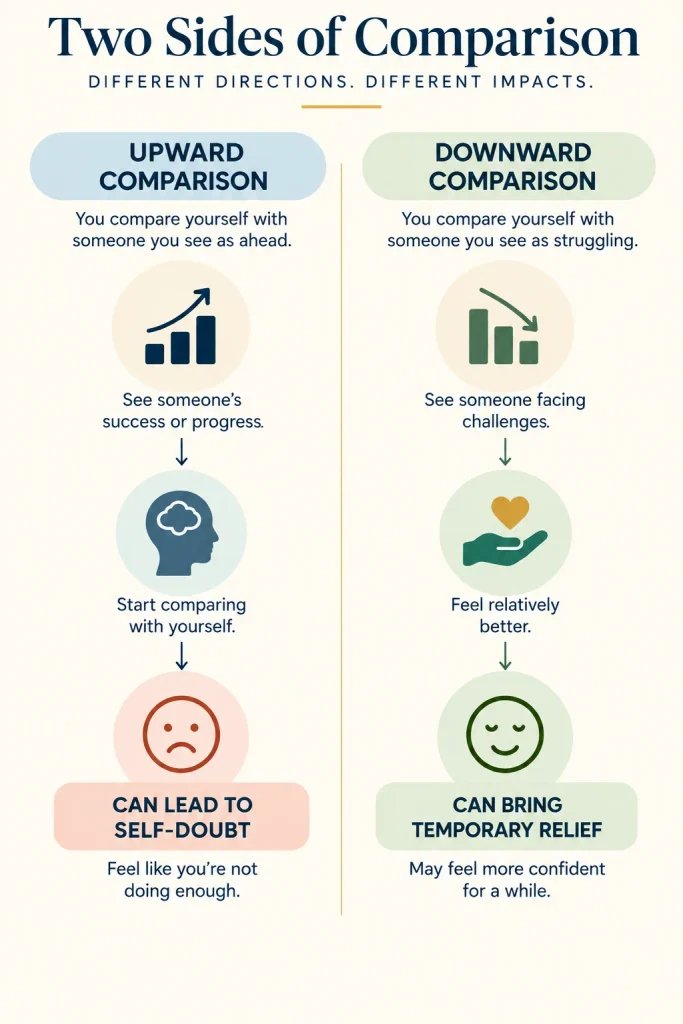
One form is upward social comparison, which happens when you compare yourself with someone you believe is doing better than you in a particular area.
Imagine that you and a former classmate started working around the same time. Years later, your classmate receives a promotion and begins earning more money. You may initially feel happy for them, but then a thought appears: “We started at the same point. Why haven’t I achieved as much?”
Before you realise it, your friend’s success has become a measure of your own progress.
A 2018 meta-analysis by Gerber, Wheeler, and Suls reviewed decades of social comparison research. It found that comparisons can influence how people evaluate themselves relative to others, although their effects depend on the situation and what is being compared. You can read the research published in Psychological Bulletin.
Comparison is not always harmful. Seeing someone achieve something can inspire you or show you what might be possible. The difficulty arises when you interpret another person’s success as evidence of your own failure.
Your friend may have a successful career while you are still working towards professional stability. Your cousin may have bought a house while you are supporting your family and trying to save money. These differences can be real, but they do not automatically mean that you are failing. People have different circumstances, opportunities, responsibilities, and resources.
Instead of asking, “Why am I so far behind them? ”, try asking, “What exactly am I unhappy about in my own life?” Perhaps you genuinely want to improve your career or financial situation. Or perhaps you feel pressured because people around you seem to be reaching milestones you expected to reach by now. Understanding the difference can help you decide what needs your attention.

Why Do I Feel Like a Failure When My Life Doesn’t Match My Expectations?
Sometimes, the hardest person to keep up with is not a friend or colleague. It is the person you once thought you would become.
Perhaps you imagined that by this age, you would have a stable career, a comfortable income, or a loving relationship. When life unfolds differently, you may question your choices or wonder whether you have made a mistake.
Psychologist E. Tory Higgins developed self-discrepancy theory, which explores how differences between the way we see ourselves and the way we believe we should be can affect our emotions.
The theory describes three ways of thinking about ourselves:
- Actual self: How you see yourself right now, including your circumstances, achievements, and limitations.
- Ideal self: The person you would like to become, shaped by your hopes and aspirations.
- Ought self: The person you believe you should be, often influenced by responsibilities, social expectations, and personal rules.
For example, you may have a stable job and be working towards a better future, yet still feel unsuccessful because you expected to achieve much more by now. Your current circumstances may not be as bad as you feel they are, but the gap between what you have and what you believe you should have can leave you feeling inadequate.
A 2019 meta-analysis by Mason and colleagues examined 70 studies on self-discrepancy and psychological difficulties. It found that greater self-discrepancy was associated with more psychological difficulties, more negative emotions, and fewer positive emotions. This does not mean that having ambitions or falling short of your expectations automatically harms your mental health. The research found an association, not proof of cause and effect. You can read the study through PubMed.
The important question is whether your expectations are helping you move towards a meaningful goal or becoming a standard you use to judge your worth.
Consider a goal that makes you feel behind, such as buying a home, getting married, or reaching a particular professional position. Ask yourself: “Would I still want this if nobody around me had achieved it?” and “Does this reflect what matters to me, or do I feel that I should have it by now?”
You may discover that the goal genuinely matters to you. Alternatively, you may realise that some of the pressure comes from expectations you absorbed without questioning them. Either way, you can reconsider your direction without treating yourself as a failure.
How Do Social Media and Other People’s Milestones Affect the Way I See My Life?
You open Instagram for a few minutes. Someone has received a promotion, another person is sharing holiday photographs, and a former classmate has bought a house. After scrolling for a while, you begin thinking about what you have not achieved and how much further you thought you would be by now.
Most people share selected moments of their lives. They may post achievements, celebrations, and exciting experiences without sharing every disappointment, financial worry, or ordinary day. As a result, you may end up comparing your everyday circumstances with selected moments from someone else’s life.
This does not mean that other people’s achievements are false or that they are secretly unhappy. Their success may be genuine. The point is that a post gives you only a limited view of their circumstances, while you experience your own difficulties in full.
Research supports the relevance of this comparison process. A 2024 meta-analysis by Marciano and colleagues examined 78 studies on social media use and well-being. It found a negative association between social comparison on social media and well-being. In simple terms, people who reported more social comparison also tended to report lower well-being. However, this does not prove that comparison alone caused the difference.
You can read the research in SSM – Mental Health.
Social media is not necessarily bad for everyone. Seeing someone else’s progress may inspire you or introduce you to new possibilities. The important thing is to notice how you feel after viewing particular content. Do you feel motivated to work towards something meaningful, or do you feel that your own life has become less valuable?
If certain accounts repeatedly leave you feeling inadequate, consider adjusting your feed or taking a break from scrolling. You do not need to stop using social media altogether. The aim is to notice when comparison stops being useful and starts undermining how you see yourself.

Why Does It Feel as Though I Am Running Out of Time?
Sometimes, feeling behind is not just about what you have achieved. It is about when you believe you should have achieved it.
Perhaps you expected to have a stable career by 25, financial security by 30, or your personal life figured out by a certain age. Family expectations, cultural traditions, friendships, and workplace pressures can reinforce these invisible deadlines.
Over time, a preference can become a personal rule. Instead of thinking, “I would like to get married when I find the right person,” you may begin thinking, “I should already be married at this age.” The difference matters. One expresses a desire; the other turns your current circumstances into a judgement about yourself.
If you are in your twenties or early thirties, you may have heard the term quarter-life crisis. It is commonly used to describe periods of uncertainty or distress during the transition into adulthood, when people question their careers, relationships, identity, and future. A systematic review of quarter-life crisis research discusses several contributing factors, including uncertainty and social support. You can read the review in PubMed Central.
However, a quarter-life crisis is not a formal mental health diagnosis, and not everyone experiences one. Feeling behind can happen at other stages of life, too.
It is also important not to dismiss every concern about timing as social pressure. Some goals involve genuine practical constraints, financial responsibilities, or opportunities that require timely decisions. Recognising these realities can help you plan without treating every delay as a personal failure.
Ask yourself whether there is a genuine deadline or whether you are comparing yourself with people who reached a milestone earlier. Then consider what you can realistically do about your situation now.
Your age tells you how much time has passed. It does not, by itself, determine your worth or what remains possible for you.
How Can I Stop Comparing My Life to Other People’s Lives?
Knowing why you compare yourself with others is helpful, but it does not automatically stop the feeling. The aim is not to force yourself to stop noticing other people’s achievements. It is to change how you respond to them and how you judge your own progress.
1. Notice what triggers the comparison
You might feel fine until you hear about a colleague’s promotion, attend a family gathering, or scroll through social media. When this happens, pause and ask yourself what triggered the feeling.
Perhaps it was someone’s financial success or a conversation about marriage. Identifying the trigger can help you understand what is bothering you. If a friend’s promotion leaves you feeling inadequate, the deeper concern may be that you feel stuck in your own career. Recognising this gives you something more useful to work with than self-criticism.
2. Separate what happened from what you tell yourself it means
“My friend has progressed further in their career than I have” describes a difference in circumstances. “I have failed because my friend is more successful than me” turns that difference into a judgement about your entire life.
When you notice yourself making a harsh judgement, ask, “Do I know that I have failed, or am I interpreting this difference as failure?” You may still feel disappointed, and that is understandable. But you can acknowledge disappointment without treating it as proof that you are inadequate.
3. Ask yourself what you genuinely want
Imagine that several friends are buying homes. You may begin feeling that you should buy one too, even though renting is more practical for your current financial circumstances. Before turning comparison into a new goal, ask yourself, “Would I still want this if I were not comparing myself with anyone?”
Your answer may help you distinguish between a genuine aspiration and pressure you have absorbed from others. You do not need to abandon your ambitions. You deserve the opportunity to choose them for reasons that make sense to you.
If you’re finding it hard to choose your next step, read our article on why you can’t make decisions to understand what might be holding you back.
4. Recognise your own progress
When you compare yourself with someone who seems further ahead, it is easy to overlook how far you have already come. Perhaps you have learned new skills, become more financially responsible, recovered from a difficult period, or developed greater confidence in handling challenges.
Take a moment to consider where you were a year ago. What have you learned? What have you handled that once felt difficult? This is not about convincing yourself that everything is fine. It is about seeing your life more completely instead of judging it only by what remains unfinished.
5. Change how you use social media
If certain accounts repeatedly leave you feeling inadequate, consider muting them, adjusting your feed, or taking breaks from scrolling when you are already feeling low. You might also notice what you are looking for when you open an app. Are you connecting with friends, learning something, relaxing, or checking whether your life measures up?
You do not need to avoid every uncomfortable feeling. The aim is to use social media in ways that support your life rather than repeatedly undermine your confidence.
6. Turn comparison into a useful question
Sometimes, comparison reveals something important. Perhaps you admire a colleague’s skills or feel disappointed because financial independence is something you genuinely want.
Instead of criticising yourself for feeling envious, ask, “What is this comparison showing me that I value?” If the answer matters to you, consider a practical step, such as developing a skill, reviewing your career options, or making a savings plan.
You can learn from another person’s progress without turning their achievements into a measure of your worth.
7. Allow yourself a different timeline
Your life may not unfold in the order you once expected. You may change careers later than planned, need more time to become financially secure, return to education, or discover that a goal no longer fits the person you have become.
Allowing yourself a different timeline does not mean giving up. It means recognising that progress is not always straightforward and that taking longer does not automatically make a goal less worthwhile. You can be honest about what you want to change while treating yourself with respect.
A simple reflection to try today
The next time you feel behind, take a few minutes to consider three questions:
- What am I comparing? Identify the achievement, relationship, or milestone that triggered the feeling.
- What does it make me believe about myself? Notice whether you are turning someone else’s progress into a judgement about your worth.
- What is one useful step I can take? Choose an action that reflects your own needs and priorities rather than a desire to catch up with someone else.
You do not have to solve your entire life in one sitting. Sometimes, understanding one comparison more clearly is a worthwhile beginning.
What If I Really Am Behind on Something Important to Me?
Sometimes, the feeling of being behind reflects a genuine unmet goal. Perhaps you want a more stable career, better financial security, a relationship, or an opportunity to study further. You have not reached that goal yet, and it hurts.
Telling yourself that everyone has their own timeline may offer some comfort, but it does not address what you are actually struggling with. You do not have to pretend that an unmet goal does not matter. You can acknowledge your disappointment without treating it as evidence that you have failed at life.
Imagine that you want to change careers but have not found the right opportunity. You could think, “I am not where I want to be professionally. I need to understand what is holding me back and what I can do next.” Or you could conclude, “Everyone else is moving ahead. I am a failure, and I will never achieve anything.”
The first response recognises a problem that may need attention. The second turns that problem into a judgement about your entire identity and future.
Try to identify what you have not achieved, what obstacles you face, and what resources or support might help. Some aspects of progress depend on your choices, while others depend on opportunities, finances, family responsibilities, and circumstances beyond your control. Not every delay can be solved through greater effort or a more positive attitude.
You can want more from life and still respect the person you are today. Your goals matter, but so does the way you treat yourself while working towards them.
When Should You Seek Professional Support?
Feeling behind in life is not, by itself, a mental-health diagnosis. It is normal to experience periods of disappointment, uncertainty, or self-doubt. However, if feelings of inadequacy, hopelessness, anxiety, or low self-worth persist and begin affecting your sleep, work, relationships, or everyday activities, consider speaking with a qualified mental-health professional.
Counselling may help you explore the expectations you place on yourself, understand patterns of comparison, and work towards goals that reflect your own values. You do not need to wait until you are struggling severely to seek support.
Your Life Is Not a Competition, but Your Goals Still Matter
Feeling behind in life can make you question your choices, abilities, and worth. When people around you seem to be moving forward, it is easy to believe that you should be further ahead, too. But another person’s progress does not tell you whether you are living well or making meaningful choices.
You may have goals you have not reached yet. You may wish some things had worked out differently. You may also be doing better in certain areas than you give yourself credit for. All these things can be true at the same time.
The aim is not to stop wanting more from life. It is to pursue what matters to you without turning every delay, setback, or comparison into a reason to criticise yourself.
The next time you find yourself wondering, “Am I falling behind?”, try asking a more useful question: “What matters to me at this stage of my life, and what is one step I can take towards it?”
You do not have to follow someone else’s timeline to build a life that feels meaningful to you. You can learn from others, celebrate their achievements, acknowledge your own disappointments, and still choose your direction.
Your life does not need to look like someone else’s to be worth moving forward with.
Frequently Asked Questions
Is it normal to feel behind in life?
Yes. Many people experience this feeling at different stages of life, especially when they compare themselves with friends, colleagues, or family members. It may also arise when life does not match their expectations. Feeling behind does not automatically mean that you are failing.
Why do I compare myself to people my age?
People of a similar age can feel like natural reference points because they may have experienced similar stages of education, work, or adulthood. When someone your age reaches a milestone you have not reached, you may wonder whether you should have achieved it by now. But being the same age does not mean having the same opportunities, responsibilities, resources, or priorities.
How do I stop feeling jealous when my friends succeed?
Acknowledge the feeling without judging yourself for having it. Envy may arise when another person’s achievement reminds you of something you also want. Ask yourself what their success brings up for you. You can be happy for someone else and still feel disappointed about something in your own life.
What if I have genuinely wasted years of my life?
It is worth looking honestly at what you regret. Perhaps there are decisions you would make differently today. You can acknowledge that without assuming the years were entirely wasted. You may have gained experience or learned what does not work for you. Although you cannot change the past, you can use what you understand today to make more deliberate choices.
How can I focus on my own life instead of comparing myself with others?
Identify what matters to you independently of other people’s achievements. Choose goals that reflect your values and circumstances, and look for manageable steps towards them. When comparison becomes self-criticism, pause and reconsider the standard you are using. You do not need to eliminate every comparison; you can learn to respond to it without allowing it to define your worth.
References and Further Reading
- Festinger, L. (1954). A Theory of Social Comparison Processes. Human Relations, 7(2), 117–140. Read the original paper.
- Gerber, J. P., Wheeler, L., & Suls, J. (2018). A Social Comparison Theory Meta-Analysis 60+ Years On. Psychological Bulletin, 144(2), 177–197. Read the research.
- Mason, T. B., et al. (2019). Self-Discrepancy Theory as a Transdiagnostic Framework: A Meta-Analysis of Self-Discrepancy and Psychopathology. Psychological Bulletin, 145(4), 372–389. Read the study on PubMed.
- Marciano, L., et al. (2024). Does Social Media Use Make Us Happy? A Meta-Analysis on Social Media and Positive Well-Being Outcomes. SSM – Mental Health, 6, 100331. Read the research.
- Factors Contributing to Quarter Life Crisis on Early Adulthood: A Systematic Literature Review (2024). Read the review in PubMed Central.
Disclaimer
This article is intended for general psychological education and mental-health awareness. It is not a substitute for individual psychological assessment, diagnosis, or treatment. People’s experiences and circumstances differ. If feelings of inadequacy or distress persist or interfere with daily life, consider consulting an appropriately qualified mental-health professional.
Sunil Prasad, M.A. in Psychology (Counselling)
At The Psyche Inspire, I write about emotional fitness, self-awareness, relationships, and everyday psychological experiences. My aim is to make psychological concepts easier to understand through accessible explanations, research-informed perspectives, and practical reflections.