

Have you ever felt strangely close to someone who does not know you?
Maybe it is a YouTuber whose videos you watch after a difficult day. Maybe it is a singer whose songs have stayed with you through different phases of your life. It could be an actor, podcaster, sportsperson, influencer, online educator, or even a fictional character.
Over time, something interesting can happen. You begin to recognise their voice, expressions, humour, habits, and the stories they have shared. You may even know how they usually react when they are excited, disappointed, nervous, or happy.
And without really noticing it, you may begin to feel that you know them.
Not just about them.
You feel like you know them.
Then comes the strange part.
They do not know you.
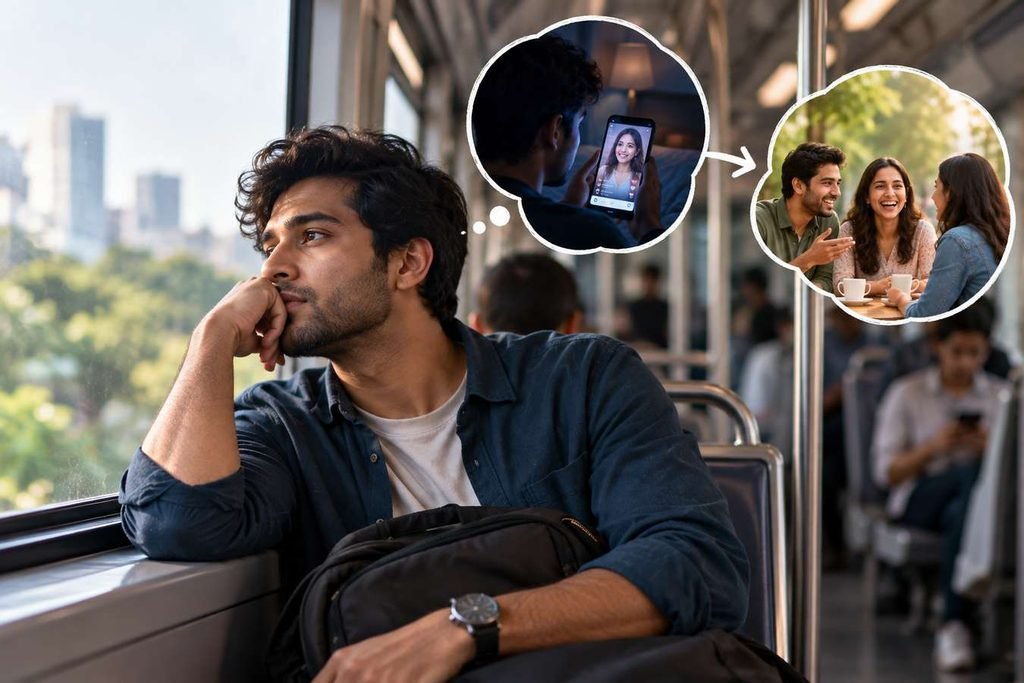
You may never have spoken to them. They may not know your name, your story, or anything about your life. Yet their success can make you genuinely happy. Their struggles can concern you. Their absence can sometimes leave a small emotional gap in your day.
When something important happens in their life, you may find yourself thinking about it long after you have put your phone down.
You might even wonder:
“Why do I feel so connected to someone I’ve never met?”
Table of Contents
There is a psychological explanation for this experience. It is known as a parasocial relationship.
The term may sound clinical, but the experience itself is very human.
And having a parasocial relationship does not automatically mean that something is wrong with you.
Research increasingly shows that these relationships can exist alongside ordinary friendships, family relationships, and social support. A 2025 mixed-methods study of 124 Indian youth, for example, found that stronger parasocial relationships were not significantly related to psychological well-being, and people with stronger parasocial relationships did not necessarily lack good social support in real life. The researchers also cautioned that their findings were based on a relatively restricted sample of Indian youth.
So perhaps the better question is not:
“Why am I attached to someone who doesn’t know me?”
A more useful question might be:
“What is this connection doing for me?”
Maybe it gives you comfort. Maybe it makes you laugh after a difficult day. Perhaps you see something of yourself in that person, or they represent a version of yourself you would like to become.
Sometimes their story may have helped you through a difficult period.
And sometimes there may be nothing deeper behind it.
You simply enjoy their work.
All of these experiences can matter.
At the same time, there is an important difference between feeling connected and being known.
Someone on your screen can become very familiar to you. You may know many details about their life, remember their stories, and develop genuine affection for them.
But the relationship is still different from a mutual friendship or close personal relationship.
That difference does not make your feelings fake.
It simply helps us understand what kind of connection it is.
And once we understand that, something interesting becomes possible.
Perhaps the connection is not only telling you something about the person you follow.
It may also be telling you something about yourself.
What Is a Parasocial Relationship?
Before we explore why someone we have never met can begin to feel so familiar, it helps to understand what psychologists mean by a parasocial relationship.
The term “parasocial interaction” was introduced by Donald Horton and Richard Wohl in 1956. They described how audiences could experience a sense of intimacy with media personalities who appeared to communicate directly with them. The original idea emerged in the age of radio and television.
Today, the concept has expanded considerably.
In simple terms, a parasocial relationship is a one-sided socio-emotional connection with a media figure or fictional character.
That person could be a film actor, singer, sportsperson, YouTuber, podcaster, influencer, online educator, or fictional character.
You may follow their work regularly. You may feel familiar with their personality. You may care about what happens to them or look forward to seeing them again.
You may even feel that they are part of your life in some small way.
But there is an important difference.
You may know them, but they do not know you in the same personal way.
You may know where they grew up, what they enjoy, what they believe in, or what they have been struggling with recently because they have shared these things publicly.
They may know very little about your life.
That imbalance is one of the defining features of a parasocial relationship.
How Is It Different From a Friendship?
A friendship is reciprocal.
You share something. Your friend responds. You listen to their experiences, and they listen to yours. Both people gradually learn about each other and participate in building the relationship.
A parasocial relationship works differently.
The emotional experience can be very real for the viewer, but the relationship itself is not equally experienced by both sides.
You can understand that a celebrity does not know you personally and still feel emotionally connected to them.
Both things can be true at the same time.
Parasocial Interaction Is Slightly Different
You may also come across another term: parasocial interaction.
The two ideas are closely related, but researchers increasingly distinguish between them.
Imagine that your favourite creator uploads a video and speaks directly to the camera. You laugh at something they say. You mentally respond to a question. For a few moments, it can almost feel like you are part of a conversation.
That immediate experience is closer to parasocial interaction.
A parasocial relationship is broader and develops over time.
After repeatedly watching the same person, you may develop a lasting sense of familiarity or attachment. You may think about them even when you are not watching their content.
A 2024 review of 281 studies found that researchers now distinguish parasocial interactions as experiences occurring during media use from parasocial relationships as more enduring connections that extend beyond a particular media encounter.
Why Does Social Media Make It Feel So Personal?
Think about watching an actor in a two-hour film.
You see the character they are playing, but the experience has a clear beginning and end.
Now compare that with following a creator on social media.
You may see their morning routine, hear them talk about a difficult day, watch them celebrate a success, see photographs from their life, and then encounter another post from them the next morning.
You are no longer seeing only their professional work.
You are repeatedly seeing small pieces of a life.
Research shows that parasocial research has increasingly moved from traditional television and film toward social and new media. In the 281-study review, social and new media accounted for the largest proportion of the research contexts examined between 2016 and 2020.
Self-disclosure can also contribute to feelings of familiarity and closeness. When people share personal experiences, opinions, emotions, or everyday moments online, audiences may feel that they are getting to know the person behind the public image.
This does not necessarily mean the creator is deliberately trying to make the audience feel close.
It simply means that modern digital communication provides many more opportunities for that feeling to develop.
So, Is the Feeling Real?
This is perhaps the most important point.
The relationship may not be reciprocal, but the emotion you experience can still be genuine.
If someone’s videos comfort you after a difficult day, the comfort is real.
If a singer’s music helps you through a difficult period, the emotional experience is real.
If a creator inspires you to make a change in your life, that motivation is real.
What is different is the structure of the relationship.
You are experiencing a genuine emotional response to a mediated relationship with someone who does not have the same personal knowledge of you.
Understanding that difference does not require you to dismiss the connection.
It simply gives you a clearer way to understand it.
How Does Someone We’ve Never Met Start Feeling So Familiar?
At first, they are just another person on your screen.
You watch one video. Then another. You hear their voice, notice their mannerisms, learn their sense of humour, and become familiar with the way they tell stories.
Nothing dramatic has happened.
But something has started to change.
They are becoming familiar.
Repeated exposure gives you more information about a person. Their face becomes recognisable. Their voice becomes familiar. You begin to know what to expect from them.
Eventually, seeing that person can feel less like encountering a stranger and more like encountering someone familiar.
But familiarity alone does not explain everything.
A person can become familiar without becoming emotionally important.
What often deepens the connection is the feeling that you are learning something personal about them.
Imagine a creator talking about failing an important exam, struggling with self-doubt, feeling nervous before an event, dealing with a difficult relationship, or simply having a bad day.
You are not just watching their work.
You are seeing pieces of their personal experience.
That can create a feeling of intimacy.
Sometimes the Strongest Connection Comes From Similarity
Have you ever watched someone speak about an experience and thought:
“That’s exactly how I feel.”
Perhaps they talk about overthinking after a conversation.
Perhaps they describe being shy in social situations.
Maybe they speak about relationship difficulties, work pressure, self-doubt, loneliness, or trying to figure out what they want from life.
Suddenly, the person on the screen does not feel quite so distant.
You recognise something of yourself in them.
Research has repeatedly examined perceived similarity as one factor associated with stronger parasocial experiences. The similarity does not have to be exact. It may involve shared values, experiences, attitudes, interests, or ways of seeing the world.
This can create a powerful feeling:
“They get it.”
And sometimes that feeling matters more than fame.
You may not care about someone simply because they are famous.
You may care because something about their story feels familiar to your own.
Sometimes We See a Version of Ourselves in Them
There is another layer.
Sometimes you do not simply think, “This person is like me.”
You think:
“I want to be more like them.”
Maybe you admire their confidence. Their creativity. Their courage. Their discipline. Their independence.
Perhaps they represent a life you would like to build.
This is one reason parasocial relationships can become connected with identity and personal growth. Research has examined processes such as identification and perceived similarity as part of how audiences relate to media figures.
The person can become a psychological reference point.
You may think:
“If they could do that, perhaps I can try too.”
They may never know that they influenced you.
But the influence can still be meaningful.
Emotional Moments Can Make the Connection Stronger
Think about the creator you discovered during a difficult period of your life.
Perhaps you found them after a breakup.
Perhaps you were preparing for an examination, starting a new job, moving to a new place, caring for someone, or simply spending more time alone.
Their content became part of that period.
Years later, hearing their voice may bring some of those feelings back.
The attachment may therefore be connected not only to the person but also to what they came to represent in your life.
They may remind you of a time when you needed comfort.
They may remind you of who you were before something changed.
They may remind you of a version of yourself you still want to become.
Social Media Keeps Bringing Them Back
Traditional media usually required you to deliberately turn on the television, play a song, or watch a particular programme.
Social media is different.
Once you follow someone, their content can become part of your everyday feed.
You may encounter the same person several times a day without actively searching for them.
That repeated exposure creates more opportunities for familiarity and perceived closeness.
This does not mean that an algorithm is simply “making you emotionally attached”.
Human behaviour is more complicated than that.
But frequent exposure, personal storytelling, comments, livestreams and other forms of digital interaction can all give a parasocial connection more opportunities to develop.
Familiarity Is Not the Same as Reciprocity
You may eventually know a creator’s usual expressions.
You may predict what they will say.
You may know which subjects excite them.
You may even think:
“They would probably understand this.”
At that point, the person can feel psychologically familiar.
But there is an important distinction.
Familiarity is not reciprocity.
You may feel that you know them very well.
That does not mean they know you equally well.
Recognising this does not make the connection meaningless.
It simply makes it easier to understand.
And that brings us to a deeper question:
What exactly are we receiving from these connections that can make them feel so meaningful?
Sometimes We Are Not Just Attached to the Person — We Are Attached to How They Make Us Feel
Sometimes, when we say, “I really like this person,” there is another question underneath it.
What do I feel when I am around them?
Maybe you feel calmer.
Maybe you feel understood.
Maybe you laugh after a difficult day.
Perhaps you feel inspired, hopeful, less alone, or simply comfortable.

This is an important part of understanding parasocial relationships.
The emotional bond may not be only about the person themselves. It can also be about the emotional experience associated with them. This can become easier to understand when we look at how emotional attachment develops in the first place.
They Can Become Part of Our Emotional Routine
Think about what happens after a difficult day.
You come home mentally exhausted. You do not necessarily want advice. You may not even want to talk.
You simply open your phone and watch someone whose content has become familiar.
For the next twenty minutes, you feel a little lighter.
Nothing about your external situation has changed.
But your emotional state has.
Over time, that person may become associated with this feeling of relief.
Research supports the idea that parasocial relationships can be perceived as useful for fulfilling certain emotional needs. In three studies involving 3,085 participants, strong parasocial relationships were rated as more effective for emotional needs than relationships with acquaintances, although close reciprocal relationships were still considered more effective.
That distinction matters.
A parasocial connection can provide something emotionally meaningful without being equivalent to a close friendship.
Sometimes What We Need Is Simply a Sense of Companionship
There are moments when we do not need someone to solve a problem.
We simply do not want to feel completely alone.
A familiar voice in a podcast. A favourite creator talking about their day. A television character whose story you have followed for years.
These experiences can create a feeling of social presence.
You know the person is not actually sitting beside you.
But their presence in your emotional world can still feel comforting.
Research suggests that parasocial relationships can exist as part of a person’s broader social world rather than simply being substitutes for real relationships.
This is important because it challenges a common assumption.
A person can have friends, family, colleagues, and a loving partner and still enjoy a strong connection with a public figure.
Human beings can have many forms of emotional connection.
Sometimes They Help Us Understand Ourselves
Sometimes we are drawn to people who express something we have not yet found the words for ourselves.
A creator talks openly about anxiety, and you realise that some of your own experiences have a name.
Someone talks about failure, and you begin thinking differently about your own mistakes.
A person discusses boundaries, and something about your own relationships suddenly becomes clearer.
They may never know that their words affected you.
But the effect can still be real.
This is one of the potentially constructive sides of parasocial relationships. Research has examined their links with learning, identity exploration, inspiration, and emotional experiences.
Sometimes, the person on the screen becomes a mirror.
You are not necessarily trying to become them.
You are discovering something about yourself through your response to them.
Sometimes We Are Attracted to a Version of Ourselves
Consider the person you admire most online.
What exactly do you admire?
Their confidence?
Their kindness?
Their creativity?
Their courage?
Their ability to speak openly?
Their discipline?
The qualities that fascinate us in another person can sometimes point toward qualities we value in ourselves—or qualities we wish we could express more fully.
That is one reason identification can become part of a parasocial relationship.
You may not want to be the person.
You may simply want to develop something you see in them.
There Is Nothing Wrong With Simply Enjoying Someone
This point deserves to be said clearly.
Not every strong attachment needs to be explained as a hidden problem.
You may simply love an actor’s work.
You may genuinely enjoy a particular creator.
A fictional character may have meant a great deal to you during an important period of your life.
You can have a favourite singer without secretly being lonely.
You can follow an influencer without confusing them with a friend.
You can feel emotionally moved by someone you have never met without needing to turn the experience into a diagnosis.
The important question is what place the connection occupies in your life.
Does a Parasocial Relationship Mean You Are Lonely?
There is a common assumption about parasocial relationships.
If you feel strongly connected to someone you have never met, perhaps you must be lonely.
It sounds logical at first.
But human behaviour is rarely that simple.
Having a parasocial relationship does not automatically mean that you are lonely.
You can have close friends, a loving family, a partner, colleagues you enjoy, and still feel deeply connected to someone you follow online.
The 2025 Indian study mentioned earlier provides a useful example. Among its 124 participants, stronger parasocial relationships were not significantly associated with poorer well-being, and participants with strong parasocial relationships did not necessarily report poor social support in real life. The researchers also emphasised that the sample was relatively restricted, so the findings should not be generalised to all Indian youth or all populations.
Loneliness Is Not the Whole Explanation
Loneliness is not simply about being physically alone.
It is the subjective experience that one’s social connections are insufficient or do not meet one’s needs.
Someone can spend most of the day surrounded by people and still feel lonely.
Another person may spend considerable time alone and feel perfectly content.
This distinction matters when we talk about parasocial relationships.
A person might watch a favourite creator because they genuinely enjoy the humour.
Someone else might turn to the same creator because the content provides comfort during a period when they feel isolated.
The behaviour may look similar from the outside.
The emotional reason can be completely different.
Sometimes the Connection Becomes More Important During Difficult Periods
If someone is going through a breakup, relocation, bereavement, social isolation, or another major life change, a familiar person on a screen may become especially comforting.
There is nothing shameful about that.
People naturally look for connection when life feels difficult.
A parasocial relationship can become one source of that connection.
The important question is what happens around it.
Is it one source of comfort among many?
Or is it gradually becoming the only place where the person feels emotionally connected?
When Comfort Starts Replacing Connection
There is a difference between:
“I enjoy spending time with this creator.”
and:
“I would rather spend all my time watching this person than deal with people in my life.”
The first may simply be enjoyment.
The second deserves some curiosity.
The concern is not that the online connection exists.
It is that the person’s social world may gradually become narrower.
Current evidence does not support treating parasocial engagement as inherently harmful. A 2026 systematic review and meta-analysis of 17 studies and 52 effect sizes found associations with both positive and negative mental health outcomes. The authors concluded that parasocial engagement should not be viewed as uniformly beneficial or harmful.
Sometimes the Problem Is Not Loneliness but Comparison
There is another possibility.
The person you follow may initially inspire you.
Then you begin comparing yourself with them.
Why doesn’t my life look like that?
Why don’t I look like that?
Why haven’t I achieved as much?
Why does their relationship seem so perfect?
The same person who once made you feel inspired can begin making you feel inadequate.
The person may not have changed.
Your experience of following them has changed.
This is why it is useful to notice how you feel before and after consuming someone’s content.
The Better Question Is Not “Am I Lonely?”
Instead, ask:
“What happens to me after I spend time with this person?”
Do you feel lighter?
Inspired?
Comforted?
Motivated?
Or do you regularly feel anxious, inadequate, jealous, or dissatisfied with your own life?
Do you enjoy their content and then return to your relationships?
Or are you increasingly withdrawing from people around you?
These questions tell us much more than simply asking how strongly you like someone.
When Does a Parasocial Relationship Stop Feeling Healthy?
Liking someone you have never met is not a problem.
Following their work is not a problem either. Neither is getting excited when they release something new, feeling moved by their story, or thinking about them from time to time.
The more useful question is not:
“How strong is my attachment?”
It is:
“What is this attachment doing to my life?”
A strong emotional connection can still exist within a healthy life.
The concern begins when the connection becomes difficult to control, causes significant distress, or starts interfering with important areas of everyday life.
When Watching Becomes Difficult to Stop
Perhaps you planned to watch one video before going to bed.
One video becomes five.
Then you notice it is past midnight, and you still cannot stop scrolling.
This does not mean you have an unhealthy parasocial relationship because it happened once. Most people occasionally lose track of time online.
The question is whether it becomes a repeated pattern that you struggle to control.
Control and consequences matter more than a simple time count.
When Their Life Begins to Control Your Mood
Imagine waking up and immediately checking whether your favourite creator has posted.
If they have, you feel good.
If they have not, you feel strangely disappointed.
Perhaps they announce a relationship and you become genuinely upset. Maybe they make a decision you strongly disagree with, and you remain angry for hours.
Having emotions about someone you admire is not automatically concerning.
But it is worth noticing when your emotional stability becomes heavily dependent on what happens in the life of someone you do not personally know.
Your emotional world needs more than one source of stability.
When Criticism Starts Feeling Personal
This is a subtle one.
Someone criticises a celebrity you admire.
Instead of thinking, “I disagree with that opinion,” you feel personally attacked.
You may immediately want to defend the person. You may argue with strangers online. You may spend hours trying to prove that the criticism is wrong. When criticism of a creator starts feeling like criticism of you, it may help to understand why some people are more likely to start taking things personally.
Sometimes the person has become connected with your own identity, values, or sense of belonging.
A useful boundary is simple:
Their identity is theirs. Your identity is yours.
You can admire someone without needing to defend everything they say or do.
When the Connection Starts Replacing Real Relationships
Ask yourself:
Do you enjoy watching someone online alongside your relationships?
Or are you increasingly using their content instead of your relationships?
There is a meaningful difference.
A person may spend an evening watching a favourite creator and still call a friend the next morning, meet family members, participate at work, and maintain their usual social life.
Another person may gradually withdraw from everyone around them because the online connection feels easier and safer.
The concern is not that one relationship exists.
It is that the person’s social world becomes increasingly narrow.

When You Start Spending Beyond Your Comfort Zone
Buying an album, attending an event, subscribing to a service, or purchasing merchandise can simply be part of being a fan.
But what happens when you repeatedly spend money you cannot comfortably afford?
Perhaps you feel that you have to buy something to prove that you are a genuine supporter.
Or you spend impulsively because buying something connected to the person gives you a temporary emotional lift.
The issue is not the purchase itself.
It is whether the attachment is beginning to interfere with your financial well-being or your ability to make decisions freely.
When Inspiration Becomes Comparison
At first, you may follow someone because they inspire you.
But constant exposure can change the feeling.
Instead of thinking, “That inspires me,” you begin thinking:
“Why isn’t my life like that?”
“Why don’t I look like that?”
“Why haven’t I achieved as much?”
“What is wrong with me?”
At that point, it may be worth changing how you engage with the content.
Perhaps you need less of it.
Perhaps you need different kinds of content.
Perhaps you need to remind yourself that social media content is not a complete picture of another person’s life.
When the Imagined Relationship Becomes More Important Than Reality
You may sometimes imagine what it would be like to meet the person you follow.
That is perfectly human.
You may imagine having a conversation with them or wonder what they would say about something happening in your life.
Imagination itself is not the problem.
The concern arises when the imagined relationship becomes so emotionally important that reality begins to feel disappointing by comparison.
You may start believing that this person understands you better than anyone in your actual life, even though they have never had the opportunity to know you personally.
At that point, it can help to remind yourself:
“I can feel connected to this person without assuming that we have a mutual relationship.”
That is not rejection.
It is emotional clarity.
When You Cannot Step Away
Perhaps the simplest question is also one of the most useful:
Can I take a break?
Could you go a few days without checking their updates?
Could you spend an evening with family or friends without feeling that you are missing something essential?
Could you disagree with the person and still enjoy your own life?
If stepping away repeatedly feels almost impossible or causes significant distress, it may be worth exploring what the connection has come to represent for you. Not because the relationship is automatically “bad”, but because flexibility matters.
When the connection begins occupying your thoughts long after you have put your phone away, it can sometimes become part of an overthinking cycle.
Look at the Effect, Not Just the Intensity
Someone can feel extremely attached to a fictional character and still have a balanced, fulfilling life.
Someone else may have a relatively modest attachment to a social media creator but spend hours compulsively checking their content, losing sleep, neglecting responsibilities, or constantly comparing themselves.
So intensity alone does not tell us whether a parasocial connection is helpful or harmful.
The impact matters.
The 2026 meta-analysis found associations with both positive and negative outcomes and highlighted the need to consider the particular type of parasocial engagement, the outcome involved, age, and cultural context. Importantly, the evidence is largely correlational, so these findings should not be interpreted as proving that parasocial engagement causes either better or worse mental health.
A Gentle Self-Check
If you are wondering about your own relationship with someone online, you do not need to diagnose yourself.
Instead, pause and ask:
Does this connection add something positive to my life?
Can I enjoy it without losing control of my time?
Can I disagree with this person without feeling personally threatened?
Am I still investing in people who can know me and respond to me in return?
Does following them leave me feeling inspired or increasingly inadequate?
Can I step away when I need to?
There are no automatic right or wrong answers.
The purpose is simply to become more aware.
Sometimes awareness is enough to make a small adjustment.
Perhaps you need to spend less time scrolling before bed. Perhaps you need to mute content that consistently makes you compare yourself. Perhaps you need to reconnect with a friend you have been avoiding.
And sometimes you may realise something much simpler:
You enjoy this person’s work. It makes your life a little better. And there is no problem to solve.
That is also a perfectly valid answer.
The goal is not to eliminate emotional connections with people we see through screens.
The goal is to make sure those connections add to our lives rather than quietly taking over them.
Why Can Losing Someone We Never Met Feel Like Real Loss?
There is another side of parasocial relationships that we do not talk about enough.
Sometimes the person leaves.
A favourite creator stops making videos. A television series ends. A character you have followed for years disappears from the story. A musician retires. An actor dies.
And suddenly, something that had quietly been part of your life is no longer there.
You may feel sad.
You may miss them.
You may even surprise yourself by how deeply the loss affects you.
Then another thought appears:
“Why am I feeling this way? I didn’t even know them.”
That can make the experience even more confusing.
The Loss Can Be Real Even When the Relationship Was Not Mutual
A public figure may never have known you personally.
But they may still have occupied a meaningful place in your emotional life.
Perhaps you watched them every week for years.
Maybe their music was part of your college years. Their videos helped you through a difficult period. A particular television character became part of your daily routine.
So when they disappear, you are not only losing a person or character.
You may also be losing a familiar part of your own life.
A 2024 study of 1,289 Neighbours fans found that stronger parasocial and empathic relationships with favourite characters were associated with greater grief and loss reactions when the long-running series ended.
Sometimes You Are Grieving a Period of Your Own Life
Imagine that you discovered a particular singer when you were twenty.
You listened to their songs while travelling to college. You played them during your first relationship. You listened again when that relationship ended.
Years later, the music still carries something from that period.
Now imagine that the singer dies.
You may grieve for the artist.
But perhaps you are also grieving the version of yourself who listened to those songs for the first time.
Their work became attached to memories.
Their voice became part of a chapter of your life.
Sometimes we are not only saying goodbye to a person.
We are saying goodbye to a piece of our own story.
Why Can the Grief Feel Embarrassing?
Because other people may not understand it.
If you lose someone close to you, people usually recognise your right to grieve.
But if you say, “I feel devastated because my favourite actor died,” someone might respond:
“But you didn’t know them.”
Technically, that is true.
Emotionally, however, it does not settle the question.
Research on parasocial grief has described how people can experience and express genuine grief following the death of a public or fictional figure, while also finding that this grief may receive less social recognition than other forms of loss.
That does not mean the loss is identical to losing someone from your personal life.
It means the emotional response deserves to be understood rather than mocked.
Closeness May Matter More Than Whether the Relationship Was “Real”
A study examining anticipated grief after celebrity and social-network deaths found that perceived closeness, rather than simply whether the relationship was parasocial or face-to-face, was associated with stronger grief responses.
This gives us a useful way of thinking about parasocial grief.
The important question is not simply:
“Did I know this person personally?”
It may be:
“How meaningful had this person become in my emotional world?”
That can explain why one celebrity’s death may leave you relatively unaffected while another person’s death hits you unexpectedly hard.
You did not have the same relationship with both.
Not Every Loss Involves Death
A creator may simply stop posting.
A podcast may end.
A favourite television programme may be cancelled.
An actor may leave a role.
Nothing tragic may have happened.
Yet you can still feel that something is missing.
A 2025 study of parasocial breakups in fictional media found that people can experience genuine grief reactions when a parasocial relationship naturally ends, with social support influencing how people experience and cope with that loss.
Sometimes what we miss is not only the person.
We miss the feeling of knowing they would be there.
You Do Not Have to Pretend the Relationship Was Mutual
You can understand perfectly well that a celebrity did not know you personally and still feels grief when they die.
You do not have to convince yourself that you were secretly their friend.
You also do not have to tell yourself that your feelings are foolish.
You can simply acknowledge:
“This person mattered to me, even though they did not know me personally.”
Both realities can exist together.
What Can Help?
There is no special rule for how you are supposed to feel.
You may want to listen to their music, revisit old episodes, talk with other fans, share memories online, or simply allow yourself to feel sad.
Research on parasocial mourning has found examples of people using remembrance, memorialising, community discussion, and other forms of tribute while coping with the deaths of public figures.
But it can also help to gently return to your own life.
Spend time with people who know you.
Maintain your routines.
Allow the memories to have a place without allowing the loss to consume your entire life.
If grief becomes overwhelming or persistent enough to significantly interfere with daily functioning, relationships, sleep, or your ability to cope, professional support can be appropriate.
So, Is It Bad to Feel Connected to Someone You’ve Never Met?
After everything we have explored, perhaps the answer is not as simple as yes or no.
Feeling connected to someone you have never met is not automatically unhealthy.
It is not proof that you are lonely, emotionally dependent, or unable to form real relationships.
You can admire a celebrity, follow a creator closely, love a fictional character, or feel deeply moved by someone’s story and still have a rich and satisfying life outside that connection.
Current evidence supports a more nuanced view. The 2026 meta-analysis found that parasocial engagement was associated with both positive and negative outcomes rather than falling neatly into one category.
So perhaps the better question is not:
“Is this connection real?”
A more useful question is:
“What place does this connection have in my life?”
What Is This Connection Giving You?
Maybe this person makes you laugh after a difficult day.
Maybe their story helped you believe that change is possible.
Maybe their work gave you language for something you were struggling to understand.
Maybe you admire qualities you would like to develop in yourself.
Maybe you simply enjoy their personality.
There is nothing inherently wrong with that.
But sometimes the person we are attached to is not the entire reason for the attachment.
Perhaps you are looking for comfort.
Perhaps you want to feel understood.
Perhaps you want a sense of belonging.
Perhaps you miss a particular period of your life.
Perhaps you admire a quality you would like to develop.
Or perhaps there is nothing missing at all.
You simply enjoy the connection.
The C.O.N.N.E.C.T. Check
If you want to understand your own relationship with someone online, try this simple reflection exercise.
This is not a clinical test or a scientifically validated assessment. It is simply a reflection tool created for this article to help you think about the role the connection plays in your life.
C — Comfort
What feeling do I usually get from this person?
Do I feel calmer, happier, inspired, understood, or simply entertained?
O — Occupancy
How much space does this connection take in my day?
Am I choosing to engage with it, or does it increasingly occupy my attention without my intending it?
N — Need
What might I be receiving from this connection?
Is it companionship, motivation, belonging, identity, comfort, escape, inspiration, or something else?
N — Notice
How do I usually feel after engaging with their content?
Do I feel better and connected?
Or do I often feel inadequate, anxious, jealous, or emotionally drained?
E — Exchange
Am I still investing in relationships where people can know me, respond to me, challenge me, support me, and grow with me?
This is not about choosing real people instead of online connections.
It is about making sure reciprocal relationships still have a place in your life.
C — Control
Can I step away when I want to?
Can I take a break without feeling overwhelmed by anxiety or a sense that I am missing something essential?
T — Transfer
What can I take from this connection into my own life?
Perhaps you admire someone’s courage.
Can you practise a little more courage yourself?
Perhaps their story taught you something.
Can you apply it to your own life?
Perhaps their content simply makes you happy.
Can you allow that happiness without needing the connection to become more than it is?
The purpose of this exercise is not to decide whether your parasocial relationship is “good” or “bad”.
It is to help you understand it.
You Do Not Have to Feel Ashamed of the Connection
There is a tendency to laugh at people who become emotionally attached to celebrities or online personalities.
Sometimes the response is:
“They don’t even know you.”
There is truth in that statement.
But it does not have to be used to shame someone.
A person can know that a celebrity does not know them personally and still feel grateful for the role that person’s work played in their life.
A person can understand that a fictional character is not real and still have learned something important from that character’s story.
Someone can know that a creator is speaking to thousands of people and still feel personally comforted by what they hear.
Understanding the boundary does not require you to invalidate the feeling.
In fact, understanding the boundary may allow you to enjoy the connection more freely.
You can appreciate someone without needing them to know you.
You can admire them without defending everything they do.
You can learn from them without becoming them.
And you can feel connected without forgetting your own life.
When the Connection Becomes a Signal to Look Inward
Sometimes a strong attachment can tell you that something in your life deserves attention.
Perhaps you are feeling isolated.
Perhaps you have stopped talking to people you once felt close to.
Perhaps you are using someone’s content to avoid difficult emotions.
Perhaps you are constantly comparing your life with theirs.
Perhaps you cannot step away even when the connection is affecting your sleep, work, finances, relationships, or everyday functioning.
In those situations, the question is no longer simply:
“Why do I like this person so much?”
It may be:
“What am I needing right now that I am trying to meet through this connection?”
That question can be surprisingly powerful.
And you do not have to answer it perfectly.
Sometimes recognising the need is the beginning of taking care of it.
When Is It Time to Talk to Someone?
Most parasocial attachments do not require professional intervention.
But if the connection is causing significant or persistent distress, interfering with sleep, work, studies, relationships, finances, or daily functioning, or if you repeatedly feel unable to step away despite wanting to, talking with a qualified mental-health professional can be helpful.
The same is true if the attachment has become a major source of anxiety, sadness, anger, isolation, or difficulty coping with everyday life.
You do not have to wait until the situation becomes a crisis.
A counsellor or psychologist can help you explore what the connection means to you and whether there are emotional needs or patterns underneath it. Sometimes what we are really looking for is emotional safety, not necessarily another person.
If you ever feel that you may hurt yourself or someone else, or that you cannot keep yourself safe, seek immediate help through local emergency services, a crisis service, or the nearest emergency department.
Asking for help does not mean that your feelings were wrong. It means you are taking care of yourself.
Perhaps the Real Question Is Not “Why Do I Feel This Way?”
Maybe, after reading all of this, you still have the same feeling.
You still care about that person.
You still look forward to their videos.
You still feel something when you hear their voice.
And that is okay.
You do not have to eliminate every emotional connection simply because it exists through a screen.
Perhaps what matters is understanding the place it occupies in your life.
Does it bring something meaningful?
Does it inspire you?
Does it comfort you?
Does it help you discover something about yourself?
Can you enjoy it while continuing to build relationships with people who can know you in return?
Can you put the phone down and return to your own life?
If the answer is yes, perhaps there is no mystery that needs to be solved.
You may simply have been touched by another person’s story.
And human beings have always been changed by stories.
A book can comfort us.
A song can carry us through grief.
A character can teach us courage.
A stranger’s words can make us feel understood.
And someone we have never met can sometimes become part of our emotional world.
The important thing is to remember the difference between feeling connected and being known.
A person on a screen can inspire you, comfort you, entertain you, or become meaningful during an important chapter of your life.
But your own life deserves space too.
Space for people who can ask how you are.
People who can hear your answer.
People who can sit with you when things become difficult.
People who can challenge you, support you, laugh with you, and know the parts of your story that no algorithm could ever see.
Perhaps that is the healthiest way to understand a parasocial relationship.
You do not have to stop caring about people you have never met.
Just remember to keep making room for the people—and the life—that can meet you halfway.
Frequently Asked Questions About Parasocial Relationships
What is a parasocial relationship?
A parasocial relationship is a one-sided socio-emotional connection that a person develops with a media figure or fictional character. The concept originated with Horton and Wohl’s work on parasocial interaction in 1956 and has since developed into a broader area of media and psychology research.
Is it normal to feel connected to someone I’ve never met?
Yes. Feeling emotionally connected to a celebrity, creator, fictional character, or other media figure can be a normal part of media use. Research does not support the idea that a strong parasocial relationship automatically means someone is lonely or psychologically unwell. A 2025 study among Indian youth, for example, found that stronger parasocial relationships did not necessarily mean poorer real-life social support or lower well-being.
Are parasocial relationships unhealthy?
Not necessarily. Current research presents a more nuanced picture. A 2026 systematic review and meta-analysis found associations between parasocial engagement and both positive and negative outcomes. The evidence does not justify describing all parasocial relationships as either healthy or unhealthy.
Why can I feel so close to a celebrity or influencer?
Repeated exposure, perceived similarity, personal disclosure, and the feeling of social presence can contribute to psychological closeness. Social media can strengthen these experiences because people may encounter the same creator frequently and see personal details about their life.
Can a parasocial relationship make me feel less lonely?
It can provide a sense of companionship or emotional connection for some people. Research involving 3,085 participants found that people perceived strong parasocial relationships as capable of fulfilling some emotional needs, although close reciprocal relationships were still considered more effective overall.
When should I be concerned about a parasocial relationship?
The attachment itself is not necessarily the concern. It may be worth paying attention when the connection becomes difficult to control or begins interfering with sleep, work, studies, relationships, finances, or everyday functioning. Significant or persistent distress is also a good reason to consider speaking with a qualified mental-health professional.