

You ask a simple question, forget to mention something, disagree about a decision or make an innocent comment. Suddenly, your partner becomes irritated. Their voice changes, their response becomes sharp, or an ordinary conversation turns into an argument.
At first, you may try to understand what went wrong. You explain yourself, choose your words more carefully or decide not to respond. But when similar incidents keep happening, you may begin to feel confused, emotionally exhausted and increasingly cautious about what you say or do.
Perhaps you have started wondering: Why Does My Partner Get Angry Over Small Things? Am I doing something wrong? Why does an ordinary situation become such a big issue between us?
Table of Contents
The intensity of an angry reaction does not always reflect the importance of the incident that triggered it. Sometimes, an apparently minor disagreement becomes emotionally charged because of accumulated stress, unmet expectations, unresolved frustrations or the way a situation is interpreted.
Understanding these possible reasons can help you look beyond individual arguments and recognise what may be happening in your relationship.
Why Does Your Partner React So Strongly to Small Things?
When your partner becomes angry over something that appears insignificant, it is natural to focus on the immediate incident. However, the reaction may be influenced by circumstances and concerns that extend beyond that particular moment.
Here are six possible psychological and relationship-related explanations.
Accumulated Stress May Spill Into the Relationship
Sometimes, the frustration expressed at home is not entirely about what happens at home. Work pressure, financial responsibilities, family demands, poor sleep and everyday difficulties can gradually reduce a person’s capacity to respond calmly.
For example, your partner may have had a particularly difficult day at work. Later, when you ask why a household task has not been completed, they respond with unusual irritation. Your question may be reasonable, but their reaction may be influenced by the stress they have been carrying.
Research by Timmons, Arbel and Margolin (2017), published in the Journal of Family Psychology, examined daily stress and marital conflict. The researchers found that higher daily stress was associated with greater conflict between partners on the same day. This suggests that pressures outside a relationship can spill over into interactions within it.
You can explore the findings in the original study, Daily Patterns of Stress and Conflict in Couples.
However, stress is an explanation, not an excuse. A difficult day does not remove a person’s responsibility for treating their partner respectfully.
Unmet Expectations May Be Behind the Reaction
Not every disagreement is really about the immediate issue. Sometimes, a small incident becomes emotionally significant because it connects with an expectation that has remained unspoken or unmet.
Imagine your partner becomes angry because you did not call when you were running late. On the surface, the disagreement is about a phone call. But your partner may have expected consideration, reassurance or a sense that their time matters.
If similar expectations have been disappointed repeatedly, the latest incident may bring earlier frustrations to the surface. The difficulty arises when expectations are never discussed clearly. One partner may assume that something should be understood without explanation, while the other may not realise that it carries such emotional importance.
Over time, ordinary situations can begin to feel like repeated disappointments.
Disagreement May Be Experienced as Personal Criticism
Some people find it difficult to separate disagreement about an action from criticism of themselves. A simple suggestion or correction may be interpreted as a judgement about their competence, intelligence or worth.
For example, you might say, “Perhaps we should handle this differently next time.” Your partner may hear, “You never do anything properly.” Instead of discussing the suggestion, they become defensive because they feel personally criticised.
A study published in Behavior Therapy in 2016 examined emotion regulation and perceptions of criticism in romantic relationships. It found that difficulties with emotion regulation were associated with more hostile perceptions of criticism, while reappraisal during discussions was associated with more constructive perceptions.
This offers one possible explanation for why a suggestion may sometimes be received as a personal attack. You can read the original research, Emotion Regulation and Perceptions of Hostile and Constructive Criticism in Romantic Relationships.
Of course, this does not mean that every angry reaction is caused by misinterpretation. The way people communicate and the way they interpret communication can both influence disagreements.
For a broader discussion of how intention and interpretation affect everyday conversations, read Why Do People Misunderstand Each Other?.
Difficulty Tolerating Frustration Can Intensify Reactions
People differ in how comfortably they handle disappointment, inconvenience and situations that do not go according to their expectations. Some can pause, reconsider and adjust. Others may become irritated quickly when something interrupts their plans or challenges what they want.
Consider a situation in which you suggest changing a weekend plan because of an unavoidable commitment. Your partner may respond with disproportionate anger because they struggle to manage the disappointment or uncertainty associated with the change.
This may reflect difficulty managing frustration in that moment. It does not automatically indicate a psychological disorder or a particular personality trait.
What matters is whether your partner can recognise the reaction, communicate their frustration and gradually develop more constructive ways of responding.
Learned Ways of Expressing Anger May Influence Behaviour
People develop ways of expressing disagreement through their experiences. Family interactions, childhood environments, previous relationships and social expectations can influence what someone considers a normal response to conflict.
For example, a person who grew up in a household where disagreements regularly involved shouting may have learned to raise their voice whenever they feel frustrated. Another may have learned to express anger through criticism, blame or prolonged silence.
These patterns can continue into adult relationships, sometimes without conscious awareness. But learned behaviour is not fixed behaviour. A person’s past may help explain why a particular response feels familiar, but adults remain responsible for examining how their behaviour affects others.
Unresolved Frustrations May Have Built Up Over Time
Sometimes, what appears to be anger over a small issue is connected to several unresolved concerns. A disagreement about household responsibilities, for instance, may bring back earlier arguments about unequal effort, lack of appreciation or feeling unsupported.
When concerns are repeatedly postponed rather than discussed and resolved, they may accumulate. The latest disagreement then becomes an outlet for frustrations that have been present for much longer.
It is useful to notice whether the same concerns keep returning in different forms. If they do, focusing only on the latest incident may not address what is maintaining the conflict.
Why Do the Same Arguments Keep Happening?
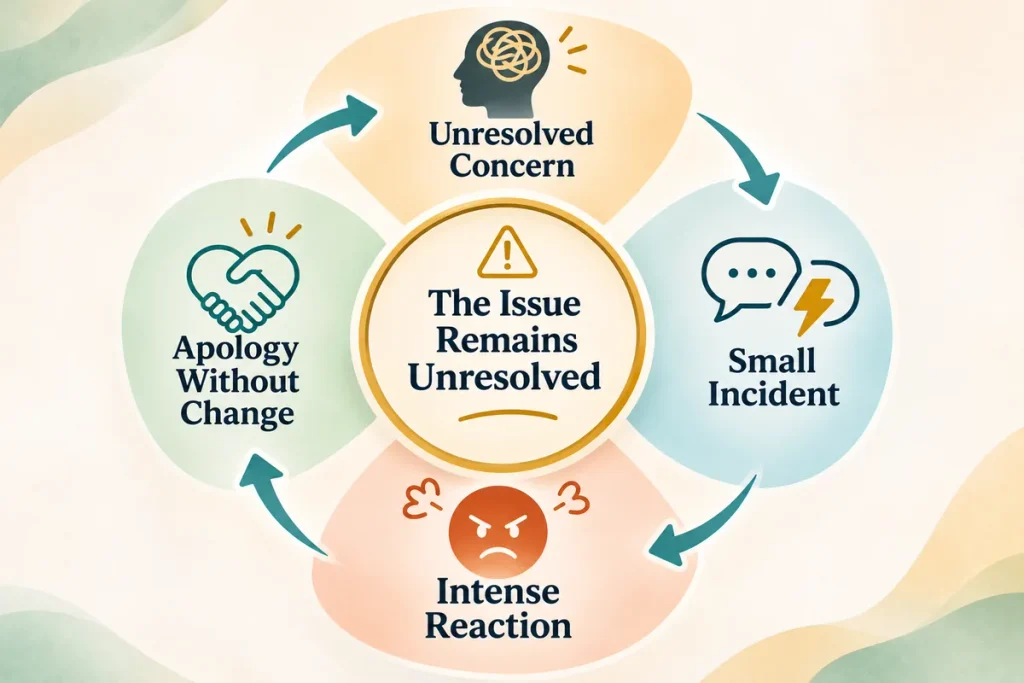
One of the most exhausting experiences in a relationship is having the same argument repeatedly. You discuss an issue, the tension settles and you both move on. Yet another seemingly minor incident brings back the same frustration.
Sometimes, the original issue was never resolved. One partner may stop discussing it because they are tired of fighting, while the other assumes the matter has been settled. The immediate argument ends, but the dissatisfaction remains.
Each new incident may also begin carrying the weight of previous disagreements. A forgotten phone call may bring up earlier feelings of being overlooked. A disagreement about plans may revive concerns about consideration and shared responsibilities.
This can make the reaction appear much bigger than the immediate situation warrants.
An apology can help repair a relationship, but an apology alone does not necessarily resolve a recurring problem. Meaningful repair involves acknowledging the behaviour, understanding its impact, taking responsibility and making a consistent effort to respond differently.
A 2024 study by Wilder, Prager and Garapati, involving 217 cohabiting couples, examined how couples attempted to reconcile after conflict. The researchers found that attentive listening during everyday conflict was associated with more helpful attempts to repair the relationship afterwards.
The study, But I Said I’m Sorry: Helpfulness of Romantic Couples’ Efforts to Reconcile After Conflict, offers useful insight into why the quality of interaction during disagreements matters even after the argument has ended.
The important question is not simply whether your partner apologises. It is whether the behaviour gradually changes.
The R.E.A.C.T. Lens: Understanding the Pattern Behind the Reaction
When your partner repeatedly gets angry over small things, looking at individual incidents may not give you the complete picture. You need to consider the circumstances, the recurring pattern and the effect on your relationship.
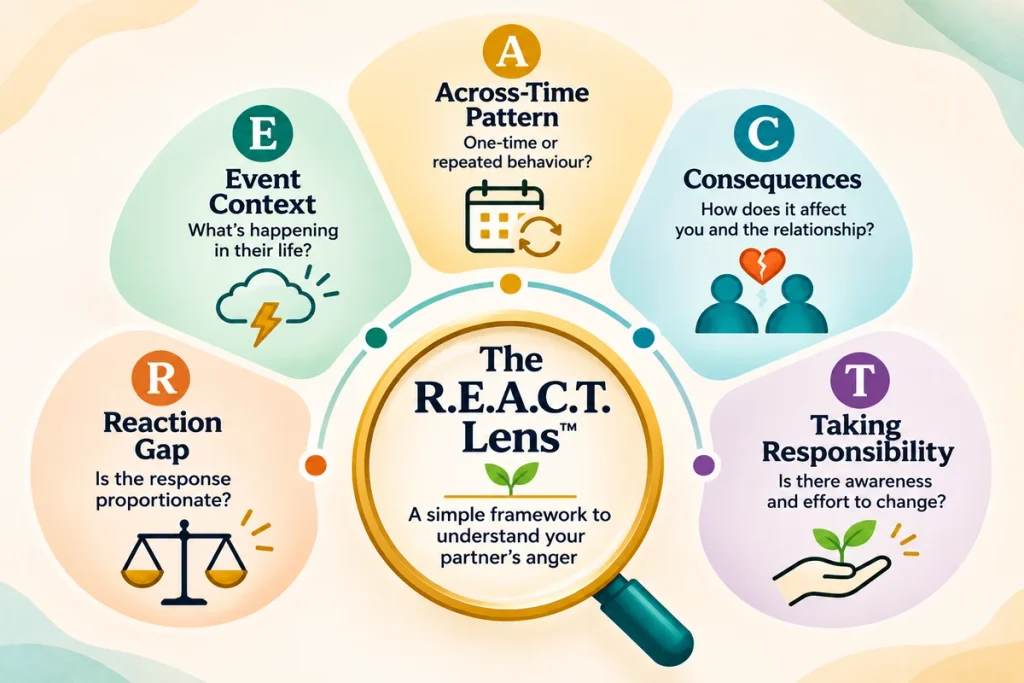
The R.E.A.C.T. Lens is an educational reflection framework developed for this article. It is not a clinically validated assessment or diagnostic tool. Its purpose is to help you observe recurring reactions more thoughtfully.
- R – Reaction Gap: Is the response proportionate to the situation? Consider the difference between what happened and how your partner responded.
- E – Event Context: What circumstances may be influencing the reaction? Consider stress, unresolved disagreements and unmet expectations.
- A – Across-Time Pattern: Is this an isolated incident or something that happens repeatedly? Notice whether similar reactions occur in different situations.
- C – Consequences: How is the behaviour affecting you? Do you hesitate before speaking, avoid certain conversations or constantly monitor your partner’s mood?
- T – Taking Responsibility: What happens afterwards? Does your partner acknowledge the behaviour, listen to its impact and make a genuine effort to change?
For example, forgetting to complete a household task may be an ordinary mistake. But if your partner repeatedly responds with insults, brings up unrelated grievances and later refuses to acknowledge the impact, the concern is no longer limited to that one incident.
The R.E.A.C.T. Lens encourages you to look beyond the immediate argument. It helps distinguish occasional frustration from a recurring pattern that may require attention.
What Can You Do When This Keeps Happening?
If ordinary conversations repeatedly turn into arguments, try not to resolve every issue when emotions are at their highest. When both partners are calmer, discuss the recurring behaviour rather than focusing only on the latest incident.
You might say, “I’ve noticed that small disagreements sometimes become quite intense between us. I feel uncomfortable bringing up certain things, and I would like us to understand why this keeps happening.”
You can also establish boundaries around shouting, insults and disrespectful communication. Remember that you can reflect on your own behaviour, but you cannot take responsibility for managing every angry reaction your partner has.
For more detailed guidance on handling persistent partner anger, setting boundaries and recognising when the relationship needs support, read our broader guide to understanding and responding to an angry and negative partner.
When Is Your Partner’s Anger More Than an Ordinary Relationship Disagreement?
Occasional irritation is different from a repeated pattern of humiliation, intimidation, threats or controlling behaviour. Pay attention if you feel afraid to express ordinary opinions, constantly monitor your partner’s mood or find that your choices are increasingly restricted because of their reactions.
The World Health Organization recognises psychological abuse and controlling behaviours as forms of intimate partner violence. Its fact sheet, Violence Against Women, explains why relationship harm should not be understood only in terms of physical violence.
If you feel unsafe, prioritise your safety rather than trying to manage your partner’s anger through better communication. Reach out to someone you trust or an appropriate support service. In India, the national emergency response number is 112.
You can also explore Why Do I Feel Emotionally Unsafe? to understand the emotional impact of feeling unsafe in a relationship.
Frequently Asked Questions
Why does my partner get angry over small things but remain calm with others?
People may behave differently in different social situations. Someone may control their reactions at work or around friends but express frustration more openly at home. Relationship expectations and unresolved concerns may contribute. However, being calm with others does not make repeated angry behaviour towards a partner acceptable.
Why does my partner get angry when I ask questions?
Your partner may interpret certain questions as criticism, questioning of their decisions or a sign of distrust. Previous disagreements or existing tension may also influence their response. Asking reasonable questions is a normal part of a relationship, and you should not have to feel afraid of communicating.
Is getting angry over small things a sign of stress or an anger problem?
It may be related to stress, poor sleep, unresolved relationship concerns or difficulty managing emotions. However, frequent anger alone is not enough to establish an anger disorder or any other psychological diagnosis. If the behaviour is persistent or affecting everyday functioning, professional assessment may help.
Final Thoughts: Understanding Anger Is Not the Same as Accepting It
When your partner gets angry over small things, it is easy to become preoccupied with the immediate arguments. You may repeatedly question your words, reconsider your actions or wonder what you could have done differently.
But a relationship should not become a place where one person constantly adjusts their behaviour to prevent the other from becoming angry.
Stress, unmet expectations, defensiveness and unresolved frustrations can all contribute to disproportionate reactions. Understanding these influences can help you approach relationship difficulties with greater awareness.
At the same time, explanations should not become excuses. What matters is whether both partners can recognise the problem, communicate respectfully, take responsibility and make meaningful changes.
A healthy relationship is not one in which nobody gets angry. It is one in which anger does not repeatedly take away the other person’s sense of respect, freedom and emotional safety.
A Gentle Note: This article is intended for psychological education and general self-reflection. It does not replace individual assessment, diagnosis or professional mental health care.