

There may be mornings when the thought of going to work feels exhausting. You wake up worrying about the day ahead, feel anxious about meeting your manager or struggle to concentrate even on familiar responsibilities. What once felt like an ordinary working day may now seem difficult to face.
Perhaps the anxiety follows you home. You keep thinking about unfinished work, difficult conversations or what might go wrong the next morning. Gradually, a question begins to emerge: Should I quit my job because of anxiety?
Table of Contents
It is not an easy decision. Leaving may seem like the only way to regain your peace of mind, but financial responsibilities, family commitments and uncertainty about finding another job can hold you back. Before deciding, it is important to understand what is causing your distress, including the workplace factors that contribute to anxiety. You can begin by understanding workplace anxiety and its causes, particularly how professional demands and working conditions affect emotional well-being.
This article explores seven important considerations to help you understand your situation, evaluate your options and make a thoughtful decision without ignoring your mental health.
Is It Okay to Quit a Job Because of Anxiety?
Yes. It is okay to consider leaving a job when your mental health is being affected. You do not have to wait until you reach a breaking point before taking your well-being seriously. Your health deserves consideration alongside your professional responsibilities.
However, quitting is not always the only solution. You might be struggling with excessive workloads, an unsupportive manager, workplace conflict or a persistent fear of making mistakes. Sometimes, the difficulty lies in the working environment rather than the profession itself.
The World Health Organization identifies excessive workloads, job insecurity, bullying, unclear roles and inadequate workplace support as potential risks to mental health. These conditions can affect how people feel and function at work. WHO – Mental Health at Work.
This is an important distinction. Workplace anxiety should not automatically be interpreted as an inability to handle professional responsibilities. Struggling in a particular working environment does not mean you are professionally incapable. Your job is important, but it is not your entire identity. You are allowed to consider your mental health when making career decisions.
When Does Work Anxiety Become Serious?
Occasional nervousness before a meeting or an important deadline is common. However, persistent anxiety that interferes with your ability to function deserves attention. You might notice difficulty concentrating, racing thoughts about mistakes, physical symptoms such as sweating or a racing heartbeat, or an urge to avoid meetings and particular responsibilities.
You may also struggle to sleep because you keep thinking about work. Irritability, emotional exhaustion and withdrawal from personal relationships can become more noticeable. Sometimes, even getting ready for work begins to feel overwhelming.
Anxiety can create a difficult cycle. You struggle to complete tasks because you are worried, and unfinished work then increases your anxiety, making concentration even harder. Over time, you may begin questioning your abilities, even when your professional competence has not changed.
If anxiety is affecting your work, sleep or everyday functioning, consider speaking with a qualified mental health professional or doctor. Cognitive behavioural therapy (CBT) is a well-established treatment for generalised anxiety disorder, although the appropriate support depends on an individual’s circumstances. National Institute of Mental Health – Generalized Anxiety Disorder.

Should I Quit My Job Because of Anxiety? Questions to Ask Yourself Before Resigning
Before deciding to resign, take some time to understand what is happening. Anxiety can make a difficult situation feel even more overwhelming, especially when you are uncertain about what comes next. These seven considerations can help you examine your circumstances more clearly.
What Exactly About Your Job Is Making You Anxious?
Start by identifying the source of your distress. Is it your workload, a difficult manager, workplace relationships, fear of failure or uncertainty about your performance? Sometimes, people describe their entire job as stressful when the actual difficulty is associated with one particular situation.
For example, you may enjoy your profession but become extremely anxious whenever you interact with a particular supervisor. In another situation, the workload itself may be unreasonable, leaving you with little time to recover. Understanding the source can help you determine whether changing your working conditions might make a difference.
Is Your Anxiety Temporary or Persistent?
Every job has difficult periods. An approaching deadline, a new responsibility or an unexpected disagreement can temporarily increase stress. Such experiences do not necessarily mean that you need to leave your job.
However, feeling anxious almost every day is different from experiencing occasional professional pressure. Notice when your anxiety began, how frequently it occurs and whether it is becoming more difficult to manage. There is no universal time limit for deciding whether to resign. What matters is recognising whether your distress is resolving, recurring or becoming more serious.
Does Your Anxiety Disappear When You Leave Work?
Some people feel relatively comfortable outside the workplace but become anxious when they approach the office or think about particular responsibilities. Others continue worrying long after working hours. They may repeatedly replay conversations, anticipate criticism or worry about what might happen the following day.
Psychologists describe the ability to mentally disengage from work during personal time as psychological detachment. It allows people to take a mental break from work-related demands during their time away from work. A systematic review by Agolli and Holtz (2023), which examined 159 empirical studies, identifies psychological detachment as an important recovery experience associated with employee health and well-being.
Ask yourself whether you can genuinely rest without constantly thinking about work. If work-related thoughts occupy most of your personal time, it may be worth examining what is making it difficult to switch off. This does not automatically mean you should resign, but it is an important signal to understand.
Is Your Workplace Contributing to the Problem?
It is important to distinguish between individual psychological difficulties and unhealthy workplace conditions. Consider two situations. An employee may experience intense fear of making mistakes, even in a reasonably supportive environment. Another employee may experience anxiety because their manager repeatedly humiliates staff or creates an atmosphere of fear.
Both may feel anxious, but their circumstances are different. The first person may benefit from psychological support to understand performance-related fears, while the second may need organisational intervention or a change in working conditions. Sometimes, both factors contribute to the same person’s distress.
Not every difficult emotion needs to be managed by changing yourself. Sometimes, the circumstances around you also need to change. Recognising this difference can prevent you from blaming yourself for problems that are partly caused by your working environment.
Have You Explored Alternatives Before Resigning?
If your workplace is reasonably safe, consider whether specific changes could make your situation more manageable. You might discuss an unrealistic workload, request clearer responsibilities, explore a transfer or change in role, take appropriate leave, or seek professional support. Sometimes, a change in responsibilities or working arrangements can make a meaningful difference.
The WHO guidelines on mental health at work recognise the importance of organisational interventions and reasonable workplace accommodations. These approaches aim to address workplace risks and support employees’ mental health. WHO – Guidelines on Mental Health at Work.
However, exploring alternatives does not mean tolerating harassment, threats or serious mistreatment indefinitely. You do not have to exhaust every possible option before leaving an unsafe or seriously harmful environment. Your safety and dignity matter.
How Seriously Is Anxiety Affecting Your Personal Life?
Notice whether work-related anxiety is affecting your sleep, relationships, physical well-being or ability to enjoy ordinary activities. Perhaps you have become unusually irritable with family members, stopped meeting friends or lost interest in activities you previously enjoyed. These changes may indicate that work-related distress is extending beyond your professional life.
Sometimes, people also begin measuring their self-worth through their professional performance. They interpret every mistake as evidence that they are inadequate or believe that struggling at work means they are not capable enough. But your professional performance is not the complete measure of your worth.
If anxiety is affecting several areas of your life, consider seeking professional support rather than trying to manage everything alone. You deserve to have a life beyond meeting deadlines, completing responsibilities and proving your professional abilities.
Am I Making This Decision From Clarity or Emotional Exhaustion?
When someone feels overwhelmed, resignation may appear to be the only way to obtain immediate relief. At the same time, fear of financial uncertainty may make another person remain in an unhealthy situation. You may experience two competing thoughts: “I cannot bear going back to this workplace” and “What if I cannot find another job?”
Both feelings can exist together. Research by Starcke and Brand (2016) examined how stress influences decisions under uncertainty. Their meta-analysis found that stress can affect decision-making, although the effects vary according to the situation. It does not mean that a person experiencing anxiety is incapable of making a sound decision.
Ask yourself whether you genuinely want to leave your profession or whether you desperately need the current circumstances to change. You do not have to make a rushed decision simply to escape discomfort. Equally, you should not ignore serious workplace problems because leaving feels frightening.
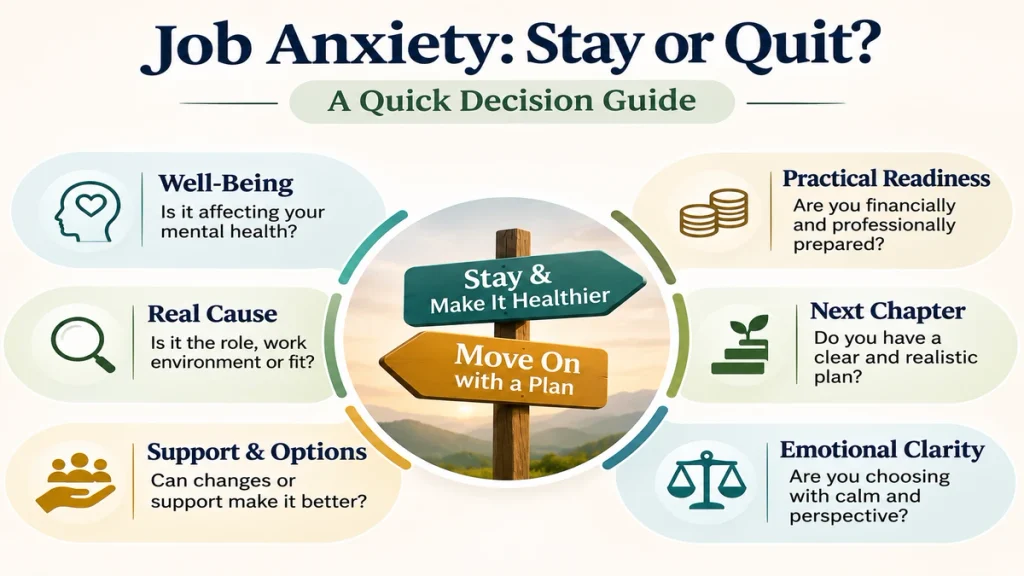
I Want to Quit My Job but I Need Money. What Should I Do?
Financial responsibilities can make this decision particularly difficult. You may want to leave, but rent, loan repayments, family responsibilities and other commitments depend on your income. This can create a conflict between emotional well-being and financial security.
If your workplace is not an immediate threat to your safety, consider preparing a transition rather than resigning without a plan. Explore alternative employment while you are still working, review your essential financial commitments and consider whether appropriate leave or workplace adjustments are available.
This decision can also be difficult because of the psychological and financial reasons why people stay in jobs they no longer enjoy, even when their work is affecting their well-being. You may also seek professional support while planning your next career move.
Remember, needing your salary does not mean you must ignore persistent psychological distress. Sometimes, the most realistic approach is to protect your health while preparing a transition you can manage. The aim is not simply to leave quickly, but to make a decision that considers both your well-being and your practical circumstances.
What If You Quit and Regret Your Decision?
Leaving a difficult job may bring relief, but uncertainty can follow. You may miss your colleagues, worry about your finances or question whether you should have tried harder to make things work. However, experiencing doubt after resignation does not automatically mean that your decision was wrong.
You may miss the routine, financial security or professional identity associated with your previous position without wanting to return to the circumstances that made you leave. It can help to ask yourself a few questions: Do I miss the actual job or the security it provided? Am I regretting my decision or worrying about the future? If the workplace conditions remained unchanged, would I genuinely want to return?
Career transitions can involve changes in routine, professional identity and social support. Coppola and Young (2022) discuss these challenges in their review of career transitions, highlighting the value of planning and support during periods of change.
Give yourself time to adjust where circumstances allow. A difficult transition does not necessarily mean a wrong decision. Sometimes, uncertainty is simply part of adapting to a new stage of professional life.
How to Explain Leaving a Job for Mental Health Reasons
You may feel uncomfortable explaining your resignation to a manager or future employer. You might worry about being judged or appearing professionally unreliable. However, you do not necessarily have to disclose every detail of your psychological experience.
When speaking to your current employer, you could say: “I have decided to move on for personal reasons and to focus on my overall well-being.” For a future employer, you might explain: “I took some time to reassess my professional priorities and am now looking for an opportunity that aligns with my skills and long-term career goals.”
These are examples, not mandatory scripts. Keep your explanation truthful and consistent with your circumstances. Employment policies and disclosure requirements can vary, particularly when medical leave or workplace accommodations are involved.
Your professional history and your personal health information are not the same thing. You can maintain professional boundaries while deciding how much personal information you are comfortable sharing.
The C.L.E.A.R. Framework: Making a Thoughtful Career Decision
To bring these considerations together, here is the C.L.E.A.R. Decision Framework, an original reflection tool developed for The Psyche Inspire. It offers five steps to help you examine your situation before deciding what to do. It is an educational tool, not a clinically validated psychological assessment.

C — Clarify the cause
Identify what is actually making you anxious. Is it your workload, workplace relationships, fear of failure or something outside work?
L — Listen to your emotional signals
Notice how frequently anxiety occurs and how it affects your sleep, concentration and personal life.
E — Evaluate your alternatives
Consider whether workplace adjustments, professional support, a transfer or other changes could improve your circumstances.
A — Assess your practical circumstances
Review your financial commitments, family responsibilities, available support and employment alternatives.
R — Respond with a realistic decision
Decide whether to remain with changes, prepare for a career transition or leave if necessary.
The purpose of this framework is not to tell you whether to resign. It is to help you make a decision with greater awareness and less self-judgment. Sometimes, the next step may be changing your working conditions. In other situations, preparing to leave may be the more realistic choice.
You Deserve a Working Life That Respects Your Well-Being
Deciding whether to quit your job because of anxiety is rarely straightforward. For some people, the answer may involve changing workplace conditions. Others may need professional psychological support. And sometimes, leaving an unhealthy working environment may be the most appropriate decision.
What matters is understanding the difference. You do not have to prove your strength by tolerating every difficult situation. Nor do you need to make an immediate career decision simply because you are experiencing anxiety. Give yourself permission to understand what is happening, seek support and consider your options.
Your professional life matters, but it is not your entire identity. You deserve to work in an environment where you can contribute and grow without constantly sacrificing your emotional well-being. Your mental health deserves a place in every important career decision.
Frequently Asked Questions
1. Is It Normal to Feel Anxious About Going to Work Every Day?
Occasional work-related nervousness is common. However, persistent anxiety that affects your sleep, concentration or everyday functioning deserves attention. If it continues, consider speaking with a qualified mental health professional.
2. Should I Leave My Job If It Affects My Mental Health?
Leaving may be appropriate when working conditions are persistently harmful or meaningful improvements are unlikely. Consider your health, available alternatives and practical circumstances before deciding. If the workplace poses an immediate safety concern, prioritise your safety.
3. Can Changing Jobs Improve Anxiety?
It can help when the current working environment is a significant source of distress. However, changing jobs does not automatically resolve every form of anxiety. Some difficulties may require psychological support, even after a career change.
4. What Should I Do If I Cannot Afford to Leave My Stressful Job?
Explore workplace adjustments, appropriate leave, alternative employment and professional support. Review your financial commitments and prepare a realistic transition plan if it is safe to remain temporarily. Needing your salary does not mean your mental health should be ignored.