

You have had a demanding day. There are unfinished tasks at work. Something at home needs your attention. A family member is depending on you, and your mind is already thinking about tomorrow.
Someone notices and asks, “Do you need any help?”
Before you even consider the question, you reply, “No, I’m fine. I’ll manage.”
The answer comes almost automatically.
Later, you may feel tired, overwhelmed or even a little hurt. A part of you wonders why nobody understands how much you are carrying. Yet when support was offered, another part of you could not accept it.
This can be confusing.
You may be generous with your time. You may help friends, family members and colleagues without thinking twice. But when you need something, asking can feel uncomfortable. You might delay it, minimise your problem or convince yourself that handling it alone would be easier.
If you often wonder, “Why do I struggle to ask for help, even when I clearly need it? “ The answer is not necessarily that you are proud, difficult or unwilling to trust people.
Sometimes, asking for help carries an emotional meaning that other people cannot see.
It may feel like admitting failure. It may make you worry that you are becoming a burden. You may fear rejection, judgement or being indebted to someone. Perhaps experience has taught you that depending on people can lead to disappointment.
So, you keep managing.
From the outside, this may look like strength. Inside, however, it can feel lonely and exhausting.
Quick Answer

You may struggle to ask for help because needing another person feels exposing, unsafe or burdensome. Past disappointment, family expectations, fear of rejection, perfectionism or an insecure attachment pattern can teach you to rely mainly on yourself. This rigid form of self-reliance is sometimes described as hyper-independence. It is not a mental-health diagnosis, and it does not automatically mean that you have experienced trauma.
Table of Contents
Why Can Asking for Help Feel So Uncomfortable?
A request may look simple from the outside.
“Could you help me finish this?”
“Can I talk to you for a few minutes?”
“Would you come with me?”
“I’m not doing very well today.”
But inside your mind, that small request may open the door to several uncomfortable questions:
What if they say no?
What if they think I am incapable?
What if they agree but secretly resent me?
What if I have to return the favour immediately?
What if they use this vulnerable moment against me later?
This is why the practical size of a request does not always match its emotional weight.
Imagine a 35-year-old professional who has been given more work than one person can reasonably complete. A colleague could help, and the manager has already said that tasks can be shared. Still, he stays late and tries to finish everything himself.
On the surface, it looks like commitment.
Underneath, he may be thinking, “If I ask for help, they will realise I am not capable enough.”
Now consider a woman who manages her job, children and an ageing parent. Her family offers to take over one responsibility for the weekend. She refuses and says, “It’s okay. I’m used to it.”
She may genuinely want relief. But accepting it could bring another thought: “A good daughter and mother should be able to handle this.”
In both situations, the person is not refusing support because support has no value. They are refusing because asking touches something deeper—their sense of competence, identity or safety.
For some people, this pattern begins early.
Perhaps you were praised for being the child who never caused trouble. Maybe you learned to solve problems quietly because the adults around you were already stressed. You may have asked for comfort and received irritation, dismissal or advice when what you needed was warmth.
Over time, you may have formed a private rule:
“It is safer to need less.”
That rule may once have helped you cope. It may have made you responsible, resourceful and emotionally observant. But a strategy that protected you in one stage of life can become restrictive in another.
You may now be surrounded by people who genuinely want to support you. Still, your mind responds according to what it learned before.
This does not mean that every difficulty asking for help comes from childhood. Personality, culture, gender expectations, workplace experiences and previous betrayals can also shape the way you respond to support. Sometimes the difficulty is practical: you may not know whom to approach or how to explain what you need.
The aim, therefore, is not to label yourself.
It is to become curious about the hesitation.
The next time you are about to say, “I’ll manage,” pause for a moment. Ask yourself:
“Do I truly want to do this alone, or does accepting help feel emotionally risky?”
That small question can reveal an important difference.
Choosing independence is healthy. Feeling that you must always be independent, regardless of the cost, may be a sign that self-reliance has become a form of self-protection.
What Is Hyper-Independence?
Independence is usually seen as a strength—and in many ways, it is.
Being able to make decisions, solve problems and take responsibility for your life can build confidence. It helps you trust your abilities. It also allows you to support yourself without expecting other people to meet every need.
But independence can become restrictive when it stops being a choice.
Hyper-independence is a pattern of relying heavily on yourself, even when support is available and accepting it would be reasonable. It can make asking for help feel unsafe, uncomfortable or unnecessary—even when doing everything alone is leaving you exhausted.
A hyper-independent person may quietly believe:
“If I need nothing from anyone, nobody can disappoint, control or reject me.”
This belief does not always appear as a clear thought. Sometimes, it simply shows up as behaviour.
You take on more than you can manage. You avoid delegating. You keep personal difficulties private. When someone offers support, you quickly say, “I’ve got it.”
From the outside, you may appear organised, capable and emotionally strong. People may even admire how much you handle.
What they may not see is the pressure underneath it.
You may feel that you are never allowed to fall apart. You may long for someone to notice your struggle but feel deeply uncomfortable when they do. You may want closeness while also feeling safer when nobody gets too close to your needs.
It is important to be careful with the term hyper-independence. It is widely used in mental-health conversations, but it is not a formal psychological diagnosis. It is better understood as a descriptive pattern of rigid self-reliance.
It also does not automatically prove that someone has experienced trauma.
For some people, hyper-independence may develop after emotional neglect, unpredictable caregiving, betrayal or repeated disappointment. For others, it may be connected to family expectations, perfectionism, cultural values, demanding life circumstances or a strong fear of losing control.
Research on adult attachment has used the related term ‘compulsive self-reliance’ to describe a pattern in which a person limits their dependence on others as a way of managing emotional vulnerability. However, attachment patterns are not permanent labels. They can change through awareness, safer relationships and new experiences.
Healthy Independence vs Hyper-Independence
The difference is not whether you are capable of managing things by yourself. The real difference is whether you can choose when to act alone and when to accept support.
| Healthy independence | Hyper-independence |
| “I can handle many things myself.” | “I must handle everything myself.” |
| Accepts help when it is useful | Experiences help as uncomfortable or risky |
| Values autonomy but remains connected | Uses autonomy to avoid vulnerability |
| Can admit uncertainty or limitation | Hides uncertainty and pushes beyond limits |
| Delegates without feeling incapable | Associates delegation with weakness |
| Sees relationships as mutual | Feels safer when nobody is depended upon |
A healthy independent person may first try to solve a problem alone. If it becomes too difficult, they can consult someone without feeling that their competence has disappeared.
A hyper-independent person may continue struggling long after help would have been appropriate. The emotional cost of asking feels greater than the practical cost of continuing alone.
That is why this pattern can remain hidden for years.
Signs You May Be Protecting Yourself Through Self-Reliance
Not every sign below means that you are hyper-independent. Many people recognise one or two of these habits occasionally. What matters is how rigidly and repeatedly the pattern appears.
You may notice that:
- You offer help easily but feel awkward receiving it.
- You wait until you are completely overwhelmed before speaking.
- You minimise your struggles by saying, “It’s not a big deal.”
- You feel embarrassed or exposed after asking for something.
- You redo tasks because it is difficult to trust someone else’s way.
- You assume that relying on others will eventually lead to disappointment.
- You feel indebted when someone supports you.
- You withdraw from people when life becomes difficult.
- You rarely tell anyone what you need.
- People describe you as strong but do not realise when you are struggling.
One of the clearest signs is not simply doing things alone. It is a feeling that you have no emotionally safe alternative.
For example, you may have a caring partner but still hide your financial worry. You may work within a supportive team but stay silent when your workload becomes unreasonable. You may have close friends but disappear during painful periods because you do not want them to see you struggling.
In such moments, self-reliance is doing more than helping you remain capable. It is protecting you from being seen.
That protection may have made sense at another time in your life. It may even have helped you survive difficult circumstances. But it can also prevent people from knowing you fully or supporting you in the ways you quietly need.
The goal is not to give up your independence.
It is to develop flexibility.
Healthy emotional strength allows you to say both:
“I can try to manage this.”
and
“I do not have to manage all of it alone.”

Why Do I Struggle to Ask for Help? 7 Possible Reasons
There is rarely one simple reason why someone finds it difficult to ask for help.
You may recognise yourself in several of the patterns below. You may also notice that your response changes depending on the person or situation. Asking a colleague for information might feel easy, while telling your partner that you need emotional support feels almost impossible.
These possibilities are not diagnoses. They are different ways of understanding what may be happening beneath your hesitation.
1. You Learned That Support Was Unreliable
People usually learn how to seek support through experience.
When a child is upset, frightened or confused, they naturally turn toward the people responsible for them. If those adults respond with reasonable consistency, the child gradually learns:
“When I need help, someone may be available.”
But support is not always dependable.
Perhaps the adults around you were loving but overwhelmed. Maybe they were emotionally unavailable, unpredictable or easily irritated. You may have heard:
- “Stop making such a fuss.”
- “You can handle it yourself.”
- “I don’t have time for this.”
- “Why are you so sensitive?”
After enough experiences like these, asking can begin to feel pointless. Worse, it may seem risky because the request could bring criticism, disappointment or shame.
This does not require one dramatic event. Sometimes it develops through many small moments in which your needs were repeatedly overlooked.
A child who learns to solve problems quietly may grow into a highly capable adult. Yet the old expectation can remain:
“If I rely on someone, I will probably be disappointed.”
Attachment theory helps explain this pattern. Some people develop strategies that reduce emotional dependence because closeness or support has not always felt reliable. Research has associated attachment avoidance with less direct support-seeking during stressful periods. This is an association, not a fixed rule about everyone with an avoidant attachment style. British Journal of Clinical Psychology
If this feels familiar, you may find it helpful to understand more about how childhood shapes emotional regulation.
Your reluctance may not mean that you do not need people. It may mean that you have learnt not to expect them.
2. You Are Afraid of Becoming a Burden
Many people do not ask for help because they believe their needs will create trouble for someone else.
You may think:
- “They are already busy.”
- “My problem is not serious enough.”
- “I should not add to their stress.”
- “Other people have it worse.”
- “I don’t want to be needy.”
This fear of being a burden often appears in people who are deeply considerate of others. You notice when someone is tired. You respect their time. You do not want to take advantage of their kindness.
These are valuable qualities. The difficulty begins when consideration for others leaves no room for your own needs.
Imagine a 38-year-old woman managing her job, children and an ageing parent. Her sister offers to accompany their parent to a medical appointment. She declines, saying, “You have enough going on.”
The offer was genuine. Still, accepting it feels selfish.
People who fear becoming a burden often offer others the compassion they deny themselves. They would never tell a struggling friend, “You should manage everything alone.” Yet that is exactly what they expect from themselves.
A respectful request does not force another person to say yes. It gives them an opportunity to choose.
There is an important difference between burdening someone and allowing them to care about you.
3. Your Self-Worth Has Become Tied to Being Capable
Perhaps you have always been “the responsible one”.
You may be the person family members call during a crisis. At work, you are known for finishing difficult tasks. Friends trust you to remain calm when their lives feel chaotic.
Being capable may have become more than something you do. It may have become the way you understand your value.
This is sometimes called conditional self-worth. You feel worthy when you are productive, useful, dependable or emotionally controlled. When you cannot manage something, your sense of worth becomes unsettled.
Asking for help can then feel like more than sharing a task. It can feel like admitting:
“Perhaps I am not the person everyone thinks I am.”
Consider an employee struggling with unfamiliar software. A colleague could explain it in ten minutes, but he spends hours trying to solve it privately. He is not only solving a technical problem. He is protecting his image of himself as someone who always knows what to do.
This pattern often overlaps with perfectionism and emotional over-responsibility.
You may believe that competent people should know the answer, strong people should cope quietly, and responsible people should never make life harder for anyone else.
But capability is not cancelled by needing assistance.
In fact, knowing when to consult, delegate or seek guidance is part of mature competence. Strength becomes more sustainable when it does not require you to prove yourself every day.
4. Asking for Help Makes You Feel Exposed
A request allows another person to see something you cannot fully manage.
They may see that you are uncertain. They may learn that you feel lonely, frightened, financially worried or emotionally exhausted.
That level of visibility can feel uncomfortable.
You might be able to discuss a painful event in a factual way. You can explain what happened, give dates and describe what you plan to do. But saying, “I am not coping well and I need you,” feels much harder.
For example, someone going through a breakup may tell friends, “It was the right decision. I’m focusing on work now.”
What they cannot say is:
“The evenings feel very lonely. Could you stay with me for a while?”
The second statement contains a need. It creates the possibility of comfort, but it also creates the possibility of rejection.
Vulnerability is not simply sharing personal information. It is allowing another person to respond to something that matters to you.
Privacy itself is not unhealthy. You are allowed to decide what you share and with whom. The concern arises when hiding your needs becomes your only safe option, even in relationships where trust has been earned.
5. You Fear Losing Control or Owing Something in Return
Not all help has been helpful.
Perhaps someone offered assistance and then took over completely. Maybe they repeatedly reminded you of what they had done. They might have used their support to influence your decisions or make you feel guilty later.
You may have heard:
“After everything I have done for you, this is how you behave?”
Experiences like these can teach you that receiving help creates debt.
As an adult, you may therefore feel calmer when you handle everything yourself. You know how the task will be completed. You remain in control. Nobody can claim that you owe them.
This fear can appear in small situations.
A friend pays for lunch, and you feel unsettled until you repay them. A colleague helps with a task, and you immediately look for a larger favour to return. Your partner takes care of something for you, but instead of feeling supported, you worry about what may be expected later.
There is nothing wrong with mutuality. Healthy relationships involve giving and receiving over time.
But mutuality is different from keeping an emotional account of every kind act.
When kindness has previously carried a hidden price, even genuine support can feel suspicious. Healing this pattern does not mean trusting everyone. It means learning to distinguish controlling help from freely offered care.
6. Your Family, Culture or Gender Role Taught You to Endure Silently
Our understanding of strength does not develop in isolation.
Families, communities, workplaces and cultures teach us which needs are acceptable and which ones should remain private.
You may have grown up hearing messages such as the following:
- “Strong men do not complain.”
- “A good mother puts the family first.”
- “Personal matters should stay within the family.”
- “You should be grateful. Others have less.”
- “Do not show people your weakness.”
These messages may be spoken directly. Sometimes, they are learned by watching.
A boy sees that the men in his family respond to pain with silence. A girl watches her mother manage the household, employment and caregiving without ever admitting exhaustion. The children may come to admire endurance while never learning what healthy support looks like.
A systematic review found that traditional masculinity norms involving self-reliance, stoicism and emotional restriction can discourage some men from seeking mental-health support. This does not mean that every man responds in the same way or that difficulty seeking help is limited to men. It shows how social expectations can shape what people believe strength should look like. American Journal of Men’s Health
The Indian context adds further layers. Family responsibility, privacy, reputation, access to services and uncertainty about professional roles can all influence help-seeking. Indian research has identified barriers including stigma and minimisation, difficulty recognising the problem, negative expectations and practical obstacles. Indian Journal of Psychological Medicine
Culture should not be blamed or reduced to one explanation. It can provide belonging, resilience and strong family support. At the same time, certain expectations may make it harder to say, “I cannot manage this alone.”
The aim is not to reject the values you grew up with. It is to decide which forms of strength still serve you.
7. You Do Not Know What You Need or How to Ask
Sometimes, the problem is not an unwillingness to reach out.
You may know that something is wrong but cannot explain what would help.
Do you need advice? Practical assistance? Reassurance? Company? Time alone? Professional guidance?
When everything feels tangled, “Can you help me?” may seem too vague. So, you say nothing.
Imagine returning home after a difficult day. You feel irritable and drained. Your partner asks what is wrong, but you reply, “Nothing.”
You may not be trying to shut them out. You may genuinely be unable to put your experience into words.
What you might need is:
“Please sit with me for ten minutes. I don’t need solutions yet. I just need to settle down.”
Recognising and communicating a need is an emotional skill. Not everyone had the opportunity to learn it.
Systematic reviews of help-seeking have identified difficulties recognising emotional problems, stigma and not knowing where to seek support as meaningful barriers. These are not signs of laziness or indifference. Sometimes, a person cannot request support because they do not yet have a clear map of what they are experiencing. Systematic review
You can begin by asking yourself one simple question:
“What would make the next hour slightly easier?”
The answer does not need to solve your entire problem.
Perhaps you need someone to listen. Maybe you need help completing one task. You might need information, transport, childcare, rest or an appointment with a professional.
A specific need is usually easier to communicate than a general sense of overwhelm.
These seven reasons can overlap. You may fear burdening people because your self-worth depends on being useful. You may struggle to name your needs because nobody asked about them when you were younger. You may prefer control because earlier support came with criticism or obligation.
Understanding these connections is not about finding someone to blame.
It is about recognising that your hesitation has a history and a purpose.
Once you understand what asking for help seems to threaten—your safety, dignity, competence, control or belonging—you can begin finding ways to ask without feeling that you are giving up who you are.

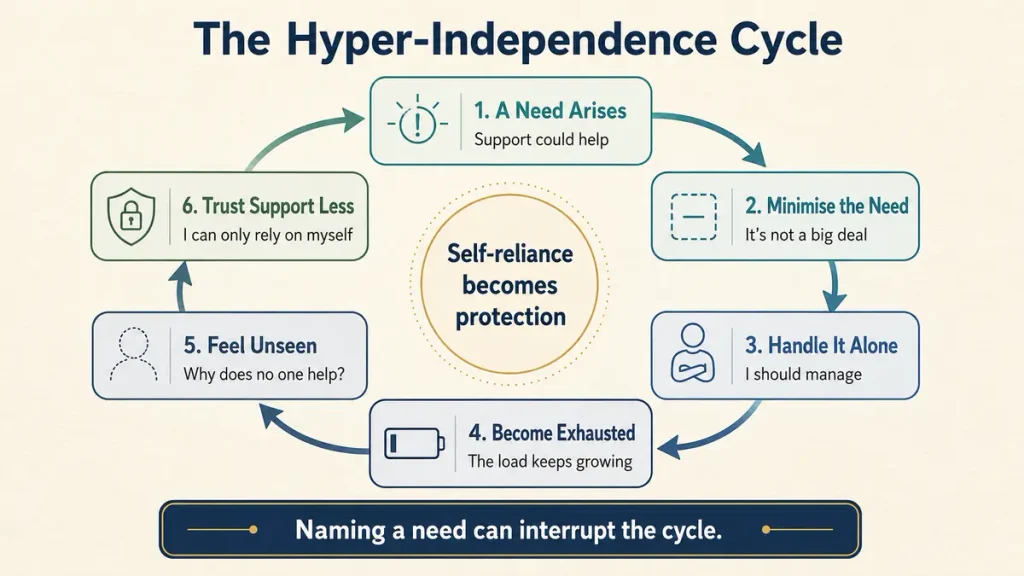
What Hyper-Independence Can Cost You Over Time
Hyper-independence can be useful in certain situations.
It may help you remain calm during a crisis. It can make you resourceful, disciplined and dependable. When other people hesitate, you may be the one who takes responsibility and gets things done.
The cost is not always visible at first.
It develops gradually when self-reliance becomes the only way you know how to respond. You continue functioning, but you do so with less rest, less emotional support and fewer opportunities to be cared for.
Quiet Exhaustion
Handling everything alone requires more than practical effort.
You must remember every detail. Make every decision. Solve every problem. Manage your own emotions while often helping other people manage theirs.
Over time, this can create a form of exhaustion that is difficult to explain.
You may still go to work, fulfil family responsibilities and appear organised. Yet small demands begin to feel unusually heavy. You become irritable. You struggle to switch off. Even rest may not feel restorative because your mind remains responsible for everything.
When someone asks how you are doing, you still say, “I’m okay.”
The problem is not that you lack strength. You may have been using strength without enough recovery or support.
Resentment When Nobody Helps
One of the most painful effects of hyper-independence is the feeling that nobody notices what you are carrying.
You may think:
“Why am I always the person who takes care of everything?”
That frustration is understandable. But there can also be an unspoken contradiction.
You want people to recognise that you need help. At the same time, you minimise your struggle, refuse offers and assure everyone that you can manage.
The people around you may believe you because that is what you have shown them.
This creates an unspoken-help paradox:
You may hope that people will notice your needs while giving them every reason to believe that you do not have any.
This does not mean you are responsible for other people’s lack of care. Attentive relationships should include curiosity and mutual concern. But people cannot always understand a need that is repeatedly hidden from them.
Resentment often grows in the space between the support you quietly hope for and the support you feel unable to request.
Emotional Distance in Relationships
Close relationships are built through more than spending time together. They also develop through mutual trust, emotional openness and the experience of being needed in healthy ways.
When you never ask for help, a partner or friend may begin to feel shut out.
They may wonder:
- “Why didn’t you tell me?”
- “Don’t you trust me?”
- “Why do I only hear about problems after they are over?”
- “Is there a place for me in your life?”
You may believe that hiding your problems protects the relationship. You do not want to worry anyone or appear demanding. Yet the other person may experience your silence as distance.
This can create a confusing pattern. You want closeness, but you withdraw when you need it most.
Some people respond to insecurity by seeking frequent reassurance. Others protect themselves by relying almost entirely on themselves. These reactions may look opposite, but both can be attempts to feel safer in relationships.
Understanding why some people become emotionally attached so easily can help explain the other side of this emotional pattern.
Burnout and Delayed Support
A hyper-independent person may not seek support when a problem begins.
They wait.
They try another solution. Work harder. Reduce their sleep. Cancel personal plans. Tell themselves that the difficult period will soon pass.
Help is considered only when the situation becomes impossible to hide.
Research shows that wanting support does not always lead to actually seeking it. A recent systematic review and meta-analysis involving college students found a clear gap between help-seeking intentions and behaviour. Preference for managing problems alone was among the commonly reported barriers. Systematic review and meta-analysis
Although that research focused on students and professional mental-health support, the pattern is recognisable in everyday life: people often wait until their distress becomes severe before reaching out.
Early support may not remove every difficulty. But it can prevent an ordinary struggle from turning into complete exhaustion.
Difficulty Receiving Care
Even when support is offered and accepted, receiving it may still feel uncomfortable.
You might:
- Apologise repeatedly for needing something.
- Say, “You didn’t have to do that.”
- Minimise how much the help mattered.
- Look for an immediate way to repay the person.
- Retake control before they can finish.
- Feel guilty instead of relieved.
These reactions may prevent you from fully experiencing care.
Receiving support asks you to tolerate a temporary imbalance. For that moment, someone is giving and you are receiving. In a healthy relationship, the balance does not need to be corrected immediately. It develops naturally over time.
You are not weak because another person carried something for you.
You are participating in a relationship where care can move in both directions.
The aim is not to depend on everyone or disclose your struggles to people who have not earned your trust. It is to build enough flexibility to recognise when doing everything alone is no longer protecting you.
Sometimes, it is simply wearing you down.
How to Ask for Help When It Feels Uncomfortable
Understanding why you struggle to ask for help is important. But insight alone may not immediately change the pattern.
You may fully understand that support is healthy and still feel anxious when you need it. Your mind may agree, while another part of you continues to say:
“I should handle this myself.”
That does not mean you are failing.
If self-reliance has protected you for years, learning to receive support may feel unfamiliar. The aim is not to force yourself into sudden vulnerability. It is to take small, thoughtful steps that allow you to remain safe, respected and in control of your choices.
1. Notice the Rule Beneath Your Hesitation
Before making a request, pay attention to what your mind predicts will happen.
Try completing these sentences:
- “If I ask for help, they will think…”
- “Needing another person means…”
- “If they say no, it will prove…”
- “When someone helps me, I owe them…”
- “A strong person should always…”
Your answers may reveal the belief shaping your response.
For example:
“If I ask my colleague, they will think I am incompetent.”
Or:
“If I tell my friend I am struggling, I will become emotionally demanding.”
Once a belief is visible, you can examine it instead of automatically following it.
Ask yourself:
- Is this expectation based on what is happening now?
- Is it connected to an earlier experience?
- Would I judge another person this harshly for asking me?
- What evidence supports this fear?
- What evidence suggests a different outcome is possible?
The purpose is not to argue with every uncomfortable thought. It is to create a little space between the thought and your response.
2. Separate Emotional Discomfort From Actual Danger
Asking the wrong person for help can be unsafe or unwise. Some people are dismissive, controlling or unreliable. Your caution may have valid reasons.
But discomfort and danger are not always the same.
You may feel exposed when asking a trustworthy friend for support, even when that person has consistently treated you with care. The feeling is real, but it may be responding to an older expectation rather than the present relationship.
Pause and ask:
“Is this person unsafe, or does being seen simply feel unfamiliar?”
This question helps you remain discerning without allowing every uncomfortable feeling to make the decision for you.
3. Start With a Small, Specific Request
You do not need to begin with your deepest emotional struggle.
Choose a request that feels manageable:
- “Could you review this email before I send it?”
- “Can you pick up the medicine on your way home?”
- “Would you explain how you completed this form?”
- “Could you stay with the children for thirty minutes?”
- “Are you free for a short call this evening?”
Small requests allow you to practise without feeling overwhelmed.
They also give your mind new information. You may discover that someone can help without judging, controlling or keeping score.
Not every request will receive a yes. People have their own limits and responsibilities. A refusal may be disappointing, but it does not mean that your need was unreasonable.
It means that this particular person could not help in this particular moment.
4. Say What Kind of Help You Need
People may want to support you but not know what would be useful.
If possible, identify the type of support you need before reaching out.
| Type of support | What you might say |
| Practical support | “Could you take care of this task today?” |
| Emotional support | “Could you listen for a few minutes without trying to fix it?” |
| Informational support | “Can you explain how you handled this situation?” |
| Companion support | “Would you come with me? I would feel better with someone there.” |
Being specific protects both people.
You are less likely to feel misunderstood, and the other person can decide honestly whether they are able to offer what you need.
If you are unsure, you can say that too:
“I don’t fully know what I need yet. Could I talk it through with you?”
You do not need perfect emotional clarity before reaching out.
5. Allow the Other Person to Answer Freely
A respectful request leaves space for a genuine answer.
You might say:
“Would you be able to help me with this? It is completely okay if you cannot.”
This does not make your request weak. It acknowledges the other person’s freedom and reduces your fear that you are forcing them.
Be careful, however, not to cancel the request before they can respond.
Sometimes, fear of burdening others sounds like:
“You’re probably too busy, and it’s not important, so don’t worry about it.”
The person has been given no real opportunity to help.
Try making the request clearly. Then pause. Let them answer.
6. Practise Receiving Without Immediately Repaying
When someone helps you, notice the urge to restore the balance at once.
You may want to return a larger favour, buy them something or insist that their help was unnecessary. These responses can come from gratitude, but they can also come from discomfort.
Try allowing a simple response to be enough:
“Thank you. That really helped me.”
Receiving does not make you selfish.
Healthy relationships are not built by calculating the value of every act. Care moves in both directions across time. Some days you will give more. On other days, you may need more.
Mutuality is not the same as immediate repayment.
7. Build Discernment, Not Dependence
Learning to ask for help does not mean trusting everyone.
Support is safest when offered by people who:
- Respect your privacy
- Accept your boundaries
- Can say no without punishing you
- Do not use help to control your decisions
- Remain reasonably consistent
- Listen without making everything about themselves
- Leave you feeling supported rather than ashamed
Before sharing something important, consider the person’s past behaviour.
Have they handled other people’s vulnerability respectfully? Do they keep private matters private? Can they disagree without becoming cruel? Do they allow you to remain responsible for your own choices?
Trust does not have to be given all at once. It can be built through repeated, smaller experiences.
8. Consider Professional Support When the Pattern Is Affecting Your Life
Not every difficulty asking for help requires counselling or therapy.
However, professional support may be useful if:
- You remain isolated during serious emotional distress.
- Relationships repeatedly suffer because you cannot express your needs.
- Asking for help brings intense shame, fear or panic.
- You want closeness but cannot trust anyone.
- You are exhausted from carrying responsibilities alone.
- Past neglect, betrayal or abuse continues to influence present relationships.
- Low mood, anxiety or emotional numbness is affecting daily life.
A qualified mental-health professional can help you explore the pattern without forcing you to depend on them. The goal is often to develop a healthier range of choices—not to remove your independence.
The S.A.F.E. Request: A Simple Way to Reach Out
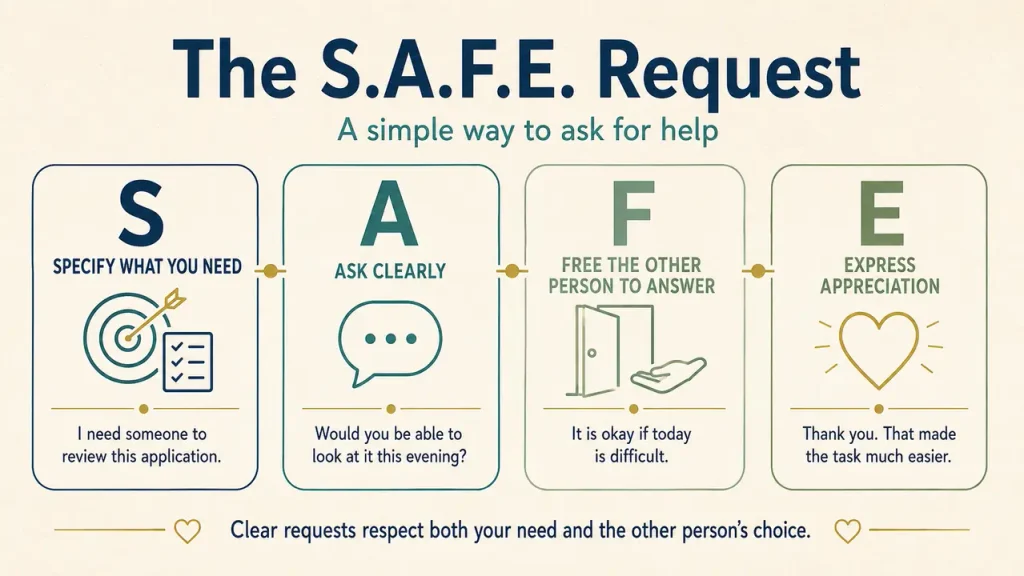
When you know you need support but do not know how to begin, use the S.A.F.E. Request:
S — Specify What You Need
Identify one clear need rather than explaining everything at once.
“I need someone to review this application.”
A — Ask Clearly
Make a direct and respectful request.
“Would you be able to look at it this evening?”
F — Free the Other Person to Answer Honestly
Allow them to accept, decline or suggest another time.
“It is okay if today is difficult.”
E — Express Appreciation Without Over-Repaying
Let gratitude be enough.
“Thank you. That made the task much easier.”
The S.A.F.E. Request is not a guarantee that every person will respond well. It is a way to communicate without minimising your need or taking away the other person’s choice.
At first, even a small request may feel uncomfortable. That discomfort does not mean you are doing something wrong.
You are practising a different kind of strength—the strength to let another person see that you are human, capable and sometimes in need of support.
You Do Not Have to Stop Being Independent
Learning to ask for help does not mean giving up your independence.
It does not mean sharing every difficulty, trusting everyone or expecting other people to solve your problems. It does not make you less responsible for your own life.
The goal is flexibility.
Healthy independence allows you to think:
“I can handle many things myself, but I do not have to handle everything alone.”
Perhaps self-reliance has helped you through difficult periods. It may have allowed you to remain steady when the people around you could not. It may have made you practical, observant and capable.
That part of you does not need to be criticised.
It needs to understand that the circumstances may have changed.
You may now have people who can listen without judging. You may have relationships in which care does not carry a hidden cost. You may have access to guidance that was not available earlier.
Letting someone support you does not erase the strength that brought you this far.
It simply gives that strength somewhere to rest.
If you continue wondering, “Why do I struggle to ask for help?”, try replacing self-criticism with curiosity. Instead of saying, “Why am I like this?”, ask:
“What am I afraid might happen if I let someone help me?”
Your answer may reveal a fear of rejection, judgement, obligation, disappointment or loss of control. Once you recognise that fear, you can decide whether it belongs to the present situation or to an earlier experience.
Change may begin with something small.
You might ask a colleague one question instead of spending an hour struggling privately. You may tell your partner that you need listening rather than advice. You could allow a friend to do something kind without immediately trying to repay them.
These moments may seem ordinary. But each one offers a new emotional experience:
“I asked. I remained worthy. I did not lose myself.”
Not everyone will respond perfectly. Sometimes a person will be unavailable. Sometimes they may misunderstand what you need. A disappointing response does not mean that reaching out was a mistake.
It means that asking for help also involves learning who is able to meet you with care.
Healthy interdependence is not helplessness. It is the understanding that human beings can be capable and connected at the same time. We can contribute to other people’s lives while allowing them to contribute to ours.
You may have learned to survive by needing very little from anyone. That strategy deserves understanding, not shame.
But you are also allowed to discover that support can sometimes be safe, freely given and shared without costing you your dignity. Frequently Asked Questions
Frequently Asked Questions (FAQs)
Is Struggling to Ask for Help a Trauma Response?
It can be, but it is not always.
Some people become highly self-reliant after neglect, abuse, betrayal, unpredictable caregiving or other experiences that made dependence feel unsafe. In these cases, avoiding help may function as protection from being disappointed or controlled again.
However, difficulty asking for help can also come from perfectionism, family expectations, cultural messages, fear of judgement, previous rejection or simply not knowing how to express a need.
One behaviour cannot confirm that someone has experienced trauma. It needs to be understood within the person’s wider life and circumstances.
Is Hyper-Independence a Mental-Health Disorder?
No. Hyper-independence is not a formal mental-health diagnosis.
It is an informal term used to describe rigid or excessive self-reliance. It becomes concerning when a person cannot seek or accept reasonable support, even when doing everything alone is affecting their well-being, relationships or daily functioning.
Liking independence, living alone or solving problems yourself does not automatically mean that you are hyper-independent.
Why Can I Help Others but Not Accept Help Myself?
Giving help often feels safer because you remain capable and in control. Receiving help places you in a more vulnerable position.
You may also have learned that your value comes from being useful. Supporting others then strengthens your identity, while needing something for yourself creates guilt or embarrassment.
Notice whether you view other people’s needs with compassion but treat your own needs as an inconvenience. The difference may reveal a standard you would never impose on someone else.
How Can I Ask for Help Without Feeling Like a Burden?
Make your request clear, specific and optional.
For example:
“I’m having a difficult day. Would you have ten minutes to listen? It is okay if now is not a good time.”
This approach respects the other person’s choice without apologising for having a need.
You may still feel uncomfortable. That feeling often becomes easier to tolerate through repeated experiences of asking safely.
What Is the Difference Between Independence and Hyper-Independence?
The main difference is flexibility.
A healthy independent person can manage many things alone but accepts support when it is useful. A hyper-independent person feels compelled to manage alone, even when support is available and continuing without it is harmful.
Healthy independence says:
“I can do this myself.”
Hyper-independence says:
“I must do this myself because relying on someone feels unsafe.”
Final Perspective
Asking for help is not the opposite of strength.
Sometimes, it is an honest recognition of your limits. Sometimes, it is an act of trust. And sometimes, it is simply the most practical thing you can do.
You do not need to become dependent to become more open to support.
You only need to create enough space between “I can manage” and “I must manage” to recognise that you have a choice.
That choice is part of emotional regulation as a life skill. It allows you to respond to your needs with awareness rather than automatically repeating an old survival pattern.
Your strength is still yours.
Receiving support does not take it away.
A Gentle Note

This article is intended for education and self-reflection. It is not a substitute for professional mental-health assessment, diagnosis or treatment. If emotional distress, isolation or past experiences are affecting your daily life, consider speaking with a qualified mental-health professional. Reaching out is not a failure of strength.