

The Person You Lost Wasn’t Really You
“You weren’t born afraid of people. You learned to protect yourself.”
Have you ever looked at your old photographs and quietly wondered, “What happened to that version of me?”
Table of Contents
Perhaps you once laughed without hesitation, trusted people easily, and spoke your mind without worrying about being judged. You were excited about making new friends, trying new opportunities, or expressing your emotions openly. Yet somewhere along the way, something changed.
Today, you hesitate before sending a message. You overthink simple conversations. You expect disappointment before giving people a chance. You find yourself keeping an emotional distance, even from those who genuinely care about you.
If this feels familiar, you are not alone.
One of the most painful truths in psychology is that rejection can gradually change the way we experience ourselves and the world around us. Many people search online asking why rejection changes your personality, believing there must be something fundamentally wrong with them. The reassuring answer is that there isn’t.
Your personality has not been broken.
It has been adapting.
Every criticism that made you question your worth, every unanswered message that left you wondering what you did wrong, every friendship that quietly faded, every opportunity where you heard “no,” and every relationship that ended unexpectedly teaches your brain one lesson:
“Be careful. This hurts.”
From a psychological perspective, this is not weakness. It is survival.
Your Brain Was Designed to Protect You—Not to Make You Happy
Imagine touching a hot stove.
After getting burned once, you naturally become more cautious around fire. You don’t need to consciously remind yourself every day. Your brain remembers because remembering protects you.
The same principle applies to emotional pain.
When rejection hurts deeply, your brain begins looking for ways to prevent the same experience from happening again. It becomes more alert to criticism, more cautious in relationships, and quicker to notice signs of exclusion.
What often feels like a personality change is actually your nervous system trying to reduce future emotional pain.
This is one of the biggest reasons why rejection changes your personality. The brain isn’t trying to make you anxious, withdrawn, or overly cautious—it is trying to keep you safe.
Unfortunately, the strategies that protect us in the short term can quietly limit us in the long term.
You may avoid expressing your opinions to prevent criticism.
You may stop trusting people because betrayal feels unbearable.
You may become a perfectionist because making mistakes once led to rejection.
You may convince yourself that staying emotionally distant is safer than risking another heartbreak.
These reactions are understandable.
But they are not your identity.
Rejection Doesn’t Just Hurt—It Leaves Psychological Footprints
Most of us think of rejection as a single painful moment.
Psychology tells a different story.
Rejection rarely ends when the event ends. Instead, it often leaves behind invisible footprints that influence future thoughts, emotions, and behaviours.
Someone ignored your message.
Now you hesitate before texting anyone.
A teacher publicly criticised you.
Years later, speaking in meetings feels terrifying.
A partner walked away unexpectedly.
Now every new relationship feels uncertain before it even begins.
These are not random personality traits.
They are learned emotional adaptations.
Over time, these protective habits become so familiar that they begin to feel like who we are.
But there is an important difference between who you are and how you’ve learned to survive.
Understanding that difference is the beginning of healing.
The Hidden Link Between Rejection and Emotional Fitness
One of the central ideas behind Emotional Fitness™ is that our emotional responses can be strengthened, just like physical muscles.
Many people believe confidence disappears after rejection.
In reality, confidence often becomes buried beneath protective habits.
The encouraging news is that the brain remains remarkably adaptable throughout life. With awareness, self-compassion, and consistent practice, it is possible to develop healthier emotional responses without denying the pain you’ve experienced.
Healing doesn’t mean pretending rejection never happened.
It means learning how to respond differently when it happens again.
This article will show you how.
This Isn’t Just About Romantic Rejection
When people hear the word “rejection,” they often think about relationships.
But rejection wears many faces.
You may have felt rejected when:
- A close friend slowly stopped including you.
- Your ideas were dismissed at work.
- You weren’t selected for a job you truly wanted.
- A family member criticised you repeatedly.
- You were excluded from a social group.
- Your efforts went unnoticed despite working hard.
- Someone important ignored your feelings.
Although these experiences look different on the surface, the brain often processes them in surprisingly similar ways.
If you’ve recently read our article “Why Being Ignored Hurts So Much: The Psychology of Social Rejection,” you’ll already know that the brain interprets social exclusion as a meaningful emotional threat. In this article, we’ll take the next step—not just understanding why rejection hurts, but exploring why rejection changes your personality over time and, more importantly, how you can reclaim the parts of yourself that fear persuaded you to hide.
Similarly, if overthinking becomes your response after rejection, our comprehensive guide on The Hidden Psychology of Overthinking explores why the mind keeps replaying painful experiences and practical ways to interrupt that cycle. If your fear of losing people leads you to become overly dependent, you’ll also find valuable insights in Why Do I Get Emotionally Attached So Easily? These articles expand on concepts that we’ll keep concise here so we can focus on how rejection reshapes identity.
A Different Way to Read This Article
As you continue reading, I invite you to do something different.
Don’t ask yourself,
“What’s wrong with me?”
Instead, ask,
“What has my mind been trying to protect me from?”
That single question has helped countless people replace self-blame with self-understanding.
And as you’ll discover in the pages ahead, understanding why rejection changes your personality isn’t about dwelling on the past.
It’s about recognising that your deepest wounds do not have the final say in who you become.
In the next section, we’ll explore the fascinating neuroscience of rejection and discover why emotional pain can feel as real as physical pain—and why your brain responds the way it does.
Why Rejection Feels Like Physical Pain: The Science Behind Emotional Survival
“Your heart may feel broken, but the pain begins in your brain.”
Imagine placing your hand on a hot surface.
Your brain immediately recognizes the danger, sending signals that make you pull away before the injury becomes worse. Physical pain evolved to protect us from threats that could endanger our survival.
Now imagine something very different.
A friend suddenly stops replying to your messages.
A partner ends a relationship without explanation.
You are excluded from an important meeting at work.
Someone you deeply care about slowly becomes emotionally distant.
Although no physical injury has occurred, the pain can feel surprisingly similar. Your chest feels heavy, your stomach tightens, your thoughts race, and sleep becomes difficult. For many people, the emotional distress is so intense that they describe it as heartbreak.
This isn’t just a figure of speech.
Modern neuroscience suggests that social rejection activates some of the same neural systems involved in processing physical pain. In other words, the pain you feel after rejection is not “imaginary.” It is a genuine biological response that reflects one of the brain’s oldest survival mechanisms. Understanding this science is essential to understanding why rejection changes your personality over time.
Your Brain Was Never Meant to Face Rejection Alone
Thousands of years ago, human survival depended on belonging to a group.
Being accepted meant protection, food, and cooperation.
Being rejected often meant danger.
Although modern life looks very different, our brains have evolved much more slowly than our societies. Deep inside, the nervous system still treats social belonging as a fundamental need.
This helps explain why rejection from a loved one, criticism from a parent, exclusion by friends, or even being ignored on social media can trigger such powerful emotional reactions.
Your brain isn’t overreacting.
It is responding according to an ancient survival system designed to keep you connected to others.
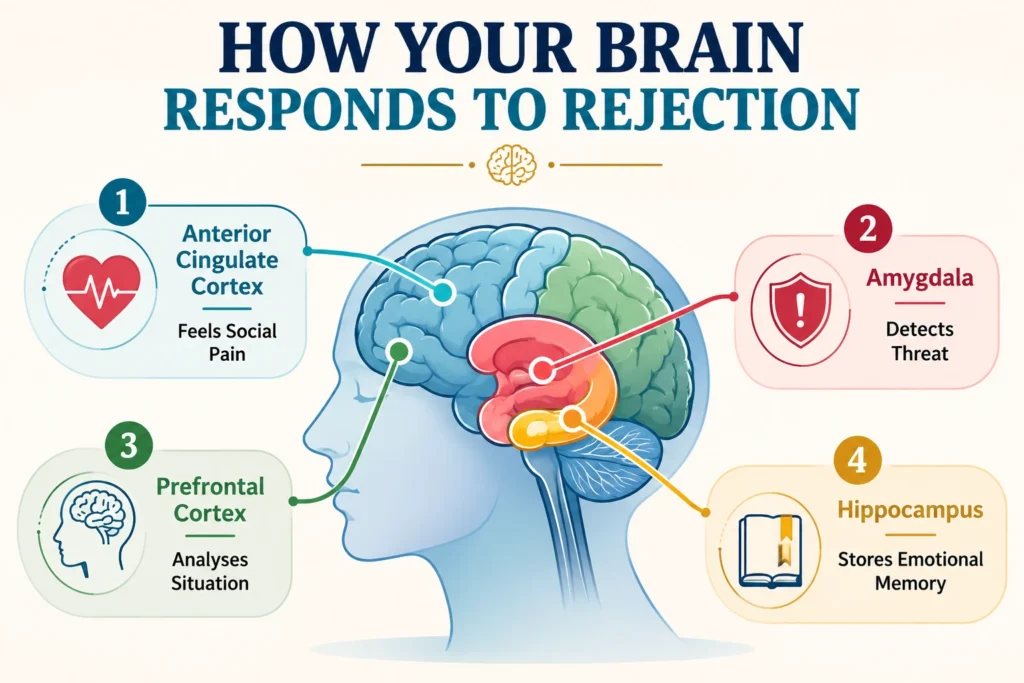
Four Brain Regions That Help Explain Why Rejection Hurts
Researchers have identified several brain regions that become particularly active during experiences of social rejection. While neuroscience continues to evolve, these findings offer valuable insight into why emotional pain can feel so overwhelming.
1. The Anterior Cingulate Cortex—The Brain’s Social Pain Alarm
Think of this area as your brain’s emotional alarm system.
When you experience rejection, the anterior cingulate cortex helps process the distress associated with social pain. It doesn’t distinguish perfectly between physical and emotional suffering, which helps explain why rejection can feel surprisingly intense.
If you’ve read our article “Why Being Ignored Hurts So Much,” you’ll remember that this shared neural activity is one reason silence from someone important can feel deeply personal. Here, that same mechanism also helps us understand why rejection changes your personality when painful experiences become repeated rather than occasional.
2. The Amygdala—Your Internal Threat Detector
The amygdala constantly scans your environment for possible danger.
While it helps protect you from physical threats, it also responds to emotional ones.
After repeated rejection, the amygdala may become increasingly sensitive, causing you to notice criticism more quickly, expect disappointment sooner, or interpret neutral situations as signs of rejection.
For example, a delayed text message may immediately trigger thoughts like:
“Did I say something wrong?”
“Are they losing interest?”
“Maybe they don’t like me anymore.”
The situation hasn’t changed.
Your brain’s prediction system has.
3. The Prefrontal Cortex – The Meaning-Maker
The prefrontal cortex helps us interpret experiences, solve problems, and regulate emotions.
During rejection, it begins searching for explanations.
Sometimes this is helpful.
But when emotions become overwhelming, the mind often fills gaps with assumptions rather than facts.
This is where many people begin overthinking.
Questions such as:
“Why did this happen?”
“What is wrong with me?”
“Could I have prevented it?”
can quickly become repetitive mental loops.
If you’d like to explore why the mind replays painful experiences long after they end, our article “The Hidden Psychology of Overthinking” explains this process in much greater detail.
4. The Hippocampus – Where Emotional Memories Live
The hippocampus plays an important role in storing memories.
But it doesn’t simply record events.
It records the emotions attached to them.
A painful rejection today may unconsciously remind your brain of a similar experience from years ago.
Perhaps being ignored by classmates.
Being criticized as a child.
Feeling excluded from a family gathering.
Because the brain links similar emotional experiences together, one rejection can reactivate many earlier memories.
This is one reason today’s pain can feel much bigger than today’s situation alone.
Why Repeated Rejection Quietly Changes You
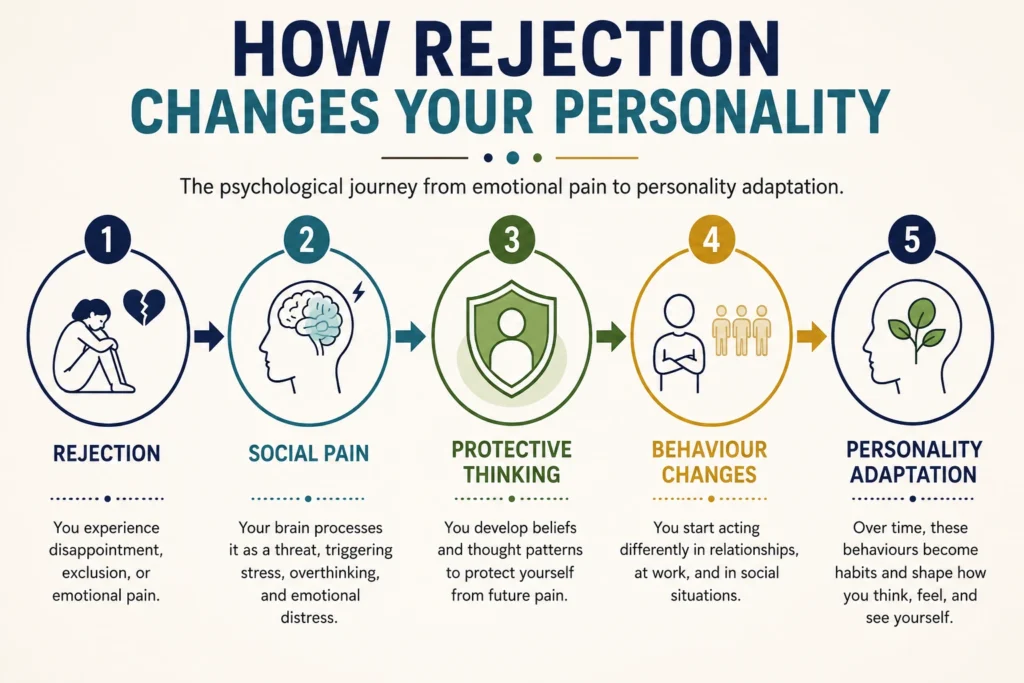
One rejection rarely changes a person’s personality.
Repeated rejection often does.
Imagine walking through a forest.
The first time you walk across the grass, almost nothing changes.
Walk the same path every day, however, and eventually a visible trail appears.
The brain works in a similar way.
Every repeated emotional experience strengthens certain neural pathways.
If rejection becomes frequent, the brain becomes increasingly efficient at expecting rejection.
This process is called neuroplasticity—the brain’s ability to change through experience.
Neuroplasticity is neither good nor bad.
It simply reflects learning.
The encouraging news is that the same brain capable of learning fear is also capable of learning confidence, emotional security, and resilience.
Your Personality Isn’t Broken—It’s Adapting
Many readers arrive at this point feeling relieved.
They begin to realize:
“Maybe I’m not weak.”
“Maybe I’m not overly sensitive.”
“Maybe my reactions actually make sense.”
Psychology supports this perspective.
Many of the behaviors people criticize in themselves—avoiding vulnerability, expecting rejection, seeking constant reassurance, or becoming emotionally distant—often begin as intelligent attempts to prevent future pain.
The problem is not that these protective strategies exist.
The problem is that they continue long after the danger has passed.
Healing begins when protection no longer has to become your permanent personality.
A Bridge to the Next Step
Understanding the brain helps explain why rejection changes your personality, but it doesn’t fully explain how those changes appear in everyday life.
Why do some people become people-pleasers after rejection?
Why do others withdraw emotionally?
Why do some lose confidence while others become perfectionists?
The Seven Hidden Ways Rejection Quietly Changes Your Personality
“Sometimes rejection doesn’t change who you are—it changes who you believe you have to become.”
Have you ever noticed that after a painful rejection, you started behaving differently without consciously deciding to?
Perhaps you stopped sharing your opinions.
You became quieter in social situations.
You apologized more often, even when you had done nothing wrong.
Or maybe you found yourself working harder than ever—not because you loved success, but because you desperately wanted to avoid failing again.
These changes rarely happen overnight.
They develop gradually, often so subtly that we mistake them for personality traits rather than emotional adaptations.
This is one of the most important reasons why rejection changes your personality. The mind isn’t trying to change your identity—it is trying to prevent another painful experience.
Let’s explore the seven most common ways this happens.
1. You Become More Cautious Around People
One painful rejection can make you cautious.
Repeated rejection can make caution become your default way of relating to others.
You may hesitate before expressing your thoughts.
You replay conversations in your mind after they end.
You become reluctant to meet new people because every new relationship feels like another opportunity to be hurt.
To others, you may appear reserved or distant.
Inside, however, you’re simply trying to protect yourself.
Healthy caution is useful.
Constant emotional guarding, however, often prevents the very connection we long for.
Instead of asking,
“Will they reject me?”
try asking,
“Have they given me evidence that they will?”
That small shift helps separate past experiences from present reality.
2. You Begin Expecting Rejection Before It Happens
One of the brain’s greatest strengths is prediction.
After repeated emotional pain, it begins anticipating rejection—even when there is little evidence.
A delayed reply feels intentional.
Constructive feedback sounds like criticism.
Someone looking tired seems angry with you.
This pattern is often called rejection sensitivity.
Rather than responding to what is actually happening, the brain responds to what it expects might happen.
If this sounds familiar, remember:
Expecting rejection is not proof that rejection is coming. It is proof that your brain is trying to keep you safe.
3. You Become a People-Pleaser
Not everyone responds to rejection by withdrawing.
Some respond by trying harder to earn acceptance.
You begin saying “yes” when you want to say “no.”
You avoid disagreements.
You suppress your own needs.
You constantly worry about disappointing others.
At first, this feels like kindness.
Over time, it becomes emotional exhaustion.
People-pleasing often grows from a simple belief:
“If everyone likes me, no one can reject me.”
Unfortunately, this strategy usually creates relationships built on approval rather than authenticity. One of the healthiest forms of emotional fitness is learning that your worth does not depend on constant validation.
4. You Mistake Perfectionism for Protection
Many high achievers are not driven by success alone.
They are driven by fear.
Fear of criticism.
Fear of failure.
Fear of disappointment.
Fear of rejection.
Perfectionism often develops as an emotional shield.
“If I never make mistakes, nobody can reject me.”
While striving for excellence is healthy, chasing perfection usually leads to chronic stress, self-criticism, and burnout.
Ironically, perfectionism often increases anxiety instead of reducing it. True confidence grows not from never failing—but from knowing you can recover when you do.
5. You Start Hiding Your Real Emotions
Perhaps one of the quietest personality changes is emotional withdrawal.
Instead of expressing sadness, you say,
“I’m fine.”
Instead of asking for support, you convince yourself to handle everything alone.
Instead of being vulnerable, you build emotional walls.
This may feel like strength.
In reality, it is often protection disguised as independence.
If you’ve already explored our article “Emotional Fitness vs. Emotional Suppression,” you’ll know that suppressing emotions doesn’t eliminate them—it simply changes how they appear. Over time, unexpressed emotions may contribute to anxiety, irritability, or emotional numbness.
Here, it’s enough to remember one important truth:
Healthy emotional boundaries protect relationships.
Emotional walls prevent them.
6. You Lose Trust in Yourself
Most people assume rejection damages trust in others.
Often, it damages trust in ourselves even more.
You begin questioning every decision.
You seek reassurance before taking action.
You doubt your instincts.
Simple choices suddenly feel overwhelming.
This inner uncertainty develops because rejection teaches the brain to believe,
“Maybe my judgment isn’t reliable.”
Yet the reality is often very different.
A relationship ending doesn’t prove you are unworthy.
A job rejection doesn’t prove you are incapable.
One person’s opinion cannot define your entire identity.
Learning to trust yourself again is one of the most powerful steps toward emotional healing.
7. You Forget Who You Were Before the Pain
Perhaps the deepest consequence of repeated rejection is this:
You begin confusing survival with personality.
You tell yourself,
“I’ve always been shy.”
“I’ve never been confident.”
“I’m just not good with people.”
But if someone had met you before those painful experiences, would they describe you the same way?
Many people discover that beneath years of self-protection still lives the curious, hopeful, expressive person they thought they had lost.
The goal of healing is not to create a new personality.
It is to reconnect with the parts of yourself that fear persuaded you to hide.
The Difference Between Personality and Protection
As you reflect on these seven patterns, you may recognize yourself in one—or perhaps several—of them.
That doesn’t mean your personality is permanently damaged.
It means your mind has been doing exactly what it was designed to do:
Protect you.
The challenge is that protective strategies often remain active long after the original threat has disappeared.
The encouraging news is that the brain can learn new patterns just as it learned old ones.
Through awareness, practice, and emotionally healthy relationships, many of these protective habits can gradually soften, allowing your authentic personality to emerge again.
A Gentle Reflection

Before reading further, pause for a moment and ask yourself:

•	Which of these patterns feels most familiar?
•	When did it first begin?
•	Was it always part of who you are—or did it develop after a painful experience?

Sometimes, healing begins not with changing yourself but with understanding yourself.
Why Some People Recover from Rejection While Others Carry It for Years
“The same storm can strengthen one tree while uprooting another. The difference is often found beneath the surface.”
If rejection affects everyone, why do some people recover within weeks while others carry its emotional weight for years?
Why does one person view rejection as a temporary setback while another begins questioning their entire self-worth?
These questions have fascinated psychologists for decades. The answer isn’t that some people are naturally “stronger” or others are simply “too sensitive.” Human emotions are far more complex than that.
In reality, how we respond to rejection is shaped by our past experiences, emotional habits, relationships, and the beliefs we’ve developed about ourselves over time.
Understanding these influences not only explains why rejection changes your personality but also reminds us that healing is possible because these patterns can be understood, challenged, and gradually reshaped.
1. Childhood Experiences Become Your Emotional Blueprint
Long before we understand relationships, our brains begin learning what connection feels like.
As children, we naturally ask ourselves questions such as:
“Am I safe?”
“Am I loved?”
“Will someone be there when I need them?”
The answers aren’t learned through words.
They’re learned through repeated experiences.
When caregivers respond with warmth, consistency, and emotional support, children often develop a secure sense of belonging.
But when love feels unpredictable, overly critical, emotionally unavailable, or conditional, the brain may learn a different lesson:
“I have to earn love.”
“People leave.”
“Something must be wrong with me.”
These beliefs rarely remain in childhood.
Without realizing it, we often carry them into friendships, workplaces, and romantic relationships.
This doesn’t mean our childhood determines our future.
It simply means our earliest relationships often become the starting point—not the final destination.
2. Attachment Styles Shape Adult Relationships
One of psychology’s most influential ideas is attachment theory, which explains how our early relationships influence the way we connect with others throughout life.
Someone with a secure attachment style may still feel hurt by rejection, but they’re generally better able to recover because their sense of worth isn’t entirely dependent on other people’s approval.
Others may respond differently.
Some become anxious, constantly seeking reassurance.
Others become emotionally distant, convincing themselves they don’t need anyone at all.
If you’ve noticed yourself becoming deeply dependent on certain relationships or fearing abandonment, you may enjoy reading our article “Why Do I Get Emotionally Attached So Easily?”, where we explore attachment patterns in much greater depth.
For now, remember this:
Attachment styles are learned. And what is learned can also be strengthened and reshaped through healthier experiences.
3. Your Inner Story Matters More Than the Event Itself
Two people can experience the exact same rejection and walk away with completely different conclusions.
One person thinks:
“That wasn’t the right opportunity for me.”
Another thinks:
“I’m not good enough.”
The event is identical.
The meaning is completely different.
Psychologists often refer to these deeply held beliefs as core beliefs or schemas.
Over time, these internal stories begin influencing how we interpret new situations.
A missed phone call becomes evidence of abandonment.
Constructive feedback feels like personal failure.
A friend’s busy schedule becomes proof that they no longer care.
Changing these stories isn’t about positive thinking.
It’s about replacing assumptions with balanced, evidence-based perspectives.
Healing often begins when we stop asking,
“Why does this always happen to me?”
and start asking,
“Is there another explanation I haven’t considered?”
4. Emotional Fitness Determines How Quickly We Recover
Imagine two people lifting the same heavy weight.
The person who has trained consistently will usually recover more quickly—not because the weight is lighter, but because their capacity is greater.
Our emotional lives work in much the same way.
This is the heart of Emotional Fitness™.
Emotional fitness isn’t about avoiding painful emotions or pretending rejection doesn’t hurt.
It’s about developing the skills needed to experience difficult emotions without becoming overwhelmed by them.
These skills include:
- Emotional awareness.
- Self-compassion.
- Healthy boundaries.
- Flexible thinking.
- Supportive relationships.
- Emotional regulation.
If you’d like to explore these ideas further, our articles on Emotional Fitness vs. Emotional Suppression and The Hidden Cost of Emotional Dysregulation explain why learning to work with your emotions is one of the greatest investments you can make in your psychological well-being.
The encouraging truth is this: Emotional fitness can be developed at any stage of life.
5. Healing Doesn’t Mean You Forget—It Means You Grow Differently
One of the biggest myths about rejection is that healing means never thinking about it again.
In reality, emotionally healthy people still remember painful experiences.
The difference is that those memories no longer control their identity.
They no longer think,
“I was rejected, therefore I’m unworthy.”
Instead, they begin thinking,
“I experienced rejection, but it doesn’t define who I am.”
That shift may sound small.
Psychologically, it changes everything.
Healing isn’t the absence of painful memories.
It’s the presence of a stronger relationship with yourself.
What Truly Makes People Resilient?
Research consistently suggests that resilience is less about avoiding adversity and more about how we respond to it.
People who recover well from rejection often share several common qualities:
- They acknowledge their emotions instead of suppressing them.
- They separate their self-worth from temporary setbacks.
- They seek support when needed.
- They remain open to new relationships and experiences.
- They view rejection as information rather than a verdict on their value.
Most importantly, they understand that one painful chapter is not the entire story of their life.
Resilience is not a personality trait reserved for a fortunate few.
It is a set of skills that can be strengthened with awareness, practice, and patience.
A Gentle Reflection

Take a moment to reflect on your own journey.
Ask yourself:

•	Which experiences shaped the way I see rejection today?
•	Am I reacting to this moment—or to many moments from the past?
•	What beliefs about myself have I been carrying without questioning them?
•	If someone I loved had experienced the same rejection, would I judge them as harshly as I judge myself?

Often, the answers to these questions reveal that our greatest struggle isn't rejection itself.
It's the story we've quietly built around it.
The R.E.C.L.A.I.M. Method: A Practical Framework to Heal After Rejection
“Healing doesn’t begin when rejection disappears. It begins when you stop allowing rejection to define who you are.”
By now, we’ve explored why rejection changes your personality, how the brain responds to emotional pain, and why some people recover more quickly than others.
But understanding alone isn’t enough.
Imagine learning everything about how a broken bone heals but never putting on the cast. Knowledge matters, but healing requires action.
The same is true for emotional wounds.
You cannot always control who rejects you, but you can learn how to respond in ways that strengthen—not weaken—your emotional well-being.
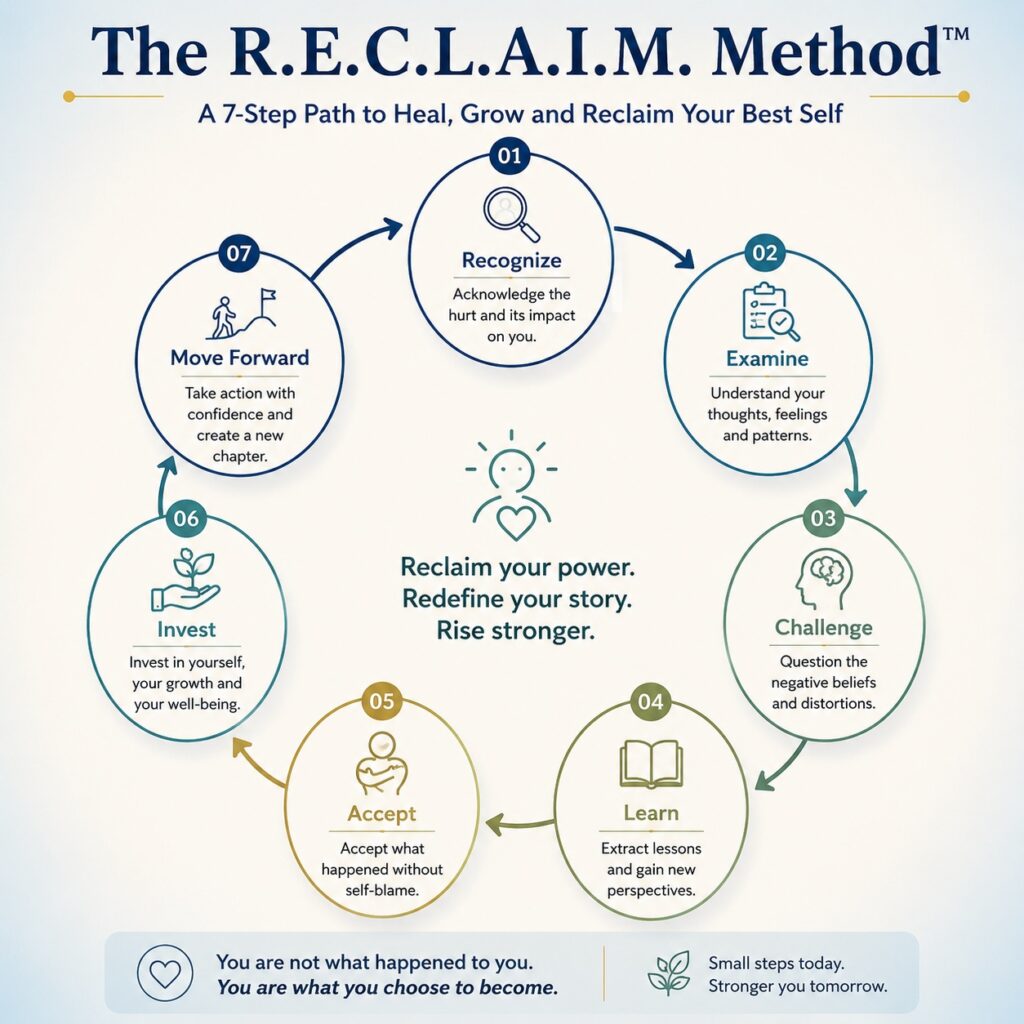
That’s where The R.E.C.L.A.I.M. Method™ comes in.
Think of it as a practical roadmap for rebuilding your emotional confidence after rejection. Rather than trying to erase painful experiences, it helps you transform them into opportunities for growth.
R – Recognize What You’re Really Feeling
The first reaction to rejection is often automatic.
You may feel anger.
Embarrassment.
Loneliness.
Disappointment.
Or even numbness.
Many people try to suppress these emotions because they believe acknowledging them will make the pain worse.
Ironically, psychology suggests the opposite.
Emotions that are recognised and accepted tend to lose their intensity more quickly than emotions that are ignored or suppressed.
Instead of saying,
“I shouldn’t feel this way.”
Try saying,
“I’m feeling rejected right now, and that’s a completely human response.”
Naming your emotions doesn’t make them stronger.
It makes them clearer.
If emotional suppression is something you struggle with, our article “Emotional Fitness vs. Emotional Suppression” explores why allowing yourself to feel is often the first step toward healing.
E – Examine the Story You’re Telling Yourself
Rejection is painful.
The story we attach to rejection is often even more painful.
Imagine two people who aren’t selected for the same job.
One thinks,
“This wasn’t the right opportunity.”
The other thinks,
“I’ll never be good enough.”
The event is identical.
The meaning is completely different.
Ask yourself:
- What story am I creating about this rejection?
- Am I interpreting facts or making assumptions?
- Would I say these same things to someone I love?
Often, rejection hurts less when we stop confusing an event with our identity.
Remember:
A rejection is an experience.
It is not a description of who you are.
C – Challenge Automatic Beliefs
The brain naturally tries to protect us by predicting future pain.
Unfortunately, those predictions are not always accurate.
After one painful relationship, the mind may conclude:
“Nobody can be trusted.”
After failing an interview:
“I’ll never succeed.”
After being ignored:
“People don’t care about me.”
These thoughts often feel convincing because they are emotionally charged.
But feelings are not always facts.
Instead of asking,
“Is this thought true?”
Try asking,
“What evidence supports it—and what evidence challenges it?”
This gentle curiosity interrupts the cycle of self-criticism before it becomes part of your identity.
L – Learn the Lesson Without Becoming the Lesson
Every difficult experience has something to teach us.
Perhaps it revealed an unhealthy relationship.
Perhaps it showed where stronger boundaries were needed.
Perhaps it encouraged personal growth.
Learning from rejection is healthy.
Living inside rejection is not.
One of the healthiest questions you can ask yourself is:
“What can this experience teach me without allowing it to define me?”
Growth begins when lessons replace labels.
A – Accept What You Cannot Control
One of the greatest sources of suffering is trying to control things that were never ours to control.
You cannot control another person’s choices.
You cannot force acceptance.
You cannot guarantee every relationship will last.
What you can control is your response.
Acceptance doesn’t mean approving of rejection.
It means releasing the exhausting battle against reality.
Acceptance says:
“This happened.”
It does not say:
“This is all I’ll ever be.”
That distinction creates space for healing.
I – Invest in the Relationship That Lasts a Lifetime
After rejection, many people become completely focused on repairing external relationships.
Few remember to strengthen the most important relationship of all—the one they have with themselves.
Ask yourself:
- Do I speak to myself with kindness?
- Do I respect my own boundaries?
- Am I waiting for other people to give me the acceptance I’m unwilling to give myself?
Self-worth grows when your value becomes rooted in your character rather than other people’s opinions.
This doesn’t happen overnight.
It grows through small daily choices:
Resting when you’re exhausted.
Saying no without guilt.
Celebrating progress instead of perfection.
Showing yourself the same compassion you readily offer others.
M – Move Forward With Courage, Not Certainty
Many people wait until fear disappears before taking another chance.
Psychology teaches us something different.
Courage doesn’t require the absence of fear.
It requires moving despite it.
You may still feel nervous before trusting someone again.
You may still remember previous disappointments.
Healing doesn’t erase those memories.
It changes your relationship with them.
Every healthy conversation.
Every new friendship.
Every opportunity you choose despite uncertainty.
Every time you express your authentic self instead of hiding it.
You teach your brain a powerful new lesson:
“Not every ending predicts another one.”
That is how emotional resilience grows.
Not through perfection. But through repeated experiences of hope.
The Goal Was Never to Become Fearless
Many readers believe healing means becoming someone who never feels rejected again.
That isn’t realistic.
Even emotionally healthy people experience disappointment, criticism, and loss.
The difference is that rejection no longer controls their identity.
Instead of thinking,
“This rejection proves I am not enough.”
They begin thinking,
“This experience hurts, but it cannot define my worth.”
That single shift changes the entire recovery process.
It transforms rejection from an identity into an experience.
And experiences—even painful ones—can become teachers rather than life sentences.
A Gentle Practice for This Week
Before you finish reading, try this simple exercise.
Write down one rejection that still affects you.
Then answer these three questions honestly:
- What happened?
- What did I begin believing about myself because of it?
- If I looked at this situation with compassion instead of criticism, what would I say to myself today?
You may be surprised how differently the story begins to feel.
Healing often starts with changing the conversation you have with yourself.
Reclaiming Yourself: Healing Is Remembering Who You Were Before Fear Took Over
“The opposite of rejection isn’t acceptance. It’s self-belonging.”
If you’ve read this far, I want you to pause for a moment.
Not to think about the people who rejected you.
Not to replay the conversations that still hurt.
But to think about yourself.
The version of you that existed before disappointment taught you to doubt your worth.
Because beneath every protective habit we’ve explored throughout this article—the people-pleasing, the emotional distance, the perfectionism, and the fear of vulnerability—there is something remarkably hopeful.
None of these patterns are your true identity.
They are learned responses.
And what the brain learns, it can also relearn.
That is perhaps the most encouraging discovery in modern psychology. Understanding why rejection changes your personality isn’t meant to keep you focused on the past. It’s meant to help you recognize that many of the qualities you believe you’ve “lost” may simply be hidden beneath years of emotional self-protection.
What Emotional Healing Really Looks Like
Many people expect healing to arrive as a dramatic breakthrough.
More often, it arrives quietly.
You notice that you no longer replay every conversation before going to sleep.
You express your opinion without apologizing for it.
You stop interpreting silence as immediate rejection.
You enjoy your own company without feeling lonely.
You set a boundary without feeling guilty.
You begin trusting your judgment again.
These moments may seem ordinary.
Psychologically, they are extraordinary.
They are signs that your nervous system is learning a new way to experience the world.
Healing isn’t becoming fearless.
Healing is becoming less controlled by fear.
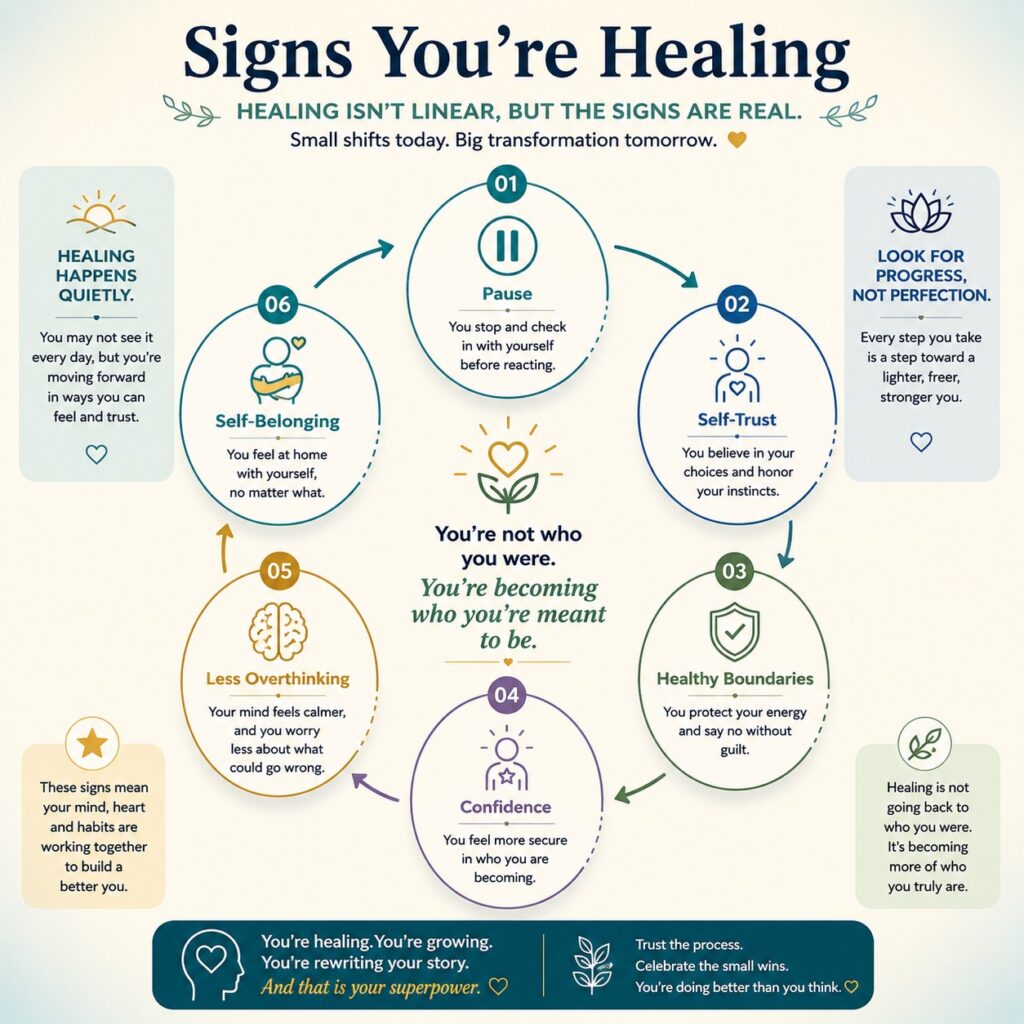
Seven Quiet Signs You’re Becoming Emotionally Stronger
Progress is often easier to feel than to measure. Here are seven gentle indicators that you’re moving in the right direction:
1. You pause before reacting.
Instead of responding immediately from hurt, you create space to understand what you’re feeling.
2. You need less external validation.
Compliments still feel good, but they no longer determine your self-worth.
3. You recover more quickly.
Rejection still hurts, but it no longer defines your week—or your identity.
4. You stop assuming the worst.
You become curious before becoming self-critical.
5. You express your needs honestly.
You no longer believe that being authentic automatically leads to rejection.
6. You protect your peace without isolating yourself.
Healthy boundaries replace emotional walls.
7. You begin trusting yourself again.
Perhaps the greatest sign of healing is this:
You stop asking everyone else who you are.
You begin listening to yourself.
Remember What We’ve Learned
Throughout this article, we’ve explored an important psychological truth:
Rejection can influence your personality, but it does not have to define it.
We’ve learned that:
- The brain experiences rejection as a meaningful social threat.
- Repeated emotional pain can create protective habits.
- Childhood experiences and attachment patterns influence how we respond to rejection.
- Emotional fitness strengthens resilience over time.
- Healing begins with awareness, self-compassion, and consistent practice.
- Your personality is far more flexible than your fears would have you believe.
Perhaps most importantly, we’ve discovered that understanding why rejection changes your personality is not about finding another reason to criticize yourself.
It’s about finding a better reason to be compassionate with yourself.
Frequently Asked Questions
Can rejection permanently change your personality?
Repeated rejection can influence your thoughts, emotions, and behaviours, especially if it occurs over a long period. However, psychology also shows that the brain remains adaptable throughout life. With healthier experiences, supportive relationships, and intentional emotional growth, many of these changes can gradually be reshaped.
Why am I so sensitive to rejection?
Rejection sensitivity often develops through a combination of past experiences, attachment patterns, personality, and learned emotional responses. It isn’t a character flaw. It’s often a protective strategy developed after emotional pain.
Can childhood rejection affect adult relationships?
Yes. Early experiences of criticism, emotional neglect, or inconsistent care can influence trust, self-worth, and attachment styles later in life. The encouraging news is that these patterns are not fixed and can improve through awareness and healthier relationships.
Why do I overthink after rejection?
The mind naturally searches for explanations after emotionally painful experiences. This process can become repetitive when the brain mistakes uncertainty for danger. If you’d like to understand this cycle in greater depth, our article “The Hidden Psychology of Overthinking” explores practical ways to interrupt it.
How can I become emotionally resilient after rejection?
Emotional resilience grows through self-awareness, self-compassion, healthy boundaries, supportive relationships, and regular emotional practice. Like physical fitness, emotional fitness develops gradually through consistent effort rather than one dramatic change.
Final Thoughts
There will always be people who misunderstand you.
There will be opportunities that don’t work out.
Relationships that end.
Conversations that leave you questioning yourself.
Rejection is an unavoidable part of being human.
But allowing rejection to become the author of your identity is a choice you no longer have to make.
The person you are becoming is not defined by the doors that closed.
You are defined by the courage to keep opening new ones.
So the next time rejection whispers,
“You’re not enough,”
I hope you’ll remember a different truth:
You were never meant to measure your worth by someone else’s inability to see it.
Your personality was shaped by many experiences.
Your future will be shaped by the choices you make from this moment onward.
And perhaps the most powerful choice is this:
To stop surviving rejection… and start belonging to yourself.
References

1. DeWall, C. N., & Richman, S. B. (2011). Belongingness as a Core Personality Trait: How Social Exclusion Influences Social Functioning and Personality Expression. Journal of Personality.

2. Williams, K. D. (2007). Ostracism. Annual Review of Psychology, 58, 425–452.

3. Baumeister, R. F., Brewer, L. E., Tice, D. M., & Twenge, J. M. (2007). Thwarting the Need to Belong: Understanding the Interpersonal and Inner Effects of Social Exclusion. Social and Personality Psychology Compass.

4. Eisenberger, N. I., Lieberman, M. D., & Williams, K. D. (2003). Does Rejection Hurt? An fMRI Study of Social Exclusion. Science, 302(5643), 290–292.