

Have you ever been in a conversation where everyone seemed to agree, but something inside you felt different?
Perhaps you were sitting with colleagues in a meeting, talking with friends, or listening to family members discuss an important decision. You had a different opinion. You wanted to say something, but before the words could come out, you began wondering how others might react.
What if they think I am wrong? What if someone takes it personally? What if disagreeing changes how they see me?
So, you stayed quiet.
The conversation continued. Others expressed their views, and you may even have nodded along. But later, when you were alone, you found yourself thinking about what you had wanted to say. You might have wondered why you did not speak up, especially when you knew that you had a reasonable point to make.
Why do I stay silent when I disagree, even when I know what I think?
Table of Contents
There is often more behind this moment than a lack of confidence. Sometimes, we remain silent because we want to avoid an argument. Sometimes, we are unsure whether our understanding is correct. And sometimes, the possibility of being judged, rejected or treated differently feels more uncomfortable than keeping our opinions to ourselves.
This is where the psychology of social conformity becomes relevant.
Human beings value acceptance, connection and a sense of belonging. These relationships matter to our emotional lives. Yet, the same desire to belong can sometimes make it difficult to express what we genuinely think.
Staying silent does not necessarily mean that we agree with everyone. Nor does it automatically mean that we lack courage. In some situations, choosing not to speak is thoughtful and appropriate. In others, repeatedly holding back can leave us feeling unheard, frustrated or disconnected from our own preferences.
The important question is not whether we should disagree with people more often. It is whether we can understand what makes us hold back, when silence serves us, and when it prevents us from expressing something that matters.
What Is Social Conformity? Understanding Why We Follow the Group
Social conformity is the tendency to adjust our behaviour, expressed opinions or judgements to align with the expectations or behaviour of a group. You may have experienced it without even noticing.
Imagine that you are in an office meeting. Your colleagues support a proposal, but you have doubts about whether it will work. You consider raising a concern, yet everyone else seems convinced. You begin wondering whether you have missed something. Eventually, you decide not to speak.
Now imagine a different situation. You are with friends who are making fun of someone. You feel uncomfortable, but nobody else seems bothered. Rather than expressing your discomfort, you remain silent because you do not want to become the odd one out.
Both situations involve social influence, but the reasons behind them may be different.
We do not always follow a group because we genuinely agree with it. Sometimes, we follow because we want to belong. At other times, we follow because we believe the group might be right.
Psychologists have studied these patterns for decades. A review by Robert Cialdini and Noah Goldstein, published in Annual Review of Psychology, explains how social influence relates to our desire to understand the world accurately, maintain meaningful relationships and preserve a favourable view of ourselves.
Two forms of social influence are particularly useful for understanding why we sometimes remain silent. This desire to belong can also influence how we respond to authority, admired figures and strongly held group beliefs. You can explore the related mechanisms in our article on why we sometimes follow without questioning.
Normative social influence: The need to belong
Normative social influence occurs when we adjust our behaviour or outward responses to gain acceptance or avoid disapproval. In simple terms, we may go along with others because we do not want to feel excluded.
Think about a family gathering where everyone strongly supports a particular decision. You have reservations, but you know that expressing them might lead to criticism or an uncomfortable discussion. You decide that keeping quiet is easier than dealing with the reaction.
You might not have changed your opinion at all. You may simply have decided that expressing it is not worth the emotional discomfort at that moment.
This is an important distinction. Outward agreement does not always reflect inward agreement.
The desire to belong is not a weakness. Human relationships matter to us. The difficulty begins when avoiding disapproval becomes so important that we repeatedly ignore our own considered views, needs or values.
Informational social influence: The need to be right
Sometimes, we follow a group for a different reason. We genuinely believe that other people may know more than we do.
Imagine discussing an unfamiliar subject with several experienced colleagues. They all support a particular decision, while you are uncertain. You may reasonably assume that they have information you do not possess.
In this situation, listening to the group can be sensible. Other people’s experience can help us recognise mistakes, reconsider assumptions and make better decisions. However, there is a difference between learning from others and assuming that the majority must be correct.
A group can share accurate information, but it can also repeat an assumption that nobody has examined carefully. Before accepting a group’s opinion, consider the evidence, the experience of those involved and whether alternative explanations have been considered.
You do not need to disagree simply to prove your independence. Being willing to change your mind is an important part of good judgement. The aim is to make that change thoughtfully rather than automatically.
What did Solomon Asch’s experiments teach us?
Psychologist Solomon Asch conducted influential conformity experiments in the 1950s. Participants were asked to compare the lengths of lines, a task with an apparently straightforward answer. In certain trials, other people in the group deliberately gave the same incorrect answer. The real participant then had to decide whether to give their own judgement or agree with the group.
Many participants conformed to the group’s incorrect answer at least once, even though the task itself was relatively simple. The findings demonstrated that the presence of a unanimous group can influence what people publicly say, even when the evidence appears clear.
However, the experiments do not mean that everyone will conform or that people who do so lack independent judgement. Responses varied, and the laboratory situation was specific. The value of Asch’s work is that it helps us understand how a seemingly simple decision can become socially difficult when we stand apart from a group.
Social conformity is not inherently harmful. It can help us learn, cooperate and coordinate our behaviour. The concern arises when the desire to fit in begins to replace independent thought.
Healthy independence does not mean rejecting the group. It means remaining open to others’ views without automatically abandoning your own judgement.
Why Disagreeing Can Feel Emotionally Risky
Sometimes, you know exactly what you want to say. You have thought about the issue and even rehearsed your response in your mind. Yet, when the moment arrives, you hesitate.
You may become unusually aware of everyone’s expressions. You imagine how the other person will react before you have said a single word.
Then you tell yourself, “It’s better to leave it. Why create a problem?”
Disagreement is not always just an exchange of opinions. Depending on the relationship and the situation, it can also feel like a risk to your sense of belonging, acceptance or security.
1. You worry that people may see you differently
Most of us want to feel accepted by the people who matter to us. We want to know that our relationships are secure and that expressing a different opinion will not suddenly change how others treat us.
This is why disagreeing with a close friend, parent, partner or respected colleague may feel more difficult than disagreeing with a stranger.
Perhaps your friend will think you are unsupportive. Perhaps your colleagues will consider you difficult. Perhaps a family member will interpret your different opinion as disrespect. These possibilities may feel real even when you have no clear evidence that they will happen.
When we anticipate rejection, we may begin managing other people’s possible reactions rather than expressing our own thoughts. But being afraid that someone may reject you is not the same as knowing that they will. Some people respond to disagreement with curiosity and respect. Others may react defensively. Learning to recognise the difference can help you make more considered choices.
2. You want to avoid conflict
For some people, the difficulty is not being different. It is the possibility that a conversation may become emotionally uncomfortable.
Perhaps you have seen ordinary disagreements turn into shouting, personal criticism or days of silence. After such experiences, even a small difference of opinion may begin to feel like the start of something much bigger.
Imagine that your colleagues are agreeing to a deadline you believe is unrealistic. You want to explain the practical difficulties, but you remember how another colleague was criticised for questioning a similar decision.
You remain silent. In the short term, you avoid an uncomfortable exchange. But the concern remains, and the deadline may eventually create the very problem you were trying to prevent.
However, not every fear of conflict is irrational. In some relationships or workplaces, disagreement can genuinely lead to intimidation or retaliation. In those situations, protecting yourself may matter more than speaking openly.
Emotional courage does not require you to ignore genuine risks. For a closer look at a related response, read our guide to why some people freeze when someone raises their voice.
3. You begin to doubt yourself when everyone disagrees
Imagine that everyone in a meeting supports a proposal, but you believe something important has been overlooked.
You begin wondering whether you have misunderstood the issue. You question your judgment because nobody else appears to share your concern.
This is one way group pressure can influence us. When nobody openly disagrees, it becomes harder to know whether others genuinely share the same opinion or whether some of them are also holding back.
One person remains silent because they think everyone else agrees. Another interprets that silence as confirmation that the decision is sound. Others follow.
The room may eventually appear to contain complete agreement even though several people have reservations.
Sometimes, reconsidering your view is appropriate. Groups can possess useful knowledge that an individual lacks. But the number of people supporting an opinion does not, by itself, establish that the opinion is correct.
A useful question is: “What reasons support this view, and what reasons support the alternative?”
This allows you to remain open to other perspectives without dismissing your own simply because you are outnumbered.
4. You feel responsible for keeping everyone comfortable
Some people find it particularly difficult to disappoint others. They may feel responsible for keeping conversations pleasant and relationships peaceful.
You might agree with a decision you dislike because you do not want to upset someone. You may laugh along with a joke that makes you uncomfortable because you do not want to appear difficult.
These reactions do not necessarily mean that you are being dishonest. Most of us adjust how we communicate depending on the people around us. The difficulty begins when being liked becomes more important than being honest with yourself.
You may gradually become so focused on avoiding disapproval that you stop asking what you actually think, want or believe. You can care about someone’s feelings without making their approval the final judge of your decisions. Consideration and self-expression do not have to be opposites.
5. Your emotional response takes over the moment
Before speaking, you may experience anxiety, embarrassment, irritation or uncertainty. Your attention shifts towards the possible consequences of disagreeing. You begin imagining the other person’s reaction and searching for the safest words.
In that moment, your immediate goal may become reducing discomfort rather than communicating what you think. Remaining silent can bring short-term relief. The conversation moves on, and you no longer have to face the uncertainty of speaking up.
But if silence becomes your automatic response whenever disagreement feels uncomfortable, you may have fewer opportunities to discover that some disagreements can be handled respectfully.
Emotional regulation can help here. It involves recognising what you are feeling, allowing yourself time to respond and choosing an action that fits the situation rather than reacting solely to the strongest emotion of the moment.
Instead of agreeing immediately, you might say, “I’d like to think about that before giving my view.”
That small pause gives you room to consider your position without committing yourself to either agreement or confrontation.
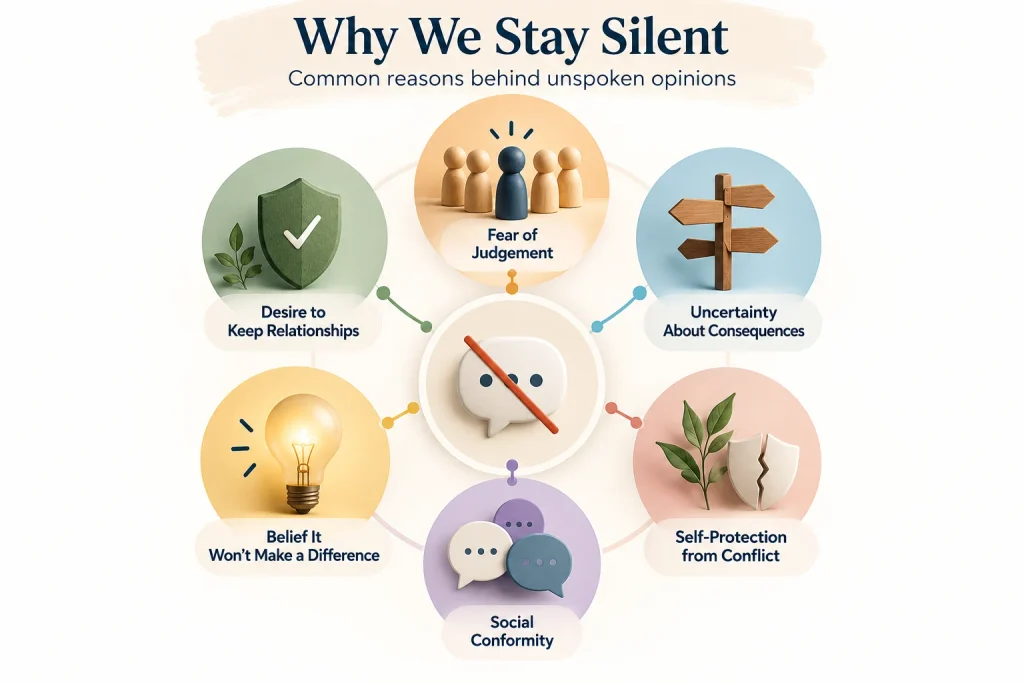
Where Does Social Conformity Show Up in Everyday Life?
Social conformity does not always happen in dramatic situations. Often, it appears in small, ordinary moments that we barely notice.
You agree with a family decision you are uncomfortable with. You remain quiet in a meeting when you notice a problem. You hesitate to express an opinion online because you know that others may disagree.
Each situation is different, but a similar question may arise beneath the surface: Can I express what I really think without risking my place in this group?
In families: When respect makes disagreement difficult
In some families, people can question a decision openly while still feeling respected and loved. In others, disagreement may be interpreted as disrespect or disobedience.
Imagine an adult whose family has already decided what would be best for them. They have different preferences but worry that expressing them will disappoint their parents. Rather than explaining their concerns, they agree to avoid an uncomfortable conversation.
Silence may come from affection and consideration. But it may also reflect a feeling that there is no room for a different opinion.
The tension becomes difficult when it repeats over time. Other family members may assume that the person is comfortable with arrangements they have never openly questioned.
A respectful approach can make room for both consideration and honest communication. You might say, “I understand why this matters to you, and I would like to explain how I see it.”
The other person may not agree, but a difference of opinion does not automatically mean that the relationship has failed.
If disagreement leads to threats, intimidation or coercion, however, safety and appropriate support must take priority over direct confrontation.
At work: When everyone agrees with the person in charge
Imagine a senior colleague proposes a new procedure. You notice a practical problem, but nobody else raises a concern. You begin wondering whether you should speak.
Perhaps you worry that your question will be interpreted as criticism. Perhaps you have seen someone dismissed for raising an inconvenient point.
You decide to remain silent.
The difficulty is that the group may interpret your silence as agreement. If several people do the same, a decision can appear more widely supported than it actually is.
Research on psychological safety—the shared belief that people can take interpersonal risks, such as asking questions or raising concerns, without undue punishment—helps explain why the working environment matters.
A systematic review of interventions to improve psychological safety and speaking-up behaviour found mixed results. This is an important reminder that individual confidence alone cannot solve every workplace problem. Leadership, team relationships and organisational practices also matter.
In a reasonably supportive environment, you might ask, “Could we consider one possible difficulty with this approach?”
In a less supportive environment, it may be wiser to choose the timing, document relevant concerns or use an appropriate confidential channel.
Speaking up is not always a simple matter of personal courage. Power and workplace culture influence what people feel able to say.

Among friends: When belonging matters more than your opinion
Imagine that your friends are making jokes about someone who is not present. You feel uncomfortable, but everyone else seems amused. You consider saying something, then wonder whether your friends will accuse you of being too serious.
You laugh along, even though the joke does not sit comfortably with you.
Sometimes, going along with a group is harmless. We do not need to turn every difference in taste, humour or opinion into a discussion.
But when you repeatedly act against your own considered values simply to avoid disapproval, it may be worth pausing.
You could express your view gently: “I know everyone sees it differently, but that doesn’t sit quite right with me.”
You can also choose not to participate without trying to persuade everyone else.
Healthy friendships do not require identical opinions. They allow people to disagree, reconsider their views and remain connected without making every difference a test of loyalty.
Online: When the majority appears to have already decided
Social media creates another environment in which group influence can shape our responses.
You come across a post expressing a strong opinion. Hundreds of people appear to agree. You have another perspective, but you hesitate to express it.
You may worry about being misunderstood or receiving hostile replies. You may also wonder whether so many people could possibly be wrong.
However, the opinions visible on a platform are not necessarily representative of everyone’s views. People who feel strongly or are motivated to comment may be more visible than those who are uncertain or simply choose not to participate.
A large number of reactions also does not establish that a claim is accurate.
Before accepting a widely shared opinion, consider the source, the reasoning and the information supporting it. You are also not obliged to express every disagreement online. Sometimes, the wisest response is to ask a genuine question. At other times, it is to disengage.
The goal is not to win an argument with strangers. It is to retain the ability to think carefully rather than allowing the visible reactions of a group to make the decision for you.
Across all these situations, the same principle applies: you can respect other people and still give your own judgment a place in the conversation.
When Does Staying Silent Become a Pattern?
Staying silent during one conversation does not necessarily mean that something is wrong. You may decide that the discussion is not worth having, that you need more time to think, or that speaking at that moment would make the situation worse.
But what happens when you repeatedly hold back, even when something matters to you?
Perhaps you agree with a decision you believe is unfair. You have a concern at work but never raise it. You keep telling your family that everything is fine because explaining your feelings seems too difficult.
Each time, you avoid an uncomfortable conversation. Yet, the thoughts you wanted to express do not necessarily disappear.
The concern is not silence itself. It is the possibility that silence has become your automatic response, even when expressing yourself would be important to you.
Psychologists and organisational researchers study related patterns under concepts such as self-silencing and employee silence. These terms refer to different contexts and should not be treated as interchangeable, but both help us examine what happens when people withhold their thoughts, feelings or concerns.
You may feel unheard
When you rarely express your preferences, other people may have difficulty understanding what you actually think or need.
Imagine that your friends always choose where to meet. You have a preference, but you usually say, “Anywhere is fine.” After several months, you begin feeling that nobody considers your wishes.
Sometimes, other people really may be overlooking your preferences. But it is also possible that they have come to believe you genuinely do not mind.
This does not make every misunderstanding your responsibility. Other people also need to listen and make room for different perspectives. However, expressing yourself gives them a better opportunity to understand you.
You do not have to begin with a major disagreement. Sometimes, simply saying, “I would prefer something different today,” is enough.
You may feel frustrated about decisions you never questioned
Have you ever agreed to something in the moment, only to feel irritated about it later?
Perhaps you accepted an additional responsibility because you did not want to disappoint a colleague. Perhaps you agreed to a family arrangement that did not work for you.
Initially, agreeing may have felt easier than explaining your concerns. Later, you might find yourself thinking, “Why did I say yes? Why didn’t I explain what I wanted?”
Not every compromise creates resentment. Relationships often require us to adjust our preferences for the benefit of others. The distinction lies in whether the compromise is freely chosen or repeatedly made out of fear.
If you notice growing resentment, ask yourself: “What did I actually want in that situation?” and “Would I make the same choice if I felt comfortable explaining my reasons?”
The purpose is not to regret every compromise. It is to understand whether your choices reflect your values or an automatic attempt to avoid disapproval.
You may begin doubting your own judgment
When you repeatedly dismiss your opinions because other people disagree, you may become less willing to trust your own reasoning.
Sometimes, the group really does have more information. Listening and reconsidering your position are important parts of sound judgment.
The difficulty arises when you stop examining the reasons behind your own opinion simply because it differs from the majority.
You may begin relying on other people’s reactions to decide whether your thoughts are reasonable. You might wait for someone else to speak first or abandon a concern as soon as another person sounds certain.
Confidence in your judgment does not mean believing that you are always right. It means being willing to consider evidence, recognise uncertainty and explain why you hold a particular view.
You can change your mind when someone makes a convincing argument. You can also retain your position when the available reasons support it, even if others disagree.
The goal is not to become more stubborn. It is to become more thoughtful about whose judgment you rely on and why.
Repeated workplace silence may be associated with burnout
Research has also examined the relationship between employee silence and well-being.
A systematic review and meta-analysis published in Psychology & Health in 2026 combined 84 studies involving 34,975 participants. Greater employee silence and lower speaking-up behaviour were associated with higher burnout. The authors also noted limitations in the available evidence, including the largely correlational nature of the studies.
This finding deserves attention, but it must be interpreted carefully. An association does not establish that staying silent causes burnout.
A workplace that discourages questions may make employees feel less able to contribute. At the same time, an employee who is already emotionally exhausted may find it more difficult to raise concerns.
If raising a legitimate concern repeatedly leads to humiliation or retaliation, an employee’s reluctance to speak may be a response to the environment rather than a personal failure.
Improving well-being at work may therefore require both individual support and changes in leadership, communication practices and organisational culture.
How can you recognise your own pattern?
You do not need to analyse every conversation or question every decision you make. Instead, notice whether a pattern is emerging.
Perhaps you frequently agree with people and regret it later. Perhaps you avoid expressing preferences even with people you trust. Perhaps you feel unable to raise a concern at work, or you become increasingly frustrated because others do not seem to understand what matters to you.
These patterns do not prove that you have a psychological difficulty. They are simply reasons to pause and understand what is happening.
After a conversation in which you held back, try asking yourself:
- What did I want to say? Identify your actual thought, concern or preference without judging it.
- Why did I remain silent? Consider uncertainty, a wish to avoid unnecessary conflict, fear of rejection or a genuine concern about the consequences.
- Would I make the same choice again? Decide whether the silence served your needs and values or whether you would prefer to respond differently in a similar situation.
You may discover that you made a sensible decision to let something go. You may also recognise a situation in which you would like to express yourself more clearly next time. Learning to recognise your emotional responses is part of building emotional fitness and emotional regulation.
Both discoveries can be useful. The purpose of reflection is not to make you speak more often. It is to help you understand your own choices.
The S.P.E.A.K. Method: How to Disagree Without Losing Yourself
Understanding why you remain silent is an important first step. But what can you do when you find yourself in that familiar moment again—when everyone seems to agree, you have a different opinion, and you are unsure whether to speak?
You do not need to become the loudest person in the room. You do not have to challenge every opinion or prove that you can stand your ground.
The S.P.E.A.K. method is a practical reflection framework developed for this article. It brings together five steps to help you move from automatic silence towards more thoughtful communication. It is not a clinically validated intervention, and it cannot guarantee that other people will respond positively.
S — Stop and notice your reaction
When you feel the urge to agree simply because everyone else agrees, pause for a moment.
Are you genuinely convinced by what the group is saying? Are you uncertain about the facts? Are you worried that someone might judge you? Or do you simply want the conversation to end without an argument?
These experiences can feel similar in the moment, but they may call for different responses.
You might quietly ask yourself:
“Am I agreeing because I believe this, or because disagreement feels uncomfortable?”
You are not trying to discover the perfect answer. You are giving your own judgment an opportunity to be heard before the group’s opinion takes over.
A pause is not a refusal to cooperate. It is an opportunity to respond rather than agree automatically.
P — Pinpoint what you fear
Once you recognise your reaction, try to understand what makes speaking difficult.
Are you afraid of rejection, embarrassment, conflict or disappointing someone? Or is there a practical concern, such as the possibility of genuine professional consequences?
Naming the concern can help you distinguish an uncomfortable possibility from a realistic risk.
Imagine that you are with friends who generally respect your opinions, but you worry they might tease you for disagreeing. You may decide that it is worth expressing yourself gently.
Now imagine dealing with someone who has previously responded to disagreement with threats or retaliation. Here, your hesitation may be protecting you from a genuine risk.
These situations should not be treated in the same way.
Ask yourself: “What am I afraid will happen if I speak, and what do I know about that possibility?”
The answer does not have to persuade you to speak. It should help you understand your fear rather than automatically obey it or dismiss it.
E — Examine the facts and the situation
Now turn your attention to the issue itself.
It is easy to assume that either the group must be right or your own opinion must be defended. Neither assumption is necessary.
Ask yourself:
- What evidence supports the group’s position?
- What makes me question it?
- Is there information I still need?
- Am I changing my view because I have learned something, or because I feel uncomfortable being different?
- Is this a situation in which expressing disagreement is reasonably safe?
Imagine that a team has selected a particular approach to a project. You initially disagree, but after listening to the reasoning, you discover that your colleagues have considered a problem you had not noticed.
Changing your opinion in this situation is not a failure of independence. It is learning.
Now imagine that the team has overlooked a serious practical difficulty and you have information that could help them reconsider the decision. Raising your concern may be valuable.
The difference lies not in whether you agree with the group, but in whether you have examined the reasons behind your position.
A — Articulate your view respectfully
Once you have considered your position and decided that speaking is appropriate, you do not need to deliver a perfect argument.
Often, a simple and honest sentence is enough.
You could begin with:
- “I see it a little differently.”
- “Could we consider another possibility?”
- “I understand your point, but I have a concern.”
- “I may be missing something, but this is how I understand the situation.”
- “Before we decide, could I share one concern?”
These statements allow you to express a different view without attacking the other person.
You are not claiming that you know everything or that everyone else is wrong. You are making your perspective available for consideration.
In a family conversation, you might say, “I understand why you prefer that option, but I would like us to consider what works for me as well.”
At work, you might explain the practical difficulty you have identified and suggest an alternative.
Choose words that feel natural to you. You do not need to memorise scripts or turn every disagreement into a formal discussion.
And remember: respectful communication cannot control another person’s reaction. Someone may still become defensive or dismissive. Your responsibility is to communicate thoughtfully where it is safe to do so—not to guarantee that everyone will approve.
K — Keep reflecting and learning
After the conversation, give yourself a moment to reflect.
If you spoke up, you may feel relieved. You may also feel uncomfortable, especially if expressing disagreement is unfamiliar to you.
Do not assume that discomfort means you made a mistake. Likewise, do not assume that speaking up was automatically the right decision simply because it took courage.
Ask yourself:
- Did I express the concern that mattered to me?
- Did I listen to the other person’s perspective?
- Did I make a considered choice about how to respond?
- Is there anything I would like to communicate differently next time?
If you chose to remain silent, reflect on that decision too. Perhaps the issue was unimportant. Perhaps you needed time to think. Perhaps the circumstances were not safe. Or perhaps fear of disapproval had made the decision for you.
Each situation offers different information.
The purpose of reflection is not to criticise yourself for every word you did not say. It is to become more aware of your patterns so that you gradually have more choice in how you respond.
The goal is not to speak in every situation. It is to make room for your own judgment, so that silence becomes a choice rather than your only available response.
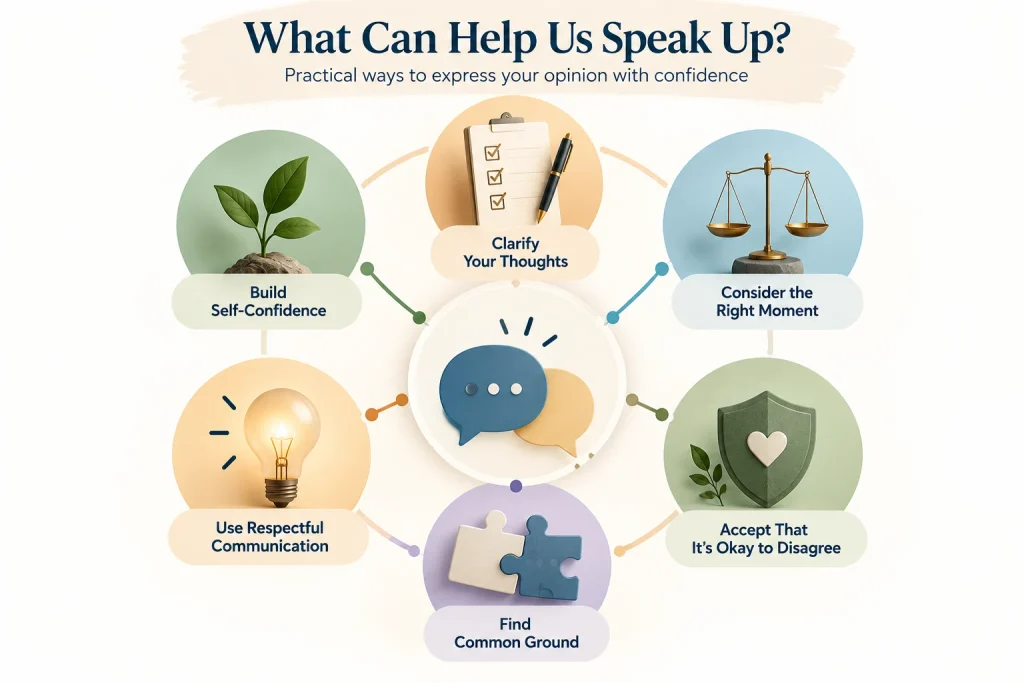
Choosing Silence or Silencing Yourself: What Is the Difference?
Not every disagreement needs to be expressed. You may decide that a conversation is not worth having, that you need more time to think, or that speaking at that moment would make the situation worse.
These can be thoughtful choices.
The difficulty arises when you repeatedly remain silent about things that matter to you, even when the circumstances allow you to express yourself safely.
A useful question is:
Am I choosing not to speak because I believe it is the right decision, or because I feel I am not allowed to disagree?
You may not always know the answer immediately. That is perfectly fine. Understanding a pattern takes time, and you do not need to judge yourself for the way you have learned to respond.
It is also worth remembering three things.
Confident people do not always speak their minds. Confidence does not mean expressing every opinion that comes to mind. A thoughtful person may wait for better information or decide that a discussion is unlikely to be productive.
Agreement does not automatically mean conformity. People can reach the same conclusion independently because they have considered the same evidence and found it convincing. The important question is how the decision was reached.
You do not have to speak up to prove your self-respect. There may be situations in which speaking openly would put your safety, livelihood or well-being at risk. You can respect yourself while choosing your words carefully, waiting for a better opportunity or deciding not to continue an unproductive conversation.
The aim is not to become someone who never stays silent. It is to develop enough awareness to recognise when silence serves you and when it prevents you from expressing something important.
Learning to Belong Without Losing Your Voice
The next time you find yourself in a room where everyone seems to agree, notice what happens inside you.
Do you genuinely share their opinion? Are you uncertain and willing to learn more? Are you concerned that expressing a different view might create unnecessary tension? Or do you already know what you think but feel uncomfortable allowing others to see it?
You do not need to answer these questions perfectly. Even noticing them can help you approach the situation with greater awareness.
You may begin with something small. Express a preference when someone asks what you would like. Ask a question when you do not understand a decision. Offer a different perspective when you have a meaningful concern and feel safe enough to raise it.
You may still feel nervous. You may not always find the right words. Some people may disagree with you, and some conversations may not go as you hoped.
That is part of being in relationships with other human beings.
You can listen without automatically agreeing. You can disagree without treating another person as an enemy. You can change your mind when you encounter better information without assuming that your original opinion was foolish.
And you can care deeply about your relationships without making everyone’s approval the condition for expressing yourself.
If you have spent a long time staying silent, be patient with yourself. You do not need to transform your behaviour overnight. Start by understanding your reactions, recognising the situations in which you feel safe and giving yourself permission to consider your own perspective.
Belonging to a group does not require you to agree with everything the group believes. You can value other people’s opinions while allowing your own to have a place in the conversation.
Sometimes, that may mean speaking. Sometimes, it may mean listening.
What matters is that the choice becomes more thoughtful, more conscious and more genuinely yours.
References and further reading
The following sources support the article’s explanations of conformity, social influence and speaking-up behaviour.
- Cialdini, R. B., & Goldstein, N. J. (2004). Social Influence: Compliance and Conformity. Annual Review of Psychology, 55, 591–621. Read the research review.
- Asch, S. E. (1956). Studies of Independence and Conformity: I. A Minority of One Against a Unanimous Majority. Psychological Monographs: General and Applied, 70(9), 1–70. Read the original study.
- Capuano, C., & Chekroun, P. (2024). A Systematic Review of Research on Conformity. International Review of Social Psychology, 37(1). Read the open-access review.
- O’Donovan, R., & McAuliffe, E. (2020). A systematic review exploring the content and outcomes of interventions to improve psychological safety, speaking up and voice behaviour. BMC Health Services Research, 20, 101. Read the open-access review.
- Lainidi, O., et al. (2026). Associations between burnout, employee silence and voice: a systematic review and meta-analysis. Psychology & Health, 41(8), 1245–1265. Read the meta-analysis.
These studies examine different aspects of social influence and speaking-up behaviour. They should not be taken as evidence that every instance of silence is harmful or that one communication technique works for everyone.