

There are nights when you do not really want advice.
You simply want someone to talk to.
Maybe you have had a difficult day. Maybe your friends are busy. Maybe you do not feel comfortable telling anyone what is actually going on in your mind.
So you open an AI chatbot and start typing.
A few minutes later, you feel a little lighter.
And then a strange question appears:
Why do I talk to AI when I am lonely?
Table of Contents
It is easy to think the answer is simply convenience. AI is available. It responds quickly. You do not have to wait for someone to reply.
But psychology tells us that there may be something deeper happening.
Sometimes, the conversation is not really about the technology.
It is about connection, comfort, being heard, reassurance, or simply having somewhere to put your thoughts.
And that is what makes AI companionship psychologically interesting.
Maybe You’re Not Talking to AI. You’re Looking for Connection.
Loneliness is not simply the same as being physically alone.
The World Health Organization describes loneliness as a distressing feeling that comes from a gap between the social connections we have and the connections we want or need.
You can therefore be surrounded by people and still feel lonely.
You can also spend an evening alone without feeling lonely at all.
The difference is often what is happening emotionally.
When you feel disconnected, your mind naturally looks for ways to restore some sense of connection.
For some people, that means calling a friend.
For others, it may mean watching something familiar, writing in a journal, going for a walk, or talking to an AI chatbot.
The behaviour may look different.
The underlying need can be surprisingly similar.
“I don’t want to feel so alone right now.”

Sometimes We Need a Listener More Than an Answer
Think about the last time you had something on your mind and said:
“I just need to talk about it.”
You may not have wanted someone to solve the problem.
You wanted to say it out loud.
Putting feelings into words can sometimes make an overwhelming experience feel more organised. And being listened to can itself feel meaningful.
This may help explain why conversations with AI can sometimes feel surprisingly comforting.
Research published in the Journal of Consumer Research found that AI companions could produce short-term reductions in loneliness after interaction and that feeling heard was an important factor associated with this effect. However, the study examined AI companions specifically and does not establish that all chatbot use produces lasting reductions in loneliness.
So if you finish a conversation with AI feeling a little better, that feeling does not necessarily mean something is wrong with you.
It may simply mean that the conversation met a temporary emotional need.
Why Does Talking to AI Sometimes Feel Easier Than Talking to People?
This is where the psychology becomes particularly interesting.
You might think:
“Why can I tell a chatbot things that I struggle to tell people?”
There are several possible reasons.
The Fear of Being Judged
Human conversations carry social consequences.
When you tell a friend something personal, you may wonder:
Will they judge me?
Will they see me differently?
Will they tell someone else?
What if they disagree with me?
Those concerns can make self-disclosure difficult.
A chatbot does not have the same social consequences.
You can type something embarrassing, complicated, or emotionally messy without having to look another person in the eye.
That can make disclosure feel easier.
Recent research examining why people share emotions with conversational AI identified motives including casual conversation, emotional connection, venting, advice-seeking, and discussing topics that feel difficult to discuss with people. For in-depth understanding of this issue, go through the article on emotional safety.
When Social Interaction Feels Exhausting
For someone who already feels socially anxious, rejected, overwhelmed, or emotionally tired, starting a conversation with another person can require effort.
You have to think about what to say.
You have to read the other person’s reaction.
You may worry about saying the wrong thing.
AI removes much of that uncertainty.
You can pause.
Rewrite your message.
Start again.
Take your time.
That control can feel comforting.
Why Control Can Feel So Comforting
Human relationships are unpredictable.
People get busy.
They misunderstand us.
They disagree.
Sometimes they disappoint us.
An AI chatbot is much more predictable in comparison. It is available whenever you open the conversation and responds to what you type.
That predictability can feel emotionally soothing, particularly during moments when life itself feels uncertain.
But there is an important distinction:
Predictability is not the same as human closeness.
Why Does AI Feel Surprisingly Human?
Part of the answer lies in a basic human tendency called anthropomorphism—attributing human qualities to non-human things.
Modern conversational AI can produce language that sounds warm, attentive and personalised.
It can remember details within a conversation.
It can respond to emotional language.
It can ask follow-up questions.
It can appear to understand what you mean.
These features can create a sense of social presence.
The American Psychological Association notes that humans naturally anthropomorphise non-human agents, while AI companions are often deliberately designed with personalised, human-like and emotionally responsive features.
So the feeling of connection can be real even though the relationship is not the same as a human relationship.
That distinction matters.
An AI can generate a response that feels empathetic.
That does not mean it experiences empathy in the human sense.
It can respond to your story.
It does not share your life.
When a Conversation Starts to Feel Like a Relationship
Something interesting can happen when conversations become frequent.
You may start giving the chatbot a name.
You may look forward to talking to it.
You may tell it things you do not tell anyone else.
You may even feel uncomfortable when it is unavailable.
None of these experiences automatically mean that something is wrong.
Humans can form emotional bonds with many things that provide familiarity, comfort or perceived support.
Recent cross-national research involving 7,027 respondents found substantial levels of attachment-related behaviour toward AI chatbots and found that perceived emotional support was strongly associated with attachment. The researchers also found a strong association between emotional attachment and indicators of dependence. These were survey associations, not proof that chatbot use causes dependence.
The important question is therefore not simply:
“Am I attached to AI?”
A better question is:
“What place is AI beginning to occupy in my emotional life?”
A Gentle Boundary: Let AI Support Your Life, Not Become Your Whole Emotional World
AI does not necessarily have to be the enemy of human connection.
It can sometimes help you organise your thoughts before speaking to someone.
It can help you practise what you want to say.
It can give you a place to reflect when nobody is available.
It can help you put feelings into words.
The concern begins when the direction changes.
Instead of helping you return to life, the conversation becomes a way of avoiding life.
That is an important difference.
One useful question is:
After talking to AI, do I feel more ready to engage with my life—or more willing to withdraw from it?
Can AI Actually Reduce Loneliness?
The honest answer is:
Sometimes, at least temporarily. But the evidence is more complicated than a simple yes or no.
A 2025 study published in the Journal of Consumer Research found that AI companions could reduce loneliness in the moment, including across repeated interactions over a week. The researchers found that feeling heard was particularly important.
That is an important finding.
But it should not be interpreted as proof that AI companionship solves loneliness.
A separate 12-month longitudinal study of more than 2,000 adults across four Western countries found a more complicated pattern. People who felt less socially connected were more likely to subsequently use social chatbots. Increased chatbot use also predicted increased loneliness on one single-item measure of emotional isolation, but this finding did not replicate on the broader measure of social connection. The authors specifically caution against strong causal conclusions.
That nuance matters.
It may be that lonely people turn to AI because they are lonely.
It may also be that intensive use sometimes contributes to a cycle of withdrawal.
Different people may experience the same technology differently.
A 2026 Nature Human Behaviour study of 1,131 U.S. Character.AI users similarly found that the relationship between AI companionship and well-being was not uniform. Smaller social networks were associated with using chatbots primarily for companionship, and companionship-focused use was associated with lower well-being. The associations were stronger among people reporting more intensive and highly disclosive use.
So the most responsible conclusion is not:
“AI makes loneliness worse.”
Nor is it:
“AI solves loneliness.”
It is:
AI may provide meaningful short-term social or emotional relief, but its longer-term relationship with loneliness depends on the person, the way AI is used, and what happens to their offline social life.
When Does AI Companionship Become Too Much?
There is no universal number of minutes that tells you when AI use has become unhealthy.
The more useful question is what the behaviour is doing to your life.
Pay attention if you notice patterns such as:
You Choose AI Instead of People
You repeatedly turn to AI even when a trusted person is available.
AI Becomes Your Main Emotional Outlet
Most of your emotional processing happens with a chatbot rather than with people, journaling, reflection, or other forms of support.
You Use It Mainly to Avoid Difficult Feelings
Instead of dealing with loneliness, grief, conflict, rejection, or uncertainty, you continually escape into conversation.
You Need Reassurance Again and Again
You keep asking the chatbot the same emotional question because the reassurance never quite feels sufficient.
Your Offline Life Starts Getting Smaller
You stop calling people.
You avoid social situations.
You lose interest in activities you once enjoyed.
You spend increasingly more time in AI conversations.
Its Absence Causes Significant Distress
You feel unusually upset, anxious, or empty when you cannot access the chatbot.
These are not diagnostic criteria for a disorder.
They are simply signals worth noticing.
Recent research on AI companions and well-being suggests that intensity of use, degree of disclosure and the user’s existing social environment can all matter.
What Are You Really Looking for When You Talk to AI?
This may be the most important question in the entire conversation.
Instead of asking:
“Why am I talking to AI?”
Try asking:
“What do I need right now?”
Perhaps you need:
Comfort
You have had a difficult day and want something soothing.
Reassurance
You are uncertain and want someone—or something—to tell you that things will be okay.
Being heard
You have thoughts that have been sitting inside you for too long.
Emotional safety
Talking to people feels difficult right now.
Clarity
Your thoughts are tangled, and you need help putting them into words.
Connection
More than anything, you simply do not want to feel alone.
The technology may be new.
The needs are not.
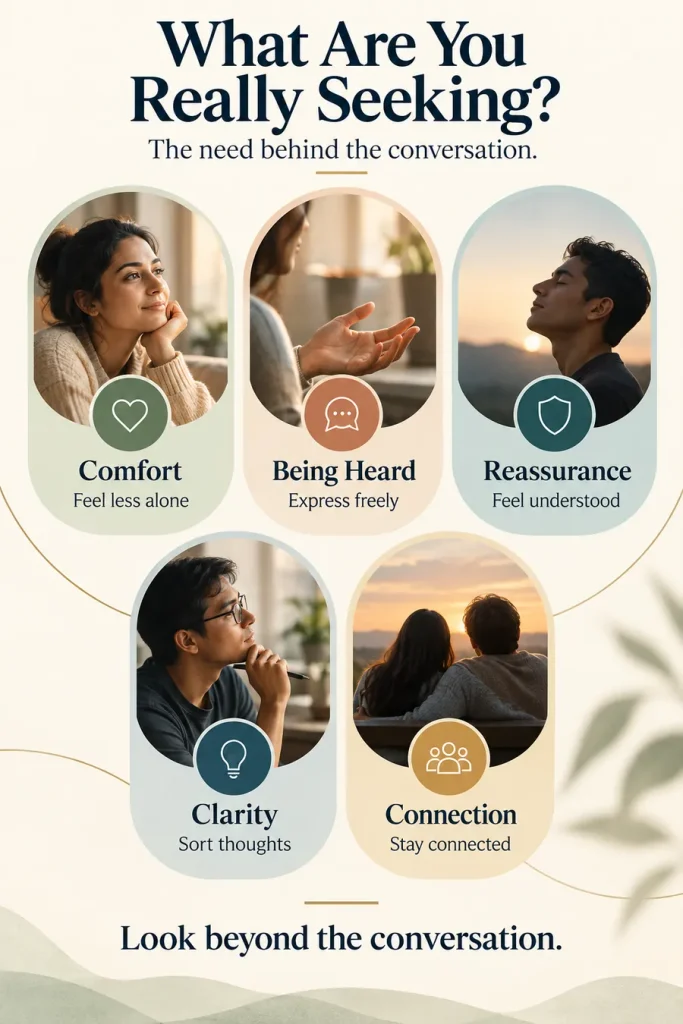
The Need Behind the Conversation
Sometimes the most helpful thing is not to stop talking to AI.
It is to understand why you are talking to it.
If you need clarity, perhaps the conversation can help you organise your thoughts.
If you need reassurance, perhaps it can help you identify what uncertainty is making you uncomfortable.
If you need to feel heard, perhaps writing your feelings down can help you understand them more clearly.
And if you need human connection, that may be a sign to reach outward.
Send someone a message.
Call a friend.
Sit with family.
Join a group.
Go somewhere where other people are.
The goal is not to make AI disappear from your life.
The goal is to make sure it does not quietly replace the parts of life that nourish you.
How to Use AI When You’re Lonely Without Replacing Human Connection
A few simple boundaries can help.
Use AI With an Intention
Before opening a chatbot, ask yourself:
“What am I looking for right now?”
A little awareness can change the entire interaction.
Let the Conversation Lead Somewhere
If AI helps you understand what you are feeling, take that understanding with you.
Write something down.
Make a decision.
Have the conversation you have been avoiding.
Take a walk.
Call someone.
The conversation should not always end with another conversation.
Keep Real People in Your Life
AI can be one source of support.
It should not become your only source.
Human relationships offer things that AI cannot fully reproduce: shared experiences, mutual vulnerability, physical presence, reciprocity and a life that exists outside the conversation.
Research comparing a supportive chatbot with a randomly assigned human peer among 296 first-year university students found that, over two weeks, interaction with the human peer produced greater reductions in loneliness than interaction with the chatbot.
That does not mean every human interaction will feel better than every AI conversation. To understand this issue in detail, you can go through another article on Why Do I Feel Lonely Even Around People?
It simply reminds us that human connection has qualities that technology cannot completely reproduce.
Notice the Direction of Your Life
Here is a simple question worth remembering:
Is this conversation helping me return to my life—or helping me avoid it?
There is no need to judge yourself.
Just notice.
What AI Companionship Cannot Replace
AI can respond.
It can listen in a conversational sense.
It can help you reflect.
It can make you feel heard.
But human relationships involve something more.
A friend remembers an experience because they lived it with you.
A partner can sit beside you when words are unnecessary.
A family member can share a history with you.
A friend can disagree with you, challenge you, forgive you, surprise you and grow alongside you.
Human relationships are sometimes messy.
They can also be deeply meaningful because they are mutual.
That reciprocity is important.
AI can simulate aspects of companionship.
It does not share your human life.

So, Why Do I Talk to AI When I am Lonely?
Maybe because you are lonely.
Maybe because you need someone to listen.
Maybe because talking feels easier when you do not have to worry about judgement.
Maybe because you need reassurance.
Maybe because your thoughts feel tangled and you want somewhere to put them.
Or maybe you simply had a difficult day and wanted a little company.
None of those needs are strange.
The more useful question is what happens after the conversation.
If talking to AI helps you understand yourself, organise your thoughts or take a small step toward your life, it may be serving a useful role.
If it increasingly replaces people, relationships and real-world experiences, it may be worth pausing and looking at what you are avoiding.
You do not have to choose between technology and human connection.
But it helps to remember which one can actually share your life with you.
The technology is new.
The human need for connection is not.
FAQs
Is it normal to talk to AI when I am lonely?
Yes. People may use conversational AI for many reasons, including emotional expression, advice, casual conversation and a sense of connection. Recent research has documented these different motives for sharing emotions with AI.
Talking to AI is not automatically a sign that something is wrong.
What matters more is the role it plays in your life.
Why do I feel emotionally attached to AI?
Repeated conversations can create familiarity and a sense of continuity. Human beings also naturally attribute human qualities to non-human agents, and modern chatbots are designed to communicate in increasingly personalised and socially responsive ways.
Attachment itself is not necessarily harmful. The important question is whether it remains one part of your life or begins displacing important relationships and activities.
Can talking to AI reduce loneliness?
Research suggests it can reduce feelings of loneliness temporarily for some people, particularly when the interaction creates a sense of being heard.
However, evidence about longer-term effects is mixed. Current research does not support treating AI companionship as a proven long-term solution to loneliness.
Can AI companionship make loneliness worse?
It may, particularly when intensive use becomes connected with social withdrawal or replaces offline relationships.
However, research is still developing, and studies have not established a simple cause-and-effect relationship for everyone.
Why is it easier to talk to AI than people?
AI can feel easier because there is less fear of immediate judgement, rejection or social consequences. You can also control the pace of the conversation.
For people who find certain conversations difficult, this can make disclosure feel less threatening.
Can you become emotionally dependent on an AI chatbot?
It is possible for emotional attachment to become strong enough that a person finds it difficult to function without the chatbot.
Recent cross-national research found a strong association between emotional attachment to chatbots and indicators of dependence, although the study was correlational and does not establish that chatbot use causes dependence.
Can AI replace human companionship?
AI can reproduce some features of conversation and companionship, and it may provide useful support at certain moments.
But it does not reproduce the full reciprocity, shared experience, physical presence and mutual life of human relationships.
For many people, the healthiest approach is to treat AI as one possible source of support rather than the whole support system.
Should I stop talking to AI if I use it when I am lonely?
Not necessarily.
Instead, notice what happens around the conversation.
Does it help you feel calmer and reconnect with your life?
Or are you increasingly using it to avoid people, difficult emotions and everyday experiences?
That distinction may tell you more than the number of hours you spend chatting.
A Final Thought
Sometimes loneliness does not ask for a solution.
It asks to be noticed.
So the next time you find yourself opening an AI chatbot because you feel alone, pause for a moment.
Ask yourself:
“What is my loneliness asking me for right now?”
Maybe it is comfort.
Maybe it is reassurance.
Maybe it is a conversation.
Maybe it is human company.
Knowing the difference can help you choose the kind of connection you actually need.
Psychology & Mental Health Disclaimer
This article is for general education and awareness. It is not intended to diagnose, treat or manage any mental health condition.
AI chatbots are not a substitute for qualified mental-health professionals, trusted human relationships or emergency support.
If loneliness, sadness, anxiety or emotional distress feels persistent or overwhelming, consider speaking with a qualified mental-health professional.
If you are in immediate danger or experiencing thoughts of self-harm, seek urgent help through appropriate local emergency or crisis services.