
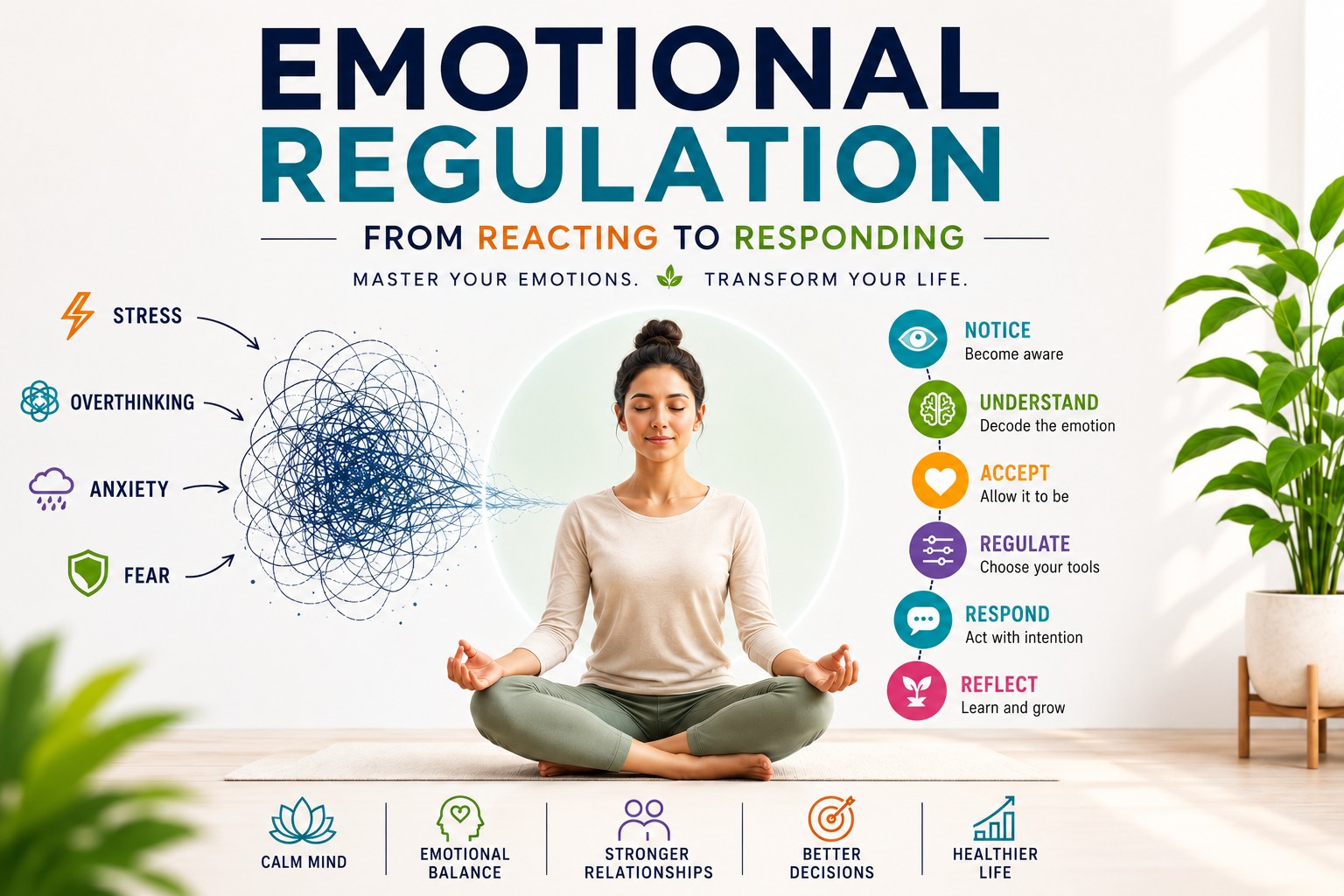
Why Mastering Your Emotions Is More Powerful Than Controlling Them
Table of Contents
Have you ever promised yourself,
“Next time, I won’t lose my temper.”
Or replaying an argument in your mind, thinking,
“Why did I react like that? That isn’t who I really am.”
Perhaps you’ve stayed awake at night wishing you had said something different. Or maybe you’ve remained silent during an important conversation, only to be overwhelmed by regret hours later.
Most of us have experienced moments like these.
We blame ourselves for being “too emotional,” “too sensitive,” or “unable to control our feelings.” We assume the problem is a lack of willpower.
But psychology tells a very different story.
The issue isn’t that you have emotions.
The issue is that very few of us were ever taught how to work with them.
From childhood, we learn mathematics, grammar, history, and science. Yet almost no one teaches us how to understand fear, calm anxiety, process disappointment, manage anger, or sit with sadness without becoming overwhelmed.
As a result, many adults spend decades trying to escape emotions they were never taught to understand.
That struggle quietly affects every part of life—our relationships, careers, parenting, health, confidence, and even the conversations we have with ourselves.
This ability has a name.
It is called emotional regulation, and it may be one of the most valuable life skills you can ever develop.
Not because it removes difficult emotions.
But because it changes how you experience them.
A Story Most of Us Have Lived
Imagine two colleagues receiving identical feedback from their manager.
The first person hears the criticism and immediately feels attacked. Their heart races. They become defensive, spend the rest of the day replaying the conversation, and return home emotionally exhausted.
The second person feels the same initial sting. They also experience disappointment.
But after taking a few slow breaths, they recognize what they’re feeling. Instead of reacting immediately, they ask a few clarifying questions, reflect on the feedback, and use it as an opportunity to improve.
The difference isn’t intelligence.
It isn’t confidence.
It isn’t personality.
Both experienced the same emotion.
The difference lies in what happened during the few seconds between feeling the emotion and responding to it.
That small space changes everything. And learning to use that space is what emotional regulation is all about.
Why This Skill Matters More Than Ever
We live in a world designed to keep our emotions activated.
Every notification competes for our attention.
Social media constantly invites comparison.
News headlines trigger fear.
Work demands increase.
Relationships become more complex.
Even moments of rest are interrupted by endless scrolling.
Our brains evolved to respond to occasional threats—not to hundreds of emotional triggers every day.
Without healthy emotional regulation, this constant stimulation can leave us feeling:
- Easily irritated
- Mentally exhausted
- Emotionally reactive
- Chronically anxious
- Overwhelmed by small setbacks
- Stuck in cycles of overthinking
Many people assume these experiences mean something is “wrong” with them.
More often, they simply indicate that their emotional system is overloaded.
The encouraging news is that emotional regulation is not an inborn talent reserved for a fortunate few.
It is a learnable skill.
Like strengthening a muscle, it improves with awareness, practice, and patience.
What You’ll Discover in This Guide
By the end of this article, you’ll understand:
- What emotional regulation actually means—and what it doesn’t.
- Why your brain reacts before your logical mind has a chance to think.
- Why suppressing emotions often makes them stronger.
- The science behind emotional regulation and emotional resilience.
- Practical, research-backed techniques you can begin using today.
- A simple framework to help you respond to emotions with greater clarity and confidence.
- Daily habits that gradually strengthen emotional fitness.
Most importantly, you’ll discover that emotional regulation isn’t about becoming emotionally “perfect.”
It’s about becoming emotionally free.
Free to respond instead of react.
Free to experience emotions without being controlled by them. Free to build a life guided by your values rather than your impulses.
A Small Reflection Before We Continue
Think back to the last time you reacted in a way you later regretted.
Pause for a moment.
Ask yourself:
Was the emotion really the problem?
Or was it that the emotion took control before you had the opportunity to understand it?
That single question opens the door to one of psychology’s most transformative insights.
Because before we learn how to regulate emotions, we first need to understand what emotional regulation truly is—and why so many people misunderstand it.
Let’s begin there.
What Emotional Regulation Really Means (And What It Doesn’t)
“If I could just stop feeling this way, everything would be fine.”
It’s a thought many of us have had.
When anxiety keeps us awake, anger spills into our relationships, or sadness lingers longer than we’d like, our first instinct is often to get rid of the emotion as quickly as possible.
We distract ourselves with work. We scroll through social media. We tell ourselves to “stay positive.” Sometimes we pretend we’re fine even when we’re falling apart inside.
For a moment, it may seem to help.
But sooner or later, those emotions return—often stronger than before.
Why?
Because emotions are not problems to eliminate. They are messages to understand. And this is where one of the biggest misconceptions about emotional regulation begins.
The Biggest Myth About Emotional Regulation
Many people believe emotional regulation means the following:
- Never getting angry.
- Staying calm all the time.
- Ignoring painful feelings.
- Being mentally “strong enough” not to cry.
- Keeping emotions under complete control.
None of these define emotional regulation.
In fact, trying to control emotions too tightly often creates the very problems we’re trying to avoid.
Imagine holding a beach ball underwater.
At first, you can keep it submerged.
But the harder you push it down, the more forcefully it wants to rise back to the surface.
Our emotions often behave in much the same way.
The more we fight them, deny them, or judge ourselves for having them, the more persistent they can become.
Psychologists have long observed that what we resist often becomes more mentally demanding. Trying not to think or feel something can unintentionally keep our attention fixed on it.
Instead of disappearing, the emotion waits for another opportunity to surface.
So, What Is Emotional Regulation?
At its core, emotional regulation is the ability to:
Notice your emotions, understand what they’re telling you, and choose a helpful response instead of reacting automatically.
Notice what’s missing from that definition.
It doesn’t say:
- Eliminate emotions.
- Suppress emotions.
- Always feel positive.
- Stay happy all the time.
Healthy emotional regulation accepts a simple truth:
Every emotion has a purpose.
Fear alerts us to danger.
Anger tells us that a boundary may have been crossed.
Sadness encourages us to slow down and process loss.
Joy strengthens social bonds and motivates growth.
Even guilt can help us realign our actions with our values.
The goal isn’t to silence these emotions.
The goal is to listen without letting them take over.
Emotional Regulation Is About Creating Space
One of the most important ideas in modern psychology is that there is often a small gap between what happens to us and how we respond.
Most of us don’t notice this gap because our reactions feel instantaneous.
Someone criticises us.
Someone ignores our message.
A driver cuts us off in traffic.
A family member says something hurtful.
Before we’re even aware of it, we’ve already reacted.
But emotionally healthy people aren’t free from these triggers.
They’ve simply learned to widen the space between the trigger and their response.
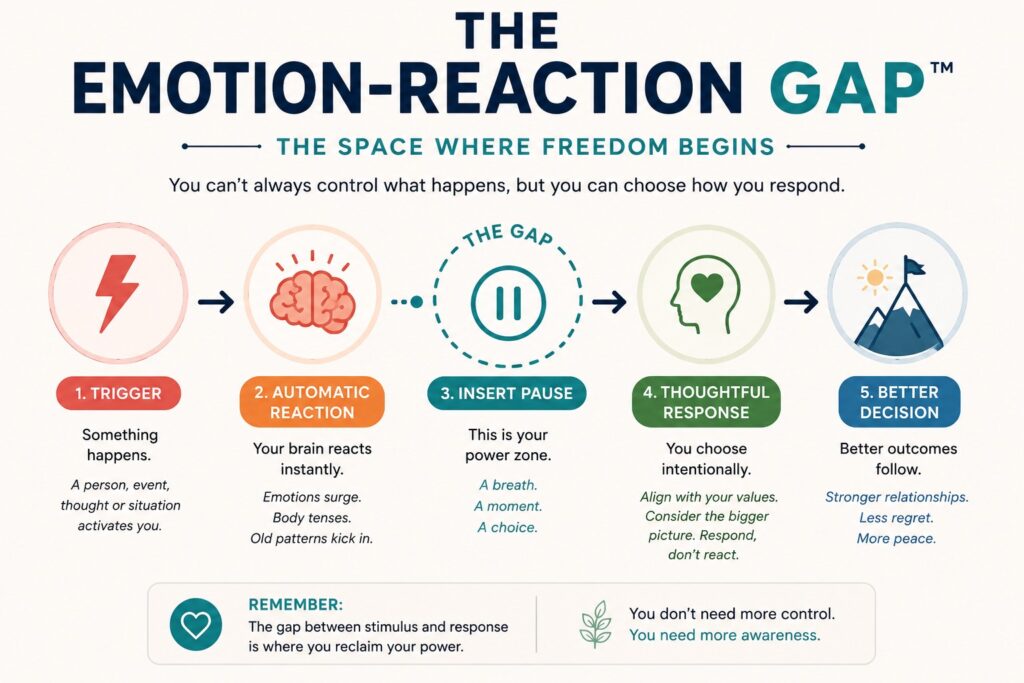
In that space, they ask questions like:
- What am I feeling right now?
- Why might I be reacting this way?
- What response will help rather than harm this situation?
- What action aligns with the kind of person I want to be?
That pause may last only a few seconds.
Yet those few seconds often determine whether a conversation becomes a conflict, whether stress turns into panic, or whether disappointment becomes an opportunity for growth.
Emotional Regulation Is Not Emotional Suppression
This distinction is so important that it’s worth exploring carefully.
Many people confuse being emotionally regulated with appearing emotionally unaffected.
But they are not the same.
Consider these two scenarios.
Person A
They feel hurt after receiving criticism.
They immediately say,
“I’m fine.”
They force a smile.
They bury the emotion.
For days, resentment quietly grows beneath the surface until it eventually explodes during an unrelated conversation.
Person B
They also feel hurt.
Instead of denying it, they acknowledge the feeling privately.
They take time to calm their body.
They reflect on why the feedback affected them so deeply.
Later, they respond thoughtfully rather than impulsively.
Both people experienced the same emotion.
Only one regulated it.
The other suppressed it.
Suppression may create temporary comfort. Regulation creates lasting resilience.
The Four Common Ways People Deal With Difficult Emotions
When emotions become uncomfortable, most people fall into one of four patterns.
1. Avoidance
“I’ll keep myself busy so I don’t have to think about it.”
The emotion remains unresolved.
2. Suppression
“I shouldn’t feel this way.”
The feeling is pushed aside rather than processed.
3. Reaction
The emotion takes complete control.
Words are spoken in anger.
Decisions are made impulsively.
Regret often follows.
4. Regulation
The emotion is noticed.
Accepted.
Understood.
Responded to with intention.
This doesn’t eliminate discomfort.
It transforms how we move through it.
Why Emotional Regulation Feels Difficult
If emotional regulation is so beneficial, why doesn’t it come naturally?
The answer has little to do with weakness.
Most of us simply weren’t taught these skills.
As children, many people heard messages like:
- “Stop crying.”
- “Don’t be so sensitive.”
- “Big boys don’t cry.”
- “Good girls don’t get angry.”
- “Calm down.”
These statements were often well-intentioned.
But they taught many of us how to hide emotions—not how to understand them.
Over time, we became experts at ignoring our internal experiences while remaining uncertain about how to process them.
Learning emotional regulation as an adult is, in many ways, learning a language that was never taught during childhood.
The encouraging news is that our brains remain capable of learning throughout life.
With practice, new emotional habits can become new emotional strengths.
A Simple Shift That Changes Everything
Instead of asking:
“How do I stop feeling this?”
Try asking:
“What is this emotion trying to tell me?”
That single change in perspective can transform your relationship with difficult emotions.
You stop treating them as enemies.
You begin seeing them as information.
And information, when understood, becomes wisdom.
Key Takeaways

Before moving forward, remember these essential ideas:

•	Emotional regulation is not about controlling or eliminating emotions.
•	Every emotion serves a purpose.
•	Suppressing emotions often delays rather than resolves them.
•	Regulation creates space between feeling and action.
•	The goal is not emotional perfection—it is emotional flexibility.
•	Emotional regulation is a skill that anyone can strengthen through practice.
What Happens Inside Your Brain Before You Even Realize It?
If emotional regulation isn’t about willpower, then why do emotions sometimes seem to take over before we’ve had a chance to think?
Why can a single comment ruin your entire day?
Why does your heart race before your mind even understands what’s happening?
The answer lies deep within the brain—a remarkable survival system that evolved to protect you long before modern life existed.
Understanding this system is one of the most empowering insights in psychology because it reveals something surprising:
Your brain is designed to react first and think later.
And once you understand why, you’ll stop blaming yourself for many of your emotional reactions—and start learning how to work with your brain instead of against it.
Why Your Brain Reacts Before You Think
The Neuroscience of Emotional Regulation Explained Simply
Have you ever found yourself saying something in anger and regretting it almost immediately?
Or perhaps you’ve received an unexpected email from your boss, and before opening it, your stomach tightened and your mind raced through every possible worst-case scenario.
In those moments, it can feel as though your emotions have taken over before you’ve even had a chance to think.
Here’s the reassuring truth:
You’re not “bad at handling emotions.” You’re experiencing the way the human brain was designed to work.
Understanding this doesn’t excuse harmful behavior—but it does explain why emotional regulation can feel so difficult.
And once you understand why your brain reacts the way it does, you’ll be in a much better position to respond differently.
Your Brain Has Two Jobs
Although the brain is extraordinarily complex, we can simplify its role into two essential jobs:
- Keep you alive.
- Help you live well.
The first job evolved millions of years before the second.
Long before humans worried about deadlines, job interviews, or difficult conversations, our ancestors needed to survive immediate threats—predators, harsh environments, and physical danger.
To survive, the brain developed a system that could react instantly, often before conscious thought had time to catch up.
That ancient survival system still exists today.
The challenge is that your brain doesn’t always distinguish between a charging predator and a harsh email, a critical comment, or the fear of rejection.
To your survival system, many emotional threats can feel surprisingly similar.
Meet Your Brain’s Emotional Alarm System
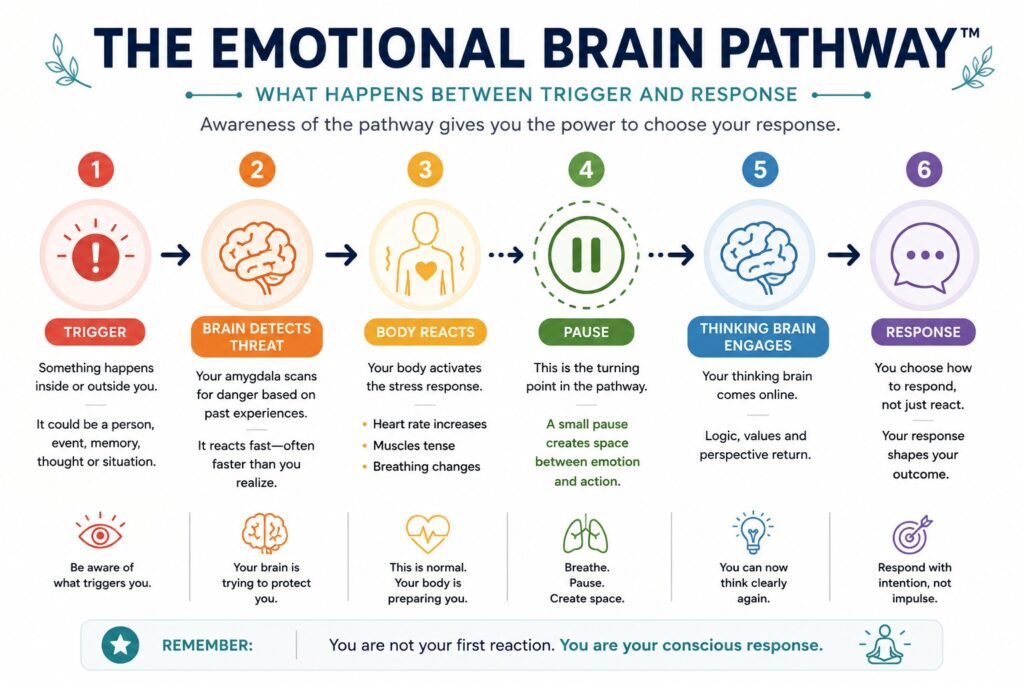
Deep inside your brain is a small structure that acts like an emotional alarm.
Its primary responsibility isn’t to make you happy.
Its responsibility is to keep you safe.
Every second, it asks questions such as:
- Is this safe?
- Could this hurt me?
- Should I prepare for danger?
- Do I need to react quickly?
When the answer appears to be “yes,” your body begins preparing for action almost immediately.
Your heart beats faster.
Your muscles tense.
Your breathing changes.
Your attention narrows.
All of this happens before your logical thinking has fully caught up.
This is why emotional reactions often feel automatic.
Your brain is trying to protect you—not sabotage you.
The Wise Thinker Arrives a Moment Later
Fortunately, your brain has another remarkable ability.
Once the initial emotional alarm settles, the more reflective parts of your brain begin asking different questions:
- Is this actually dangerous?
- Am I interpreting the situation correctly?
- Is there another explanation?
- What’s the most helpful response?
This slower system helps you:
- Plan ahead.
- Solve problems.
- Consider consequences.
- Empathise with others.
- Make thoughtful decisions.
Emotional regulation depends on allowing this reflective system enough time to do its job.
Sometimes, that difference is only a few seconds.
But those seconds can completely change the outcome of a conversation, a decision, or a relationship.
Why We Often Misread Emotional Threats
Our brains evolved in environments where reacting quickly often meant surviving.
Today, however, many of the “threats” we experience are social rather than physical.
For example:
- A delayed text message.
- Negative feedback at work.
- Being excluded from a group.
- A disagreement with a partner.
- Public embarrassment.
- Uncertainty about the future.
None of these situations are physically dangerous.
Yet they can activate the same emotional alarm system because humans are deeply wired for connection, belonging, and social acceptance.
From an evolutionary perspective, being rejected by the group once carried real survival risks.
Although modern life has changed dramatically, our brains still respond strongly to social threats.
This is one reason why emotional pain can feel surprisingly physical.
The Emotion-Reaction Loop
Let’s look at what often happens in everyday life.
Imagine someone criticizes your work during a meeting.
Within moments, your brain may begin this sequence:
Trigger
↓
"This feels threatening."
↓
The body prepares for action.
↓
Strong emotion appears.
↓
An automatic reaction begins.
↓
Words or behaviors follow.
↓
Later comes reflection.
↓
"Why did I react like that?"
Notice something important.
Reflection usually arrives after the reaction.
Emotional regulation helps reverse that pattern.
Instead of:
Trigger → Reaction → Regret
You gradually develop the following:
Trigger → Awareness → Reflection → Response
That single change is one of the most powerful skills you can develop.
Why Overthinking Often Begins Here
If you’ve read our previous article on overthinking, you’ll notice something familiar.
When the brain cannot quickly determine whether a situation is safe or threatening, it often keeps searching for answers.
It replays conversations.
It imagines different outcomes.
It analyses every possibility.
This isn’t because your brain enjoys making you anxious.
It’s because uncertainty feels unresolved.
And the brain naturally wants resolution.
Unfortunately, endless thinking rarely provides the certainty we’re searching for.
Instead, it can keep the emotional alarm switched on. Learning emotional regulation interrupts this cycle by helping us tolerate uncertainty without becoming trapped inside it.
Stress Changes the Brain’s Priorities
Think about the last time you were extremely stressed.
Did you notice that you became:
- More impatient?
- More forgetful?
- More reactive?
- Less able to concentrate?
- More likely to misunderstand other people’s intentions?
That’s not a character flaw.
It’s a predictable response.
Under stress, the brain temporarily prioritizes survival over careful reasoning.
It’s much harder to think clearly when your nervous system believes you need protection.
This explains why difficult conversations rarely go well when we’re emotionally overwhelmed.
Sometimes, the healthiest response isn’t to solve the problem immediately.
It’s to calm the nervous system first.
Only then can the thinking brain fully re-engage.
Emotional Regulation Begins in the Body
Many people assume emotional regulation starts with changing their thoughts.
Sometimes it does.
But often, it starts even earlier.
Your emotions aren’t experienced only in your mind.
They’re experienced throughout your body.
You may notice:
- Tight shoulders.
- A racing heartbeat.
- Shallow breathing.
- A clenched jaw.
- Butterflies in your stomach.
- A heavy feeling in your chest.
These physical sensations are not separate from your emotions.
They are part of them.
That’s why practices such as slow breathing, mindful walking, stretching, or simply pausing for a moment can be surprisingly effective.
You’re not “ignoring” the emotion.
You’re helping your nervous system recognize that you’re safe enough to think clearly again.
Your Brain Is More Adaptable Than You Think
Here’s one of the most hopeful discoveries in modern neuroscience:
Your brain changes through experience.
Every time you pause before reacting…
Every time you notice an emotion without judging yourself…
Every time you choose a thoughtful response over an impulsive one…
You strengthen the neural pathways that support emotional regulation.
These small moments may seem insignificant.
Yet repeated consistently, they reshape how you respond to future challenges.
This ability is known as neuroplasticity—the brain’s remarkable capacity to adapt and learn throughout life.
In other words:
You are not permanently wired to react the way you do today.
Your emotional habits can change.
And with them, your life can change too.
A Gentle Reminder
The next time you react more strongly than you intended, try replacing self-criticism with curiosity.
Instead of saying,
“What’s wrong with me?”
Ask,
“What was my brain trying to protect me from?”
That question doesn’t remove responsibility.
It replaces shame with understanding. And understanding is where lasting change begins.
Key Takeaways

•	Your brain is designed to react quickly to potential threats.
•	Emotional reactions often occur before logical thinking catches up.
•	Modern emotional triggers activate ancient survival systems.
•	Stress makes thoughtful decision-making more difficult.
•	Emotional regulation starts with calming both the body and the mind.
•	Thanks to neuroplasticity, emotional regulation can improve with practice at any age.
If Our Brain Is Built This Way, Why Do Some People Stay Calm Under Pressure?
You’ve probably met someone who remains composed during conflict, handles setbacks with remarkable resilience, or recovers quickly after disappointment.
Were they simply born that way?
Or did they develop something the rest of us can learn?
The answer is encouraging.
Calmness is rarely a personality trait alone.
More often, it’s the result of specific habits and emotional skills practiced consistently over time.
The Seven Signs of Healthy Emotional Regulation
How Emotionally Resilient People Think, Feel, and Respond Differently
Have you ever met someone who remains calm during a heated disagreement?
Someone who receives criticism without becoming defensive.
Someone who experiences disappointment, yet somehow recovers without becoming trapped in anger, shame, or self-doubt.
At first glance, it can seem as though they simply have an easier life.
But if you look more closely, you’ll often discover something surprising.
They experience the same emotions as everyone else.
They feel hurt.
They get frustrated.
They worry about the future.
They make mistakes.
The difference isn’t what they feel.
It’s what they do after they feel it.
Healthy emotional regulation doesn’t remove life’s storms.
It helps you become a steadier captain.
The following seven qualities aren’t personality traits you’re born with.
They’re skills that can be strengthened over time, one moment of awareness at a time.
As you read, don’t ask yourself,
“Do I do this perfectly?”
Instead ask,
“Which of these skills could I begin strengthening today?”
1. They Notice Their Emotions Before Their Emotions Take Over
Imagine trying to stop a small campfire after it has already become a forest fire.
It’s much harder.
Emotions work in a similar way.
Emotionally regulated people don’t wait until they’re overwhelmed.
They learn to recognize early signals.
Perhaps they notice:
- Their shoulders becoming tense.
- Their breathing becoming shallow.
- Their thoughts becoming unusually negative.
- A growing urge to withdraw.
- Irritation that seems stronger than the situation deserves.
These early signals act like an emotional weather forecast.
Recognizing them doesn’t stop the storm.
It gives you time to prepare for it.
Reflection
When was the last time you noticed an emotion while it was still small?
2. They Name What They’re Feeling Instead of Simply Saying “I’m Fine”
One of the simplest yet most powerful psychological skills is putting emotions into words.
Many of us describe our emotional world using only a handful of expressions:
“I’m stressed.”
“I’m upset.”
“I’m okay.”
But human emotions are far more nuanced.
Perhaps you’re not angry.
Perhaps you’re disappointed.
Perhaps you’re not anxious.
Perhaps you’re uncertain.
Perhaps you’re not sad.
Perhaps you’re grieving an expectation that never came true.
The more accurately we identify our emotions, the easier they become to understand.
Psychologists sometimes refer to this as affect labeling—the practice of naming emotions, which research suggests can reduce their intensity and improve emotional processing.
Sometimes the most healing sentence begins with
“What I’m actually feeling is…”
3. They Pause Before They Respond
This may be the most visible sign of emotional regulation.
Life constantly presents us with moments that invite immediate reactions.
A harsh comment.
An unexpected criticism.
A frustrating delay.
An unfair accusation.
Most reactions happen automatically.
Emotionally resilient people create something different.
A pause.
Sometimes it’s only one deep breath.
Sometimes it’s a few minutes.
Sometimes it’s waiting until tomorrow before responding.
That pause isn’t avoidance.
It’s wisdom.
Because once words leave our mouths, they cannot be taken back.
But they can often be improved by waiting.
As the saying goes, “A reaction satisfies the emotion. A response serves the situation.“
4. They Accept Emotions Without Letting Them Make Every Decision
Many people assume emotions must either be obeyed or ignored.
Healthy emotional regulation offers a third option.
Listen.
Learn.
Then choose.
Feeling angry doesn’t automatically mean confrontation is the best answer.
Feeling afraid doesn’t necessarily mean the situation is dangerous.
Feeling discouraged doesn’t prove you’re incapable.
Emotions deserve attention.
They don’t deserve complete control over your life.
Think of emotions as trusted advisors.
They should have a voice.
They shouldn’t always have the final vote.
5. They Recover More Quickly After Difficult Moments
Resilience isn’t measured by how rarely you struggle.
It’s measured by how gently you return to yourself afterward.
Emotionally regulated people still have difficult days.
They still lose patience.
They still make mistakes.
But they don’t remain trapped in self-blame for weeks.
They ask questions like:
- What happened?
- What can I learn?
- What would I do differently next time?
Growth replaces rumination.
Curiosity replaces shame.
Progress replaces perfection.
Recovery, not perfection, becomes the goal.
6. They Stay Curious Instead of Becoming Judgmental
Imagine receiving unexpected criticism.
One response is:
“They’re attacking me.”
Another response is:
“I wonder why that affected me so strongly.”
Notice the difference.
The first closes the conversation.
The second opens it.
Curiosity is one of the most underrated emotional skills.
It transforms emotional reactions into opportunities for learning.
Instead of fighting every uncomfortable feeling, emotionally resilient people investigate it.
Every emotion becomes a question instead of a verdict.
7. They Act According to Their Values—Not Just Their Feelings
This is where emotional regulation reaches its highest purpose.
Emotions influence us.
Values guide us.
Imagine you’re furious during an argument.
Your emotion urges you to say something hurtful.
Your values remind you that kindness matters.
Or perhaps fear tells you to avoid an important opportunity.
Your values remind you that growth requires courage.
Emotionally healthy people don’t wait until they feel confident before acting.
They learn to act consistently with the kind of person they want to become.
Their emotions inform their choices.
Their values shape them.
That distinction quietly changes the direction of an entire life.
The Emotional Fitness Compass
Imagine your emotional life as a compass rather than a scorecard.
Each of the seven qualities points you toward greater emotional fitness:
🧭 Notice → Become aware of your emotions early.
🧭 Name → Identify what you’re truly feeling.
🧭 Pause → Create space before reacting.
🧭 Accept → Welcome emotions without surrendering to them.
🧭 Recover → Return with self-compassion after setbacks.
🧭 Stay Curious → Ask questions instead of making judgments.
🧭 Choose Values → Let your principles lead your actions.
You don’t need to master all seven today.
Even strengthening one of these directions can change how you experience tomorrow.
Key Takeaways

•	Emotional regulation is reflected in everyday habits, not extraordinary moments.
•	The seven skills work together like muscles that become stronger with practice.
•	Progress comes through awareness, not perfection.
•	Living according to your values is one of the clearest signs of emotional maturity.
The Price We Pay When These Skills Are Missing
If these seven habits strengthen emotional fitness, what happens when they’re absent?
The effects aren’t always dramatic.
More often, they quietly shape our relationships, health, confidence, work, and overall quality of life without us even noticing.
Many people spend years trying to solve problems like overthinking, burnout, or recurring relationship conflicts without realizing they all share a common thread.
In the next section, we’ll uncover the hidden cost of poor emotional regulation—and why improving this single skill can create positive ripple effects across nearly every area of life.
The Hidden Cost of Poor Emotional Regulation
The Silent Habit That Shapes Your Relationships, Health, and Happiness
Most people don’t wake up one morning and think,
“My biggest problem is poor emotional regulation.”
Instead, they notice the symptoms.
They feel constantly exhausted, even after a good night’s sleep.
They lose patience with the people they love.
Small inconveniences feel overwhelming.
They replay conversations long after they’ve ended.
They avoid difficult discussions because conflict feels unbearable.
They apologize for reactions they never intended to have.
Over time, they begin to wonder:
“Why does life feel harder for me than it seems to for everyone else?”
The answer often isn’t a lack of intelligence, motivation, or willpower.
It’s that their emotional system is working overtime.
Like driving a car with the handbrake partially engaged, you may still move forward—but every journey requires more energy than it should.
Poor emotional regulation rarely announces itself dramatically.
Instead, it quietly drains your emotional resources day after day.
The Cost You Don’t See
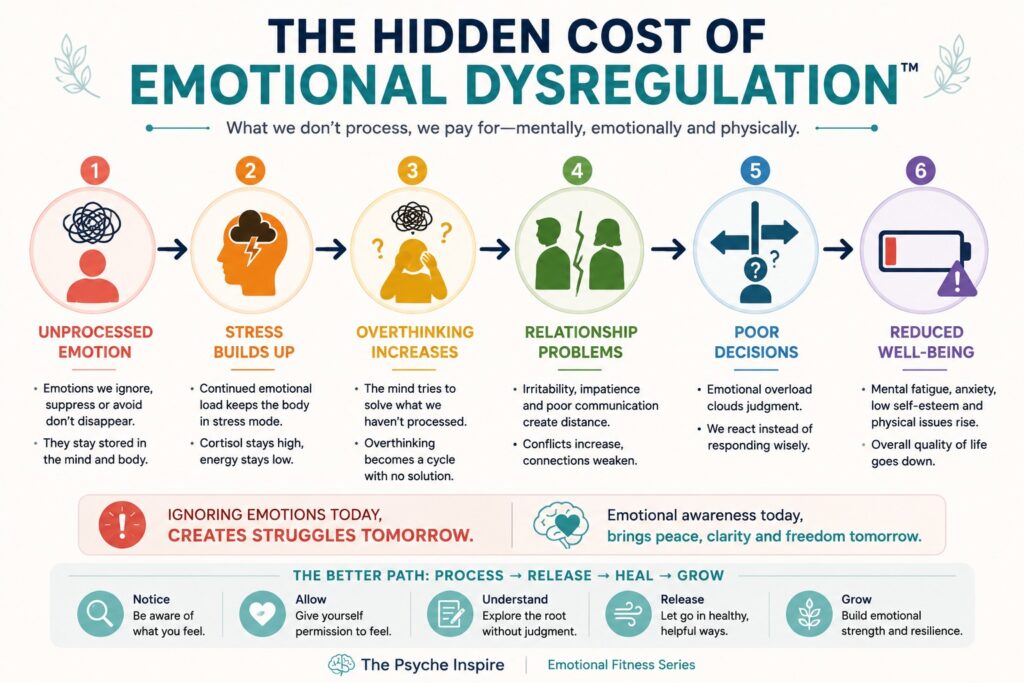
Imagine carrying a backpack.
At first, it feels light.
One disappointment is placed inside.
Then an unresolved argument.
A stressful week at work.
A few moments of self-doubt.
Some unspoken resentment.
An embarrassing memory you never processed.
None of these experiences seem overwhelming on their own.
But together, they become a weight you carry everywhere.
Many people adapt to this emotional load so gradually that they stop noticing it’s there.
They assume constant tension is simply part of adult life.
It doesn’t have to be.
How Emotional Dysregulation Affects Your Relationships
Think about the last disagreement you had with someone close to you.
Was the conflict really about the dishes?
The late reply?
The forgotten promise?
Or was something deeper happening beneath the surface?
Psychology suggests that arguments are often less about the event itself and more about the emotions attached to it.
A delayed text may awaken fears of being ignored.
Constructive feedback may touch old feelings of inadequacy.
A simple misunderstanding may trigger memories of past rejection.
When emotions remain unrecognized, we often react to the past while believing we’re responding to the present.
This is why two people can experience the same situation very differently.
Healthy emotional regulation doesn’t eliminate conflict.
It helps us respond to today’s reality instead of yesterday’s emotional wounds.
The Conversation That Never Happened
Sometimes poor emotional regulation doesn’t look like anger.
Sometimes it looks like silence.
How many meaningful conversations have never happened because someone feared the following:
- “They’ll think I’m weak.”
- “I’ll make things worse.”
- “It’s better if I keep this to myself.”
Avoiding emotions can feel safer in the moment.
But what remains unspoken often grows louder inside us.
Relationships rarely struggle because people have emotions.
They struggle because emotions remain misunderstood, hidden, or expressed in ways that create distance instead of connection.
When Your Body Carries What Your Mind Can’t Process
Have you ever noticed that emotional stress doesn’t stay in your thoughts?
It often shows up in your body.
You may experience:
- Difficulty sleeping.
- Persistent fatigue.
- Muscle tension.
- Frequent headaches.
- Digestive discomfort.
- Restlessness.
- Difficulty concentrating.
This doesn’t mean every physical symptom is caused by emotions.
But psychology and health research consistently show that prolonged emotional stress can influence both mental and physical well-being.
Your mind and body are not separate systems.
They are constantly communicating with one another.
When emotional strain continues without healthy regulation, the body often becomes the messenger.
The Workplace Cost No One Talks About
Many people believe professional success depends mainly on technical knowledge.
While expertise certainly matters, emotional regulation often determines how consistently that expertise can be applied.
Think about workplace situations like the following:
- Receiving unexpected criticism.
- Managing tight deadlines.
- Leading a difficult conversation.
- Working with conflicting personalities.
- Adapting to organisational change.
In these moments, emotional regulation becomes a professional skill.
People who regulate emotions effectively are often better able to:
- Think clearly under pressure.
- Make balanced decisions.
- Communicate respectfully during disagreements.
- Recover from setbacks.
- Build trust within teams.
It’s not because they experience less stress.
It’s because stress doesn’t completely take over their decision-making.
The Cost to Your Sense of Self
Perhaps the greatest hidden cost is the story we begin telling ourselves.
After enough emotional reactions, many people quietly conclude:
“I’m too sensitive.”
“I always overreact.”
“I’ll never change.”
“I’m just an anxious person.”
“I’m bad at relationships.”
These aren’t facts.
They’re conclusions drawn from repeated emotional experiences.
The danger is that we begin confusing our behaviours with our identity.
But emotional regulation teaches a profoundly hopeful lesson:
You are not your emotional reactions.
You are the person who can learn from them.
That distinction changes everything.
Emotional Regulation Doesn’t Make Life Easier—It Makes You Stronger
Difficult emotions don’t disappear.
Life still brings disappointment, uncertainty, grief, frustration, and change.
The difference is that these experiences no longer control every decision you make.
You begin responding with greater intention.
Recovering more quickly.
Listening more deeply.
Speaking more thoughtfully.
And gradually, you notice something remarkable.
The situations that once overwhelmed you now become opportunities to practice a skill you’ve been quietly strengthening all along.
This isn’t emotional perfection.
It’s emotional growth.
And growth is always possible.
A Moment of Reflection

Before reading further, pause and ask yourself:

•	Which emotion do I find hardest to sit with?
•	When I'm overwhelmed, do I tend to avoid, suppress, or react?
•	How has that pattern affected my relationships, work, or well-being?
•	If I learned to regulate that one emotion more effectively, what might become possible in my life?

Sometimes, meaningful change begins not with a dramatic breakthrough but with one honest answer.
If Emotional Regulation Is a Skill, Can It Actually Be Learned?
By now, you may be thinking:
“I understand why my emotions work this way—but how do I change it?”
That’s the most important question in this entire guide.
Because awareness alone doesn’t transform our lives.
Practice does.
The encouraging news is that psychologists have spent decades studying strategies that genuinely improve emotional regulation. They don’t require becoming emotionless or endlessly positive. Instead, they help you work with your emotions rather than against them.
Science-Backed Emotional Regulation Techniques That Actually Work
Practical Skills You Can Start Using Today
Imagine learning to swim.
You could spend months reading books about water, watching videos, and understanding the science of buoyancy.
But until you step into the pool, nothing truly changes.
Emotional regulation works in much the same way.
Understanding your emotions is the beginning.
Practicing new responses is what creates lasting change.
The encouraging news is that emotional regulation isn’t built through dramatic life transformations.
It’s built through small, repeatable moments of awareness that gradually reshape how your brain and nervous system respond to stress.
Let’s explore some of the most effective techniques supported by psychological research.
1. Pause Before You Proceed
The Skill
When emotions rise, resist the urge to respond immediately.
Instead, pause.
Sometimes for one deep breath.
Sometimes for ten seconds.
Sometimes for ten minutes.
Sometimes, if the situation allows, until the next day.
That pause creates space for your thinking brain to re-engage.
Why It Works
Strong emotions narrow our attention and increase impulsive reactions.
Even a brief pause allows your nervous system to begin settling, making thoughtful decisions more likely.
Try This
The next time someone says something upsetting, silently ask yourself:
“Do I want to react, or do I want to respond?”
That single question often changes the direction of the conversation.
2. Name the Emotion You’re Feeling
Our emotions become easier to manage when we can describe them accurately.
Instead of saying,
“I’m stressed.”
Ask yourself:
- Am I disappointed?
- Am I embarrassed?
- Am I overwhelmed?
- Am I anxious?
- Am I feeling rejected?
- Am I frustrated because my expectations weren’t met?
Naming an emotion doesn’t make it disappear.
It makes it easier to understand.
Think of it as turning on a light in a dark room.
The room hasn’t changed.
But now you can see where you’re standing.
3. Breathe Like You’re Sending Your Brain a Safety Signal
When we’re anxious, our breathing often becomes fast and shallow.
Your brain interprets this as a sign that danger may still be present.
Slow, steady breathing communicates something different.
It tells your nervous system:
“Right now, I’m safe enough to slow down.”
A simple technique is:
- Inhale gently for four seconds.
- Exhale slowly for six seconds.
- Repeat for one to three minutes.
Notice that the exhale is slightly longer than the inhale.
This encourages the body to shift toward a calmer physiological state.
The goal isn’t perfect breathing.
It’s creating enough calm for clearer thinking.
4. Ask Better Questions
When emotions take over, our minds often ask questions like:
- Why does this always happen to me?
- What’s wrong with me?
- Why can’t I handle anything?
These questions rarely lead to helpful answers.
Instead, try replacing them with questions that invite understanding.
For example:
Instead of:
“Why am I like this?”
Ask:
“What might this emotion be trying to protect?”
Instead of:
“Why can’t I stop worrying?”
Ask:
“What uncertainty am I struggling to accept?”
Curious questions calm the mind far more effectively than critical ones.
5. Regulate Your Body Before Solving the Problem
One of the biggest mistakes we make is trying to think our way out of an overwhelmed nervous system.
Imagine trying to solve a difficult puzzle while someone is continuously sounding a loud alarm beside you.
That’s what happens when your body remains in a heightened state of stress.
Before analysing the situation, try calming your body first.
You might:
- Take a slow walk.
- Stretch for a few minutes.
- Wash your face with cool water.
- Step outside for fresh air.
- Drink a glass of water slowly.
- Notice five things you can see around you.
These aren’t distractions.
There are ways of helping your body recognise that immediate danger has passed.
Only then does your thinking brain have the best chance to solve the problem effectively.
6. Make Space for Every Emotion
Many of us divide emotions into two categories:
Good emotions.
Bad emotions.
But psychology suggests a healthier perspective.
Emotions are not good or bad.
They are helpful or unhelpful depending on how we respond to them.
Instead of saying,
“I shouldn’t feel angry.”
Try saying,
“I’m noticing anger right now.”
That small change creates psychological distance.
You are no longer becoming the emotion.
You are observing it. This practice helps reduce emotional overwhelm while increasing self-awareness.
7. Build Daily Emotional Fitness, Not Occasional Emotional Rescue
Many people only work on emotional regulation after life becomes overwhelming.
It’s like exercising only after becoming seriously unfit.
Emotional fitness grows through daily habits.
Simple practices include:
- Five minutes of mindful breathing.
- Writing about one meaningful emotion each evening.
- Taking short pauses between stressful tasks.
- Checking in with yourself three times each day.
- Ending the day by asking:
“What emotion shaped my decisions today?”
These small habits strengthen your emotional resilience long before major challenges appear.
What to Do During an Emotional Storm
Despite your best efforts, there will still be moments when emotions feel overwhelming.
That’s part of being human.
During those moments, remember this simple sequence:
Stop.
Not because your emotions are wrong.
Because your reaction doesn’t have to be immediate.
Breathe.
Allow your body to recognise safety.
Notice.
Name what you’re feeling.
Choose.
Ask yourself:
“What response will my future self be proud of?”
Sometimes emotional regulation isn’t about finding the perfect answer.
It’s about preventing the worst reaction.
And that alone can change the outcome of an entire day.
A Gentle Truth About Progress
There will be days when you forget every technique in this guide.
You’ll lose patience.
You’ll say something you wish you hadn’t.
You’ll overthink.
You’ll react impulsively.
That doesn’t mean you’ve failed.
It means you’re practicing.
Emotional regulation isn’t measured by never making mistakes.
It’s measured by how quickly you recognise them, learn from them, and begin again.
Growth is rarely dramatic.
More often, it looks like choosing a slightly wiser response than you chose yesterday.
Key Takeaways

•	Emotional regulation improves through consistent practice, not perfection.
•	Small pauses create opportunities for wiser decisions.
•	Naming emotions increases self-awareness and reduces emotional intensity.
•	Calming the body often comes before calming the mind.
•	Curiosity is more effective than self-criticism.
•	Daily emotional habits build long-term resilience.
Introducing The R.E.S.P.O.N.D. Method™
A Practical Framework for Everyday Emotional Regulation
To make these techniques easy to remember, I’ve created a simple framework you can return to whenever emotions feel overwhelming.
R – Recognize
Notice the emotion before it grows stronger.
“What am I feeling right now?”
E – Exhale
Slow your breathing.
Signal safety to your nervous system.
S – Slow Down
Delay immediate reactions.
Create space between emotion and action.
P – Put a Name to It
Identify the specific emotion.
Clarity reduces confusion.
O – Observe Without Judgment
Instead of saying,
“I shouldn’t feel this.”
Try,
“I’m noticing this feeling.”
N – Navigate With Your Values
Ask:
“What kind of person do I want to be in this moment?”
D – Decide Intentionally
Choose the response that serves your long-term well-being rather than your short-term impulse.
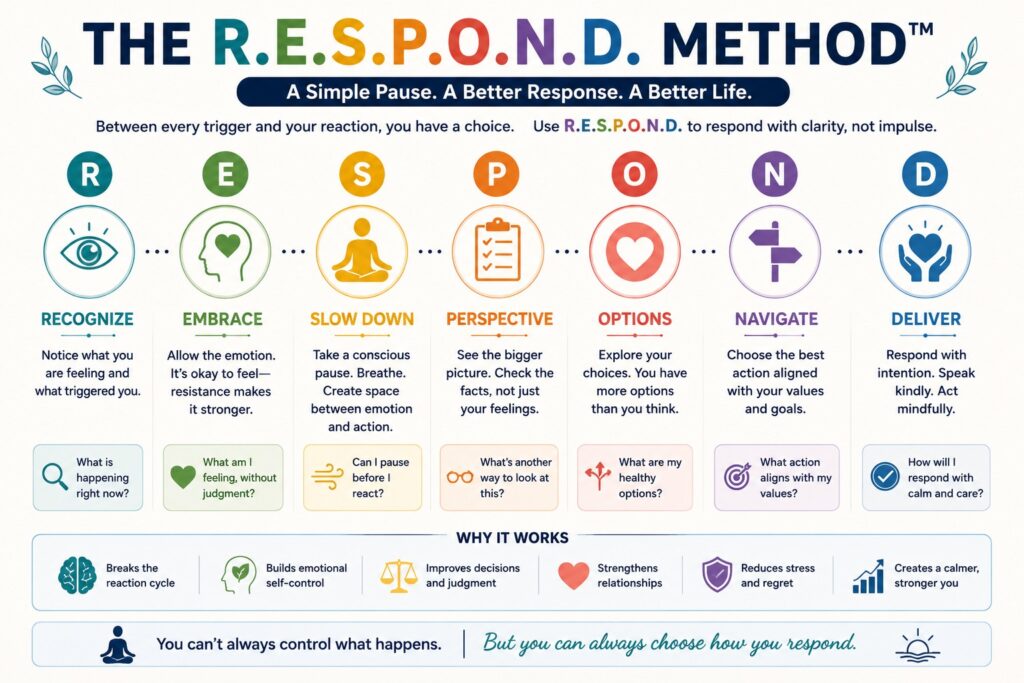
Think of the R.E.S.P.O.N.D. Method™ as a mental compass you can carry into difficult conversations, stressful situations, and emotionally charged moments. With repetition, these steps become less of a checklist and more of a habit.
What If Emotional Regulation Could Become a Daily Way of Living?
Reading about emotional regulation is valuable.
Practicing it is transformative.
But lasting emotional fitness doesn’t come from isolated techniques.
It comes from a consistent way of approaching your emotions every single day.
So how do we turn these ideas into a sustainable life skill?
The Emotional Fitness Cycle™
A Practical Framework for Building Lifelong Emotional Resilience
Imagine learning to ride a bicycle.
At first, every movement requires conscious effort.
You think about balance.
You focus on steering.
You worry about falling.
But with practice, something remarkable happens.
The skills that once felt difficult become natural.
You stop thinking about every movement because your brain has learned a new pattern.
Emotional regulation develops in much the same way.
At first, remembering to pause before reacting feels difficult.
Naming emotions feels unfamiliar.
Choosing a thoughtful response requires effort.
But every time you practice these skills, you strengthen the pathways that make them easier next time.
Eventually, emotional regulation becomes less about trying harder and more about living differently.
This is the foundation of The Emotional Fitness Cycle™.
Why Emotional Fitness Is Like Physical Fitness
No one becomes physically fit after a single workout.
Likewise, no one becomes emotionally resilient after reading one article or practicing one breathing exercise.
Physical fitness grows through repeated movement.
Emotional fitness grows through repeated awareness.
Every difficult conversation…
Every unexpected disappointment…
Every stressful day…
Every moment of frustration…
These aren’t interruptions to your emotional growth.
They are your emotional training.
Life isn’t testing your emotional fitness.
Life is helping you build it.
That simple shift changes how we see challenges.
The Emotional Fitness Cycle™
At the heart of emotional resilience is a simple but powerful cycle.
Instead of reacting automatically, emotionally healthy people move through six intentional stages.
1. Notice
Everything begins with awareness.
Before we can regulate an emotion, we must first recognise that it’s present.
Ask yourself:
- What am I feeling?
- Where do I notice it in my body?
- What just happened?
Awareness interrupts autopilot.
Without awareness, there is no choice.
2. Understand
Every emotion carries information.
Instead of asking,
“How do I stop feeling this?”
Ask,
“What might this emotion be trying to tell me?”
Perhaps:
Fear is asking for preparation.
Anger is pointing toward a boundary.
Sadness is inviting reflection.
Disappointment is revealing an unmet expectation.
Understanding doesn’t justify every emotion.
It helps us learn from it.
3. Accept
This may be the most misunderstood step.
Acceptance does not mean approval.
It means acknowledging reality without fighting it.
Instead of saying,
“I shouldn’t feel anxious.”
Try saying,
“Anxiety is present right now, and I can still choose how I respond.”
When we stop fighting emotions, we free our energy to work with them.
4. Regulate
Now we apply the skills we’ve learned.
Perhaps we:
Slow our breathing.
Take a short walk.
Name the emotion.
Pause before replying.
Ground ourselves in the present.
Ask a more helpful question.
Regulation isn’t about making emotions disappear.
It’s about reducing their influence over our decisions.
5. Respond
This is where emotional fitness becomes visible.
Anyone can react.
Responding requires intention.
Before acting, ask:
“Will this response solve the problem—or simply express the emotion?”
Sometimes the wisest response is speaking.
Sometimes it’s listening.
Sometimes it’s waiting.
Sometimes it’s walking away until you can return with greater clarity.
Responding wisely doesn’t always feel satisfying in the moment.
But it often leads to outcomes you’ll be grateful for later.
6. Reflect
Growth happens after the moment has passed.
Ask yourself:
- What triggered me?
- What helped?
- What would I like to do differently next time?
- What did I learn about myself today?
Reflection transforms experience into wisdom.
Without reflection, we repeat experiences.
With reflection, we learn from them.
And then the cycle begins again.
Each repetition strengthens emotional fitness a little more.
Why This Cycle Works
Many people believe emotional growth happens through major life events.
In reality, it often develops through hundreds of ordinary moments.
Choosing not to send the angry message immediately.
Taking one slow breath before answering.
Admitting,
“I feel hurt.”
Listening instead of interrupting.
Asking a curious question instead of making an accusation.
These moments may seem insignificant.
Together, they gradually reshape how we think, relate, and respond.
Emotional fitness isn’t built through extraordinary days.
It’s built through ordinary days lived with greater awareness.
The Ripple Effect
One improved emotional response rarely stays confined to a single moment.
It creates ripple effects.
You become calmer.
Your conversations improve.
People begin trusting you more.
Conflicts become shorter.
Recovery becomes faster.
Your confidence grows—not because life has become easier, but because you’ve become more capable of navigating it.
This is one of psychology’s quiet truths:
Changing the way you respond to emotions can change the direction of your relationships, your career, your health, and your inner life.
The Emotional Fitness Promise™
Here is the promise I hope every reader carries from this guide:
You will still experience anger.
But anger no longer has to decide your words.
You will still feel fear.
But fear no longer has to decide your future.
You will still experience sadness.
But sadness no longer has to define your identity.
You will still encounter uncertainty.
But uncertainty no longer has to steal your peace.
Emotional fitness isn’t the absence of emotion.
It’s the presence of wisdom in the middle of emotion.
And that is a skill every human being can continue developing for the rest of their life.
Your Emotional Fitness Begins Today
You don’t need to remember every technique in this article.
You don’t need to master every step perfectly.
Start with one question.
Every time a strong emotion appears, simply ask:
“What would my emotionally healthiest self choose in this moment?”
That single question has the power to interrupt years of automatic reactions.
Small questions create new habits.
New habits create new identities.
And new identities quietly create new lives.
Key Takeaways

•	Emotional fitness is built through repeated practice rather than isolated breakthroughs.
•	The Emotional Fitness Cycle™ transforms emotional reactions into intentional responses.
•	Every difficult emotion is an opportunity to strengthen emotional resilience.
•	Reflection completes the learning process and prepares you for future challenges.
•	Emotional fitness is a lifelong journey of awareness, understanding, and growth.
What Would Happen If You Practised This Every Day for 30 Days?
Knowledge is inspiring.
Practice is life-changing.
Imagine waking up each morning with a simple daily exercise that gradually strengthens your emotional resilience—one small habit at a time.
No complicated routines.
No unrealistic expectations.
Just a practical way to build emotional fitness into your everyday life.
The 30-Day Emotional Fitness Challenge
Small Daily Practices That Can Change the Way You Experience Your Emotions
If you’ve read this far, you’ve already taken an important first step.
You now understand that emotional regulation isn’t about suppressing feelings or pretending to be positive all the time.
It’s about developing the ability to respond to emotions with greater awareness, wisdom, and intention.
But understanding alone doesn’t create transformation.
Practice does.
Think about learning a musical instrument.
Reading about the piano won’t teach your fingers to play.
Likewise, emotional fitness grows through repeated experiences—not repeated reading.
The good news?
You don’t need hours of practice each day.
Research on habit formation consistently suggests that small, consistent actions are far more sustainable than dramatic changes that quickly fade.
That’s why this challenge focuses on simple practices that fit into everyday life.
The goal isn’t perfection.
The goal is progress.
Before You Begin
Make one simple promise to yourself:
“For the next 30 days, I won’t try to eliminate my emotions. I’ll simply become more curious about them.”
That shift alone changes the purpose of this challenge.
You’re no longer fighting yourself.
You’re learning from yourself.
Week 1: Build Awareness
Theme: Notice Before You React
During the first week, your only responsibility is to notice your emotional experiences.
Don’t try to change them.
Simply become aware of them.
Daily Practice
Three times each day, pause for one minute and ask yourself:
- What emotion am I feeling right now?
- Where do I notice it in my body?
- What might have triggered it?
That’s all.
No judgement.
No fixing.
Just noticing.
Why This Matters
Awareness is the foundation of every emotionally intelligent decision.
You cannot regulate an emotion you haven’t recognized. Remember: Awareness always comes before change.
Week 2: Create Space
Theme: Slow Down Your Reactions
This week is about strengthening the pause between emotion and action.
Every time you experience a strong emotion, practice delaying your first response.
Before replying to a difficult message…
Before raising your voice…
Before making an impulsive decision…
Pause.
Take three slow breaths.
Ask yourself:
“What outcome do I really want from this moment?”
Sometimes, those few seconds become the difference between regret and wisdom.
Week 3: Respond with Intention
Theme: Let Your Values Lead
Now begin asking a different question.
Instead of:
“What do I feel like doing?”
Ask:
“What kind of person do I want to be in this moment?”
Perhaps you value:
- Kindness.
- Honesty.
- Courage.
- Patience.
- Respect.
- Compassion.
Use those values as your compass.
Your emotions provide information. Your values provide direction.
Week 4: Reflect and Grow
Theme: Turn Experience into Wisdom
Each evening, spend five quiet minutes reflecting on your day.
Ask yourself:
What emotion visited me most often today?
When did I regulate my emotions well?
When did I react impulsively?
What helped me stay emotionally balanced?
What would I like to practise tomorrow?
Notice the wording.
Not:
“What did I do wrong?”
Instead:
“What can I learn?”
That’s how emotional fitness develops.
The Emotional Fitness Journal
If possible, keep a simple notebook during these 30 days.
Each evening, write just three short sentences:
Today I felt…
Today I learned…
Tomorrow I will practice…
That’s enough.
You aren’t writing a diary.
You’re training your emotional awareness.
Over time, you’ll begin noticing patterns that were once invisible.
You may discover that certain situations, environments, or even lack of sleep consistently influence your emotions.
Awareness turns patterns into opportunities for growth.
Expect Progress—Not Perfection
Some days will feel easy.
Others won’t.
There will be moments when you forget to pause.
You’ll still become frustrated.
You’ll still overthink.
You’ll still react emotionally.
That doesn’t mean the challenge isn’t working.
In fact, those moments often become your greatest teachers.
Every emotionally resilient person has difficult days.
The difference is that they recover more quickly and treat mistakes as opportunities to learn rather than proof that they’ve failed.
Remember: Consistency matters far more than perfection.
A Letter to Your Future Self
Imagine yourself one month from today.
Not completely transformed.
Not suddenly free from every difficult emotion.
Just… a little different.
Perhaps you pause before speaking.
Perhaps you recognise anxiety earlier.
Perhaps you recover more quickly after disappointment.
Perhaps your relationships feel a little calmer.
Perhaps you’re kinder to yourself.
Small improvements may seem insignificant.
But over months and years, they become profound.
Just as a single drop of water rarely changes a stone, repeated drops eventually reshape it. Your emotional habits work the same way.
Your Challenge Starts with One Decision
You don’t need to wait until Monday.
Or next month.
Or the beginning of a new year.
Your emotional fitness begins the next time you notice an emotion and choose curiosity instead of criticism.
That’s all.
One moment.
One pause.
One wiser response.
Then another.
And another.
Eventually, those moments become the person you’re becoming.
Emotional Fitness Challenge Checklist
Use this simple checklist each day:
☐ I noticed my emotions without judging them.
☐ I paused before reacting.
☐ I named at least one emotion accurately.
☐ I took a moment to calm my body.
☐ I responded according to my values.
☐ I reflected on one lesson from today.
If you complete even four of these consistently, you’re strengthening emotional habits that can benefit you for years to come.
Key Takeaways

•	Emotional fitness is developed through daily practice, not occasional breakthroughs.
•	Small, consistent habits often create the greatest long-term change.
•	Self-reflection transforms experience into emotional wisdom.
•	Values provide direction when emotions feel overwhelming.
•	Every day offers another opportunity to strengthen emotional resilience.
Your Emotional Fitness Journey Doesn’t End Here
If you’ve completed this challenge, you’ve already taken meaningful steps toward understanding and responding to your emotions more effectively.
But emotional fitness is a lifelong practice, not a 30-day destination.
Some emotions—such as grief, shame, chronic anxiety, or persistent emotional overwhelm—may require additional support, deeper reflection, or guidance from a qualified mental health professional.
Knowing when to seek help is not a sign of weakness.
It is one of the strongest expressions of emotional wisdom.
Emotional Fitness Is Not About Feeling Less.
It’s About Living More Fully.
If there’s one idea I hope stays with you long after you’ve finished reading this guide, it’s this:
Your emotions are not the enemy.
They never were.
Fear tries to protect you.
Anger points toward what matters to you.
Sadness reminds you of what you’ve loved.
Joy invites you to stay present.
Even uncertainty has something to teach, encouraging humility, curiosity, and growth.
The challenge isn’t that we have emotions.
The challenge is that many of us were never taught how to understand them.
For years, we may have believed that being emotionally strong meant hiding our feelings, staying positive no matter what, or never letting others see us struggle.
But real emotional strength looks very different.
Sometimes it looks like pausing before speaking.
Sometimes it looks like admitting,
“I’m hurt.”
Sometimes it means asking for help.
Sometimes it means choosing compassion when anger feels easier.
Sometimes it means sitting quietly with an uncomfortable emotion instead of rushing to escape it.
These moments may appear small.
Yet they quietly shape the quality of our relationships, our decisions, our work, and the stories we tell ourselves.
Over time, they shape the person we become.
You Don’t Need to Become a Different Person
One of the greatest misconceptions about personal growth is the belief that we must completely reinvent ourselves.
In reality, meaningful change often begins much more gently.
You don’t need to become fearless.
You don’t need to stop feeling anxious.
You don’t need to eliminate sadness or frustration from your life.
You simply need to become a little more aware than you were yesterday.
A little more patient.
A little more curious.
A little more intentional.
Small changes, repeated consistently, create extraordinary transformations over time.
Just as physical fitness develops through repeated movement, emotional fitness develops through repeated moments of awareness, understanding, and wise action.
A Personal Invitation
The next time a difficult emotion appears, resist the urge to ask,
“How do I make this feeling disappear?”
Instead, ask,
“What can this feeling teach me?”
That single question has the power to change your relationship with your emotions forever.
Because growth rarely begins with having all the answers.
It begins with asking better questions.
Frequently Asked Questions
1. What is emotional regulation?
Emotional regulation is the ability to recognize, understand, and manage emotions in ways that support healthy decisions and relationships. It doesn’t mean suppressing emotions—it means responding to them with awareness and intention.
2. Is emotional regulation the same as emotional suppression?
No.
Emotional suppression involves pushing emotions away or pretending they don’t exist.
Emotional regulation involves acknowledging emotions, understanding them, and choosing a constructive response.
3. Can emotional regulation be learned?
Yes.
Research in psychology and neuroscience shows that emotional regulation improves through repeated practice. Thanks to the brain’s ability to adapt throughout life, people of all ages can strengthen these skills over time.
4. Why do I react emotionally before I can think?
Your brain is designed to detect potential threats quickly.
This automatic response helps protect you but can also be activated by modern emotional challenges such as criticism, uncertainty, or conflict.
Learning emotional regulation creates more space between the emotional trigger and your response.
5. How long does it take to improve emotional regulation?
There is no fixed timeline.
Many people notice greater awareness within a few weeks of consistent practice, while deeper changes often develop over months through repeated real-life experiences.
The goal isn’t speed.
It’s steady progress.
6. Does emotional regulation improve mental health?
Healthy emotional regulation is associated with greater resilience, healthier relationships, improved stress management, and overall psychological well-being.
However, emotional regulation is not a substitute for professional mental health care when someone is experiencing significant or persistent psychological distress.
7. When should I seek professional help?
Consider speaking with a qualified mental health professional if emotions are consistently interfering with your daily life, relationships, work, sleep, or safety.
Seeking support is a sign of wisdom—not weakness.
Professional guidance can provide personalized strategies that complement the emotional fitness skills discussed in this article.
Final Thought
At The Psyche Inspire, we believe that psychology isn’t just something to understand.
It’s something to practise.
Every conversation.
Every challenge.
Every relationship.
Every difficult emotion.
Each one offers another opportunity to become a little more emotionally fit than you were yesterday.
And perhaps that’s the most hopeful truth of all.
You don’t have to control every emotion to change your life.
You only need to learn how to walk alongside your emotions with awareness, courage, and compassion.
One moment at a time.
One choice at a time.
One day at a time.
3 thoughts on “Emotional Regulation: The Life Skill That Changes Everything”