

Have you ever started something with genuine excitement, only to lose interest a few days or weeks later? Perhaps you began learning a new language, joined a fitness programme, bought books you were eager to read, or started an online course. At first, you felt motivated. Then, gradually, the excitement faded, and continuing began to feel like a chore.
If this happens repeatedly, you may wonder, “Why do I lose interest in things so quickly? Am I lazy, inconsistent, or simply unable to commit?”
Table of Contents
Not necessarily. Losing interest does not always mean you lack discipline or that something is wrong with your personality. Your interest can change because of novelty, expectations, motivation, the way you experience progress, or the demands of everyday life.
Understanding what happens when your interest fades can help you decide whether to continue, change your approach, or move on without blaming yourself.
Why Do I Lose Interest in Things So Quickly?
One reason this experience can feel confusing is that your initial excitement may be completely genuine. You might truly want to learn guitar, improve your fitness, develop a new skill, or pursue a personal goal. Yet wanting something at the beginning does not guarantee that you will enjoy every stage of the process.
Interest is not a fixed resource that remains equally strong every day. It can rise and fall as an activity becomes familiar, your expectations change, or your circumstances demand more of your attention. What feels exciting today may require patience and effort tomorrow.
The important question is not simply why your interest disappears. It is also what changes between the moment you begin and the moment you want to stop.
Why Do New Things Feel So Exciting at First?
New activities offer possibilities. You imagine what you might learn, how you might improve, and how satisfying the experience could become. Before beginning, you can focus on the exciting possibilities without yet facing the repetitive practice or difficulties involved.
Psychological research distinguishes between wanting a reward and enjoying the experience itself. These processes are related, but they are not identical. The anticipation of doing something can be stronger than the pleasure you experience while actually doing it.
For example, imagining yourself speaking a new language confidently may feel exciting. Practising unfamiliar words every day can feel much less rewarding. The goal has not necessarily become unimportant; you have moved from imagining the outcome to experiencing the work required to reach it.
Why Does the Excitement Fade After a While?
Repeated experiences often become less stimulating as they become familiar. Researchers call one related process hedonic decline: the enjoyment people experience from a repeated stimulus can decrease with continued exposure.
Galak and Redden reviewed research on this process in the Annual Review of Psychology in 2018. Their work explores how repetition, changing perceptions and self-reflection can influence enjoyment. This helps explain why the same activity may feel less exciting after you have done it many times.
However, fading excitement does not automatically mean that an activity has lost its value. Reading, exercise, learning and creative work can remain meaningful even when they no longer provide the same initial thrill.
Why Do I Lose Interest Even in Things I Genuinely Wanted to Do?
Sometimes, the problem is not the activity itself but the way you experience it. You may have wanted to learn a skill for personal satisfaction, but gradually begin judging every session by how quickly you improve. What began as curiosity can become another source of pressure.

Self-Determination Theory, discussed by psychologists Richard Ryan and Edward Deci, offers a useful way to understand motivation. It highlights the importance of autonomy, competence and relatedness. In simple terms, people tend to be more motivated when they feel some ownership over what they do, experience opportunities to develop, and feel connected or supported.
When an activity becomes entirely about meeting expectations, avoiding criticism or proving your worth, it may feel less personally rewarding. You might still care about the outcome while struggling to enjoy the process.
This does not mean that every activity must be enjoyable at every moment. It means that understanding your reasons for continuing can help you build a more sustainable relationship with your goals.
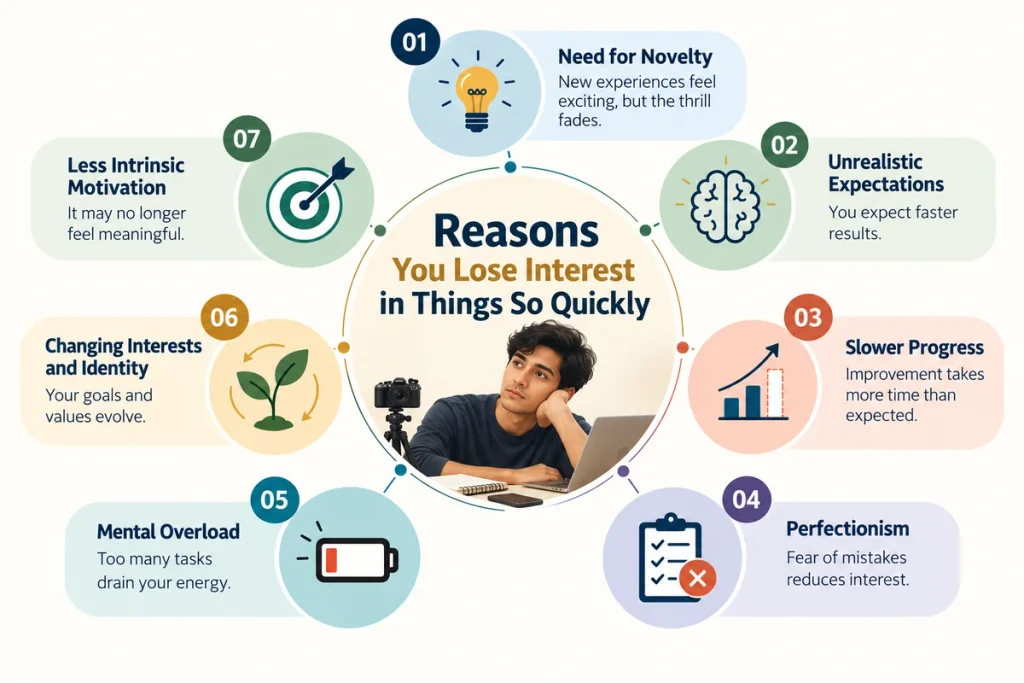
7 Reasons You May Lose Interest in Things So Quickly
There is rarely one explanation that applies to everyone. The pattern may involve your expectations, the kind of challenge you enjoy, your current priorities, or the amount of energy available to you. The following possibilities can help you identify what may be happening in your own experience.
1. You Enjoy the Anticipation More Than the Process
Before starting something new, you can imagine the best possible outcome. You picture yourself becoming skilled, confident or successful. That imagined future can be motivating, even though you have not yet experienced the everyday work involved.
Once you begin, the reality may feel less exciting. Progress may be slow, practice may become repetitive, and the outcome may require more patience than expected. You may then find yourself searching for another activity that brings back the feeling of a fresh start.
Try noticing whether you enjoy imagining what an activity could become more than you enjoy participating in it. This distinction can help you recognise when you need a more realistic plan rather than a completely new interest.
2. Familiarity Makes the Activity Feel Less Interesting
Novelty naturally attracts attention. A new hobby, course or routine gives you something unfamiliar to explore. As you become accustomed to it, the experience may offer fewer surprises.
For example, a new exercise routine might feel exciting during the first week. After several weeks, repeating the same movements may feel ordinary. This does not necessarily mean that exercise has stopped benefiting you or that you chose the wrong routine.
Instead of abandoning the activity immediately, consider whether you need a new challenge, a different approach or a clearer sense of progress. Sometimes, a small adjustment can restore engagement without requiring you to start from scratch.
3. Your Expectations Are Higher Than the Reality
It is easy to underestimate the difficult or repetitive parts of an activity when you first imagine doing it. You may expect learning to be enjoyable, progress to be steady, or motivation to remain strong. When reality does not match those expectations, disappointment can follow.
Suppose you begin writing because you enjoy expressing your ideas. After a few attempts, you compare your work with experienced writers and feel dissatisfied. The activity that once offered curiosity now seems like a test of your ability.
Try separating the activity from the outcome you expect from it. You can enjoy learning without being immediately good at something. Allowing yourself to be a beginner may make it easier to stay engaged long enough to develop your skills.
4. You Lose Interest When Progress Slows Down
Early progress can be encouraging because small improvements are often easy to notice. Later, development may become less visible. You might practise regularly without feeling that you are improving as quickly as you would like.
This stage can be frustrating, especially if you interpret slower progress as evidence that you are not capable. You may begin to doubt the activity or assume that your interest was never genuine.
Instead, look for signs of progress beyond immediate results. You may be making fewer mistakes, understanding something more clearly, or finding a task easier than before. Progress is not always dramatic, and a slower stage does not automatically mean you should stop.
5. The Activity No Longer Fits Your Values or Priorities
Interests change as your circumstances change. Something that suited you a year ago may no longer fit your current responsibilities, available time or personal goals. That change is not necessarily a failure of commitment.
For example, you may once have enjoyed spending hours on a hobby but now have family responsibilities, work demands or a different long-term priority. The hobby may still matter to you, yet you may no longer want to give it the same amount of time.
Ask yourself whether the activity still has a meaningful place in your life. You may want to continue it less frequently, adapt it to your current circumstances, or let it go. Changing priorities can be a reasonable response to changing needs.
6. Pressure and Obligation Replace Personal Interest
An activity can feel different when you turn it into a demand. A hobby you once enjoyed may become another item on a long list of things you believe you must accomplish. You may start judging yourself whenever you miss a session or fail to meet a target.
Over time, the pressure to perform can overshadow the original reason you started. Instead of asking whether the activity is interesting or meaningful, you may focus on whether you are doing enough.
Consider making the activity less rigid. Choose a realistic schedule, leave room for flexibility and reconnect with what originally attracted you to it. Structure can support motivation, but excessive self-criticism may make it harder to continue.
7. Stress, Exhaustion or Emotional Changes Affect Your Interest
Sometimes, losing interest has less to do with the activity and more to do with your current capacity. Work pressure, poor sleep, caregiving responsibilities, prolonged stress or emotional strain can leave you with less energy for activities that once felt rewarding.
You might still value a hobby but struggle to concentrate on it. You may start something with good intentions and find that your attention or energy fades quickly. In these circumstances, pushing yourself harder may not address the underlying problem.
Notice whether your interest has declined only in one activity or across many parts of your life. If you have also been feeling persistently low, disconnected or unable to enjoy things you previously liked, consider seeking professional guidance. Persistent loss of interest can have several causes and deserves attention rather than self-blame.
Why Do I Lose Interest in Hobbies, Goals and Projects?
The pattern can look different depending on what you are trying to do. Recognising the specific difficulty can help you decide whether you need more structure, a different challenge, or permission to change direction.
Why Do Hobbies Stop Feeling Exciting?
Hobbies often begin with curiosity and freedom. You may paint, cook, play a musical instrument or read because you enjoy the experience itself. When you begin measuring the hobby mainly by achievement, productivity or comparison with others, that freedom can gradually disappear.
Social media can add another layer of pressure. Seeing other people produce impressive work may make your own progress feel inadequate, even when you originally chose the hobby simply because you enjoyed it.
Try returning to a simpler question: What do I enjoy about doing this? You do not need to turn every interest into a skill, achievement or source of income. Some activities can remain valuable because they give you pleasure, curiosity or a break from everyday demands.
Why Do I Start Projects but Struggle to Continue?
Starting a project often provides a clear sense of possibility. You can imagine the finished result and feel motivated by the first few steps. Continuing, however, may involve planning, repetition, uncertainty and solving problems that were not obvious at the beginning.
If you expect motivation to carry you through every stage, the project may stall as soon as your enthusiasm dips. This is especially likely when the goal is large and the next step feels vague or difficult to manage.
Try defining the smallest useful next action. Instead of deciding to complete an entire course, commit to one lesson. Instead of aiming to finish a large personal project in one sitting, identify a manageable task you can complete today. Small, specific actions can help you continue even when excitement is limited.
Sometimes, the difficulty is not that you have lost interest but that you keep delaying the next step. You can explore why you procrastinate even when you want to get things done to understand the psychological reasons behind this pattern.
How to Stay Interested in Things Without Forcing Yourself
You do not need to maintain the same level of excitement to make meaningful progress. The aim is to understand what helps you stay engaged and to respond thoughtfully when your interest changes. These strategies can help you do that.
Stop Expecting Constant Excitement
Motivation fluctuates, even when you care about something. Some days, an activity will feel satisfying; on other days, it may feel ordinary or difficult. This variation is part of many long-term pursuits.
Instead of asking, “Am I still excited?”, ask, “Is this still worthwhile to me?” That question allows you to consider both your current feelings and the longer-term value of the activity.
You do not have to ignore your emotions or force yourself to continue indefinitely. You are simply giving yourself more information before making a decision.
Give the Activity Enough Time to Move Beyond Novelty
If you stop every time an activity becomes familiar, you may never discover what it feels like to develop genuine competence. The early stage is often about exploration, while later stages may involve practice and deeper understanding.
Choose a reasonable trial period for activities that matter to you. During that time, focus on showing up consistently rather than deciding every day whether you still feel passionate. Make the commitment realistic enough to fit your schedule and energy.
At the end of the trial, review your experience honestly. You may discover renewed interest, a need to change your approach, or a clear reason to stop. The purpose is not to trap yourself in a commitment but to make a more informed choice.
Break Progress Into Manageable Steps
Large goals can become discouraging when you cannot see how to reach them. A goal such as becoming fluent in a language or writing a book can feel distant, especially when you are unsure what to do next.
Divide the goal into smaller actions that you can complete within a realistic period. For example, practise a few phrases, read a short section or draft one paragraph. These steps make the process easier to approach and give you clearer evidence of your effort.
Small steps do not guarantee that you will remain interested. They can, however, reduce the burden of getting started and help you see progress that might otherwise go unnoticed.
Make Sure the Activity Still Matters to You
Sometimes, we continue pursuing something because we once wanted it, because other people expect it, or because abandoning it feels embarrassing. Yet a past decision does not have to determine every future choice.
Ask yourself what the activity offers you now. Does it support a personal value, teach you something useful, bring you enjoyment or help you work towards a goal you still care about?
If the answer is yes, consider how to make it more sustainable. If the activity no longer fits your priorities, you may be able to release it without treating the decision as a personal failure.
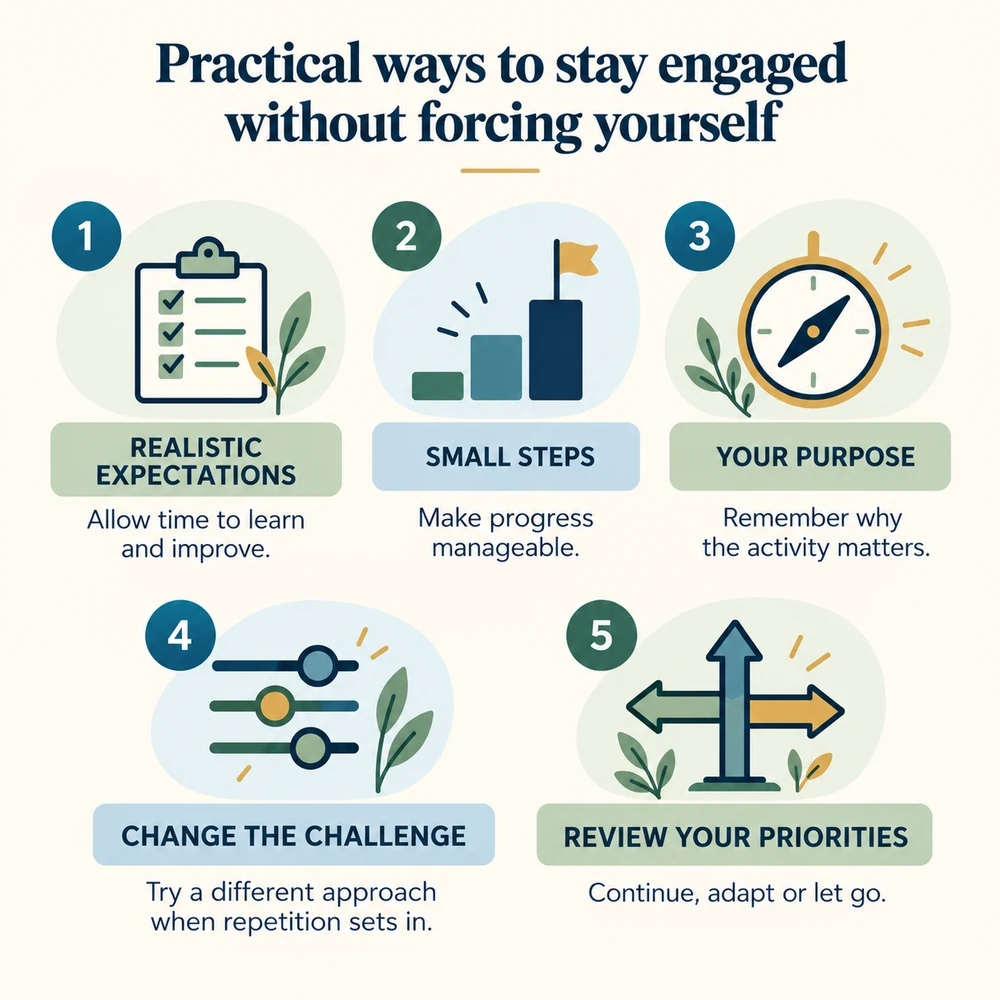
Change the Challenge When the Activity Becomes Repetitive
Familiarity can reduce excitement, but it does not always mean you need to quit. You may simply need a different way to engage with the same activity.
If your usual routine feels stale, try a new technique, set a modest challenge or explore a different aspect of the subject. A person learning to cook, for example, might experiment with a new recipe instead of abandoning cooking altogether.
The change should serve your interest rather than create unnecessary pressure. You are looking for a useful adjustment, not a constant stream of new activities to keep yourself entertained.
Decide Whether to Continue, Adapt or Let Go
When your interest fades, you do not have to choose between forcing yourself to continue and abandoning the activity immediately. There are at least three reasonable options: continue as planned, adapt the activity, or stop.
Continue if the activity remains meaningful and the main difficulty is a temporary dip in enthusiasm. Adapt it if the pace, structure or level of challenge no longer works for you. Let it go if it no longer fits your priorities or if continuing brings little value relative to its cost.
This approach can help you distinguish a temporary struggle from a genuine change in direction. It also allows you to take responsibility for your choices without expecting yourself to finish everything you ever started.
Notice Whether Your Interest Has Changed More Broadly
If you have lost interest in one hobby, you may simply be ready for something different. If you have lost interest in many activities at once, it is worth looking beyond the individual activities.
Consider your sleep, energy, stress levels, concentration and emotional wellbeing. Have you been under unusual pressure? Do you feel tired most of the time? Are you still able to enjoy time with people or activities that usually matter to you?
You do not need to diagnose yourself to take these changes seriously. If the loss of interest is persistent, affects everyday functioning or comes with other distressing changes, consider speaking with a qualified mental health professional.
A Simple Reflection Exercise: What Happens When My Interest Fades?
The next time you notice yourself losing interest, pause before judging yourself. Try answering these four questions honestly. You can write your answers in a journal or simply reflect on them for a few minutes.
What changed after I started?
Did the activity become repetitive, more difficult than expected, or less relevant to my current priorities? Identifying the change can help you understand what you are responding to.
What am I telling myself about this?
Are you thinking, “I am lazy,” “I am not good enough,” or “I should have finished by now”? Notice whether you are describing the situation accurately or turning a temporary difficulty into a judgement about your character.
Does this activity still matter to me?
Consider whether you continue because you value the activity or because you feel guilty about stopping. Your answer may help you distinguish genuine interest from pressure or obligation.
What is the next reasonable step?
You might continue for a short period, make a small adjustment, take a break or decide to let the activity go. Choose a step that fits the situation rather than reacting automatically to the loss of excitement.
The aim of this exercise is not to make every interest last forever. It is to help you respond with curiosity instead of criticism.
Is It Normal to Lose Interest in Things?
Yes, changing interests is a normal part of life. You may become interested in something, explore it, learn from it and eventually move on. Your preferences can change as you gain experience, develop new skills or enter a different stage of life.
The more useful question is whether the change feels specific and understandable or whether it reflects a broader change in your wellbeing. Losing interest in one course or hobby is different from feeling unable to enjoy almost anything that once mattered to you.
There is no universal rule that says you must finish every activity you start. At the same time, repeatedly abandoning meaningful goals may be worth exploring if it causes distress or prevents you from doing things you genuinely want to do.
When Is Losing Interest a Pattern Worth Examining?
Pay attention if you regularly abandon activities that matter to you, especially when the same difficulty appears across different areas of life. You may notice that you enjoy planning more than doing, struggle when progress slows, or lose motivation whenever an activity becomes demanding.
These patterns are not diagnoses, and they do not necessarily mean that you have a psychological problem. They can, however, reveal habits or expectations that you may want to understand better.
For example, if you repeatedly stop because you expect quick results, learning to set realistic goals may help. If you stop because every activity becomes a source of pressure, it may be useful to reconsider how you define success and progress.
When Can Losing Interest Signal a Broader Wellbeing Concern?
A more general loss of interest deserves attention when activities that once felt enjoyable no longer bring much pleasure. This experience can sometimes be associated with anhedonia, a term used to describe a reduced ability to experience pleasure. It can occur in different health contexts and is not, by itself, a diagnosis.
Persistent loss of interest or pleasure can be one symptom of depression, particularly when it occurs alongside changes such as low mood, fatigue, sleep difficulties, concentration problems or feelings of hopelessness. However, these experiences can have different causes, and an article cannot determine what is happening for an individual.
If you have been feeling disconnected from most activities, or these changes are affecting your daily life, consider talking to a qualified mental health professional or doctor. You may also find it helpful to read our related article, Why Do I Feel Emotionally Numb?, if emotional disconnection is part of what you are experiencing.
Frequently Asked Questions
Why do I lose interest in things so quickly?
You may lose interest quickly because the initial excitement of something new fades, the activity becomes repetitive, or the reality differs from your expectations. Stress, limited energy and changing priorities can also affect motivation. Looking at what happens just before your interest fades may help you identify your particular pattern.
Why do I lose interest in things I used to enjoy?
Interests can change as your circumstances, needs and values change. Sometimes, an activity becomes less rewarding because it feels repetitive or pressured. If you have lost interest in many things you previously enjoyed, especially for a sustained period, consider whether your emotional wellbeing or health may also need attention.
Why do I lose interest in hobbies so fast?
A hobby may lose its initial novelty, become more demanding than expected or start to feel like an obligation. You may also be comparing your progress with other people’s achievements. Try changing the challenge, reducing unnecessary pressure or reconnecting with the reason you chose the hobby in the first place.
Why do I start things but never finish them?
Starting often feels exciting because the possibilities are clear, while finishing requires sustained effort and tolerance for slower progress. Large or poorly defined goals can make continuation difficult. Breaking projects into manageable steps and reviewing your expectations may help you understand whether the difficulty is practical, motivational or related to something else.
Why do I lose interest in everything but still feel okay emotionally?
Sometimes, you simply need a break from your usual activities or are ready to explore different interests. However, a broad loss of interest can also be related to stress, exhaustion or changes in mental or physical health. If the change persists, becomes distressing or affects everyday functioning, seek professional advice rather than assuming it is only boredom.
Do people with ADHD lose interest quickly?
Some people with ADHD experience difficulty sustaining attention or motivation for tasks that feel repetitive or offer little immediate reward. However, experiences vary, and losing interest quickly is not enough to establish that someone has ADHD. A diagnosis requires a broader assessment of symptoms, their history and their effects on daily life by a qualified professional.
Do people with borderline personality disorder (BPD) lose interest quickly?
Experiences vary among people with borderline personality disorder. The condition can involve difficulties with emotion regulation, identity and relationships, but rapidly losing interest in hobbies or projects is not enough to identify BPD. It is important not to infer a diagnosis from one behaviour or assume that everyone with a particular condition experiences the same pattern.
What do you call a person who loses interest easily?
There is no single psychological label for someone who frequently loses interest. Depending on the circumstances, people may describe the pattern as novelty-seeking, difficulty sustaining motivation or changing interests. These descriptions are not diagnoses, and the reason behind the pattern matters more than the label.
Why do I lose interest in people so quickly?
Losing interest in people involves a different set of questions from losing interest in hobbies or projects. Expectations, compatibility, emotional closeness and relationship patterns may all be relevant. If this is your main concern, it is worth exploring it separately rather than assuming that the same explanation applies to every kind of interest.
How can I get interested in things again?
Start by considering whether you need rest, a different level of challenge, a more realistic goal or a change in priorities. Try one small, manageable activity without expecting yourself to feel excited immediately. If you have lost interest in nearly everything and the change persists, consider seeking professional guidance.
You Do Not Have to Love Every Stage of Something
Losing interest in things quickly can be frustrating, especially when you repeatedly begin with enthusiasm and later struggle to continue. It may leave you questioning your discipline or wondering why you cannot maintain the same excitement you felt at the beginning.
But a fading feeling does not tell the whole story. Sometimes, novelty has worn off. Sometimes, your expectations need adjusting. At other times, your priorities have changed, or you may be carrying more stress and exhaustion than you realise.
Instead of labelling yourself as lazy or inconsistent, try to understand what your experience is telling you. Ask whether the activity still matters, whether your approach needs to change, and whether your wider wellbeing deserves attention.
You are allowed to change your mind, adapt your goals and leave behind activities that no longer fit your life. You can also learn to stay with meaningful pursuits when the initial excitement gives way to ordinary effort.
The goal is not to remain interested in everything. It is to understand your changing interests well enough to choose what deserves your time, attention and energy.
References and Further Reading
- Galak, J., & Redden, J. P. (2018). The Properties and Antecedents of Hedonic Decline. Annual Review of Psychology, 69, 1–25.
- Ryan, R. M., & Deci, E. L. (2020). Intrinsic and Extrinsic Motivation from a Self-Determination Theory Perspective: Definitions, Theory, Practices, and Future Directions. Contemporary Educational Psychology, 61, 101860.
Editorial note: This article is for educational purposes and is not a substitute for individual psychological assessment, diagnosis or treatment. Persistent loss of interest, especially when accompanied by other changes in mood or daily functioning, deserves appropriate professional attention.