

There are people we admire deeply.
A teacher who changed the way we think. A parent whose advice has guided us for years. A spiritual figure whose words gave us comfort. A celebrity who inspired us during a difficult period. A social media creator whose content seems to understand exactly what we are going through.
When we admire someone, trust often comes naturally.
We listen more carefully. We give their words more weight. We may even give them the benefit of the doubt when something seems unclear.
There is nothing unhealthy about that. Trust is part of being human. But sometimes something changes.
We move from:
“I trust this person.”
to:
“This person cannot be wrong.”
That small psychological shift can affect how we interpret information, respond to criticism and make decisions.
This is where the everyday word “Andhbhakti” becomes psychologically interesting.
Not as a diagnosis. Not as an attack on religion, politics or any particular community.
But as a way of exploring a very human question:
Why do we sometimes become so attached to a person, belief or group that questioning it begins to feel uncomfortable?
Table of Contents
What Does “Andhbhakti” Mean in Psychological Terms?
“Andhbhakti” is a commonly used Indian expression for what people generally understand as unquestioning or blind devotion.
It is important, however, to make one distinction clear.
Andhbhakti is not a recognised psychological disorder or clinical diagnosis.
Psychology does not classify people as “Andhbhakts”.
Instead, psychology gives us several concepts that can help explain some of the behaviours people may describe using this word.
These include confirmation bias, authority bias, cognitive dissonance, motivated reasoning, social conformity, group identity, emotional attachment, need for cognitive closure and cognitive rigidity.
Each explains a different part of the picture.
And none of these concepts means that someone with strong beliefs is automatically irrational.
A person can have deep faith and still ask questions. Someone can admire a leader and disagree with some of their decisions. A person can love a parent and recognise that parents make mistakes. A fan can genuinely admire a celebrity while understanding that admiration does not mean knowing everything about that person’s life.
So the real psychological distinction is not:
Belief versus disbelief.
It is closer to:
Belief that remains open to reflection versus belief that becomes resistant to examination.
That distinction is at the heart of this article.
When Belief Meets Contradictory Information
Imagine that you have believed for years that someone you admire is an honest person. Then you encounter credible information suggesting that they may have behaved dishonestly.
You now have two things in your mind:
“This person is honest.”
and
“This information suggests otherwise.”
You could investigate. You could look for the original source. You could consider alternative explanations. You could eventually say:
“Perhaps I was wrong about this.”
But you could also immediately begin searching for reasons why the information must be false.
Perhaps the source is biased. Perhaps the statement was taken out of context. Perhaps the person has been misunderstood. Any of those possibilities could be true.
The psychological question is:
Did I examine the evidence first, or did I decide what the evidence must mean before examining it?
This is where confirmation bias becomes relevant.
Confirmation bias refers broadly to the tendency to favour information that supports existing beliefs or hypotheses. Recent research has continued to demonstrate that confirmation-related biases can appear across different stages of thinking, including information search, evaluation of evidence and memory. A 2024 Scientific Reports study found evidence for a common factor underlying several forms of confirmation bias.
A useful research discussion of recognising and reducing confirmation bias is also available from the neuroscience and psychology literature.
The important thing is that confirmation bias does not always look dramatic. It can appear in ordinary life.
Suppose you already believe:
“My colleague is trying to undermine me.”
They send a short message:
“We need to discuss the report.”
You may immediately remember the time they criticised your work, the meeting where they disagreed with you and the occasion when they did not invite you to something.
Each event now seems to support your original belief. But perhaps there were also several occasions when they helped you. Those moments may receive less attention because they do not fit the story already forming in your mind.
The same process can happen when we admire someone. A mistake may be explained away. A positive action may receive extra weight. A criticism may be examined much more harshly.
The person may not consciously decide to be biased. The mind can simply become selective.

Trusting Authority Is Not the Same as Giving Up Your Judgement
Human beings depend on other people’s knowledge. We listen to doctors because they have medical training. We consult lawyers about legal matters. We learn from teachers. We seek advice from experienced colleagues.
We trust people who have demonstrated knowledge and reliability. This is not irrational.
In fact, it would be impossible to function in modern society if we personally verified every piece of information before accepting it.
The problem begins when:
“This person is knowledgeable about X.”
quietly becomes:
“This person knows what is right about everything.”
Expertise is usually specific.
A successful entrepreneur may know a great deal about building a business without being an expert in psychology.
A famous actor may understand performance without being qualified to give medical advice.
A spiritual teacher may offer meaningful guidance about faith without automatically becoming an authority on financial investment.
A social media influencer may know a great deal about fitness without becoming a mental-health professional.
Popularity can make this distinction difficult to remember.
When someone is admired, their opinions can begin to feel more credible simply because they are the person saying them.
That is why an important question is:
“Is this person actually qualified or well-informed in the area where I am accepting their advice?”
Respect the person. Examine the claim. Those two things can exist together.

When “I Trust You” Becomes “I Don’t Need to Question You”
Consider a close friend who has given you excellent advice for years. You naturally trust them. Now suppose they recommend a financial investment. You may listen carefully because of your relationship.
But if the investment involves a significant amount of your savings, it would still be reasonable to ask:
- What are the risks?
- What is the evidence?
- What happens if it goes wrong?
- Does the person giving the advice benefit from my decision?
Asking these questions does not mean you distrust your friend. It means you retain responsibility for your own decision.
That distinction matters.
Trust can inform judgement. It should not automatically replace judgement.
The same principle applies to health decisions, relationships, career choices and information we consume online.
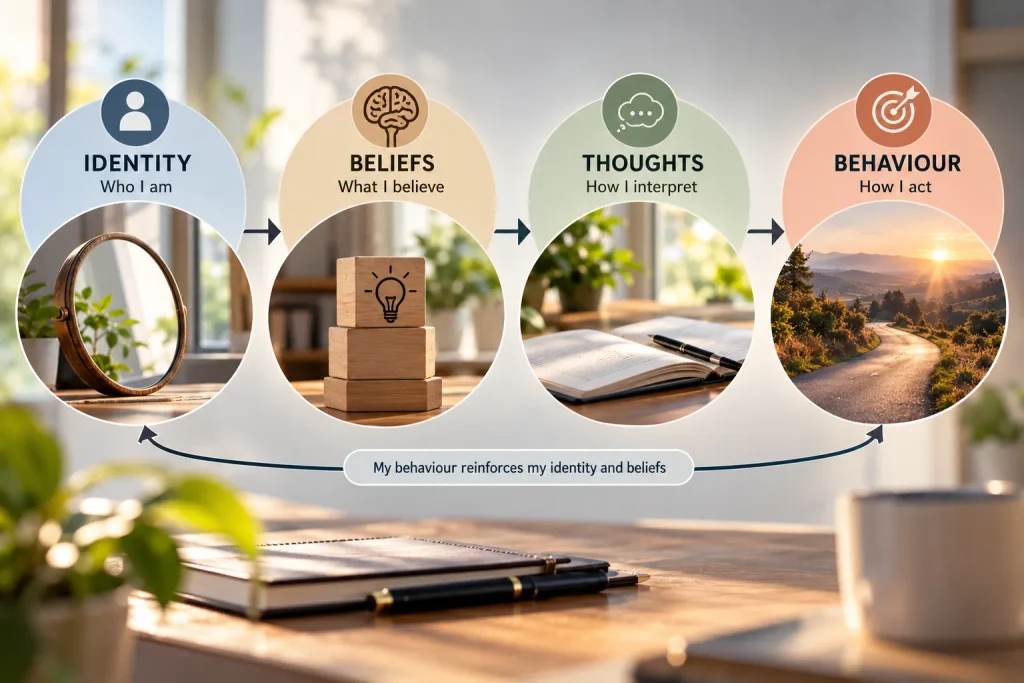
When a Belief Becomes Part of Who We Are
Sometimes a belief is more than an opinion. It becomes part of identity.
Instead of saying:
“I believe this.”
We begin to feel:
“This is who I am.”
That changes the emotional stakes.
Imagine someone who has supported a particular person for ten years. They have defended that person. Recommended them to friends. Shared their ideas. Built memories around their admiration. Now credible information challenges their view.
Accepting it may mean admitting:
“I may have judged this person incorrectly.”
That can be uncomfortable.
But there may be an even deeper question underneath it:
“What does it say about me if I was wrong?”
Research on belief revision suggests that considering alternative possibilities can increase people’s willingness to update beliefs when confronted with contradictory evidence. This is particularly relevant when beliefs are connected to personal identity.
This helps explain why changing one’s mind can sometimes feel emotionally harder than intellectually difficult.
The person is not only protecting a belief. They may be protecting their self-image.
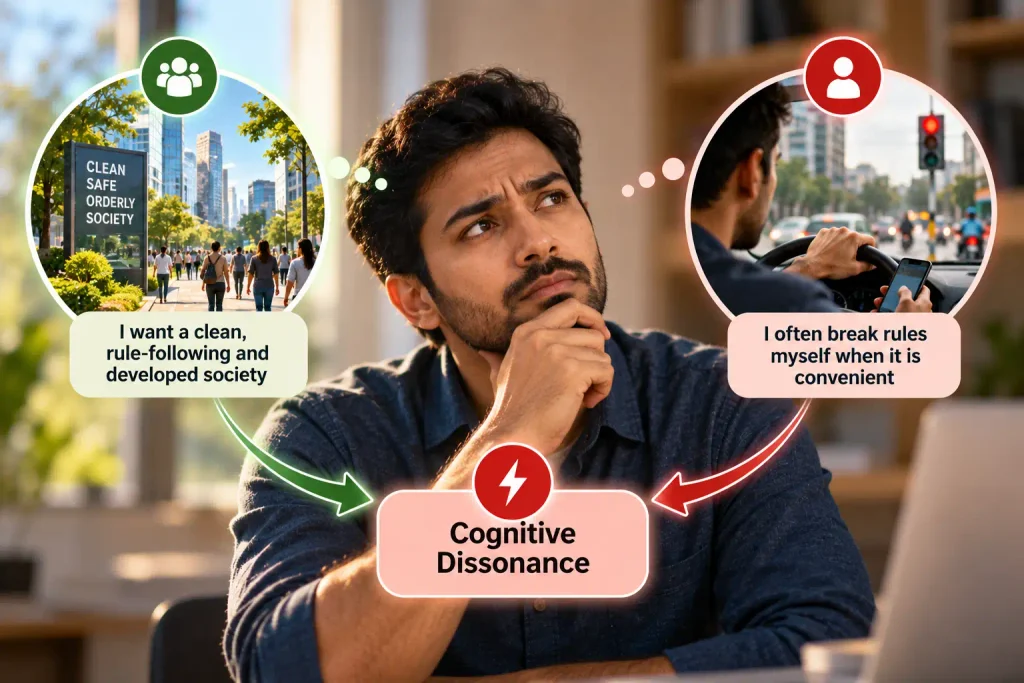
Cognitive Dissonance: When Two Beliefs Don’t Fit Together
Suppose you strongly believe:
“My closest friend is an honest person.”
Then you discover that they deliberately hid something important from you.
Two ideas now exist together:
“My friend is honest.”
and
“My friend was dishonest with me.”
That inconsistency can create psychological discomfort, commonly discussed under the concept of cognitive dissonance.
People can respond to such discomfort in different ways.
They may change their belief:
“Perhaps I was wrong about them.”
They may change their interpretation:
“Maybe there was another reason.”
They may change their behaviour.
Or they may search for explanations that allow the original belief to remain intact. This does not mean every explanation is an excuse. Sometimes there genuinely is missing information.
The concern arises when we become willing to accept almost any explanation as long as it protects what we already believe.
A simple self-check is:
“What evidence would genuinely make me reconsider?”
If the honest answer is “nothing”, it may be worth examining whether you are evaluating evidence or protecting a conclusion.
Motivated Reasoning: When We Want a Conclusion to Be True
Sometimes we do not merely believe something.
We want it to be true.
A person in love wants to believe their partner is trustworthy. A parent wants to believe their child is doing well. An investor wants to believe their investment will succeed. A supporter wants to believe the person they admire is acting for the right reasons. A person who has spent years defending a belief wants to believe those years were not wasted.
Recent research continues to examine how goals, emotions and existing attitudes can influence belief updating. Research published in Nature Human Behaviour, for example, has examined how goals and affective information can influence the way people update beliefs about future events.
This does not mean emotion makes us irrational. Emotions are an important part of human decision-making. The problem comes when we fail to notice that an emotional preference may be influencing the way we interpret evidence.
A useful question is:
“Do I believe this because the evidence supports it, or because I desperately want it to be true?”
Sometimes the answer will be both. Recognising that is already a form of self-awareness.
When Belonging Becomes Part of Belief
Beliefs do not exist only inside individual minds. They live inside families, friendships, workplaces, communities and online spaces. We want to belong. We want people who understand us. We want to know that we are not alone. This is why shared beliefs can become powerful.
A person may move from:
“These are people who share my belief.”
to:
“These are my people.”
Now questioning the belief can feel like questioning the group.
Social identity research shows that group membership can influence how people understand themselves and relate to others. A 2024 meta-analysis of 33 studies involving more than 33,000 participants found a moderate relationship between social identity and social integration, illustrating how identity and belonging are psychologically connected.
Consider a simple workplace example.
A new employee notices that everyone strongly supports a senior colleague’s proposal. They are unsure about it but remain silent. No one has threatened them. No one has told them they must agree. They simply sense what the group expects.
Over time, they may begin adopting the group’s position. This is one of the quieter forms of social influence.
The psychological calculation can become:
“Do I say what I really think, or do I stay connected to the group?”
When Disagreement Starts Feeling Like Betrayal
A healthy group can tolerate disagreement.
A colleague can say:
“I don’t think this plan will work.”
A friend can say:
“I understand your point, but I see it differently.”
A family member can say:
“I respect your view, but I don’t agree.”
But when disagreement becomes evidence of disloyalty, something changes.
The question is no longer:
“Is this idea accurate?”
It becomes:
“Are you one of us?”
That can make people suppress doubts they genuinely have. They may remain silent because belonging feels more important than expressing disagreement. This is one reason a psychologically healthy community does not require complete agreement.
It allows people to say:
“I disagree, and I still belong here.”
That is a much stronger form of belonging.
Social Media Can Make Agreement Feel Universal
Online environments add another layer. Imagine following twenty accounts that broadly share your worldview. You join groups where people mostly agree with one another. Your feed recommends similar content because that is what you already engage with. Every morning you see the same arguments, the same phrases and the same emotional reactions.
Eventually you may begin to think:
“Everyone knows this.”
But your online environment may represent only a small slice of people.
This does not mean social media automatically “brainwashes” people. That would be an oversimplification. But repeated exposure to similar views can shape the social information surrounding us. It can make a belief feel more familiar, more socially accepted and therefore more certain.
That is why occasionally stepping outside our usual information environment can be useful. Not because every opposing view is correct. But because we cannot properly examine a belief if we never allow ourselves to encounter information that could challenge it.
Parasocial Relationships: When We Feel Close to Someone We Have Never Met
The digital world creates another particularly interesting form of emotional connection.
You may watch the same creator every evening. You know their voice. You recognise their humour. You know stories about their childhood. You hear them talk about their struggles.
Eventually, you may feel:
“I know this person.”
The feeling can be genuine even though the relationship is one-sided.
Psychologists use the term ‘parasocial relationship‘ for these one-sided socio-emotional connections with media figures or fictional characters.
Importantly, having a parasocial relationship is not automatically unhealthy.
Research published in Scientific Reports in 2024, involving more than 3,000 participants across three studies, found that people perceived parasocial relationships as capable of fulfilling some emotional needs, although close two-sided relationships were generally perceived as more effective.
Recent research also suggests that parasocial relationships can influence how receptive people are to information from media figures. A 2026 meta-analysis of 58 studies found associations between parasocial relationships and health attitudes, information seeking and perceived source credibility, while also finding links with reduced resistance to persuasion.
This does not mean influencers automatically manipulate their audiences.
It means something much simpler:
When we feel emotionally connected to someone, we may become more receptive to what they say.
That makes independent evaluation particularly important when the subject involves health, money or other high-stakes decisions.
A useful question is:
“Do I trust this information because it is well supported, or because I feel connected to the person delivering it?”
When Certainty Feels Better Than Uncertainty
There is another reason people may hold tightly to beliefs. Sometimes not knowing feels uncomfortable.
Imagine receiving a message:
“We need to talk.”
You don’t know what it means. Your mind begins generating possibilities.
Maybe they are angry. Maybe they are worried. Maybe something happened. Maybe nothing serious happened at all. But uncertainty creates an uncomfortable gap.
The mind may quickly fill it:
“They are definitely upset with me.”
Now you have certainty.
It may be wrong, but at least the uncertainty has disappeared.
Psychologists use the concept need for cognitive closure to describe a preference for definite answers and reduced tolerance for ambiguity.
Research continues to examine how this need can influence judgement and attitudes. For example, a 2024 study examined the relationship between need for cognitive closure and attitudes through related belief processes.
The everyday lesson is simple:
Feeling certain is not the same as being correct.
Sometimes “I don’t know yet” is the most rational answer available.
When the Mind Turns Complex People Into Simple Categories
This is where black-and-white thinking becomes relevant.
A person is either good or bad. A relationship is either perfect or toxic. Someone is either with us or against us. A decision is either a success or a failure.
Real people rarely fit so neatly into two boxes. Someone can be kind and selfish.
A person can make a serious mistake without being a completely bad person. A relationship can contain love and unhealthy behaviour at the same time. A decision can have both benefits and costs.
Your existing thinking patterns may make this difficult to notice, especially during emotional moments. Our article on black-and-white thinking explores this pattern in greater depth.
The goal is not to make every possibility equally valid. It is to leave enough room for reality to be more complicated than our first conclusion.
Why This Matters for Real-Life Decisions
These psychological processes are not merely theoretical. They can influence ordinary decisions.
In relationships
A partner forgets something important.
The immediate conclusion becomes:
“You never care about me.”
The hurt may be completely real.
But “I felt uncared for when this happened” is different from deciding what the incident means about the entire relationship.
At the same time, balanced thinking does not mean excusing repeated harm.
If someone repeatedly lies, controls or humiliates you, looking at the complete pattern may lead to a firm boundary.
The point is to distinguish one painful event from an established pattern.
If emotional attachment is making that distinction difficult, our article on emotional attachment can help explore that side of the experience.
At work
A respected manager proposes something.
Everyone agrees.
You notice a genuine risk but remain silent:
“They probably know better.”
Perhaps they do. But perhaps they missed something.
Questioning a decision respectfully is not disloyalty. A healthy team should be able to examine an idea without turning the discussion into a judgement of the person.
With money
A successful friend or influencer says:
“This is a great opportunity.”
Their experience may be relevant. It is not enough on its own to justify risking your money.
Ask:
“What is the evidence?”
“What are the risks?”
“Does this person benefit from my decision?”
Trust should not replace due diligence.
How to Become More Rational Without Becoming Cynical
After reading about confirmation bias, authority, identity and group influence, someone might decide:
“I should never trust anyone.”
That is not the goal. Constant suspicion is not the same as critical thinking.
We need trust to live. We need relationships. We need expertise. We need communities. We need beliefs and values.
The healthier goal is psychological autonomy—the ability to listen to other people while remaining an active participant in your own decisions.
You can trust without surrendering judgement. You can belong without losing yourself. You can admire without idealising. You can disagree without turning the other person into an enemy. And you can change your mind without feeling that you have lost your identity.
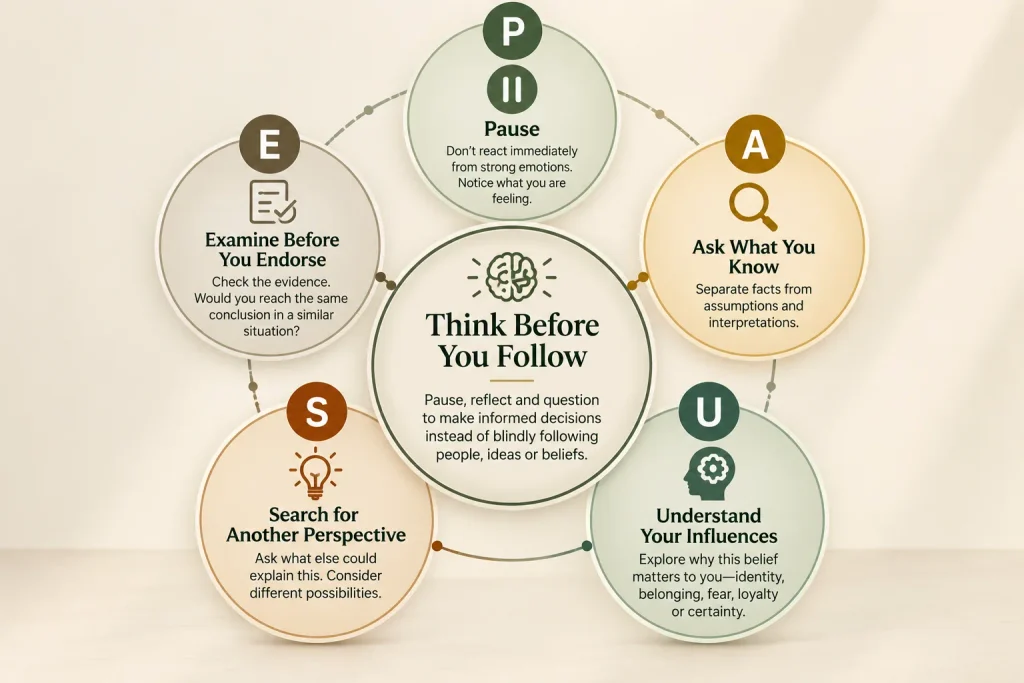
A Simple P.A.U.S.E. Before Important Decisions
When you notice yourself becoming strongly defensive about a person, belief or decision, try this short reflection.
P — Pause
Don’t act immediately from the strongest emotion.
Ask:
“What am I feeling right now?”
Anger? Fear? Attachment? Embarrassment? or Hope?
A — Ask what you actually know
Separate facts from interpretation.
Fact: “My friend has not replied for two days.”
Interpretation: “My friend is deliberately ignoring me.”
The second may be true. But it is not the same as the first.
U — Understand what may be influencing you
Ask:
“Why does this belief matter so much to me?”
Is it connected to identity, belonging, fear, loyalty, certainty, or emotional attachment?
S — Search for another reasonable explanation
You don’t have to accept the opposite view.
Simply ask:
“What else could explain this?”
This creates room for information you may have overlooked.
E — Examine before you endorse
Finally ask:
“Would I reach the same conclusion if this involved someone I disliked?”
And:
“What evidence would genuinely change my mind?”
Then decide.
You may still reach exactly the same conclusion. But now the decision belongs to you.
The Most Important Question: Could I Be Wrong?
Perhaps the healthiest habit we can develop is the ability to say:
“I may be wrong.”
Not:
“I am definitely wrong.”
And not:
“I am definitely right.”
Just:
“I may be wrong, and I can handle finding out.”
That sentence creates room for learning.
It allows us to listen without automatically accepting. It allows us to question without automatically rejecting. It allows us to remain connected without becoming psychologically dependent. And it allows our beliefs to change when meaningful evidence changes.
A flexible mind is not an empty mind.
You do not have to give every opinion equal weight. You do not have to abandon a well-supported belief simply because someone disagrees with you. You can consider without believing. You can listen without accepting. You can remain curious without becoming gullible.
An open mind still needs standards.
So, Is Andhbhakti Really About Belief?
Perhaps not.
At a deeper psychological level, the issue may be less about what we believe and more about how we hold the belief.
A person can have strong faith and still reflect. A person can deeply admire someone and still acknowledge their mistakes. A person can belong to a group and still disagree with it. A person can trust an expert and still ask sensible questions. A person can love someone and still maintain healthy boundaries.
The psychological concern begins when questioning becomes impossible because the belief has become too closely connected to identity, belonging, emotional security or certainty.
That is why the most useful question is not:
“Who is an Andhbhakt?”
It is:
“Where might I be protecting a belief instead of examining it?”
That question turns the subject inward. And that is where psychology becomes useful.
A Final Self-Reflection
Think about one belief you feel strongly about. It could concern a person, relationship, career, money, parenting, religion, politics, success—or even yourself.
Ask:
Why do I believe this?
What evidence supports it?
What evidence challenges it?
Am I emotionally attached to the conclusion?
Would I judge the same behaviour differently if someone I disliked did it?
Can someone outside my group still make a valid point?
What would genuinely make me reconsider?
And finally:
“Am I protecting the truth—or protecting my attachment to my version of the truth?”
Sometimes the answer will be the first. Sometimes the second. Often it will be a mixture of both. The purpose is not to make ourselves perfect thinkers. It is to become more aware of our own minds.
Belief Without Blindness
We do not need to become people who believe nothing. We need to become people who can believe without becoming prisoners of our beliefs.
We can admire without idealising. Trust without surrendering judgement. Belong without losing ourselves. Love without ignoring reality. Have faith without fearing questions. Listen without automatically accepting. And change our minds without feeling that we have betrayed ourselves.
Perhaps the opposite of blind devotion is not disbelief.
It is awareness.
The ability to pause. To ask. To listen. To examine. To tolerate uncertainty. To recognise our emotional investment.
And then, after all of that—
to decide for ourselves.
Because psychological growth does not mean reaching a point where we are never wrong. It means becoming increasingly willing to notice when we might be.
And perhaps that is one of the quietest forms of freedom we have:
The freedom to think, even when something we deeply care about is asking us not to.
A Gentle Note
This article explores psychological processes associated with unquestioning belief, authority, cognitive bias, group influence, emotional attachment and decision-making.
“Andhbhakti” is used here as an everyday cultural expression, not as a clinical diagnosis or a scientific psychological category.
Strong faith, admiration, loyalty, community belonging or deeply held values are not, by themselves, signs of psychological dysfunction.
The examples in this article are illustrative and are not intended to diagnose or characterise any individual, group, religion, political organisation or community.
This article provides general psychological education and self-reflection. It is not a substitute for individual assessment or professional mental health care. If rigid thinking, emotional distress or relationship difficulties are significantly affecting your daily life, consider speaking with a qualified mental-health professional.