

The day is finally over.
You have answered the messages, finished the urgent work and taken care of what everyone needed from you. Nothing demands your attention right now. You sit down, hoping to enjoy a little peace.
But your body does not seem to understand that the busy part of the day has ended.
Your shoulders remain tense. Your thoughts move from one unfinished task to another. You check your phone without knowing what you are looking for. Within a few minutes, you get up to do something that could easily wait until tomorrow.
Perhaps your experience looks different.
You may be a university student who spends the entire semester waiting for a break, only to feel restless when that break arrives. You may be a working parent who finally gets an hour alone but cannot enjoy it without feeling guilty. Or you may be someone who feels exhausted throughout the day yet becomes strangely alert as soon as it is time to sleep.
When this keeps happening, you may begin to wonder, “Why can’t I relax when nothing is actually wrong?”
It is a confusing experience. You can see that the room is quiet. You know that no immediate danger is present. Part of you understands that it is safe to slow down.
Another part of you, however, is still preparing for something.
That does not mean you are ungrateful for the peaceful moments in your life. It does not mean you are choosing to worry. And it certainly does not mean you are failing at something that should be easy.
Sometimes, having time to rest and feeling able to rest are two very different things.
Quick Answer: Why Can’t I Relax?
You may find it difficult to relax when the demands around you have stopped, but your mind and body are still prepared for the next demand.
This can happen after prolonged stress. It may also be connected with worry, perfectionism, poor sleep, constant digital stimulation, productivity guilt or a habit of staying alert to other people’s moods and reactions. For some people, quiet moments bring uncomfortable thoughts or physical sensations into greater awareness. This can make relaxation feel uneasy rather than comforting.
Difficulty relaxing does not automatically mean that you have an anxiety disorder or unresolved trauma. It is a broad human experience with several possible causes. However, if you are constantly on edge and it is affecting your sleep, health, relationships or daily life, it deserves careful attention.

Table of Contents
What Does It Mean When You Cannot Relax?
Relaxation is often described as doing nothing. But you can be sitting on a sofa, lying in bed or spending a day away from work and still not feel relaxed.
Genuine relaxation involves more than physical stillness.
Your muscles begin to release some of their tension. Your attention no longer needs to check every possible problem. Thoughts may still appear, but they do not all feel urgent. You can pause without immediately judging yourself for being unproductive.
Most importantly, your system becomes flexible enough to move from effort towards recovery.
This does not mean that your mind must become completely empty. It does not mean that you should feel calm every minute. A healthy emotional life includes periods of energy, concern, excitement, frustration and rest.
As I explain in this guide to healthy emotional regulation, emotional regulation is not about remaining calm all the time. It includes the ability to respond to a demand and gradually recover after that demand has passed.
The difficulty begins when recovery does not seem to happen.
You may finish the presentation, but continue rehearsing it in your mind. You may leave the office, but mentally remain at your desk. You may solve one problem and immediately start searching for another.
Even enjoyable activities can become tasks. A walk has to reach a certain number of steps. A holiday must follow a perfect itinerary. A hobby has to produce something useful. Rest quietly becomes another area in which you feel pressure to perform well.
Common Signs You Are Not Fully Switching Off
Difficulty relaxing can appear in the body, thoughts, habits and emotions. You may notice that you:
- Keep your jaw tight or shoulders raised without realising it.
- Check emails, messages or notifications when nothing urgent is expected.
- Feel as though you have forgotten something important.
- Plan tomorrow while trying to rest today.
- Struggle to sit still without reaching for your phone.
- Feel guilty when watching television, reading or taking a nap.
- Become irritable when a small interruption occurs.
- Replay conversations when you are trying to sleep.
- Need constant noise, scrolling or activity to avoid quiet.
- Feel tired after a break instead of restored.
- Become uncomfortable when somebody tells you to “just relax”.
One or two of these experiences occasionally are not necessarily a concern. Most people carry some tension during demanding periods.
The pattern becomes more important when it happens regularly, continues even during relatively calm periods or begins to affect your well-being.
Stress, Anxiety and Hypervigilance Are Not the Same
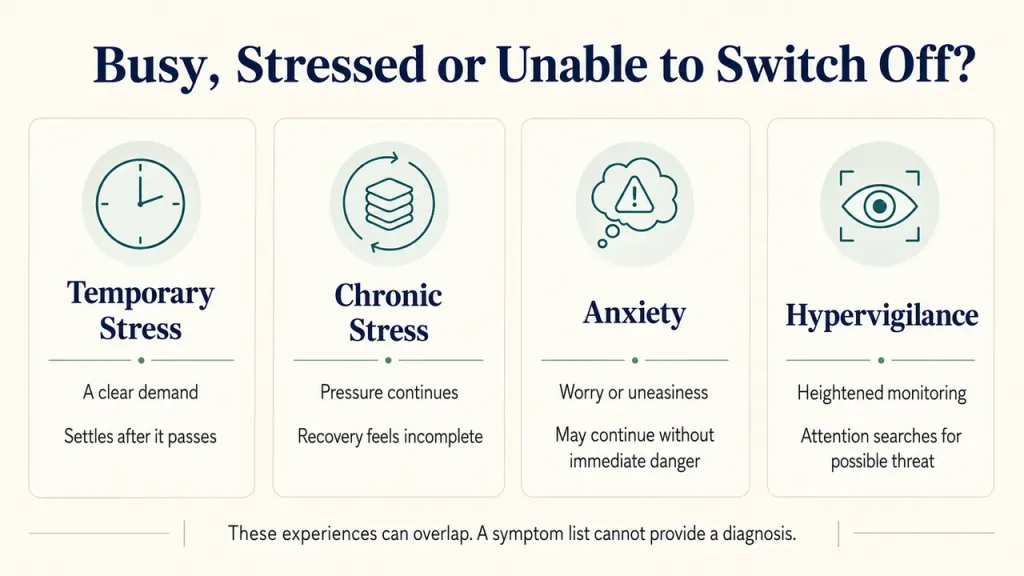
Words such as stress, anxiety, hypervigilance and nervous system dysregulation are often used interchangeably online. They can describe related experiences, but they do not all mean the same thing.
| Experience | What it may look like |
| Temporary stress | You feel tense while dealing with a clear demand but gradually settle after it passes. |
| Chronic stress | Demands continue for so long, or recovery is so limited, that physical and emotional tension begins to feel normal. |
| Anxiety | Worry, apprehension or physical uneasiness continues even when the outcome is uncertain or no immediate threat is visible. |
| Hypervigilance | Your attention remains unusually focused on possible danger, changes in the environment or other people’s reactions. |
| Difficulty relaxing | A broad experience that may occur with any of the above but is not a diagnosis by itself. |
The American Psychological Association explains that chronic stress can affect sleep, concentration, mood and physical health. Anxiety can also involve worried thoughts, tension and physical changes, even when there is no immediate danger.
Hypervigilance is more specific. It describes heightened monitoring for possible threats. A person may repeatedly scan a room, listen closely for changes in someone’s voice or feel unable to lower their guard. It can occur in trauma-related conditions, but it should not be assumed from a single symptom or diagnosed through an online article.
It is also important to be careful with the popular statement that the nervous system is “stuck in fight-or-flight”.
It can certainly feel that way. But the body is not normally frozen in one unchanging state. A more accurate explanation is that repeated stress may make activation easier to trigger and comfortable recovery harder to reach.
The autonomic nervous system helps regulate involuntary processes such as heart rate, breathing, blood pressure and digestion. The stress response also involves the brain, hormones, attention, behaviour and previous learning. It is a coordinated process—not a simple switch that is either on or off.
Over time, your mind and body may become very practised at preparing, monitoring and responding. They may become less practised at recognising that enough has been done for now.
This is why telling yourself to calm down may not be enough.
You are not arguing with a lack of common sense. You may be dealing with a pattern that has been reinforced through months or years of pressure, responsibility or uncertainty.
The encouraging part is that a learned pattern is not necessarily a permanent one. Before trying to change it, however, it helps to understand what may be keeping it alive.
In the next section, we will look at seven possible reasons you may find it hard to relax—even when nothing around you appears to be wrong.
Why Can’t I Relax? 7 Possible Reasons
There is rarely one simple explanation for why you cannot relax.
For one person, the main difficulty may be an overloaded schedule that never allows enough recovery. For another, it may be the feeling that staying worried is the only way to remain prepared. Someone else may have learned to measure their worth through productivity, making every quiet moment feel undeserved.
More than one of these patterns can exist at the same time.
The aim of exploring them is not to place another label on yourself. It is to help you notice what happens inside you when the outside world becomes quiet.
1. Your Stress Response Has Not Had Enough Opportunity to Recover
Stress is not always harmful.
The World Health Organization describes stress as a natural human response to difficult situations. A manageable amount can help us respond to everyday challenges. The concern is not that the body reacts to pressure, but that stress becomes excessive, persistent or difficult to recover from.
When you face a deadline, attend an interview or respond to an emergency, your body mobilises energy and attention. Your heart may beat faster. Your muscles become ready for action. Your focus narrows towards the immediate demand.
These changes help you respond.
Once the situation passes, the body usually begins moving towards recovery. But that process needs time, sleep, nourishment and moments in which nothing new is asking for your attention.
Many people rarely receive that kind of uninterrupted recovery.
Imagine a 42-year-old employee who manages a demanding job while also helping an ageing parent. His workday finishes at six, but responsibility does not. There are medical appointments to arrange, household expenses to review and family messages to answer.
By Sunday afternoon, nothing urgent is happening. Still, he cannot settle. His mind has already moved towards Monday.
This does not necessarily mean that he has forgotten how to relax. His system may simply have had too few opportunities to complete the movement from effort to recovery.
The same pattern can affect younger adults.
A 23-year-old may attend college during the day, prepare for competitive examinations at night and use weekends for extra classes. Even when she takes a break, messages, results and future plans remain close to her attention. Her body is resting on the bed, but her mind is still living inside the next demand.
Over time, repeated pressure can create what researchers call allostatic load.
The word sounds technical, but the basic idea is understandable. Your body adjusts to challenges so that you can keep functioning. When those adjustments are activated repeatedly, without enough recovery, they begin to carry a cost.
You may notice:
- Muscle tension that returns soon after stretching.
- Irritability over small inconveniences.
- Difficulty concentrating.
- Light or disrupted sleep.
- Headaches or digestive changes.
- Feeling exhausted while still unable to slow down.
- Needing more effort to feel the same sense of control.
The American Psychological Association notes that chronic stress can affect sleep, concentration, mood and several areas of physical health. Research on chronic stress also shows that its effects extend beyond one part of the nervous system. Brain processes, stress hormones, immune activity, behaviour and physical health can all be involved.
This is why one quiet evening may not feel sufficient after months of pressure.
A holiday can remove you from work, but your body does not read the travel booking and immediately decide that recovery has begun. On the first day, you may still wake at your usual work time. You may keep checking emails. You may feel restless because the familiar demands are absent.
This does not mean the break has failed. It may mean that recovery is gradual.
It is also worth remembering that resilience is not the same as enduring without recovery. Being dependable can help you through difficult periods. But if you are always the person who keeps going, others may not notice how rarely you get to stop.
Sometimes, your inability to relax is not a sign that you need a better relaxation technique. It is a sign that too much has been required of you for too long.
2. Worry Has Become Your Mind’s Way of Staying Prepared
Worry is uncomfortable. Yet it can also create a temporary sense of control.
When you mentally rehearse every possible problem, part of you may feel that you are being responsible. If you consider every outcome in advance, perhaps nothing will surprise you. If you keep thinking, perhaps you will find the one solution that finally makes uncertainty disappear.
That relief is usually brief.
Suppose a 25-year-old has recently attended an important job interview. He has done what he can. The decision now belongs to someone else.
He tries to watch a film, but his mind keeps returning to the interview.
Did that answer sound confident enough?
Why did the interviewer pause?
Should he send another email?
What will he do if he is rejected?
None of these thoughts changes the decision that evening. Still, worrying feels more active than waiting. Relaxing may feel careless, as though lowering his guard could somehow cause a bad result.
Psychologists sometimes describe this difficulty as intolerance of uncertainty. It means that not knowing what will happen feels especially hard to tolerate.
Most people prefer certainty. But when uncertainty becomes deeply uncomfortable, the mind may respond by checking, planning, seeking reassurance or imagining possible threats. These actions can briefly reduce anxiety, which encourages the mind to repeat them later.
There is another useful explanation called the contrast avoidance model.
According to this model, some people continue worrying because moving from calm to sudden distress feels especially unpleasant. Remaining somewhat worried may seem safer than relaxing and then being emotionally surprised by bad news.
In simple terms, the mind may be saying:
If I stay prepared for the worst, the worst will not hit me as hard.
This is not usually a deliberate decision. The person is not choosing misery. Worry has gradually become a protective habit.
A scholarly review of worry and generalised anxiety describes several processes that can maintain persistent worry, including cognitive habits, emotional avoidance, biological vulnerability and developmental experiences. Read the research review
Worry may also be mistaken for problem-solving, although the two are different.
Problem-solving tends to produce a specific action:
- I will call the office tomorrow.
- I will prepare the documents tonight.
- I will ask for clarification.
- I will set aside money for this expense.
Worry often circles around possibilities without reaching a useful next step:
- What if something goes wrong?
- What if I have missed something?
- What if I cannot cope?
- What if relaxing makes me unprepared?
When the same questions continue without new information, you may be caught in the overthinking loop rather than actively solving the problem.
A helpful question is:
Is there something useful I can do now, or is my mind trying to make uncertainty feel certain?
If there is a practical step, write it down and decide when you will take it. If there is no available action, continuing to think may be creating the feeling of preparation without increasing your actual control.
This is why relaxation can feel so difficult. To a worried mind, resting is not merely resting. It may feel like giving up your watch.
3. Your Self-Worth May Have Become Tied to Productivity
For some people, the problem is not fear that something bad will happen. It is the belief that they should always be doing something useful.
A 31-year-old working mother finally has an evening without an urgent responsibility. She chooses a film she has wanted to watch for months.
Ten minutes later, she begins folding clothes.
Then she answers a work message that could have waited. She checks the school calendar. She remembers a cupboard that needs organising.
She may tell herself that she prefers staying busy. But underneath the activity, another message may be operating:
Sitting here while work remains means I am being lazy.
This is often called productivity guilt or leisure guilt. It is the uneasiness that appears when time is being used for rest or enjoyment rather than achievement.
Recent research published in 2026 examined leisure guilt as a measurable psychological pattern. Across four studies, greater proneness to leisure guilt was associated with poorer leisure experiences and lower well-being. Read the study in Personality and Social Psychology Bulletin
The important point is not simply that guilty people take fewer breaks. Guilt can follow them into the break itself.
They may be physically resting while mentally defending their right to do so.
This relationship with productivity can develop in many ways.
Perhaps praise came mainly when you achieved something. You may have been described as “the responsible one”, “the intelligent child” or “the person everyone can depend on”. Those descriptions may have felt encouraging, but they may also have taught you that your value was most visible when you were useful.
School and workplace culture can strengthen the pattern. Long hours are often treated as commitment. Immediate replies are mistaken for professionalism. Being busy becomes something people display, while ordinary human recovery is kept private.
Eventually, the question changes from:
What needs to be done?
to:
Have I done enough to deserve rest?
The difficulty is that “enough” keeps moving.
There is always another email, household task, fitness goal or article to read. If rest can begin only after everything is complete, rest may never begin at all.
Perfectionism can make this even harder.
A perfectionistic person may not feel satisfied when a task is reasonably complete. They continue checking, refining or preparing because stopping exposes them to the possibility that something is imperfect.
This can resemble discipline from the outside. Inside, however, it often feels like pressure.
It is worth asking yourself:
- Do I rest only after I have reached exhaustion?
- Do I feel I need a reason to take a break?
- Does another person’s rest seem acceptable while my own feels irresponsible?
- Do I turn hobbies into goals that must be measured?
- Do I secretly judge myself when I am not producing something?
If these questions feel familiar, your difficulty relaxing may involve more than poor time management. Rest may have become connected with identity, approval and self-worth.
People are often told that rest is valuable because it improves productivity. That can be useful, but it does not go far enough.
You are not a machine that deserves maintenance only because it can produce more afterwards.
Rest is part of being human. It supports attention, relationships, physical health and emotional recovery. It can also be enjoyable without needing to justify itself through a better result tomorrow.
Learning this intellectually is one step. Feeling it emotionally may take longer.

These first three reasons mainly involve accumulated demand, worry and achievement-based self-worth. But some people struggle to relax for another reason: calm itself does not yet feel familiar.
In the next section, we will explore how learned alertness, overstimulation, physical activation and relaxation-induced anxiety can make peaceful moments surprisingly uncomfortable.
4. Calm May Feel Unfamiliar After Prolonged Unpredictability
Some people do not experience quiet as comforting straight away.
They may want peace. They may even create a peaceful environment around themselves. Yet when everything becomes calm, their attention remains watchful.
This can happen when a person has spent a long time in circumstances where moods, expectations or reactions were difficult to predict.
Consider a 38-year-old woman sitting with her partner after dinner. They are watching television. There has been no disagreement, and her partner appears relaxed.
Then he becomes slightly quieter.
She notices the change immediately. Her mind begins searching for an explanation.
Is he upset with me?
Did I say something wrong?
Is he about to start an argument?
She asks whether everything is okay. He says he is simply tired. But she continues observing his face and tone of voice.
Part of her knows that nothing is wrong. Another part is still looking for evidence.
Earlier in life, she may have lived around unpredictable anger, criticism or emotional withdrawal. Paying close attention to small changes may once have helped her prepare for what came next.
This kind of monitoring can become deeply practised.
A child who cannot predict a caregiver’s mood may learn to study footsteps, facial expressions or the way a door closes. An adult in a volatile relationship may become highly sensitive to silence or changes in tone. Someone who has worked for years under an intimidating supervisor may keep expecting criticism, even after moving to a healthier workplace.
The original situation may end. The attentional habit may continue.
This does not mean that everyone who notices other people’s moods has experienced trauma. Sensitivity to social cues is a normal human ability. It becomes exhausting when the mind repeatedly treats small, uncertain changes as signs that something may be wrong.
The term ‘hypervigilance’ describes an unusually heightened state of monitoring for possible threats. A hypervigilant person may scan the environment, startle easily or find it difficult to lower their guard. Research suggests that hypervigilance and attentional bias can help maintain anxiety and trauma-related symptoms in some people. Read the research review
However, hypervigilance is not a label to apply simply because you feel tense sometimes. It is a clinical concept that needs context. An online article cannot determine whether it describes your experience.
What we can recognise is a broader pattern: when alertness has repeatedly helped you feel safer, letting go of it may feel risky.
Calm may even create uncertainty.
If you are used to solving problems, reading the room or preparing for other people’s reactions, a peaceful moment removes the activity that normally gives you a sense of control. You may then begin searching for the next problem—not because you want one, but because waiting for an unknown problem feels harder.
Early experiences can influence how we learn to regulate emotions. They can also shape what emotional safety feels like in adult relationships.
Still, childhood is only one possible influence.
Long periods of workplace pressure, caregiving, illness, financial uncertainty, discrimination or an unsafe adult relationship can also teach a person to remain prepared. We should not assume that every difficulty in adulthood is caused by childhood or trauma.
A more compassionate question is:
When might staying alert have started to feel necessary for me?
The answer may help you understand the pattern without blaming yourself or forcing a diagnosis.

5. Your Brain Is Receiving Stimulation Without Genuine Recovery
Sometimes, we believe we are resting because we have stopped working.
We sit down and pick up the phone. One short video leads to another. A message arrives. We check the news, open an email, compare prices, watch another clip and return to the message we forgot to answer.
An hour passes.
We have not completed any demanding task, but our attention has shifted dozens of times.
This is a change of activity. It is not always recovery.
Imagine a 21-year-old university student after a long day of classes. He lies on his bed and tells himself that he is taking a break.
During the next two hours, he moves between social media, placement updates, messages from friends, examination discussions and videos about becoming more successful. Some content entertains him. Other content creates comparison or urgency.
When he puts the phone down, he feels more restless than before.
The problem is not simply “screen time”. Screens can support friendship, learning, relaxation and access to help. Watching a familiar programme may feel calming. Talking to someone you trust may support recovery.
The effect depends on what you are doing, why you are doing it and how your attention responds.
Fast-changing content, repeated notifications and emotionally charged information can keep the mind orientated towards what comes next. Even pleasant stimulation can make it difficult to notice tiredness or tension until the device is removed.
This may explain why silence suddenly feels uncomfortable at bedtime.
Throughout the day, every empty moment has been filled with information. When the lights go out, the thoughts that had no room earlier finally become noticeable.
Digital activity can also leave several mental threads open:
- A message you intend to answer.
- A headline that made you worried.
- A video you want to finish.
- A comparison that made you question your progress.
- A work notification you saw but could not resolve.
- A reminder of something you still need to buy or arrange.
Your body may be lying still while your attention remains in a state of continual switching.
The answer is not necessarily to remove every device or force yourself into complete silence. Extreme rules are difficult to maintain and may not address why you reach for stimulation in the first place.
It is more useful to notice the difference between an activity that leaves you refreshed and one that merely keeps you occupied.
Ask yourself:
After this activity, do I feel more settled, or simply more distracted?
Distraction can be helpful in small doses. But when every quiet moment is filled, the mind gets very little opportunity to practise being still without needing new input.
6. You May Be Exhausted but Still Physiologically Activated
Being tired and being relaxed are not the same thing.
You can have very little energy while your body remains tense and your thoughts remain active. People often describe this as feeling “tired but wired”.
A 29-year-old professional sleeps late because work regularly extends into the evening. The next morning, he needs several cups of tea or coffee to feel functional. By afternoon, he is exhausted. At night, however, his thoughts speed up as soon as he gets into bed.
He feels tired enough to sleep, but not settled enough to let sleep happen.
Several factors may contribute to this pattern:
- Inadequate or irregular sleep.
- Caffeine or nicotine use.
- Alcohol disrupting sleep quality.
- Pain or physical discomfort.
- Some prescribed or non-prescribed medications.
- Thyroid or hormonal problems.
- Anxiety or prolonged stress.
- Working, studying or exercising intensely close to bedtime.
- Continual exposure to stimulating information late at night.
Caffeine affects people differently. One person may drink tea in the evening and sleep comfortably, while another remains alert after a smaller amount taken much earlier. The answer is not to assume that caffeine is always responsible but to notice timing, quantity and personal sensitivity.
Alcohol can create another confusing pattern. It may make a person feel sleepy initially, but sedation is not the same as restorative sleep. Sleep may become lighter or more disrupted later in the night.
Physical symptoms also deserve proper attention.
Palpitations, breathlessness, sweating, trembling or muscle tension can occur with anxiety. They can also have medical causes. It is unsafe to assume that every physical sensation is “just stress”.
Similarly, prescribed medication should never be stopped or changed based on an online article. If you suspect that a medicine is affecting your sleep or ability to settle, speak with the clinician who prescribed it.
Consider speaking with a qualified health professional if:
- Your difficulty relaxing is new, severe or getting progressively worse.
- It regularly interferes with sleep, work or relationships.
- You experience persistent palpitations or unexplained physical symptoms.
- You think medication, caffeine, alcohol or another substance may be contributing.
- You are using alcohol, nicotine or other substances mainly to switch off.
- Anxiety or physical tension is becoming difficult to manage alone.
Seek urgent medical help for severe chest pain, serious breathing difficulty, fainting or other sudden and concerning symptoms.
This does not mean that something serious is necessarily wrong. It means that responsible psychological information should leave room for physical health and individual assessment.
7. Relaxation Itself May Bring Uncomfortable Feelings Closer
This final reason can be surprising.
For some people, attempting to relax temporarily increases their anxiety.
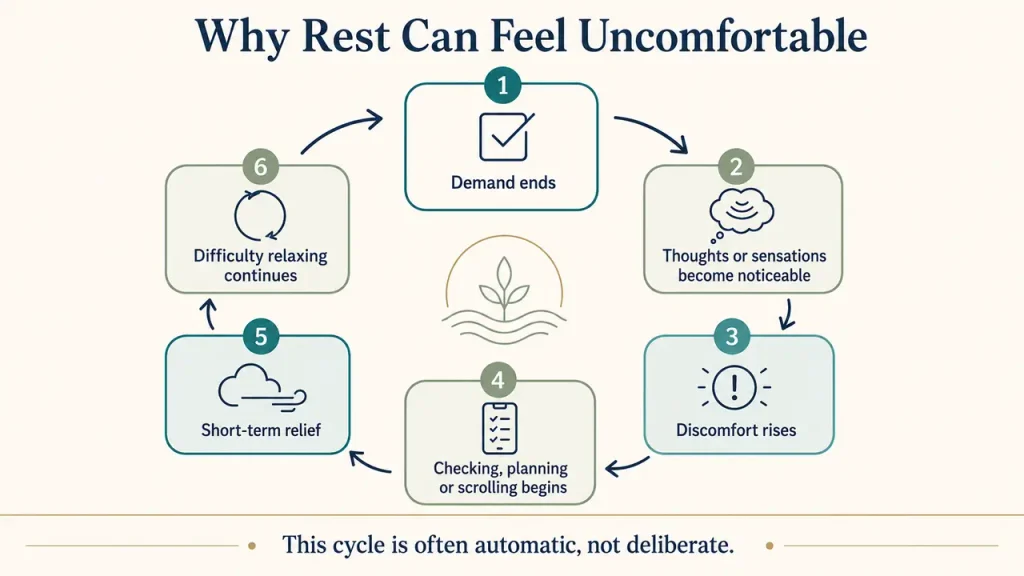
They may sit quietly, close their eyes or begin a breathing exercise. Instead of feeling calmer, they become more aware of their heartbeat, breathing or muscle sensations. Thoughts that were easier to ignore during the day begin to surface.
Within a few minutes, they open their eyes, reach for their phone or decide that relaxation “does not work” for them.
Psychologists use the term ‘relaxation-induced anxiety’ for a paradoxical increase in anxiety during relaxation. A related concept, relaxation sensitivity, refers to fear of sensations, thoughts or consequences associated with becoming relaxed.
Researchers have developed and tested a Relaxation Sensitivity Index to better understand this experience. The research suggests that people can be concerned about physical, cognitive or social consequences of relaxation. Read the Relaxation Sensitivity Index study
For example, a person may fear the following:
- Becoming too aware of their heartbeat or breathing.
- Losing control of their thoughts.
- Being caught unprepared.
- Appearing lazy or vulnerable.
- Allowing upsetting memories or emotions to surface.
- Feeling calm and then experiencing a sudden return of distress.
One study examining people with generalised anxiety found that some participants experienced increased anxiety during relaxation. The researchers explored whether maintaining worry helps people avoid the uncomfortable emotional contrast between feeling calm and becoming distressed again. Read the study
This does not mean that relaxation is dangerous. It also does not mean that everyone who dislikes meditation has an anxiety disorder.
It means that relaxation techniques do not feel identical for everyone.
Imagine a 46-year-old who has spent years caring for other people. During the day, practical responsibilities keep her attention moving. When she finally sits alone and closes her eyes, sadness and exhaustion become more noticeable.
She quickly gets up and starts cleaning.
Cleaning gives her something familiar to do. The uncomfortable feelings move into the background. She experiences short-term relief, which makes it more likely that she will respond the same way next time.
Another person may become alarmed by a slower heartbeat or changes in breathing during a relaxation exercise. Someone who is used to monitoring the environment may dislike closing their eyes. A person with painful memories may find complete stillness too intense.
Telling these people to “try harder” can create more pressure.
A gentler approach may involve keeping the eyes open, using movement, choosing a familiar environment or beginning with very short periods of rest. We will explore these options in the practical section.
For now, the most important message is this:
If relaxation makes you uncomfortable, you are not necessarily doing it incorrectly. Your reaction may be showing you what your mind or body has learned to expect when activity stops.
Why Trying Harder to Relax Can Make It More Difficult
Once you notice that you cannot relax, you may turn relaxation into another task.
You sit down and tell yourself:
I have twenty minutes. I need to calm down now.
Then you begin checking.
Has my breathing slowed?
Are my shoulders still tense?
Why am I still thinking?
Is this technique working?
The more closely you monitor the result, the more pressure you create. When calm does not appear immediately, you may feel frustrated or conclude that something is wrong with you.
This creates a self-reinforcing cycle:
- You notice tension.
- You decide that you must relax.
- You monitor whether relaxation is happening.
- Monitoring increases effort and frustration.
- The lack of immediate calm feels like failure.
- You return to work, checking or distraction.
- The belief that you cannot relax becomes stronger.
This is similar to trying very hard to fall asleep. Sleep usually comes when the conditions support it. Demanding it immediately often creates more alertness.
Relaxation can work in a similar way.
You cannot always command your mind and body to become calm. But you can create conditions that make settling more possible. You can reduce unnecessary stimulation, complete small transitions, respond differently to worried thoughts and practise rest in amounts that feel manageable.
The goal is not to force yourself into perfect calm.
It is to help your system discover, through repeated experience, that a quiet moment does not always require another task, another check or another form of protection.
That is where we will turn next.
How to Relax When Your Mind and Body Will Not Switch Off
When you have been tense for a long time, advice such as “take a deep breath” or “stop thinking so much” can feel dismissive.
You may already be trying to relax. The problem is that your mind and body are not responding as quickly as you want them to.
Instead of forcing calm, it can be more helpful to become curious about what is keeping you activated. The aim is not to make every uncomfortable feeling disappear. It is to help yourself move towards recovery without turning relaxation into another test you must pass.
Begin by Identifying What Kind of Tension You Are Experiencing
Before choosing a relaxation technique, pause and ask what is actually happening.
Is your mind worrying about a specific situation?
Is your body tense after a demanding day?
Do you feel guilty because you are not working?
Have you been consuming information continuously?
Does quiet bring up feelings you have been postponing?
Are you exhausted because you have not slept properly?
These experiences may feel similar, but they do not always need the same response.
If your mind is holding unfinished tasks, writing them down may help more than another breathing exercise. If your body feels physically charged, gentle movement may be more comfortable than sitting still. If guilt appears whenever you rest, the belief beneath that guilt may need attention.
Try putting the experience into a simple sentence:
“My body is tired, but my mind is still planning.”
Or:
“Nothing urgent is happening, but I feel guilty for stopping.”
Naming what you notice does not solve everything. It does, however, turn a vague feeling of “I cannot relax” into something more understandable.
Create a Transition Between Effort and Rest
Modern life often gives us very little transition time.
You may close a work application and immediately open social media. You may finish caring for your family and go straight to bed. If you work from home, the same room may hold meetings, meals and evening rest.
Your responsibilities may have ended, but there has been no clear moment telling your mind that one part of the day is complete.
A transition does not need to be elaborate. It could be:
- Taking a brief walk after work.
- Changing out of work clothes.
- Washing your face or taking a shower.
- Putting away the laptop rather than leaving it visible.
- Writing down unfinished tasks for tomorrow.
- Sitting quietly for a few minutes before turning on entertainment.
- Listening to one familiar piece of music.
- Making a warm, caffeine-free drink.
The specific activity matters less than its meaning. Repeating a small transition can help create a clearer boundary between responding to demands and recovering from them.
If unfinished tasks keep returning to your mind, write them down along with the next realistic step.
For example:
“Send the document tomorrow at 10 a.m.”
This reassures your mind that the task has not been forgotten. You are postponing it deliberately, not neglecting it.
Reduce Physical Activation Before Expecting Stillness
Complete stillness is not the best starting point for everyone.
If you have spent the day rushing, solving problems or sitting with tense muscles, suddenly asking your body to become perfectly calm can feel unnatural. A short period of gentle movement may create a more comfortable bridge.
You might try:
- Walking slowly for five or ten minutes.
- Stretching without trying to achieve a fitness target.
- Shaking out the hands and loosening the shoulders.
- Completing a simple household task at an unhurried pace.
- Practising progressive muscle relaxation.
- Breathing slowly and comfortably without forcing very deep breaths.
Progressive muscle relaxation involves gently tensing and then releasing different muscle groups. This can help you notice the contrast between tension and release. A systematic review found that progressive muscle relaxation can help reduce stress and anxiety in adults, although individual responses vary. Read the systematic review
Regulated breathing practices may also help some people reduce stress and anxiety. However, the methods used in studies vary, and no single breathing pattern is right for everyone. Read the systematic review
If focusing on your breathing makes you light-headed, frightened or overly aware of bodily sensations, stop forcing the exercise. Return to your normal breathing and try an eyes-open or movement-based approach instead.
Mindfulness can also be adapted in this way. It does not have to involve closing your eyes, sitting completely still or focusing closely on internal sensations.
The purpose is not to take the deepest possible breath. It is to allow breathing to become comfortable and unhurried.
Practise Rest in Small, Tolerable Amounts
If stillness makes you uneasy, beginning with thirty minutes of meditation may be too much.
Start smaller.
Two minutes of quiet sitting can be a meaningful beginning. So can drinking tea without checking your phone, standing on a balcony for a few minutes or listening to one song without doing another task at the same time.
Choose a familiar environment. Keep your eyes open if that feels safer. Let yourself shift position. You do not need to remain completely motionless.
During this time, thoughts will probably appear.
You may remember a task. You may feel bored. You may wonder whether the exercise is working. None of this means that you have failed.
Notice the thought and gently return to what you were doing.
The goal is not to create an empty mind. It is to experience a short period in which you do not have to respond to every thought immediately.
When two minutes begins to feel manageable, try three or five. Let your capacity for rest grow through repetition rather than force.
Question the Belief That Rest Must Be Earned
Productivity guilt does not disappear simply because someone tells you that rest is important.
The belief may be connected to years of praise for being useful, responsible or constantly available. It may feel like part of your identity.
Instead of arguing with yourself, try asking a few honest questions:
- What does my fear, rest, say about me?
- Would I judge someone I care about for taking the same break?
- Is this task genuinely urgent, or am I uncomfortable because I have stopped?
- Do I permit myself to rest only after reaching exhaustion?
- Am I trying to complete everything before allowing myself to pause?
- Who taught me that being busy makes me more worthy?
You may notice thoughts such as:
“If I stop, I will fall behind.”
“Other people are doing more than I am.”
“I should use this time properly.”
Rather than trying to replace these thoughts with exaggerated positivity, respond more realistically:
“There will always be more to do. This task can wait until the time I have chosen for it.”
Or:
“Feeling guilty does not necessarily mean I am doing something wrong.”
It is common to justify rest by saying that it will make you more productive later. Rest can certainly support concentration and performance. But that should not be its only value.
You are allowed to enjoy an ordinary moment even if it produces no measurable result.
Reduce the Input That Keeps Your Attention Moving
You do not need a complete digital detox to notice how information affects you.
Begin with one small boundary:
- Turn off non-essential notifications for part of the evening.
- Keep work email closed after a chosen time.
- Avoid taking the phone into every quiet moment.
- Place the device out of immediate reach during a meal.
- Choose one programme instead of switching repeatedly between apps.
- Give yourself a short period without news or short-form content before bed.
Pay attention to how different activities leave you feeling.
A conversation with a trusted friend may involve a screen but leave you calmer. Thirty minutes of rapid scrolling may leave you restless or inadequate. The important question is not simply, “Was I online?” It is, “What happened to my attention while I was there?”
You are looking for fewer unnecessary shifts, not perfect digital discipline.
Support the Physical Foundations of Recovery
Relaxation techniques have limits when the body is repeatedly deprived of its basic needs.
Consider whether your routine allows enough support through:
- A reasonably consistent sleep and waking schedule.
- Regular meals and adequate hydration.
- Physical movement suited to your health.
- Daylight exposure.
- Awareness of your caffeine timing and quantity.
- Recovery after demanding work or social situations.
- Medical care for persistent pain or physical symptoms.
These habits are not a cure for every form of anxiety. Nor should they be used to blame someone who is struggling.
They simply influence the baseline from which your mind and body are trying to recover.
If sleep remains poor, physical symptoms persist or you suspect a medication or health condition is contributing, seek individual medical advice.
Let Safe Connection Help You Settle
Relaxation is often presented as something you must achieve alone.
Yet human beings also settle through safe connection.
A calm conversation can help your thoughts slow down. Walking beside someone may feel easier than sitting alone with intense sensations. Being with a person who does not demand an explanation can make quiet feel less threatening.
This is sometimes called co-regulation. It refers to the ways people influence and support one another’s emotional and physiological states through presence, tone, responsiveness and connection.
Co-regulation does not mean making another person responsible for all your emotions. It means recognising that support can be part of healthy regulation.
You might:
- Take an unhurried walk with someone you trust.
- Tell your partner that you need calm company rather than advice.
- Sit with a family member while doing separate quiet activities.
- Speak honestly about the pressure you have been carrying.
- Ask someone to share a responsibility that has become too much.
If you are used to handling everything alone, accepting support may itself feel uncomfortable. This article on why some people struggle to ask for help explores how self-reliance can become protective, even when it is exhausting.
Breathing exercises, mindfulness and progressive muscle relaxation are coping tools. They are not complete treatments for every cause of persistent tension.
A coping tool may help you settle in a particular moment. Therapy goes further by exploring the beliefs, avoidance patterns, emotional experiences or life pressures that repeatedly bring the tension back. Some people benefit from both. Others may need changes in workload, sleep, physical health care or their environment more than another relaxation exercise.

A Gradual Return to Calm
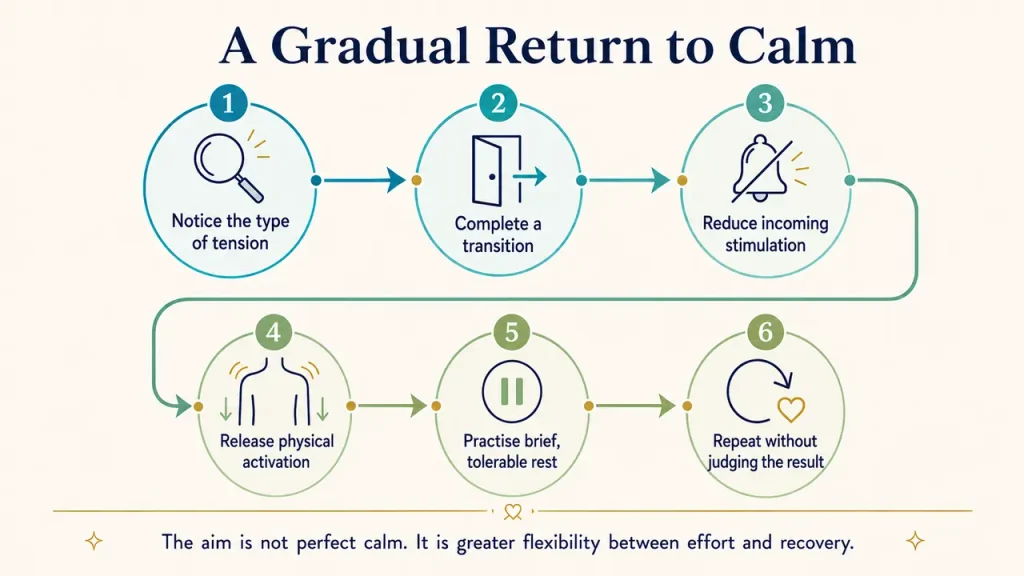
You do not need to apply every suggestion at once.
Choose the step that matches what you are experiencing:
- Notice the tension. Is it mainly physical, mental, emotional or connected with guilt?
- Complete a transition. Give the demanding part of your day a clear ending.
- Reduce unnecessary input. Allow your attention to stop jumping for a few minutes.
- Release some activation. Use gentle movement, comfortable breathing or muscle relaxation.
- Practise brief rest. Begin with an amount that feels manageable.
- Repeat without grading yourself. Calm may come gradually, and some days will feel easier than others.
The most helpful question may not be:
“How do I make myself relax right now?”
Try asking:
“What would help this moment feel five per cent less demanding?”
Perhaps the answer is writing down tomorrow’s task. Perhaps it is turning off one notification, walking for a few minutes or allowing someone to sit beside you.
Small changes can seem unimpressive. But when your system has become accustomed to constant activity, small and repeatable experiences are often more useful than dramatic attempts to force peace.
When Difficulty Relaxing May Need Professional Support
Everyone feels tense occasionally. A stressful week, an important decision or several nights of poor sleep can make it difficult to settle.
Sometimes the tension improves when the situation passes and the body gets enough recovery. At other times, the feeling continues. You may make time to rest, reduce your workload and try different calming practices, yet still feel constantly on edge.
Consider speaking with a qualified mental-health professional if:
- You have been unable to relax for several weeks or months.
- Worry or physical tension regularly disrupts your sleep.
- You experience panic attacks or intense fear without a clear immediate danger.
- Stillness brings up memories, emotions or sensations that feel overwhelming.
- You avoid holidays, quiet time or being alone because stopping feels frightening.
- Irritability or exhaustion is affecting your relationships.
- You cannot concentrate properly at work or while studying.
- You rely on alcohol, nicotine or another substance to switch off.
- Self-help exercises repeatedly increase your distress.
- You feel that you must stay alert to remain safe.
Seeking help does not mean that your experience is severe enough to require a diagnosis. You are allowed to ask for support before you reach a crisis.
A mental-health professional can help you understand whether your difficulty relaxing is connected with anxiety, chronic stress, perfectionism, sleep problems, past experiences or another concern. The aim should be to understand your individual pattern rather than place every symptom under the same explanation.
Depending on your needs, support may involve cognitive behavioural therapy, acceptance-based approaches, stress-management work or trauma-informed therapy when there is a relevant history of trauma.
A clinician may also recommend a medical assessment if physical symptoms, medication effects, hormonal changes, sleep difficulties or another health condition could be contributing.
No single method is right for everyone.
Meditation may help one person and feel uncomfortable for another. One person may benefit from structured breathing, while someone else responds better to movement or conversation. Professional support should consider your symptoms, preferences, health and personal circumstances.
If you have had a difficult experience with a therapist or relaxation practice before, you can mention it. A responsible professional should take that information seriously and adjust the approach rather than suggesting that you simply need to try harder.
A Gentle Note
Difficulty relaxing can have many causes. This article is intended for education and self-reflection. It cannot diagnose anxiety, trauma, hypervigilance, nervous system dysregulation or any other physical or mental-health condition.
Feeling tense during peaceful moments does not automatically mean that something is seriously wrong. It may reflect prolonged stress, learned habits, poor recovery or several factors working together.
If the difficulty is persistent, worsening or affecting your sleep, health, work or relationships, consider speaking with a qualified mental-health or medical professional.
Seek urgent medical assistance if you experience severe chest pain, serious breathing difficulty, fainting or another sudden and concerning physical symptom. If you feel at risk of harming yourself or someone else, contact your local emergency service or a crisis-support service in your country immediately.
Frequently Asked Questions (FAQs)
Why can’t I relax even when nothing is wrong?
You may consciously know that you are safe while your attention and body remain prepared for another demand. Chronic stress, persistent worry, perfectionism, poor sleep, overstimulation or learned alertness may all contribute.
Sometimes the problem is not the current moment. Your mind and body may still be responding to pressure that has accumulated over time. This does not automatically indicate an anxiety disorder or trauma.
Does Difficulty Relaxing Always Mean Anxiety?
No. Anxiety is one possible explanation, but it is not the only one.
You may find it hard to relax because of ongoing responsibilities, inadequate sleep, caffeine, pain, digital overstimulation, productivity guilt or a demanding environment. Some medications and physical conditions may also contribute.
A qualified professional can help when symptoms are persistent, severe or difficult to explain.
Why Do I Feel Guilty When I Try to Rest?
Rest may feel guilty when your self-worth has become closely connected with achievement, usefulness or responsibility.
You may have learned that being busy earns approval, while stopping means being lazy or falling behind. This belief can remain active even after your work is complete.
Feeling guilty does not necessarily mean you are doing something wrong. It may mean that rest conflicts with an older belief about what makes you worthy.
Why Does Meditation Sometimes Make Me More Anxious?
Meditation reduces external distraction. This can make thoughts, emotions or physical sensations more noticeable.
Some people become uneasy when they focus closely on breathing, heartbeat or internal sensations. Others find that quiet allows postponed feelings to surface. Researchers describe a temporary increase in anxiety during relaxation as relaxation-induced anxiety.
You do not need to force meditation. Eyes-open grounding, gentle walking or shorter practices may feel more manageable.
How Long Does It Take to Learn to Relax Again?
There is no standard timeline.
The time needed depends on what is keeping you activated, how long the pattern has been present and whether the underlying pressures are continuing. Someone recovering from a demanding week may settle quickly. A person who has carried responsibility or uncertainty for years may need more time and support.
Look for gradual changes rather than perfect calm: fewer checks, slightly softer muscles, better sleep or an increased ability to pause.
Can Caffeine or Poor Sleep Make It Harder to Switch Off?
Yes. Inadequate sleep can leave you exhausted while also making emotions and stress harder to regulate. Caffeine and nicotine can increase alertness, restlessness or physical sensations in some people.
Sensitivity and timing vary widely. Observe your own pattern rather than assuming that one rule applies to everyone. If sleep problems continue or you are concerned about a substance or medication, discuss it with a qualified clinician.
Final Perspective: You Are Not Failing at Rest
When you repeatedly ask yourself, “Why can’t I relax?”, it is easy to believe that you are creating the problem.
You may watch other people rest without effort and wonder why your own mind refuses to stop. You may criticise yourself for wasting free time, overthinking peaceful moments or needing activity to feel comfortable.
But difficulty relaxing is not necessarily a lack of discipline.
Your mind and body may have become highly practised at anticipating, managing and protecting. These patterns may have helped you meet deadlines, care for people, avoid criticism or cope with uncertainty. The same patterns can become tiring when they continue after the danger or demand has passed.
You do not have to force them away.
Start by noticing what keeps you alert. Create a small transition at the end of a demanding period. Allow rest to be brief and imperfect. Accept safe support when carrying everything alone has become exhausting.
Some days, calm may arrive. On other days, it may not.
The aim is not to control every feeling or remain peaceful all the time. It is to develop enough flexibility to respond when life requires effort and recover when that effort is no longer needed. That gradual capacity is part of what it means to build emotional fitness without suppressing what you feel.
You may not be incapable of peace.
You may simply be learning that you no longer have to earn every quiet moment.
1 thought on “Why Can’t I Relax Even When Nothing Is Wrong? 7 Reasons and What Helps”